


Litomerice

Encyclopedia
Litoměřice (ˈlɪtomɲɛr̝ɪtsɛ; ) is a town at the junction of the rivers Elbe
and Ohře
in the north part of the Czech Republic
, approximately 64 km (39,7 mi) northwest of Prague
.
The area within the Ústí nad Labem Region
is called Garden of Bohemia
thanks to mild weather conditions important for growing fruits and grape
s. During the time of the Austro-Hungarian Empire, many pensionists chose it over more southern areas of the Empire.
fort. A royal-town statute was granted in 1219. From the 12th to the 17th century it was a significant trading center in the Holy Roman Empire
. The German population suffered during the 15th century Hussite Wars
. After the Protestant insurrection that triggered the Thirty Years' War
and the Protestants' defeat in the Battle of White Mountain
, the population of the city had to accept Catholicism
or leave the town, which became a bishop's residency in 1655. As a result, the Czech population shrank and the town became largely Germanized.
After the Austro-Hungarian Empire was dissolved in late 1918, the areas along the border with Germany, where a majority of the former Austrian citizens spoke German language
, tried to join German Austria
(which in turn aimed to join Germany), but Czechoslovak troops prevented this. In 1919, all of Bohemia and Moravia
was put under the Czechoslovak
rule by the Treaty of St. Germain, including the large area stretching around central Bohemia and Moravia. Known as Sudetenland
, the region became the subject of political controversy in the following years. Slavs settled there again, but remained a minority. In 1938, after the Munich Agreement
, German troops occupied the Sudetenland
. The Czech population, which had grown to about 5,000 people, had to leave again.
 In the final stages of World War II
, German troops retreated to escape the advancing Red Army
. The Czech resistance took control of the castle on 27 April 1945, and after a few days they started negotiations with the German commander about the terms of his surrender. The Wehrmacht
capitulated in the night after 8 May, but German troops fled on 9 May, just before Soviet troops entered the town on 10 May 1945. Most of the German population of the town was expelled
by the Beneš decrees
in August 1945, along with about 2.5 million other Czechoslovak citizens of German ethnicity.
There are several successful sportsmen who were born, lived or are living in Litoměřice, among other olympic
medalists, world champions or Stanley Cup
winners:
with: Calamba City
, Philippines (1974) Meissen
, Germany (1996) Fulda
, Germany (2001) Dapitan, Philippines (2006) Armentieres
, France
Elbe
The Elbe is one of the major rivers of Central Europe. It rises in the Krkonoše Mountains of the northwestern Czech Republic before traversing much of Bohemia , then Germany and flowing into the North Sea at Cuxhaven, 110 km northwest of Hamburg...
and Ohře
Ohre
The Ohře is a 316 km long river in Germany and the Czech Republic , left tributary of the Elbe. The basin area of the river has a size of 6,255 km², of which 5,614 km² are in the Czech Republic and 641 km² in Germany...
in the north part of the Czech Republic
Czech Republic
The Czech Republic is a landlocked country in Central Europe. The country is bordered by Poland to the northeast, Slovakia to the east, Austria to the south, and Germany to the west and northwest....
, approximately 64 km (39,7 mi) northwest of Prague
Prague
Prague is the capital and largest city of the Czech Republic. Situated in the north-west of the country on the Vltava river, the city is home to about 1.3 million people, while its metropolitan area is estimated to have a population of over 2.3 million...
.
The area within the Ústí nad Labem Region
Ústí nad Labem Region
Ústí nad Labem Region is an administrative unit of the Czech Republic, located in the north-western part of its historical region of Bohemia...
is called Garden of Bohemia
Bohemia
Bohemia is a historical region in central Europe, occupying the western two-thirds of the traditional Czech Lands. It is located in the contemporary Czech Republic with its capital in Prague...
thanks to mild weather conditions important for growing fruits and grape
Grape
A grape is a non-climacteric fruit, specifically a berry, that grows on the perennial and deciduous woody vines of the genus Vitis. Grapes can be eaten raw or they can be used for making jam, juice, jelly, vinegar, wine, grape seed extracts, raisins, molasses and grape seed oil. Grapes are also...
s. During the time of the Austro-Hungarian Empire, many pensionists chose it over more southern areas of the Empire.
History
One of the oldest Czech towns, Litoměřice was established in the 10th century on the site of an early medieval SlavicSlavic peoples
The Slavic people are an Indo-European panethnicity living in Eastern Europe, Southeast Europe, North Asia and Central Asia. The term Slavic represents a broad ethno-linguistic group of people, who speak languages belonging to the Slavic language family and share, to varying degrees, certain...
fort. A royal-town statute was granted in 1219. From the 12th to the 17th century it was a significant trading center in the Holy Roman Empire
Holy Roman Empire
The Holy Roman Empire was a realm that existed from 962 to 1806 in Central Europe.It was ruled by the Holy Roman Emperor. Its character changed during the Middle Ages and the Early Modern period, when the power of the emperor gradually weakened in favour of the princes...
. The German population suffered during the 15th century Hussite Wars
Hussite Wars
The Hussite Wars, also called the Bohemian Wars involved the military actions against and amongst the followers of Jan Hus in Bohemia in the period 1419 to circa 1434. The Hussite Wars were notable for the extensive use of early hand-held gunpowder weapons such as hand cannons...
. After the Protestant insurrection that triggered the Thirty Years' War
Thirty Years' War
The Thirty Years' War was fought primarily in what is now Germany, and at various points involved most countries in Europe. It was one of the most destructive conflicts in European history....
and the Protestants' defeat in the Battle of White Mountain
Battle of White Mountain
The Battle of White Mountain, 8 November 1620 was an early battle in the Thirty Years' War in which an army of 30,000 Bohemians and mercenaries under Christian of Anhalt were routed by 27,000 men of the combined armies of Ferdinand II, Holy Roman Emperor under Charles Bonaventure de Longueval,...
, the population of the city had to accept Catholicism
Catholicism
Catholicism is a broad term for the body of the Catholic faith, its theologies and doctrines, its liturgical, ethical, spiritual, and behavioral characteristics, as well as a religious people as a whole....
or leave the town, which became a bishop's residency in 1655. As a result, the Czech population shrank and the town became largely Germanized.
After the Austro-Hungarian Empire was dissolved in late 1918, the areas along the border with Germany, where a majority of the former Austrian citizens spoke German language
German language
German is a West Germanic language, related to and classified alongside English and Dutch. With an estimated 90 – 98 million native speakers, German is one of the world's major languages and is the most widely-spoken first language in the European Union....
, tried to join German Austria
German Austria
Republic of German Austria was created following World War I as the initial rump state for areas with a predominantly German-speaking population within what had been the Austro-Hungarian Empire, without the Kingdom of Hungary, which in 1918 had become the Hungarian Democratic Republic.German...
(which in turn aimed to join Germany), but Czechoslovak troops prevented this. In 1919, all of Bohemia and Moravia
Moravia
Moravia is a historical region in Central Europe in the east of the Czech Republic, and one of the former Czech lands, together with Bohemia and Silesia. It takes its name from the Morava River which rises in the northwest of the region...
was put under the Czechoslovak
Czechoslovakia
Czechoslovakia or Czecho-Slovakia was a sovereign state in Central Europe which existed from October 1918, when it declared its independence from the Austro-Hungarian Empire, until 1992...
rule by the Treaty of St. Germain, including the large area stretching around central Bohemia and Moravia. Known as Sudetenland
Sudetenland
Sudetenland is the German name used in English in the first half of the 20th century for the northern, southwest and western regions of Czechoslovakia inhabited mostly by ethnic Germans, specifically the border areas of Bohemia, Moravia, and those parts of Silesia being within Czechoslovakia.The...
, the region became the subject of political controversy in the following years. Slavs settled there again, but remained a minority. In 1938, after the Munich Agreement
Munich Agreement
The Munich Pact was an agreement permitting the Nazi German annexation of Czechoslovakia's Sudetenland. The Sudetenland were areas along Czech borders, mainly inhabited by ethnic Germans. The agreement was negotiated at a conference held in Munich, Germany, among the major powers of Europe without...
, German troops occupied the Sudetenland
Sudetenland
Sudetenland is the German name used in English in the first half of the 20th century for the northern, southwest and western regions of Czechoslovakia inhabited mostly by ethnic Germans, specifically the border areas of Bohemia, Moravia, and those parts of Silesia being within Czechoslovakia.The...
. The Czech population, which had grown to about 5,000 people, had to leave again.
World War II
World War II, or the Second World War , was a global conflict lasting from 1939 to 1945, involving most of the world's nations—including all of the great powers—eventually forming two opposing military alliances: the Allies and the Axis...
, German troops retreated to escape the advancing Red Army
Red Army
The Workers' and Peasants' Red Army started out as the Soviet Union's revolutionary communist combat groups during the Russian Civil War of 1918-1922. It grew into the national army of the Soviet Union. By the 1930s the Red Army was among the largest armies in history.The "Red Army" name refers to...
. The Czech resistance took control of the castle on 27 April 1945, and after a few days they started negotiations with the German commander about the terms of his surrender. The Wehrmacht
Wehrmacht
The Wehrmacht – from , to defend and , the might/power) were the unified armed forces of Nazi Germany from 1935 to 1945. It consisted of the Heer , the Kriegsmarine and the Luftwaffe .-Origin and use of the term:...
capitulated in the night after 8 May, but German troops fled on 9 May, just before Soviet troops entered the town on 10 May 1945. Most of the German population of the town was expelled
Expulsion of Germans after World War II
The later stages of World War II, and the period after the end of that war, saw the forced migration of millions of German nationals and ethnic Germans from various European states and territories, mostly into the areas which would become post-war Germany and post-war Austria...
by the Beneš decrees
Beneš decrees
Decrees of the President of the Republic , more commonly known as the Beneš decrees, were a series of laws that were drafted by the Czechoslovak Government-in-Exile in the absence of the Czechoslovak parliament during the German occupation of Czechoslovakia in World War II and issued by President...
in August 1945, along with about 2.5 million other Czechoslovak citizens of German ethnicity.
Sights
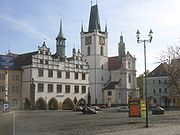
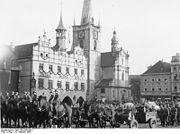
There are several main sights already visible when approaching Litoměřice. St. Stephen's cathedral at the Dome Square (Dómské náměstí) was built in 1664-1668 at the place of roman basilica. The interior is almost completely authentic with main and six side altars and a lot of original paintings. Right next to the dome is a Bishop Residency built in 1683-1701 by Giulio Broggio. On the main square there is All-Saints Church and within distance there is an Annunciation (Lady Day) Church, another masterpiece built by the son of Giulio Broggio, Octavio. The old town hall (now city museum) and Black Eagle House (Dům u černého orla) on the main square are also worthy a look. The symbol of the city is a chalice, since the watchout tower on the Town Hall has this shape. There are numerous cellars connected by an extensive web of underground ways under the town. In some places the cellars were built in three floors. The ways are about three kilometers long and they belong to one of the longest in the Czech Republic. Unfortunately, only 336 meters of these underground ways are open to the public. You can notice the ancient town wall when entering the town. The original town wall was built in the Gothic style. Northern Bohemian Gallery of Creative Arts (SGVU) is based close the main square. Extensive collection spans from 13th century to contemporary art with numerous other exhibitions during the year.Population
- 1 December 1930 : 18,498
- 17 May 1939: 17,267
- 22 May 1947: 14,402
- 2 June 2004: 25,517
Notables
- The greatest representative of Czech romanticism, Karel Hynek MáchaKarel Hynek MáchaKarel Hynek Mácha was a Czech romantic poet.- Biography :Mácha grew up in Prague, the son of a foreman at a mill. He learned Latin and German in school...
, died in Litoměřice, shortly after he had moved to the town, and was buried there. Later his grave was moved to Prague where he is buried now at the Vyšehrad cemeteryVyšehrad cemeteryEstablished in 1869 on the grounds of Vyšehrad Castle in Prague, Czech Republic, the Vyšehrad cemetery is the final resting place of many composers, artists, sculptors, writers, and those from the world of science and politics...
. - Josef JungmannJosef JungmannJosef Jungmann was a Bohemian poet and linguist, and a leading figure of the Czech National Revival. Together with Josef Dobrovský, he is considered to be a creator of the modern Czech language.-Life:Jungmann was the sixth child of a cobbler. In his youth, he wanted to become a priest...
, creator of the modern Czech language, lived and taught here from 1799 to 1815. - Štěpán Cardinal TrochtaŠtepán TrochtaCardinal Štěpán Trochta was born on Cardinal Štěpán Trochta was born on Cardinal Štěpán Trochta was born on (March 26, 1905 in Francova Lhota. He was a Czech Salesian (monk) and Junák (Boy Scout). Pope Pius XII appointed him Bishop of Litoměřice in 1947. Trochta was spokesman of the...
was a bishop of Litoměřice from 1947. - The Master of the Litoměřice AltarpieceMaster of the Litomerice AltarpieceThe Master of the Litoměřice Altarpiece was a Bohemian painter active from the end of the 15th century to the beginning of the 16th. Active in the International Gothic style, he was one of the first practitioners of Renaissance art north of the Alps, and had a heavy influence on the future of the...
received his name from this town. - Karel Pejml, co-founder of modern historical climatologyHistorical climatologyHistorical climatology is the study of historical changes in climate and their effect on human history and development. This differs from paleoclimatology which encompasses climate change over the entire history of the earth. The study seeks to define periods in human history where temperature or...
, lived here from 1978 to 1989. - Ferdinand BlumentrittFerdinand BlumentrittFerdinand Blumentritt , was a teacher, secondary school principal in Litoměřice, lecturer, and author of articles and books on the Philippines and its ethnography...
, teacher, historian, ethnologist and close friend of the Philippine national hero José RizalJosé RizalJosé Protacio Rizal Mercado y Alonso Realonda , was a Filipino polymath, patriot and the most prominent advocate for reform in the Philippines during the Spanish colonial era. He is regarded as the foremost Filipino patriot and is listed as one of the national heroes of the Philippines by...
, lived and taught here 1877 - 1913. - Josef Rudolf Zavrtal, composer and conductor.
- Alfred KubinAlfred KubinAlfred Leopold Isidor Kubin was an Austrian printmaker, illustrator and occasional writer. Kubin is considered an important representative of Symbolism and Expressionism.-Biography:...
, Austrian expressionist and illustrator was born in Litoměřice in 1877. - Miroslav Vurma, lecturer in Japan, born in Litoměřice in 1953.
There are several successful sportsmen who were born, lived or are living in Litoměřice, among other olympic
Olympic Games
The Olympic Games is a major international event featuring summer and winter sports, in which thousands of athletes participate in a variety of competitions. The Olympic Games have come to be regarded as the world’s foremost sports competition where more than 200 nations participate...
medalists, world champions or Stanley Cup
Stanley Cup
The Stanley Cup is an ice hockey club trophy, awarded annually to the National Hockey League playoffs champion after the conclusion of the Stanley Cup Finals. It has been referred to as The Cup, Lord Stanley's Cup, The Holy Grail, or facetiously as Lord Stanley's Mug...
winners:
- Květa Jeriová-Pecková, triple olympic medalist, Cross-country skiingCross-country skiingCross-country skiing is a winter sport in which participants propel themselves across snow-covered terrain using skis and poles...
- Zdeněk PeckaZdenek PeckaZdeněk Pecka is a Czech rower who competed for Czechoslovakia in the 1976 Summer Olympics and in the 1980 Summer Olympics.He was born in Litoměřice....
, double olympic medalist, quadruple and double scullsRowing (sport)Rowing is a sport in which athletes race against each other on rivers, on lakes or on the ocean, depending upon the type of race and the discipline. The boats are propelled by the reaction forces on the oar blades as they are pushed against the water...
crew member - Martin ŠkoulaMartin SkoulaMartin Škoula is a professional ice hockey defenceman, currently with Avangard Omsk of the Kontinental Hockey League.- Playing career :...
, a professional ice hockeyIce hockeyIce hockey, often referred to as hockey, is a team sport played on ice, in which skaters use wooden or composite sticks to shoot a hard rubber puck into their opponent's net. The game is played between two teams of six players each. Five members of each team skate up and down the ice trying to take...
player currently playing for the Avangard OmskAvangard OmskAvangard Omsk are a professional ice hockey team from Siberia based in the city of Omsk, Russia. They are members of the Chernyshev Division of the Kontinental Hockey League.-Overview:...
of the Kontinental Hockey LeagueKontinental Hockey LeagueThe Kontinental Hockey League is an international professional ice hockey league in Eurasia founded in 2008. As of 2009, it is ranked as the strongest hockey league in Europe....
. - Luděk Štyks, quadruple national road cyclingRoad cyclingRoad cycling is the most widespread form of cycling. It includes recreational, racing, and utility cycling. Road cyclists are generally expected to obey the same rules and laws as other vehicle drivers or riders and may also be vehicular cyclists....
champion born in Litoměřice in 1961
Twin towns — Sister cities
Litoměřice is twinnedTown twinning
Twin towns and sister cities are two of many terms used to describe the cooperative agreements between towns, cities, and even counties in geographically and politically distinct areas to promote cultural and commercial ties.- Terminology :...
with: Calamba City
Calamba City
Calamba City is a first class component city located in the province of Laguna, Philippines. Situated only 54 kilometers south of Manila, about an hour by chartered bus, Calamba City is a popular tourist destination with its hot spring resorts, most of the resorts are located in Barangay Pansol...
, Philippines (1974) Meissen
Meissen
Meissen is a town of approximately 30,000 about northwest of Dresden on both banks of the Elbe river in the Free State of Saxony, in eastern Germany. Meissen is the home of Meissen porcelain, the Albrechtsburg castle, the Gothic Meissen Cathedral and the Meissen Frauenkirche...
, Germany (1996) Fulda
Fulda
Fulda is a city in Hesse, Germany; it is located on the river Fulda and is the administrative seat of the Fulda district .- Early Middle Ages :...
, Germany (2001) Dapitan, Philippines (2006) Armentieres
Armentières
Armentières is a commune in the Nord department in the Nord-Pas-de-Calais region in northern France. It is part of the Urban Community of Lille Métropole, and lies on the Belgian border, northwest of the city of Lille, on the right bank of the river Lys....
, France