

List of language families

Encyclopedia
This List of language families includes also language isolates, unclassified languages and other types of languages.
For a legend, see language family.
For more details, see Distribution of languages in the world.
This is a list of the top ten families that are fairly often recognized as phylogenetic units, in terms of numbers of native speakers as a proportion of world population
, listed with their core geographic areas.
Phyla with historically wide geographical distributions but comparatively few contemporary speakers include Eskimo–Aleut, Algic
, Quechuan and Nilo-Saharan
.
, the largest language families in terms of number of languages are the following. Some families are controversial, and in many the language count varies between researchers.
Africa
Europe
East Asia
New Guinea
Australia
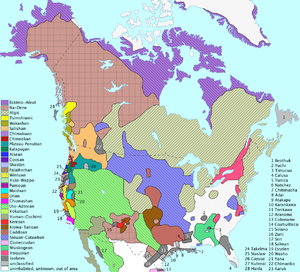
North America
Central America
Possible examples include:
1991).
By number of native speakers
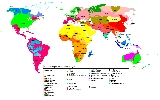
Distribution of the major language families.For a legend, see language family.
For more details, see Distribution of languages in the world.
This is a list of the top ten families that are fairly often recognized as phylogenetic units, in terms of numbers of native speakers as a proportion of world population
World population
The world population is the total number of living humans on the planet Earth. As of today, it is estimated to be billion by the United States Census Bureau...
, listed with their core geographic areas.
- Indo-European languagesIndo-European languagesThe Indo-European languages are a family of several hundred related languages and dialects, including most major current languages of Europe, the Iranian plateau, and South Asia and also historically predominant in Anatolia...
46% (EuropeEuropeEurope is, by convention, one of the world's seven continents. Comprising the westernmost peninsula of Eurasia, Europe is generally 'divided' from Asia to its east by the watershed divides of the Ural and Caucasus Mountains, the Ural River, the Caspian and Black Seas, and the waterways connecting...
, SouthwestSouthwest AsiaWestern Asia, West Asia, Southwest Asia or Southwestern Asia are terms that describe the westernmost portion of Asia. The terms are partly coterminous with the Middle East, which describes a geographical position in relation to Western Europe rather than its location within Asia...
to South AsiaSouth AsiaSouth Asia, also known as Southern Asia, is the southern region of the Asian continent, which comprises the sub-Himalayan countries and, for some authorities , also includes the adjoining countries to the west and the east...
, North AsiaNorth AsiaNorth Asia or Northern Asia is a subregion of Asia, consisting of the Asian portion of Russia.The Phillips Illustrated Atlas of the World 1988 defines it as being most of the former USSR, the part that is to the east of the Ural Mountains...
, North AmericaNorth AmericaNorth America is a continent wholly within the Northern Hemisphere and almost wholly within the Western Hemisphere. It is also considered a northern subcontinent of the Americas...
, South AmericaSouth AmericaSouth America is a continent situated in the Western Hemisphere, mostly in the Southern Hemisphere, with a relatively small portion in the Northern Hemisphere. The continent is also considered a subcontinent of the Americas. It is bordered on the west by the Pacific Ocean and on the north and east...
, OceaniaOceaniaOceania is a region centered on the islands of the tropical Pacific Ocean. Conceptions of what constitutes Oceania range from the coral atolls and volcanic islands of the South Pacific to the entire insular region between Asia and the Americas, including Australasia and the Malay Archipelago...
) - Sino-Tibetan languagesSino-Tibetan languagesThe Sino-Tibetan languages are a language family comprising, at least, the Chinese and the Tibeto-Burman languages, including some 250 languages of East Asia, Southeast Asia and parts of South Asia. They are second only to the Indo-European languages in terms of the number of native speakers...
21% (East AsiaEast AsiaEast Asia or Eastern Asia is a subregion of Asia that can be defined in either geographical or cultural terms...
) - Niger–Congo languagesNiger–Congo languagesThe Niger–Congo languages constitute one of the world's major language families, and Africa's largest in terms of geographical area, number of speakers, and number of distinct languages. They may constitute the world's largest language family in terms of distinct languages, although this question...
6.4% (Sub-Saharan AfricaSub-Saharan AfricaSub-Saharan Africa as a geographical term refers to the area of the African continent which lies south of the Sahara. A political definition of Sub-Saharan Africa, instead, covers all African countries which are fully or partially located south of the Sahara...
) - Afro-Asiatic languagesAfro-Asiatic languagesThe Afroasiatic languages , also known as Hamito-Semitic, constitute one of the world's largest language families, with about 375 living languages...
6.0% (North AfricaNorth AfricaNorth Africa or Northern Africa is the northernmost region of the African continent, linked by the Sahara to Sub-Saharan Africa. Geopolitically, the United Nations definition of Northern Africa includes eight countries or territories; Algeria, Egypt, Libya, Morocco, South Sudan, Sudan, Tunisia, and...
to Horn of AfricaHorn of AfricaThe Horn of Africa is a peninsula in East Africa that juts hundreds of kilometers into the Arabian Sea and lies along the southern side of the Gulf of Aden. It is the easternmost projection of the African continent...
, Southwest AsiaSouthwest AsiaWestern Asia, West Asia, Southwest Asia or Southwestern Asia are terms that describe the westernmost portion of Asia. The terms are partly coterminous with the Middle East, which describes a geographical position in relation to Western Europe rather than its location within Asia...
) - Austronesian languagesAustronesian languagesThe Austronesian languages are a language family widely dispersed throughout the islands of Southeast Asia and the Pacific, with a few members spoken on continental Asia that are spoken by about 386 million people. It is on par with Indo-European, Niger-Congo, Afroasiatic and Uralic as one of the...
5.9% (OceaniaOceaniaOceania is a region centered on the islands of the tropical Pacific Ocean. Conceptions of what constitutes Oceania range from the coral atolls and volcanic islands of the South Pacific to the entire insular region between Asia and the Americas, including Australasia and the Malay Archipelago...
, MadagascarMadagascarThe Republic of Madagascar is an island country located in the Indian Ocean off the southeastern coast of Africa...
, maritime Southeast AsiaMaritime Southeast AsiaMaritime Southeast Asia refers to the maritime region of Southeast Asia as opposed to mainland Southeast Asia and includes the modern countries of Indonesia, Malaysia, the Philippines, Brunei, East Timor and Singapore....
) - Dravidian languagesDravidian languagesThe Dravidian language family includes approximately 85 genetically related languages, spoken by about 217 million people. They are mainly spoken in southern India and parts of eastern and central India as well as in northeastern Sri Lanka, Pakistan, Nepal, Bangladesh, Afghanistan, Iran, and...
3.7% (South AsiaSouth AsiaSouth Asia, also known as Southern Asia, is the southern region of the Asian continent, which comprises the sub-Himalayan countries and, for some authorities , also includes the adjoining countries to the west and the east...
) - Altaic languagesAltaic languagesAltaic is a proposed language family that includes the Turkic, Mongolic, Tungusic, and Japonic language families and the Korean language isolate. These languages are spoken in a wide arc stretching from northeast Asia through Central Asia to Anatolia and eastern Europe...
(controversial combination of Turkic, Mongolic, and Tungusic families) 2.3% (Central AsiaCentral AsiaCentral Asia is a core region of the Asian continent from the Caspian Sea in the west, China in the east, Afghanistan in the south, and Russia in the north...
, Northern Asia, AnatoliaAnatoliaAnatolia is a geographic and historical term denoting the westernmost protrusion of Asia, comprising the majority of the Republic of Turkey...
, SiberiaSiberiaSiberia is an extensive region constituting almost all of Northern Asia. Comprising the central and eastern portion of the Russian Federation, it was part of the Soviet Union from its beginning, as its predecessor states, the Tsardom of Russia and the Russian Empire, conquered it during the 16th...
) - Austro-Asiatic languagesAustro-Asiatic languagesThe Austro-Asiatic languages, in recent classifications synonymous with Mon–Khmer, are a large language family of Southeast Asia, also scattered throughout India and Bangladesh. The name Austro-Asiatic comes from the Latin words for "south" and "Asia", hence "South Asia"...
1.7% (mainland Southeast Asia) - Tai–Kadai languages 1.3% (Southeast AsiaSoutheast AsiaSoutheast Asia, South-East Asia, South East Asia or Southeastern Asia is a subregion of Asia, consisting of the countries that are geographically south of China, east of India, west of New Guinea and north of Australia. The region lies on the intersection of geological plates, with heavy seismic...
)
Phyla with historically wide geographical distributions but comparatively few contemporary speakers include Eskimo–Aleut, Algic
Algic languages
The Algic languages are an indigenous language family of North America. Most Algic languages belong to the Algonquian family, dispersed over a broad area from the Rocky Mountains to Atlantic Canada...
, Quechuan and Nilo-Saharan
Nilo-Saharan languages
The Nilo-Saharan languages are a proposed family of African languages spoken by some 50 million people, mainly in the upper parts of the Chari and Nile rivers , including historic Nubia, north of where the two tributaries of Nile meet...
.
By number of languages
According to the numbers in EthnologueEthnologue
Ethnologue: Languages of the World is a web and print publication of SIL International , a Christian linguistic service organization, which studies lesser-known languages, to provide the speakers with Bibles in their native language and support their efforts in language development.The Ethnologue...
, the largest language families in terms of number of languages are the following. Some families are controversial, and in many the language count varies between researchers.
- Niger–CongoNiger–Congo languagesThe Niger–Congo languages constitute one of the world's major language families, and Africa's largest in terms of geographical area, number of speakers, and number of distinct languages. They may constitute the world's largest language family in terms of distinct languages, although this question...
(1,532 languages) - AustronesianAustronesian languagesThe Austronesian languages are a language family widely dispersed throughout the islands of Southeast Asia and the Pacific, with a few members spoken on continental Asia that are spoken by about 386 million people. It is on par with Indo-European, Niger-Congo, Afroasiatic and Uralic as one of the...
(1,257 languages) - Trans–New Guinea (477 languages)
- Sino-TibetanSino-Tibetan languagesThe Sino-Tibetan languages are a language family comprising, at least, the Chinese and the Tibeto-Burman languages, including some 250 languages of East Asia, Southeast Asia and parts of South Asia. They are second only to the Indo-European languages in terms of the number of native speakers...
(449 languages) - Indo-EuropeanIndo-European languagesThe Indo-European languages are a family of several hundred related languages and dialects, including most major current languages of Europe, the Iranian plateau, and South Asia and also historically predominant in Anatolia...
(439 languages) - Afro-AsiaticAfro-Asiatic languagesThe Afroasiatic languages , also known as Hamito-Semitic, constitute one of the world's largest language families, with about 375 living languages...
(374 languages) - Nilo-SaharanNilo-Saharan languagesThe Nilo-Saharan languages are a proposed family of African languages spoken by some 50 million people, mainly in the upper parts of the Chari and Nile rivers , including historic Nubia, north of where the two tributaries of Nile meet...
(205 languages) (controversial) - Pama–Nyungan (178 languages)
- Oto-MangueanOto-Manguean languagesOto-Manguean languages are a large family comprising several families of Native American languages. All of the Oto-Manguean languages that are now spoken are indigenous to Mexico, but the Manguean branch of the family, which is now extinct, was spoken as far south as Nicaragua and Costa Rica.The...
(177 languages) (number varies; Lyle CampbellLyle CampbellLyle Richard Campbell is a linguist and leading expert on indigenous American languages—especially those of Mesoamerica—and on historical linguistics in general. He also has expertise in Uralic languages. He is presently Professor of Linguistics at the University of Hawaii at Manoa.-Life and...
counts 27) - Austro-AsiaticAustro-Asiatic languagesThe Austro-Asiatic languages, in recent classifications synonymous with Mon–Khmer, are a large language family of Southeast Asia, also scattered throughout India and Bangladesh. The name Austro-Asiatic comes from the Latin words for "south" and "Asia", hence "South Asia"...
(169 languages) - Tai–Kadai (92 languages)
- DravidianDravidian languagesThe Dravidian language family includes approximately 85 genetically related languages, spoken by about 217 million people. They are mainly spoken in southern India and parts of eastern and central India as well as in northeastern Sri Lanka, Pakistan, Nepal, Bangladesh, Afghanistan, Iran, and...
(85 languages) - TupianTupian languagesThe Tupi or Tupian language family comprises some 70 languages spoken in South America, of which the best known are Tupi proper and Guarani.-History, members and classification:...
(76 languages)
Language families
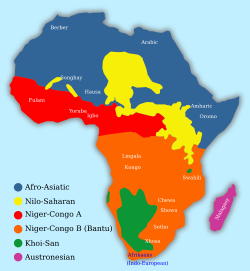
In the following, each "bulleted" item is a known or suspected language family. The geographic headings over them are meant solely as a tool for grouping families into collections more comprehensible than an unstructured list of a few hundred independent families. Geographic relationship is convenient for that purpose, but these headings are not a suggestion of any "super-families" phylogenetically relating the families named. AfricaAfricaAfrica is the world's second largest and second most populous continent, after Asia. At about 30.2 million km² including adjacent islands, it covers 6% of the Earth's total surface area and 20.4% of the total land area...
and Southwest AsiaSouthwest AsiaWestern Asia, West Asia, Southwest Asia or Southwestern Asia are terms that describe the westernmost portion of Asia. The terms are partly coterminous with the Middle East, which describes a geographical position in relation to Western Europe rather than its location within Asia...
- Afro-Asiatic languagesAfro-Asiatic languagesThe Afroasiatic languages , also known as Hamito-Semitic, constitute one of the world's largest language families, with about 375 living languages...
(formerly Hamito-Semitic) - Niger–Congo languagesNiger–Congo languagesThe Niger–Congo languages constitute one of the world's major language families, and Africa's largest in terms of geographical area, number of speakers, and number of distinct languages. They may constitute the world's largest language family in terms of distinct languages, although this question...
(sometimes Niger-Kordofanian) - Nilo-Saharan languagesNilo-Saharan languagesThe Nilo-Saharan languages are a proposed family of African languages spoken by some 50 million people, mainly in the upper parts of the Chari and Nile rivers , including historic Nubia, north of where the two tributaries of Nile meet...
- Khoe languagesKhoe languagesThe Khoe languages are the largest of the non-Bantu language families indigenous to southern Africa. They are often considered to be a branch of a suspected Khoisan language family, and are known as Central Khoisan in that scenario. The nearest relative of the Khoe family is the extinct and poorly...
(part of the KhoisanKhoisan languagesThe Khoisan languages are the click languages of Africa which do not belong to other language families. They include languages indigenous to southern and eastern Africa, though some, such as the Khoi languages, appear to have moved to their current locations not long before the Bantu expansion...
proposal) - Tuu languagesTuu languagesThe Tuu or Taa–ǃKwi languages are a language family consisting of two language clusters spoken in Botswana and South Africa. The relationship between the two clusters is not doubted, but is not close. The name Tuu comes from a word for person common to both branches of the family...
(part of Khoisan) - Kx'a languages (part of Khoisan)
- Ubangian languagesUbangian languagesThe Ubangian languages form a fairly close-knit language family of some seventy languages centered on the Central African Republic. They are the predominant languages of the CAR, spoken by 2–3 million people, and include the national language, Sango....
- Mande languagesMande languagesThe Mande languages are spoken in several countries in West Africa by the Mandé people and include Mandinka, Soninke, Bambara, Bissa, Dioula, Kagoro, Bozo, Mende, Susu, Yacouba, Vai, and Ligbi...
(perhaps Niger–Congo) - Songhay languagesSonghay languagesThe Songhay, Songhai, or Songai languages are a group of closely related languages/dialects centered on the middle stretches of the Niger River in the west African states of Mali, Niger, Benin, Burkina Faso, and Nigeria. They have been widely used as a lingua franca in that region ever since the...
(perhaps Nilo-Saharan) - Kadu languagesKadu languagesThe Kadu, Kadugli–Krongo, or Tumtum languages are a small language family, once included in Kordofanian but since Thilo Schadeberg widely seen as Nilo-Saharan. However, there is little evidence, and a conservative classification would treat them as an independent family. There are three...
(perhaps Nilo-Saharan) - Koman languages (perhaps Nilo-Saharan)
EuropeEuropeEurope is, by convention, one of the world's seven continents. Comprising the westernmost peninsula of Eurasia, Europe is generally 'divided' from Asia to its east by the watershed divides of the Ural and Caucasus Mountains, the Ural River, the Caspian and Black Seas, and the waterways connecting...
and NorthNorth AsiaNorth Asia or Northern Asia is a subregion of Asia, consisting of the Asian portion of Russia.The Phillips Illustrated Atlas of the World 1988 defines it as being most of the former USSR, the part that is to the east of the Ural Mountains...
, West and South AsiaSouth AsiaSouth Asia, also known as Southern Asia, is the southern region of the Asian continent, which comprises the sub-Himalayan countries and, for some authorities , also includes the adjoining countries to the west and the east...
- Indo-European languagesIndo-European languagesThe Indo-European languages are a family of several hundred related languages and dialects, including most major current languages of Europe, the Iranian plateau, and South Asia and also historically predominant in Anatolia...
- Tyrsenian languagesTyrsenian languagesTyrsenian , named after the Tyrrhenians , is a closely related ancient language family proposed by Helmut Rix , that consists of the extinct Etruscan language of central Italy, the extinct Raetic language of the Alps, and the extinct Lemnian language of the Aegean Sea.-The...
(extinct) - Dravidian languagesDravidian languagesThe Dravidian language family includes approximately 85 genetically related languages, spoken by about 217 million people. They are mainly spoken in southern India and parts of eastern and central India as well as in northeastern Sri Lanka, Pakistan, Nepal, Bangladesh, Afghanistan, Iran, and...
- Northwest Caucasian languagesNorthwest Caucasian languagesThe Northwest Caucasian languages, also called Abkhazo-Adyghean, or sometimes Pontic as opposed to Caspian for the Northeast Caucasian languages, are a group of languages spoken in the Caucasus region, chiefly in Russia , the disputed territory of Abkhazia, and Turkey, with smaller communities...
(often included in North CaucasianNorth Caucasian languagesNorth Caucasian languages is a blanket term for two language phyla spoken chiefly in the north Caucasus and Turkey: the Northwest Caucasian family and the Northeast Caucasian family North Caucasian languages (sometimes called simply Caucasic as opposed to Kartvelian, and to avoid confusion with...
) - Northeast Caucasian languagesNortheast Caucasian languagesThe Northeast Caucasian languages constitute a language family spoken in the Russian republics of Dagestan, Chechnya, Ingushetia, northern Azerbaijan, and in northeastern Georgia, as well as in diaspora populations in Russia, Turkey, and the Middle East...
(often included in North Caucasian) - Hurro-Urartian languagesHurro-Urartian languagesThe Hurro-Urartian languages are an extinct language family of the Ancient Near East, comprising only two known languages: Hurrian and Urartian, both of which were spoken in the Taurus mountains area.-Classification:...
(extinctExtinct languageAn extinct language is a language that no longer has any speakers., or that is no longer in current use. Extinct languages are sometimes contrasted with dead languages, which are still known and used in special contexts in written form, but not as ordinary spoken languages for everyday communication...
, perhaps related to Northeast Caucasian) - South Caucasian languagesSouth Caucasian languagesThe Kartvelian languages are spoken primarily in Georgia, with a large group of ethnic Georgian speakers in Russia, the United States, the European Union, and northeastern parts of Turkey. There are approximately 5.2 million speakers of this language family worldwide.It is not known to be related...
- Turkic languagesTurkic languagesThe Turkic languages constitute a language family of at least thirty five languages, spoken by Turkic peoples across a vast area from Eastern Europe and the Mediterranean to Siberia and Western China, and are considered to be part of the proposed Altaic language family.Turkic languages are spoken...
(part of the AltaicAltaic languagesAltaic is a proposed language family that includes the Turkic, Mongolic, Tungusic, and Japonic language families and the Korean language isolate. These languages are spoken in a wide arc stretching from northeast Asia through Central Asia to Anatolia and eastern Europe...
proposal) - Mongolic languagesMongolic languagesThe Mongolic languages are a group of languages spoken in East-Central Asia, mostly in Mongolia and surrounding areas plus in Kalmykia. The best-known member of this language family, Mongolian, is the primary language of most of the residents of Mongolia and the Mongolian residents of Inner...
(part of Altaic) - Tungusic languagesTungusic languagesThe Tungusic languages form a language family spoken in Eastern Siberia and Manchuria by Tungusic peoples. Many Tungusic languages are endangered, and the long-term future of the family is uncertain...
(part of Altaic) - Uralic languagesUralic languagesThe Uralic languages constitute a language family of some three dozen languages spoken by approximately 25 million people. The healthiest Uralic languages in terms of the number of native speakers are Hungarian, Finnish, Estonian, Mari and Udmurt...
- Yukaghir languagesYukaghir languagesThe Yukaghir languages are a small family of two closely related languages – Tundra and Kolyma Yukaghir – spoken by the Yukaghir in the Russian Far East living in the basin of the Kolyma River. According to the 2002 Russian census, both Yukaghir languages taken together have 604 speakers...
- Chukotko-Kamchatkan languagesChukotko-Kamchatkan languagesThe Chukotko-Kamchatkan or Chukchi–Kamchatkan languages are a language family of extreme northeastern Siberia. Its speakers are indigenous hunter-gatherers and reindeer-herders....
- Yeniseian languagesYeniseian languagesThe Yeniseian language family is spoken in central Siberia.-Family division:0. Proto-Yeniseian...
(part of proposed Dené–Yeniseian family)
East AsiaEast AsiaEast Asia or Eastern Asia is a subregion of Asia that can be defined in either geographical or cultural terms...
, Southeast AsiaSoutheast AsiaSoutheast Asia, South-East Asia, South East Asia or Southeastern Asia is a subregion of Asia, consisting of the countries that are geographically south of China, east of India, west of New Guinea and north of Australia. The region lies on the intersection of geological plates, with heavy seismic...
, Northeast India and the Pacific
- Austro-Asiatic languagesAustro-Asiatic languagesThe Austro-Asiatic languages, in recent classifications synonymous with Mon–Khmer, are a large language family of Southeast Asia, also scattered throughout India and Bangladesh. The name Austro-Asiatic comes from the Latin words for "south" and "Asia", hence "South Asia"...
- Austronesian languagesAustronesian languagesThe Austronesian languages are a language family widely dispersed throughout the islands of Southeast Asia and the Pacific, with a few members spoken on continental Asia that are spoken by about 386 million people. It is on par with Indo-European, Niger-Congo, Afroasiatic and Uralic as one of the...
(part of the Austro-Tai proposal) - Great Andamanese languagesGreat Andamanese languagesThe Great Andamanese languages are a nearly extinct language family spoken by the Great Andamanese peoples of the Andaman Islands, a union territory of India.- History :...
(part of the AndamaneseAndamanese languagesThe Andamanese languages form a proposed language family spoken by the Andamanese peoples, a group of Negritos who live in the Andaman Islands, a union territory of India. Its validity is disputed...
proposal) - Hmong–Mien languages
- Japonic languagesJaponic languagesJaponic languages is a term which identifies and characterises the Japanese which is spoken on the main islands of Japan and the Ryukyuan languages spoken in the Ryukyu Islands. This widely accepted linguistics term was coined by Leon Serafim....
(part of an expanded AltaicAltaic languagesAltaic is a proposed language family that includes the Turkic, Mongolic, Tungusic, and Japonic language families and the Korean language isolate. These languages are spoken in a wide arc stretching from northeast Asia through Central Asia to Anatolia and eastern Europe...
proposal) - Ongan languagesOngan languagesOngan, or South Andamanese, is a small family of two languages, Önge and Jarawa, spoken in the southern Andaman Islands:*Ongan**Önge or Onge; 96 speakers in 1997, mostly monolingual...
(part of the Andamanese proposal) - Sino-Tibetan languagesSino-Tibetan languagesThe Sino-Tibetan languages are a language family comprising, at least, the Chinese and the Tibeto-Burman languages, including some 250 languages of East Asia, Southeast Asia and parts of South Asia. They are second only to the Indo-European languages in terms of the number of native speakers...
- Tai–Kadai languages (part of Austro-Tai proposal)
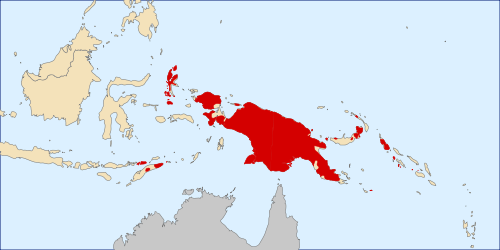
New GuineaNew GuineaNew Guinea is the world's second largest island, after Greenland, covering a land area of 786,000 km2. Located in the southwest Pacific Ocean, it lies geographically to the east of the Malay Archipelago, with which it is sometimes included as part of a greater Indo-Australian Archipelago...
and neighboring islands
- Baining languagesBaining languagesThe Baining or East New Britain languages are a small language family spoken by the Baining people on the island of New Britain in Papua New Guinea...
- Border languagesBorder languages (New Guinea)The Border or Tami languages are an independent family of Papuan languages in Malcolm Ross's version of the Trans–New Guinea proposal.-Classification:* ? Morwap isolate...
- Central Solomons languagesEast Papuan languages*Baining family*North Bougainville family — Bougainville*South Bougainville family — Bougainville*Central Solomon family...
- East Bird's Head – Sentani languages
- Eastern Trans-Fly languagesEastern Trans-Fly languagesThe Eastern Trans-Fly languages are a small independent family of Papuan languages in the classification of Malcolm Ross, that constituted a branch of Stephen Wurm's 1970 Trans-Fly proposal, which he later incorporated into his 1975 expansion of the Trans–New Guinea family as part of a Trans-Fly –...
(one in Australia) - Fas languagesFas languagesThe Fas languages are a small language family of Papua New Guinea. They are generally classified as part of a larger as-yet unproven Kwomtari–Fas family.-Classification:...
- East Geelvink Bay languages
- Lakes Plain languagesLakes Plain languages-Pronouns:The pronouns Ross reconstructs for proto-Tariku are,The corresponding "I" and "thou" pronouns are proto–East Lake Plain *a, *do, Awera yai, nai , and Rasawa e-, de-. Saponi shares no pronouns with the Lakes Plain family; indeed its pronouns mamire "I, we" and ba "thou" are remenincent of...
(upper Mamberamo River) - Left May languagesLeft May languagesThe Left May or Arai languages are a small language family of half a dozen closely related but not mutually intelligible languages in the centre of New Guinea, along the left bank of the May River...
- Kwomtari languagesKwomtari languagesThe Kwomtari languages are a small language family of Papua New Guinea.-Classification:The family consists of the highly divergent language Guriaso, and the two closely related languages Kwomtari and Nai:*Kwomtari stock**Guriaso...
- Mairasi languagesMairasi languagesThe Mairasi languages are a small independent family of Papuan languages in the classification of Malcolm Ross, that had been part of Stephen Wurm's Trans–New Guinea proposal.-Classification:* Mairasi family: Semimi, Mer, Mairasi, Northeastern Mairasi...
- Nimboran languagesNimboran languagesThe Nimboran languages are a small independent family of Papuan languages in the classification of Malcolm Ross, that had been part of Stephen Wurm's Trans–New Guinea proposal...
- North Bougainville languagesNorth Bougainville languagesThe North or West Bougainville languages are a small language family spoken on the island of Bougainville in Papua New Guinea. They were classified as East Papuan languages by Stephen Wurm, but this does not now seem tenable, and was abandoned in Ethnologue .The family includes the closely related...
- Piawi languagesPiawi languagesThe Piawi languages are a small independent family of Papuan languages in the classification of Malcolm Ross, that had been part of Stephen Wurm's Trans–New Guinea proposal.-Classification:Piawi consists of only two languages:...
- Ramu – Lower Sepik languages
- Senagi languagesSenagi languagesThe Senagi languages are a small independent family of Papuan languages in the classification of Malcolm Ross, that had been part of Stephen Wurm's Trans–New Guinea proposal....
- Sepik languagesSepik languages-Pronouns:The pronouns Ross reconstructs for proto-Sepik are:Note the similarities of the dual and plural suffixes with those of the Torricelli languages.-See also:*Papuan languages*Sepik–Ramu languages*Donald Laycock...
- Skou languagesSko languagesThe Sko or Skou languages are a small language family spoken by about 7000 people, mainly along the coast of Sandaun Province in Papua New Guinea, with a few being inland from this area and at least one just across the border in the Indonesian province of Papua . Skou languages are unusual in New...
- South Bougainville languagesSouth Bougainville languagesThe South or East Bougainville languages are a small language family spoken on the island of Bougainville in Papua New Guinea. They were classified as East Papuan languages by Wurm, but this does not now seem tenable, and was abandoned in Ethnologue .The languages include a closely related group...
- South-Central Papuan languagesSouth-Central Papuan languages-Pronouns:The pronouns Ross reconstructs for the three families are,Proto–Morehead – Upper MaroProto-PahoturiProto–Bulaka River-References:...
- Tor–Kwerba languages
- Torricelli languagesTorricelli languagesThe Torricelli languages are a language family of about fifty languages of the northern Papua New Guinea coast, spoken by only about 80,000 people. Named after Torricelli Mountains. The most populous and best known Torricelli languages are the Arapesh, with about 30,000 speakers.The most promising...
- Trans–New Guinea (the largest family)
- West New Britain languages
- West Papuan languagesWest Papuan languagesThe West Papuan languages are a hypothetical language family of about two dozen Papuan languages of the Bird's Head Peninsula of far western New Guinea and the island of Halmahera, spoken by about 220 000 people in all....
- Yuat languagesYuat languagesThe Yuat languages are an independent family of six Papuan languages in the classification of Malcolm Ross that had been part of Stephen Wurm's Sepik–Ramu proposal. However, there is no lexical or morphological evidence that the families are related....
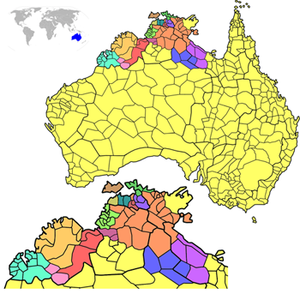
AustraliaAustraliaAustralia , officially the Commonwealth of Australia, is a country in the Southern Hemisphere comprising the mainland of the Australian continent, the island of Tasmania, and numerous smaller islands in the Indian and Pacific Oceans. It is the world's sixth-largest country by total area...
- Bunaban languages
- Daly languagesDaly languagesThe Daly languages are proposed to be the third largest family of Indigenous Australian languages . They are spoken within the vicinity of the Daly River in the Northern Territory....
- Limilngan languagesLimilngan languagesThe Limilngan languages are a small family of Australian Aboriginal languages spoken in northern Australia. There are only two languages in this group, Limilngan and Wulna, which as of 1981 had only three and one speakers, respectively, and which may now be extinct.-See also:* Australia* Aboriginal...
- Djeragan languages
- Nyulnyulan languagesNyulnyulan languagesThe Nyulnyulan languages are a small family of closely related Australian Aboriginal languages spoken in northern Australia.The languages form two branches established on the basis of lexical and morphological innovation....
- Wororan languages
- Mirndi languages
- Arnhem Land languagesArnhem Land languagesThe Arnhem Land languages are a proposed Australian language family spoken over a large part of Arnhem Land in northern Australia. The languages within the group are distinctive and not mutually intelligible....
(3 families and 2 isolates) - Gunwinyguan languagesGunwinyguan languagesThe Gunwinyguan languages form the second largest family of Australian Aboriginal languages. They are spoken in Arnhem Land in northern Australia. The most populous language is Gunwinygu, with some 1500 speakers....
- Pama–Nyungan languages (the largest family)
North AmericaNorth AmericaNorth America is a continent wholly within the Northern Hemisphere and almost wholly within the Western Hemisphere. It is also considered a northern subcontinent of the Americas...
and MesoamericaMesoamericaMesoamerica is a region and culture area in the Americas, extending approximately from central Mexico to Belize, Guatemala, El Salvador, Honduras, Nicaragua, and Costa Rica, within which a number of pre-Columbian societies flourished before the Spanish colonization of the Americas in the 15th and...
- Algic languagesAlgic languagesThe Algic languages are an indigenous language family of North America. Most Algic languages belong to the Algonquian family, dispersed over a broad area from the Rocky Mountains to Atlantic Canada...
(incl. Algonquian languagesAlgonquian languagesThe Algonquian languages also Algonkian) are a subfamily of Native American languages which includes most of the languages in the Algic language family. The name of the Algonquian language family is distinguished from the orthographically similar Algonquin dialect of the Ojibwe language, which is a...
) (14) - Alsean languagesAlsean languagesAlsea or Alsean was two closely related speech varieties spoken along the central Oregon coast. They are sometimes taken to be different languages, but it is difficult to be sure given the poor state of attestation; Mithun believes they were probably dialects of a single language.-Varieties:#...
(0) - Caddoan languagesCaddoan languagesThe Caddoan languages are a family of Native American languages. They are spoken by Native Americans in parts of the Great Plains of the central United States, from North Dakota south to Oklahoma.-Family division:...
(4) - Chimakuan languagesChimakuan languagesThe Chimakuan language family consists of two languages spoken in northwestern Washington, USA on the Olympic Peninsula. It is part of the Mosan sprachbund, and one of its languages is famous for having no nasal consonants...
(1) - Chinookan languagesChinookan languagesChinookan is a small family of languages spoken in Oregon and Washington along the Columbia River by Chinook peoples.-Family division:Chinookan languages consists of three languages with multiple varieties. There is some dispute over classification, and there are two ISO 639-3 codes assigned: and...
(1) - Chumashan languagesChumashan languagesChumashan is a family of languages that were spoken on the southern California coast by Native American Chumash people.From the Coastal plains and valleys of San Luis Obispo to Malibu), neighboring inland and Transverse Ranges valleys and canyons east to bordering the San Joaquin Valley; and on...
(0) - Comecrudan languagesComecrudan languagesComecrudan refers to a group of possibly related languages spoken in the southernmost part of Texas and in northern Mexico along the Rio Grande. Comecrudo is the most well-known.Very little is known about these languages or the people who spoke them...
(0) - Coosan languagesCoosan languagesThe Coosan language family consists of two languages spoken along the southern Oregon coast. Both languages are now extinct.-Classification:* Hanis* Miluk...
(0) - Eskimo–Aleut languages (5)
- Iroquoian languagesIroquoian languagesThe Iroquoian languages are a First Nation and Native American language family.-Family division:*Ruttenber, Edward Manning. 1992 [1872]. History of the Indian tribes of Hudson's River. Hope Farm Press....
(7) - Kalapuyan languagesKalapuyan languagesKalapuyan is a small extinct language family that was spoken in the Willamette Valley of Western Oregon, United States. It consists of three languages.-Family division:Kalapuyan consists of...
(0) - Keres languages (2)
- Maiduan languagesMaiduan languagesMaiduan is a small endangered language family of northeastern California.-Family division:The Maiduan consists of 4 languages:# Maidu # Chico † # Konkow # Nisenan...
(3) - Mayan languagesMayan languagesThe Mayan languages form a language family spoken in Mesoamerica and northern Central America. Mayan languages are spoken by at least 6 million indigenous Maya, primarily in Guatemala, Mexico, Belize and Honduras...
(Mesoamerica) (31) - Mixe–Zoquean languages (Mesoamerica) (19)
- Muskogean languagesMuskogean languagesMuskogean is an indigenous language family of the Southeastern United States. Though there is an ongoing debate concerning their interrelationships, the Muskogean languages are generally divided into two branches, Eastern Muskogean and Western Muskogean...
(5) - Na-Dene languagesNa-Dené languagesNa-Dene is a Native American language family which includes at least the Athabaskan languages, Eyak, and Tlingit languages. An inclusion of Haida is controversial....
(44) (part of proposed Dené–Yeniseian family) - Oto-Manguean languagesOto-Manguean languagesOto-Manguean languages are a large family comprising several families of Native American languages. All of the Oto-Manguean languages that are now spoken are indigenous to Mexico, but the Manguean branch of the family, which is now extinct, was spoken as far south as Nicaragua and Costa Rica.The...
(Mesoamerica) (27) - Palaihnihan languagesPalaihnihan languages-Family division:Palaihnihan is said to comprise:# Atsugewi # Achumawi -Genetic relations:The basis of this Palaihnihan grouping is weakened by poor quality of data...
(1) - Plateau Penutian languagesPlateau Penutian languages-History:Plateau Penutian as originally proposed was one branch of the hypothetical Penutian phylum as proposed by Edward Sapir. The original proposal also included Cayuse ; however, this language has little documentation and that which is documented is inadequately recorded...
(a.k.a. Shahapwailutan) (3) - Pomoan languagesPomoan languagesPomoan is a family of endangered languages spoken in northern California by the Pomo people on the Pacific Coast. According to the 2000 census, there are 255 speakers of the languages...
(5) - Salishan languagesSalishan languagesThe Salishan languages are a group of languages of the Pacific Northwest...
(16) - Shastan languagesShastan languagesThe Shastan family consisted of four languages, spoken in present-day northern California and southern Oregon.-Family division:# Konomihu # New River Shasta # Okwanuchu # Shasta ...
(0) - Siouan–Catawban languages (10)
- Tanoan languagesTanoan languagesTanoan is a family of languages spoken in New Mexico, Kansas, Oklahoma, and Texas.Most of the languages – Tiwa , Tewa, and Towa – are spoken in the Pueblos of New Mexico and were the ones first given the collective name Tanoan, while Kiowa is spoken mostly in southwestern...
(6) - Tequistlatecan languages (Mesoamerica) (2)
- Totonacan languagesTotonacan languagesThe Totonacan languages are a family of closely related languages spoken by approximately 200,000 Totonac and Tepehua people in the states of Veracruz, Puebla, and Hidalgo in Mexico...
(Mesoamerica) (2) - Tsimshian languagesTsimshianic languagesThe Tsimshianic languages are a family of languages spoken in northwestern British Columbia and in southern Alaska on Annette Island and Ketchikan. About 2,170 people of the ethnic Tsimshian population in Canada still speak the Tsimshian languages; about 50 of the 1,300 Tsimshian people living in...
(3) - Utian languagesUtian languagesUtian is a family of indigenous languages spoken in the central and north portion of California, United States. The Miwok and Ohlone peoples both spoke languages in the Utian linguistic group...
(5) - Uto-Aztecan languagesUto-Aztecan languagesUto-Aztecan or Uto-Aztekan is a Native American language family consisting of over 30 languages. Uto-Aztecan languages are found from the Great Basin of the Western United States , through western, central and southern Mexico Uto-Aztecan or Uto-Aztekan is a Native American language family...
(North America & Mesoamerica) (31) - Wakashan languagesWakashan languagesWakashan is a family of languages spoken in British Columbia around and on Vancouver Island, and in the northwestern corner of the Olympic Peninsula of Washington state, on the south side of the Strait of Juan de Fuca....
(7) - Wintuan languagesWintuan languagesWintuan is a family of languages spoken in the Sacramento Valley of central Northern California.All Wintuan languages are severely endangered.-Family division:...
(1) - Yokutsan languagesYokutsan languagesYokutsan is an endangered language family spoken in the interior of Northern and Central California in and around the San Joaquin Valley by the Yokut people. The speakers of Yokutsan languages were severely affected by disease, missionaries, and the Gold Rush...
(1) - Yukian languages (0)
- Yuman languages (10)
Central AmericaCentral AmericaCentral America is the central geographic region of the Americas. It is the southernmost, isthmian portion of the North American continent, which connects with South America on the southeast. When considered part of the unified continental model, it is considered a subcontinent...
and South AmericaSouth AmericaSouth America is a continent situated in the Western Hemisphere, mostly in the Southern Hemisphere, with a relatively small portion in the Northern Hemisphere. The continent is also considered a subcontinent of the Americas. It is bordered on the west by the Pacific Ocean and on the north and east...
- Alacalufan languagesAlacalufan languagesThe Alacalufan languages are a small language family of South America. They have not been definitely linked to any other American language family.Kakauhua is extinct and Kawésqar is highly endangered.- References :*...
(2) - Arauan languagesArauan languagesArawan is a family of languages spoken in western Brazil and Peru.-Family division:Arauan consists of 8 or 9 languages:...
(8) - Araucanian languagesAraucanian languagesThe Araucanian languages, sometimes considered divergent dialects of a single language isolate, are a small language family of central Chile and neighboring areas of Argentina....
(2) - Arawakan languagesArawakan languagesMacro-Arawakan is a proposed language family of South America and the Caribbean based on the Arawakan languages. Sometimes the proposal is called Arawakan, in which case the central family is called Maipurean....
(South America & Caribbean) (73) - Arutani–Sape languages (2)
- Aymaran languagesAymaran languagesAymaran is one of the two dominant language families of the central Andes, along with Quechuan....
(3) - Barbacoan languagesBarbacoan languagesBarbacoan is a language family spoken in Colombia and Ecuador.-Family division:Barboacoan consists of 6 languages:*Northern* Awan...
(7) - Cahuapanan languagesCahuapanan languagesThe Cahuapanan languages include two languages, Chayahuita and Jebero. They are spoken by more than 11,300 people in Peru. Chayahuita is spoken by most of that number, but Jebero is almost extinct....
(2) - Carib languages (29)
- Catacaoan languagesCatacaoan languagesThe Catacaoan languages or Tallán languages are an extinct family of three languages spoken in the Piura Region of Peru. The three languages in the family are:*Catacao or Katakao, once spoken around the city of Catacaos...
(0) - Chapacuran languages (5)
- Chibchan languagesChibchan languagesThe Chibchan languages make up a language family indigenous to the Isthmo-Colombian area, which extends from eastern Honduras to northern Colombia and includes populations of these countries as well as Nicaragua, Costa Rica, and Panama...
(Central & South America) (22) - Chimuan languagesChimuan languagesChimuan or Yuncan is a hypothetical small extinct language family of northern Peru and Ecuador .-Family division:Chimuan consisted of three attested languages:* Mochica * Cañar–Puruhá** Cañari ** Puruhá...
(0) - Choco languagesChoco languagesThe Choco languages are a small family of Native American languages spread across Colombia and Panama.-Family division:Choco consists of perhaps ten languages, half of them extinct....
(10) - Chon languagesChon languages-External links:*Alain Fabre, 2005, Diccionario etnolingüístico y guía bibliográfica de los pueblos indígenas sudamericanos: CHON...
(2) - Esmerelda–Yaruro languagesEsmerelda–Yaruro languagesEsmeralda–Yaruro or Takame–Jarúroan, is a proposed connection between two unclassified languages of Venezuela, Yaruro , 6000 speakers, and the extinct Esmeralda . They would be only distantly related, but Kaufman finds the connection convincing.-References:...
(2) - Guaicuruan languagesGuaicuruan languagesGuaicuruan is a language family spoken in northern Argentina, western Paraguay, and Brazil .-Family division:...
(a.k.a. Waikurian) (8) - Hibito–Cholon languagesHibito–Cholon languagesThe extinct Hibito–Cholón or Cholónan languages form a proposed language family that links two languages of Peru, Hibito and Cholón, extinct as of 2000...
(0) - Hodï languages (2)
- Ge languagesGe languagesThe Jê languages , or Jê–Kaingang languages, are spoken by the Gê, a group of indigenous peoples in Brazil.-Family division:The language family is as follows:*Jaikó...
(13) - Jicaquean languages (Central America)
- Jirajaran languagesJirajaran languagesThe Jirajaran languages are group of extinct languages once spoken in western Venezuela in the regions of Falcón and Lara. All of the Jirajaran languages appear to have become extinct in the early 20th Century.-Characteristics:...
(0) - Jivaroan languagesJivaroan languagesJivaroan is a small language family, or perhaps a language isolate, of northern Peru and eastern Ecuador.-Family division:Jivaroan consists of 4 languages:-Genetic relations:...
(4) - Katembri–Taruma languages (0)
- Katukinan languagesKatukinan languagesKatukinan is a language group consisting of three languages in Brazil.*Kanamarí*Katawixi*Katukína-References:*Alain Fabre, 2005, Diccionario etnolingüístico y guía bibliográfica de los pueblos indígenas sudamericanos: KATUKINA...
(3) - Lencan languages (Central America)
- Lule–Vilela languagesLule–Vilela languages-External links:*Alain Fabre. 2005. Diccionario etnolingüístico y guía bibliográfica de los pueblos indígenas sudamericanos....
(1) - Mascoian languagesMascoian languagesThe Mascoian languages are a small language family of Paraguay. They are part of the Mataco–Guaicuru proposal.The languages are:*Emok*Guana *Lengua...
(5) - Mashakalian languagesMaxakalían languagesThe Maxakalían languages were first classified into the Gê languages. It was only in 1931 that Loukotka separated them from the Gê family. Alfred Métraux and Curt Nimuendaju Unkel considered the Maxakalían family isolated from others...
- Matacoan languagesMatacoan languagesMatacoan is a language family of northern Argentina, western Paraguay, and southeastern Bolivia.-Family division:...
(4) - Misumalpan languagesMisumalpan languagesThe Misumalpan languages are a small family of Native American languages spoken by indigenous peoples on the east coast of Nicaragua and nearby areas. The name "Misumalpan" was devised by John Alden Mason and is composed of syllables from the names of the family's three members Miskitu, Sumu and...
(Central America) (9) - Mosetenan languages (1)
- Mura languages (1)
- Nadahup languages (4)
- Nambiquaran languages (5)
- Otomakoan languagesOtomakoan languagesMacro-Otomákoan is a proposal linking three small language families of the Amazon: The Harákmbut family, the extinct Otomakoan languages, and the Trumai language isolate....
? (3) - Pano–Tacanan languages (36)
- Peba–Yaguan languages (2)
- Puinavean languagesPuinavean languagesMartins, proposal BHowever, Epps considers Hup and Yahup to be distinct languages, and maintains that the inclusion of the poorly attested Nukak and Kakwa has not been demonstrated and is in fact highly dubious:Epps...
(Maku) (9) - Quechuan languages (46)
- Salivan languages (2)
- Tequiraca–Canichana languagesTequiraca–Canichana languagesTequiraca–Canichana is a possibly language family proposed in Kaufman uniting two erstwhile language isolates, Canichana of Bolivia and Tequiraca of Peru, both of which are either extinct or nearly so....
(2) - Tucanoan languagesTucanoan languagesTucanoan is a language family of Colombia, Brazil, Ecuador, and Peru.-Family division:There are two dozen Tucanoan languages:*Western Tucanoan**Correguaje **Tama **Macaguaje ...
(25) - Tupi languages (70)
- Uru–Chipaya languages (2)
- Witotoan languagesWitotoan languagesBora–Witóto is a proposal to unite the Bora and Witotoan language families of northeastern Peru , southwestern Colombia , and western Brazil...
(6) - Xincan languages (Central America)
- Yabutian languagesYabutian languagesThe Yabutian or Jabutian languages are two similar moribund languages of Brazil. They are members of the Macro-Je language family.-References:*Ribeiro, Eduardo & Hein van der Voort. 2008...
(2) - Yanomam languages (4)
- Zamucoan languagesZamucoan languagesZamucoan is a small language family of Paraguay and Bolivia .The family has hardly been studied by linguists , although several studies have recently appeared .-Extant languages:Zamucoan consists of two living languages:*...
(2) - Zaparoan languagesZaparoan languagesZaparoan is an endangered language family of Peru and Ecuador with fewer than 100 speakers...
(7)
Central & South America
- AbishiraAbishira languageTequiraca , also known as Abishira *, is a language spoken in Peru. In 1925 there were between 50 and 80 speakers in Puerto Elvira on Lake Vacacocha...
- AikanáAikana languageAikanã is an endangered language isolate spoken by about 200 Aikanã people in Rondônia, Brazil. It is morphologically complex and has SOV word order. Aikanã uses a modified Latin alphabet...
(Brazil: Rondônia) - AndoqueAndoque languageThe Andoque language is an aboriginal language spoken by a few hundred Andoque in Northern South America, and is in decline.In 2000, there were 610 speakers in the area of the Anduche River, downstream from Aracuara, Amazonas, Colombia; 50 were monolinguals. The language is no longer spoken in...
(Colombia, Peru) - BetoiBetoi languageBetoi or Betoi-Jirara is an extinct language of Venezuela, south of the Apure River near the modern border with Columbia. The names Betoi and Jirara are those of two of its peoples/dialects; the language proper has no known name. At contact, Betoi was a local lingua franca spoken between the...
(Colombia) - CamsáCamsá languageCamsá is a language isolate of Colombia.-Genealogical relations:Camsá has been linked with various hypothetical phylum proposals including Macro-Chibchan....
(Colombia) - Candoshi-ShapraCandoshi-ShapraCandoshi-Shapra is an indigenous American language isolate spoken by several thousand people in western South America along the Chapuli, Huitoyacu, Pastaza, and Morona river valleys. There are two dialects, Chapara and Kandoashi...
(Peru) - CayubabaCayubaba languageCayuvava is an extinct language of Bolivia, the descendants of the ethnic group of the same name live in the region of Beni, west of Mamore River, north of Santa Ana del Yacuma with a population of 794 inhabitants.-References:...
(Bolivia) - CofánCofán languageThe Cofán language is the language of the Cofán people, an indigenous group native to Napo Province northeast Ecuador and southern Colombia, between the Guamués River and the Aguarico River .Approximately 60% of Cofán speakers in Ecuador are literate in their...
(Colombia, Ecuador) - FulniôFulniô languageFulniô, or Yatê, is a language isolate of Brazil, and the only indigenous language remaining in the northeastern part of that country. The two dialects, Fulniô and Yatê, are very close...
- GuatóGuató languageThe Guató language, or , is a possible language isolate spoken by the about 10% Guató people of Brazil. Kaufman provisionally classifies it as a branch of the Macro-Gê languages, but no evidence for this was found by Eduardo Ribeiro.-Phonology:...
(Brazil, Bolivia) - HuaoraniHuaorani languageThe Huaorani language, commonly known as Sabela is a language isolate spoken by the Huaorani people, an indigenous group living in the Amazon Rainforest between the Napo and Curaray Rivers...
(a.k.a. Sabela, Waorani, Waodani) (Ecuador, Peru) - IrantxeIrantxe languageIrantxe , also known as Münkü , is an indigenous American language that is spoken in Mato Grosso, Brazil by about 200 people. It is generally left unclassified due to lack of data. Ethnologue idiosyncratically assigns it to the Arawakan family, but there is no published account to back this up...
(Brazil: Mato Grosso) - ItonamaItonama languageItonama is a moribund language isolate spoken in the Amazonian lowlands of north-eastern Bolivia. Greenberg’s classification of Itonama as Paezan, a sub-branch of Macro-Chibchan, remains unsupported and Itonama continues to be considered an isolate or unclassified language.-Vowels:Diphthongs:...
(Bolivia) - Kapixaná (Brazil)
- Koayá (Brazil: Rondônia)
- LecoLeco languageLeco is a language isolate that, though long reported to be extinct, is spoken by 20–40 individuals in areas east of Lake Titicaca, Bolivia. The Leco ethnic population is about 80.-External links:...
(Bolivia) - Mapudungun (Chile, Argentina)
- MovimaMovima languageMovima is a language that is spoken by about 1400 of the Movima, a group of Native Americans that resides in Bolivia. It is considered a language isolate, as it has not been proven related to any other language.-Phonology:Movima has five vowels:...
(Bolivia) - OmuranoOmurano languageOmurano is an unclassified extinct language from Peru. It is also known as Humurana, Roamaina, Numurana, Umurano, and Mayna.Tovar linked Omurano to Taushiro ; Kaufman finds the links reasonable, and tentatively proposes a Kandoshi–Omurano–Taushiro language family...
(Peru) - OtíOti languageThe Oti language, also known as Chavante or Euchavante, is an extinct language isolate once spoken by the Oti people near São Paulo, Brazil....
(Brazil: São Paulo) [extinct] - PaezPáez languagePáez is a language isolate of Colombia spoken by Páez people in the central Andes region near Popayán...
(see also PaezanPaezan languagesPaezan may be any of several language-family proposals of Colombia and Ecuador named after the Paez language.-Proposed genealogical relations:...
) - PuelchePuelche languagePuelche is an extinct or nearly extinct language spoken by the Puelche people in the Pampas region of Argentina. The language is also known as Gününa Küne, Gennaken , Pehuenche, Northern Tehuelche, Gününa Yajich, Ranquelche, and Pampa, and may have five speakers, according to Ethnologue, if not it...
(Argentina,Chile) - PuquinaPuquina languagePuquina is an extinct language once spoken by the ancient Inca in the region surrounding Lake Titicaca and in the north of what is now Chile....
(Bolivia) [extinct] - TaushiroTaushiro languageTaushiro, also known as Pinche or Pinchi, is a nearly extinct possible language isolate of the Peruvian Amazon near Ecuador. In 2000 SIL counted one speaker in an ethnic population of 20...
(Peru) - TicunaTicuna languageTïcuna, or Tïkuna, is a language spoken by approximately 40,000 people in Brazil, Peru, and Colombia. It is the native language of the Tïcuna people. Tïcuna is generally classified as a language isolate, but may be related to the extinct Yuri language...
(Colombia, Peru, Brazil) - TimoteTimote languageTimote, also known as Cuica or Timote–Cuica, was the language of the Timote–Cuica state in the Venezuelan Andes, around the present city of Mérida and south of Lake Maracaibo....
(Venezuela) - Tiníwa (Colombia)
- WaraoWarao languageWarao is a language isolate of the indigenous Warao people. It is the native language spoken by approximately 18,000 people inhabiting the Orinoco River delta in northeastern Venezuela as well as small populations of speakers in western Guyana and Suriname.A connection to the extinct Timucua...
(Guyana, Surinam, Venezuela) - WayuuWayuu languageThe Wayuu language, or Goajiro , is spoken by 305,000 indigenous Wayuu people in northeastern Colombia and northwestern Venezuela on the Guajira Peninsula....
(a.k.a Goajiro) (Colombia, Venezuela) - Yámana (a.k.a Yagan) (Chile)
- YuracareYuracaré languageYuracaré is an endangered language isolate of central Bolivia in Cochabamba and Beni departments spoken by the Yuracaré people....
(Bolivia) - YuriYuri language (Amazon)Yurí is, or was, a language previously spoken near a stretch of the Caquetá River in the Brazilian Amazon, extending slightly into Colombia. A small amount of data was collected on two occasions in the 19th century, in 1853 and 1867...
(Colombia, Brazil) - YurumanguíYurumanguí languageYurumanguí is an extinct language of Colombia. It is known to us only through a short list of words and phrases recorded by Father Christoval Romero and given by him to Captain Sebastián Lanchas de Estrada, who included them in the report of his travels of 1768...
(Colombia)
North America
- ChimarikoChimariko languageChimariko is an extinct language isolate formerly spoken in Trinity County in northwestern California by Chimariko peoples.-Genetic relations:...
(US: California) [extinct] - ChitimachaChitimacha languageThe Chitimacha language is a language isolate historically spoken by the Chitimacha people of Louisiana, United States. It went extinct in 1940 with the death of the last fluent speaker, Delphine Ducloux....
(US: Louisiana) [extinct] - CoahuiltecoCoahuilteco languageCoahuilteco was a language isolate that was spoken in southern Texas and northeastern Coahuila . It was spoken by one tribe of a group of American Indian hunter-gatherers named the Quems....
(US: Texas, northeast Mexico) [extinct] - CuitlatecCuitlatec languageCuitlatec, or Cuitlateco, is an extinct language of Mexico, formerly spoken by an indigenous people also known as Cuitlatec.-Classification:...
(Mexico: Guerrero) [extinct] - EsselenEsselen languageEsselen is a language isolate that was spoken by the Esselen Native Americans on the Central Coast of California, south of Monterey....
(US: California) [extinct] - HaidaHaida languageThe Haida language is the language of the Haida people. It contains seven vowels and well over 30 consonants.-History:The first documented contact between the Haida and Europeans was in 1774, on Juan Pérez's exploratory voyage. At this time Haidas inhabited the Queen Charlotte Islands, Dall...
(Canada: British Columbia; US: Alaska) - HuaveHuave languageHuave is a language isolate spoken by the indigenous Huave people on the Pacific coast of the Mexican state of Oaxaca. The language is spoken in four villages on the Isthmus of Tehuantepec, in the southeast of the state, by around 18,000 people...
(Mexico: Oaxaca) - KarankawaKarankawa languageKarankawa is the extinct, unclassified language of the Texan coast, where the Karankawa people migrated between the mainland and the barrier islands. It was not closely related to other known languages in the area, much of which are also poorly attested, and may have been a language isolate...
(US: Texas) [extinct] - KarokKaruk languageKaruk or Karok is an endangered language of northwestern California. It is the traditional language of the Karuk people, most of whom now speak English....
(a.k.a. Karuk) (US: California) - KootenaiKutenai languageThe Kutenai language is named after and is spoken by some of the Kootenai Native American/First Nations people who are indigenous to the area of North America that is now Montana, Idaho, and British Columbia....
(Canada: British Columbia; US: Idaho, Montana) - NatchezNatchez languageNatchez was a language of Louisiana. Its two last fluent speakers, Watt Sam and Nancy Raven, died in the late 1930s. The Natchez nation is now working to revive it as a spoken language.-Classification:...
(US: Mississippi, Louisiana) (sometimes linked to Muskogean) - P'urhépechaP'urhépecha languageP'urhépecha is a language isolate or small language family spoken by more than 100,000 P'urhépecha people in the highlands of the Mexican state of Michoacán...
(a.k.a. Tarascan) (Mexico: Michoacán) - SalinanSalinanThe Salinan Native Americans lived in what is now the Central Coast of California, in the Salinas Valley. Said to have gone extinct by the Census of 1930, the Salinan Native Americans survived and are now in the process of applying for tribal recognition from the Bureau of Indian Affairs.There...
(US: California) [extinct] - SeriSeri languageSeri is a language isolate spoken by the Seri people by between 716 and 900 people in two villages on the coast of Sonora, Mexico.-Classification:...
(Mexico: Sonora) - Siuslaw (US: Oregon) [extinct]
- TakelmaTakelma languageTakelma was the language spoken by the Takelma people. It was first extensively described by Edward Sapir in his graduate thesis, The Takelma Language of Southwestern Oregon...
(US: Oregon) [extinct] - TimucuaTimucua languageTimucua is a language isolate formerly spoken in northern and central Florida and southern Georgia by the Timucua people. Timucua was the primary language used in the area at the time of Spanish arrival in Florida. Linguistic and archaeological studies suggest that it may have been spoken from...
(US: Florida, Georgia) [extinct] - TonkawaTonkawa languageThe Tonkawa language was spoken in Oklahoma, Texas, and New Mexico by the Tonkawa people. A language isolate, with no known related languages, Tonkawa is now extinct...
(US: Texas) [extinct] - TunicaTunica languageThe Tunica language was a language isolate spoken in the Central and Lower Mississippi Valley by in the United States by Native American Tunica peoples. There are no known speakers of the Tunica language remaining.When the last known fluent speaker Sesostrie Youchigant died, the language became...
(US: Mississippi, Louisiana, Arkansas) [extinct] - WashoWasho languageThe Washo language is an endangered Native American language isolate spoken by the Washo on the California–Nevada border in the drainages of the Truckee and Carson Rivers, especially around Lake Tahoe...
(US: California, Nevada) - YanaYana languageYana is an extinct language isolate formerly spoken in north-central California between the Feather and Pit rivers in what is now Shasta and Tehama counties....
(US: California) [extinct] - YuchiYuchi languageThe Yuchi language is the language of the Yuchi people living in the southeastern United States, including eastern Tennessee, western Carolinas, northern Georgia and Alabama, in the period of early European colonization. However, speakers of the Yuchi language were forcibly relocated to Oklahoma...
(US: Georgia, Oklahoma) - ZuniZuni languageZuni is a language of the Zuni people, indigenous to western New Mexico and eastern Arizona in the United States. It is spoken by around 9,500 people worldwide, especially in the vicinity of Zuni Pueblo, New Mexico, and much smaller numbers in parts of Arizona.Unlike most indigenous languages in...
(a.k.a. Shiwi) (US: New Mexico)
Australia
- EnindhilyagwaEnindhilyagwa languageEnindhilyagwa is an Australian language isolate spoken by the Warnindhilyagwa people on Groote Eylandt in the Gulf of Carpentaria in northern Australia. A 2001 Australian government identified more than one thousand speakers of the language, although there are reports of as many as three thousand...
(AKA Andilyaugwa, Anindilyakwa) - LaragiyaLaragiya languageThe Laragiya language is an Australian language isolate spoken by just six people near the city of Darwin in northern Australia as of 1983. Ethnologue reported that it was extinct....
- MinkinMinkin languageThe Minkin language is an extinct Australian Aboriginal language, perhaps a language isolate, of northern Australia. It was spoken in the area around Burketown, on the southern coast of the Gulf of Carpentaria, in an area that contains the headwaters of the Leichhardt River.The classification of...
[extinct; perhaps a member of Yiwaidjan or Tankic] - NgurmburNgurmbur languageThe Ngumbur language is an Australian language isolate spoken by just one person in Arnhem Land, northern Australia, as of 1981. By 2009 Ethnologue reported that it was extinct.Ngumbur is not known to be related to any other language...
(perhaps a member of Macro-Pama–Nyungan) - TiwiTiwi languageTiwi is an Australian Aboriginal language spoken on the Tiwi Islands, within sight of the coast of northern Australia. It is one of about 10% of Australian languages still being learned by children....
(Melville and Bathurst Islands)
New Guinea
- AbinomnAbinomn languageThe Abinomn language is a language isolate initially reported by Mark Donohue from Papua province, Indonesia. It is also known as Avinomen, Baso , and Foia. There are about 300 speakers.-Pronouns:The Abinomn pronouns are-External links:*...
(Baso, Foia) (north Irian) - AnêmAnêm languageThe Anêm language is a language isolate spoken in five main villages along the northwestern coast of New Britain island, Papua New Guinea: Malasoŋo , Karaiai, Mosiliki, Pudêlîŋ, Atiatu and Bolo...
(New Britain) - AtaAta languageThe Ata language, also known as Pele-Ata or Wasi, is a language isolate spoken on New Britain island, Papua New Guinea. It may be related to the Anêm and Yélî Dnye isolates in a tentative Yele-West New Britain family. There are about 2000 speakers....
(Pele-Ata, Wasi) (New Britain) - BusaBusa languageThe Busa language, also known as Odiai , is a language isolate in northwestern Papua New Guinea. There were 244 speakers at the time of the 2000 census.-External links:*...
(Sandaun) - IsirawaIsirawa languageIsirawa is a Papuan language spoken by about two thousand people on the north coast of Papua province, Indonesia. It's a local trade language, and use is vigorous. Stephen Wurm linked it to the Kwerba languages within the Trans–New Guinea family, and it does share about 20% of its vocabulary with...
(north Irian) - KolKol language (Papua New Guinea)The Kol language is a language spoken in eastern New Britain island, Papua New Guinea. There are about 4000 speakers.Kol appears to be a language isolate, though it may be distantly related to the poorly attested Sulka language.-See also:...
(New Britain) - KuotKuot languageThe Kuot language, or Panaras, is a language isolate, the only non-Austronesian language spoken on the island of New Ireland, Papua New Guinea. There are about 2,400 speakers, concentrated primarily on the northwest coast of the island...
(Panaras) (New Ireland) - MassepMassep languageMassep is a poorly documented Papuan language spoken by under 50 people in a single village. Despite the small number of speakers, however, language use is vigorous. Donohue et al. conclude that it is definitely not a Kwerba language, as it had been classified by Wurm , and they did not notice...
- PyuPyu languagePyu language may refer to:*Pyu language , Papua New Guinea, different from Piu*Pyu language , ancient...
- SulkaSulka languageSulka is a possible language isolate scattered across the eastern end of New Britain island, Papua New Guinea. There are about 3000 speakers.Sulka is very poorly attested. There is some evidence that it might be related to Kol or Baining....
(New Britain) - TaiapTaiap languageTaiap is an endangered language isolate spoken by around a hundred people in the East Sepik Province of Papua New Guinea. It is being replaced by the national language and lingua franca Tok Pisin.The first European to come across Taiap was a German missionary in 1938...
(Gapun) (Sepik) - YalëYalë languageThe Yalë language, also known as Nagatman, is a language isolate in northwestern Papua New Guinea. There are about 600 speakers, of whom 5% are monolingual....
(Nagatman) (Sandaun) - YawaYawa languagesThe Yawa languages, or Yapen, are a small family of two closely related Papuan languages, Yawa and Saweru, which are often considered to be divergent dialects of a single language...
(Geelvink Bay) - Yélî DnyeYélî Dnye languageThe Yélî Dnye language, also known as Yele, is the language of Rossel island, the easternmost island in the Louisiade Archipelago off the eastern tip of Papua New Guinea. For now it is best considered a language isolate, but it may turn out to be related to the Anêm and Ata language isolates of New...
(Yele) (Rennell Island) - Yuri (Karkar) (Sandaun)
Asia
- Ainu languageAinu languageAinu is one of the Ainu languages, spoken by members of the Ainu ethnic group on the northern Japanese island of Hokkaidō....
or languages (Japan, Russia) (like ArabicArabic languageArabic is a name applied to the descendants of the Classical Arabic language of the 6th century AD, used most prominently in the Quran, the Islamic Holy Book...
or JapaneseJapanese languageis a language spoken by over 130 million people in Japan and in Japanese emigrant communities. It is a member of the Japonic language family, which has a number of proposed relationships with other languages, none of which has gained wide acceptance among historical linguists .Japanese is an...
, the diversity within Ainu is large enough that some consider it to be perhaps up to a dozen languages while others consider it a single language with high dialectal diversity) - NivkhNivkh languageNivkh or Gilyak is a language spoken in Outer Manchuria, in the basin of the Amgun , along the lower reaches of the Amur itself, and on the northern half of Sakhalin. 'Gilyak' is the Manchu appellation...
or Gilyak (Russia) (sometimes linked to Chukchi–KamchatkanChukotko-Kamchatkan languagesThe Chukotko-Kamchatkan or Chukchi–Kamchatkan languages are a language family of extreme northeastern Siberia. Its speakers are indigenous hunter-gatherers and reindeer-herders....
) - KoreanKorean languageKorean is the official language of the country Korea, in both South and North. It is also one of the two official languages in the Yanbian Korean Autonomous Prefecture in People's Republic of China. There are about 78 million Korean speakers worldwide. In the 15th century, a national writing...
(North & South Korea, China, USA) (sometimes linked to AltaicAltaic languagesAltaic is a proposed language family that includes the Turkic, Mongolic, Tungusic, and Japonic language families and the Korean language isolate. These languages are spoken in a wide arc stretching from northeast Asia through Central Asia to Anatolia and eastern Europe...
; its dialect JejuJeju dialectJeju dialect or Jeju language is the dialect used on the island of Jeju in Korea, with the exception of Chuja in the former Bukjeju County area of Jeju City. It differs greatly from the dialects of the mainland, and preserves many archaic words which have since been lost in other Korean dialects...
is often considered a different language) - KusundaKusunda languageKusunda is a language isolate spoken by a handful of people in western Nepal. It has only recently been described in any detail.For decades the Kusunda language was thought to be on the verge of extinction, with little hope of ever knowing it well...
(Nepal) - NihaliNihali languageNihali, also known as Nahali or erroneously as Kalto, is a language isolate spoken in west-central India by around 2,000 people out of an ethnic population of 5,000...
(India) (sometimes linked to MundaMunda languages-Anderson :Gregory Anderson's 1999 proposal is as follows. Individual languages are highlighted in italics.*North Munda **Korku**Kherwarian***Santhali***Mundari*South Munda **Kharia–Juang***Juang***Kharia...
) - BurushaskiBurushaski languageThe Burushaski or Burushko language , is a language isolate . It is spoken by some 87,000 Burusho people in the Hunza, Nagar, Yasin, and Ishkoman valleys, and some parts of the Gilgit valley, in Gilgit–Baltistan in Pakistan and by about 300 Burusho people in Srinagar in Jammu and Kashmir, India...
(Pakistan, India) (sometimes linked to YeniseianYeniseian languagesThe Yeniseian language family is spoken in central Siberia.-Family division:0. Proto-Yeniseian...
) - ElamiteElamite languageElamite is an extinct language spoken by the ancient Elamites. Elamite was the primary language in present day Iran from 2800–550 BCE. The last written records in Elamite appear about the time of the conquest of the Persian Empire by Alexander the Great....
(Iran) [extinct] (sometimes linked to Dravidian) - SumerianSumerian languageSumerian is the language of ancient Sumer, which was spoken in southern Mesopotamia since at least the 4th millennium BC. During the 3rd millennium BC, there developed a very intimate cultural symbiosis between the Sumerians and the Akkadians, which included widespread bilingualism...
(Iraq) [extinct] - HatticHattic languageHattic was a language spoken by the Hattians in Asia Minor between the 3rd and the 2nd millennia BC. Scholars call this language 'Hattic' to distinguish it from the Hittite language--the Indo-European language of the Hittite Empire....
(Turkey) [extinct] (sometimes linked to Northwest CaucasianNorthwest Caucasian languagesThe Northwest Caucasian languages, also called Abkhazo-Adyghean, or sometimes Pontic as opposed to Caspian for the Northeast Caucasian languages, are a group of languages spoken in the Caucasus region, chiefly in Russia , the disputed territory of Abkhazia, and Turkey, with smaller communities...
)
Africa
- HadzaHadza languageHadza is a language isolate spoken by fewer than a thousand Hadza people along the shores of Lake Eyasi in Tanzania, the last full-time hunter-gatherers in Africa. Despite the small number of speakers, language use is vigorous, with most children learning it...
(Tanzania) - SandaweSandawe languageSandawe or Sandawi is a tonal language spoken by about 40,000 Sandawe people in the Dodoma region of Tanzania. Language use is vigorous among both adults and children, with people in some areas monolingual. Sandawe had generally been classified as a member of the defunct Khoisan family since Albert...
(Tanzania) (may be related to KhoeKhoe languagesThe Khoe languages are the largest of the non-Bantu language families indigenous to southern Africa. They are often considered to be a branch of a suspected Khoisan language family, and are known as Central Khoisan in that scenario. The nearest relative of the Khoe family is the extinct and poorly...
)
Europe
- BasqueBasque languageBasque is the ancestral language of the Basque people, who inhabit the Basque Country, a region spanning an area in northeastern Spain and southwestern France. It is spoken by 25.7% of Basques in all territories...
(Spain, France) (related to extinct AquitanianAquitanian languageThe Aquitanian language was spoken in ancient Aquitaine before the Roman conquest and, probably much later, until the Early Middle Ages....
)
Unclassified languages
Languages are considered unclassified either because, for one reason or another, little effort has been made to compare them with other languages, or, more commonly, because they are too poorly documented to permit reliable classification. Most such languages are extinct and most likely will never be known well enough to classify.Europe
- IberianIberian languageThe Iberian language was the language of a people identified by Greek and Roman sources who lived in the eastern and southeastern regions of the Iberian peninsula. The ancient Iberians can be identified as a rather nebulous local culture between the 7th and 1st century BC...
(Spain) [extinct] - TartessianTartessian languageThe Tartessian language is the extinct Paleohispanic language of inscriptions in the Southwestern script found in the southwest of the Iberian Peninsula: mainly in the south of Portugal , but also in Spain . There are 95 of these inscriptions with the longest having 82 readable signs...
(Spain, Portugal) [extinct] - North PiceneNorth Picene languageThe North Picene language is a hypothetical construct based on four inscriptions of the Italian Iron Age from the Pesaro region of northeast Italy. The total number of words is about 60...
(Italy) [extinct] - PictishPictish languagePictish is a term used for the extinct language or languages thought to have been spoken by the Picts, the people of northern and central Scotland in the Early Middle Ages...
(Scotland) [extinct]
Africa
- OngotaOngota languageOngota is a moribund language of southwest Ethiopia. In 2008, it was said to be in a state of decline with only 6 elderly native speakers, the rest of their small village on the west bank of the Weito River having adopted the Tsamai language instead. The grammar follows a Subject Object Verb word...
(perhaps Afro-Asiatic) - GumuzGumuz languageGumuz is a dialect cluster spoken along the border of Ethiopia and Sudan. Most Ethiopian speakers live in the Metekel Zone of the Benishangul-Gumuz Region, although a group of 1,000 live outside the town of Welkite...
(perhaps Nilo-Saharan) - KwadiKwadi languageKwadi is a "click language" of uncertain classification once spoken in the southwest corner of Angola. It is believed to be extinct. There were only fifty Kwadi in the 1950s, of which only 4–5 were competent speakers of the language...
(extinct; perhaps Khoe) - Bangi-meBangi-meThe Bangime language, or in full , is spoken by some 1500 ethnic Dogon in seven villages in southern Mali, who call themselves the . Long known to be highly divergent from Dogon languages, it was first proposed as a possible isolate by Blench...
(ethnically Dogon) - Dompo
- MpreMpre languageMpre Mpra is a language once spoken in the village of Butie in Ghana, near the confluence of the Black and White Voltas, that has been difficult to classify...
- JalaaJalaa languageJalaa Centúúm or Cen Tuum is an endangered language of northeastern Nigeria , of uncertain origins...
- LaalLaal languageLaal is an unclassified language spoken by 749 people in three villages in the Moyen-Chari prefecture of Chad on opposite banks of the Chari River,...
- MeroiticMeroitic languageThe Meroitic language was spoken in Meroë and the Sudan during the Meroitic period and went extinct about 400 CE. It was written in two forms of the Meroitic alphabet: Meroitic Cursive, which was written with a stylus and was used for general record-keeping; and Meroitic Hieroglyphic, which was...
(extinct; variously thought to be Nilo-Saharan or Afro-Asiatic) - ShaboShabo languageShabo is an endangered language spoken by about 600 hunter-gatherers in southwestern Ethiopia, in the westernmost part of the Southern Nations, Nationalities, and People's Region. They live in three places in the Keficho Shekicho Zone: Anderaccha, Gecha, and Kaabo...
Asia
- Quti [extinct]
- KaskianKaskian languageKaskian was a non-Indo-European language of the Kaskians of northeastern Bronze Age Anatolia, in the mountains along the Black Sea coast....
[extinct] - Cimmerian [extinct]
- ShompenShompen languagesThe Shompen languages are spoken on Great Nicobar Island in the Indian union territory of the Andaman and Nicobar Islands in the Indian Ocean south of Burma....
(Nicobar Islands) - EngganoEnggano languageThe Enggano language, or Engganese, is the language of Enggano Island off the southwestern coast of Sumatra.Although adjacent to Austronesian languages, Enggano has not been established as Austronesian; it may instead be a language isolate with Austronesian borrowing. Much of the basic vocabulary...
(Sumatra)
South America
- BaenanBaenan languageBaenan is a poorly attested language of Brazil. The last remaining speaker lived in Bahia, Brazil in 1940. The language of this speaker was associated with the Baenan language as the last members of the Baenan tribe lived in Paragaçú, Bahia, near where the language was attested...
(Brazil) [extinct] - CulleCulle languageCulle , also known as Ilinga , is a poorly attested extinct language of northern Peru. It is the original language of the regions of La Libertad, Cajabamba, and Pallasca...
(Peru) [extinct] - KunzaKunzaKunza Cunza, also known as Likanantaí, Lipe, Ulipe, or Atacameño, is an extinct, unclassified language spoken in the Atacama Desert of northern Chile and southern Perú by the Lickan-antay people, who have since shifted to Spanish.The last Kunza speaker was found in 1949, although some have...
(Chile, Bolivia, Argentina) [extinct] - GamelaGamela languageGamela Curinsi or Acobu, is an unclassified and presumably extinct language of Brazil. Kaufman said that 'only Gr[eenberg] dares to classify this language', due to the lack of data on it....
(Brazil: Maranhão) [extinct] - GorgotoquiGorgotoqui languageGorgotoqui is a currently undocumented extinct language of the Chiquitanía region of the eastern Bolivian lowlands.During the period of the Jesuit missions to the Chiquitos, Gorgotoqui was the most numerous language of the area. It became a lingua franca and the sole language of the Jesuit mission...
(Bolivia) [extinct] - HuamoéHuamoé languageHuamoé Uamué is an extinct language of Brazil that is too poorly attested to classify.Also spelled Huamuê, Huamoi, Uame, Wamoé; also called Umã or Aticum .-References:...
(Brazil: Pernambuco) [extinct] - Kukurá (Brazil: Mato Grosso) [extinct]
- Malibu languagesMalibu languagesThe Malibu languages are a poorly attested group of extinct languages once spoken along the Magdalena River in Colombia. Material exists only for two of the numerous languages mentioned in the literature: Malibú and Mocana.-Classification:...
(Colombia) [extinct] - MunichiMunichi languageMunichi is a recently extinct language which was spoken in the village of Munichis, about 10 miles or 16 km West of Yurimaguas, Loreto Region, Peru. The last known mother-tongue speaker, Victoria Huancho Icahuate, died in the late 1990s, though some people remain in the village who know a few...
(Peru) - NatúNatú language- References :* Nimuendajú, Curt: Lista comparativa com 19 itens Natu. Pasta nº. 6 del Archivo da Sala Lingüística del Departamento de Antropología del Museo Nacional, Río de Janeiro....
(Brazil: Pernambuco) [extinct] - PankararúPankararú languagePankararú is an extinct language of eastern Brazil. There are 6,000 ethnic Pankararú, but they all speak Portuguese. In 1961, only two elders could remember anything of the language.In the 19th century the people split into two ethnic groups, the Pankararú and the Pankararé...
(Brazil: Pernambuco) - SechuraSechura languageThe Sechura language, also known as Sek, is an extinct language spoken in the Piura Region of Peru, near the port of Sechura. It appears to have become extinct by the beginning of the 20th Century.-Classification:...
- TarairiúTarairiú languageTarairiú Caratiú is an extinct and very poorly known language of eastern Brazil. The Tarairiu nation was divided into several tribes: the Jandoino, Kanindé, Paiaku , Jenipapos, Jenipabuçu, Javó, Kamaçu, Tukuriju, Arariu, and "Xukuru" / Xacó.The language is attested only through a few word lists...
(Brazil: Rio Grande do Norte) - TuxáTuxá languageTuxá was the eastern Brazilian language of the Tuxá people, who now speak Portuguese. The language ceased being spoken in the late 19th century, but in the 1960s a research team found two women that had been expelled from the Tuxa tribe in Bahia who knew some thirty words....
(Brazil: Bahia, Pernambuco) [extinct] - Xokó (Brazil: Alagoas, Pernambuco) [extinct]
- Xukurú (Brazil: Pernambuco, Paraíba) [extinct]
- YurumanguíYurumanguí languageYurumanguí is an extinct language of Colombia. It is known to us only through a short list of words and phrases recorded by Father Christoval Romero and given by him to Captain Sebastián Lanchas de Estrada, who included them in the report of his travels of 1768...
(Colombia) [extinct]
North America
- AdaiAdai languageAdai is an extinct language that was spoken in northwestern Louisiana. It is very poorly documented, being known only from a list of 275 words from 1804, so classification is probably impossible...
(US: Louisiana, Texas) [extinct] - AlagüilacAlaguilac languageAgüilac is an undocumented indigenous American language that is thought to have been spoken in Guatemala at the time of the Spanish conquest.-Views on the language:...
(Guatemala) - Aranama-Tamique (US: Texas) [extinct]
- AtakapaAtakapa languageAtakapa is an extinct language isolate native to southwestern Louisiana and nearby coastal eastern Texas. It was spoken by the Atakapa people .-Geographic variation:There were two varieties of Atakapa Atakapa is an extinct language isolate native to southwestern Louisiana and nearby coastal eastern...
(US: Louisiana, Texas) [extinct] - BeothukBeothuk languageThe Beothuk language , also called Beothukan, was spoken by the indigenous Beothuk people of Newfoundland. The Beothuk have been extinct since 1829 and there are few written accounts of their language, little is known about it. There have been claims of links with the neighbouring Algonquian...
(Canada: Newfoundland) [extinct] - CalusaCalusaThe Calusa were a Native American people who lived on the coast and along the inner waterways of Florida's southwest coast. Calusa society developed from that of archaic peoples of the Everglades region; at the time of European contact, the Calusa were the people of the Caloosahatchee culture...
(US: Florida) [extinct] - CayuseCayuseThe Cayuse are a Native American tribe in the state of Oregon in the United States. The Cayuse tribe shares a reservation in northeastern Oregon with the Umatilla and the Walla Walla tribes as part of the Confederated Tribes of the Umatilla Indian Reservation...
(US: Oregon, Washington) [extinct] - CotonameCotoname languageCotoname is an extinct language isolate spoken by Native Americans indigenous to the lower Rio Grande Valley of northeastern Mexico and extreme southern Texas .-External links:* * *...
(northeast Mexico; US: Texas) [extinct] - MaratinoMaratino languageMaratino is a barely attested extinct language that was spoken in north-east Mexico, near Martín, Tamaulipas. Swanton, who called it 'Tamaulipeco', classified it as Uto-Aztecan based on a few obvious cognates, such as Maratino chiguat 'woman' ~ Nahuatl cihuātl 'woman' and peyot 'peyote' ~ Nahuatl...
(northeastern Mexico) [extinct] - NaolanNaolan languageNaolan is a barely attested extinct language that was spoken a five-hour walk from Tula, Tamaulipas in north-east Mexico. It is only known from 48 words compiled from a few phrases collected in the 1940s, and was nearly extinct at that time...
(Mexico: Tamaulipas) [extinct] - Quinigua (northeast Mexico) [extinct]
- SolanoSolano languageSolano is an unclassified extinct language formerly spoken in northeast Mexico and perhaps also in the neighboring U.S. state of Texas.Solano is known only from a 21-word vocabulary list that appears at the end of a 1703–1708 baptism book from the San Francisco Solano mission. Supposedly the...
(northeast Mexico; US: Texas) [extinct]
Mixed languages
- MichifMichif languageMichif is the language of the Métis people of Canada and the United States, who are the descendants of First Nations women and fur trade workers of European ancestry...
, a mixture of FrenchFrench languageFrench is a Romance language spoken as a first language in France, the Romandy region in Switzerland, Wallonia and Brussels in Belgium, Monaco, the regions of Quebec and Acadia in Canada, and by various communities elsewhere. Second-language speakers of French are distributed throughout many parts...
and CreeCree languageCree is an Algonquian language spoken by approximately 117,000 people across Canada, from the Northwest Territories and Alberta to Labrador, making it the aboriginal language with the highest number of speakers in Canada. It is also spoken in the U.S. state of Montana...
, where the nouns and adjectives tend to be French (including agreement), and the polysynthetic verbs are entirely Cree. There are two simultaneous gender systems, French masculine/feminine as well as Cree animate/inanimate, and the Cree obviativeObviativeObviate third person person is a grammatical person marking that distinguishes a non-salient third person referent from a more salient third person referent in a given discourse context...
(fourth personGrammatical personGrammatical person, in linguistics, is deictic reference to a participant in an event; such as the speaker, the addressee, or others. Grammatical person typically defines a language's set of personal pronouns...
). - Mednyj AleutMednyj AleutMednyj Aleut is a nearly extinct mixed language spoken on Bering Island. It is characterized by Aleut nouns and Russian verbs, each with the full inflectional complexity of the source languages...
, a mixture of RussianRussian languageRussian is a Slavic language used primarily in Russia, Belarus, Uzbekistan, Kazakhstan, Tajikistan and Kyrgyzstan. It is an unofficial but widely spoken language in Ukraine, Moldova, Latvia, Turkmenistan and Estonia and, to a lesser extent, the other countries that were once constituent republics...
and AleutAleut languageAleut is a language of the Eskimo–Aleut language family. It is the heritage language of the Aleut people living in the Aleutian Islands, Pribilof Islands, and Commander Islands. As of 2007 there were about 150 speakers of Aleut .- Dialects :Aleut is alone with the Eskimo languages in the...
, which retains Aleut verbs but has replaced most of the inflectional endings with their Russian equivalents. - Cappadocian GreekCappadocian Greek languageCappadocian , also known as Cappadocian Greek or Asia Minor Greek, is a mixed language formerly spoken in Cappadocia . In the population exchange between Greece and Turkey in the 1920s, Cappadocian speakers were forced to emigrate to Greece, where they were resettled in various locations,...
, comprising mostly Greek root words, but with many TurkishTurkish languageTurkish is a language spoken as a native language by over 83 million people worldwide, making it the most commonly spoken of the Turkic languages. Its speakers are located predominantly in Turkey and Northern Cyprus with smaller groups in Iraq, Greece, Bulgaria, the Republic of Macedonia, Kosovo,...
grammatical endings and Turkish vowel harmonyVowel harmonyVowel harmony is a type of long-distance assimilatory phonological process involving vowels that occurs in some languages. In languages with vowel harmony, there are constraints on which vowels may be found near each other....
, and no gender. - MbuguMbugu languageMbugu, or Ma’a, is a mixed language of Tanzania.The Mbugu speak two divergent registers. One consists of an inherited South Cushitic vocabulary with Bantu morphology similar to that of Shambala and Pare. The other register is Bantu, with vocabulary closely related to Pare.-References:* Mous,...
or Ma’a: an inherited CushiticCushitic languagesThe Cushitic languages are a branch of the Afroasiatic language family spoken in the Horn of Africa, Tanzania, Kenya, Sudan and Egypt. They are named after the Biblical character Cush, who was identified as an ancestor of the speakers of these specific languages as early as AD 947...
vocabulary with a borrowed BantuBantu languagesThe Bantu languages constitute a traditional sub-branch of the Niger–Congo languages. There are about 250 Bantu languages by the criterion of mutual intelligibility, though the distinction between language and dialect is often unclear, and Ethnologue counts 535 languages...
inflectional system.
Possible examples include:
- Chiac, a mixture of Acadian French language and English languageEnglish languageEnglish is a West Germanic language that arose in the Anglo-Saxon kingdoms of England and spread into what was to become south-east Scotland under the influence of the Anglian medieval kingdom of Northumbria...
- WutunhuaWutunhuaWutun language , is a Chinese–Tibetan–Mongolian mixed language. It is spoken by about 2,000 people, most of whom are classified as Monguor by the Chinese government, living in two villages in Tongren County, in the eastern part of the Qinghai province in western People's Republic of China.The two...
(a mixture of ChineseChinese languageThe Chinese language is a language or language family consisting of varieties which are mutually intelligible to varying degrees. Originally the indigenous languages spoken by the Han Chinese in China, it forms one of the branches of Sino-Tibetan family of languages...
and TibetanTibetan languageThe Tibetan languages are a cluster of mutually-unintelligible Tibeto-Burman languages spoken primarily by Tibetan peoples who live across a wide area of eastern Central Asia bordering the Indian subcontinent, including the Tibetan Plateau and the northern Indian subcontinent in Baltistan, Ladakh,...
). - Yeniche (a mixture of GermanGerman languageGerman is a West Germanic language, related to and classified alongside English and Dutch. With an estimated 90 – 98 million native speakers, German is one of the world's major languages and is the most widely-spoken first language in the European Union....
, YiddishYiddish languageYiddish is a High German language of Ashkenazi Jewish origin, spoken throughout the world. It developed as a fusion of German dialects with Hebrew, Aramaic, Slavic languages and traces of Romance languages...
, and Romani). - JoparáJoparáJopará The majority of Paraguayans, particularly younger ones, speak some form of jopará.Since 1992, under the Paraguay's Ministry of Education and Culture Act, Guaraní in its "pure form" — different from the day-to-day speech of jopará — has been taught in schools...
, mixture of GuaraníGuaraní languageGuaraní, specifically the primary variety known as Paraguayan Guaraní , is an indigenous language of South America that belongs to the Tupí–Guaraní subfamily of the Tupian languages. It is one of the official languages of Paraguay , where it is spoken by the majority of the population, and half of...
and SpanishSpanish languageSpanish , also known as Castilian , is a Romance language in the Ibero-Romance group that evolved from several languages and dialects in central-northern Iberia around the 9th century and gradually spread with the expansion of the Kingdom of Castile into central and southern Iberia during the...
, Spanish verbs are changed to match Guaraní phonologyPhonologyPhonology is, broadly speaking, the subdiscipline of linguistics concerned with the sounds of language. That is, it is the systematic use of sound to encode meaning in any spoken human language, or the field of linguistics studying this use...
and conjugated following Guaraní patterns.
Creoles
Like mixed languages, the world's numerous creoles do not fit easily into language families.Sign languages
The family relationships of sign languages are not well established, and many are isolates (cf. WittmannHenri Wittmann
Henri Wittmann is a Canadian linguist from Quebec. He is best known for his work on Quebec French.-Biography:Henri Wittmann was born in Alsace in 1937...
1991).
- BANZSLBANZSLBANZSL, or British, Australian and New Zealand Sign Language, is the language of which British Sign Language , Auslan and New Zealand Sign Language may be considered dialects...
- French Sign Language familyFrench Sign Language familyThe French Sign Language family is a proposed language family of sign languages which includes French Sign Language and American Sign Language, among others....
Proposed language stocks
Note that many of the listed proposals disagree with one another (for example Nostratic with Pontic, or Keresiouan with Hokan–Siouan).- Proto-WorldProto-World languageThe Proto-Human language is the hypothetical most recent common ancestor of all the world's languages.The concept of "Proto-Human" presupposes monogenesis of all recorded spoken human languages....
- AmerindAmerind languagesAmerind is a higher-level language family proposed by Joseph Greenberg in 1960. Greenberg proposed that all of the indigenous languages of the Americas belong to one of three language families, the previously established Eskimo–Aleut and Na–Dene, and with everything else—almost universally believed...
- Almosan–Keresiouan
- Almosan (= Sapir's Algonkin–Wakashan)
- Mosan
- Keresiouan
- Macro-SiouanMacro-Siouan languagesThe Macro-Siouan languages are a proposed language family that would include the Siouan, Iroquoian, and Caddoan families. Most linguists remain unconvinced that these languages share a genetic relationship, and the existence of a Macro-Siouan language family remains a subject of debate.In the 19th...
- Macro-Siouan
- Almosan (= Sapir's Algonkin–Wakashan)
- Algonkian–Gulf Algonquin, Algonkin
- Andean
- QuechumaranQuechumaranQuechumaran is a language-family proposal that unites Quechua and Aymara. Quechuan languages, especially those of the south, share a large amount of vocabulary with Aymara. Kaufman finds the proposal reasonably convincing, but Wlillem Adelaar, a Quechua specialist believes the similarities to be...
- Quechumaran
- Chibchan–Paezan
- Central Amerind
- Aztec–Tanoan
- CoahuiltecanCoahuiltecanCoahuiltecan or Paikawa was a proposed language family in John Wesley Powell's 1891 classification of Native American languages that consisted of Coahuilteco and Cotoname. The proposal was expanded to include Comecrudo, Karankawa, and Tonkawa...
- GulfGulf languagesGulf is a proposed native North American language family composed of the Muskogean languages, along with four extinct language isolates: Natchez, Tunica, Atakapa, and Chitimacha....
- Hokan–Siouan
- HokanHokan languagesThe Hokan language family is a hypothetical grouping of a dozen small language families spoken in California, Arizona and Mexico. In nearly a century since Edward Sapir first proposed the "Hokan" hypothesis, little additional evidence has been found that these families were related to each other...
- Hokan
- Macro-Carib
- Je–Tupi–Carib
- Macro-Ge
- Macro-MayanMacro-MayanMacro-Mayan is a proposal linking the clearly established Mayan family with neighboring families that show similarities to Mayan.The first proposals of this hypothesis were made by Norman McQuown in 1942 who linked Mayan and Mixe–Zoquean...
- Macro-PanoanMacro-PanoanMacro-Panoan is a hypothetical proposal linking four language families of Peru, Brazil, Bolivia, Paraguay, and Argentina that Kaufman says "seems promising". The Pano–Takanan connection is generally accepted. Kaufman also finds the Moseten–Chon connection fairly convincing. However, the deeper...
- Macro-Tucanoan
- PenutianPenutian languagesPenutian is a proposed grouping of language families that includes many Native American languages of western North America, predominantly spoken at one time in Washington, Oregon, and California. The existence of a Penutian stock or phylum has been the subject of debate among specialists. Even the...
- Yuki–Wappo
- Almosan–Keresiouan
- BoreanBorean languagesBorean is a hypothetical linguistic macrofamily that traces the possible genetic relationships of the various languages of Eurasia and adjacent regions with languages spoken in the Upper Paleolithic in the millennia following the Last Glacial Maximum. The name "Borean", based on Greek βορέας,...
- AlarodianAlarodian languagesThe Alarodian languages are a proposed language family that encompasses the Northeast Caucasian languages and the extinct Hurro-Urartian languages.- History of the concept :...
- Dene–Daic
- Sino-AustronesianSino-Austronesian languages-See also:*Classification schemes for Southeast Asian languages*Austric languages*Austro-Tai languages*Dené–Caucasian languages*Austronesian languages*Sino-Tibetan languages*Old Chinese language*Tibeto-Burman languages*Haplogroup O *Languages of China...
- AustricAustric languagesThe Austric language superfamily is a large hypothetical grouping of languages primarily spoken in Southeast Asia, the Pacific, and the eastern Indian subcontinent. It includes the Austronesian language family of Taiwan, the Malay Archipelago, Pacific Islands, and Madagascar, as well as the...
- Austro-TaiAustro-Tai languagesAustro-Tai is a hypothesis that the Tai–Kadai and Austronesian language families of southern China and the Pacific are genealogically related. Related proposals include Austric and Sino-Austronesian .-Origins:...
- Austro-Tai
- Dene–Caucasian
- KarasukKarasuk languagesKarasuk is a language family proposed by George van Driem of the University of Leiden that links the Yeniseian languages of central Siberia with the Burushaski language of northern Pakistan....
- Karasuk
- Sino-Austronesian
- NostraticNostratic languagesNostratic is a proposed language family that includes many of the indigenous language families of Eurasia, including the Indo-European, Uralic and Altaic as well as Kartvelian languages...
- EurasiaticEurasiatic languagesEurasiatic is a language macrofamily proposed by Joseph Greenberg that includes many language families historically spoken in northern Eurasia. The eight branches of Eurasiatic are Etruscan, Indo-European, Uralic–Yukaghir, Altaic, Korean-Japanese-Ainu, Gilyak, Chukotian, and Eskimo–Aleut, spoken in...
- Indo-Uralic languagesIndo-Uralic languagesIndo-Uralic is a proposed language family consisting of Indo-European and Uralic.A genetic relationship between Indo-European and Uralic was first proposed by the Danish linguist Vilhelm Thomsen in 1869 but was received with little enthusiasm...
- Ural–Altaic
- Uralic–Yukaghir
- Uralo-SiberianUralo-Siberian languagesUralo-Siberian is a hypothetical language family consisting of Uralic, Yukaghir, Chukotko-Kamchatkan and Eskimo–Aleut. It was proposed in 1998 by Michael Fortescue, an expert in Eskimo–Aleut and Chukotko-Kamchatkan, in his book Language Relations across Bering Strait...
- Indo-Uralic languages
- Eurasiatic
- Pontic
- Ibero-CaucasianIbero-Caucasian languagesThe term Ibero-Caucasian was proposed by Georgian linguist Arnold Chikobava for the union of the three language families that are specific to the Caucasus area, namely* Kartvelian languages...
- Alarodian
- Indo-PacificIndo-Pacific languagesIndo-Pacific is a hypothetical language macrofamily proposed in 1971 by Joseph Greenberg. Supporters of Indo-Pacific see it as an extremely ancient and internally diverse family...
- Kongo–Saharan
- Macro-Khoisan
- Na-Dene (Sapir's)
- Amerind
See also
- Language familyLanguage familyA language family is a group of languages related through descent from a common ancestor, called the proto-language of that family. The term 'family' comes from the tree model of language origination in historical linguistics, which makes use of a metaphor comparing languages to people in a...
- Auxiliary language
- Constructed languageConstructed languageA planned or constructed language—known colloquially as a conlang—is a language whose phonology, grammar, and/or vocabulary has been consciously devised by an individual or group, instead of having evolved naturally...
- Endangered languageEndangered languageAn endangered language is a language that is at risk of falling out of use. If it loses all its native speakers, it becomes a dead language. If eventually no one speaks the language at all it becomes an "extinct language"....
- Extinct languageExtinct languageAn extinct language is a language that no longer has any speakers., or that is no longer in current use. Extinct languages are sometimes contrasted with dead languages, which are still known and used in special contexts in written form, but not as ordinary spoken languages for everyday communication...
- Intercontinental Dictionary SeriesIntercontinental Dictionary SeriesThe Intercontinental Dictionary Series is a large database of topical vocabulary lists in various world languages. The general editor of the database is Bernard Comrie of the Max Planck Institute for Evolutionary Anthropology, Leipzig. Mary Ritchie Key of the University of California, Irvine is the...
External links
- Ethnologue
- MultiTree Project
- Number of speakers by language (Out of date)
- Comparative Swadesh list tables of various language families (from Wiktionary)