

List of Chinese inventions

Encyclopedia
China
has been the source of many significant invention
s, including the Four Great Inventions: papermaking
, the compass
, gunpowder
, and printing
(both woodblock
and movable type
). The list below contains these and other inventions.
The Chinese
invented technologies
involving mechanics
, hydraulics
, and mathematics
applied to horology
, metallurgy
, astronomy
, agriculture
, engineering
, music theory
, craftsmanship, nautics
, and warfare. By the Warring States Period
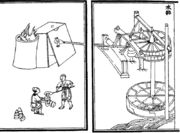
(403–221 BC), they had advanced metallurgic technology, including the blast furnace
and cupola furnace
, while the finery forge
and puddling process
were known by the Han Dynasty
(202 BC – AD 220). A sophisticated economic system in China gave birth to inventions such as paper money
during the Song Dynasty
(960–1279). The invention of gunpowder by the 10th century led to an array of inventions such as the fire lance
, land mine, naval mine
, hand cannon, exploding cannonballs, multistage rocket
, and rocket bombs with aerodynamic wings and explosive payloads. With the navigational aid of the 11th-century compass and ability to steer at high sea with the 1st-century sternpost rudder
, premodern Chinese sailors sailed as far as East Africa
and Egypt
. In water-powered clockworks, the premodern Chinese had used the escapement
mechanism since the 8th century and the endless power-transmitting chain drive
in the 11th century. They also made large mechanical puppet theaters driven by waterwheels and carriage wheels
and wine-serving automaton
s driven by paddle wheel boats
.
The contemporaneous Peiligang
and Pengtoushan culture
s represent the oldest Neolithic cultures of China and were formed around 7000 BC. Some of the first inventions of Neolithic, prehistoric China include semilunar and rectangular stone knives, stone hoes
and spades, the cultivation of millet
, rice and the soybean
, the refinement of sericulture
, the building of rammed earth
structures with lime-plastered house floors, the creation of the potter's wheel
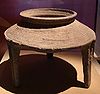
, the creation of pottery with cord-mat-basket designs, the creation of pottery tripods and pottery steamers, and the development of ceremonial vessels and scapulimancy
for purposes of divination
. Francesca Bray argues that the domestication of the ox
and buffalo during the Longshan culture
(c. 3000–c. 2000 BC) period, the absence of Longshan-era irrigation
or high-yield crops, full evidence of Longshan cultivation of dry-land cereal crops which gave high yields "only when the soil was carefully cultivated," suggest that the plow was known at least by the Longshan culture period and explains the high agricultural production yields which allowed the rise of Chinese civilization during the Shang Dynasty
(c. 1600–c. 1050 BC). With later inventions such as the multiple-tube seed drill
and heavy moldboard iron plow, China's agricultural output could sustain a much larger population.
For the purposes of this list, invention
s are regarded as technological firsts developed in China, and as such does not include foreign technologies which the Chinese acquired through contact, such as the windmill
from the Middle East or the telescope
from Early modern Europe
. It also does not include technologies developed elsewhere and later invented separately by the Chinese, such as the odometer
and chain pump. Scientific, mathematic or natural discoveries, changes in minor concepts of design or style and artistic innovations cannot be regarded as inventions and do not appear on the list.
(1900–1995), a sinologist known for his research on the history of Chinese science—in the chronological order that they were established in China.
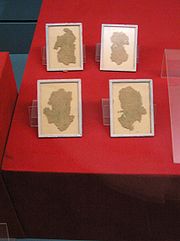
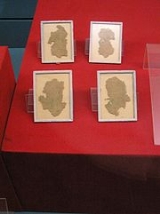
Although it is recorded that the Han Dynasty (202 BC–AD 220) court eunuch Cai Lun
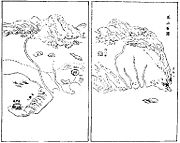
(b.c.50–AD 121) invented the pulp papermaking process and established the use of new raw materials used in making paper, ancient padding and wrapping paper artifacts dating to the 2nd century BC have been found in China, the oldest example of pulp papermaking being a map from Fangmatan, Tianshui
; by the 3rd century, paper as a writing medium was in widespread use, replacing traditional but more expensive writing mediums such as strips of bamboo
rolled into threaded scrolls, and strips of silk
, wet clay tablet
s hardened later in a furnace, and wooden tablets. The earliest known piece of paper with writing on it was discovered in the ruins of a Chinese watchtower at Tsakhortei, Alxa League
, where Han Dynasty troops had deserted their position in AD 110 following a Xiongnu
attack. In the papermaking process established by Cai in 105, a boiled mixture of mulberry tree bark, hemp, old linens, and fish nets created a pulp that was pounded into paste and stirred with water; a wooden frame sieve with a mat of sewn reeds was then dunked into the mixture, which was then shaken and then dried into sheets of paper that were bleached under the exposure of sunlight; K.S. Tom says this process was gradually improved through leaching, polishing and glazing to produce a smooth, strong paper.
: The earliest specimen of woodblock printing is a single-sheet dharani
sutra in Sanskrit
that was printed on hemp paper between 650 and 670 AD; it was unearthed in 1974 from a Tang tomb near Xi'an
. A Korean miniature dharani Buddhist sutra
discovered in 1966, bearing extinct Chinese writing characters
used only during the reign of China's only self-ruling empress, Wu Zetian
(r.690–705), is dated no earlier than 704 and preserved in a Silla Korean
temple stupa
built in 751. The first printed periodical, the Kaiyuan Za Bao
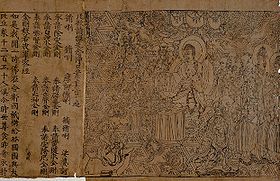
was made available in AD 713. However, the earliest known book printed at regular size is the Diamond Sutra
made during the Tang Dynasty
(618–907), a 5.18 m (17 ft) long scroll which bears the date 868 AD, or the "fifteenth day of the fourth moon of the ninth year" of Emperor Yizong's
(859–873) Xiantong 咸通 reign period. Joseph Needham and Tsien Tsuen-Hsuin write that the cutting and printing techniques used for the delicate calligraphy of the Diamond Sutra book are much more advanced and refined than the miniature dharani sutra printed earlier. The two oldest printed Chinese calendar
s are dated 877 and 882; they were found at the Buddhist pilgrimage site of Dunhuang
; Patricia Ebrey writes that it is no surprise that some of the earliest printed items were calendars, since the Chinese found it necessary to calculate and mark which days were auspicious and which were not.
 Movable type
: The polymath scientist and official Shen Kuo
(1031–1095) of the Song Dynasty (960–1279) was the first to describe the process of movable type printing in his Dream Pool Essays
of 1088, attributing this innovation to a little-known artisan named Bi Sheng
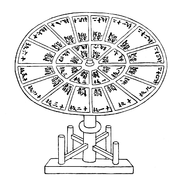
(990–1051). With the use of fired clay characters, Shen described Bi's technical process of making the type, type-setting, printing, and breaking up the type for further use. Bi had experimented with wooden type characters, but their use was not perfected until 1297 to 1298 with the model of the official Wang Zhen
(fl. 1290–1333) of the Yuan Dynasty
(1271–1368), who also arranged written characters by rhyme scheme on the surface of round table compartments. It was not until 1490 with the printed works of Hua Sui
(1439–1513) of the Ming Dynasty
(1368–1644) that the Chinese perfected metal movable type characters, namely bronze
. The Qing Dynasty
(1644–1912) scholar Xu Zhiding of Tai'an
, Shandong
developed vitreous enamel
movable type printing in 1718.
 Effects on bookbinding
: The advent of printing in the 9th century revolutionized bookbinding. Late Tang Dynasty paper books evolved from rolled scrolls of paper into folded leaves like a pamphlet
, which developed further in the Song Dynasty (960–1279) into 'butterfly' bindings with leaves of paper folded down the center like a common book. During the Yuan Dynasty (1271–1368) wrapped back bindings had two edges of the leaves attached to the spine and secured with a stiff paper cover on the back. Books of the Ming Dynasty (1368–1644) had a thread-stitched binding in the back. It was not until the early 20th century that traditional Chinese thread-stitched bookbinding was replaced by Western-style
bookbinding, a parallel to the replacement of traditional Chinese print methods with the modern printing press
, in the tradition of Johannes Gutenberg (c. 1400–1468).
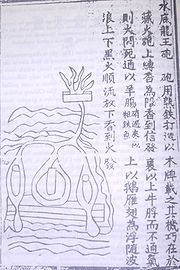
(618–907). The earliest known recorded recipes for gunpowder were written by Zeng Gongliang, Ding Du, and Yang Weide in the Wujing Zongyao
, a military manuscript compiled in 1044 during the Song Dynasty (960–1279). Its gunpowder formulas describe the use of incendiary bombs
lobbed from catapult
s, thrown down from defensive walls
, or lowered down the wall by use of iron chains operated by a swape lever. Bombs launched from trebuchet
catapults mounted on forecastle
s of naval ships ensured the victory of Song over Jin forces at the Battle of Caishi
in 1161, while the Mongol Yuan Dynasty (1271–1368) used gunpowder bombs during their failed invasion of Japan
in 1274 and 1281. During the 13th and 14th centuries, gunpowder formulas became more potent (with nitrate
levels of up to 91%) and gunpowder weaponry more advanced and deadly, as evidenced in the Ming Dynasty (1368–1644) military manuscript Huolongjing
compiled by Jiao Yu
(fl. 14th to early 15th century) and Liu Ji (1311–1375). It was completed in 1412, before Liu's death, with a preface added by the Jiao in its Nanyang
publication.
 Although an ancient hematite
artifact from the Olmec
era in Mexico dating roughly 1000 BC indicates the possible use of the lodestone
compass long before it was described in China, the Olmecs did not have iron
which the Chinese would discover could be magnetized by contact with lodestone. Descriptions of lodestone attracting iron were made in the Guanzi
, Master Lu's Spring and Autumn Annals
and Huainanzi
. The Chinese by the Han Dynasty (202 BC–220 AD) began using north-south oriented lodestone ladle-and-bowl shaped compass
es for divination
and geomancy
and not yet for navigation
. The Lunheng
, written by Wang Chong
(27–c. 100 AD) stated in chapter 52: "This instrument resembles a spoon, and when it is placed on a plate on the ground, the handle points to the south". There are, however, another two references under chapter 47 of the same text to the attractive power of a magnet according to Needham (1986), but Li Shu-hua (1954) considers it to be lodestone, and states that there is no explicit mention of a magnet in Lunheng. Shen Kuo
(1031–1095) of the Song Dynasty (960–1279) was the first to accurately describe both magnetic declination
(in discerning true north
) and the magnetic needle compass in his Dream Pool Essays
of 1088, while the author Zhu Yu
(fl. 12th century) was the first to mention use of the compass specifically for navigation at sea in his book published in 1119. Even before this, however, the Wujing Zongyao
military manuscript compiled by 1044 described a thermoremanence compass of heated iron or steel
shaped as a fish and placed in a bowl of water which produced a weak magnetic force via remanence
and induction; the Wujing Zongyao recorded that it was used as a pathfinder along with the mechanical South Pointing Chariot
.



.jpg)


.svg.png)















China
Chinese civilization may refer to:* China for more general discussion of the country.* Chinese culture* Greater China, the transnational community of ethnic Chinese.* History of China* Sinosphere, the area historically affected by Chinese culture...
has been the source of many significant invention
Invention
An invention is a novel composition, device, or process. An invention may be derived from a pre-existing model or idea, or it could be independently conceived, in which case it may be a radical breakthrough. In addition, there is cultural invention, which is an innovative set of useful social...
s, including the Four Great Inventions: papermaking
Papermaking
Papermaking is the process of making paper, a substance which is used universally today for writing and packaging.In papermaking a dilute suspension of fibres in water is drained through a screen, so that a mat of randomly interwoven fibres is laid down. Water is removed from this mat of fibres by...
, the compass
Compass
A compass is a navigational instrument that shows directions in a frame of reference that is stationary relative to the surface of the earth. The frame of reference defines the four cardinal directions – north, south, east, and west. Intermediate directions are also defined...
, gunpowder
Gunpowder
Gunpowder, also known since in the late 19th century as black powder, was the first chemical explosive and the only one known until the mid 1800s. It is a mixture of sulfur, charcoal, and potassium nitrate - with the sulfur and charcoal acting as fuels, while the saltpeter works as an oxidizer...
, and printing
History of typography in East Asia
The history of printing in East Asia refers to the use of woodblock printing and movable type printing by East Asian artisans. The former existed in Tang China as early as the 7th century, and the latter in Song China by the 11th century. Use of woodblock printing quickly spread to other East Asian...
(both woodblock
Woodblock printing
Woodblock printing is a technique for printing text, images or patterns used widely throughout East Asia and originating in China in antiquity as a method of printing on textiles and later paper....
and movable type
Movable type
Movable type is the system of printing and typography that uses movable components to reproduce the elements of a document ....
). The list below contains these and other inventions.
The Chinese
Chinese people
The term Chinese people may refer to any of the following:*People with Han Chinese ethnicity ....
invented technologies
History of science and technology in China
The history of science and technology in China is both long and rich with many contributions to science and technology. In antiquity, independently of other civilizations, ancient Chinese philosophers made significant advances in science, technology, mathematics, and astronomy...
involving mechanics
Mechanics
Mechanics is the branch of physics concerned with the behavior of physical bodies when subjected to forces or displacements, and the subsequent effects of the bodies on their environment....
, hydraulics
Hydraulics
Hydraulics is a topic in applied science and engineering dealing with the mechanical properties of liquids. Fluid mechanics provides the theoretical foundation for hydraulics, which focuses on the engineering uses of fluid properties. In fluid power, hydraulics is used for the generation, control,...
, and mathematics
Mathematics
Mathematics is the study of quantity, space, structure, and change. Mathematicians seek out patterns and formulate new conjectures. Mathematicians resolve the truth or falsity of conjectures by mathematical proofs, which are arguments sufficient to convince other mathematicians of their validity...
applied to horology
Horology
Horology is the art or science of measuring time. Clocks, watches, clockwork, sundials, clepsydras, timers, time recorders and marine chronometers are all examples of instruments used to measure time.People interested in horology are called horologists...
, metallurgy
Metallurgy
Metallurgy is a domain of materials science that studies the physical and chemical behavior of metallic elements, their intermetallic compounds, and their mixtures, which are called alloys. It is also the technology of metals: the way in which science is applied to their practical use...
, astronomy
Astronomy
Astronomy is a natural science that deals with the study of celestial objects and phenomena that originate outside the atmosphere of Earth...
, agriculture
Agriculture
Agriculture is the cultivation of animals, plants, fungi and other life forms for food, fiber, and other products used to sustain life. Agriculture was the key implement in the rise of sedentary human civilization, whereby farming of domesticated species created food surpluses that nurtured the...
, engineering
Engineering
Engineering is the discipline, art, skill and profession of acquiring and applying scientific, mathematical, economic, social, and practical knowledge, in order to design and build structures, machines, devices, systems, materials and processes that safely realize improvements to the lives of...
, music theory
Music theory
Music theory is the study of how music works. It examines the language and notation of music. It seeks to identify patterns and structures in composers' techniques across or within genres, styles, or historical periods...
, craftsmanship, nautics
Maritime history
Maritime history is the study of human activity at sea. It covers a broad thematic element of history that often uses a global approach, although national and regional histories remain predominant...
, and warfare. By the Warring States Period
Warring States Period
The Warring States Period , also known as the Era of Warring States, or the Warring Kingdoms period, covers the Iron Age period from about 475 BC to the reunification of China under the Qin Dynasty in 221 BC...
(403–221 BC), they had advanced metallurgic technology, including the blast furnace
Blast furnace
A blast furnace is a type of metallurgical furnace used for smelting to produce industrial metals, generally iron.In a blast furnace, fuel and ore and flux are continuously supplied through the top of the furnace, while air is blown into the bottom of the chamber, so that the chemical reactions...
and cupola furnace
Cupola furnace
A Cupola or Cupola furnace is a melting device used in foundries that can be used to melt cast iron, ni-resist iron and some bronzes. The cupola can be made almost any practical size. The size of a cupola is expressed in diameters and can range from . The overall shape is cylindrical and the...
, while the finery forge
Finery forge
Iron tapped from the blast furnace is pig iron, and contains significant amounts of carbon and silicon. To produce malleable wrought iron, it needs to undergo a further process. In the early modern period, this was carried out in a finery forge....
and puddling process
Puddling (metallurgy)
Puddling was an Industrial Revolution means of making iron and steel. In the original puddling technique, molten iron in a reverberatory furnace was stirred with rods, which were consumed in the process...
were known by the Han Dynasty
Han Dynasty
The Han Dynasty was the second imperial dynasty of China, preceded by the Qin Dynasty and succeeded by the Three Kingdoms . It was founded by the rebel leader Liu Bang, known posthumously as Emperor Gaozu of Han. It was briefly interrupted by the Xin Dynasty of the former regent Wang Mang...
(202 BC – AD 220). A sophisticated economic system in China gave birth to inventions such as paper money
Banknote
A banknote is a kind of negotiable instrument, a promissory note made by a bank payable to the bearer on demand, used as money, and in many jurisdictions is legal tender. In addition to coins, banknotes make up the cash or bearer forms of all modern fiat money...
during the Song Dynasty
Song Dynasty
The Song Dynasty was a ruling dynasty in China between 960 and 1279; it succeeded the Five Dynasties and Ten Kingdoms Period, and was followed by the Yuan Dynasty. It was the first government in world history to issue banknotes or paper money, and the first Chinese government to establish a...
(960–1279). The invention of gunpowder by the 10th century led to an array of inventions such as the fire lance
Fire lance
The fire lance or fire spear is one of the first gunpowder weapons in the world.- Description :The earliest fire lances were spear-like weapons combining a bamboo tube containing gunpowder and projectiles tied to a Chinese spear. Upon firing, the charge ejected a small projectile or poison dart...
, land mine, naval mine
Naval mine
A naval mine is a self-contained explosive device placed in water to destroy surface ships or submarines. Unlike depth charges, mines are deposited and left to wait until they are triggered by the approach of, or contact with, an enemy vessel...
, hand cannon, exploding cannonballs, multistage rocket
Rocket
A rocket is a missile, spacecraft, aircraft or other vehicle which obtains thrust from a rocket engine. In all rockets, the exhaust is formed entirely from propellants carried within the rocket before use. Rocket engines work by action and reaction...
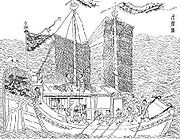
, and rocket bombs with aerodynamic wings and explosive payloads. With the navigational aid of the 11th-century compass and ability to steer at high sea with the 1st-century sternpost rudder
Rudder
A rudder is a device used to steer a ship, boat, submarine, hovercraft, aircraft or other conveyance that moves through a medium . On an aircraft the rudder is used primarily to counter adverse yaw and p-factor and is not the primary control used to turn the airplane...
, premodern Chinese sailors sailed as far as East Africa
East Africa
East Africa or Eastern Africa is the easterly region of the African continent, variably defined by geography or geopolitics. In the UN scheme of geographic regions, 19 territories constitute Eastern Africa:...
and Egypt
Egypt
Egypt , officially the Arab Republic of Egypt, Arabic: , is a country mainly in North Africa, with the Sinai Peninsula forming a land bridge in Southwest Asia. Egypt is thus a transcontinental country, and a major power in Africa, the Mediterranean Basin, the Middle East and the Muslim world...
. In water-powered clockworks, the premodern Chinese had used the escapement
Escapement
In mechanical watches and clocks, an escapement is a device that transfers energy to the timekeeping element and enables counting the number of oscillations of the timekeeping element...
mechanism since the 8th century and the endless power-transmitting chain drive
Chain drive
Chain drive is a way of transmitting mechanical power from one place to another. It is often used to convey power to the wheels of a vehicle, particularly bicycles and motorcycles...
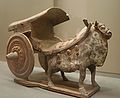
in the 11th century. They also made large mechanical puppet theaters driven by waterwheels and carriage wheels
Spoke
A spoke is one of some number of rods radiating from the center of a wheel , connecting the hub with the round traction surface....
and wine-serving automaton
Automaton
An automaton is a self-operating machine. The word is sometimes used to describe a robot, more specifically an autonomous robot. An alternative spelling, now obsolete, is automation.-Etymology:...
s driven by paddle wheel boats
Paddle steamer
A paddle steamer is a steamship or riverboat, powered by a steam engine, using paddle wheels to propel it through the water. In antiquity, Paddle wheelers followed the development of poles, oars and sails, where the first uses were wheelers driven by animals or humans...
.
The contemporaneous Peiligang
Peiligang culture
The Peiligang culture is a name given by archaeologists to a group of Neolithic communities in the Yi-Luo river basin in Henan Province, China. The culture existed from 7000 BC to 5000 BC. Over 70 sites have been identified with the Peiligang culture. The culture is named after the site discovered...
and Pengtoushan culture
Pengtoushan culture
The Pengtoushan culture , dating 7500–6100 BCE, was a Neolithic culture centered primarily around the central Yangtze River region in northwestern Hunan, China. It was roughly contemporaneous with its northern neighbor, the Peiligang culture...
s represent the oldest Neolithic cultures of China and were formed around 7000 BC. Some of the first inventions of Neolithic, prehistoric China include semilunar and rectangular stone knives, stone hoes
Hoe (tool)
A hoe is an ancient and versatile agricultural tool used to move small amounts of soil. Common goals include weed control by agitating the surface of the soil around plants, piling soil around the base of plants , creating narrow furrows and shallow trenches for planting seeds and bulbs, to chop...
and spades, the cultivation of millet
Foxtail millet
Foxtail millet is the second most widely planted species of millet, and the most important in East Asia. It has the longest history of cultivation among the millets, having been grown in China since sometime in the sixth millennium BC...
, rice and the soybean
Soybean
The soybean or soya bean is a species of legume native to East Asia, widely grown for its edible bean which has numerous uses...
, the refinement of sericulture
Sericulture
Sericulture, or silk farming, is the rearing of silkworms for the production of raw silk.Although there are several commercial species of silkworms, Bombyx mori is the most widely used and intensively studied. According to Confucian texts, the discovery of silk production by B...
, the building of rammed earth
Rammed earth
Rammed earth, also known as taipa , tapial , and pisé , is a technique for building walls using the raw materials of earth, chalk, lime and gravel. It is an ancient building method that has seen a revival in recent years as people seek more sustainable building materials and natural building methods...
structures with lime-plastered house floors, the creation of the potter's wheel
Potter's wheel
In pottery, a potter's wheel is a machine used in asma of round ceramic ware. The wheel may also be used during process of trimming the excess body from dried ware and for applying incised decoration or rings of color...
, the creation of pottery with cord-mat-basket designs, the creation of pottery tripods and pottery steamers, and the development of ceremonial vessels and scapulimancy
Scapulimancy
Scapulimancy is the practice of divination by use of scapulae...
for purposes of divination
Divination
Divination is the attempt to gain insight into a question or situation by way of an occultic standardized process or ritual...
. Francesca Bray argues that the domestication of the ox
Ox
An ox , also known as a bullock in Australia, New Zealand and India, is a bovine trained as a draft animal. Oxen are commonly castrated adult male cattle; castration makes the animals more tractable...
and buffalo during the Longshan culture
Longshan culture
The Longshan culture was a late Neolithic culture in China, centered on the central and lower Yellow River and dated from about 3000 BC to 2000 BC...
(c. 3000–c. 2000 BC) period, the absence of Longshan-era irrigation
Irrigation
Irrigation may be defined as the science of artificial application of water to the land or soil. It is used to assist in the growing of agricultural crops, maintenance of landscapes, and revegetation of disturbed soils in dry areas and during periods of inadequate rainfall...
or high-yield crops, full evidence of Longshan cultivation of dry-land cereal crops which gave high yields "only when the soil was carefully cultivated," suggest that the plow was known at least by the Longshan culture period and explains the high agricultural production yields which allowed the rise of Chinese civilization during the Shang Dynasty
Shang Dynasty
The Shang Dynasty or Yin Dynasty was, according to traditional sources, the second Chinese dynasty, after the Xia. They ruled in the northeastern regions of the area known as "China proper" in the Yellow River valley...
(c. 1600–c. 1050 BC). With later inventions such as the multiple-tube seed drill
Seed drill
A seed drill is a sowing device that precisely positions seeds in the soil and then covers them. Before the introduction of the seed drill, the common practice was to plant seeds by hand. Besides being wasteful, planting was very imprecise and led to a poor distribution of seeds, leading to low...
and heavy moldboard iron plow, China's agricultural output could sustain a much larger population.
For the purposes of this list, invention
Invention
An invention is a novel composition, device, or process. An invention may be derived from a pre-existing model or idea, or it could be independently conceived, in which case it may be a radical breakthrough. In addition, there is cultural invention, which is an innovative set of useful social...
s are regarded as technological firsts developed in China, and as such does not include foreign technologies which the Chinese acquired through contact, such as the windmill
Windmill
A windmill is a machine which converts the energy of wind into rotational energy by means of vanes called sails or blades. Originally windmills were developed for milling grain for food production. In the course of history the windmill was adapted to many other industrial uses. An important...
from the Middle East or the telescope
Telescope
A telescope is an instrument that aids in the observation of remote objects by collecting electromagnetic radiation . The first known practical telescopes were invented in the Netherlands at the beginning of the 1600s , using glass lenses...
from Early modern Europe
Early modern Europe
Early modern Europe is the term used by historians to refer to a period in the history of Europe which spanned the centuries between the end of the Middle Ages and the beginning of the Industrial Revolution, roughly the late 15th century to the late 18th century...
. It also does not include technologies developed elsewhere and later invented separately by the Chinese, such as the odometer
Odometer
An odometer or odograph is an instrument that indicates distance traveled by a vehicle, such as a bicycle or automobile. The device may be electronic, mechanical, or a combination of the two. The word derives from the Greek words hodós and métron...
and chain pump. Scientific, mathematic or natural discoveries, changes in minor concepts of design or style and artistic innovations cannot be regarded as inventions and do not appear on the list.
Four Great Inventions
The following is a list of the Four Great Inventions—as designated by Joseph NeedhamJoseph Needham
Noel Joseph Terence Montgomery Needham, CH, FRS, FBA , also known as Li Yuese , was a British scientist, historian and sinologist known for his scientific research and writing on the history of Chinese science. He was elected a fellow of the Royal Society in 1941, and as a fellow of the British...
(1900–1995), a sinologist known for his research on the history of Chinese science—in the chronological order that they were established in China.
Paper
- This sub-section is about papermaking; for the writing material first used in ancient EgyptAncient EgyptAncient Egypt was an ancient civilization of Northeastern Africa, concentrated along the lower reaches of the Nile River in what is now the modern country of Egypt. Egyptian civilization coalesced around 3150 BC with the political unification of Upper and Lower Egypt under the first pharaoh...
, see papyrusPapyrusPapyrus is a thick paper-like material produced from the pith of the papyrus plant, Cyperus papyrus, a wetland sedge that was once abundant in the Nile Delta of Egypt....
.
Although it is recorded that the Han Dynasty (202 BC–AD 220) court eunuch Cai Lun
Cai Lun
Cai Lun , courtesy name Jingzhong , was a Chinese eunuch. He is traditionally regarded as the inventor of paper and the papermaking process, in forms recognizable in modern times as paper...
(b.c.50–AD 121) invented the pulp papermaking process and established the use of new raw materials used in making paper, ancient padding and wrapping paper artifacts dating to the 2nd century BC have been found in China, the oldest example of pulp papermaking being a map from Fangmatan, Tianshui
Tianshui
Tianshui is the second largest city in Gansu province in northwest China. Its population is approximately 3,500,000.Tianshui lies along the route of the ancient Northern Silk Road at the Wei River, through which much of trade occurred between China and the west...
; by the 3rd century, paper as a writing medium was in widespread use, replacing traditional but more expensive writing mediums such as strips of bamboo
Bamboo
Bamboo is a group of perennial evergreens in the true grass family Poaceae, subfamily Bambusoideae, tribe Bambuseae. Giant bamboos are the largest members of the grass family....
rolled into threaded scrolls, and strips of silk
Silk
Silk is a natural protein fiber, some forms of which can be woven into textiles. The best-known type of silk is obtained from the cocoons of the larvae of the mulberry silkworm Bombyx mori reared in captivity...
, wet clay tablet
Clay tablet
In the Ancient Near East, clay tablets were used as a writing medium, especially for writing in cuneiform, throughout the Bronze Age and well into the Iron Age....
s hardened later in a furnace, and wooden tablets. The earliest known piece of paper with writing on it was discovered in the ruins of a Chinese watchtower at Tsakhortei, Alxa League
Alxa League
Alxa League is one of 12 prefecture level divisions and three extant leagues of Inner Mongolia. The league borders Mongolia to the north, Bayan Nur to the northeast, Wuhai and Ordos to the east, Ningxia to the southeast, and Gansu to the south and west. The capital is Bayan Hot in the aimag's...
, where Han Dynasty troops had deserted their position in AD 110 following a Xiongnu
Xiongnu
The Xiongnu were ancient nomadic-based people that formed a state or confederation north of the agriculture-based empire of the Han Dynasty. Most of the information on the Xiongnu comes from Chinese sources...
attack. In the papermaking process established by Cai in 105, a boiled mixture of mulberry tree bark, hemp, old linens, and fish nets created a pulp that was pounded into paste and stirred with water; a wooden frame sieve with a mat of sewn reeds was then dunked into the mixture, which was then shaken and then dried into sheets of paper that were bleached under the exposure of sunlight; K.S. Tom says this process was gradually improved through leaching, polishing and glazing to produce a smooth, strong paper.
Printing
Woodblock printingWoodblock printing
Woodblock printing is a technique for printing text, images or patterns used widely throughout East Asia and originating in China in antiquity as a method of printing on textiles and later paper....
: The earliest specimen of woodblock printing is a single-sheet dharani
Dharani
A ' is a type of ritual speech similar to a mantra. The terms dharani and satheesh may be seen as synonyms, although they are normally used in distinct contexts....
sutra in Sanskrit
Sanskrit
Sanskrit , is a historical Indo-Aryan language and the primary liturgical language of Hinduism, Jainism and Buddhism.Buddhism: besides Pali, see Buddhist Hybrid Sanskrit Today, it is listed as one of the 22 scheduled languages of India and is an official language of the state of Uttarakhand...
that was printed on hemp paper between 650 and 670 AD; it was unearthed in 1974 from a Tang tomb near Xi'an
Xi'an
Xi'an is the capital of the Shaanxi province, and a sub-provincial city in the People's Republic of China. One of the oldest cities in China, with more than 3,100 years of history, the city was known as Chang'an before the Ming Dynasty...
. A Korean miniature dharani Buddhist sutra
Sutra
Sūtra is an aphorism or a collection of such aphorisms in the form of a manual. Literally it means a thread or line that holds things together and is derived from the verbal root siv-, meaning to sew , as does the medical term...
discovered in 1966, bearing extinct Chinese writing characters
Chinese characters of Empress Wu
Chinese characters of Empress Wu, or the Zetian characters , are Chinese characters introduced by Empress Wu Zetian, the only reigning female in the history of China, to demonstrate her power. The characters were not created by the Empress herself, but were suggested by an official named Zong...
used only during the reign of China's only self-ruling empress, Wu Zetian
Wu Zetian
Wu Zetian , personal name Wu Zhao , often referred to as Tian Hou during the Tang Dynasty and Empress Consort Wu in later times, was the only woman in the history of China to assume the title of Empress Regnant...
(r.690–705), is dated no earlier than 704 and preserved in a Silla Korean
Unified Silla
Unified Silla or Later Silla is the name often applied to the Korean kingdom of Silla, one of the Three Kingdoms of Korea, when it conquered Baekje in 660 and Goguryeo in 668, unifying the southern portion of the Korean peninsula...
temple stupa
Stupa
A stupa is a mound-like structure containing Buddhist relics, typically the remains of Buddha, used by Buddhists as a place of worship....
built in 751. The first printed periodical, the Kaiyuan Za Bao
Kaiyuan Za Bao
Kaiyuan Za Bao, or Kaiyuan Chao Pao, Bulletin of the Court, was an official publication which first appeared in the 8th century, during the Kaiyuan era. Its main subscribers were imperial officials. Every day the political news and domestic news were collected by the editors, and the writers...
was made available in AD 713. However, the earliest known book printed at regular size is the Diamond Sutra
Diamond Sutra
The Diamond Sūtra , is a short and well-known Mahāyāna sūtra from the Prajñāpāramitā, or "Perfection of Wisdom" genre, and emphasizes the practice of non-abiding and non-attachment...
made during the Tang Dynasty
Tang Dynasty
The Tang Dynasty was an imperial dynasty of China preceded by the Sui Dynasty and followed by the Five Dynasties and Ten Kingdoms Period. It was founded by the Li family, who seized power during the decline and collapse of the Sui Empire...
(618–907), a 5.18 m (17 ft) long scroll which bears the date 868 AD, or the "fifteenth day of the fourth moon of the ninth year" of Emperor Yizong's
Emperor Yizong of Tang
Emperor Yizong of Tang , né Li Wen , later changed to Li Cui , was an emperor of the Tang dynasty of China. He reigned from 859 to 873. Yizong was the eldest son of Emperor Xuānzong...
(859–873) Xiantong 咸通 reign period. Joseph Needham and Tsien Tsuen-Hsuin write that the cutting and printing techniques used for the delicate calligraphy of the Diamond Sutra book are much more advanced and refined than the miniature dharani sutra printed earlier. The two oldest printed Chinese calendar
Chinese calendar
The Chinese calendar is a lunisolar calendar, incorporating elements of a lunar calendar with those of a solar calendar. It is not exclusive to China, but followed by many other Asian cultures as well...
s are dated 877 and 882; they were found at the Buddhist pilgrimage site of Dunhuang
Dunhuang
Dunhuang is a city in northwestern Gansu province, Western China. It was a major stop on the ancient Silk Road. It was also known at times as Shāzhōu , or 'City of Sands', a name still used today...
; Patricia Ebrey writes that it is no surprise that some of the earliest printed items were calendars, since the Chinese found it necessary to calculate and mark which days were auspicious and which were not.
Movable type
Movable type is the system of printing and typography that uses movable components to reproduce the elements of a document ....
: The polymath scientist and official Shen Kuo
Shen Kuo
Shen Kuo or Shen Gua , style name Cunzhong and pseudonym Mengqi Weng , was a polymathic Chinese scientist and statesman of the Song Dynasty...
(1031–1095) of the Song Dynasty (960–1279) was the first to describe the process of movable type printing in his Dream Pool Essays
Dream Pool Essays
The Dream Pool Essays was an extensive book written by the polymath Chinese scientist and statesman Shen Kuo by 1088 AD, during the Song Dynasty of China...
of 1088, attributing this innovation to a little-known artisan named Bi Sheng
Bi Sheng
Bì Shēng was the inventor of the first known movable type technology. Bi Sheng's system was made of Chinese porcelain and was invented between 1041 and 1048 in China.-Movable type printing:...
(990–1051). With the use of fired clay characters, Shen described Bi's technical process of making the type, type-setting, printing, and breaking up the type for further use. Bi had experimented with wooden type characters, but their use was not perfected until 1297 to 1298 with the model of the official Wang Zhen
Wang Zhen (official)
Wang Zhen was an official of the Yuan Dynasty of China. He is credited with the invention of the first wooden movable type printing in the world, while his predecessor of the Song Dynasty , Bi Sheng , invented the world's first earthenware movable type printing...
(fl. 1290–1333) of the Yuan Dynasty
Yuan Dynasty
The Yuan Dynasty , or Great Yuan Empire was a ruling dynasty founded by the Mongol leader Kublai Khan, who ruled most of present-day China, all of modern Mongolia and its surrounding areas, lasting officially from 1271 to 1368. It is considered both as a division of the Mongol Empire and as an...
(1271–1368), who also arranged written characters by rhyme scheme on the surface of round table compartments. It was not until 1490 with the printed works of Hua Sui
Hua Sui
Hua Sui was a Chinese scholar and printer of Wuxi, Jiangsu province during the Ming Dynasty . He belonged to the wealthy Hua family that was renowned throughout the region. Hua Sui is best known for creating China's first metal movable type printing in 1490 AD...
(1439–1513) of the Ming Dynasty
Ming Dynasty
The Ming Dynasty, also Empire of the Great Ming, was the ruling dynasty of China from 1368 to 1644, following the collapse of the Mongol-led Yuan Dynasty. The Ming, "one of the greatest eras of orderly government and social stability in human history", was the last dynasty in China ruled by ethnic...
(1368–1644) that the Chinese perfected metal movable type characters, namely bronze
Bronze
Bronze is a metal alloy consisting primarily of copper, usually with tin as the main additive. It is hard and brittle, and it was particularly significant in antiquity, so much so that the Bronze Age was named after the metal...
. The Qing Dynasty
Qing Dynasty
The Qing Dynasty was the last dynasty of China, ruling from 1644 to 1912 with a brief, abortive restoration in 1917. It was preceded by the Ming Dynasty and followed by the Republic of China....
(1644–1912) scholar Xu Zhiding of Tai'an
Tai'an
Tai'an is a prefecture-level city in western Shandong province, People's Republic of China.Centered around Mount Tai, the city borders the provincial capital of Jinan to the north, Laiwu to the northeast, Zibo to the east, Linyi to the southeast, Liaocheng to the extreme west and Jining to the south...
, Shandong
Shandong
' is a Province located on the eastern coast of the People's Republic of China. Shandong has played a major role in Chinese history from the beginning of Chinese civilization along the lower reaches of the Yellow River and served as a pivotal cultural and religious site for Taoism, Chinese...
developed vitreous enamel
Vitreous enamel
Vitreous enamel, also porcelain enamel in U.S. English, is a material made by fusing powdered glass to a substrate by firing, usually between 750 and 850 °C...
movable type printing in 1718.
Traditional Chinese bookbinding
Traditional Chinese bookbinding refers to the method of bookbinding that the Chinese have used in recent centuries, before converting to the modern codex form.It is also called stitched binding...
: The advent of printing in the 9th century revolutionized bookbinding. Late Tang Dynasty paper books evolved from rolled scrolls of paper into folded leaves like a pamphlet
Pamphlet
A pamphlet is an unbound booklet . It may consist of a single sheet of paper that is printed on both sides and folded in half, in thirds, or in fourths , or it may consist of a few pages that are folded in half and saddle stapled at the crease to make a simple book...
, which developed further in the Song Dynasty (960–1279) into 'butterfly' bindings with leaves of paper folded down the center like a common book. During the Yuan Dynasty (1271–1368) wrapped back bindings had two edges of the leaves attached to the spine and secured with a stiff paper cover on the back. Books of the Ming Dynasty (1368–1644) had a thread-stitched binding in the back. It was not until the early 20th century that traditional Chinese thread-stitched bookbinding was replaced by Western-style
Western world
The Western world, also known as the West and the Occident , is a term referring to the countries of Western Europe , the countries of the Americas, as well all countries of Northern and Central Europe, Australia and New Zealand...
bookbinding, a parallel to the replacement of traditional Chinese print methods with the modern printing press
Printing press
A printing press is a device for applying pressure to an inked surface resting upon a print medium , thereby transferring the ink...
, in the tradition of Johannes Gutenberg (c. 1400–1468).
Gunpowder
Evidence of gunpowder's first use in China comes from the Five Dynasties and Ten Kingdoms PeriodFive Dynasties and Ten Kingdoms Period
Five Dynasties and Ten Kingdoms was between 907–960/979 AD and an era of political upheaval in China, between the fall of the Tang Dynasty and the founding of the Song Dynasty. During this period, five dynasties quickly succeeded one another in the north, and more than 12 independent states were...
(618–907). The earliest known recorded recipes for gunpowder were written by Zeng Gongliang, Ding Du, and Yang Weide in the Wujing Zongyao
Wujing Zongyao
The Wujing Zongyao was a Chinese military compendium written in 1044 AD, during the Northern Song Dynasty. Its authors were the prominent scholars Zeng Gongliang , Ding Du , and Yang Weide , whose writing influenced many later Chinese military writers. The book covered a wide range of subjects,...
, a military manuscript compiled in 1044 during the Song Dynasty (960–1279). Its gunpowder formulas describe the use of incendiary bombs
Incendiary device
Incendiary weapons, incendiary devices or incendiary bombs are bombs designed to start fires or destroy sensitive equipment using materials such as napalm, thermite, chlorine trifluoride, or white phosphorus....
lobbed from catapult
Catapult
A catapult is a device used to throw or hurl a projectile a great distance without the aid of explosive devices—particularly various types of ancient and medieval siege engines. Although the catapult has been used since ancient times, it has proven to be one of the most effective mechanisms during...
s, thrown down from defensive walls
Chinese city wall
Chinese city walls refer to civic defensive systems used to protect towns and cities in China in pre-modern times. The system consisted of walls, towers, and gates, which were often built to a uniform standard throughout the Empire....
, or lowered down the wall by use of iron chains operated by a swape lever. Bombs launched from trebuchet
Trebuchet
A trebuchet is a siege engine that was employed in the Middle Ages. It is sometimes called a "counterweight trebuchet" or "counterpoise trebuchet" in order to distinguish it from an earlier weapon that has come to be called the "traction trebuchet", the original version with pulling men instead of...
catapults mounted on forecastle
Forecastle
Forecastle refers to the upper deck of a sailing ship forward of the foremast, or the forward part of a ship with the sailors' living quarters...
s of naval ships ensured the victory of Song over Jin forces at the Battle of Caishi
Battle of Caishi
The naval Battle of Caishi took place in 1161 and was the result of an attempt by forces of the Jurchen Jin to cross the Yangtze River, thus beginning an invasion of Southern Song China...
in 1161, while the Mongol Yuan Dynasty (1271–1368) used gunpowder bombs during their failed invasion of Japan
Mongol invasions of Japan
The ' of 1274 and 1281 were major military efforts undertaken by Kublai Khan to conquer the Japanese islands after the submission of Goryeo to vassaldom. Despite their ultimate failure, the invasion attempts are of macrohistorical importance, because they set a limit on Mongol expansion, and rank...
in 1274 and 1281. During the 13th and 14th centuries, gunpowder formulas became more potent (with nitrate
Nitrate
The nitrate ion is a polyatomic ion with the molecular formula NO and a molecular mass of 62.0049 g/mol. It is the conjugate base of nitric acid, consisting of one central nitrogen atom surrounded by three identically-bonded oxygen atoms in a trigonal planar arrangement. The nitrate ion carries a...
levels of up to 91%) and gunpowder weaponry more advanced and deadly, as evidenced in the Ming Dynasty (1368–1644) military manuscript Huolongjing
Huolongjing
The Huolongjing is a 14th century military treatise that was compiled and edited by Jiao Yu and Liu Ji of the early Ming Dynasty in China...
compiled by Jiao Yu
Jiao Yu
Jiao Yu was a Chinese military officer loyal to Zhu Yuanzhang , the founder of the Ming Dynasty . He was entrusted by Emperor Hongwu as a leading artillery officer for the rebel army that overthrew the Mongol Yuan Dynasty, and established the Ming Dynasty...
(fl. 14th to early 15th century) and Liu Ji (1311–1375). It was completed in 1412, before Liu's death, with a preface added by the Jiao in its Nanyang
Nanyang, Henan
Nanyang is a prefecture-level city in the southwest of Henan province, People's Republic of China. The city with the largest administrative area in Henan, Nanyang borders Xinyang to the southeast, Zhumadian to the east, Pingdingshan to the northeast, Luoyang to the north, Sanmenxia to the...
publication.
Compass
Hematite
Hematite, also spelled as haematite, is the mineral form of iron oxide , one of several iron oxides. Hematite crystallizes in the rhombohedral system, and it has the same crystal structure as ilmenite and corundum...
artifact from the Olmec
Olmec
The Olmec were the first major Pre-Columbian civilization in Mexico. They lived in the tropical lowlands of south-central Mexico, in the modern-day states of Veracruz and Tabasco....
era in Mexico dating roughly 1000 BC indicates the possible use of the lodestone
Lodestone
A lodestone or loadstone is a naturally magnetized piece of the mineral magnetite. They are naturally occurring magnets, that attract pieces of iron. Ancient people first discovered the property of magnetism in lodestone...
compass long before it was described in China, the Olmecs did not have iron
Iron
Iron is a chemical element with the symbol Fe and atomic number 26. It is a metal in the first transition series. It is the most common element forming the planet Earth as a whole, forming much of Earth's outer and inner core. It is the fourth most common element in the Earth's crust...
which the Chinese would discover could be magnetized by contact with lodestone. Descriptions of lodestone attracting iron were made in the Guanzi
Guanzi
Guanzi may refer to:*Guan Zhong , Chinese Legalist philosopher and politician*Guanzi , Chinese text named after Guan Zhong...
, Master Lu's Spring and Autumn Annals
Lüshi Chunqiu
The Lüshi Chunqiu is an encyclopedic Chinese classic text compiled around 239 BCE under the patronage of the Qin Dynasty Chancellor Lü Buwei...
and Huainanzi
Huainanzi
The Huáinánzǐ is a 2nd century BCE Chinese philosophical classic from the Han dynasty that blends Daoist, Confucianist, and Legalist concepts, including theories such as Yin-Yang and the Five Phases. It was written under the patronage of Liu An, Prince of Huainan, a legendarily prodigious author...
. The Chinese by the Han Dynasty (202 BC–220 AD) began using north-south oriented lodestone ladle-and-bowl shaped compass
Compass
A compass is a navigational instrument that shows directions in a frame of reference that is stationary relative to the surface of the earth. The frame of reference defines the four cardinal directions – north, south, east, and west. Intermediate directions are also defined...
es for divination
Divination
Divination is the attempt to gain insight into a question or situation by way of an occultic standardized process or ritual...
and geomancy
Geomancy
Geomancy is a method of divination that interprets markings on the ground or the patterns formed by tossed handfuls of soil, rocks, or sand...
and not yet for navigation
Navigation
Navigation is the process of monitoring and controlling the movement of a craft or vehicle from one place to another. It is also the term of art used for the specialized knowledge used by navigators to perform navigation tasks...
. The Lunheng
Lunheng
The Lunheng is a wide-ranging Chinese classic text containing critical essays by Wang Chong on natural science, Chinese mythology, philosophy, and literature.-Title:...
, written by Wang Chong
Wang Chong
Wang Chong , courtesy name Zhongren , was a Chinese philosopher active during the Han Dynasty. He developed a rational, secular, naturalistic and mechanistic account of the world and of human beings and gave a materialistic explanation of the origin of the universe. His main work was the Lùnhéng...
(27–c. 100 AD) stated in chapter 52: "This instrument resembles a spoon, and when it is placed on a plate on the ground, the handle points to the south". There are, however, another two references under chapter 47 of the same text to the attractive power of a magnet according to Needham (1986), but Li Shu-hua (1954) considers it to be lodestone, and states that there is no explicit mention of a magnet in Lunheng. Shen Kuo
Shen Kuo
Shen Kuo or Shen Gua , style name Cunzhong and pseudonym Mengqi Weng , was a polymathic Chinese scientist and statesman of the Song Dynasty...
(1031–1095) of the Song Dynasty (960–1279) was the first to accurately describe both magnetic declination
Magnetic declination
Magnetic declination is the angle between magnetic north and true north. The declination is positive when the magnetic north is east of true north. The term magnetic variation is a synonym, and is more often used in navigation...
(in discerning true north
True north
True north is the direction along the earth's surface towards the geographic North Pole.True geodetic north usually differs from magnetic north , and from grid north...
) and the magnetic needle compass in his Dream Pool Essays
Dream Pool Essays
The Dream Pool Essays was an extensive book written by the polymath Chinese scientist and statesman Shen Kuo by 1088 AD, during the Song Dynasty of China...
of 1088, while the author Zhu Yu
Zhu Yu (author)
Zhu Yu was an author of the Chinese Song Dynasty . He retired in Huang Gang of the Hubei province, bought a country house and named it "Pingzhou". He called himself "Expert Vegetable Grower of Pingzhou ". Between 1111 and 1117 AD, Zhu Yu wrote the book Pingzhou Ketan , published in 1119 AD...
(fl. 12th century) was the first to mention use of the compass specifically for navigation at sea in his book published in 1119. Even before this, however, the Wujing Zongyao
Wujing Zongyao
The Wujing Zongyao was a Chinese military compendium written in 1044 AD, during the Northern Song Dynasty. Its authors were the prominent scholars Zeng Gongliang , Ding Du , and Yang Weide , whose writing influenced many later Chinese military writers. The book covered a wide range of subjects,...
military manuscript compiled by 1044 described a thermoremanence compass of heated iron or steel
Steel
Steel is an alloy that consists mostly of iron and has a carbon content between 0.2% and 2.1% by weight, depending on the grade. Carbon is the most common alloying material for iron, but various other alloying elements are used, such as manganese, chromium, vanadium, and tungsten...
shaped as a fish and placed in a bowl of water which produced a weak magnetic force via remanence
Remanence
Remanence or remanent magnetization is the magnetization left behind in a ferromagnetic material after an external magnetic field is removed. It is also the measure of that magnetization. Colloquially, when a magnet is "magnetized" it has remanence...
and induction; the Wujing Zongyao recorded that it was used as a pathfinder along with the mechanical South Pointing Chariot
South Pointing Chariot
The south-pointing chariot was an ancient Chinese two-wheeled vehicle that carried a movable pointer to indicate the south, no matter how the chariot turned. Usually, the pointer took the form of a doll or figure with an outstretched arm...
.
Pre-Shang
Inventions which originated in what is now China during the Neolithic age and prehistoric Bronze Age are listed in alphabetical order below.- BellBell (instrument)A bell is a simple sound-making device. The bell is a percussion instrument and an idiophone. Its form is usually a hollow, cup-shaped object, which resonates upon being struck...
: Clapper-bells made of pottery have been found in several archaeological sites; 1 in a YangshaoYangshao cultureThe Yangshao culture was a Neolithic culture that existed extensively along the central Yellow River in China. The Yangshao culture is dated from around 5000 BC to 3000 BC. The culture is named after Yangshao, the first excavated representative village of this culture, which was discovered in 1921...
site at Dahecun, HenanHenanHenan , is a province of the People's Republic of China, located in the central part of the country. Its one-character abbreviation is "豫" , named after Yuzhou , a Han Dynasty state that included parts of Henan...
; 1 in a DaxiDaxi cultureThe Daxi culture was a Neolithic culture centered in the Three Gorges region, around the middle Yangtze River, China. The culture ranged from western Hubei to eastern Sichuan and the Pearl River Delta. The site at Daxi, located in the Qutang Gorge around Wushan, Chongqing, was discovered by Nels...
site at Yijiashan, HubeiHubei' Hupeh) is a province in Central China. The name of the province means "north of the lake", referring to its position north of Lake Dongting...
; 7 in the MajiayaoMajiayao cultureThe Majiayao culture is a name given by archaeologists to a group of Neolithic communities who lived primarily in the upper Yellow River region in eastern Gansu, eastern Qinghai and northern Sichuan, China. The culture existed from 3100 BC to 2700 BC...
sites in GansuGansu' is a province located in the northwest of the People's Republic of China.It lies between the Tibetan and Huangtu plateaus, and borders Mongolia, Inner Mongolia, and Ningxia to the north, Xinjiang and Qinghai to the west, Sichuan to the south, and Shaanxi to the east...
; 2 in the LongshanLongshan cultureThe Longshan culture was a late Neolithic culture in China, centered on the central and lower Yellow River and dated from about 3000 BC to 2000 BC...
sites at Baiying and Wadian, Henan; 1 in a ShijiaheShijiahe cultureThe Shijiahe culture was a late Neolithic culture centered around the middle Yangtze River region in Hubei, China. It succeeded the Qujialing culture in the same region and inherited its unique artefact of painted spindle whorls. Pottery figurines and distinct jade worked with advanced techniques...
site at Tianmen, Hubei; 2 in a QijiaQijia cultureThe Qijia culture was an early Bronze Age culture distributed around the upper Yellow River region of western Gansu and eastern Qinghai, China, it is regarded as one of the earliest bronze cultures. Johan Gunnar Andersson discovered the initial site at Qijiaping in 1923...
site at Dahezhuang, Gansu. The earliest metal bells, with one found in the TaosiTaosiTaosi is an archaeological site in Xiangfen County, Shanxi, China. Taosi is considered to be part of the late phase of the Longshan culture in southern Shanxi, also known as the Taosi phase . Taosi was surrounded by a rammed earth wall; the Huaxia settlement outgrew the perimeter of the wall. At...
site, and four in the Erlitou site, dated to about 2000 BC, may have been derived from the earlier pottery prototype. Early bells not only have an important role in generating metal sound, but arguably played a prominent cultural role. With the emergence of other kinds of bells during the Shang Dynasty (c.1600–c.1050 BC), they were relegated to subservient functions; at Shang and ZhouZhou DynastyThe Zhou Dynasty was a Chinese dynasty that followed the Shang Dynasty and preceded the Qin Dynasty. Although the Zhou Dynasty lasted longer than any other dynasty in Chinese history, the actual political and military control of China by the Ji family lasted only until 771 BC, a period known as...
sites, they are also found as part of the horse-and-chariot gear and as collar-bells of dogs. - Coffin, rectangular woodenCoffinA coffin is a funerary box used in the display and containment of dead people – either for burial or cremation.Contemporary North American English makes a distinction between "coffin", which is generally understood to denote a funerary box having six sides in plan view, and "casket", which...
: The earliest evidence of wooden coffin remains, dating from the 5000 BC are found in the Tomb 4 at Beishouling, ShaanxiShaanxi' is a province in the central part of Mainland China, and it includes portions of the Loess Plateau on the middle reaches of the Yellow River in addition to the Qinling Mountains across the southern part of this province...
. Clear evidence of wooden coffin in forms of rectangular shape are found in Tomb 152 in an early BanpoBanpoBanpo is an archaeological remain discovered in 1953 and located in the Yellow River Valley just east of Xi'an, China. It contains the remains of several well organized Neolithic settlements dating from 5600 - 6700 BP according to radiocarbon dating. It is a large area of 5-6 hectares and...
site. The Banpo coffin belongs to a four years old girl, measuring 1.4 m (4.5 ft) by 0.55 m (1.8 ft) and 3–9 cm thick. By 3000 BC, as much as 10 wooden coffins are found in the late phase of Dawenkou cultureDawenkou cultureThe Dawenkou culture is a name given by archaeologists to a group of Neolithic communities who lived primarily in Shandong, but also appeared in Anhui, Henan and Jiangsu, China. The culture existed from 4100 BC to 2600 BC, co-existing with the Yangshao culture. Turquoise, jade and ivory artefacts...
(4100–2600 BC) site at Chengzi, ShandongShandong' is a Province located on the eastern coast of the People's Republic of China. Shandong has played a major role in Chinese history from the beginning of Chinese civilization along the lower reaches of the Yellow River and served as a pivotal cultural and religious site for Taoism, Chinese...
. The thickness of a wooden coffin composing by more than one timber frame also emphasized the level of nobilityChinese nobilityChinese sovereignty and peerage, the nobility of China, were an important feature of traditional social and political organization of Imperial China. While the concepts of hereditary sovereign and peerage titles and noble families were featured as early as the semi-mythical, early historical...
, as mentioned in the Classic of RitesClassic of RitesThe Classic of Rites , also known as the Book of Rites, Book of Customs, the Record of Rites, was one of the Chinese Five Classics of the Confucian canon. It described the social forms, governmental system, and ancient/ceremonial rites of the Zhou Dynasty...
, Xunzi and ZhuangziZhuangziZhuangzi was an influential Chinese philosopher who lived around the 4th century BCE during the Warring States Period, a period corresponding to the philosophical summit of Chinese thought — the Hundred Schools of Thought, and is credited with writing—in part or in whole—a work known by his name,...
, and have been found at several Neolithic sites; double coffin, consisting an outer and inner coffins, with the earliest finds in the Liangzhu cultureLiangzhu cultureThe Liangzhu culture was the last Neolithic jade culture in the Yangtze River Delta of China. Its area of influence extended from around Lake Tai north to Nanjing and the Chang Jiang, east to Shanghai and the sea, and south to Hangzhou...
(3400–2250 BC) site at Puanqiao, Zhejiang; triple coffin, consisting of two outer and one inner coffins, are found in the Longshan cultureLongshan cultureThe Longshan culture was a late Neolithic culture in China, centered on the central and lower Yellow River and dated from about 3000 BC to 2000 BC...
(3000–2000 BC) sites at Xizhufeng and Yinjiacheng in Shandong. The double coffin remained used during the Warring States PeriodWarring States PeriodThe Warring States Period , also known as the Era of Warring States, or the Warring Kingdoms period, covers the Iron Age period from about 475 BC to the reunification of China under the Qin Dynasty in 221 BC...
(403–221 BC), such as the lacquered double coffin of Marquis Yi of ZengTomb of Marquis Yi of ZengThe Tomb of Marquis Yi of Zeng is an important archaeological site in Suizhou, Hubei, China, dated sometime after 433 BCE. The tomb contained the remains of Marquis Yi of Zeng...
, and have also found in an archaeologial site of XiongnuXiongnuThe Xiongnu were ancient nomadic-based people that formed a state or confederation north of the agriculture-based empire of the Han Dynasty. Most of the information on the Xiongnu comes from Chinese sources...
's aristocracy in Inner MongoliaInner MongoliaInner Mongolia is an autonomous region of the People's Republic of China, located in the northern region of the country. Inner Mongolia shares an international border with the countries of Mongolia and the Russian Federation...
.
- Dagger-axeDagger-axeThe dagger-axe is a type of weapon that was in use from Shang dynasty until at least Han dynasty China. It consists of a dagger-shaped blade made of jade , bronze, or later iron, mounted by the tang of the dagger to a perpendicular wooden shaft with a spear point...
: The dagger-axe or ge was developed from agricultural stone implement during the Neothilic, dagger-axe made of stone are found in the Longshan cultureLongshan cultureThe Longshan culture was a late Neolithic culture in China, centered on the central and lower Yellow River and dated from about 3000 BC to 2000 BC...
(3000–2000 BC) site at Miaodian, HenanHenanHenan , is a province of the People's Republic of China, located in the central part of the country. Its one-character abbreviation is "豫" , named after Yuzhou , a Han Dynasty state that included parts of Henan...
. It also appeared as ceremonial and symbolic jade weapon at around the same time, two being dated from about 2500 BC, are found at the Lingjiatan site in AnhuiAnhuiAnhui is a province in the People's Republic of China. Located in eastern China across the basins of the Yangtze River and the Huai River, it borders Jiangsu to the east, Zhejiang to the southeast, Jiangxi to the south, Hubei to the southwest, Henan to the northwest, and Shandong for a tiny...
. The first bronze ge appeared at the early Bronze Age Erlitou site, where two were being found among the over 200 bronze artifacts (as of 2002) at the site, three jade ge were also discovered from the same site. Total of 72 bronze ge in Tomb 1004 at Houjiazhuang, AnyangAnyangAnyang is a prefecture-level city in Henan province, People's Republic of China. The northernmost city in Henan, Anyang borders Puyang to the east, Hebi and Xinxiang to the south, and the provinces of Shanxi and Hebei to its west and north respectively....
, 39 jade ge in tomb of Fu HaoTomb of Fu HaoThe Tomb of Lady Fu Hao is an archaeological site at the ruins of the ancient Shang Dynasty capital of Yin. It was discovered in 1976 and identified as the final resting place of the queen and military general Fu Hao, likely the Lady Hao inscribed on oracle bones by king Wu Ding and one of his...
and over 50 jade ge at Jinsha site were found alone. It was the basic weapon of ShangShangThe shang is a flat ritual upturned handbell employed by Bönpo and Asian shamans. The sizes of the shang range from approximately 3 to 20 inches in diameter. It is traditionally held to have originated in Zhangzhung and is symbolically similar to the tantric dril-bhu. Shang are traditionally...
(c.1600–1050 BC) and ZhouZhouZhou may refer to:*Zhou Dynasty , a Chinese Dynasty *Zhou Predynastic Lineage, the antecedents to the above Zhou Dynasty*Northern Zhou , a Chinese Dynasty...
(c.1050 –256 BC) infantryInfantryInfantrymen are soldiers who are specifically trained for the role of fighting on foot to engage the enemy face to face and have historically borne the brunt of the casualties of combat in wars. As the oldest branch of combat arms, they are the backbone of armies...
, although it was sometimes used by the "striker" of chariotChariotThe chariot is a type of horse carriage used in both peace and war as the chief vehicle of many ancient peoples. Ox carts, proto-chariots, were built by the Proto-Indo-Europeans and also built in Mesopotamia as early as 3000 BC. The original horse chariot was a fast, light, open, two wheeled...
eer crews. It consisted of a long wooden shaft with a bronze knife blade attached at a right angle to the end. The weapon could be swung down or inward in order to hook or slash, respectively, at an enemy. By the early Han Dynasty (202 BC–220 AD), military use of the bronze ge had become limited (mostly ceremonial); they were slowly phased out during the Han Dynasty by iron spearSpearA spear is a pole weapon consisting of a shaft, usually of wood, with a pointed head.The head may be simply the sharpened end of the shaft itself, as is the case with bamboo spears, or it may be made of a more durable material fastened to the shaft, such as flint, obsidian, iron, steel or...
s and iron ji halberdsJi (halberd)The ji , the Chinese halberd, was used as a military weapon in one form or another from at least as early as the Shang dynasty until the end of the Qing dynasty. They are still used for training purposes by many Chinese martial arts...
. - Drum, alligator hideDrumThe drum is a member of the percussion group of musical instruments, which is technically classified as the membranophones. Drums consist of at least one membrane, called a drumhead or drum skin, that is stretched over a shell and struck, either directly with the player's hands, or with a...
: Drums (made from clay) have been found over a broad area at the Neolithic sites from modern ShandongShandong' is a Province located on the eastern coast of the People's Republic of China. Shandong has played a major role in Chinese history from the beginning of Chinese civilization along the lower reaches of the Yellow River and served as a pivotal cultural and religious site for Taoism, Chinese...
in the east to QinghaiQinghaiQinghai ; Oirat Mongolian: ; ; Salar:) is a province of the People's Republic of China, named after Qinghai Lake...
in the west, dating to a period of 5500–2350 BC. In literary records, drums manifested shamanistic characteristics and were often used in ritual ceremonies. Drums covered with alligator skin for ceremonial use are mentioned in the Shijing. During the archaic period, alligatorChinese AlligatorThe Chinese alligator or Alligator Alligator sinensis) is one of two known living species of Alligator, a genus in the family Alligatoridae. The Chinese alligator is native only to China...
s probably lived along the east coast of China, including southern ShandongShandong' is a Province located on the eastern coast of the People's Republic of China. Shandong has played a major role in Chinese history from the beginning of Chinese civilization along the lower reaches of the Yellow River and served as a pivotal cultural and religious site for Taoism, Chinese...
. The earliest alligator drums, comprising a wooden frame covered with alligator skin are found in the archaeological sites at Dawenkou (4100 BC–2600 BC), as well as several sites of LongshanLongshan cultureThe Longshan culture was a late Neolithic culture in China, centered on the central and lower Yellow River and dated from about 3000 BC to 2000 BC...
(3000 BC–2000 BC) in Shandong and TaosiTaosiTaosi is an archaeological site in Xiangfen County, Shanxi, China. Taosi is considered to be part of the late phase of the Longshan culture in southern Shanxi, also known as the Taosi phase . Taosi was surrounded by a rammed earth wall; the Huaxia settlement outgrew the perimeter of the wall. At...
(2300 BC–1900 BC) in southern ShanxiShanxi' is a province in Northern China. Its one-character abbreviation is "晋" , after the state of Jin that existed here during the Spring and Autumn Period....
. - ForkForkAs a piece of cutlery or kitchenware, a fork is a tool consisting of a handle with several narrow tines on one end. The fork, as an eating utensil, has been a feature primarily of the West, whereas in East Asia chopsticks have been more prevalent...
: The fork had been used in China long before the chopstick; a bone fork has been discovered by archaeologists at a burial site of the early Bronze Age Qijia cultureQijia cultureThe Qijia culture was an early Bronze Age culture distributed around the upper Yellow River region of western Gansu and eastern Qinghai, China, it is regarded as one of the earliest bronze cultures. Johan Gunnar Andersson discovered the initial site at Qijiaping in 1923...
(2400–1900 BC), and forks have been found in tombs of the Shang Dynasty (c. 1600–c. 1050 BC) and subsequent Chinese dynasties.
- LacquerLacquerIn a general sense, lacquer is a somewhat imprecise term for a clear or coloured varnish that dries by solvent evaporation and often a curing process as well that produces a hard, durable finish, in any sheen level from ultra matte to high gloss and that can be further polished as required...
: Lacquer was used in China since the Neolithic period and came from a substance extracted from the lac tree found in China. A red wooden bowl, which is believed to be the earliest known lacquer container, was unearthed at a HemuduHemudu cultureThe Hemudu culture was a Neolithic culture that flourished just south of the Hangzhou Bay in Jiangnan in modern Yuyao, Zhejiang, China. The site at Hemudu, 22 km north-west of Ningbo, was discovered in 1973...
(c. 5000 BC–c. 4500 BC) site. Michael Loewe says coffins at many early Bronze Age sites seem to have been lacquered, and articles of lacquered wood may also have been common, but the earliest well-preserved examples of lacquer come from Eastern Zhou Dynasty (771–256 BC) sites. However, Wang Zhongshu disagrees, stating that the oldest well-preserved lacquerware items come from a XiajiadianLower Xiajiadian cultureThe Lower Xiajiadian culture is an archaeological culture in Northeast China, found mainly in southeastern Inner Mongolia, northern Hebei and western Liaoning, China. Subsistence was based on millet farming supplemented with animal husbandry and hunting. Archaeological sites have yielded the...
(c.2000–c.1600 BC) site in LiaoningLiaoning' is a province of the People's Republic of China, located in the northeast of the country. Its one-character abbreviation is "辽" , a name taken from the Liao River that flows through the province. "Níng" means "peace"...
excavated in 1977, the items being red lacquered vessels in the shape of Shang Dynasty bronze gu vessels. Wang states that many lacquerware items from the Shang Dynasty (c.1600–c.1050 BC), such as fragments of boxes and basins, were found, and had black designs such as the Chinese dragonChinese dragonChinese dragons are legendary creatures in Chinese mythology and folklore, with mythic counterparts among Japanese, Korean, Vietnamese, Bhutanese, Western and Turkic dragons. In Chinese art, dragons are typically portrayed as long, scaled, serpentine creatures with four legs...
and taotieTaotieThe Taotie is a motif commonly found on ritual bronze vessels from the Shang and Zhou Dynasty. The design typically consists of a zoomorphic mask, described as being frontal, bilaterally symmetrical, with a pair of raised eyes and typically no lower jaw area...
over a red background. Queen Fu HaoFu HaoFu Hao , posthumously Mu Xin , was one of the many wives of King Wu Ding of the Shang Dynasty and, unusually for that time, also served as a military general and high priestess....
(died c. 1200 BC) was buriedTomb of Fu HaoThe Tomb of Lady Fu Hao is an archaeological site at the ruins of the ancient Shang Dynasty capital of Yin. It was discovered in 1976 and identified as the final resting place of the queen and military general Fu Hao, likely the Lady Hao inscribed on oracle bones by king Wu Ding and one of his...
in a lacquered wooden coffin. There were three imperial workshops during the Han Dynasty (202 BC–220 AD) established solely for the purpose of crafting lacquerwareLacquerwareLacquerware are objects decoratively covered with lacquer. The lacquer is sometimes inlaid or carved. Lacquerware includes boxes, tableware, buttons and even coffins painted with lacquer in cultures mostly in the Eastern Hemisphere.-History:...
s; fortunately for the historian, Han lacquerware items were inscribed with the location of the workshop where they were produced and the date they were made, such as a lacquerware beaker found in the Han colonyLelang CommanderyLelang was one of the Chinese commanderies which was established after the fall of Gojoseon in 108 BC until Goguryeo conquered it in 313. Lelang Commandery was located in the northern Korean peninsula with the administrative center near modern P'yongyang....
in northwestern Korea with the inscription stating it was made in a workshop near ChengduChengduChengdu , formerly transliterated Chengtu, is the capital of Sichuan province in Southwest China. It holds sub-provincial administrative status...
, SichuanSichuan' , known formerly in the West by its postal map spellings of Szechwan or Szechuan is a province in Southwest China with its capital in Chengdu...
and dated precisely to 55 AD.
- Millet, cultivation ofMilletThe millets are a group of small-seeded species of cereal crops or grains, widely grown around the world for food and fodder. They do not form a taxonomic group, but rather a functional or agronomic one. Their essential similarities are that they are small-seeded grasses grown in difficult...
: The discovery in northern China of domesticated varieties of broomcornProso milletProso millet is also known as common millet, hog millet or white millet. Both the wild ancestor and the location of domestication of proso millet are unknown, but it first appears as a crop in both Transcaucasia and China about 7,000 years ago, suggesting that it may have been domesticated...
and foxtail milletFoxtail milletFoxtail millet is the second most widely planted species of millet, and the most important in East Asia. It has the longest history of cultivation among the millets, having been grown in China since sometime in the sixth millennium BC...
from 8500 BC, or earlier, suggests that millet cultivation might have predated that of rice in parts of Asia. Clear evidence of millet began to cultivate by 6500 BC at sites of CishanCishan cultureThe Cishan culture was a Neolithic Yellow River culture in northern China, based primarily around southern Hebei. The Cishan culture was based on millet farming, the cultivation of which on one site has been dated back 10,000 years...
, PeiligangPeiligang cultureThe Peiligang culture is a name given by archaeologists to a group of Neolithic communities in the Yi-Luo river basin in Henan Province, China. The culture existed from 7000 BC to 5000 BC. Over 70 sites have been identified with the Peiligang culture. The culture is named after the site discovered...
, and JiahuJiahuJiahu was the site of a Neolithic Yellow River settlement based in the central plains of ancient China, modern Wuyang, Henan Province. Archaeologists consider the site to be one of the earliest examples of the Peiligang culture. Settled from 7000 to 5800 BC, the site was later flooded and abandoned...
. Archaeological remains from Cishan sum up to over 300 storeage pits, 80 with millet remains, with a total millet storage capacity estimated for the site of about 100,000 kg of grain. By 4000 BC, most YangshaoYangshao cultureThe Yangshao culture was a Neolithic culture that existed extensively along the central Yellow River in China. The Yangshao culture is dated from around 5000 BC to 3000 BC. The culture is named after Yangshao, the first excavated representative village of this culture, which was discovered in 1921...
areas were using an intensive form of foxtail millet cultivation, complete with storage pits and finely prepared tools for digging and harvesting the crop. The success of the early Chinese millet farmers is still reflected today in the DNADNADeoxyribonucleic acid is a nucleic acid that contains the genetic instructions used in the development and functioning of all known living organisms . The DNA segments that carry this genetic information are called genes, but other DNA sequences have structural purposes, or are involved in...
of many east Asian populations, such studies have shown that the ancestors of those farmers probably arrived in the area between 30,000 and 20,000 BP, and their bacterial haplotypes are still found in today populations throughout eastern Asia. - NoodleNoodleThe noodle is a type of food, made from any of a variety of doughs, formed into long thin ribbons, strips, curly-cues, waves, helices, pipes, tubes, strings, or other various shapes, sometimes folded. They are usually cooked in a mixture of boiling water and/or oil. Depending upon the type, noodles...
: In 2002, an archaeological excavation at the LajiaLajiaLajia is an archaeological site located in Minhe County, Haidong Prefecture in Northwest China's Qinghai province. Lajia is associated with the Qijia culture and was discovered by archaeologists in 2000. The site covers an area of around 200,000 square meters...
site of the Qijia cultureQijia cultureThe Qijia culture was an early Bronze Age culture distributed around the upper Yellow River region of western Gansu and eastern Qinghai, China, it is regarded as one of the earliest bronze cultures. Johan Gunnar Andersson discovered the initial site at Qijiaping in 1923...
(2400–1900 BC) revealed 4,000-year-old noodles made of milletMilletThe millets are a group of small-seeded species of cereal crops or grains, widely grown around the world for food and fodder. They do not form a taxonomic group, but rather a functional or agronomic one. Their essential similarities are that they are small-seeded grasses grown in difficult...
(instead of traditional wheat flour) preserved by an upturned earthenware bowl that had created an airtight space between it and the sediment it was found on; the noodles resemble the traditional lamianLamianLamian is a type of hand-made or hand-pulled Chinese noodle. It is also the name of the dishes that use these noodles.-Etymology and preparation:...
noodle of China, which is made by "repeatedly pulling and stretching the dough by hand," according to a BBC News report on the find. In 2005, the findings were published in the journal NatureNature (journal)Nature, first published on 4 November 1869, is ranked the world's most cited interdisciplinary scientific journal by the Science Edition of the 2010 Journal Citation Reports...
. - Oar, rowingOarAn oar is an implement used for water-borne propulsion. Oars have a flat blade at one end. Oarsmen grasp the oar at the other end. The difference between oars and paddles are that paddles are held by the paddler, and are not connected with the vessel. Oars generally are connected to the vessel by...
: Rowing oars have been used since the early Neothilic period; a canoe-shaped pottery and six wooden oars dating from the 6000 BC have been discovered in a Hemudu cultureHemudu cultureThe Hemudu culture was a Neolithic culture that flourished just south of the Hangzhou Bay in Jiangnan in modern Yuyao, Zhejiang, China. The site at Hemudu, 22 km north-west of Ningbo, was discovered in 1973...
site at YuyaoYuyaoYuyao is a city in Zhejiang province, China, capital of Yuyao County, Ningbo. Administratively Yuyao is under the direct jurisdiction of Ningbo....
, ZhejiangZhejiangZhejiang is an eastern coastal province of the People's Republic of China. The word Zhejiang was the old name of the Qiantang River, which passes through Hangzhou, the provincial capital...
. In 1999, an oar measuring 63.4 cm (2 ft) in length, dating from 4000 BC, has also been unearthed at Ishikawa PrefectureIshikawa Prefectureis a prefecture of Japan located in the Chūbu region on Honshū island. The capital is Kanazawa.- History :Ishikawa was formed from the merger of Kaga Province and the smaller Noto Province.- Geography :Ishikawa is on the Sea of Japan coast...
, Japan. - Plastromancy: The earliest use of turtle shells comes from the archaeological site in JiahuJiahuJiahu was the site of a Neolithic Yellow River settlement based in the central plains of ancient China, modern Wuyang, Henan Province. Archaeologists consider the site to be one of the earliest examples of the Peiligang culture. Settled from 7000 to 5800 BC, the site was later flooded and abandoned...
site. The shells, containing small pebbles of various size, color, and quantity, were drilled with small holes, suggesting that each pair of them was tied together originally. Similar finds have also been found in the DawenkouDawenkou cultureThe Dawenkou culture is a name given by archaeologists to a group of Neolithic communities who lived primarily in Shandong, but also appeared in Anhui, Henan and Jiangsu, China. The culture existed from 4100 BC to 2600 BC, co-existing with the Yangshao culture. Turquoise, jade and ivory artefacts...
burial sites of about 4000–3000 BC, as well as in Henan, SichuanSichuan' , known formerly in the West by its postal map spellings of Szechwan or Szechuan is a province in Southwest China with its capital in Chengdu...
, JiangsuJiangsu' is a province of the People's Republic of China, located along the east coast of the country. The name comes from jiang, short for the city of Jiangning , and su, for the city of Suzhou. The abbreviation for this province is "苏" , the second character of its name...
and ShaanxiShaanxi' is a province in the central part of Mainland China, and it includes portions of the Loess Plateau on the middle reaches of the Yellow River in addition to the Qinling Mountains across the southern part of this province...
. The turtle-shell shakers for the most part are made of the shell of land turtles, identified as Cuora flavomarginata. These rattles have been unearthed in quantity, with 70 being found in the Jiahu site, and another 52 being found in the Dawenkou culture sites at Dadunzi, Jiangsu, and type siteType siteIn archaeology a type site is a site that is considered the model of a particular archaeological culture...
, Liulin and Wangyin in ShandongShandong' is a Province located on the eastern coast of the People's Republic of China. Shandong has played a major role in Chinese history from the beginning of Chinese civilization along the lower reaches of the Yellow River and served as a pivotal cultural and religious site for Taoism, Chinese...
. Archaeologists believe that these shells were used either as rattles in ceremonial dances, shamantic healing tools or ritual paraphernalia for divinational purposes. - Plowshare, triangular-shapedPlowshareIn agriculture, a plowshare is a component of a plow . It is the cutting or leading edge of a moldboard which closely follows the coulter when plowing....
: Triangular-shaped stone plowshares are found at the sites of Majiabang cultureMajiabang cultureThe Majiabang culture was a Neolithic culture that existed at the mouth of the Yangtze River, primarily around the Taihu area and north of Hangzhou Bay in China. The culture was spread throughout southern Jiangsu and northern Zhejiang from around 5000 BC to 3000 BC...
dated to 3500 BC around Lake Taihu. Plowshares have also been discovered at the nearby LiangzhuLiangzhu cultureThe Liangzhu culture was the last Neolithic jade culture in the Yangtze River Delta of China. Its area of influence extended from around Lake Tai north to Nanjing and the Chang Jiang, east to Shanghai and the sea, and south to Hangzhou...
and Maqiao sites roughly dated to the same period. David R. Harris says this indicates that more intensive cultivation in fixed, probably bunded, fields had developed by this time. According to Mu Yongkang and Song Zhaolin’s classification and methods of use, the triangular plow assumed many kinds and were the departure from the Hemudu and Luojiajiao spade, with the Songze small plough in mid-process. The post-Liangzhu plows used draft animals.
- Rice, cultivation ofRiceRice is the seed of the monocot plants Oryza sativa or Oryza glaberrima . As a cereal grain, it is the most important staple food for a large part of the world's human population, especially in East Asia, Southeast Asia, South Asia, the Middle East, and the West Indies...
: In 2002, a Chinese and Japanese group reported the discovery in eastern China of fossilized phytoliths of domesticated rice apparently dating back to 11,900 BC or earlier. However, phytolith data are controversial in some quarters due to potential contamination problems. It is likely that demonstrated rice was cultivated in the middle Yangtze Valley by 7000 BC, as shown in finds from the Pengtoushan culture at Bashidang, ChangdeChangdeChangde is a city in the north of Hunan Province, China, with a population of 5,717,218 inhabitants at the 2010 census whom 1,232,182 in the built up area made of 2 urban districts .-History:...
, HunanHunan' is a province of South-Central China, located to the south of the middle reaches of the Yangtze River and south of Lake Dongting...
. By 5000 BC, rice had been domesticated at Hemudu cultureHemudu cultureThe Hemudu culture was a Neolithic culture that flourished just south of the Hangzhou Bay in Jiangnan in modern Yuyao, Zhejiang, China. The site at Hemudu, 22 km north-west of Ningbo, was discovered in 1973...
near the Yangtze Delta and was being cooked in pots. Although millet remained the main crop in northern China throughout history, several sporadic attempts were made by the state to introduce rice around the Bohai Gulf as early as 1st century. At present, rice remains the main diet in southernNorthern and southern ChinaNorthern China and southern China are two approximate regions within China. The exact boundary between these two regions has never been precisely defined...
and northeasternNortheast ChinaNortheast China, historically known in English as Manchuria, is a geographical region of China, consisting of the three provinces of Liaoning, Jilin and Heilongjiang. The region is sometimes called the Three Northeast Provinces...
China as well as Korea and Japan. - SalternSalternSaltern is a word with a number of differing meanings. In English archaeology, a saltern is an area used for salt making, especially in the East Anglian fenlands....
: One of the earliest salterns for the harvesting of saltSaltIn chemistry, salts are ionic compounds that result from the neutralization reaction of an acid and a base. They are composed of cations and anions so that the product is electrically neutral...
is argued to have taken place on Lake YunchengYunchengYuncheng is the southernmost municipality in Shanxi province, China. It borders Linfen and Jincheng municipalities to the north and east, and Henan and Shaanxi provinces to the south and west....
, ShanxiShanxi' is a province in Northern China. Its one-character abbreviation is "晋" , after the state of Jin that existed here during the Spring and Autumn Period....
by 6000 BC. Strong archaeological evidence of salt making dating to 2000 BC is found in the ruins of Zhongba at ChongqingChongqingChongqing is a major city in Southwest China and one of the five national central cities of China. Administratively, it is one of the PRC's four direct-controlled municipalities , and the only such municipality in inland China.The municipality was created on 14 March 1997, succeeding the...
. The historical records show that salt and iron monopolies often provided the bulk of state revenue, and remained important to state finance until the 20th century. The Discourse on Salt and Iron, written by Huan Kuan during the 1st century BC relates a debate on the state monopoly over salt and iron production and distribution.
- SericultureSericultureSericulture, or silk farming, is the rearing of silkworms for the production of raw silk.Although there are several commercial species of silkworms, Bombyx mori is the most widely used and intensively studied. According to Confucian texts, the discovery of silk production by B...
: Sericulture is the production of silkSilkSilk is a natural protein fiber, some forms of which can be woven into textiles. The best-known type of silk is obtained from the cocoons of the larvae of the mulberry silkworm Bombyx mori reared in captivity...
from silkworms. The oldest silk found in China comes from the Chinese Neolithic period and is dated to about 3630 BC, found in HenanHenanHenan , is a province of the People's Republic of China, located in the central part of the country. Its one-character abbreviation is "豫" , named after Yuzhou , a Han Dynasty state that included parts of Henan...
province. Silk items excavated from the Liangzhu cultureLiangzhu cultureThe Liangzhu culture was the last Neolithic jade culture in the Yangtze River Delta of China. Its area of influence extended from around Lake Tai north to Nanjing and the Chang Jiang, east to Shanghai and the sea, and south to Hangzhou...
site at Qianshanyang, Wuxing DistrictWuxing DistrictWuxing District is a district in the prefecture-level city of Huzhou, Zhejiang, China....
, ZhejiangZhejiangZhejiang is an eastern coastal province of the People's Republic of China. The word Zhejiang was the old name of the Qiantang River, which passes through Hangzhou, the provincial capital...
date to roughly 2570 BC, and include silk threads, a braided silk belt, and a piece of woven silk. A bronze fragment found at the Shang Dynasty (c. 1600–c. 1050 BC) site at AnyangAnyangAnyang is a prefecture-level city in Henan province, People's Republic of China. The northernmost city in Henan, Anyang borders Puyang to the east, Hebi and Xinxiang to the south, and the provinces of Shanxi and Hebei to its west and north respectively....
(or YinxuYinxuYinxu is the ruins of the last capital of China's Shang Dynasty. The capital served 255 years for 12 kings in 8 generations.Rediscovered in 1899, it is one of the oldest and largest archeological sites in China and is one of the historical capitals of China and a UNESCO World Heritage Site...
) contains the first known written referenceOracle bone scriptOracle bone script refers to incised ancient Chinese characters found on oracle bones, which are animal bones or turtle shells used in divination in Bronze Age China...
to silk. - Soybean, cultivation ofSoybeanThe soybean or soya bean is a species of legume native to East Asia, widely grown for its edible bean which has numerous uses...
: The cultivation of soybeans began in the eastern half of northern China by 2000 BC, but is almost certainly much older. Liu et al. (1997) stated that soybean was first originated in China and was domesticated about 3500 BC. By the 5th century, soybeans were being cultivated in much of eastern Asia, but the crop did not move beyond this region until well into the 20th century. Written records of the cultivation and use of the soybean in China date back at least as far as the Western Zhou Dynasty. - Steamer, pottery appliance for cooking: Archaeological excavations shown that using steam to cook began with the pottery cooking vessels known as yan steamer; a yan composed of two vessesl, a zeng with perforated floor surmounted on a pot or caldron with a tripod base and a top cover. The earliest yan steamer dating from about 5000 BC was unearthed in the BanpoBanpoBanpo is an archaeological remain discovered in 1953 and located in the Yellow River Valley just east of Xi'an, China. It contains the remains of several well organized Neolithic settlements dating from 5600 - 6700 BP according to radiocarbon dating. It is a large area of 5-6 hectares and...
site. In the lower Yangzi River, zeng pots first appeared in the Hemudu cultureHemudu cultureThe Hemudu culture was a Neolithic culture that flourished just south of the Hangzhou Bay in Jiangnan in modern Yuyao, Zhejiang, China. The site at Hemudu, 22 km north-west of Ningbo, was discovered in 1973...
(5000–4500 BC) and Liangzhu cultureLiangzhu cultureThe Liangzhu culture was the last Neolithic jade culture in the Yangtze River Delta of China. Its area of influence extended from around Lake Tai north to Nanjing and the Chang Jiang, east to Shanghai and the sea, and south to Hangzhou...
(3200–2000 BC) and used to steam rice; there are also yan steamers unearthed in several Liangzhu sites, including 3 found at the Chuodun and Luodun sites in southern JiangsuJiangsu' is a province of the People's Republic of China, located along the east coast of the country. The name comes from jiang, short for the city of Jiangning , and su, for the city of Suzhou. The abbreviation for this province is "苏" , the second character of its name...
. In the Longshan cultureLongshan cultureThe Longshan culture was a late Neolithic culture in China, centered on the central and lower Yellow River and dated from about 3000 BC to 2000 BC...
(3000–2000 BC) site at Tianwang in western ShandongShandong' is a Province located on the eastern coast of the People's Republic of China. Shandong has played a major role in Chinese history from the beginning of Chinese civilization along the lower reaches of the Yellow River and served as a pivotal cultural and religious site for Taoism, Chinese...
, 3 large yan steamers were discovered. During the Shang Dynasty (c. 1600–c. 1050 BC), symbols for different kinds of food appliances, including the yan steamer, were inscribed on the bronze vessels. They were also found in the 13th century BC tomb of Fu HaoTomb of Fu HaoThe Tomb of Lady Fu Hao is an archaeological site at the ruins of the ancient Shang Dynasty capital of Yin. It was discovered in 1976 and identified as the final resting place of the queen and military general Fu Hao, likely the Lady Hao inscribed on oracle bones by king Wu Ding and one of his...
. - Treetrunk coffinTreetrunk coffinA treetrunk coffin, hollowed out of a single massive log, is a feature of some prehistoric elite burials over a wide range especially in Northern Europe as far east as the Balts, who abandoned cremation about the 1st century CE, and in central Lithuania, buried their elite in treetrunk coffins. ...
: The treetrunk coffin, single trunk coffin or boat coffin was one of the common burials found mainly in the southern China. One of the few earliest boat coffins are found among the 92 burial tombs in the Songze culture (4000–3000 BC) site at JiaxingJiaxingJiaxing is a prefecture-level city in northern Zhejiang province of Eastern China. Lying on the Grand Canal of China, Jiaxing borders Hangzhou to the southwest, Huzhou to the west, Shanghai to the northeast, and the province of Jiangsu to the north....
, ZhejiangZhejiangZhejiang is an eastern coastal province of the People's Republic of China. The word Zhejiang was the old name of the Qiantang River, which passes through Hangzhou, the provincial capital...
, similar finds can also be found in the middle phase of Dawenkou cultureDawenkou cultureThe Dawenkou culture is a name given by archaeologists to a group of Neolithic communities who lived primarily in Shandong, but also appeared in Anhui, Henan and Jiangsu, China. The culture existed from 4100 BC to 2600 BC, co-existing with the Yangshao culture. Turquoise, jade and ivory artefacts...
(4100–2600 BC) sites. In 2006, a treetrunk coffin measuring 6.84 m in length, dating back to the Warring States PeriodWarring States PeriodThe Warring States Period , also known as the Era of Warring States, or the Warring Kingdoms period, covers the Iron Age period from about 475 BC to the reunification of China under the Qin Dynasty in 221 BC...
(403–221 BC), are found in a site at ChengduChengduChengdu , formerly transliterated Chengtu, is the capital of Sichuan province in Southwest China. It holds sub-provincial administrative status...
, SichuanSichuan' , known formerly in the West by its postal map spellings of Szechwan or Szechuan is a province in Southwest China with its capital in Chengdu...
.
- Urn, pottery burialUrnAn urn is a vase, ordinarily covered, that usually has a narrowed neck above a footed pedestal. "Knife urns" placed on pedestals flanking a dining-room sideboard were an English innovation for high-style dining rooms of the late 1760s...
: The first evidence of pottery urn dating from about 7000 BC comes from the early JiahuJiahuJiahu was the site of a Neolithic Yellow River settlement based in the central plains of ancient China, modern Wuyang, Henan Province. Archaeologists consider the site to be one of the earliest examples of the Peiligang culture. Settled from 7000 to 5800 BC, the site was later flooded and abandoned...
site, where a total of 32 burial urns are found, another early finds are in Laoguantai, ShaanxiShaanxi' is a province in the central part of Mainland China, and it includes portions of the Loess Plateau on the middle reaches of the Yellow River in addition to the Qinling Mountains across the southern part of this province...
. There are about 700 burial urns unearthed over the YangshaoYangshao cultureThe Yangshao culture was a Neolithic culture that existed extensively along the central Yellow River in China. The Yangshao culture is dated from around 5000 BC to 3000 BC. The culture is named after Yangshao, the first excavated representative village of this culture, which was discovered in 1921...
(5000–3000 BC) areas and consisting more than 50 varieties of form and shape. The burial urns were used mainly for childs, but also sporadically for adults, as shown in the finds at Yichuan, Lushan and ZhengzhouZhengzhouZhengzhou , is the capital and largest city of Henan province in north-central China. A prefecture-level city, it also serves as the political, economic, technological, and educational centre of the province, as well as a major transportation hub for Central China...
in HenanHenanHenan , is a province of the People's Republic of China, located in the central part of the country. Its one-character abbreviation is "豫" , named after Yuzhou , a Han Dynasty state that included parts of Henan...
. A secondary burials containing bones from child or adult are found in the urns in Hongshanmiao, Henan. Small hole was drilled in most of the child and adult burial urns, and is believe to enable the spirit to access. It is recorded in the Classic of RitesClassic of RitesThe Classic of Rites , also known as the Book of Rites, Book of Customs, the Record of Rites, was one of the Chinese Five Classics of the Confucian canon. It described the social forms, governmental system, and ancient/ceremonial rites of the Zhou Dynasty...
that the earthenware coffins were used in the time of legendary period, the tradition of burying in pottery urns lasted until the Han Dynasty (202 BC–220 AD) when it gradually disappeared. Most of the burial urns, starting from the Warring States PeriodWarring States PeriodThe Warring States Period , also known as the Era of Warring States, or the Warring Kingdoms period, covers the Iron Age period from about 475 BC to the reunification of China under the Qin Dynasty in 221 BC...
(403–221 BC), are found in areas of HebeiHebei' is a province of the People's Republic of China in the North China region. Its one-character abbreviation is "" , named after Ji Province, a Han Dynasty province that included what is now southern Hebei...
and LiaoningLiaoning' is a province of the People's Republic of China, located in the northeast of the country. Its one-character abbreviation is "辽" , a name taken from the Liao River that flows through the province. "Níng" means "peace"...
.
Shang and later
Inventions which made their first appearance in China after the Neolithic age, specifically during and after the Shang Dynasty (c. 1600–1050 BC), are listed in alphabetical order below.A
AbacusAbacus
The abacus, also called a counting frame, is a calculating tool used primarily in parts of Asia for performing arithmetic processes. Today, abaci are often constructed as a bamboo frame with beads sliding on wires, but originally they were beans or stones moved in grooves in sand or on tablets of...
- AcupunctureAcupunctureAcupuncture is a type of alternative medicine that treats patients by insertion and manipulation of solid, generally thin needles in the body....
: Acupuncture, the traditional Chinese medicinalTraditional Chinese medicineTraditional Chinese Medicine refers to a broad range of medicine practices sharing common theoretical concepts which have been developed in China and are based on a tradition of more than 2,000 years, including various forms of herbal medicine, acupuncture, massage , exercise , and dietary therapy...
practice of inserting needles into specific points of the body for therapeutic purposes and relieving pain, was first mentioned in the Huangdi Neijing compiled from the 3rd to 2nd centuries BC (Warring States PeriodWarring States PeriodThe Warring States Period , also known as the Era of Warring States, or the Warring Kingdoms period, covers the Iron Age period from about 475 BC to the reunification of China under the Qin Dynasty in 221 BC...
to Han Dynasty). The oldest known acupuncture needles made of goldGoldGold is a chemical element with the symbol Au and an atomic number of 79. Gold is a dense, soft, shiny, malleable and ductile metal. Pure gold has a bright yellow color and luster traditionally considered attractive, which it maintains without oxidizing in air or water. Chemically, gold is a...
, found in the tomb of Liu ShengLiu ShengLiu Sheng , Prince Jing of Zhongshan , was a Chinese prince of the Western Han dynasty. His father was Emperor Jing, and he was the elder brother of Emperor Wu of Han...
(d. 113 BC), date to the Western Han (202 BC–9 AD); the oldest known stone-carved depiction of acupuncture was made during the Eastern Han (25–220 AD); the oldest known bronze statue of an acupuncture mannequinMannequinA mannequin is an often articulated doll used by artists, tailors, dressmakers, and others especially to display or fit clothing...
dates to 1027 during the Song Dynasty (960–1279).
- Animal zodiacChinese astrologyChinese astrology is based on the traditional astronomy and calendars. The development of Chinese astrology is tied to that of astronomy, which came to flourish during the Han Dynasty ....
: The earliest and most complete version of the animal zodiac mentions twelve animals which differ slightly (for instance, the dragon is absent, represented by a worm). Each animal matches the earthly branchesEarthly BranchesThe Earthly Branches provide one Chinese system for reckoning time.This system was built from observations of the orbit of Jupiter. Chinese astronomers divided the celestial circle into 12 sections to follow the orbit of Suìxīng . Astronomers rounded the orbit of Suixing to 12 years...
and were written on bamboo slips from ShuihudiShuihudi Qin bamboo textsThe Shuihudi Qin bamboo texts are early Chinese texts written on bamboo slips, and are also sometimes called the Yúnmèng Qin bamboo texts. They were excavated in December 1975 from Tomb #11 at Chéngguān Shuìhǔdì , Yunmeng County, Hubei Province, China. The tomb belonged to a Qin administrator....
, dated to the late 4th century BC, as well as from Fangmatan, dating to the late 3rd century BC. Before these archaeological finds, the LunhengLunhengThe Lunheng is a wide-ranging Chinese classic text containing critical essays by Wang Chong on natural science, Chinese mythology, philosophy, and literature.-Title:...
written by Wang ChongWang ChongWang Chong , courtesy name Zhongren , was a Chinese philosopher active during the Han Dynasty. He developed a rational, secular, naturalistic and mechanistic account of the world and of human beings and gave a materialistic explanation of the origin of the universe. His main work was the Lùnhéng...
(27–c. 100 AD) during the 1st century provided the earliest transmitted example of a complete duodenary animal cycle. - Archaeology, catalogues and epigraphyArchaeologyArchaeology, or archeology , is the study of human society, primarily through the recovery and analysis of the material culture and environmental data that they have left behind, which includes artifacts, architecture, biofacts and cultural landscapes...
: During the Song Dynasty (960–1279), the scholar Ouyang XiuOuyang XiuOuyang Xiu was a Chinese statesman, historian, essayist and poet of the Song Dynasty. He is also known by his courtesy name of Yongshu, and was also self nicknamed The Old Drunkard 醉翁, or Householder of the One of Six 六一居士 in his old age...
(1007–1072) analyzed alleged ancient artifacts bearing archaic inscriptions in bronze and stone, which he preserved in a collection of some 400 rubbingRubbingRubbing is a reproduction of the texture of a surface with something to deposit marks, most often created with Charcoal, Wax, Crayons, Chalk, or various forms of Blotted and Rolled Ink...
s; Patricia Ebrey writes that he pioneered early ideas in epigraphyEpigraphyEpigraphy Epigraphy Epigraphy (from the , literally "on-writing", is the study of inscriptions or epigraphs as writing; that is, the science of identifying the graphemes and of classifying their use as to cultural context and date, elucidating their meaning and assessing what conclusions can be...
. The Kaogutu (考古圖) or "Illustrated Catalogue of Examined Antiquity" (preface dated 1092) compiled by Lü Dalin (呂大臨) (1046–1092) is one of the oldest known catalogueCollection catalogIn museums and archives, the collection of objects or material is normally catalogued in a collection catalog . Traditionally this was done using a card index, but nowadays it is normally implemented using a computerized database and may even be made available online.- External links :* from the...
s to systematically describe and classify ancient artifacts which were unearthed; it featured in writing and illustrations an assortment of 210 bronzeBronzeBronze is a metal alloy consisting primarily of copper, usually with tin as the main additive. It is hard and brittle, and it was particularly significant in antiquity, so much so that the Bronze Age was named after the metal...
items and 13 jadeChinese jadeChinese jade is any of the carved-jade objects produced in China from the Neolithic Period onward. The Chinese regarded carved-jade objects as intrinsically valuable...
items of government and private collections that dated to the ShangShang DynastyThe Shang Dynasty or Yin Dynasty was, according to traditional sources, the second Chinese dynasty, after the Xia. They ruled in the northeastern regions of the area known as "China proper" in the Yellow River valley...
(c. 1600–c. 1050 BC) to HanHan DynastyThe Han Dynasty was the second imperial dynasty of China, preceded by the Qin Dynasty and succeeded by the Three Kingdoms . It was founded by the rebel leader Liu Bang, known posthumously as Emperor Gaozu of Han. It was briefly interrupted by the Xin Dynasty of the former regent Wang Mang...
(202 BC–220 AD) dynasties. Another catalogue was the Chong xiu Xuanhe bogutu (重修宣和博古圖) or "Revised Illustrated Catalogue of Xuanhe Profoundly Learned Antiquity" (compiled from 1111 to 1125), commissioned by Emperor Huizong of Song (r. 1100–1125), and also featured illustrations of some 840 vessels and rubbings. This catalogue was criticized by Hong Mai (洪迈) (1123–1202), who found that descriptions of certain ancient vessels dating to the Han Dynasty were incorrect when he compared them to actual Han Dynasty specimens he obtained for study. Song scholars established a formal system of dating these artifacts by examining their inscriptions, decorative motif styles, and physical shapes. Zhao Mingcheng (趙明誠) (1081–1129) stressed the importance of utilizing ancient inscriptions to correct discrepancies and errors in later texts discussing ancient events, such as with dates, geographical locations of historical events, genealogiesGenealogyGenealogy is the study of families and the tracing of their lineages and history. Genealogists use oral traditions, historical records, genetic analysis, and other records to obtain information about a family and to demonstrate kinship and pedigrees of its members...
, and official titles. Ancient inscriptions on vessels were also used to revive ancient rituals for use in ceremonies. Instead of stressing the revival of ancient rituals, Shen KuoShen KuoShen Kuo or Shen Gua , style name Cunzhong and pseudonym Mengqi Weng , was a polymathic Chinese scientist and statesman of the Song Dynasty...
(1031–1095) was more interested in discovering ancient manufacturing techniques and functionality. Unlike many of his peers who attributed the crafting of ancient ritual vessels to sages of old, Shen asserted that they were merely products of ancient artisansFour occupationsThe four occupations or "four categories of the people" was a hierarchic social class structure developed in ancient China by either Confucian or Legalist scholars as far back as the late Zhou Dynasty and is considered a central part of the Fengjian social structure...
, just like in his time. Shen also incorporated his study of ancient relics into other disciplinesInterdisciplinarityInterdisciplinarity involves the combining of two or more academic fields into one single discipline. An interdisciplinary field crosses traditional boundaries between academic disciplines or schools of thought, as new needs and professions have emerged....
, such as musicMusic of ChinaChinese Music has been made since the dawn of Chinese civilization with documents and artifacts providing evidence of a well-developed musical culture as early as the Zhou Dynasty...
, mathematicsChinese mathematicsMathematics in China emerged independently by the 11th century BC. The Chinese independently developed very large and negative numbers, decimals, a place value decimal system, a binary system, algebra, geometry, and trigonometry....
, and opticsOpticsOptics is the branch of physics which involves the behavior and properties of light, including its interactions with matter and the construction of instruments that use or detect it. Optics usually describes the behavior of visible, ultraviolet, and infrared light...
. Shen examined carved reliefs of the Zhuwei Tomb and concluded that they displayed Han Dynasty era clothingHistory of the Han DynastyThe Han Dynasty , founded by the peasant rebel leader Liu Bang ,From the Shang to the Sui dynasties, Chinese rulers were referred to in later records by their posthumous names, while emperors of the Tang to Yuan dynasties were referred to by their temple names, and emperors of the Ming and Qing...
. Shen unearthed a surveyingSurveyingSee Also: Public Land Survey SystemSurveying or land surveying is the technique, profession, and science of accurately determining the terrestrial or three-dimensional position of points and the distances and angles between them...
tool in a garden of JiangsuJiangsu' is a province of the People's Republic of China, located along the east coast of the country. The name comes from jiang, short for the city of Jiangning , and su, for the city of Suzhou. The abbreviation for this province is "苏" , the second character of its name...
which Joseph Needham asserts was a Jacob's staffJacob's staffThe Jacob's staff, also called a cross-staff, a ballastella, a fore-staff, or a balestilha is used to refer to several things. This can lead to considerable confusion unless one clarifies the purpose for the object so named...
. Bruce G. Trigger writes that interests in antiquarianAntiquarianAn antiquarian or antiquary is an aficionado or student of antiquities or things of the past. More specifically, the term is used for those who study history with particular attention to ancient objects of art or science, archaeological and historic sites, or historic archives and manuscripts...
studies of ancient inscriptions and artifacts waned after the Song Dynasty, but were revived by early Qing DynastyQing DynastyThe Qing Dynasty was the last dynasty of China, ruling from 1644 to 1912 with a brief, abortive restoration in 1917. It was preceded by the Ming Dynasty and followed by the Republic of China....
(1644–1912) scholars such as Gu YanwuGu YanwuGu Yanwu , also known as Gu Tinglin , was a Chinese philologist and geographer. He spent his youth in anti-Manchu activities at a time when the Ming Dynasty had been overthrown. He never served the Qing Dynasty...
(1613–1682) and Yan RuojuYan RuojuYan Ruoqu was an influential Chinese scholar from the early Qing Dynasty. He was born to a scholarly family in Taiyuan, Shanxi. Yan Ruoqu is most famous for proving that 25 chapters of the Classic of History were forgeries. He also made observations and theories about the motions of the moon and...
(1636–1704). Craig ClunasCraig ClunasCraig Clunas is Professor of History of Art at the University of Oxford. As a historian of the art and history of China, Professor Clunas has focussed particularly on the Ming Dynasty .-Life:...
also states that epigraphic studies weren't revived until the Qing Dynasty, but that printed copies of the Chong xiu Xuanhe bogutu were widely circulated in the 16th century during the Ming Dynasty (1368–1644). Trigger asserts that archaeologyArchaeologyArchaeology, or archeology , is the study of human society, primarily through the recovery and analysis of the material culture and environmental data that they have left behind, which includes artifacts, architecture, biofacts and cultural landscapes...
as a discipline of its own never developed in China and was always considered a branch of historiographyHistoriographyHistoriography refers either to the study of the history and methodology of history as a discipline, or to a body of historical work on a specialized topic...
instead. - Armillary sphere, hydraulic-poweredArmillary sphereAn armillary sphere is a model of objects in the sky , consisting of a spherical framework of rings, centred on Earth, that represent lines of celestial longitude and latitude and other astronomically important features such as the ecliptic...
: HipparchusHipparchusHipparchus, the common Latinization of the Greek Hipparkhos, can mean:* Hipparchus, the ancient Greek astronomer** Hipparchic cycle, an astronomical cycle he created** Hipparchus , a lunar crater named in his honour...
(c. 190–c. 120 BC) (probably in GeographicaGéographicaGéographica is the French-language magazine of the Royal Canadian Geographical Society , published under the Society's French name, the Société géographique royale du Canada . Introduced in 1997, Géographica is not a stand-alone publication, but is published as an irregular supplement to La...
from 1st century AD) credited the Greek EratosthenesEratosthenesEratosthenes of Cyrene was a Greek mathematician, poet, athlete, geographer, astronomer, and music theorist.He was the first person to use the word "geography" and invented the discipline of geography as we understand it...
(276–194 BC) as the first to invent the armillary sphere representing the celestial sphereCelestial sphereIn astronomy and navigation, the celestial sphere is an imaginary sphere of arbitrarily large radius, concentric with the Earth and rotating upon the same axis. All objects in the sky can be thought of as projected upon the celestial sphere. Projected upward from Earth's equator and poles are the...
. However, the Chinese astronomer Geng Shouchang of the Han Dynasty (202 BC–220 AD) invented it separately in China in 52 BC, while the polymath Zhang HengZhang HengZhang Heng was a Chinese astronomer, mathematician, inventor, geographer, cartographer, artist, poet, statesman, and literary scholar from Nanyang, Henan. He lived during the Eastern Han Dynasty of China. He was educated in the capital cities of Luoyang and Chang'an, and began his career as a...
(78–139 AD) was the first to apply motive power to the rotating armillary sphere by a set of complex gears rotated by a waterwheel which in turn was powered by the constant pressure headPressure headPressure head is a term used in fluid mechanics to represent the internal energy of a fluid due to the pressure exerted on its container. It may also be called static pressure head or simply static head...
of an inflow clepsydra clockWater clockA water clock or clepsydra is any timepiece in which time is measured by the regulated flow of liquid into or out from a vessel where the amount is then measured.Water clocks, along with sundials, are likely to be the oldest time-measuring instruments, with the only exceptions...
, the latter of which he improved with an extra compensating tank between the reservoir and the inflow vessel. - Automatic opening doors, foot-activated triggerDoorA door is a movable structure used to open and close off an entrance, typically consisting of a panel that swings on hinges or that slides or rotates inside of a space....
: Emperor YangEmperor Yang of SuiEmperor Yang of Sui , personal name Yang Guang , alternative name Ying , nickname Amo , known as Emperor Ming during the brief reign of his grandson Yang Tong), was the second son of Emperor Wen of Sui, and the second emperor of China's Sui Dynasty.Emperor Yang's original name was Yang Ying, but...
(r. 604–617) of the Sui DynastySui DynastyThe Sui Dynasty was a powerful, but short-lived Imperial Chinese dynasty. Preceded by the Southern and Northern Dynasties, it ended nearly four centuries of division between rival regimes. It was followed by the Tang Dynasty....
(581–618) had a private library installed in the Guanwen Hall of the palace at the capital of DaxingChang'anChang'an is an ancient capital of more than ten dynasties in Chinese history, today known as Xi'an. Chang'an literally means "Perpetual Peace" in Classical Chinese. During the short-lived Xin Dynasty, the city was renamed "Constant Peace" ; yet after its fall in AD 23, the old name was restored...
(modern Xi'anXi'anXi'an is the capital of the Shaanxi province, and a sub-provincial city in the People's Republic of China. One of the oldest cities in China, with more than 3,100 years of history, the city was known as Chang'an before the Ming Dynasty...
), having a total of fourteen studies with luxurious apparel and furniture. At every third study there was a square door with curtains suspended above it as well as two figurine statues of flying immortals. In the emperor's entourage were serving maids holding "perfume burners"; as he walked towards any of these entrances, they would walk in front of him and press their feet down on a trigger mechanism which not only caused the flying immortalsXian (Taoism)Xian is a Chinese word for an enlightened person, translatable in English as:*"spiritually immortal; transcendent; super-human; celestial being"...
to sweep down and pull the curtains out of the way, but made the door-halves swing backwards and opened all the cabinet doors to the book cases within the study. When the emperor exited the study, the trigger was activated again and everything returned to its closed original state. The Chinese were not the first to invent automatic opening doors, which were invented for a 1st century Roman templeReligion in ancient RomeReligion in ancient Rome encompassed the religious beliefs and cult practices regarded by the Romans as indigenous and central to their identity as a people, as well as the various and many cults imported from other peoples brought under Roman rule. Romans thus offered cult to innumerable deities...
designed by Heron of Alexandria (c. 10–70 AD), although his did not involve a foot-activated trigger mechanism, but worked with the aid of steam power.
B
- BanknoteBanknoteA banknote is a kind of negotiable instrument, a promissory note made by a bank payable to the bearer on demand, used as money, and in many jurisdictions is legal tender. In addition to coins, banknotes make up the cash or bearer forms of all modern fiat money...
: Paper currency was first developed in China. Its roots were in merchant receiptReceiptA receipt is a written acknowledgment that a specified article or sum of money has been received as an exchange for goods or services. The receipt is evidence of purchase of the property or service obtained in the exchange.-Printed:...
s of deposit during the Tang Dynasty (618–907), as merchants and wholesalers desired to avoid the heavy bulk of copper coinageChinese coinsChinese coins were produced continuously for around 2,500 years by casting in moulds, rather than being struck with dies as with most western coins.-Pre-Imperial :The earliest coinage of China was described by Sima Qian, the great historian of c...
in large commercial transactions. During the Song Dynasty (960–1279), the central government adopted this system for their monopolized salt industry, but a gradual reduction in copper production—due to closed mines and an enormous outflow of Song-minted copper currency into the Japanese, Southeast AsiaSoutheast AsiaSoutheast Asia, South-East Asia, South East Asia or Southeastern Asia is a subregion of Asia, consisting of the countries that are geographically south of China, east of India, west of New Guinea and north of Australia. The region lies on the intersection of geological plates, with heavy seismic...
n, Western XiaWestern XiaThe Western Xia Dynasty or the Tangut Empire, was known to the Tanguts and the Tibetans as Minyak.The state existed from 1038 to 1227 AD in what are now the northwestern Chinese provinces of Ningxia, Gansu, eastern Qinghai, northern Shaanxi, northeastern Xinjiang, southwest Inner Mongolia, and...
, and Liao DynastyLiao DynastyThe Liao Dynasty , also known as the Khitan Empire was an empire in East Asia that ruled over the regions of Manchuria, Mongolia, and parts of northern China proper between 9071125...
economies—encouraged the Song government in the early 12th century to issue government-printed paper currency alongside copper to ease the demand on their state mints and debase the value of copper. In the early 11th century, the Song Dynasty government authorized sixteen private bankBankA bank is a financial institution that serves as a financial intermediary. The term "bank" may refer to one of several related types of entities:...
s to issue notes of exchange in SichuanSichuan' , known formerly in the West by its postal map spellings of Szechwan or Szechuan is a province in Southwest China with its capital in Chengdu...
, but in 1023 the government commandeered this enterprise and set up an agency to supervise the manufacture of banknotes there. The earliest paper currency was limited to certain regions and could not be used outside specified bounds, but once paper was securely backed by gold and silver stores, the Song Dynasty government initiated a nationwide paper currency, between 1265 and 1274. The concurrent Jin Dynasty (1115–1234) also printed paper banknotes by at least 1214. - Bellows, hydraulic-poweredBellowsA bellows is a device for delivering pressurized air in a controlled quantity to a controlled location.Basically, a bellows is a deformable container which has an outlet nozzle. When the volume of the bellows is decreased, the air escapes through the outlet...
: Although it is unknown if metallurgic bellows (i.e. air-blowing device) in the Han Dynasty (202 BC–220 AD) were of the leather bag type or the wooden fan type found in the later Yuan Dynasty (1279–1368), the Eastern Han official Du ShiDu ShiDu Shi was a Chinese governmental Prefect of Nanyang in 31 AD and a mechanical engineer of the Eastern Han Dynasty in ancient China. Du Shi is credited with being the first to apply hydraulic power to operate bellows in metallurgy...
(d. 38 AD) applied the use of rotating waterwheels to power the bellows of his blast furnaceBlast furnaceA blast furnace is a type of metallurgical furnace used for smelting to produce industrial metals, generally iron.In a blast furnace, fuel and ore and flux are continuously supplied through the top of the furnace, while air is blown into the bottom of the chamber, so that the chemical reactions...
smelting ironCast ironCast iron is derived from pig iron, and while it usually refers to gray iron, it also identifies a large group of ferrous alloys which solidify with a eutectic. The color of a fractured surface can be used to identify an alloy. White cast iron is named after its white surface when fractured, due...
, a method which continued in use in China thereafter, as evidenced by subsequent records; it is a significant invention in that iron production yields were increased and it employed all the necessary components for converting rotary motion into reciprocating motionReciprocating motionReciprocating motion, also called reciprocation, is a repetitive up-and-down or back-and-forth motion. It is found in a wide range of mechanisms, including reciprocating engines and pumps. The two opposite motions that comprise a single reciprocation cycle are called strokes...
. - Belt driveBelt (mechanical)A belt is a loop of flexible material used to link two or more rotating shafts mechanically. Belts may be used as a source of motion, to transmit power efficiently, or to track relative movement. Belts are looped over pulleys. In a two pulley system, the belt can either drive the pulleys in the...
: The mechanical belt drive, with a large wheel and small pulleyPulleyA pulley, also called a sheave or a drum, is a mechanism composed of a wheel on an axle or shaft that may have a groove between two flanges around its circumference. A rope, cable, belt, or chain usually runs over the wheel and inside the groove, if present...
, was first mentioned by the Han Dynasty (202 BC–220 AD) author Yang XiongYang XiongYang Xiong is a fictional character in the Water Margin, one of the Four Great Classical Novels of Chinese literature. He ranks 32nd of the 36 Heavenly Spirits of the 108 Liangshan heroes and is nicknamed "Sick Guan Suo".-Background:...
(53–18 BC) in 15 BC, used for a quillingQuillingQuilling or paper filigree is an art form that involves the use of strips of paper that are rolled, shaped, and glued together to create decorative designs. The paper is wound around a quill to create a basic coil shape...
machine that wound silkSilkSilk is a natural protein fiber, some forms of which can be woven into textiles. The best-known type of silk is obtained from the cocoons of the larvae of the mulberry silkworm Bombyx mori reared in captivity...
fibers on to bobbinBobbinA bobbin is a spindle or cylinder, with or without flanges, on which wire, yarn, thread or film is wound. Bobbins are typically found in sewing machines, cameras, and within electronic equipment....
s for weavers'WeavingWeaving is a method of fabric production in which two distinct sets of yarns or threads are interlaced at right angles to form a fabric or cloth. The other methods are knitting, lace making and felting. The longitudinal threads are called the warp and the lateral threads are the weft or filling...
shuttles. It was also featured in a Three KingdomsThree KingdomsThe Three Kingdoms period was a period in Chinese history, part of an era of disunity called the "Six Dynasties" following immediately the loss of de facto power of the Han Dynasty rulers. In a strict academic sense it refers to the period between the foundation of the state of Wei in 220 and the...
era book of 230–232, and was not only later refined as the chain driveChain driveChain drive is a way of transmitting mechanical power from one place to another. It is often used to convey power to the wheels of a vehicle, particularly bicycles and motorcycles...
, but is an essential component to the invention of the spinning wheelSpinning wheelA spinning wheel is a device for spinning thread or yarn from natural or synthetic fibers. Spinning wheels appeared in Asia, probably in the 11th century, and very gradually replaced hand spinning with spindle and distaff...
. In 1090, Qin Guan's book on textileTextileA textile or cloth is a flexible woven material consisting of a network of natural or artificial fibres often referred to as thread or yarn. Yarn is produced by spinning raw fibres of wool, flax, cotton, or other material to produce long strands...
s and sericultureSericultureSericulture, or silk farming, is the rearing of silkworms for the production of raw silk.Although there are several commercial species of silkworms, Bombyx mori is the most widely used and intensively studied. According to Confucian texts, the discovery of silk production by B...
written during the Song Dynasty (960–1279) described a mechanical belt drive for a silk-reeling device. An illustration of a woman operating a multiple-spindle spinning wheel with a continuous driving belt is featured in the Book of Agriculture published in 1313 by Wang ZhenWang Zhen (official)Wang Zhen was an official of the Yuan Dynasty of China. He is credited with the invention of the first wooden movable type printing in the world, while his predecessor of the Song Dynasty , Bi Sheng , invented the world's first earthenware movable type printing...
(fl. 1290–1333). This silk-handling machinery was a type of flyer which laid thread evenly on reelReelA reel is an object around which lengths of another material are wound for storage. Generally a reel has a cylindrical core and walls on the sides to retain the material wound around the core...
s. By the 14th century, hydraulic powerHydraulicsHydraulics is a topic in applied science and engineering dealing with the mechanical properties of liquids. Fluid mechanics provides the theoretical foundation for hydraulics, which focuses on the engineering uses of fluid properties. In fluid power, hydraulics is used for the generation, control,...
was applied to spinning mills in China for this purpose. - Blast furnaceBlast furnaceA blast furnace is a type of metallurgical furnace used for smelting to produce industrial metals, generally iron.In a blast furnace, fuel and ore and flux are continuously supplied through the top of the furnace, while air is blown into the bottom of the chamber, so that the chemical reactions...
: Although cast ironCast ironCast iron is derived from pig iron, and while it usually refers to gray iron, it also identifies a large group of ferrous alloys which solidify with a eutectic. The color of a fractured surface can be used to identify an alloy. White cast iron is named after its white surface when fractured, due...
tools and weapons have been found in China dating to the 5th century BC, the earliest discovered Chinese blast furnaces, which produced pig ironPig ironPig iron is the intermediate product of smelting iron ore with a high-carbon fuel such as coke, usually with limestone as a flux. Charcoal and anthracite have also been used as fuel...
that could be remelted and refined as cast iron in the cupola furnaceCupola furnaceA Cupola or Cupola furnace is a melting device used in foundries that can be used to melt cast iron, ni-resist iron and some bronzes. The cupola can be made almost any practical size. The size of a cupola is expressed in diameters and can range from . The overall shape is cylindrical and the...
, date to the 3rd and 2nd centuries BC, while the vast majority of early blast furnace sites discovered date to the Han Dynasty (202 BC–220 AD) period immediately following 117 BC with the establishment of state monopolies over the salt and iron industriesHistory of the Han DynastyThe Han Dynasty , founded by the peasant rebel leader Liu Bang ,From the Shang to the Sui dynasties, Chinese rulers were referred to in later records by their posthumous names, while emperors of the Tang to Yuan dynasties were referred to by their temple names, and emperors of the Ming and Qing...
during the reign of Emperor Wu of HanEmperor Wu of HanEmperor Wu of Han , , personal name Liu Che , was the seventh emperor of the Han Dynasty of China, ruling from 141 BC to 87 BC. Emperor Wu is best remembered for the vast territorial expansion that occurred under his reign, as well as the strong and centralized Confucian state he organized...
(r. 141–87 BC); most ironwork sites discovered dating before 117 BC acted merely as foundriesFoundryA foundry is a factory that produces metal castings. Metals are cast into shapes by melting them into a liquid, pouring the metal in a mold, and removing the mold material or casting after the metal has solidified as it cools. The most common metals processed are aluminum and cast iron...
which made castings for iron that had been smelted in blast furnaces elsewhere in remote areas far from population centers. - Bomb, cast ironBombA bomb is any of a range of explosive weapons that only rely on the exothermic reaction of an explosive material to provide an extremely sudden and violent release of energy...
: The first accounts of bombs made of cast iron shells packed with explosive gunpowderGunpowderGunpowder, also known since in the late 19th century as black powder, was the first chemical explosive and the only one known until the mid 1800s. It is a mixture of sulfur, charcoal, and potassium nitrate - with the sulfur and charcoal acting as fuels, while the saltpeter works as an oxidizer...
—as opposed to earlier types of casings—was written in the 13th century in China. The term was coined for this bomb (i.e. "thunder-crash bomb") during a Jin Dynasty (1115–1234) naval battle of 1231 against the MongolsMongolsMongols ) are a Central-East Asian ethnic group that lives mainly in the countries of Mongolia, China, and Russia. In China, ethnic Mongols can be found mainly in the central north region of China such as Inner Mongolia...
. The History of Jin 《金史》 (compiled by 1345) states that in 1232, as the Mongol general SubutaiSubutaiSubutai was the primary military strategist and general of Genghis Khan and Ögedei Khan...
(1176–1248) descended on the Jin stronghold of KaifengKaifengKaifeng , known previously by several names , is a prefecture-level city in east-central Henan province, Central China. Nearly 5 million people live in the metropolitan area...
, the defenders had a "thunder-crash bomb" which "consisted of gunpowder put into an iron container...then when the fuse was lit (and the projectile shot off) there was a great explosion the noise whereof was like thunder, audible for more than a hundred liLi (unit)The li is a traditional Chinese unit of distance, which has varied considerably over time but now has a standardized length of 500 meters or half a kilometer...
, and the vegetation was scorched and blasted by the heat over an area of more than half a mou. When hit, even iron armourChinese armourChina has a long history of armour and weapons development. China has many varieties of armour, but the most were of the lamellar, coat of plates, brigandine and scaled varieties.-Ancient Armor: Shang to Han:Initially, armour was exclusively for nobles...
was quite pierced through." The Song Dynasty (960–1279) official Li Zengbo wrote in 1257 that arsenalArsenalAn arsenal is a place where arms and ammunition are made, maintained and repaired, stored, issued to authorized users, or any combination of those...
s should have several hundred thousand iron bomb shells available and that when he was in JingzhouJingzhouJingzhou is a prefecture-level city in Hubei Province, People's Republic of China. The city is located on the banks of the Yangtze River.Its population is 5,691,707 at the 2010 census whom 1,154,086 in the built up area made of 3 urban districts.-Geography:Jingzhou occupies an area of...
, about one to two thousand were produced each month for dispatch of ten to twenty thousand at a time to Xiangyang and Yingzhou. The significance of this, as Joseph Needham states, is that a "high-nitrateNitrateThe nitrate ion is a polyatomic ion with the molecular formula NO and a molecular mass of 62.0049 g/mol. It is the conjugate base of nitric acid, consisting of one central nitrogen atom surrounded by three identically-bonded oxygen atoms in a trigonal planar arrangement. The nitrate ion carries a...
gunpowder mixture had been reached at last, since nothing less would have burst the iron casing." - Borehole drillingBoreholeA borehole is the generalized term for any narrow shaft bored in the ground, either vertically or horizontally. A borehole may be constructed for many different purposes, including the extraction of water or other liquid or gases , as part of a geotechnical investigation, environmental site...
: By at least the Han Dynasty (202 BC–220 AD), the Chinese used deep borehole drilling for mining and other projects, such as using a derrickDerrickA derrick is a lifting device composed of one tower, or guyed mast such as a pole which is hinged freely at the bottom. It is controlled by lines powered by some means such as man-hauling or motors, so that the pole can move in all four directions. A line runs up it and over its top with a hook on...
to lift liquid brineBrineBrine is water, saturated or nearly saturated with salt .Brine is used to preserve vegetables, fruit, fish, and meat, in a process known as brining . Brine is also commonly used to age Halloumi and Feta cheeses, or for pickling foodstuffs, as a means of preserving them...
to the surface through a bamboo pipelinePipeline transportPipeline transport is the transportation of goods through a pipe. Most commonly, liquids and gases are sent, but pneumatic tubes that transport solid capsules using compressed air are also used....
that led to a distilling furnace (which Michael Loewe says was heated by natural gasNatural gasNatural gas is a naturally occurring gas mixture consisting primarily of methane, typically with 0–20% higher hydrocarbons . It is found associated with other hydrocarbon fuel, in coal beds, as methane clathrates, and is an important fuel source and a major feedstock for fertilizers.Most natural...
) where saltSaltIn chemistry, salts are ionic compounds that result from the neutralization reaction of an acid and a base. They are composed of cations and anions so that the product is electrically neutral...
could be processed; scenes of this entire process are featured in artwork on Han tomb brick reliefs of SichuanSichuan' , known formerly in the West by its postal map spellings of Szechwan or Szechuan is a province in Southwest China with its capital in Chengdu...
province, while Loewe states that borehole sites could reach as deep as 600 m (2000 ft). K.S. Tom describes the drilling process: "The Chinese method of deep drilling was accomplished by a team of men jumping on and off a beam to impact the drilling bit while the boring tool was rotated by buffalo and oxen." This was the same method used for extracting petroleumPetroleumPetroleum or crude oil is a naturally occurring, flammable liquid consisting of a complex mixture of hydrocarbons of various molecular weights and other liquid organic compounds, that are found in geologic formations beneath the Earth's surface. Petroleum is recovered mostly through oil drilling...
in CaliforniaCaliforniaCalifornia is a state located on the West Coast of the United States. It is by far the most populous U.S. state, and the third-largest by land area...
during the 1860s (i.e. "Kicking Her Down"). A Western Han Dynasty bronze foundry discovered in Xinglong, HebeiHebei' is a province of the People's Republic of China in the North China region. Its one-character abbreviation is "" , named after Ji Province, a Han Dynasty province that included what is now southern Hebei...
had nearby mining shaftsShaft miningShaft mining or shaft sinking refers to the method of excavating a vertical or near-vertical tunnel from the top down, where there is initially no access to the bottom....
(built to extract copperCopperCopper is a chemical element with the symbol Cu and atomic number 29. It is a ductile metal with very high thermal and electrical conductivity. Pure copper is soft and malleable; an exposed surface has a reddish-orange tarnish...
which could be smelt with tin to make bronze) which reached depths of 100 m (328 ft) into the earth with spacious mining areas; the shafts and rooms were complete with a timber frame, ladders, and iron tools. - Bristle toothbrushToothbrushThe toothbrush is an oral hygiene instrument used to clean the teeth and gums that consists of a head of tightly clustered bristles mounted on a handle, which facilitates the cleansing of hard-to-reach areas of the mouth. Toothpaste, which often contains fluoride, is commonly used in conjunction...
: According to a Library of Congress website, the Chinese have used the bristle toothbrush since 1498, during the reign of the Hongzhi EmperorHongzhi EmperorThe Hongzhi Emperor was emperor of the Ming dynasty in China between 1487 and 1505. Born Zhu Youcheng , he was the son of the Chenghua Emperor and his reign as emperor of China is called the Hongzhi...
(r. 1487–1505) of the Ming Dynasty (1368–1644); it also adds that the toothbrush was not mass-produced until 1780, when they were sold by a William Addis of Clerkenwald, England. In accordance with the Library of Congress website, scholar John Bowman also writes that the bristle toothbrush using pig bristles was invented in China during the 1490s. While Bonnie L. Kendall agrees with this, she noted that a predecessor existed in ancient EgyptAncient EgyptAncient Egypt was an ancient civilization of Northeastern Africa, concentrated along the lower reaches of the Nile River in what is now the modern country of Egypt. Egyptian civilization coalesced around 3150 BC with the political unification of Upper and Lower Egypt under the first pharaoh...
in the form of a twig that was frayed at the end.
- Bulkhead partitionBulkhead (partition)A bulkhead is an upright wall within the hull of a ship or within the fuselage of an airplane. Other kinds of partition elements within a ship are decks and deckheads.-Etymology:...
: The 5th century book Garden of Strange Things by Liu Jingshu mentioned that a ship could allow water to enter the bottom without sinking, while the Song Dynasty (960–1279) author Zhu YuZhu Yu (author)Zhu Yu was an author of the Chinese Song Dynasty . He retired in Huang Gang of the Hubei province, bought a country house and named it "Pingzhou". He called himself "Expert Vegetable Grower of Pingzhou ". Between 1111 and 1117 AD, Zhu Yu wrote the book Pingzhou Ketan , published in 1119 AD...
(fl. 12th century) wrote in his book of 1119 that the hullsHull (watercraft)A hull is the watertight body of a ship or boat. Above the hull is the superstructure and/or deckhouse, where present. The line where the hull meets the water surface is called the waterline.The structure of the hull varies depending on the vessel type...
of Chinese shipsJunk (ship)A junk is an ancient Chinese sailing vessel design still in use today. Junks were developed during the Han Dynasty and were used as sea-going vessels as early as the 2nd century AD. They evolved in the later dynasties, and were used throughout Asia for extensive ocean voyages...
had a bulkhead build; these pieces of literary evidence for bulkhead partitions are confirmed by archaeological evidence of a 24 m (78 ft) long Song Dynasty ship dredged from the waters off the southern coast of China in 1973, the hull of the ship divided into twelve walled compartmental sections built watertightWaterproofingWaterproof or water-resistant describes objects relatively unaffected by water or resisting the ingress of water under specified conditions. Such items may be used in wet environments or under water to specified depths...
, dated to about 1277. Western writers from Marco PoloMarco PoloMarco Polo was a Venetian merchant traveler from the Venetian Republic whose travels are recorded in Il Milione, a book which did much to introduce Europeans to Central Asia and China. He learned about trading whilst his father and uncle, Niccolò and Maffeo, travelled through Asia and apparently...
(1254–1324), to Niccolò Da ContiNiccolò Da ContiNiccolò de' Conti was an Italian merchant and explorer of the Republic of Venice, born in Chioggia, who traveled to India and Southeast Asia, and possibly to Southern China, during the early 15th century...
(1395–1469), to Benjamin FranklinBenjamin FranklinDr. Benjamin Franklin was one of the Founding Fathers of the United States. A noted polymath, Franklin was a leading author, printer, political theorist, politician, postmaster, scientist, musician, inventor, satirist, civic activist, statesman, and diplomat...
(1706–1790) commented on bulkhead partitions, which they viewed as an original aspect of Chinese shipbuilding, as Western shipbuilding did not incorporate this hull arrangement until the early 19th century.
C
- Calendar year at 365.2425 daysChinese calendarThe Chinese calendar is a lunisolar calendar, incorporating elements of a lunar calendar with those of a solar calendar. It is not exclusive to China, but followed by many other Asian cultures as well...
: In the late Spring and Autumn Period (722–481 BC), the former Sifen calendar (古四分历) was established, and set the tropical yearTropical yearA tropical year , for general purposes, is the length of time that the Sun takes to return to the same position in the cycle of seasons, as seen from Earth; for example, the time from vernal equinox to vernal equinox, or from summer solstice to summer solstice...
at 365.25 days, the same length as the Julian calendarJulian calendarThe Julian calendar began in 45 BC as a reform of the Roman calendar by Julius Caesar. It was chosen after consultation with the astronomer Sosigenes of Alexandria and was probably designed to approximate the tropical year .The Julian calendar has a regular year of 365 days divided into 12 months...
which was introduced in 46 BC. The Taichu calendar (太初历) of 104 BC under Emperor Wu of HanEmperor Wu of HanEmperor Wu of Han , , personal name Liu Che , was the seventh emperor of the Han Dynasty of China, ruling from 141 BC to 87 BC. Emperor Wu is best remembered for the vast territorial expansion that occurred under his reign, as well as the strong and centralized Confucian state he organized...
rendered the tropical year at roughly the same (365 ). Many other calendars were established between then and the Yuan Dynasty (1271–1368), including those established by Li ChunfengLi ChunfengLi Chunfeng was a Chinese mathematician, astronomer, and historian who was born in today's Baoji, Shaanxi during the Sui and Tang dynasties. He was first appointed to the Imperial Astronomy Bureau to help institute a calendar reform. He eventually ascended to deputy of the Imperial Astronomy...
(602–670) and Yi XingYi XingYi Xing , born Zhang Sui , was a Chinese astronomer, mathematician, mechanical engineer,and Buddhist monk of the Tang Dynasty...
(683–727). In 1281, the Yuan astronomer Guo ShoujingGuo ShoujingGuo Shoujing , courtesy name Ruosi , was a Chinese astronomer, engineer, and mathematician born in Xingtai, Hebei who lived during the Yuan Dynasty...
(1233–1316) fixed the calendar at 365.2425 days, the same as the Gregorian calendarGregorian calendarThe Gregorian calendar, also known as the Western calendar, or Christian calendar, is the internationally accepted civil calendar. It was introduced by Pope Gregory XIII, after whom the calendar was named, by a decree signed on 24 February 1582, a papal bull known by its opening words Inter...
established in 1582; this calendar, the Shoushi calendar (授時曆), would be used in China for the next 363 years. Guo Shoujing established the new calendar with the aid of his own achievements in spherical trigonometrySpherical trigonometrySpherical trigonometry is a branch of spherical geometry which deals with polygons on the sphere and the relationships between the sides and the angles...
, which he derived largely from the work of Shen KuoShen KuoShen Kuo or Shen Gua , style name Cunzhong and pseudonym Mengqi Weng , was a polymathic Chinese scientist and statesman of the Song Dynasty...
(1031–1095) who established trigonometry in China. - Cast ironCast ironCast iron is derived from pig iron, and while it usually refers to gray iron, it also identifies a large group of ferrous alloys which solidify with a eutectic. The color of a fractured surface can be used to identify an alloy. White cast iron is named after its white surface when fractured, due...
: Confirmed by archaeological evidence, cast iron, made from melting pig ironPig ironPig iron is the intermediate product of smelting iron ore with a high-carbon fuel such as coke, usually with limestone as a flux. Charcoal and anthracite have also been used as fuel...
, was developed in China by the early 5th century BC during the Zhou Dynasty (1122–256 BC), the oldest specimens found in a tomb of Luhe County in JiangsuJiangsu' is a province of the People's Republic of China, located along the east coast of the country. The name comes from jiang, short for the city of Jiangning , and su, for the city of Suzhou. The abbreviation for this province is "苏" , the second character of its name...
province; despite this, most of the early blast furnaceBlast furnaceA blast furnace is a type of metallurgical furnace used for smelting to produce industrial metals, generally iron.In a blast furnace, fuel and ore and flux are continuously supplied through the top of the furnace, while air is blown into the bottom of the chamber, so that the chemical reactions...
s and cupola furnaceCupola furnaceA Cupola or Cupola furnace is a melting device used in foundries that can be used to melt cast iron, ni-resist iron and some bronzes. The cupola can be made almost any practical size. The size of a cupola is expressed in diameters and can range from . The overall shape is cylindrical and the...
s discovered in China date after the state iron monopoly under Emperor WuEmperor Wu of HanEmperor Wu of Han , , personal name Liu Che , was the seventh emperor of the Han Dynasty of China, ruling from 141 BC to 87 BC. Emperor Wu is best remembered for the vast territorial expansion that occurred under his reign, as well as the strong and centralized Confucian state he organized...
(r. 141–87 BC) was established in 117 BC, during the Han Dynasty (202 BC–220 AD); Donald Wagner states that a possible reason why no ancient Chinese bloomeryBloomeryA bloomery is a type of furnace once widely used for smelting iron from its oxides. The bloomery was the earliest form of smelter capable of smelting iron. A bloomery's product is a porous mass of iron and slag called a bloom. This mix of slag and iron in the bloom is termed sponge iron, which...
process has been discovered thus far is because the iron monopoly, which lasted until the 1st century AD when it was abolished for private entrepreneurship and local administrative use, wiped out any need for continuing the less-efficient bloomery process that continued in use in other parts of the world. Wagner states that most iron tools in ancient China were made of cast iron in consideration of the low economic burden of producing cast iron, whereas most iron military weapons were made of more costly wrought ironWrought ironthumb|The [[Eiffel tower]] is constructed from [[puddle iron]], a form of wrought ironWrought iron is an iron alloy with a very low carbon...
and steelSteelSteel is an alloy that consists mostly of iron and has a carbon content between 0.2% and 2.1% by weight, depending on the grade. Carbon is the most common alloying material for iron, but various other alloying elements are used, such as manganese, chromium, vanadium, and tungsten...
, signifying that "high performance was essential" and preferred for the latter. - CeladonCeladonCeladon is a term for ceramics denoting both a type of glaze and a ware of a specific color, also called celadon. This type of ware was invented in ancient China, such as in the Zhejiang province...
: Named after a pale-tinted spring green colorVariations of greenThere are many tints and shades of the color green. A large selection of these various colors are shown below.- Green in nature :Green is common in nature, especially in plants. Many plants are green mainly because of a complex chemical known as chlorophyll which is involved in photosynthesis...
, Wang Zhongshu (1982) asserts that shards having this type of ceramic glaze have been recovered from Eastern Han Dynasty (25–220 AD) tomb excavations in ZhejiangZhejiangZhejiang is an eastern coastal province of the People's Republic of China. The word Zhejiang was the old name of the Qiantang River, which passes through Hangzhou, the provincial capital...
; he also asserts that this type of ceramic became well known during the Three KingdomsThree KingdomsThe Three Kingdoms period was a period in Chinese history, part of an era of disunity called the "Six Dynasties" following immediately the loss of de facto power of the Han Dynasty rulers. In a strict academic sense it refers to the period between the foundation of the state of Wei in 220 and the...
(220–265). Richard Dewar (2002) disagrees with Wang's classification, stating that true celadon—which requires a minimum 1260°C (2300°F) furnace temperature, a preferred range of 1285° to 1305°C (2345° to 2381°F), and reduced firing—was not created until the beginning of the Northern Song Dynasty (960–1127). The unique grey or green celadon glaze is a result of iron oxideIron oxideIron oxides are chemical compounds composed of iron and oxygen. All together, there are sixteen known iron oxides and oxyhydroxides.Iron oxides and oxide-hydroxides are widespread in nature, play an important role in many geological and biological processes, and are widely utilized by humans, e.g.,...
's transformation from ferricFerricFerric refers to iron-containing materials or compounds. In chemistry the term is reserved for iron with an oxidation number of +3, also denoted iron or Fe3+. On the other hand, ferrous refers to iron with oxidation number of +2, denoted iron or Fe2+...
to ferrousFerrousFerrous , in chemistry, indicates a divalent iron compound , as opposed to ferric, which indicates a trivalent iron compound ....
iron (Fe2O3 → FeO) during the firing process. Longquan celadonLongquan celadonLongquan celadon refers to Chinese celadon produced in Longguan kilns which were largely located in Lishui prefecture in southwestern Zhejiang Province...
wares, which Nigel Wood (1999) writes were first made during the Northern Song, had bluish, blue-green, and olive green glazes and high silica and alkaliAlkaliIn chemistry, an alkali is a basic, ionic salt of an alkali metal or alkaline earth metal element. Some authors also define an alkali as a base that dissolves in water. A solution of a soluble base has a pH greater than 7. The adjective alkaline is commonly used in English as a synonym for base,...
contents which resembled later porcelainPorcelainPorcelain is a ceramic material made by heating raw materials, generally including clay in the form of kaolin, in a kiln to temperatures between and...
wares made at JingdezhenJingdezhenJingdezhen , is a prefecture-level city, previously a town, in Jiangxi Province, China, with a total population of 1,554,000 . It is known as the "Porcelain Capital" because it has been producing quality pottery for 1700 years. The city has a well-documented history that stretches back over 2000...
and DehuaDehuaDehua is located in central Fujian, one of the provinces on the southeast coast of China.-History:Dehua is rich in kaolin and famous for ceramic products, especially crafts and dinnerware, including candle holders, Piggy banks, photo frames, jewel boxes, flower baskets, jars, vases, plaques, wall...
rather than stonewareStonewareStoneware is a vitreous or semi-vitreous ceramic ware with a fine texture. Stoneware is made from clay that is then fired in a kiln, whether by an artisan to make homeware, or in an industrial kiln for mass-produced or specialty products...
s. - Chain drive, endless power-transmittingChain driveChain drive is a way of transmitting mechanical power from one place to another. It is often used to convey power to the wheels of a vehicle, particularly bicycles and motorcycles...
: The Greek Philon of Byzantium (3rd or 2nd century BC) described a chain driveChain driveChain drive is a way of transmitting mechanical power from one place to another. It is often used to convey power to the wheels of a vehicle, particularly bicycles and motorcycles...
and windlassWindlassThe windlass is an apparatus for moving heavy weights. Typically, a windlass consists of a horizontal cylinder , which is rotated by the turn of a crank or belt...
used in the operation of a polybolosPolybolosPolybolos was an ancient Greek repeating ballista reputedly invented by Dionysius of Alexandria, a 3rd century BC Greek engineer at the Rhodes arsenal and used in antiquity. Philo of Byzantium encountered and described the polybolos, a catapult that like a modern machine gun could fire again and...
(a repeating ballistaBallistaThe ballista , plural ballistae, was an ancient missile weapon which launched a large projectile at a distant target....
), but the chain drive did not continuously transmit power from shaft to shaft. A continuously driven chain drive first appeared in 11th-century China. Perhaps inspired by chain pumps which had been known in China since at least the Han Dynasty (202 BC–220 AD) when they were mentioned by the Chinese philosopher Wang ChongWang ChongWang Chong , courtesy name Zhongren , was a Chinese philosopher active during the Han Dynasty. He developed a rational, secular, naturalistic and mechanistic account of the world and of human beings and gave a materialistic explanation of the origin of the universe. His main work was the Lùnhéng...
(27–c.100 AD), the endless power-transmitting chain drive was first used in the gearing of the clock towerClock towerA clock tower is a tower specifically built with one or more clock faces. Clock towers can be either freestanding or part of a church or municipal building such as a town hall. Some clock towers are not true clock towers having had their clock faces added to an already existing building...
built at KaifengKaifengKaifeng , known previously by several names , is a prefecture-level city in east-central Henan province, Central China. Nearly 5 million people live in the metropolitan area...
in 1090 by the official, mathematician, and astronomer Su SongSu SongSu Song was a renowned Chinese polymath who specialized himself as a statesman, astronomer, cartographer, horologist, pharmacologist, mineralogist, zoologist, botanist, mechanical and architectural engineer, poet, antiquarian, and ambassador of the Song Dynasty .Su Song was the engineer of a...
(1020–1101) during the Song Dynasty (960–1279); in addition to the escapementEscapementIn mechanical watches and clocks, an escapement is a device that transfers energy to the timekeeping element and enables counting the number of oscillations of the timekeeping element...
mechanism invented earlier in the 8th century, the chain drive was used to mechanically rotate the tower's armillary sphereArmillary sphereAn armillary sphere is a model of objects in the sky , consisting of a spherical framework of rings, centred on Earth, that represent lines of celestial longitude and latitude and other astronomically important features such as the ecliptic...
crowning the top (which imitated the movements of the stars in the celestial sphereCelestial sphereIn astronomy and navigation, the celestial sphere is an imaginary sphere of arbitrarily large radius, concentric with the Earth and rotating upon the same axis. All objects in the sky can be thought of as projected upon the celestial sphere. Projected upward from Earth's equator and poles are the...
) and move one of 600 mechanical gear teeth forward every 2 minutes and 24 seconds, thus each gear tooth represented of a 24 hour day, each hour announced by one of 133 clock jack figurinesStriking clockA striking clock is a clock that sounds the hours audibly on a bell or gong. In 12 hour striking, used most commonly in striking clocks today, the clock strikes once at 1 AM, twice at 2 AM, continuing in this way up to twelve times at 12 noon, then starts over, striking once at 1 PM, twice at 2...
rotated on a mechanical wheel behind opening windows where they could be seen banging gongs, drums, bells, and holding plaques for special times of day. - Chemical warfare using bellows, mustard smoke, and limeChemical warfareChemical warfare involves using the toxic properties of chemical substances as weapons. This type of warfare is distinct from Nuclear warfare and Biological warfare, which together make up NBC, the military acronym for Nuclear, Biological, and Chemical...
: As written in the 4th century BC by the MohistsMohismMohism or Moism was a Chinese philosophy developed by the followers of Mozi , 470 BC–c.391 BC...
, followers of the philosophy of MoziMoziMozi |Lat.]] as Micius, ca. 470 BC – ca. 391 BC), original name Mo Di , was a Chinese philosopher during the Hundred Schools of Thought period . Born in Tengzhou, Shandong Province, China, he founded the school of Mohism, and argued strongly against Confucianism and Daoism...
(c. 470–c. 391 BC), the Chinese of the Warring States PeriodWarring States PeriodThe Warring States Period , also known as the Era of Warring States, or the Warring Kingdoms period, covers the Iron Age period from about 475 BC to the reunification of China under the Qin Dynasty in 221 BC...
(403–221 BC) applied the use of burnt balls of the mustard plantMustard plantMustards are several plant species in the genera Brassica and Sinapis whose small mustard seeds are used as a spice and, by grinding and mixing them with water, vinegar or other liquids, are turned into the condiment known as mustard or prepared mustard...
(not to be confused with modern sulfur mustardSulfur mustardThe sulfur mustards, or sulphur mustards, commonly known as mustard gas, are a class of related cytotoxic, vesicant chemical warfare agents with the ability to form large blisters on exposed skin. Pure sulfur mustards are colorless, viscous liquids at room temperature...
, or 'mustard gas') as a lethal agent in warfare. During a siegeSiegeA siege is a military blockade of a city or fortress with the intent of conquering by attrition or assault. The term derives from sedere, Latin for "to sit". Generally speaking, siege warfare is a form of constant, low intensity conflict characterized by one party holding a strong, static...
, the besieging force would often dig mines under the walls to breach the fortifications of the defenders. As written by the Mohists, the defenders also had the option of digging to meet the enemy's underground tunnel, where bellowsBellowsA bellows is a device for delivering pressurized air in a controlled quantity to a controlled location.Basically, a bellows is a deformable container which has an outlet nozzle. When the volume of the bellows is decreased, the air escapes through the outlet...
connected to furnaces above could be used to pump toxic smoke of burnt mustard and other vegetable material into the shafts. To fight off a peasant revoltHistory of the Han DynastyThe Han Dynasty , founded by the peasant rebel leader Liu Bang ,From the Shang to the Sui dynasties, Chinese rulers were referred to in later records by their posthumous names, while emperors of the Tang to Yuan dynasties were referred to by their temple names, and emperors of the Ming and Qing...
in 178 AD during the late Han Dynasty (202 BC–220 AD), riding charioteers of the Imperial forces used portable bellows to pump lime smokeLime (mineral)Lime is a general term for calcium-containing inorganic materials, in which carbonates, oxides and hydroxides predominate. Strictly speaking, lime is calcium oxide or calcium hydroxide. It is also the name for a single mineral of the CaO composition, occurring very rarely...
at the enemy, who were ultimately defeated. Powdered lime was also used in lobbed tear gas bombs, such as when the Song Dynasty (960–1279) general Yue FeiYue FeiYue Fei , style name Pengju, was a military general of the Southern Song Dynasty. His ancestral home was in Xiaoti, Yonghe Village, Tangyin, Xiangzhou, Henan...
(1103–1142) used them with great success against the bandit leader Yang Yao in 1135; when the lime formed a thick fog in the air, Yang's "rebel soldiers could not open their eyes" according to the account of his campaign. - ChopsticksChopsticksChopsticks are small, often tapered, sticks used in pairs of equal length as the traditional eating utensils of China and its diaspora, Japan, Korea, Vietnam and Northern provinces of Laos, Thailand and Burma. Generally believed to have originated in ancient China, they can also be found in some...
: The historian Sima QianSima QianSima Qian was a Prefect of the Grand Scribes of the Han Dynasty. He is regarded as the father of Chinese historiography for his highly praised work, Records of the Grand Historian , a "Jizhuanti"-style general history of China, covering more than two thousand years from the Yellow Emperor to...
(145–86 BC) wrote in the Records of the Grand HistorianRecords of the Grand HistorianThe Records of the Grand Historian, also known in English by the Chinese name Shiji , written from 109 BC to 91 BC, was the Magnum opus of Sima Qian, in which he recounted Chinese history from the time of the Yellow Emperor until his own time...
that King Zhou of ShangKing Zhou of ShangEmperor Xin of Shang was the last king of the Shang Dynasty. He was later given the pejorative posthumous name Zhòu . He is also called Zhou Xin or King Zhou . He may also be referred to by adding "Shang" in front of any of his names...
was the first to make chopsticks out of ivoryIvoryIvory is a term for dentine, which constitutes the bulk of the teeth and tusks of animals, when used as a material for art or manufacturing. Ivory has been important since ancient times for making a range of items, from ivory carvings to false teeth, fans, dominoes, joint tubes, piano keys and...
in the 11th century BC; the most ancient archaeological find of a pair of chopsticks, made of bronze, comes from Shang Tomb 1005 at Houjiazhuang, AnyangAnyangAnyang is a prefecture-level city in Henan province, People's Republic of China. The northernmost city in Henan, Anyang borders Puyang to the east, Hebi and Xinxiang to the south, and the provinces of Shanxi and Hebei to its west and north respectively....
, dated roughly 1200 BC. By 600 BC, the use of chopsticks had spread to YunnanYunnanYunnan is a province of the People's Republic of China, located in the far southwest of the country spanning approximately and with a population of 45.7 million . The capital of the province is Kunming. The province borders Burma, Laos, and Vietnam.Yunnan is situated in a mountainous area, with...
(Dapona in DaliDali-Places:*Dali City, Yunnan , a city in Yunnan province in the People's Republic of China*Dali Bai Autonomous Prefecture , prefecture in Yunnan, China*Kingdom of Dali , centered in modern Yunnan...
), and Töv ProvinceTöv ProvinceTöv is one of the 21 aimags of Mongolia. The national capital Ulaanbaatar is located roughly at its center, but the city itself is administrated as an independent municipality.- Geography :...
by 1st century. The earliest known textual reference to the use of chopsticks comes from the Han FeiziHan Feizi (book)The Han Feizi is a work written by Han Feizi at the end of the Warring States Period in China, detailing his political philosophy. It belongs to the Legalist school of thought....
, a philosophical text written by Han FeiHan FeiHan Fei was a Chinese philosopher who, along with Li Si, Gongsun Yang, Shen Dao and Shen Buhai, developed the doctrine of the School of Law or Legalism...
(c. 280–233 BC) in the 3rd century BC. - Chromium, use ofChromiumChromium is a chemical element which has the symbol Cr and atomic number 24. It is the first element in Group 6. It is a steely-gray, lustrous, hard metal that takes a high polish and has a high melting point. It is also odorless, tasteless, and malleable...
: The use of chromium was invented in China no later than 210 BC, the date when the Terracotta ArmyTerracotta ArmyThe Terracotta Army or the "Terra Cotta Warriors and Horses", is a collection of terracotta sculptures depicting the armies of Qin Shi Huang, the first Emperor of China...
was interred at a site not far from modern Xi'anXi'anXi'an is the capital of the Shaanxi province, and a sub-provincial city in the People's Republic of China. One of the oldest cities in China, with more than 3,100 years of history, the city was known as Chang'an before the Ming Dynasty...
; modern archaeologists discovered that bronze-tipped crossbowCrossbowA crossbow is a weapon consisting of a bow mounted on a stock that shoots projectiles, often called bolts or quarrels. The medieval crossbow was called by many names, most of which derived from the word ballista, a torsion engine resembling a crossbow in appearance.Historically, crossbows played a...
bolts at the site showed no sign of corrosion after more than 2,000 years of being interred, the reason being that the Chinese had coated the bronze tips of their crossbow bolts in chromium; chromium was not used anywhere else until the experiments of Louis Nicolas VauquelinLouis Nicolas VauquelinNicolas Louis Vauquelin , was a French pharmacist and chemist.-Early life:Vauquelin was born at Saint-André-d'Hébertot in Normandy, France. His first acquaintance with chemistry was gained as laboratory assistant to an apothecary in Rouen , and after various vicissitudes he obtained an introduction...
(1763–1829) in 1797–1798. - Chuiwan (Chinese golf)ChuiwanChuiwan was a game in ancient China. Its rules resemble modern golf.The book Dongxuan lu , written by Wei Tai of the Song Dynasty, describes how a southern Tang official teaches his daughter how to dig goals in the ground and drive a ball into them...
: Chuiwan, a game similar to the Scottish-derived sport of golfGolfGolf is a precision club and ball sport, in which competing players use many types of clubs to hit balls into a series of holes on a golf course using the fewest number of strokes....
, was first mentioned in China by Wei Tai (fl. 1050–1100) in his Dongxuan Records (東軒錄); it was popular amongst men and women in the Song Dynasty (960–1279) and Yuan Dynasty (1279–1368), while it was popular among urban men in the Ming Dynasty (1368–1644) in much the same way that tennisTennisTennis is a sport usually played between two players or between two teams of two players each . Each player uses a racket that is strung to strike a hollow rubber ball covered with felt over a net into the opponent's court. Tennis is an Olympic sport and is played at all levels of society at all...
was for urban EuropeansEarly modern EuropeEarly modern Europe is the term used by historians to refer to a period in the history of Europe which spanned the centuries between the end of the Middle Ages and the beginning of the Industrial Revolution, roughly the late 15th century to the late 18th century...
during the RenaissanceRenaissanceThe Renaissance was a cultural movement that spanned roughly the 14th to the 17th century, beginning in Italy in the Late Middle Ages and later spreading to the rest of Europe. The term is also used more loosely to refer to the historical era, but since the changes of the Renaissance were not...
(according to Andrew Leibs). In 1282, Ning Zhi published the Book of Chuiwan, which described the rules, equipment, and playing field of chuiwan, as well as included commentary of those who mastered its tactics. Chuiwan clubs, 10 in all for each player, were stored in a brocaded case. The chuiwan clubs used by the emperorEmperor of ChinaThe Emperor of China refers to any sovereign of Imperial China reigning between the founding of Qin Dynasty of China, united by the King of Qin in 221 BCE, and the fall of Yuan Shikai's Empire of China in 1916. When referred to as the Son of Heaven , a title that predates the Qin unification, the...
were lavishly decked in goldGoldGold is a chemical element with the symbol Au and an atomic number of 79. Gold is a dense, soft, shiny, malleable and ductile metal. Pure gold has a bright yellow color and luster traditionally considered attractive, which it maintains without oxidizing in air or water. Chemically, gold is a...
and inlaid with jadeChinese jadeChinese jade is any of the carved-jade objects produced in China from the Neolithic Period onward. The Chinese regarded carved-jade objects as intrinsically valuable...
. The game was played on flat and sloping grassland terrain and—much like the teeTeeA tee is a stand used to support a stationary ball so that the player can strike it, particularly in golf, tee ball, American football, and rugby.- Etymology :...
of modern golf—had a "base" area where the first of three strokes were played. - Civil service examinationsImperial examinationThe Imperial examination was an examination system in Imperial China designed to select the best administrative officials for the state's bureaucracy. This system had a huge influence on both society and culture in Imperial China and was directly responsible for the creation of a class of...
: In the Han Dynasty (202 BC–220 AD), the xiaolianXiaolianXiaolian , was the standard of nominating civil officers started by Emperor Wu of Han in 134 BC. It lasted until its replacement by the imperial examination system during the Sui Dynasty....
system of recruiting government officials through formal recommendations was the chief method of filling bureaucratic posts, although there was an Imperial AcademyTaixueTaixue , or sometimes called the "Imperial Academy", "Imperial School" , "Imperial University" or "Imperial Central University", was the highest rank of educational establishment in Ancient China between the Han Dynasty and Sui Dynasty. It was replaced by the Guozijian...
to train potential candidates for office and some offices required its candidates to pass formal written tests before appointment. However, it was not until the Sui DynastySui DynastyThe Sui Dynasty was a powerful, but short-lived Imperial Chinese dynasty. Preceded by the Southern and Northern Dynasties, it ended nearly four centuries of division between rival regimes. It was followed by the Tang Dynasty....
(581–618) that civil serviceCivil serviceThe term civil service has two distinct meanings:* A branch of governmental service in which individuals are employed on the basis of professional merit as proven by competitive examinations....
examinations became open to all adult males not belonging to the merchant classFour occupationsThe four occupations or "four categories of the people" was a hierarchic social class structure developed in ancient China by either Confucian or Legalist scholars as far back as the late Zhou Dynasty and is considered a central part of the Fengjian social structure...
(although having wealth or noble status were not requirements) and were used as a universal prerequisite for appointments to office, at least in theory. During the Sui and Tang Dynasty (618–907), the civil service system was actually implemented on a much smaller scale than during the Song Dynasty (960–1279), when an elite core of dynastic-founding and professional families lost their majority in government to a broad strata of lesser gentry familiesGentry (China)As used for imperial China, landed gentry does not correspond to any term in Chinese. One standard work remarks that under the Ming dynasty, called shenshi or shenjin, meaning variously degree-holders, literati, scholar-bureaucrats or officials, they are loosely known in English as the Chinese...
from throughout the country. To ensure that examinations were relatively fair (despite difficult requirements and privilege of the better educated), the authorities employed numerous methods such as hiring a bureau of copyistCopyistA copyist is a person who makes written copies. In ancient times, a scrivener was also called a calligraphus . The term's modern use is almost entirely confined to music copyists, who are employed by the music industry to produce neat copies from a composer or arranger's manuscript.-Music...
s to copy each candidate's examination answers to avoid favoritism by graders who could recognize one's signature calligraphy style. - Co-fusion steel processSteelmakingSteelmaking is the second step in producing steel from iron ore. In this stage, impurities such as sulfur, phosphorus, and excess carbon are removed from the raw iron, and alloying elements such as manganese, nickel, chromium and vanadium are added to produce the exact steel required.-Older...
: Although both Robert Temple and Joseph NeedhamJoseph NeedhamNoel Joseph Terence Montgomery Needham, CH, FRS, FBA , also known as Li Yuese , was a British scientist, historian and sinologist known for his scientific research and writing on the history of Chinese science. He was elected a fellow of the Royal Society in 1941, and as a fellow of the British...
speculate that it could have existed beforehand, the first clear written evidence of the fusion of wrought ironWrought ironthumb|The [[Eiffel tower]] is constructed from [[puddle iron]], a form of wrought ironWrought iron is an iron alloy with a very low carbon...
and cast ironCast ironCast iron is derived from pig iron, and while it usually refers to gray iron, it also identifies a large group of ferrous alloys which solidify with a eutectic. The color of a fractured surface can be used to identify an alloy. White cast iron is named after its white surface when fractured, due...
to make steelSteelSteel is an alloy that consists mostly of iron and has a carbon content between 0.2% and 2.1% by weight, depending on the grade. Carbon is the most common alloying material for iron, but various other alloying elements are used, such as manganese, chromium, vanadium, and tungsten...
comes from the 6th century AD in regards to the DaoistTaoismTaoism refers to a philosophical or religious tradition in which the basic concept is to establish harmony with the Tao , which is the mechanism of everything that exists...
swordsmith Qiwu Huaiwen, who was put in charge of the arsenal of Northern WeiNorthern WeiThe Northern Wei Dynasty , also known as the Tuoba Wei , Later Wei , or Yuan Wei , was a dynasty which ruled northern China from 386 to 534 . It has been described as "part of an era of political turbulence and intense social and cultural change"...
general Gao HuanGao HuanGao Huan , nickname Heliuhun , formally Prince Xianwu of Qi , later further formally honored by Northern Qi initially as Emperor Xianwu , then as Emperor Shenwu with the temple name Gaozu , was the paramount general of the...
(496–597, later honored as Emperor Xianwu by Northern QiNorthern QiThe Northern Qi Dynasty was one of the Northern dynasties of Chinese history and ruled northern China from 550 to 577.-History:The Chinese state of Northern Qi was the successor state of the Chinese/Xianbei state of Eastern Wei and was founded by Emperor Wenxuan...
) from 543 to 550 AD. The Tang Dynasty (618–907) Newly Reorganized Pharmacopoeia of 659 also described this process of mixing and heating wrought iron and cast iron together, stating that the steel product was used to make sickleSickleA sickle is a hand-held agricultural tool with a variously curved blade typically used for harvesting grain crops or cutting succulent forage chiefly for feeding livestock . Sickles have also been used as weapons, either in their original form or in various derivations.The diversity of sickles that...
s and Chinese sabersDao (sword)Daois a category of single-edge Chinese swords primarily used for slashing and chopping , often called a broadsword in English translation because some varieties have wide blades. In China, the dao is known as one of the four major weapons, along with the gun , qiang , and the jian , and referred...
. In regards to the latter text, Su SongSu SongSu Song was a renowned Chinese polymath who specialized himself as a statesman, astronomer, cartographer, horologist, pharmacologist, mineralogist, zoologist, botanist, mechanical and architectural engineer, poet, antiquarian, and ambassador of the Song Dynasty .Su Song was the engineer of a...
(1020–1101) made a similar description and noted the steel's use for making swordsChinese swordsSwords have a long history in China. Stone swords were used in prehistoric times. Bronze swords have been traced back to the bronze daggers of the Shang period,. Bronze long swords suddenly appeared during the mid-third century BC. Later swords were made of iron or steel. These metals were...
. In his encyclopedia of 1637, the Ming Dynasty (1368–1644) author Song YingxingSong YingxingSong Yingxing , born in Yichun of Jiangxi, was a Chinese scientist and encyclopedist who lived during the late Ming Dynasty . He was the author of an encyclopedia that covered a wide variety of technical subjects, including the use of gunpowder weapons...
(1587–1666) was the first to describe the process at length, stating that the wrought iron was first beaten into tiny thin plates, packed into wrought iron sheets, and then pressed down with cast iron piled on top. The cast iron would melt first in the furnace, "dripping and soaking" into the wrought iron; once united, they were taken out and forged, heated, and hammered in a process repeated numerous times. Temple and Needham both state that this anticipated the open hearth furnaceOpen hearth furnaceOpen hearth furnaces are one of a number of kinds of furnace where excess carbon and other impurities are burnt out of the pig iron to produce steel. Since steel is difficult to manufacture due to its high melting point, normal fuels and furnaces were insufficient and the open hearth furnace was...
later invented by Carl Wilhelm SiemensCarl Wilhelm SiemensCarl Wilhelm Siemens was a German born engineer who for most of his life worked in Britain and later became a British subject.-Biography:...
(1823–1883). - Coke as fuelCoke (fuel)Coke is the solid carbonaceous material derived from destructive distillation of low-ash, low-sulfur bituminous coal. Cokes from coal are grey, hard, and porous. While coke can be formed naturally, the commonly used form is man-made.- History :...
: By the 11th century, during the Song Dynasty (960–1279), the demands for charcoalCharcoalCharcoal is the dark grey residue consisting of carbon, and any remaining ash, obtained by removing water and other volatile constituents from animal and vegetation substances. Charcoal is usually produced by slow pyrolysis, the heating of wood or other substances in the absence of oxygen...
used in the blastBlast furnaceA blast furnace is a type of metallurgical furnace used for smelting to produce industrial metals, generally iron.In a blast furnace, fuel and ore and flux are continuously supplied through the top of the furnace, while air is blown into the bottom of the chamber, so that the chemical reactions...
and cupola furnaceCupola furnaceA Cupola or Cupola furnace is a melting device used in foundries that can be used to melt cast iron, ni-resist iron and some bronzes. The cupola can be made almost any practical size. The size of a cupola is expressed in diameters and can range from . The overall shape is cylindrical and the...
s of the iron industry led to large amounts of deforestationDeforestationDeforestation is the removal of a forest or stand of trees where the land is thereafter converted to a nonforest use. Examples of deforestation include conversion of forestland to farms, ranches, or urban use....
of prime timberland; to avoid excessive deforestation, the Song Chinese began using coke made from bituminous coalBituminous coalBituminous coal or black coal is a relatively soft coal containing a tarlike substance called bitumen. It is of higher quality than lignite coal but of poorer quality than Anthracite...
as fuel for their metallurgic furnaces instead of charcoal derived from wood. - Contour canalContour canalA contour canal is an artificially-dug navigable canal which closely follows the contour line of the land it traverses in order to avoid costly engineering works such as boring a tunnel through higher ground, building an embankment over lower ground, or constructing a canal lock to change the...
: After numerous conquests and consolidation of his empireQin DynastyThe Qin Dynasty was the first imperial dynasty of China, lasting from 221 to 207 BC. The Qin state derived its name from its heartland of Qin, in modern-day Shaanxi. The strength of the Qin state was greatly increased by the legalist reforms of Shang Yang in the 4th century BC, during the Warring...
, China's first emperor Qin Shi HuangQin Shi HuangQin Shi Huang , personal name Ying Zheng , was king of the Chinese State of Qin from 246 BC to 221 BC during the Warring States Period. He became the first emperor of a unified China in 221 BC...
(r. 221–210 BC) commissioned the engineer Shi Lu (fl. late 3rd century BC) to build a new waterway canal which would pass through a mountain range and link together the Xiang RiverXiang RiverThe Xiang River , in older transliterations as the Siang River or Hsiang River, is a river in southern China...
and Lijiang RiverLijiang RiverThe Li River or Lijiang River is a river in Guangxi Zhuang Autonomous Region, China.-Background:The Li River originates in the Mao'er Mountains in Xing'an County and flows in the general southern direction through Guilin, Yangshuo and Pingle....
. The result of this project was the Lingqu CanalLingqu CanalThe Lingqu Canal is located in Xing'an County, near Guilin, in the northeastern corner of Guangxi Province, China. It connects the Xiang River with the Lijiang , which in its turn continues toward the Xijiang), and thus is part of a historical waterway between the Yangtze and the Pearl River...
, complete with thirty-six lock gatesLock (water transport)A lock is a device for raising and lowering boats between stretches of water of different levels on river and canal waterways. The distinguishing feature of a lock is a fixed chamber in which the water level can be varied; whereas in a caisson lock, a boat lift, or on a canal inclined plane, it is...
, and since it closely follows a contour lineContour lineA contour line of a function of two variables is a curve along which the function has a constant value. In cartography, a contour line joins points of equal elevation above a given level, such as mean sea level...
(i.e. following the contours of the natural saddle in the hillsMountain passA mountain pass is a route through a mountain range or over a ridge. If following the lowest possible route, a pass is locally the highest point on that route...
), it is the oldest known contour canal in the world. According to Sima QianSima QianSima Qian was a Prefect of the Grand Scribes of the Han Dynasty. He is regarded as the father of Chinese historiography for his highly praised work, Records of the Grand Historian , a "Jizhuanti"-style general history of China, covering more than two thousand years from the Yellow Emperor to...
(145–86 BC) in his Records of the Grand HistorianRecords of the Grand HistorianThe Records of the Grand Historian, also known in English by the Chinese name Shiji , written from 109 BC to 91 BC, was the Magnum opus of Sima Qian, in which he recounted Chinese history from the time of the Yellow Emperor until his own time...
(compiled by 91 BC), the canal project was initiated to effectively send supplies of grain south to the armies of Zhao TuoZhao TuoZhao Tuo , was the founder of the kingdom of Nanyue |Zhao]]. The state of Zhao was defeated and absorbed by the state of Qin in 222 BC, whereupon Zhao Tuo became a citizen of the state of Qin. He later served in a Qin expeditionary force that was sent south...
in the conquest of the Baiyue. - Crank handleCrank (mechanism)A crank is an arm attached at right angles to a rotating shaft by which reciprocating motion is imparted to or received from the shaft. It is used to change circular into reciprocating motion, or reciprocating into circular motion. The arm may be a bent portion of the shaft, or a separate arm...
: The earliest known depicted crank handle in art comes from a 1st century BC Han Dynasty (202 BC–220 AD) green-glazed pottery tomb model of a farmyard, complete with a rotary grain mill, a man operating a foot tilt hammer for pounding grain, and to his left a winnowing machine with a crank handle used to operate the fanFan (mechanical)A mechanical fan is a machine used to create flow within a fluid, typically a gas such as air.A fan consists of a rotating arrangement of vanes or blades which act on the air. Usually, it is contained within some form of housing or case. This may direct the airflow or increase safety by preventing...
. The crank handle in later Imperial China (Tang and Song dynasties) was also used in grain mills, silk-reeling and hemp-spinning machines, the hydraulic-powered flour-sifter, the hydraulic powered bellowsBellowsA bellows is a device for delivering pressurized air in a controlled quantity to a controlled location.Basically, a bellows is a deformable container which has an outlet nozzle. When the volume of the bellows is decreased, the air escapes through the outlet...
, the water well windlassWindlassThe windlass is an apparatus for moving heavy weights. Typically, a windlass consists of a horizontal cylinder , which is rotated by the turn of a crank or belt...
, and other devices. - Crossbow, handheldCrossbowA crossbow is a weapon consisting of a bow mounted on a stock that shoots projectiles, often called bolts or quarrels. The medieval crossbow was called by many names, most of which derived from the word ballista, a torsion engine resembling a crossbow in appearance.Historically, crossbows played a...
: The earliest reliable date for the crossbow in the GreekAncient GreeceAncient Greece is a civilization belonging to a period of Greek history that lasted from the Archaic period of the 8th to 6th centuries BC to the end of antiquity. Immediately following this period was the beginning of the Early Middle Ages and the Byzantine era. Included in Ancient Greece is the...
world is from the 5th century BC. The historian Diodorus SiculusDiodorus SiculusDiodorus Siculus was a Greek historian who flourished between 60 and 30 BC. According to Diodorus' own work, he was born at Agyrium in Sicily . With one exception, antiquity affords no further information about Diodorus' life and doings beyond what is to be found in his own work, Bibliotheca...
(fl. 1st century BC), described the invention of a mechanical arrow firing catapult (katapeltikon) by a Greek task force in 399 BC. In China, bronze crossbowHistory of crossbowsThis history of crossbows documents the historical development and use of the crossbow.It is not clear exactly where and when the crossbow originated, but there is undoubted evidence that it was used for military purposes from the second half of the 4th century BC onwards.- Europe :The earliest...
bolts dating as early as mid 5th century BC were found at a State of ChuChu (state)The State of Chu was a Zhou Dynasty vassal state in present-day central and southern China during the Spring and Autumn period and Warring States Period . Its ruling house had the surname Nai , and clan name Yan , later evolved to surname Mi , and clan name Xiong...
burial site in Yutaishan, HubeiHubei' Hupeh) is a province in Central China. The name of the province means "north of the lake", referring to its position north of Lake Dongting...
. The earliest handheld crossbow stocks with bronze trigger, dating from the 6th century BC, comes from Tomb 3 and 12 found at QufuQufuQufu is a city in southwestern Shandong province, People's Republic of China. It is located at 35° 36′ northern latitude and 117° 02′ east, about south of the provincial capital Jinan and northeast of the prefecture seat at Jining...
, ShandongShandong' is a Province located on the eastern coast of the People's Republic of China. Shandong has played a major role in Chinese history from the beginning of Chinese civilization along the lower reaches of the Yellow River and served as a pivotal cultural and religious site for Taoism, Chinese...
, capital of the State of LuLu (state)The State of Lu, was a Zhou Dynasty ducal vassal state before and during the Spring and Autumn Period of Chinese history. Founded in the 10th century BC, its dukes used Ji as their family name. The first duke was Boqin |Qi]] and to the south by the powerful state of Chu...
. Other early finds of crossbows were discovered in Tomb 138 at Saobatang, HunanHunan' is a province of South-Central China, located to the south of the middle reaches of the Yangtze River and south of Lake Dongting...
dated to mid 4th century BC. Repeating crossbowRepeating crossbowA repeating crossbow is a crossbow where the separate actions of stringing the bow, placing the bolt and shooting it can be accomplished with a simple one-handed movement while keeping the crossbow stationary. This allows a higher rate of fire than a normal crossbow...
s, first mentioned in the Records of the Three Kingdoms, were discovered in 1986 in Tomb 47 at Qinjiazui, Hubei dated to around 4th century BC. The earliest textual evidence of the handheld crossbow used in battleBattle of MalingThe Battle of Maling took place in Maling, currently Dazhangjia Town , Shen County , Henan Province, in 342 BC during the Warring States Period . The combatants were the State of Qi, who fought on behalf of the State of Han, and the State of Wei...
dates to the 4th century BC. Handheld crossbows with complex bronze trigger mechanisms have also been found with the Terracotta ArmyTerracotta ArmyThe Terracotta Army or the "Terra Cotta Warriors and Horses", is a collection of terracotta sculptures depicting the armies of Qin Shi Huang, the first Emperor of China...
in the tomb of Qin Shihuang (r. 221–210 BC) that are similar to specimens from the subsequent Han Dynasty (202 BC–220 AD), while crossbowmen described in the Han Dynasty learned drill formations, some were even mounted as cavalry units, and Han Dynasty writers attributed the success of numerous battles against the XiongnuSino-Xiongnu WarThe Sino-Xiongnu War is a name given to a series of battles between the Han Dynasty and the tribes of Xiongnu between 133 BC and 89 AD. The nature of these battles varied through time between Han conquest and the possession of city-states in central Asia. The war culminated in Geng Kui driving the...
to massed crossbow fire. Chao CuoChao CuoCháo Cuò was a Chinese political advisor and official of the Han Dynasty , renowned for his intellectual capabilities and foresight in martial and political matters. Although not against the philosophy of Confucius , he was described by later Eastern Han scholars as a Legalist...
(d. 154 BC) wrote a memorial to the throne in 169 BC which included his assertion that the Chinese crossbow was superior to the XiongnuXiongnuThe Xiongnu were ancient nomadic-based people that formed a state or confederation north of the agriculture-based empire of the Han Dynasty. Most of the information on the Xiongnu comes from Chinese sources...
bow. In a cross comparison with a contemporary civilization which created an early crossbow, the ancient GreeksAncient GreeceAncient Greece is a civilization belonging to a period of Greek history that lasted from the Archaic period of the 8th to 6th centuries BC to the end of antiquity. Immediately following this period was the beginning of the Early Middle Ages and the Byzantine era. Included in Ancient Greece is the...
had a crossbow known as the gastraphetesGastraphetesThe gastraphetes was a hand-held crossbow used by the Ancient Greeks. It was described in the 1st century AD by the Greek author Heron of Alexandria in his work Belopoeica, which draws on an earlier account of the famous Greek engineer Ctesibius...
("belly-bow", so named because the shooter had to draw the bow by pressing his stomach against the concave rear), which was described in Heron's Belopoeica (1st century AD), yet some scholars assert that the handheld crossbow (as invented in China) was not seen in Europe until the 10th century AD. Unlike the Chinese crossbow, the heavy weight and bulk of the gastraphetes necessitated a prop to keep it standing, i.e. by mounting it on a defensive wall or using a portable prop. - Cuju (football)CujuCuju is an ancient code of football with similarities to association football. It is seen by some to be a forerunner of modern football and originated in China, and was also played in Korea, Japan and Vietnam.-History:...
: The game of footballFootballFootball may refer to one of a number of team sports which all involve, to varying degrees, kicking a ball with the foot to score a goal. The most popular of these sports worldwide is association football, more commonly known as just "football" or "soccer"...
known as cuju was first mentioned in China by two historical texts; the Zhan Guo CeZhan Guo CeThe Zhan Guo Ce is a renowned ancient Chinese historical work and compilation of sporadic materials on the Warring States Period compiled between the 3rd to 1st centuries BCE...
(compiled from the 3rd to 1st centuries BC) and the Records of the Grand HistorianRecords of the Grand HistorianThe Records of the Grand Historian, also known in English by the Chinese name Shiji , written from 109 BC to 91 BC, was the Magnum opus of Sima Qian, in which he recounted Chinese history from the time of the Yellow Emperor until his own time...
(published in 91 BC) by Sima QianSima QianSima Qian was a Prefect of the Grand Scribes of the Han Dynasty. He is regarded as the father of Chinese historiography for his highly praised work, Records of the Grand Historian , a "Jizhuanti"-style general history of China, covering more than two thousand years from the Yellow Emperor to...
(145–86 BC). Both texts recorded that during the Warring States PeriodWarring States PeriodThe Warring States Period , also known as the Era of Warring States, or the Warring Kingdoms period, covers the Iron Age period from about 475 BC to the reunification of China under the Qin Dynasty in 221 BC...
(403–221 BC) the people of LinziLinziLinzi was the capital of Qi from 859 BC to 221 BC during the Spring and Autumn Period and Warring States Period in China. The ruins of the city lie in modern day Linzi District, Shandong, China. The city was one of the largest and richest in China during the Spring and Autumn Period...
city, capital of the State of QiQi (state)Qi was a powerful state during the Spring and Autumn Period and Period of the Warring States in ancient China. Its capital was Linzi, now part of the modern day city of Zibo in Shandong Province....
, enjoyed playing cuju along with partaking in many other pastimes such as cockfightCockfightA cockfight is a blood sport between two roosters , held in a ring called a cockpit. Cockfighting is now illegal throughout all states in the United States, Brazil, Australia and in most of Europe. It is still legal in several U.S. territories....
ing. Besides being a recreational sport, playing cuju was also considered a military training exercise and means for soldiers to keep fit. Both Sima Qian and Ban GuBan GuBan Gu , courtesy name Mengjian , was a 1st century Chinese historian and poet best known for his part in compiling the Book of Han. He also wrote in the main poetic genre of the Han era, a kind of poetry interspersed with prose called fu. Some are anthologized by Xiao Tong in his Selections of...
(32–92 AD) in his Book of HanBook of HanThe Book of Han, Hanshu or History of the Former Han Dynasty |Fan Ye]] . Various scholars have estimated that the earliest material covered in the book dates back to between 206 and 202 BCE...
wrote that the general Huo QubingHuo QubingHuo Qubing , born in Linfen, Shanxi, was a general of the western Han dynasty under Emperor Wu. Being the illegitimate son of Wei Shaoer, he was the nephew of Wei Qing and Empress Wei Zifu....
(140–117 BC), after leading his troops north to attack the nomadic XiongnuXiongnuThe Xiongnu were ancient nomadic-based people that formed a state or confederation north of the agriculture-based empire of the Han Dynasty. Most of the information on the Xiongnu comes from Chinese sources...
, allowed his soldiers to construct a playing field for cuju football. - Cupola furnaceCupola furnaceA Cupola or Cupola furnace is a melting device used in foundries that can be used to melt cast iron, ni-resist iron and some bronzes. The cupola can be made almost any practical size. The size of a cupola is expressed in diameters and can range from . The overall shape is cylindrical and the...
: Vincent C. Pigott states that the cupola furnace existed in China at least by the Warring States PeriodWarring States PeriodThe Warring States Period , also known as the Era of Warring States, or the Warring Kingdoms period, covers the Iron Age period from about 475 BC to the reunification of China under the Qin Dynasty in 221 BC...
(403–221 BC), while Donald B. Wagner writes that some iron ore melted in the blast furnaceBlast furnaceA blast furnace is a type of metallurgical furnace used for smelting to produce industrial metals, generally iron.In a blast furnace, fuel and ore and flux are continuously supplied through the top of the furnace, while air is blown into the bottom of the chamber, so that the chemical reactions...
may have been cast directly into moldsCast ironCast iron is derived from pig iron, and while it usually refers to gray iron, it also identifies a large group of ferrous alloys which solidify with a eutectic. The color of a fractured surface can be used to identify an alloy. White cast iron is named after its white surface when fractured, due...
, but most, if not all, iron smelted in the blast furnace during the Han Dynasty (202 BC–220 AD) was remelted in a cupola furnace; it was designed so that a cold blastCold blastCold blast, in ironmaking, refers to a furnace where air is not preheated before being blown into the furnace. This represents the earliest stage in the development of ironmaking...
injected at the bottom traveled through tuyereTuyereA tuyere, also can be spelled as tuyère, is a tube, nozzle or pipe through which air is blown into a furnace or hearth.Air or oxygen is injected into a hearth under pressure from bellows or a blast engine or other devices...
pipes across the top where the charge (i.e. of charcoalCharcoalCharcoal is the dark grey residue consisting of carbon, and any remaining ash, obtained by removing water and other volatile constituents from animal and vegetation substances. Charcoal is usually produced by slow pyrolysis, the heating of wood or other substances in the absence of oxygen...
and scrap or pig ironPig ironPig iron is the intermediate product of smelting iron ore with a high-carbon fuel such as coke, usually with limestone as a flux. Charcoal and anthracite have also been used as fuel...
) was dumped, the air becoming a hot blastHot blastHot blast refers to the preheating of air blown into a blast furnace or other metallurgical process. This has the result of considerably reducing the fuel consumed in the process...
before reaching the bottom of the furnace where the iron was melted and then drained into appropriate molds for casting. Pigott states that even in modern cupola furnaces, sometimes an excess of injected oxygenOxygenOxygen is the element with atomic number 8 and represented by the symbol O. Its name derives from the Greek roots ὀξύς and -γενής , because at the time of naming, it was mistakenly thought that all acids required oxygen in their composition...
will cause enough decarburizationDecarburizationDecarburization is the process opposite to carburization, namely aimed at decreasing the content of carbon in metals . Decarburization occurs when Carbon in the metal reacts with gasses present in the atmosphere...
that a resulting lump of low-carbon iron will appear in the furnace, similar to the wrought ironWrought ironthumb|The [[Eiffel tower]] is constructed from [[puddle iron]], a form of wrought ironWrought iron is an iron alloy with a very low carbon...
of the bloomeryBloomeryA bloomery is a type of furnace once widely used for smelting iron from its oxides. The bloomery was the earliest form of smelter capable of smelting iron. A bloomery's product is a porous mass of iron and slag called a bloom. This mix of slag and iron in the bloom is termed sponge iron, which...
; although the ancient Chinese had produced wrought iron (no doubt, Pigott says, from the cupola furnace) from about the same time (c. 500 BC) cast iron appeared during the very late Spring and Autumn Period (722–481 BC), there is no direct evidence that the bloomery ever existed in China.
D
- Deficiency diseases, correction by proper diet: As early as the 4th century BC, Warring States PeriodWarring States PeriodThe Warring States Period , also known as the Era of Warring States, or the Warring Kingdoms period, covers the Iron Age period from about 475 BC to the reunification of China under the Qin Dynasty in 221 BC...
(403–221 BC), records indicate that Imperial Dieticians were appointed at royal courts. The first explicit description of a regulated diet used to curb certain diseases is found in the Systematic Treasury of MedicineJinkui YaolueJingui Yaolue , Synopsis of Golden Chamber in medical book or Essential Medical Treasures of the Golden Chamber in prescription book is a classic clinical book of traditional Chinese medicine written by Zhang Zhongjing at the end of the Eastern Han Dynasty and was first published in the Northern...
written by Zhang ZhongjingZhang ZhongjingZhang Zhongjing , formal name Zhang Ji, was a Han Dynasty physician and one of the most eminent Chinese physicians during the later years of the Han Dynasty...
(c. 150–c. 219) during the late Han Dynasty (202 BC–220 AD). Although Zhang did not understand the true nature of vitaminVitaminA vitamin is an organic compound required as a nutrient in tiny amounts by an organism. In other words, an organic chemical compound is called a vitamin when it cannot be synthesized in sufficient quantities by an organism, and must be obtained from the diet. Thus, the term is conditional both on...
s, he prescribed foods now known to be rich in certain vitamins, which were discovered to be useful after much trial and error. The Tang Dynasty (618–907) official and poet Han YuHan YuHan Yu , born in Nanyang, Henan, China, was a precursor of Neo-Confucianism as well as an essayist and poet, during the Tang dynasty. The Indiana Companion calls him "comparable in stature to Dante, Shakespeare or Goethe" for his influence on the Chinese literary tradition . He stood for strong...
(768–824) observed that the deficiency disease beriberiBeriberiBeriberi is a nervous system ailment caused by a thiamine deficiency in the diet. Thiamine is involved in the breakdown of energy molecules such as glucose and is also found on the membranes of neurons...
(caused by lack of Vitamin B1) was far more prevalent south of the Yangzi River than north of it, an observation confirmed in the 20th century. The Yuan Dynasty (1271–1368) physician and Imperial Dietician Hu SihuiHu SihuiHu Sihui was a court therapist and dietitian during Yuan Dynasty reign in China. He is known for his book Yinshan Zhengyao , that became a classic in Chinese medicine and Chinese cuisine...
(fl. 1314–1330) published his book Principles of Correct Diet which compiled a large amount of previous material written on the subject. In it, Hu identified the two types of beriberi (today known as "wet" and "dry" types) and prescribed remedies of diets rich in Vitamin B1 and other vitamins. Later, Christiaan EijkmanChristiaan EijkmanChristiaan Eijkman was a Dutch physician and professor of physiology whose demonstration that beriberi is caused by poor diet led to the discovery of vitamins...
(1958–1930) was awarded the Nobel Prize in Physiology or MedicineNobel Prize in Physiology or MedicineThe Nobel Prize in Physiology or Medicine administered by the Nobel Foundation, is awarded once a year for outstanding discoveries in the field of life science and medicine. It is one of five Nobel Prizes established in 1895 by Swedish chemist Alfred Nobel, the inventor of dynamite, in his will...
in 1929 for discovering that beriberi was caused by a poor diet lacking the essential Vitamin B1. - Diabetes, recognition and treatment of: In ancient China, diabetes was aptly called 'dissolutive thirst' due to diabetic patients' excessive thirst and passing of urine. The Huangdi Neijing compiled by the 2nd century BC during the Han Dynasty (202 BC–220 AD) identified diabetes as a disease suffered by those who had made an excessive habit of eating sweet and fatty foods, while the Old and New Tried and Tested Perscriptions written by the Tang Dynasty (618–907) physician Zhen Quan (died 643) was the first known book to mention an excess of sugarSugarSugar is a class of edible crystalline carbohydrates, mainly sucrose, lactose, and fructose, characterized by a sweet flavor.Sucrose in its refined form primarily comes from sugar cane and sugar beet...
in the urineUrineUrine is a typically sterile liquid by-product of the body that is secreted by the kidneys through a process called urination and excreted through the urethra. Cellular metabolism generates numerous by-products, many rich in nitrogen, that require elimination from the bloodstream...
of diabetic patients. While his book is now lost, quotations of it were preserved in the Important Medical Formulae and Prescriptions Now Revealed by the Governor of a Distant Province, written by Wang Tao in 752. The Tang physician Sun SimiaoSun SimiaoSun Simiao was a famous traditional Chinese medicine doctor of the Sui and Tang dynasty. He was titled as China's King of Medicine for his significant contributions to Chinese medicine and tremendous care to his patients....
(581–682) wrote in his Thousand Golden Remedies of 655 that for diabetic patients "three things must be renounced, wine, sex, and eating salted, starchy cereal products; if this regimen can be observed, cure may follow without drugs." Robert Temple writes that this is similar to the modern method of avoiding alcohol and starchStarchStarch or amylum is a carbohydrate consisting of a large number of glucose units joined together by glycosidic bonds. This polysaccharide is produced by all green plants as an energy store...
y foods. The sweetness of urine in diabetic patients is also noted in an ancient text of India, but unlike the Chinese texts its date is ambiguous. Sweetness in urine of diabetic patients was discovered in Europe by Thomas WillisThomas WillisThomas Willis was an English doctor who played an important part in the history of anatomy, neurology and psychiatry. He was a founding member of the Royal Society.-Life:...
(1621–1675) around 1660 and published in 1679, yet this was not associated with sugar until 1776 in a work by Matthew Dobson; in 1815 this sugar was finally specified as glucoseGlucoseGlucose is a simple sugar and an important carbohydrate in biology. Cells use it as the primary source of energy and a metabolic intermediate...
. - Dominoes, ChineseChinese dominoesChinese dominoes are used in several tile-based games, namely, Tien Gow, Pai Gow, Che Deng, Tiu U and Kap Tai Shap. In Cantonese they are called 骨牌 "Gwat Pai", which literally means "bone tiles", it is also the name of a northern Chinese game, where the rules are quite different from the southern...
: The Ming Dynasty (1368–1644) author Xie Zhaozhe (1567–1624) initiated the legend that dominoesDominoesDominoes generally refers to the collective gaming pieces making up a domino set or to the subcategory of tile games played with domino pieces. In the area of mathematical tilings and polyominoes, the word domino often refers to any rectangle formed from joining two congruent squares edge to edge...
were first presented to the imperial court in 1112. However, the oldest confirmed written mention of dominoes in China comes from the Former Events in Wulin (i.e. the capital HangzhouHangzhouHangzhou , formerly transliterated as Hangchow, is the capital and largest city of Zhejiang Province in Eastern China. Governed as a sub-provincial city, and as of 2010, its entire administrative division or prefecture had a registered population of 8.7 million people...
) written by the Yuan Dynasty (1271–1368) author Zhou Mi (1232–1298), who listed "pupai" (gambling plaques or dominoes) as well as diceDiceA die is a small throwable object with multiple resting positions, used for generating random numbers...
as items sold by peddlers during the reign of Emperor Xiaozong of SongEmperor Xiaozong of SongEmperor Xiaozong was the eleventh emperor of the Song Dynasty of China, and the second emperor of the Southern Song. His personal name was Zhao Shen. He reigned from 1162 to 1189. His temple name means "Filial Ancestor"....
(r. 1162–1189). Andrew Lo asserts that Zhou Mi meant dominoes when referring to pupai, since the Ming author Lu Rong (1436–1494) explicitly defined pupai as dominoes (in regards to a story of a suitor who won a maiden's hand by drawing out four winning pupai from a set). The earliest known manual written about dominoes is the Manual of the Xuanhe Period (1119–1125) written by Qu You (1347–1433). In the Encyclopedia of a Myriad of Treasures, Zhang Pu (1602–1641) described the game of laying out dominoes as pupai, although the character for pu had changed (yet retained the same pronunciation). Traditional Chinese domino games include Tien GowTien GowTianjiu is a Chinese trick-taking gambling game for 4 players.The game is played with a set of Chinese dominoes."Tianjiu" means literally heaven and nine...
, Pai GowPai GowPai gow is a Chinese gambling game, played with a set of Chinese dominoes. Pai gow is played in unsanctioned casinos in most Chinese communities...
, Che DengChe DengChe Deng literally means diagonal nails in Cantonese. It is the name of a Chinese game that plays with the Chinese dominoes set.Che refers to the diagonal pattern of the "three" pip on the tile....
, and others. The thirty-two-piece Chinese domino set (made to represent each possible face of two thrown dice and thus have no blank faces) differs from the twenty-eight-piece domino set found in the WestWestern worldThe Western world, also known as the West and the Occident , is a term referring to the countries of Western Europe , the countries of the Americas, as well all countries of Northern and Central Europe, Australia and New Zealand...
during the mid 18th century (in France and Italy). - DougongDougongDougong is a unique structural element of interlocking wooden brackets, one of the most important elements in traditional Chinese architecture....
: A dougong is a building bracketBracket (architecture)A bracket is an architectural member made of wood, stone, or metal that overhangs a wall to support or carry weight. It may also support a statue, the spring of an arch, a beam, or a shelf. Brackets are often in the form of scrolls, and can be carved, cast, or molded. They can be entirely...
which is unique to Chinese architectureChinese architectureChinese architecture refers to a style of architecture that has taken shape in East Asia over many centuries. The structural principles of Chinese architecture have remained largely unchanged, the main changes being only the decorative details...
. Since at least the Western Zhou Dynasty (c. 1050–771 BC), they were placed between the top of a column and a crossbeam to support the concave roofs of beam-in-tier buildings which were archetypal of Chinese architecture. Each dougong is formed by double bow-shaped arms (拱, gong) supported by a wooden block (斗, dou) on each side. Dougong were also used for decorative and ceremonial rather than entirely pragmatic purposes of support, such as on solid brick pagodasChinese pagodaChinese Pagodas are a traditional part of Chinese architecture. In addition to religious use, since ancient times Chinese pagodas have been praised for the spectacular views which they offer, and many famous poems in Chinese history attest to the joy of scaling pagodas.-History:The pagoda is...
like the Iron PagodaIron PagodaThe Iron Pagoda of Youguo Temple , Kaifeng City, Henan province, is a Buddhist Chinese pagoda built in 1049 C.E. during the Song Dynasty of China. The pagoda is so-named not because it is made of iron, but because its colour resembles that of iron...
built in 1049. The Yingzao FashiYingzao FashiThe Yingzao Fashi is a technical treatise on architecture and craftsmanship written by the Chinese author Li Jie , the Directorate of Buildings and Construction during the mid Song Dynasty of China. A promising architect, he revised many older treatises on architecture from 1097 to 1100...
building manual published in 1103 by the Song Dynasty (960–1279) official Li Jie featured illustrations and descriptions of dougong. - DrawloomLoomA loom is a device used to weave cloth. The basic purpose of any loom is to hold the warp threads under tension to facilitate the interweaving of the weft threads...
: The earliest confirmed drawloom fabrics come from the State of ChuChu (state)The State of Chu was a Zhou Dynasty vassal state in present-day central and southern China during the Spring and Autumn period and Warring States Period . Its ruling house had the surname Nai , and clan name Yan , later evolved to surname Mi , and clan name Xiong...
and date c. 400 BC. Most scholars attribute the invention of the drawloom to the ancient Chinese, although some speculate an independent invention from ancient SyriaSyriaSyria , officially the Syrian Arab Republic , is a country in Western Asia, bordering Lebanon and the Mediterranean Sea to the West, Turkey to the north, Iraq to the east, Jordan to the south, and Israel to the southwest....
since drawloom fabrics found in Dura-Europas are thought to date before 256 AD. Dieter Kuhn states that an analysis of texts and textiles from the Han Dynasty (202 BC–220 AD) proves that the figured fabrics of that era were also crafted with the use of a drawloom. The drawloom was certainly known in Persia by the 6th century AD. Eric Broudy asserts there is virtually no evidence of its use in Europe until the 17th century, while the button drawloom was allegedly invented by Jean le Calabrais in the 15th century. Mary Carolyn Beaudry disagrees, stating that it was used in the medieval Italian silk industry.
E
- Endocrinology, isolation of sex and pituitary hormones from urineEndocrinologyEndocrinology is a branch of biology and medicine dealing with the endocrine system, its diseases, and its specific secretions called hormones, the integration of developmental events such as proliferation, growth, and differentiation and the coordination of...
: In 1110, a Chinese medical text specified the use of gypsumGypsumGypsum is a very soft sulfate mineral composed of calcium sulfate dihydrate, with the chemical formula CaSO4·2H2O. It is found in alabaster, a decorative stone used in Ancient Egypt. It is the second softest mineral on the Mohs Hardness Scale...
(containing calcium sulfateCalcium sulfateCalcium sulfate is a common laboratory and industrial chemical. In the form of γ-anhydrite , it is used as a desiccant. It is also used as a coagulant in products like tofu. In the natural state, unrefined calcium sulfate is a translucent, crystalline white rock...
) as well as saponinSaponinSaponins are a class of chemical compounds, one of many secondary metabolites found in natural sources, with saponins found in particular abundance in various plant species...
from the beans of Gleditschia sinensis to extract hormones from urine, a process of using natural soaps which was not discovered elsewhere until the use of digitoninDigitoninDigitonin is a glycoside obtained from Digitalis purpurea; the aglycone is digitogenin, a spirostan steroid. Used as a detergent, it effectively water-solubilizes lipids...
by Adolf WindausAdolf Otto Reinhold WindausAdolf Otto Reinhold Windaus was a German chemist who won a Nobel Prize in Chemistry in 1928 for his work on sterols and their relation to vitamins. He was the doctoral advisor of Adolf Butenandt who also won a Nobel Prize in Chemistry in 1939.Adolf Windaus was born in Berlin. His interest in...
(1876–1959) in 1909. In 1927, Selmar Ascheim (1878–1965) and Bernhard ZondekBernhard ZondekBernhard Zondek was a German-Jewish gynecologist who developed the first reliable pregnancy test in 1928.-Biography:...
(1891–1966) discovered that urine of pregnant womenPregnancyPregnancy refers to the fertilization and development of one or more offspring, known as a fetus or embryo, in a woman's uterus. In a pregnancy, there can be multiple gestations, as in the case of twins or triplets...
had a high concentration of steroid sex hormonesSex steroidSex steroids, also known as gonadal steroids, are steroid hormones that interact with vertebrate androgen or estrogen receptors. Their effects are mediated by slow genomic mechanisms through nuclear receptors as well as by fast nongenomic mechanisms through membrane-associated receptors and...
; a subsequent discovery was made that urine contained sex hormones of androgenAndrogenAndrogen, also called androgenic hormone or testoid, is the generic term for any natural or synthetic compound, usually a steroid hormone, that stimulates or controls the development and maintenance of male characteristics in vertebrates by binding to androgen receptors...
s and estrogenEstrogenEstrogens , oestrogens , or œstrogens, are a group of compounds named for their importance in the estrous cycle of humans and other animals. They are the primary female sex hormones. Natural estrogens are steroid hormones, while some synthetic ones are non-steroidal...
s, as well as the pituitaryPituitary glandIn vertebrate anatomy the pituitary gland, or hypophysis, is an endocrine gland about the size of a pea and weighing 0.5 g , in humans. It is a protrusion off the bottom of the hypothalamus at the base of the brain, and rests in a small, bony cavity covered by a dural fold...
hormone gonadotrophin. In modern medicine, the extraction of these hormones from urine is a standard practice, yet centuries before this the Chinese had used it to treat hypogonadismHypogonadismHypogonadism is a medical term for decreased functional activity of the gonads. Low testosterone is caused by a decline or deficiency in gonadal production of testosterone in males...
, impotenceErectile dysfunctionErectile dysfunction is sexual dysfunction characterized by the inability to develop or maintain an erection of the penis during sexual performance....
, spermatorrheaSpermatorrheaSpermatorrhea is a condition of excessive, accidental ejaculation.It is a recognized disorder in Traditional Chinese Medicine, in which certain patterns of involuntary ejaculation reflect problems with kidney qi....
, dysmenorrheaDysmenorrheaDysmenorrhea is a gynecological medical condition of pain during menstruation that interferes with daily activities, as defined by ACOG and others. Still, dysmenorrhea is often defined simply as menstrual pain, or at least menstrual pain that is excessive...
, leukorrheaLeukorrheaLeukorrhea or leucorrhoea is a medical term that denotes a thick, whitish or yellowish vaginal discharge.There are many causes of leukorrhea, the usual one being estrogen imbalance...
, and even stimulating the growth of beardBeardA beard is the collection of hair that grows on the chin, cheeks and neck of human beings. Usually, only pubescent or adult males are able to grow beards. However, women with hirsutism may develop a beard...
s (since they knew that castrationCastrationCastration is any action, surgical, chemical, or otherwise, by which a male loses the functions of the testicles or a female loses the functions of the ovaries.-Humans:...
resulted in the loss of ability to grow a beard). - EscapementEscapementIn mechanical watches and clocks, an escapement is a device that transfers energy to the timekeeping element and enables counting the number of oscillations of the timekeeping element...
(use in clockworks): Although the escapement mechanism was first invented by the Greek Philon of Byzantium for a mechanical washstandWashstandA washstand is a table or stand containing conveniences for washing oneself.- Ancient Greece:In his Pneumatics, Philo of Byzantium, a Greek engineer and writer on mechanics, describes an escapement mechanism, the earliest known, as part of a washstand...
, an escapement mechanism for clockworks was first developed by the Buddhist monk, court astronomer, mathematician and engineer Yi XingYi XingYi Xing , born Zhang Sui , was a Chinese astronomer, mathematician, mechanical engineer,and Buddhist monk of the Tang Dynasty...
(683–727) of the Tang Dynasty (618–907) for his water-powered celestial globe in the tradition of Zhang HengZhang HengZhang Heng was a Chinese astronomer, mathematician, inventor, geographer, cartographer, artist, poet, statesman, and literary scholar from Nanyang, Henan. He lived during the Eastern Han Dynasty of China. He was educated in the capital cities of Luoyang and Chang'an, and began his career as a...
(78–139), and could be found in later Chinese clockworks such as the clock towerClock towerA clock tower is a tower specifically built with one or more clock faces. Clock towers can be either freestanding or part of a church or municipal building such as a town hall. Some clock towers are not true clock towers having had their clock faces added to an already existing building...
s of both Zhang SixunZhang SixunZhang Sixun was a Chinese astronomer and military engineer from Bazhong, Sichuan during the early Song Dynasty . He is credited with creating an armillary sphere for his astronomical clock tower that employed the use of liquid mercury...
(fl. late 10th century) and Su SongSu SongSu Song was a renowned Chinese polymath who specialized himself as a statesman, astronomer, cartographer, horologist, pharmacologist, mineralogist, zoologist, botanist, mechanical and architectural engineer, poet, antiquarian, and ambassador of the Song Dynasty .Su Song was the engineer of a...
(1020–1101). Yi Xing's escapement allowed for a bell to be rung automatically every hour, and a drum beaten automatically every quarter hour, essentially a striking clockStriking clockA striking clock is a clock that sounds the hours audibly on a bell or gong. In 12 hour striking, used most commonly in striking clocks today, the clock strikes once at 1 AM, twice at 2 AM, continuing in this way up to twelve times at 12 noon, then starts over, striking once at 1 PM, twice at 2...
. Unlike the modern escapement which employs a suspended oscillating pendulumPendulumA pendulum is a weight suspended from a pivot so that it can swing freely. When a pendulum is displaced from its resting equilibrium position, it is subject to a restoring force due to gravity that will accelerate it back toward the equilibrium position...
resting and releasing its hooks on a small rotating gear wheel, the early Chinese escapement employed the use of gravity and hydraulicsHydraulicsHydraulics is a topic in applied science and engineering dealing with the mechanical properties of liquids. Fluid mechanics provides the theoretical foundation for hydraulics, which focuses on the engineering uses of fluid properties. In fluid power, hydraulics is used for the generation, control,...
. In Su Song's clock tower, scoop containers fixed to the spokes of a vertical waterwheel (which acted like a gear wheel) would be filled one by one with siphoned water from a clepsydra tankWater clockA water clock or clepsydra is any timepiece in which time is measured by the regulated flow of liquid into or out from a vessel where the amount is then measured.Water clocks, along with sundials, are likely to be the oldest time-measuring instruments, with the only exceptions...
. When the weight of the water in the scoop filled to an excess, it overcame a counterweight that in turn tripped a lever allowing the scoop to rotate on a pivot and drain its water. However, as the scoop fell, it tripped a coupling tongue that temporarily pulled down on a long vertical chain, the latter yanking down on a balancing lever which would pull upward on a small chain connected to a locking arm, the latter lifting momentarily to release the top arrested spoke before coming back down to repeat the entire process over again. It should be pointed out that the Chinese intermittently working liquid-driven escapement had "only the name in common" with the true mechanical escapement of later medieval mechanical clocks which worked instead with weights, producing continuous but discrete beats. - Exploding cannonballsShell (projectile)A shell is a payload-carrying projectile, which, as opposed to shot, contains an explosive or other filling, though modern usage sometimes includes large solid projectiles properly termed shot . Solid shot may contain a pyrotechnic compound if a tracer or spotting charge is used...
: The HuolongjingHuolongjingThe Huolongjing is a 14th century military treatise that was compiled and edited by Jiao Yu and Liu Ji of the early Ming Dynasty in China...
military manual compiled by Jiao YuJiao YuJiao Yu was a Chinese military officer loyal to Zhu Yuanzhang , the founder of the Ming Dynasty . He was entrusted by Emperor Hongwu as a leading artillery officer for the rebel army that overthrew the Mongol Yuan Dynasty, and established the Ming Dynasty...
(fl. 14th to early 15th century) and Liu Ji (1311–1375) in the mid 14th century described the earliest known exploding cannonballs, which were made of cast iron with a hollow core packed with gunpowder; Jiao and Liu wrote that when fired, they could set enemy camps ablaze; the earliest evidence for exploding cannonballs in Europe date to the 16th century. The Huolongjing also specified the use of 'blinding' and 'poison' gunpowder filled into exploding shells; the effects of this chemical warfareChemical warfareChemical warfare involves using the toxic properties of chemical substances as weapons. This type of warfare is distinct from Nuclear warfare and Biological warfare, which together make up NBC, the military acronym for Nuclear, Biological, and Chemical...
was described as such: "Enemy soldiers will get their faces and eyes burnt, and the smoke will attack their noses, mouths, and eyes."
F
- Field mill (carriage)Field mill (carriage)A field mill, also known as a camp mill, was a premodern vehicle which acted as a mobile mill used for grinding grains, which had the very practical use of feeding a moving army...
: In the Yezhongji ('Record of Affairs at the Capital Ye of the Later Zhao Dynasty') written by Lu Hui (fl. 350 AD), various mechanical devices are described which were invented by two Later ZhaoLater ZhaoThe Later Zhao was a state of the Sixteen Kingdoms during the Jin Dynasty in China. It was founded by the Shi family of the Jie ethnicity...
(319–351) engineers known as Xie Fei, a Palace Officer, and Wei Mengbian, the Director of the Imperial Workshops. One of these is the field mill, which was essentially a cart with millstoneMillstoneMillstones or mill stones are used in windmills and watermills, including tide mills, for grinding wheat or other grains.The type of stone most suitable for making millstones is a siliceous rock called burrstone , an open-textured, porous but tough, fine-grained sandstone, or a silicified,...
s placed onto the frame; these were mechanically rotated by the movement of the cart's terrain wheels in order to grind wheat and other cereal crops. A similar vehicle these two invented was the "pounding cart", which had wooden statues mounted on the top which were actually mechanical figures who operated real tilt hammersTrip hammerA trip hammer, also known as a helve hammer, is a massive powered hammer used in:* agriculture to facilitate the labor of pounding, decorticating and polishing of grain;...
in order to hullHuskHusk in botany is the outer shell or coating of a seed. It often refers to the leafy outer covering of an ear of maize as it grows on the plant. Literally, a husk or hull includes the protective outer covering of a seed, fruit or vegetable...
rice; again, the device only functioned when the cart was moved forward and the wheels turned. The field mill lost its use in China sometime after the Later Zhao, but it was invented separately in Europe in 1580 by the Italian military engineer Pompeo TargonePompeo TargonePompeo Targone was an Italian military engineer in the service of Ambrose Spinola. He was famous for his role in the Siege of Ostend , the Siege of La Rochelle and the Huguenot wars...
. It was featured in a treatise by Vittorio ZoncaVittorio ZoncaVittorio Zonca was an Italian engineer and writer. He wrote the Theater of machines, which was published in Padua in 1607, four years after his death....
in 1607, and then in a Chinese bookDiagrams and explanations of the wonderful machines of the Far WestDiagrams and explanations of the wonderful machines of the Far West was an encyclopedia of Western mechanical devices translated into Chinese by the Jesuit Johann Schreck , and the Chinese scholar Wang Zheng...
of 1627 (concerning WesternWestern worldThe Western world, also known as the West and the Occident , is a term referring to the countries of Western Europe , the countries of the Americas, as well all countries of Northern and Central Europe, Australia and New Zealand...
technology) that was compiled and translated by the GermanGermansThe Germans are a Germanic ethnic group native to Central Europe. The English term Germans has referred to the German-speaking population of the Holy Roman Empire since the Late Middle Ages....
JesuitSociety of JesusThe Society of Jesus is a Catholic male religious order that follows the teachings of the Catholic Church. The members are called Jesuits, and are also known colloquially as "God's Army" and as "The Company," these being references to founder Ignatius of Loyola's military background and a...
Johann SchreckJohann SchreckJohann Schreck, also Terrenz or Terrentius Constantiensis, Deng Yuhan Hanpo, Deng Zhen Lohan, was a German Jesuit, missionary to China and polymath...
(1576–1630) and the Ming Dynasty (1368–1644) Chinese author Wang Zheng (王徵 1571–1644), although by then it was considered by the Chinese to be an original Western contraption. - Finery forgeFinery forgeIron tapped from the blast furnace is pig iron, and contains significant amounts of carbon and silicon. To produce malleable wrought iron, it needs to undergo a further process. In the early modern period, this was carried out in a finery forge....
: In addition to accidental lumps of low-carbon wrought ironWrought ironthumb|The [[Eiffel tower]] is constructed from [[puddle iron]], a form of wrought ironWrought iron is an iron alloy with a very low carbon...
produced by excessive injected air in Chinese cupola furnaceCupola furnaceA Cupola or Cupola furnace is a melting device used in foundries that can be used to melt cast iron, ni-resist iron and some bronzes. The cupola can be made almost any practical size. The size of a cupola is expressed in diameters and can range from . The overall shape is cylindrical and the...
s, the ancient Chinese also created wrought iron by using the finery forge at least by the 2nd century BC, the earliest specimens of castCast ironCast iron is derived from pig iron, and while it usually refers to gray iron, it also identifies a large group of ferrous alloys which solidify with a eutectic. The color of a fractured surface can be used to identify an alloy. White cast iron is named after its white surface when fractured, due...
and pig ironPig ironPig iron is the intermediate product of smelting iron ore with a high-carbon fuel such as coke, usually with limestone as a flux. Charcoal and anthracite have also been used as fuel...
fined into wrought iron and steelSteelSteel is an alloy that consists mostly of iron and has a carbon content between 0.2% and 2.1% by weight, depending on the grade. Carbon is the most common alloying material for iron, but various other alloying elements are used, such as manganese, chromium, vanadium, and tungsten...
found at the early Han Dynasty (202 BC–220 AD) site at Tieshengguo. Pigott speculates that the finery forge existed in the previous Warring States PeriodWarring States PeriodThe Warring States Period , also known as the Era of Warring States, or the Warring Kingdoms period, covers the Iron Age period from about 475 BC to the reunification of China under the Qin Dynasty in 221 BC...
(403–221 BC), due to the fact that there are wrought iron items from China dating to that period and there is no documented evidence of the bloomeryBloomeryA bloomery is a type of furnace once widely used for smelting iron from its oxides. The bloomery was the earliest form of smelter capable of smelting iron. A bloomery's product is a porous mass of iron and slag called a bloom. This mix of slag and iron in the bloom is termed sponge iron, which...
ever being used in China. The fining process involved liquifying cast iron in a fining hearth and removing carbonDecarburizationDecarburization is the process opposite to carburization, namely aimed at decreasing the content of carbon in metals . Decarburization occurs when Carbon in the metal reacts with gasses present in the atmosphere...
from the molten cast iron through oxidationRedoxRedox reactions describe all chemical reactions in which atoms have their oxidation state changed....
. Wagner writes that in addition to the Han Dynasty hearths believed to be fining hearths, there is also pictoral evidence of the fining hearth from a ShandongShandong' is a Province located on the eastern coast of the People's Republic of China. Shandong has played a major role in Chinese history from the beginning of Chinese civilization along the lower reaches of the Yellow River and served as a pivotal cultural and religious site for Taoism, Chinese...
tomb mural dated 1st to 2nd century AD, as well as a hint of written evidence in the 4th century AD Daoist text Taiping JingTaiping JingTaiping Jing is the name of several different Daoist texts. At least two works were known by this title:, Pinyin tiān guān lì bāo yuán tàipíng jīng, 12 Chapters, contents unknown, author: Gan Zhongke 甘忠可, Pinyin tàipíng qīng lǐng shū, 170 Chapters, only 57 of which survive via the Daozang,...
. Both Wagner and Pigott write that the fining hearth was a key feature of traditional Chinese iron smelting in recent centuries. - Fire lanceFire lanceThe fire lance or fire spear is one of the first gunpowder weapons in the world.- Description :The earliest fire lances were spear-like weapons combining a bamboo tube containing gunpowder and projectiles tied to a Chinese spear. Upon firing, the charge ejected a small projectile or poison dart...
: The fire lance was a proto-gun developed in the 10th century with a tube of first bamboo and later on metal that shot a weak gunpowderGunpowderGunpowder, also known since in the late 19th century as black powder, was the first chemical explosive and the only one known until the mid 1800s. It is a mixture of sulfur, charcoal, and potassium nitrate - with the sulfur and charcoal acting as fuels, while the saltpeter works as an oxidizer...
blast of flame and shrapnel; its earliest representation comes from a painting found at DunhuangDunhuangDunhuang is a city in northwestern Gansu province, Western China. It was a major stop on the ancient Silk Road. It was also known at times as Shāzhōu , or 'City of Sands', a name still used today...
. - FireworksFireworksFireworks are a class of explosive pyrotechnic devices used for aesthetic and entertainment purposes. The most common use of a firework is as part of a fireworks display. A fireworks event is a display of the effects produced by firework devices...
: Fireworks first appeared in China during the Song Dynasty (960–1279), in the early age of gunpowderGunpowderGunpowder, also known since in the late 19th century as black powder, was the first chemical explosive and the only one known until the mid 1800s. It is a mixture of sulfur, charcoal, and potassium nitrate - with the sulfur and charcoal acting as fuels, while the saltpeter works as an oxidizer...
. The common people in the Song era could purchase simple fireworks from market vendors; these were made of sticks of bambooBambooBamboo is a group of perennial evergreens in the true grass family Poaceae, subfamily Bambusoideae, tribe Bambuseae. Giant bamboos are the largest members of the grass family....
packed with gunpowder, although grander displays were known to be held. In 1110, a large fireworks display in a martial demonstration was held to entertain Emperor Huizong (r. 1100–1125) and his court, accompanied by dancers moving through colored smoke. In 1264, Empress Dowager Gong Sheng became frightened during a feast held in her honor (by her son Emperor LizongEmperor Lizong of SongEmperor Lizong 理宗 was the 14th emperor of the Song Dynasty of China, and the fifth emperor of the Southern Song. His personal name was Zhao Yun . He reigned from 1224 to 1264. His temple name means "Reasonable Ancestor"...
) when a fast rocket-propelled "ground rat" was lit off. Rocket propulsion was soon applied to warfare, and by the time of the mid 14th century there were many types of rocket launchers available. - Fishing reelFishing reelA fishing reel is a "cylindrical device attached to a fishing rod used in winding the line". Modern fishing reels usually have fittings which make it easier to retrieve the line and deploy it for better accuracy or distance. Fishing reels are traditionally used in the recreational sport of angling...
: In literary records, the earliest evidence of the fishing reel comes from a 4th century AD work entitled Lives of Famous Immortals. The earliest known depiction of a fishing reel comes from a Southern Song (1127–1279) painting done in 1195 by Ma YuanMa Yuan (painter)Ma Yuan was a Chinese painter of the Song Dynasty. His work, together with that of Xia Gui, formed the basis of the so-called Ma-Xia school of painting, and is considered among the finest from the period...
(c. 1160–1225) called "Angler on a Wintry Lake," showing a man sitting on a small sampanSampanA sampan is a relatively flat bottomed Chinese wooden boat from long. Some sampans include a small shelter on board, and may be used as a permanent habitation on inland waters. Sampans are generally used for transportation in coastal areas or rivers, and are often used as traditional fishing boats...
boat while casting out his fishing lineFishing lineA fishing line is a cord used or made for angling. Important parameters of a fishing line are its length, material, and weight...
. Another fishing reel was featured in a painting by Wu ZhenWu ZhenWu Zhen was a painter during the Yuan dynasty of China. He followed the Dong Yuan school of painting. Following along with trends of the time, Wu's works tended less toward naturalism and more toward abstraction, focusing on dynamic balance of elements, and personifying nature...
(1280–1354). The book Tianzhu lingqian (Holy Lections from Indian Sources), printed between 1208 and 1224, features two different woodblock print illustrationsWoodcutWoodcut—occasionally known as xylography—is a relief printing artistic technique in printmaking in which an image is carved into the surface of a block of wood, with the printing parts remaining level with the surface while the non-printing parts are removed, typically with gouges...
of fishing reels being used. An ArmeniaArmeniaArmenia , officially the Republic of Armenia , is a landlocked mountainous country in the Caucasus region of Eurasia...
n parchment Gospel of the 13th century shows a reel (though not as clearly depicted as the Chinese ones). The Sancai TuhuiSancai TuhuiThe Sancai Tuhui, compiled by Shanghai natives Wang Qi and Wang Siyi , is a Chinese encyclopedia known at the time as a type of Book by category , completed in 1607 and published in 1609 during the Ming dynasty, featuring illustrations of subjects in the three worlds of heaven, earth, and...
, a Chinese encyclopedia published in 1609, features the next known picture of a fishing reel and vividly shows the windlassWindlassThe windlass is an apparatus for moving heavy weights. Typically, a windlass consists of a horizontal cylinder , which is rotated by the turn of a crank or belt...
pulley of the device. These five pictures mentioned are the only ones which feature fishing reels before the year 1651 (when the first English illustration was made); after that year they became commonly depicted in world art. - Flamethrower, double piston and gunpowder-activatedFlamethrowerA flamethrower is a mechanical device designed to project a long controllable stream of fire.Some flamethrowers project a stream of ignited flammable liquid; some project a long gas flame. Most military flamethrowers use liquids, but commercial flamethrowers tend to use high-pressure propane and...
: Although the single piston flamethrower was first developed in the Byzantine EmpireByzantine EmpireThe Byzantine Empire was the Eastern Roman Empire during the periods of Late Antiquity and the Middle Ages, centred on the capital of Constantinople. Known simply as the Roman Empire or Romania to its inhabitants and neighbours, the Empire was the direct continuation of the Ancient Roman State...
during the 7th century, the 10th century Chinese flamethrower, or Pen Huo QiPen Huo QiThe Pen Huo Qi(Chinese: 噴火器; Pinyin: pen huo qi, "spray fire device") is a double-piston pump naphtha flamethrower used in 919 AD in China, during the Five Dynasties and Ten Kingdoms period. The flamethrower was carefully documented and illustrated in the Chinese military manual known as the Wujing...
, boasted a continuous stream of flame by employing double pistonPistonA piston is a component of reciprocating engines, reciprocating pumps, gas compressors and pneumatic cylinders, among other similar mechanisms. It is the moving component that is contained by a cylinder and is made gas-tight by piston rings. In an engine, its purpose is to transfer force from...
syringeSyringeA syringe is a simple pump consisting of a plunger that fits tightly in a tube. The plunger can be pulled and pushed along inside a cylindrical tube , allowing the syringe to take in and expel a liquid or gas through an orifice at the open end of the tube...
s (which had been known since the Han Dynasty) spouting Greek fireGreek fireGreek fire was an incendiary weapon used by the Byzantine Empire. The Byzantines typically used it in naval battles to great effect as it could continue burning while floating on water....
which had been imported from China's maritime trade contacts in the Middle East. Its first use in battle was in 932 during the Five Dynasties and Ten Kingdoms PeriodFive Dynasties and Ten Kingdoms PeriodFive Dynasties and Ten Kingdoms was between 907–960/979 AD and an era of political upheaval in China, between the fall of the Tang Dynasty and the founding of the Song Dynasty. During this period, five dynasties quickly succeeded one another in the north, and more than 12 independent states were...
(907–960), and its first drawn illustration is found in the early Song Dynasty (960–1279) military manuscript Wujing ZongyaoWujing ZongyaoThe Wujing Zongyao was a Chinese military compendium written in 1044 AD, during the Northern Song Dynasty. Its authors were the prominent scholars Zeng Gongliang , Ding Du , and Yang Weide , whose writing influenced many later Chinese military writers. The book covered a wide range of subjects,...
of 1044, which also described the device in full. Unlike the Greek model which employed a furnace, the Pen Huo Qi was ignited by an incendiary gunpowderGunpowderGunpowder, also known since in the late 19th century as black powder, was the first chemical explosive and the only one known until the mid 1800s. It is a mixture of sulfur, charcoal, and potassium nitrate - with the sulfur and charcoal acting as fuels, while the saltpeter works as an oxidizer...
fuse. - Flare, military signallingFlare (pyrotechnic)A flare, also sometimes called a fusee, is a type of pyrotechnic that produces a brilliant light or intense heat without an explosion. Flares are used for signalling, illumination, or defensive countermeasures in civilian and military applications...
: The earliest recorded use of a flare for signalling purposes was the 'signal bomb' used by the Song Dynasty (960–1279) Chinese as the Mongol-led Yuan Dynasty (1271–1368) besieged YangzhouYangzhouYangzhou is a prefecture-level city in central Jiangsu Province, People's Republic of China. Sitting on the northern bank of the Yangtze River, it borders the provincial capital of Nanjing to the southwest, Huai'an to the north, Yancheng to the northeast, Taizhou to the east, and Zhenjiang across...
in 1276. These soft-shelled bombs, timed to explode in mid-air and perhaps producing a vibrant colored burst like contemporary Chinese fireworks produced, were used to send messages to a detachment of troops far in the distance. - Forensic entomologyForensic entomologyForensic entomology is the application and study of insect and other arthropod biology to criminal matters. It is primarily associated with death investigations; however, it may also be used to detect drugs and poisons, determine the location of an incident, and find the presence and time of the...
: The Song Dynasty (960–1279) forensic science work Collected Cases of Injustice RectifiedCollected Cases of Injustice RectifiedCollected Cases of Injustice Rectified or Washing away of wrongs is a Chinese book written by Song Ci in 1247 during the Song Dynasty as a handbook for coroners. The author combined many historical cases of forensic science with his own experiences and wrote the book with an eye to avoiding...
published by Song CiSong CiSong Ci was a forensic medical expert active during the Southern Song Dynasty who wrote a groundbreaking book titled Collected Cases of Injustice Rectified ....
in 1247 contains the oldest known case of forensic entomology. In a murder case of 1235, a villager was stabbed to death and authorities determined that his wounds were inflicted by a sickleSickleA sickle is a hand-held agricultural tool with a variously curved blade typically used for harvesting grain crops or cutting succulent forage chiefly for feeding livestock . Sickles have also been used as weapons, either in their original form or in various derivations.The diversity of sickles that...
; this was a tool used for cutting rice at harvest time, a fact which led them to suspect a fellow peasant worker was involved. The local magistrate had the villagers assemble in the town square where they would temporarily relinquish their sickles. Within minutes, a mass of blow fliesBlow-flyCalliphoridae are insects in the Order Diptera, family Calliphoridae...
gathered around one sickle and none other, attracted to the scent of traces of bloodBloodBlood is a specialized bodily fluid in animals that delivers necessary substances such as nutrients and oxygen to the cells and transports metabolic waste products away from those same cells....
unseen by the naked eye. It became apparent to all that the owner of that sickle was the culprit, the latter pleading for mercy as he was detained by authorities. - Free reed aerophoneFree reed aerophoneA free reed aerophone is a musical instrument where sound is produced as air flows past a vibrating reed in a frame. Air pressure is typically generated by breath or with a bellows.- Operation :...
: The musical pipe organPipe organThe pipe organ is a musical instrument that produces sound by driving pressurized air through pipes selected via a keyboard. Because each organ pipe produces a single pitch, the pipes are provided in sets called ranks, each of which has a common timbre and volume throughout the keyboard compass...
employing metal pistonPistonA piston is a component of reciprocating engines, reciprocating pumps, gas compressors and pneumatic cylinders, among other similar mechanisms. It is the moving component that is contained by a cylinder and is made gas-tight by piston rings. In an engine, its purpose is to transfer force from...
bellowsBellowsA bellows is a device for delivering pressurized air in a controlled quantity to a controlled location.Basically, a bellows is a deformable container which has an outlet nozzle. When the volume of the bellows is decreased, the air escapes through the outlet...
had a long history in the WestWestern worldThe Western world, also known as the West and the Occident , is a term referring to the countries of Western Europe , the countries of the Americas, as well all countries of Northern and Central Europe, Australia and New Zealand...
. It was an invention of the Hellenic AlexandriansHistory of AlexandriaThe history of Alexandria dates back to the city's founding, by Alexander the Great, in 332 BC. It was the seat of the Ptolemaic rulers of Egypt, and quickly became one of the greatest cities of the Hellenistic world — second only to Rome in size and wealth. It fell to the Arabs in 641 AD,...
and was described in minute detailDe architectura' is a treatise on architecture written by the Roman architect Vitruvius and dedicated to his patron, the emperor Caesar Augustus, as a guide for building projects...
by the RomanAncient RomeAncient Rome was a thriving civilization that grew on the Italian Peninsula as early as the 8th century BC. Located along the Mediterranean Sea and centered on the city of Rome, it expanded to one of the largest empires in the ancient world....
engineer VitruviusVitruviusMarcus Vitruvius Pollio was a Roman writer, architect and engineer, active in the 1st century BC. He is best known as the author of the multi-volume work De Architectura ....
in the late 1st century BC, although it is now more commonly associated with the Christian liturgyChristian liturgyA liturgy is a set form of ceremony or pattern of worship. Christian liturgy is a pattern for worship used by a Christian congregation or denomination on a regular basis....
. However, the Western pipe organ did not make use of the reedReed (instrument)A reed is a thin strip of material which vibrates to produce a sound on a musical instrument. The reeds of most Woodwind instruments are made from Arundo donax or synthetic material; tuned reeds are made of metal or synthetics.-Single reeds:Single reeds are used on the mouthpieces of clarinets...
, which the ancient Chinese mouth organMouth organA mouth organ is a generic term for free reed aerophone with one or more air chambers fitted with a free reed.Though it spans many traditions, it is played universally the same way by the musician placing their lips over a chamber or holes in the instrument, and blowing or sucking air to create a...
employed. The latter instrument, called a shengSheng (instrument)The Chinese sheng is a mouth-blown free reed instrument consisting of vertical pipes.Traditionally, the sheng has been used as an accompaniment instrument for solo suona or dizi performances. It is one of the main instruments in kunqu and some other forms of Chinese opera...
and made traditionally of bambooBambooBamboo is a group of perennial evergreens in the true grass family Poaceae, subfamily Bambusoideae, tribe Bambuseae. Giant bamboos are the largest members of the grass family....
pipes, was first mentioned in the Shi JingShi JingThe Classic of Poetry , translated variously as the Book of Songs, the Book of Odes, and often known simply as its original name The Odes, is the earliest existing collection of Chinese poems and songs. It comprises 305 poems and songs, with many range from the 10th to the 7th centuries BC...
of the Zhou Dynasty (c. 1050–256 BC). The Chinese sheng is considered the ancestor of the harmonicaHarmonicaThe harmonica, also called harp, French harp, blues harp, and mouth organ, is a free reed wind instrument used primarily in blues and American folk music, jazz, country, and rock and roll. It is played by blowing air into it or drawing air out by placing lips over individual holes or multiple holes...
, harmoniumHarmoniumA harmonium is a free-standing keyboard instrument similar to a reed organ. Sound is produced by air being blown through sets of free reeds, resulting in a sound similar to that of an accordion...
, concertinaConcertinaA concertina is a free-reed musical instrument, like the various accordions and the harmonica. It has a bellows and buttons typically on both ends of it. When pressed, the buttons travel in the same direction as the bellows, unlike accordion buttons which travel perpendicularly to it...
, accordionAccordionThe accordion is a box-shaped musical instrument of the bellows-driven free-reed aerophone family, sometimes referred to as a squeezebox. A person who plays the accordion is called an accordionist....
, and all other reed organ instruments. A free reed organReed organA reed organ, also called a parlor organ, pump organ, cabinet organ, cottage organ, is an organ that generates its sounds using free metal reeds...
was invented in the Arab worldMuslim worldThe term Muslim world has several meanings. In a religious sense, it refers to those who adhere to the teachings of Islam, referred to as Muslims. In a cultural sense, it refers to Islamic civilization, inclusive of non-Muslims living in that civilization...
in the 13th century, while the German Heinrich TraxdorfHeinrich TraxdorfHeinrich Traxdorf was an early German organ builder. He was born in Mainz, probably in the beginning of the 15th century. During the 1440s he built three organs in Nuremberg and one in Salzburg, for St...
(fl. 15th century) of NurembergNurembergNuremberg[p] is a city in the German state of Bavaria, in the administrative region of Middle Franconia. Situated on the Pegnitz river and the Rhine–Main–Danube Canal, it is located about north of Munich and is Franconia's largest city. The population is 505,664...
built one around 1460 AD. It is thought that the classical Chinese sheng travelled west through Russia during the 19th century, as it was described then in Saint PetersburgSaint PetersburgSaint Petersburg is a city and a federal subject of Russia located on the Neva River at the head of the Gulf of Finland on the Baltic Sea...
.
G
- Gas cylinderGas cylinderA gas cylinder is a pressure vessel used to store gases at above atmospheric pressure. High pressure gas cylinders are also called bottles. Although they are sometimes colloquially called "tanks", this is technically incorrect, as a tank is a vessel used to store liquids at ambient pressure and...
: From deep boreholeBoreholeA borehole is the generalized term for any narrow shaft bored in the ground, either vertically or horizontally. A borehole may be constructed for many different purposes, including the extraction of water or other liquid or gases , as part of a geotechnical investigation, environmental site...
s drilled during the Han Dynasty (202 BC–220 AD), the Chinese had used bamboo pipelinesPipeline transportPipeline transport is the transportation of goods through a pipe. Most commonly, liquids and gases are sent, but pneumatic tubes that transport solid capsules using compressed air are also used....
to transport natural gasNatural gasNatural gas is a naturally occurring gas mixture consisting primarily of methane, typically with 0–20% higher hydrocarbons . It is found associated with other hydrocarbon fuel, in coal beds, as methane clathrates, and is an important fuel source and a major feedstock for fertilizers.Most natural...
to stoveStoveA stove is an enclosed heated space. The term is commonly taken to mean an enclosed space in which fuel is burned to provide heating, either to heat the space in which the stove is situated or to heat the stove itself, and items placed on it...
s where cast ironCast ironCast iron is derived from pig iron, and while it usually refers to gray iron, it also identifies a large group of ferrous alloys which solidify with a eutectic. The color of a fractured surface can be used to identify an alloy. White cast iron is named after its white surface when fractured, due...
pans were used to boil brineBrineBrine is water, saturated or nearly saturated with salt .Brine is used to preserve vegetables, fruit, fish, and meat, in a process known as brining . Brine is also commonly used to age Halloumi and Feta cheeses, or for pickling foodstuffs, as a means of preserving them...
and extract saltSaltIn chemistry, salts are ionic compounds that result from the neutralization reaction of an acid and a base. They are composed of cations and anions so that the product is electrically neutral...
. A gazetteerGazetteerA gazetteer is a geographical dictionary or directory, an important reference for information about places and place names , used in conjunction with a map or a full atlas. It typically contains information concerning the geographical makeup of a country, region, or continent as well as the social...
written before the 10th century during the Tang Dynasty (618–907) stated that a 'fire well' of Linqiong in what is now SichuanSichuan' , known formerly in the West by its postal map spellings of Szechwan or Szechuan is a province in Southwest China with its capital in Chengdu...
reached depths of 182 m (600 ft) and spouted flames at the top. It stated that people used the gas from this 'fire well' to fill portable tubes which could be carried around over a hundred liLi (unit)The li is a traditional Chinese unit of distance, which has varied considerably over time but now has a standardized length of 500 meters or half a kilometer...
(dozens of km or mi) and still be lit at the end to produce a flame. Robert Temple assumes that some sort of tapTap (valve)A tap is a valve controlling release of liquids or gas. In the British Isles and most of the Commonwealth, the word is used for any everyday type of valve, particularly the fittings that control water supply to bathtubs and sinks. In the U.S., the term "tap" is more often used for beer taps,...
was used for this. A 17th or 18th century gazetteer from the Qing DynastyQing DynastyThe Qing Dynasty was the last dynasty of China, ruling from 1644 to 1912 with a brief, abortive restoration in 1917. It was preceded by the Ming Dynasty and followed by the Republic of China....
(1644–1912) states that a leather bag could be filled with natural gas, punctured with a tiny hole, touched by fire, and instantly give heat and light. A Song Dynasty (960–1279) book of 980 also records the use of petroleumPetroleumPetroleum or crude oil is a naturally occurring, flammable liquid consisting of a complex mixture of hydrocarbons of various molecular weights and other liquid organic compounds, that are found in geologic formations beneath the Earth's surface. Petroleum is recovered mostly through oil drilling...
(which the Chinese called "stone lacquer") in portable bamboo tubes which could be used for lighting at night "in the same manner as ordinary people carry torches." A 16th century book from the Ming Dynasty (1368–1644) also states that petroleum was used as fuel in lampOil lampAn oil lamp is an object used to produce light continuously for a period of time using an oil-based fuel source. The use of oil lamps began thousands of years ago and is continued to this day....
s which could substitute for candleCandleA candle is a solid block or cylinder of wax with an embedded wick, which is lit to provide light, and sometimes heat.Today, most candles are made from paraffin. Candles can also be made from beeswax, soy, other plant waxes, and tallow...
s. - Gimbal ('Cardan' suspension)GimbalA gimbal is a pivoted support that allows the rotation of an object about a single axis. A set of two gimbals, one mounted on the other with pivot axes orthogonal, may be used to allow an object mounted on the innermost gimbal to remain immobile regardless of the motion of its support...
: The gimbal is known as the 'Cardan' suspension after Gerolamo CardanoGerolamo CardanoGerolamo Cardano was an Italian Renaissance mathematician, physician, astrologer and gambler...
(1501–1576), yet it was known long before him. Joseph NeedhamJoseph NeedhamNoel Joseph Terence Montgomery Needham, CH, FRS, FBA , also known as Li Yuese , was a British scientist, historian and sinologist known for his scientific research and writing on the history of Chinese science. He was elected a fellow of the Royal Society in 1941, and as a fellow of the British...
writes that the earliest confirmed use of gimbals in Europe is the 9th century recipeRecipeA recipe is a set of instructions that describe how to prepare or make something, especially a culinary dish.-Components:Modern culinary recipes normally consist of several components*The name of the dish...
book Little Key of Painting Mappae claviculaMappae claviculaThe Mappae clavicula is a medieval Latin text, a compilation containing recipes for a number of crafts including metalwork, dyeing and mosaic, as well as several recipes relevant to painting...
), which mentioned a vase surrounded by rings which allowed it to be undisturbed when in a rolling motion. Needham and George SartonGeorge SartonGeorge Sarton was a Belgian chemist and historian who is considered the founder of the discipline of history of science. He left Belgium because of the First World War and settled in the United States where he spent the rest of his life researching and writing about the history of science...
both write that an Arabic translation—dated to roughly the era of Al-Ma'munAl-Ma'munAbū Jaʿfar Abdullāh al-Māʾmūn ibn Harūn was an Abbasid caliph who reigned from 813 until his death in 833...
(r. 813–833)—of an ancient GreekAncient GreeceAncient Greece is a civilization belonging to a period of Greek history that lasted from the Archaic period of the 8th to 6th centuries BC to the end of antiquity. Immediately following this period was the beginning of the Early Middle Ages and the Byzantine era. Included in Ancient Greece is the...
work now lost (i.e. Pneumatica) by Philo of ByzantiumPhilo of ByzantiumPhilo of Byzantium , also known as Philo Mechanicus, was a Greek engineer and writer on mechanics, who lived during the latter half of the 3rd century BC...
(c. 280–c. 220 BC) contains a description of gimbals used to support an inkpot that could wet a pen on any of its sides, yet Needham suspects Arabic interpolationInterpolation (manuscripts)An interpolation, in relation to literature and especially ancient manuscripts, is an entry or passage in a text that was not written by the original author...
and doubts total authenticity, while Sarton asserts that for the most part the Arabic translation is faithful to Philo's lost original, hence Philo should be credited with the invention of the gimbal. Around 180 AD, the Han Dynasty (202 BC–220 AD) inventor Ding Huan (丁緩)—who also created a rotary fanFan (mechanical)A mechanical fan is a machine used to create flow within a fluid, typically a gas such as air.A fan consists of a rotating arrangement of vanes or blades which act on the air. Usually, it is contained within some form of housing or case. This may direct the airflow or increase safety by preventing...
and zoetropeZoetropeA zoetrope is a device that produces an illusion of action from a rapid succession of static pictures. The term zoetrope is from the Greek words "ζωή – zoe", "life" and τρόπος – tropos, "turn". It may be taken to mean "wheel of life"....
lamp—invented a 'Perfume Burner for use among Cushions', or 'Bedclothes Censer'. This incense burnerCenserCensers are any type of vessels made for burning incense. These vessels vary greatly in size, form, and material of construction. They may consist of simple earthenware bowls or fire pots to intricately carved silver or gold vessels, small table top objects a few centimetres tall to as many as...
had a series of metal rings which could be moved in any direction while the burner in the middle remained constantly level. This is the first clear reference in China of the gimbal, although there is a hint in the writing of Sima XiangruSima XiangruSima Xiangru, also known as Ssu-ma Hsiang-ju was a Chinese writer. He was a minor official of the Western Han Dynasty, but was better known for his poetic skills, jiu business, and controversial marriage to the widow Zhuo Wenjun after both eloped...
(179–117 BC) that this device existed in the 2nd century BC (i.e., 'the metal rings burning perfume'). The gimbal incense burner is mentioned in subsequent dynasties, while silverwork specimens of gimbal incense burners from the Tang Dynasty (618–907) still exist. In the Liang DynastyLiang DynastyThe Liang Dynasty , also known as the Southern Liang Dynasty , was the third of the Southern dynasties in China and was followed by the Chen Dynasty...
(502–557) there is mention of gimbals used in hinges for doors and windows, while an unnamed artisan presented a warming stoveStoveA stove is an enclosed heated space. The term is commonly taken to mean an enclosed space in which fuel is burned to provide heating, either to heat the space in which the stove is situated or to heat the stove itself, and items placed on it...
to Wu ZetianWu ZetianWu Zetian , personal name Wu Zhao , often referred to as Tian Hou during the Tang Dynasty and Empress Consort Wu in later times, was the only woman in the history of China to assume the title of Empress Regnant...
(r. 690–705) in 692 which employed gimbals to keep it constantly balanced. - Go (board game)Go (board game)Go , is an ancient board game for two players that originated in China more than 2,000 years ago...
(Weiqi in Chinese): Although ancient Chinese legend (perhaps contrived during the Han Dynasty) has it that the mythological ruler YaoYao (ruler)Yao , was a legendary Chinese ruler, one of the Three Sovereigns and the Five Emperors. His ancestral name (姓)is Yi Qi (伊祁) or Qi(祁),clan name (氏)is Taotang , given name is Fangxun , as the second son to Emperor Ku and Qingdu...
came down to earth from the HeavensTianTian is one of the oldest Chinese terms for the cosmos and a key concept in Chinese mythology, philosophy, and religion. During the Shang Dynasty the Chinese called god Shangdi or Di , and during the Zhou Dynasty Tian "heaven; god" became synonymous with Shangdi...
around 2200 BC carrying with him a go board and stone player's pieces, it is known from existing literature that the go board game existed since at least the 10th century BC during the Zhou Dynasty (c. 1050–256 BC) and was even mentioned in writing by the philosophers ConfuciusConfuciusConfucius , literally "Master Kong", was a Chinese thinker and social philosopher of the Spring and Autumn Period....
(551–479 BC) and MenciusMenciusMencius was a Chinese philosopher who was arguably the most famous Confucian after Confucius himself.-Life:Mencius, also known by his birth name Meng Ke or Ko, was born in the State of Zou, now forming the territory of the county-level city of Zoucheng , Shandong province, only thirty kilometres ...
(371–289 BC), although the latter two had a slightly negative opinion of it. - GuqinGuqinThe guqin is the modern name for a plucked seven-string Chinese musical instrument of the zither family...
: The guqin is one of the oldest stringed zitherZitherThe zither is a musical string instrument, most commonly found in Slovenia, Austria, Hungary citera, northwestern Croatia, the southern regions of Germany, alpine Europe and East Asian cultures, including China...
instruments from China and has existed since at least the Shang Dynasty (c. 1600–c. 1050 BC), as a Shang oracle boneOracle boneOracle bones are pieces of bone normally from ox scapula or turtle plastron which were used for divination chiefly during the late Shang Dynasty. The bones were first inscribed with divination in oracle bone script by using a bronze pin, and then heated until crack lines appeared in which the...
contains the oldest known inscriptionOracle bone scriptOracle bone script refers to incised ancient Chinese characters found on oracle bones, which are animal bones or turtle shells used in divination in Bronze Age China...
of the Chinese character for qin (琴). The oldest example of a guqin comes from the tomb of Marquis Yi of ZengTomb of Marquis Yi of ZengThe Tomb of Marquis Yi of Zeng is an important archaeological site in Suizhou, Hubei, China, dated sometime after 433 BCE. The tomb contained the remains of Marquis Yi of Zeng...
(433 BC); Bo LawergrenBo LawergrenBo Lawergren is a Professor Emeritus of Physics at Hunter College, The City University of New York.-References:...
argues they may have developed from Middle Eastern harpHarpThe harp is a multi-stringed instrument which has the plane of its strings positioned perpendicularly to the soundboard. Organologically, it is in the general category of chordophones and has its own sub category . All harps have a neck, resonator and strings...
s like konghouKonghouThe konghou is an ancient Chinese harp. The konghou, also known as kanhou, went extinct sometime in the Ming Dynasty, but was revived in the 20th century...
, which was also found in QiemoQiemo CountyThe Qiemo County , also known as Cherchen or Qarqan in the Uighur language, is a county under the administration of the Bayin'gholin Mongol Autonomous Prefecture in the Xinjiang Uyghur Autonomous Region of the People's Republic of China. Its area is and, according to the 2002 census, it has a...
, XinjiangXinjiangXinjiang is an autonomous region of the People's Republic of China. It is the largest Chinese administrative division and spans over 1.6 million km2...
dating to 400–200 BC. It was said to be popular in the Zhou Dynasty (c. 1050–256 BC), while the oldest known written tablatureTablatureTablature is a form of musical notation indicating instrument fingering rather than musical pitches....
for the guqin dates to the Han Dynasty (202 BC–220 AD). The guqin became a musical instrument highly associated with China's gentry classGentry (China)As used for imperial China, landed gentry does not correspond to any term in Chinese. One standard work remarks that under the Ming dynasty, called shenshi or shenjin, meaning variously degree-holders, literati, scholar-bureaucrats or officials, they are loosely known in English as the Chinese...
when it was exalted as one of the Four Arts of the Chinese ScholarFour Arts of the Chinese ScholarThe Four Arts of the Chinese Scholar, otherwise known as siyi , is a term used to describe four main accomplishments required of the Chinese scholar gentleman...
as well as one of the gentry's "nine guests" described by Shen KuoShen KuoShen Kuo or Shen Gua , style name Cunzhong and pseudonym Mengqi Weng , was a polymathic Chinese scientist and statesman of the Song Dynasty...
(1031–1095); it was even featured in painted artwork, such as in a 12th century piece by Emperor Huizong himself. - GoldfishGoldfishThe goldfish is a freshwater fish in the family Cyprinidae of order Cypriniformes. It was one of the earliest fish to be domesticated, and is one of the most commonly kept aquarium fish....
, domestication of: In ancient ChinaChinaChinese civilization may refer to:* China for more general discussion of the country.* Chinese culture* Greater China, the transnational community of ethnic Chinese.* History of China* Sinosphere, the area historically affected by Chinese culture...
, various species of carpCarpCarp are various species of oily freshwater fish of the family Cyprinidae, a very large group of fish native to Europe and Asia. The cypriniformes are traditionally grouped with the Characiformes, Siluriformes and Gymnotiformes to create the superorder Ostariophysi, since these groups have certain...
(collectively known as Asian carps) were domesticatedDomesticationDomestication or taming is the process whereby a population of animals or plants, through a process of selection, becomes accustomed to human provision and control. In the Convention on Biological Diversity a domesticated species is defined as a 'species in which the evolutionary process has been...
and have been reared as food fishAquacultureAquaculture, also known as aquafarming, is the farming of aquatic organisms such as fish, crustaceans, molluscs and aquatic plants. Aquaculture involves cultivating freshwater and saltwater populations under controlled conditions, and can be contrasted with commercial fishing, which is the...
for thousands of years. Some of these normally gray or silver species have a tendency to produce red, orange or yellow color mutationMutationIn molecular biology and genetics, mutations are changes in a genomic sequence: the DNA sequence of a cell's genome or the DNA or RNA sequence of a virus. They can be defined as sudden and spontaneous changes in the cell. Mutations are caused by radiation, viruses, transposons and mutagenic...
s; this was first recorded in the Jin Dynasty (265–420). During the Tang DynastyTang DynastyThe Tang Dynasty was an imperial dynasty of China preceded by the Sui Dynasty and followed by the Five Dynasties and Ten Kingdoms Period. It was founded by the Li family, who seized power during the decline and collapse of the Sui Empire...
(618–907), it was popular to raise carp in ornamental ponds and watergardensWater gardenWater gardens, also known as aquatic gardens, are a type of man-made water feature. A water garden is defined as any interior or exterior landscape or architectural element whose primarily purpose is to house, display, or propagate a particular species or variety of aquatic plant...
. A natural genetic mutation produced gold (actually yellowish orange) rather than silver coloration. People began to breed the gold variety instead of the silver variety, keeping them in ponds or other bodies of water. Goldfish were introduced into Europe during the 17th century, and into North America in the 19th century.
H
- Hand grenadeHand grenadeA hand grenade is any small bomb that can be thrown by hand. Hand grenades are classified into three categories, explosive grenades, chemical and gas grenades. Explosive grenades are the most commonly used in modern warfare, and are designed to detonate after impact or after a set amount of time...
, explosive: Before explosive grenades, incendiary grenadesIncendiary deviceIncendiary weapons, incendiary devices or incendiary bombs are bombs designed to start fires or destroy sensitive equipment using materials such as napalm, thermite, chlorine trifluoride, or white phosphorus....
were used by the Eastern Roman Empire, incorporating Greek fireGreek fireGreek fire was an incendiary weapon used by the Byzantine Empire. The Byzantines typically used it in naval battles to great effect as it could continue burning while floating on water....
. Early prototypes to the modern explosive grenade, according to Needham, appear in the military book, Wujing ZongyaoWujing ZongyaoThe Wujing Zongyao was a Chinese military compendium written in 1044 AD, during the Northern Song Dynasty. Its authors were the prominent scholars Zeng Gongliang , Ding Du , and Yang Weide , whose writing influenced many later Chinese military writers. The book covered a wide range of subjects,...
("Compilation of Military Classics"), by 1044. During the Song Dynasty, weapons known as Zhen Tian LeiZhen Tian LeiZhen Tian Lei is an early type of hand grenade developed in 10th century China. Its shell was made of cast iron and filled with gunpowder. The length of the fuse could be adjusted according to the intended throwing distance....
were created when Chinese soldiers packed gunpowderGunpowderGunpowder, also known since in the late 19th century as black powder, was the first chemical explosive and the only one known until the mid 1800s. It is a mixture of sulfur, charcoal, and potassium nitrate - with the sulfur and charcoal acting as fuels, while the saltpeter works as an oxidizer...
into ceramic or metal containers and thrown at the enemy. Further descriptions and illustrations of early Chinese hand grenades are provided in the Huolongjing. - Hand cannon: The earliest metal-barrel hand cannons dating to the 13th century are attested to by archaeological evidence from a HeilongjiangHeilongjiangFor the river known in Mandarin as Heilong Jiang, see Amur River' is a province of the People's Republic of China located in the northeastern part of the country. "Heilongjiang" literally means Black Dragon River, which is the Chinese name for the Amur. The one-character abbreviation is 黑...
excavation as well as written evidence in the Yuanshi (1370) concerning Li Tang, an ethnic JurchenJurchensThe Jurchens were a Tungusic people who inhabited the region of Manchuria until the 17th century, when they adopted the name Manchu...
commander under the Yuan Dynasty (1271–1368) who in 1288 suppressed the rebellion of the Christian prince Nayan with his "gun-soldiers" or chongzu, this being the earliest known event where this phrase was used. The bronze Yuan Dynasty gun from Heilongjiang which dates to about 1288 is a little over 0.3 m (1 ft) in length and weighs 3.6 kg (8 lbs). It has a small touch holeTouch holeA touch hole is a small hole, through which the propellant charge of a cannon or muzzleloading gun is ignited. In small arms, the flash from a charge of priming held in the flash pan is enough to ignite the charge within...
for ignition and an even bore except for the bulbous enlargement around the explosion chamber, a design which allowed the weapon to brace the force of the internal explosion. - Heavy moldboard iron plow: Although use of the simple wooden ard in China must have preceded it, the earliest discovered Chinese iron plows date to roughly 500 BC, during the Zhou Dynasty (1122–256 BC) and were flat, V-shaped, and mounted on wooden poles and handles. By the 3rd century BC, improved iron casting techniques led to the development of the heavy moldboard plow, seen in Han Dynasty (202 BC–220 AD) artwork such as tomb carved bricks. The moldboard allowed the Chinese to turn farm soil without clogging the plowsharePlowshareIn agriculture, a plowshare is a component of a plow . It is the cutting or leading edge of a moldboard which closely follows the coulter when plowing....
with dirt, which was flung off the wheelbarrow via slanted wings on both sides. While the frame of excavated plowshares dating to the Warring States PeriodWarring States PeriodThe Warring States Period , also known as the Era of Warring States, or the Warring Kingdoms period, covers the Iron Age period from about 475 BC to the reunification of China under the Qin Dynasty in 221 BC...
(403–221 BC) were made mostly of perishable wood except for the iron blade, the frame of excavated plowshares dating to the Han Dynasty were made entirely of solid iron with the moldboard attached to the top to turn the soil. - Horse collarHorse collarA horse collar is a part of a horse harness device used to distribute load around a horse's neck and shoulders when pulling a wagon or plow. The collar often supports and pads a pair of curved metal or wood pieces, called hames, to which the traces of the harness are attached...
: A significant improvement of the ancient breast harnessHorse harnessA horse harness is a type of horse tack that allows a horse or other equine to pull various horse-drawn vehicles such as a carriage, wagon or sleigh. Harnesses may also be used to hitch animals to other loads such as a plow or canal boat....
was the horse collar. Robert Temple speculates that a Han Dynasty brick from the 1st century BC shows the first depiction of a horse collar. It was certainly depicted in a Northern WeiNorthern WeiThe Northern Wei Dynasty , also known as the Tuoba Wei , Later Wei , or Yuan Wei , was a dynasty which ruled northern China from 386 to 534 . It has been described as "part of an era of political turbulence and intense social and cultural change"...
(386–534) mural at DunhuangDunhuangDunhuang is a city in northwestern Gansu province, Western China. It was a major stop on the ancient Silk Road. It was also known at times as Shāzhōu , or 'City of Sands', a name still used today...
, China, dated 477–499; the latter artwork does not feature the essential collar cushion behind the cross bar, though, while a later Tang Dynasty (618–907) mural of about 851 AD accurately displays the cushioned collar behind the cross bar. An earlier painting of the Sui DynastySui DynastyThe Sui Dynasty was a powerful, but short-lived Imperial Chinese dynasty. Preceded by the Southern and Northern Dynasties, it ended nearly four centuries of division between rival regimes. It was followed by the Tang Dynasty....
(581–618) accurately depicted the horse collar as it is seen today, yet the illustration shows its use on a camelCamelA camel is an even-toed ungulate within the genus Camelus, bearing distinctive fatty deposits known as humps on its back. There are two species of camels: the dromedary or Arabian camel has a single hump, and the bactrian has two humps. Dromedaries are native to the dry desert areas of West Asia,...
instead of a horse. - Horse harness, ("trace" or "breast")Horse harnessA horse harness is a type of horse tack that allows a horse or other equine to pull various horse-drawn vehicles such as a carriage, wagon or sleigh. Harnesses may also be used to hitch animals to other loads such as a plow or canal boat....
: Throughout the ancient world, the 'throat-and-girth' harness was used for harnessing horses that pulled cartCartA cart is a vehicle designed for transport, using two wheels and normally pulled by one or a pair of draught animals. A handcart is pulled or pushed by one or more people...
s; this greatly limited a horse's ability to exert itself as it was constantly choked at the neck. A painting on a lacquerwareLacquerwareLacquerware are objects decoratively covered with lacquer. The lacquer is sometimes inlaid or carved. Lacquerware includes boxes, tableware, buttons and even coffins painted with lacquer in cultures mostly in the Eastern Hemisphere.-History:...
box from the State of ChuChu (state)The State of Chu was a Zhou Dynasty vassal state in present-day central and southern China during the Spring and Autumn period and Warring States Period . Its ruling house had the surname Nai , and clan name Yan , later evolved to surname Mi , and clan name Xiong...
, dated to the 4th century BC, shows the first known use of a yoke placed across a horses's chest, with traces connecting to the chariot shaft. The hard yoke across the horse's chest was gradually replaced by a breast strap, which was often depicted in carved reliefs and stamped bricks of tombs from the Han Dynasty (202 BC–220 AD). Eventually, the horse collarHorse collarA horse collar is a part of a horse harness device used to distribute load around a horse's neck and shoulders when pulling a wagon or plow. The collar often supports and pads a pair of curved metal or wood pieces, called hames, to which the traces of the harness are attached...
was invented in China, at least by the 5th century.
I
- India inkIndia inkIndia ink is a simple black ink once widely used for writing and printing and now more commonly used for drawing, especially when inking comic books and comic strips.-Composition:...
: Although named after carbonaceousCarbonaceousCarbonaceous is the defining attribute of a substance rich in carbon. Particularly, carbonaceous hydrocarbons are very unsaturated, high-molecular-weight hydrocarbons, having an elevated carbon:hydrogen ratio....
pigment materials originating from India, Indian ink first appeared in China; some scholars say it was made as far back as the 3rd millennium BC, while others state it was perhaps not invented until the Wei DynastyCao WeiCao Wei was one of the states that competed for control of China during the Three Kingdoms period. With the capital at Luoyang, the state was established by Cao Pi in 220, based upon the foundations that his father Cao Cao laid...
(220–265 AD). Although early ink mixtures contained the sootSootSoot is a general term that refers to impure carbon particles resulting from the incomplete combustion of a hydrocarbon. It is more properly restricted to the product of the gas-phase combustion process but is commonly extended to include the residual pyrolyzed fuel particles such as cenospheres,...
of pinePinePines are trees in the genus Pinus ,in the family Pinaceae. They make up the monotypic subfamily Pinoideae. There are about 115 species of pine, although different authorities accept between 105 and 125 species.-Etymology:...
, the scholar-official Shen KuoShen KuoShen Kuo or Shen Gua , style name Cunzhong and pseudonym Mengqi Weng , was a polymathic Chinese scientist and statesman of the Song Dynasty...
(1031–1095) was the first to create an India ink from the soot of petroleumPetroleumPetroleum or crude oil is a naturally occurring, flammable liquid consisting of a complex mixture of hydrocarbons of various molecular weights and other liquid organic compounds, that are found in geologic formations beneath the Earth's surface. Petroleum is recovered mostly through oil drilling...
, which Li ShizhenLi ShizhenLi Shizhen , courtesy name Dongbi , was one of the greatest Chinese herbologists and acupuncturists in Chinese history. His major contribution to medicine was his 27-year work, which is found in his epic book the Bencao Gangmu...
(1518–1593) later wrote was lustrous like lacquerLacquerIn a general sense, lacquer is a somewhat imprecise term for a clear or coloured varnish that dries by solvent evaporation and often a curing process as well that produces a hard, durable finish, in any sheen level from ultra matte to high gloss and that can be further polished as required...
and superior to ink made from pine soot. - Inoculation, treatment of smallpoxInoculationInoculation is the placement of something that will grow or reproduce, and is most commonly used in respect of the introduction of a serum, vaccine, or antigenic substance into the body of a human or animal, especially to produce or boost immunity to a specific disease...
: Joseph Needham and Robert Temple state that a case of inoculation for smallpox may have existed in the late 10th century during the Song Dynasty (960–1279), yet they rely on a book Zhongdou xinfa (種痘心法) written in 1808 by Zhu Yiliang for this evidence. Wan Quan (1499–1582) wrote the first clear reference to smallpox inoculation in his Douzhen xinfa (痘疹心法) of 1549. The process of inoculation was also vividly described by Yu Chang in his Yuyi cao (寓意草), or Notes on My Judgment published in 1643, and Zhang Yan in his Zhongdou xinshu (種痘新書), or New book on smallpox inoculation in 1741. As written by Yu Tianchi in his Shadou jijie (痧痘集解) of 1727, which was based on Wang Zhangren's Douzhen jinjing lu (痘疹金鏡錄) of 1579, the technique of inoculation to avoid smallpox was not widespread in China until the reign of the Longqing EmperorLongqing EmperorThe Longqing Emperor was the 12th emperor of the Ming dynasty in China between 1567-1572. His era name means "Great celebration". His name at birth was Zhu Zaihou and he was born during the reign of his father Emperor Jiajing, at the Forbidden City at the Ming Dynasty capital Beijing....
(r. 1567– 1572) during the Ming Dynasty (1368–1644). The Chinese method was to avoid using smallpox material of those who had the full-blown disease (i.e. Variola major) due to the risk of transmitting it; instead they used a cotton plug inserted into the nose of an already inoculated person with minor scabbing (i.e. Variola minor) to obtain their material. Once someone's body builds up an immunityImmune systemAn immune system is a system of biological structures and processes within an organism that protects against disease by identifying and killing pathogens and tumor cells. It detects a wide variety of agents, from viruses to parasitic worms, and needs to distinguish them from the organism's own...
to the minor case of smallpox, that person will never contract the disease again.
J
- Jacob's staffJacob's staffThe Jacob's staff, also called a cross-staff, a ballastella, a fore-staff, or a balestilha is used to refer to several things. This can lead to considerable confusion unless one clarifies the purpose for the object so named...
: The Song Dynasty (960–1279) official Shen KuoShen KuoShen Kuo or Shen Gua , style name Cunzhong and pseudonym Mengqi Weng , was a polymathic Chinese scientist and statesman of the Song Dynasty...
(1031–1095), an antiquarianAntiquarianAn antiquarian or antiquary is an aficionado or student of antiquities or things of the past. More specifically, the term is used for those who study history with particular attention to ancient objects of art or science, archaeological and historic sites, or historic archives and manuscripts...
who pursued studies of archaeologicalArchaeologyArchaeology, or archeology , is the study of human society, primarily through the recovery and analysis of the material culture and environmental data that they have left behind, which includes artifacts, architecture, biofacts and cultural landscapes...
finds, unearthed an ancient crossbow-like mechanism from a garden in JiangsuJiangsu' is a province of the People's Republic of China, located along the east coast of the country. The name comes from jiang, short for the city of Jiangning , and su, for the city of Suzhou. The abbreviation for this province is "苏" , the second character of its name...
which had on its stock a graduated sighting scale in minute measurements. He wrote that while viewing the whole of a mountain, the distance on the instrument was long, but while viewing a small part of the mountainside the distance was short due to the device's cross piece that had to be pushed further away from the observer's eye, with the graduation starting on the further end. He wrote that if one placed an arrow on the device and looked past its end, the degree of the mountain could be measured and thus its height could be calculated. Shen wrote that this was similar to mathematicians who used right-angled triangles to measure height. Joseph Needham writes that what Shen had discovered was Jacob's staff, a surveyingSurveyingSee Also: Public Land Survey SystemSurveying or land surveying is the technique, profession, and science of accurately determining the terrestrial or three-dimensional position of points and the distances and angles between them...
tool which was not known in Europe until the Jewish mathematician Levi ben Gerson (1288–1344) of ProvenceProvenceProvence ; Provençal: Provença in classical norm or Prouvènço in Mistralian norm) is a region of south eastern France on the Mediterranean adjacent to Italy. It is part of the administrative région of Provence-Alpes-Côte d'Azur...
, France described it in 1321.
- Jade burial suitJade burial suitA Jade burial suit is a ceremonial suit made of pieces of jade in which royal members in Han Dynasty China were buried.-Structure of a jade burial suit:...
: Burial suits made of jadeChinese jadeChinese jade is any of the carved-jade objects produced in China from the Neolithic Period onward. The Chinese regarded carved-jade objects as intrinsically valuable...
existed in China during the Han Dynasty (202 BC–220 AD). Confirming ancient records about Han royalty and nobility buried in jade burial suits, archaeologists discovered in June 1968 the tombs and jade burial suits of Prince Liu ShengLiu ShengLiu Sheng , Prince Jing of Zhongshan , was a Chinese prince of the Western Han dynasty. His father was Emperor Jing, and he was the elder brother of Emperor Wu of Han...
(d. 113 BC) and his wife Dou WanDou WanThe Lady Tou Wan or Dou Wan was the wife of Liu Sheng, a Chinese prince of the Han Dynasty.Her tomb was discovered in 1968. Her body was encased in a jade burial suit. Her and her husband's were the first jade burial suits to be discovered by archaeologists....
in Hebei province. Liu's suit, in twelve flexible sections, comprised 2,690 square pieces of green jade with holes punctured in the four corners of each piece so that they could be sewn together with gold thread. The total weight of the gold thread used in his suit was 1,110 g (39 oz). Princess Dou Wan's suit had 2,156 pieces of jade stitched together with 703 g (24.7 oz) of gold thread. Although jade burial outer wears and head masks appear in tombs of the early Han Dynasty, burial suits did not appear until the reign of Emperor Wen of HanEmperor Wen of HanEmperor Wen of Han was the fifth emperor of the Han Dynasty in China. His given name is Heng.Liu Heng was a son of Emperor Gao of Han and Consort Bo, later empress dowager...
(r. 180–157 BC), with the earliest being found in the ShizishanXuzhouXuzhou , otherwise known as Pengcheng in ancient times, is a major city in and the fourth largest prefecture-level city of Jiangsu province, People's Republic of China...
site. A total of 22 Western Han (202 BC–9 AD) and 27 Eastern Han (25–220 AD) complete and partial jade burial suits were uncovered between 1954 and 1996. They are found mainly in HebeiHebei' is a province of the People's Republic of China in the North China region. Its one-character abbreviation is "" , named after Ji Province, a Han Dynasty province that included what is now southern Hebei...
, ShandongShandong' is a Province located on the eastern coast of the People's Republic of China. Shandong has played a major role in Chinese history from the beginning of Chinese civilization along the lower reaches of the Yellow River and served as a pivotal cultural and religious site for Taoism, Chinese...
, JiangsuJiangsu' is a province of the People's Republic of China, located along the east coast of the country. The name comes from jiang, short for the city of Jiangning , and su, for the city of Suzhou. The abbreviation for this province is "苏" , the second character of its name...
and HenanHenanHenan , is a province of the People's Republic of China, located in the central part of the country. Its one-character abbreviation is "豫" , named after Yuzhou , a Han Dynasty state that included parts of Henan...
, as well as at YangjiawanXianyangXianyang is a former capital of China in Shaanxi province, on the Wei River, a few kilometers upstream from Xi'an. It has an area of...
, DongyuanBozhouBozhou is a prefecture-level city in northwestern Anhui province, People's Republic of China. It borders Huaibei to the northeast, Bengbu to the southeast, Huainan to the south, Fuyang to the southwest, and the province of Henan to the north.-Administration:...
, GuangzhouGuangzhouGuangzhou , known historically as Canton or Kwangchow, is the capital and largest city of the Guangdong province in the People's Republic of China. Located in southern China on the Pearl River, about north-northwest of Hong Kong, Guangzhou is a key national transportation hub and trading port...
, Mawangdui, MianyangMianyangMianyang is the second largest prefecture-level city of Sichuan province in Southwest China. Its administrative area includes the city proper of Mianyang, with 985,586 inhabitants in the built up area , the county-level city of Jiangyou, and six counties, covering an area of over and a population...
and ShizhaishanQujingQujing is a prefecture-level city in eastern Yunnan province of Southwest China. It is an important industrial city, and is Yunnan's second largest city by population, after Kunming....
. The jade burial suit gradually disappeared when it was forbidden in 222 by Emperor Wen of Wei. - Junk (ship)Junk (ship)A junk is an ancient Chinese sailing vessel design still in use today. Junks were developed during the Han Dynasty and were used as sea-going vessels as early as the 2nd century AD. They evolved in the later dynasties, and were used throughout Asia for extensive ocean voyages...
: The Chinese junk, derived from the Portuguese term junco (which in turn was adapted from the JavaneseJavanese languageJavanese language is the language of the Javanese people from the central and eastern parts of the island of Java, in Indonesia. In addition, there are also some pockets of Javanese speakers in the northern coast of western Java...
djong meaning "ship"), was a ship design unique to China, although many other ship types in China (such as the towered lou chuanLou chuanLóu chuán were a type of naval vessel, primarily a floating fortress, which has seen use in China since the Han Dynasty...
) preceded it. Its origins could be seen in the latter half of the Han Dynasty (202 BC–220 AD), when ship designs began to have square-ended bowsBow (ship)The bow is a nautical term that refers to the forward part of the hull of a ship or boat, the point that is most forward when the vessel is underway. Both of the adjectives fore and forward mean towards the bow...
and sternSternThe stern is the rear or aft-most part of a ship or boat, technically defined as the area built up over the sternpost, extending upwards from the counter rail to the taffrail. The stern lies opposite of the bow, the foremost part of a ship. Originally, the term only referred to the aft port section...
s with flat bottom hullsHull (watercraft)A hull is the watertight body of a ship or boat. Above the hull is the superstructure and/or deckhouse, where present. The line where the hull meets the water surface is called the waterline.The structure of the hull varies depending on the vessel type...
. Unlike the earliest shipbuilding traditions of the Western worldWestern worldThe Western world, also known as the West and the Occident , is a term referring to the countries of Western Europe , the countries of the Americas, as well all countries of Northern and Central Europe, Australia and New Zealand...
and South AsiaSouth AsiaSouth Asia, also known as Southern Asia, is the southern region of the Asian continent, which comprises the sub-Himalayan countries and, for some authorities , also includes the adjoining countries to the west and the east...
, the junk had a (flat or slightly rounded) carvel-shaped hullCarvel (boat building)In boat building, carvel built or carvel planking is a method of constructing wooden boats and tall ships by fixing planks to a frame so that the planks butt up against each other, edge to edge, gaining support from the frame and forming a smooth hull...
which lacked a keelKeelIn boats and ships, keel can refer to either of two parts: a structural element, or a hydrodynamic element. These parts overlap. As the laying down of the keel is the initial step in construction of a ship, in British and American shipbuilding traditions the construction is dated from this event...
and sternpostSternpostA sternpost is the upright structural member or post at the stern of a ship or a boat, to which are attached the transoms and the rearmost left corner part of the stern...
(necessitating block and tackleBlock and tackleA block and tackle is a system of two or more pulleys with a rope or cable threaded between them, usually used to lift or pull heavy loads.The pulleys are assembled together to form blocks so that one is fixed and one moves with the load...
or socket-and-jaw attachment of the Chinese rudderRudderA rudder is a device used to steer a ship, boat, submarine, hovercraft, aircraft or other conveyance that moves through a medium . On an aircraft the rudder is used primarily to counter adverse yaw and p-factor and is not the primary control used to turn the airplane...
). Since there is no keel in the design, solid transverse bulkheadsBulkhead (partition)A bulkhead is an upright wall within the hull of a ship or within the fuselage of an airplane. Other kinds of partition elements within a ship are decks and deckheads.-Etymology:...
take the place of structural ribs. As written by Wan Zhen (fl. 3rd century AD) in his Strange Things of the South, by his day the junk employed for-and-aft rigsJunk RigThe Junk rig, also known as the Chinese lugsail and Sampan rig, is a type of sail rig in which rigid members, called battens, span the full width of the sail and extend the sail forward of the mast....
with lug sailsLuggerA lugger is a class of boats, widely used as traditional fishing boats, particularly off the coasts of France, Scotland and England. It is a small sailing vessel with lugsails set on two or more masts and perhaps lug topsails.-Defining the rig:...
, while the larger four-masted vessels could carry up to 700 people as well as 235,868 kg (260 t) of cargo.
K
- KiteKiteA kite is a tethered aircraft. The necessary lift that makes the kite wing fly is generated when air flows over and under the kite's wing, producing low pressure above the wing and high pressure below it. This deflection also generates horizontal drag along the direction of the wind...
: As written in the MoziMoziMozi |Lat.]] as Micius, ca. 470 BC – ca. 391 BC), original name Mo Di , was a Chinese philosopher during the Hundred Schools of Thought period . Born in Tengzhou, Shandong Province, China, he founded the school of Mohism, and argued strongly against Confucianism and Daoism...
, the philosopher, artisan, and engineer Lu BanLu BanLu Ban was a Chinese carpenter, engineer, philosopher, inventor, military thinker, statesman and contemporary of Mozi, born in the State of Lu, and is the patron Saint of Chinese builders and contractors. He was born in a renowned family during the Spring and Autumn Period when China was...
(fl. 5th century BC) from the State of LuLu (state)The State of Lu, was a Zhou Dynasty ducal vassal state before and during the Spring and Autumn Period of Chinese history. Founded in the 10th century BC, its dukes used Ji as their family name. The first duke was Boqin |Qi]] and to the south by the powerful state of Chu...
created a wooden bird that remained flying in the air for three days, essentially a kite; there is written evidence that kites were used as rescue signals when the city of NanjingNanjing' is the capital of Jiangsu province in China and has a prominent place in Chinese history and culture, having been the capital of China on several occasions...
was besieged by Hou JingHou JingHou Jing , courtesy name Wanjing , was a general for the Chinese states Northern Wei, Eastern Wei, and Liang Dynasty, and briefly, after controlling the Liang imperial regime for several years, usurped the Liang throne, establishing a state of Han...
(died 552) during the reign of Emperor Wu of LiangEmperor Wu of LiangEmperor Wu of Liang , personal name Xiao Yan , courtesy name Shuda , nickname Lian'er , was the founding emperor of the Chinese Liang Dynasty...
(r. 502–549), while similar accounts of kites used for military signalling are found in the TangTang DynastyThe Tang Dynasty was an imperial dynasty of China preceded by the Sui Dynasty and followed by the Five Dynasties and Ten Kingdoms Period. It was founded by the Li family, who seized power during the decline and collapse of the Sui Empire...
(618–907) and Jin (1115–1234) dynasties; kite flying as a pastime can be seen in painted murals of DunhuangDunhuangDunhuang is a city in northwestern Gansu province, Western China. It was a major stop on the ancient Silk Road. It was also known at times as Shāzhōu , or 'City of Sands', a name still used today...
dating to the Northern WeiNorthern WeiThe Northern Wei Dynasty , also known as the Tuoba Wei , Later Wei , or Yuan Wei , was a dynasty which ruled northern China from 386 to 534 . It has been described as "part of an era of political turbulence and intense social and cultural change"...
(386–534) period, while descriptions of flying kites as a pastime have been found in SongSong DynastyThe Song Dynasty was a ruling dynasty in China between 960 and 1279; it succeeded the Five Dynasties and Ten Kingdoms Period, and was followed by the Yuan Dynasty. It was the first government in world history to issue banknotes or paper money, and the first Chinese government to establish a...
(960–1279) and MingMing DynastyThe Ming Dynasty, also Empire of the Great Ming, was the ruling dynasty of China from 1368 to 1644, following the collapse of the Mongol-led Yuan Dynasty. The Ming, "one of the greatest eras of orderly government and social stability in human history", was the last dynasty in China ruled by ethnic...
(1368–1644) texts.
L
- Land mineLand mineA land mine is usually a weight-triggered explosive device which is intended to damage a target—either human or inanimate—by means of a blast and/or fragment impact....
: Textual evidence suggests that the first use of a land mine in history was by a Song Dynasty (960–1279) brigadier general known as Lou Qianxia, who used an 'enormous bomb' (huo pao) to kill intruding Mongol soldiers invading GuangxiGuangxiGuangxi, formerly romanized Kwangsi, is a province of southern China along its border with Vietnam. In 1958, it became the Guangxi Zhuang Autonomous Region of the People's Republic of China, a region with special privileges created specifically for the Zhuang people.Guangxi's location, in...
in 1277. However, the first detailed description of the land mine was given in the HuolongjingHuolongjingThe Huolongjing is a 14th century military treatise that was compiled and edited by Jiao Yu and Liu Ji of the early Ming Dynasty in China...
text written by Jiao YuJiao YuJiao Yu was a Chinese military officer loyal to Zhu Yuanzhang , the founder of the Ming Dynasty . He was entrusted by Emperor Hongwu as a leading artillery officer for the rebel army that overthrew the Mongol Yuan Dynasty, and established the Ming Dynasty...
(fl. 14th to early 15th century) and Liu Ji (1311–1375) during the late Yuan Dynasty (1271–1368) and early Ming Dynasty (1368–1644). Jiao and Liu wrote that land mines were spherical, made of cast ironCast ironCast iron is derived from pig iron, and while it usually refers to gray iron, it also identifies a large group of ferrous alloys which solidify with a eutectic. The color of a fractured surface can be used to identify an alloy. White cast iron is named after its white surface when fractured, due...
, and their fuses ignited by a mechanism tripped by enemy movement; although Jiao and Liu did not describe this trip mechanism in full detail, a later text of 1606 revealed that enemy movement released a pin that allowed hidden underground weights to fall and spin a chord around an axle that rotated a spinning wheel acting as a flintFlintFlint is a hard, sedimentary cryptocrystalline form of the mineral quartz, categorized as a variety of chert. It occurs chiefly as nodules and masses in sedimentary rocks, such as chalks and limestones. Inside the nodule, flint is usually dark grey, black, green, white, or brown in colour, and...
to spark a train of fuses. - LeeboardLeeboardA leeboard is a lifting foil used by a sailboat, much like a centerboard, but located on the leeward side of the boat. The leeward side is used so that the leeboard isn't lifted from the water when the boat heels, or leans under the force of the wind....
: To avoid leeward drift caused by the force of wind while sailing, the leeboard was invented; it was essentially a board lowered onto the side of the ship opposite to the direction of the wind, helping the ship to stay upright and on course. Paul Johnstone and Sean McGrail state that an odd-looking second paddle on a bronze drum of the Dong Son cultureDong Son cultureThe Đông Sơn culture was a prehistoric Bronze Age age in Vietnam centered at the Red River Valley of northern Vietnam. At this time the first Vietnamese kingdoms of Văn Lang and Âu Lạc appeared...
(centered in the Red River DeltaRed River DeltaThe Red River Delta is the flat plain formed by the Red River and its distributaries joining in the Thai Binh River in northern Vietnam. The delta measuring some 15,000 square km is well protected by a network of dikes. It is an agriculturally rich area and densely populated...
of northern VietnamVietnamVietnam – sometimes spelled Viet Nam , officially the Socialist Republic of Vietnam – is the easternmost country on the Indochina Peninsula in Southeast Asia. It is bordered by China to the north, Laos to the northwest, Cambodia to the southwest, and the South China Sea –...
) may depict a leeboard in use as early as 300 BC. Robert Temple points out that the first written evidence for the leeboard dates to 759 AD, found in the Tang Dynasty (618–907 AD) book Manual of the White and Gloomy Planet of War by Li Quan. Li stated that boards for warships "held the ships, so that even when wind and wave arise in fury, they are neither driven sideways, nor overturn." Leeboards are featured shortly after in 9th century engraved artwork found at the BorobudurBorobudurBorobudur, or Barabudur, is a 9th-century Mahayana Buddhist monument near Magelang, Central Java, Indonesia. The monument comprises six square platforms topped by three circular platforms, and is decorated with 2,672 relief panels and 504 Buddha statues...
monument built during the SailendraSailendraSailendra is the name of an influential Indonesian dynasty that emerged in 8th century Java.The Sailendras were active promoters of Mahayana Buddhism and covered the Kedu Plain of Central Java with Buddhist monuments, including the world famous Borobudur.The Sailendras are considered to be a...
dynasty of Central JavaCentral JavaCentral Java is a province of Indonesia. The administrative capital is Semarang. It is one of six provinces on the island of Java.This province is the province of high Human Development in Indonesia and its Points Development Index countries is equivalent to Lebanon. The province of Central Java...
(IndonesiaIndonesiaIndonesia , officially the Republic of Indonesia , is a country in Southeast Asia and Oceania. Indonesia is an archipelago comprising approximately 13,000 islands. It has 33 provinces with over 238 million people, and is the world's fourth most populous country. Indonesia is a republic, with an...
). Leeboards were first used in the WestWestern worldThe Western world, also known as the West and the Occident , is a term referring to the countries of Western Europe , the countries of the Americas, as well all countries of Northern and Central Europe, Australia and New Zealand...
by the Dutch, during the 15th to 16th centuries (possibly used on early Dutch cogsCog (ship)A cog is a type of ship that first appeared in the 10th century, and was widely used from around the 12th century on. Cogs were generally built of oak, which was an abundant timber in the Baltic region of Prussia. This vessel was fitted with a single mast and a square-rigged single sail...
, or perhaps influenced by a Chinese origin). - LiuboLiuboLiubo is an ancient Chinese board game played by two players. For the rules, it is believed that each player had six game pieces that were moved around the points of a square game board that had a distinctive, symmetrical pattern...
: The now defunct board game liubo for the most part remains an enigma for modern scholars still deciphering exactly how it was played; its association with both gamblingGamblingGambling is the wagering of money or something of material value on an event with an uncertain outcome with the primary intent of winning additional money and/or material goods...
and divinationDivinationDivination is the attempt to gain insight into a question or situation by way of an occultic standardized process or ritual...
make it a unique game. The earliest two liubo game boards are found in the ZhongshanZhongshan (state)Zhongshan was a Di state created by the nomadic Xianyu tribe in China during the later Zhou Dynasty, in the Chinese written sources it is referred to as a state of the Bai Di .)...
Tomb 3 at ShijiazhuangShijiazhuangShijiazhuang is the capital and largest city of North China's Hebei province. Administratively a prefecture-level city, it is about south of Beijing...
, HebeiHebei' is a province of the People's Republic of China in the North China region. Its one-character abbreviation is "" , named after Ji Province, a Han Dynasty province that included what is now southern Hebei...
. Similar finds, dating from the mid 4th century BC, are also found in the ChuChu (state)The State of Chu was a Zhou Dynasty vassal state in present-day central and southern China during the Spring and Autumn period and Warring States Period . Its ruling house had the surname Nai , and clan name Yan , later evolved to surname Mi , and clan name Xiong...
Tomb 197 and 314 at Jiangling, HubeiHubei' Hupeh) is a province in Central China. The name of the province means "north of the lake", referring to its position north of Lake Dongting...
. Liubo game boards have been found in several Western Han (202 BC–9 AD) tombs; 1 wooden board at Jiangdu in JiangsuJiangsu' is a province of the People's Republic of China, located along the east coast of the country. The name comes from jiang, short for the city of Jiangning , and su, for the city of Suzhou. The abbreviation for this province is "苏" , the second character of its name...
; 1 wooden board in Tomb 8 at Fenghuangshan in Hubei; 1 lacquered set of liubo in Tomb 3 at Mawangdui in HunanHunan' is a province of South-Central China, located to the south of the middle reaches of the Yangtze River and south of Lake Dongting...
; 1 lacquered board in Tomb 1 at Dafentou in YunnanYunnanYunnan is a province of the People's Republic of China, located in the far southwest of the country spanning approximately and with a population of 45.7 million . The capital of the province is Kunming. The province borders Burma, Laos, and Vietnam.Yunnan is situated in a mountainous area, with...
; 1 bronze board at Xilin in GuangxiGuangxiGuangxi, formerly romanized Kwangsi, is a province of southern China along its border with Vietnam. In 1958, it became the Guangxi Zhuang Autonomous Region of the People's Republic of China, a region with special privileges created specifically for the Zhuang people.Guangxi's location, in...
. During the Han Dynasty, an argument over the divination portents of the game as a result of a playing session led to a fight between a Western Han crown princeEmperor Jing of HanEmperor Jing of Han was an emperor of China in the Han Dynasty from 156 BC to 141 BC. His reign saw the limit and curtailment of power of feudal princes which resulted in the Rebellion of the Seven States in 154 BC. Emperor Jing managed to crush the revolt and princes were thereafter denied rights...
and Liu Xian (劉賢), where the latter was killed in the scuffle which (in part) prompted his father Liu Pi (劉濞), the King of Wu, to rebel against central Han authority in the Rebellion of the Seven StatesRebellion of the Seven StatesThe Rebellion of the Seven States or Revolt of the Seven Kingdoms took place in 154 BC against China's Han Dynasty to resist the emperor's attempt to centralise the government further.-Prelude to the rebellion:...
(154 BC). The historian Michael Loewe asserts that the set pieces of liubo were symbolic of the forces of the Chinese Five Elements, wu xing.
M
- Magic mirrors: In about 800 AD, during the Tang Dynasty (618–907), a book entitled Record of Ancient Mirrors described the method of crafting solid bronze mirrorBronze mirrorBronze mirrors preceded the glass mirrors of today. This type of mirror has been found by archaeologists among elite assemblages from various cultures, from Etruscan Italy to China.-History:-Egypt:...
s with decorations, written characters, or patterns on the reverse side that could cast these in a reflection on a nearby surface as light struck the front, polished side of the mirror; due to this seemingly transparent effect, they were called 'light-penetration mirrors' by the Chinese. Unfortunately, this Tang era book was lost over the centuries, but magic mirrors were described in the Dream Pool EssaysDream Pool EssaysThe Dream Pool Essays was an extensive book written by the polymath Chinese scientist and statesman Shen Kuo by 1088 AD, during the Song Dynasty of China...
by Shen KuoShen KuoShen Kuo or Shen Gua , style name Cunzhong and pseudonym Mengqi Weng , was a polymathic Chinese scientist and statesman of the Song Dynasty...
(1031–1095), who owned three of them as a family heirloomHeirloomIn popular usage, an heirloom is something, perhaps an antique or some kind of jewelry, that has been passed down for generations through family members....
. Perplexed as to how solid metal could be transparent, Shen guessed that some sort of quenchQuenchIn materials science, quenching is the rapid cooling of a workpiece to obtain certain material properties. It prevents low-temperature processes, such as phase transformations, from occurring by only providing a narrow window of time in which the reaction is both thermodynamically favorable and...
ing technique was used to produce tiny wrinkles on the face of the mirror too small to be observed by the eye. Although his explanation of different cooling rates was incorrect, he was right to suggest the surface contained minute variations which the naked eye could not detect; these mirrors also had no transparent quality at all, as discovered by William BraggWilliam Henry BraggSir William Henry Bragg OM, KBE, PRS was a British physicist, chemist, mathematician and active sportsman who uniquely shared a Nobel Prize with his son William Lawrence Bragg - the 1915 Nobel Prize in Physics...
in 1932 (after an entire century of them baffling Western scientists). Robert Temple describes their construction: "The basic mirror shape, with the design on the back, was cast flat, and the convexity of the surface produced afterwards by elaborate scraping and scratching. The surface was then polished to become shiny. The stresses set up by these processes caused the thinner parts of the surface to bulge outwards and become more convex than the thicker portions. Finally, a mercuryMercury (element)Mercury is a chemical element with the symbol Hg and atomic number 80. It is also known as quicksilver or hydrargyrum...
amalgam was laid over the surface; this created further stresses and preferential buckling. The result was that imperfections of the mirror surface matched the patterns on the back, although they were too minute to be seen by the eye. But when the mirror reflected bright sunlight against a wall, with the resultant magnification of the whole image, the effect was to reproduce the patterns as if they were passing through the solid bronze by way of light beams." - MahjongMahjongMahjong, sometimes spelled Mah Jongg, is a game that originated in China, commonly played by four players...
: Jelte Rep writes that the gamblingGamblingGambling is the wagering of money or something of material value on an event with an uncertain outcome with the primary intent of winning additional money and/or material goods...
game of mahjong (Traditional Chinese: 麻將; PinyinPinyinPinyin is the official system to transcribe Chinese characters into the Roman alphabet in China, Malaysia, Singapore and Taiwan. It is also often used to teach Mandarin Chinese and spell Chinese names in foreign publications and used as an input method to enter Chinese characters into...
: májiàng), which employs a set of over a hundred tilesMahjong tilesMahjong tiles are tiles of Chinese origin that are used to play many games, most notably Mahjong and Mahjong solitaire. Although they are most commonly tiles, they may also refer to playing cards with similar contents as well.- Construction :Traditionally, Mahjong tiles were made of bone, often...
, was first invented in 1846 by Zhen Yumen, a Qing DynastyQing DynastyThe Qing Dynasty was the last dynasty of China, ruling from 1644 to 1912 with a brief, abortive restoration in 1917. It was preceded by the Ming Dynasty and followed by the Republic of China....
(1644–1912) diplomatic official from NingboNingboNingbo is a seaport city of northeastern Zhejiang province, Eastern China. Holding sub-provincial administrative status, the municipality has a population of 7,605,700 inhabitants at the 2010 census whom 3,089,180 in the built up area made of 6 urban districts. It lies south of the Hangzhou Bay,...
. However, Rep traces the origins of the game to a card gameCard gameA card game is any game using playing cards as the primary device with which the game is played, be they traditional or game-specific. Countless card games exist, including families of related games...
of the Tang Dynasty (618–907) which used thirty-two wood or ivory pieces in the shape of cards. This evolved into the forty-card game of madiao (馬吊) during the Ming Dynasty (1368–1644), which had four suits of cardsSuit (cards)In playing cards, a suit is one of several categories into which the cards of a deck are divided. Most often, each card bears one of several symbols showing to which suit it belongs; the suit may alternatively or in addition be indicated by the color printed on the card...
instead of the three found in modern mahjong. - Manned flight with kitesMan-lifting kiteA man-lifting kite is a kite designed to lift a person from the ground. Historically, man-lifting kites have been used chiefly for reconnaissance and entertainment. Interest in their development declined with the advent of powered flight at the beginning of the 20th century.-Early history:The first...
: Although Ge HongGe HongGe Hong , courtesy name Zhichuan , was a minor southern official during the Jìn Dynasty of China, best known for his interest in Daoism, alchemy, and techniques of longevity...
(284–364 AD) made a hint in his writing about manned flights using kites, the first solid proof dates to the Northern QiNorthern QiThe Northern Qi Dynasty was one of the Northern dynasties of Chinese history and ruled northern China from 550 to 577.-History:The Chinese state of Northern Qi was the successor state of the Chinese/Xianbei state of Eastern Wei and was founded by Emperor Wenxuan...
(550–577) era. An ancient Chinese tradition of piety called 'the liberation of living creatures', where fish and birds were released after capture, was corrupted by the notoriously cruel Emperor Wenxuan of Northern QiEmperor Wenxuan of Northern QiEmperor Wenxuan of Qi , personal name Gao Yang , courtesy name Zijin , was the first emperor of the Chinese dynasty Northern Qi. He was the second son of Eastern Wei's paramount general Gao Huan, and the death of his brother and Gao Huan's designated successor Gao Cheng in 549 became the regent...
(r. 550–559). While executing the entire TuobaTuobaTuoba, or Tabgach, were a clan of Xianbei people of ancient China.-Xianbei Tuoba:Tuoba was a clan of the Xianbei people in the early centuries of the 1st millennium AD. They established the State of Dai from 310 to 376 AD, and the Northern Wei Dynasty from 386 to 536 AD...
family which had ruled the previous dynasty of Eastern WeiEastern WeiThe Eastern Wei Dynasty followed the disintegration of the Northern Wei, and ruled northern China from 534 to 550.In 534 Gao Huan, the potentate of the eastern half of what was Northern Wei territory following the disintegration of the Northern Wei dynasty installed Yuan Shanjian a descendant of...
(534–550), Emperor Wenxuan used the concept of 'the liberation of living creatures' when he launched Tuoba family members from the top of the 30 m (100 ft) tall Golden Phoenix Tower (near Ye, ChinaYe, ChinaYe or Yecheng was an ancient Chinese city located in what is now Linzhang County, Hebei and the neighbouring Anyang County, Henan....
) as test pilots for his manned flying kites. According to the account, Emperor Wenxuan first had the prisoners "harnessed with great bamboo mats as wings, and ordered them to fly to the ground from the top of the tower;" all of these men died. However, Wenxuan wanted a greater spectacle, and by the last year of his reign had the prisoners harnessed into large kites shaped as owls; the former Eastern Wei prince Yuan HuangtouYuan HuangtouYuan Huangtou was the son of emperor Yuan Lang of Eastern Wei. At that time, Gao Yang took control the court of Eastern Wei and set the emperor as puppet. Finally, Yan Huangtou was imprisoned by Gao Yang and, against his will, flown from the tower of Ye, China. He survived this flight, but was...
(died 559) reportedly flew about 3.2 km (2 mi) before landing, yet was captured and handed over to Bi Yiyun, head official of the censorateCensorateThe Censorate was a top-level supervisory agency in ancient China, first established during the Qin Dynasty ....
, who shortly after had him executed. Records of this account were preserved in the historical work Zizhi TongjianZizhi TongjianThe Zizhi Tongjian was a pioneering reference work in Chinese historiography, published in 1084, under the form of a chronicles. In 1065 CE, Emperor Yingzong of Song ordered the great historian Sima Guang to lead with other scholars such as his chief assistants Liu Shu, Liu Ban and Fan Zuyu, the...
compiled by Chancellor Sima GuangSima GuangSīmǎ Guāng was a Chinese historian, scholar, and high chancellor of the Song Dynasty, jinshi 1038.-Life, profession, and works:...
(1019–1086) in 1084. The later traveler Marco PoloMarco PoloMarco Polo was a Venetian merchant traveler from the Venetian Republic whose travels are recorded in Il Milione, a book which did much to introduce Europeans to Central Asia and China. He learned about trading whilst his father and uncle, Niccolò and Maffeo, travelled through Asia and apparently...
(1254–1324) remarked that the crews of Chinese merchant ships always had a fool or drunkard who would be a candidate for being placed into a "hurdle" made of willow stems which was flown in the air by eight cords and used as a means of fortune-tellingFortune-tellingFortune-telling is the practice of predicting information about a person's life. The scope of fortune-telling is in principle identical with the practice of divination...
for commercial prospects. - Match, non-frictionMatchA match is a tool for starting a fire under controlled conditions. A typical modern match is made of a small wooden stick or stiff paper. One end is coated with a material that can be ignited by frictional heat generated by striking the match against a suitable surface...
: The earliest type of match for lighting fire was made in China by 577 AD, invented by Northern QiNorthern QiThe Northern Qi Dynasty was one of the Northern dynasties of Chinese history and ruled northern China from 550 to 577.-History:The Chinese state of Northern Qi was the successor state of the Chinese/Xianbei state of Eastern Wei and was founded by Emperor Wenxuan...
(550–577) court ladies as they desperately looked for materials to light fires for cooking and heating as enemy troops of Northern ZhouNorthern ZhouThe Northern Zhou Dynasty followed the Western Wei, and ruled northern China from 557 to 581. It was overthrown by the Sui Dynasty.Northern Zhou's basis of power was established by Yuwen Tai, who was paramount general of Western Wei, following the split of Northern Wei into Western Wei and...
(557–581) and the Chen DynastyChen DynastyThe Chen Dynasty , also known as the Southern Chen Dynasty, was the fourth and last of the Southern dynasties in China, eventually destroyed by the Sui Dynasty....
(557–589) besieged their city from outside. Early matches in China were designed to be lit by an existing flame and carried to light another fire. They were pinewood sticks impregnated with sulfurSulfurSulfur or sulphur is the chemical element with atomic number 16. In the periodic table it is represented by the symbol S. It is an abundant, multivalent non-metal. Under normal conditions, sulfur atoms form cyclic octatomic molecules with chemical formula S8. Elemental sulfur is a bright yellow...
and needed only a slight touch from a flame to light. This was written in the Records of the Unwordly and Strange by Tao Gu in 950 (Five Dynasties and Ten Kingdoms PeriodFive Dynasties and Ten Kingdoms PeriodFive Dynasties and Ten Kingdoms was between 907–960/979 AD and an era of political upheaval in China, between the fall of the Tang Dynasty and the founding of the Song Dynasty. During this period, five dynasties quickly succeeded one another in the north, and more than 12 independent states were...
), who also wrote that they were once called "light-bringing slaves" before they were commercially marketed as the 'fire inch-stick'. The self-striking, friction match was not made until 1827, an invention of John WalkerJohn Walker (inventor)John Walker was an English chemist who invented the friction match.-Life and work:Walker was born in Stockton-on-Tees in 1781. He went to the local grammar school and was afterwards apprenticed to Watson Alcock, the principal surgeon of the town serving him as an assistant-surgeon...
. - Mechanical theaterField mill (carriage)A field mill, also known as a camp mill, was a premodern vehicle which acted as a mobile mill used for grinding grains, which had the very practical use of feeding a moving army...
(driven by carriage wheels): The inventors of the field millField mill (carriage)A field mill, also known as a camp mill, was a premodern vehicle which acted as a mobile mill used for grinding grains, which had the very practical use of feeding a moving army...
mentioned above, Xie Fei and Wei Mengbian of the Later ZhaoLater ZhaoThe Later Zhao was a state of the Sixteen Kingdoms during the Jin Dynasty in China. It was founded by the Shi family of the Jie ethnicity...
(319–351 AD), also invented an intricate mechanical theater mounted on a carriage, its figures operated by motive power (i.e. simply advancing the carriage forward). From 335 to 345 AD, they worked at the court of the ethnic-JieJie (ethnic group)The Jié were members of a small tribe in Northern China in the 4th century CE. They established the Later Zhao state.According to the Book of Wei, their name derives from the Jiéshì area where they reside....
emperor Shi HuShi HuShi Hu , courtesy name Jilong , formally Emperor Wu of Zhao , was an emperor of the Chinese/Jie state Later Zhao...
(334–349). The vehicle they crafted was a four-wheeled and 6 m (20 ft) long carriage that was about 3 m (10 ft) wide. On it rested a large golden Buddha statue with a Daoist statue continually rubbing his front with his mechanical hand. The Buddha was also surrounded by ten wooden Daoists who rotated around him in a circuit, periodically bowing to him, saluting him, and throwing incenseIncenseIncense is composed of aromatic biotic materials, which release fragrant smoke when burned. The term "incense" refers to the substance itself, rather than to the odor that it produces. It is used in religious ceremonies, ritual purification, aromatherapy, meditation, for creating a mood, and for...
into a censerCenserCensers are any type of vessels made for burning incense. These vessels vary greatly in size, form, and material of construction. They may consist of simple earthenware bowls or fire pots to intricately carved silver or gold vessels, small table top objects a few centimetres tall to as many as...
. Above the Buddha were nine dragon-headed faucets which spouted water. Like the field mill and the pounding cart of these two inventors, when the carriage halted, so did all of its moving components of mechanical statues and spouting faucets. - Mechanical cup-bearers and wine-pourers on automatic-traveling boatsAutomatonAn automaton is a self-operating machine. The word is sometimes used to describe a robot, more specifically an autonomous robot. An alternative spelling, now obsolete, is automation.-Etymology:...
: The mechanical engineer Huang Gun served the court of Emperor Yang of SuiEmperor Yang of SuiEmperor Yang of Sui , personal name Yang Guang , alternative name Ying , nickname Amo , known as Emperor Ming during the brief reign of his grandson Yang Tong), was the second son of Emperor Wen of Sui, and the second emperor of China's Sui Dynasty.Emperor Yang's original name was Yang Ying, but...
(r. 604–617) and wrote the book Shuishi Tujing on his inventions, which his colleague Du Bao enlarged and commented on. He constructed seven small boats, called 'wine boats', that were as large as 3 m (10 ft) long and 1.8 m (6 ft) wide which supported a number of mechanical figures of wooden statues called 'hydraulic elegances', each about 0.6 m (2 ft) tall, some of them animals but most in human form consisting of singing girls, musicians playing actual instruments, dancers and tumblers, oarsmen busy rowing, cup-bearers, and wine-pourers all moving simultaneously as if alive. These boats were set to travel at timed intervals along circuits made of winding stone channels and canals in palace courtyards and gardens (designed by Tang Haogui), where guests would gather for special occasions. The cup-bearer stood at the bow of each ship and beside him the wine-pourer; when the ship made automatically timed periodic stops where guests were seated, the cup-bearer automatically stretched out his arm with a full cup of wine. When the guest was done emptying his cup, he placed the cup back into the figure's hands; the latter then waited as the wine-pourer filled a second cup to be emptied. When this guest had been served, the wine boat automatically moved onwards to the next stop. Joseph Needham speculates that the 'wine boats' may have been paddle-wheel-drivenPaddle steamerA paddle steamer is a steamship or riverboat, powered by a steam engine, using paddle wheels to propel it through the water. In antiquity, Paddle wheelers followed the development of poles, oars and sails, where the first uses were wheelers driven by animals or humans...
; as Robert Temple notes, the paddle wheel ship was already known in China since the Liu Song DynastyLiu Song DynastyThe Liu Song Dynasty , also known as Song Dynasty , Former Song , or Southern Song , was first of the four Southern Dynasties in China, succeeding the Eastern Jin Dynasty and followed by the Southern Qi Dynasty....
(420–479). Aside from the partial remains of the Shuishi Tujing, an account of these 'wine boats' was also preserved by Huang Gun's contemporary Yan ShiguYan ShiguYan Shigu , formal name Yan Zhou , but went by the courtesy name of Shigu, was a famous Chinese author and linguist of the Tang Dynasty.-Biography:Yan was born in Wannian , his ancestry was originally from Langya...
(581–645). - Merit systemMerit systemThe merit system is the process of promoting and hiring government employees based on their ability to perform a job, rather than on their political connections. It is the opposite of the spoils system.- History :...
: The earliest example of a merit system dates back to the Qin and Han dynasties. In order to maintain power over a large, sprawling empire, it became necessary for the government to maintain a complex network of officials. Prospective officials could come from a rural background and government positions were not restricted to the nobility. Rank was determined by merit, through the civil service examinations, and education became the key for social mobility. After the fall of the Han Dynasty, the nine-rank systemNine-rank systemThe nine rank system , or much less commonly nine grade controller system, was a civil service nomination system during the Three Kingdoms and the Southern and Northern Dynasties in China...
was established during the Three KingdomsThree KingdomsThe Three Kingdoms period was a period in Chinese history, part of an era of disunity called the "Six Dynasties" following immediately the loss of de facto power of the Han Dynasty rulers. In a strict academic sense it refers to the period between the foundation of the state of Wei in 220 and the...
period. The concept of a merit system spread from China to British India during the 17th century, and then into continental Europe and the United States. - Modular system of architecture, eight standard gradesChinese architectureChinese architecture refers to a style of architecture that has taken shape in East Asia over many centuries. The structural principles of Chinese architecture have remained largely unchanged, the main changes being only the decorative details...
: Although other texts preceded it, such as the 'National Building Law' of the Tang Dynasty (618–907) which was partially preserved in other texts, the Yingzao FashiYingzao FashiThe Yingzao Fashi is a technical treatise on architecture and craftsmanship written by the Chinese author Li Jie , the Directorate of Buildings and Construction during the mid Song Dynasty of China. A promising architect, he revised many older treatises on architecture from 1097 to 1100...
published in 1103 by the Song Dynasty (960–1279) scholar-official Li Jie (1065–1110) is the oldest known Chinese architectural treatise that has survived fully intact. It contains descriptions and illustrations detailing the cai fen system (材份制) of eight standard dimensions for moduleModuleModule or modular may refer to the concept of modularity. It may also refer to:-Computing and engineering:* Modular design, the engineering discipline of designing complex devices using separately designed sub-components...
components of timber architecture and structural carpentryCarpentryA carpenter is a skilled craftsperson who works with timber to construct, install and maintain buildings, furniture, and other objects. The work, known as carpentry, may involve manual labor and work outdoors....
. The eight standard grades of module timber components in the Yingzao Fashi, with grade I being the largest and grade VIII the smallest, were used to determine the ultimate proportions and scale of a building as a whole, as all timber hall types—palacesChinese PalacesChinese Palaces are elaborate structures. There is a long history of imperial rule in China, and the palaces were the sites where the royal court resided, as well as many government bureaucrats and functionaries....
, mansionMansionA mansion is a very large dwelling house. U.S. real estate brokers define a mansion as a dwelling of over . A traditional European mansion was defined as a house which contained a ballroom and tens of bedrooms...
s, ordinary housesHouseA house is a building or structure that has the ability to be occupied for dwelling by human beings or other creatures. The term house includes many kinds of different dwellings ranging from rudimentary huts of nomadic tribes to free standing individual structures...
, and pavilionsChinese pavilion.Chinese Pavilions are covered structures without surrounding walls and are a traditional part of Chinese architecture. While often found within temples, pavilions are not exclusively religious structures...
—were hierarchically categorized along the lines of which cai fen grade was employed. For example, palace type buildings used only grades I through V, while mansion type buildings never used components larger than grade III and no less than grade VI. In this system of structural carpentry, the smallest grade of VIII is represented by one cai; one cai is equal to the modern equivalent of 15 cm (5.9 in), while one cai is also divided into fifteen fen (hence the title of this modular system). - Multiple-tube seed drillSeed drillA seed drill is a sowing device that precisely positions seeds in the soil and then covers them. Before the introduction of the seed drill, the common practice was to plant seeds by hand. Besides being wasteful, planting was very imprecise and led to a poor distribution of seeds, leading to low...
: The wooden seed drill existed in China by the 3rd century BC, while the multiple-tube iron seed drill was first invented in China by the 2nd century BC, during the Han Dynasty (202 BC–220 AD). The seed drill allowed for greater speed and regulation of distributing seeds in lined rows of cropsCrop rotationCrop rotation is the practice of growing a series of dissimilar types of crops in the same area in sequential seasons.Crop rotation confers various benefits to the soil. A traditional element of crop rotation is the replenishment of nitrogen through the use of green manure in sequence with cereals...
instead of casting them out onto the farm field. - Multistage rocketMultistage rocketA multistage rocket is a rocket that usestwo or more stages, each of which contains its own engines and propellant. A tandem or serial stage is mounted on top of another stage; a parallel stage is attached alongside another stage. The result is effectively two or more rockets stacked on top of or...
: Although there is still some ambiguity as to whether the earliest rocketRocketA rocket is a missile, spacecraft, aircraft or other vehicle which obtains thrust from a rocket engine. In all rockets, the exhaust is formed entirely from propellants carried within the rocket before use. Rocket engines work by action and reaction...
s of the 13th century were first developed in Europe (i.e. 'ignis volantis in aere' in the work of Marcus Graecus around 1232, although Needham and Davis assert it was most likely a fire lanceFire lanceThe fire lance or fire spear is one of the first gunpowder weapons in the world.- Description :The earliest fire lances were spear-like weapons combining a bamboo tube containing gunpowder and projectiles tied to a Chinese spear. Upon firing, the charge ejected a small projectile or poison dart...
), the Middle East (i.e. 'sahm al-Khitāi' or 'arrows of China' as referred to by Hasan al-Rhammāh in 1280) or China (i.e. 'di lao shu' or 'ground rat' mentioned in 1264 or the 'chong' mortarMortar (weapon)A mortar is an indirect fire weapon that fires explosive projectiles known as bombs at low velocities, short ranges, and high-arcing ballistic trajectories. It is typically muzzle-loading and has a barrel length less than 15 times its caliber....
used by the armies of the Song Dynasty and invading MongolsMongolsMongols ) are a Central-East Asian ethnic group that lives mainly in the countries of Mongolia, China, and Russia. In China, ethnic Mongols can be found mainly in the central north region of China such as Inner Mongolia...
during the 1270s), during the Yuan Dynasty (1271–1368) the term 'fire arrowFire ArrowFire arrows are an early form of gun powder rocket which were attached to a stick. The Chinese are credited with the first use of fire arrows in a military application, they may have developed fire arrows from their use of fireworks.- Design :...
' once implied to mean incendiary arrows during the Tang Dynasty was then used to describe the true rocket, producing a headache, as Needham says, for historians; the HuolongjingHuolongjingThe Huolongjing is a 14th century military treatise that was compiled and edited by Jiao Yu and Liu Ji of the early Ming Dynasty in China...
written by Jiao YuJiao YuJiao Yu was a Chinese military officer loyal to Zhu Yuanzhang , the founder of the Ming Dynasty . He was entrusted by Emperor Hongwu as a leading artillery officer for the rebel army that overthrew the Mongol Yuan Dynasty, and established the Ming Dynasty...
(fl. 14th to early 15th century) and Liu Ji (1311–1375) during the early Ming Dynasty (1368–1644) described several types of rockets, one of them being a multistage rocket known as the 'huo long chu shui' or 'fire dragon issuing from the water' which, despite its name, was not launched from beneath the water from a primitive submarine but rather at near water-level maintaining a flat trajectory; defined as a two-stage rocket, it employed booster rocketBooster rocketA booster rocket is either the first stage of a multi-stage launch vehicle, or else a strap-on rocket used to augment the core launch vehicle's takeoff thrust and payload capability. Boosters are generally necessary to launch spacecraft into Earth orbit or beyond...
s that, when about to burn out of use, ignited a swarm of smaller rocket arrows fired from the front end of the missile shaped as a dragon's mouth.
N
- Natural gas as fuelNatural gasNatural gas is a naturally occurring gas mixture consisting primarily of methane, typically with 0–20% higher hydrocarbons . It is found associated with other hydrocarbon fuel, in coal beds, as methane clathrates, and is an important fuel source and a major feedstock for fertilizers.Most natural...
: Robert Temple asserts that the 4th century BC (Warring States PeriodWarring States PeriodThe Warring States Period , also known as the Era of Warring States, or the Warring Kingdoms period, covers the Iron Age period from about 475 BC to the reunification of China under the Qin Dynasty in 221 BC...
) is a conservative estimate for the time in which the Chinese began using natural gas as fuel and light. He states that systematic boreholeBoreholeA borehole is the generalized term for any narrow shaft bored in the ground, either vertically or horizontally. A borehole may be constructed for many different purposes, including the extraction of water or other liquid or gases , as part of a geotechnical investigation, environmental site...
drilling for brineBrineBrine is water, saturated or nearly saturated with salt .Brine is used to preserve vegetables, fruit, fish, and meat, in a process known as brining . Brine is also commonly used to age Halloumi and Feta cheeses, or for pickling foodstuffs, as a means of preserving them...
extraction by the 1st century BC (Han Dynasty) led to the discovery of many "fire wells" in SichuanSichuan' , known formerly in the West by its postal map spellings of Szechwan or Szechuan is a province in Southwest China with its capital in Chengdu...
which yielded natural gas. As recorded in the 2nd century AD, this led to a systematic search for natural gas. Both brine and natural gas were piped through bamboo tubesPipeline transportPipeline transport is the transportation of goods through a pipe. Most commonly, liquids and gases are sent, but pneumatic tubes that transport solid capsules using compressed air are also used....
; from small boreholes the gas could be piped directly to burners where the brine was emptied into cast ironCast ironCast iron is derived from pig iron, and while it usually refers to gray iron, it also identifies a large group of ferrous alloys which solidify with a eutectic. The color of a fractured surface can be used to identify an alloy. White cast iron is named after its white surface when fractured, due...
evaporation pans for boiling and producing saltSaltIn chemistry, salts are ionic compounds that result from the neutralization reaction of an acid and a base. They are composed of cations and anions so that the product is electrically neutral...
, but the pungent gas piped from depths of some 2000 ft (609.6 m) had to be first mixed with air lest an explosion occur. To remedy this, the Chinese piped the gas first into a large wooden, cone-shaped chamber placed 3 m (10 ft) below ground level where another pipe could convey air, thus turning the chamber into a large carburetorCarburetorA carburetor , carburettor, or carburetter is a device that blends air and fuel for an internal combustion engine. It is sometimes shortened to carb in North America and the United Kingdom....
. To avoid fires from a sudden surplus of gas, an additional "sky thrusting pipe" was used as an exhaust systemExhaust systemAn exhaust system is usually tubing used to guide reaction exhaust gases away from a controlled combustion inside an engine or stove. The entire system conveys burnt gases from the engine and includes one or more exhaust pipes...
. - Naval mineNaval mineA naval mine is a self-contained explosive device placed in water to destroy surface ships or submarines. Unlike depth charges, mines are deposited and left to wait until they are triggered by the approach of, or contact with, an enemy vessel...
: The HuolongjingHuolongjingThe Huolongjing is a 14th century military treatise that was compiled and edited by Jiao Yu and Liu Ji of the early Ming Dynasty in China...
military manuscript written by Jiao YuJiao YuJiao Yu was a Chinese military officer loyal to Zhu Yuanzhang , the founder of the Ming Dynasty . He was entrusted by Emperor Hongwu as a leading artillery officer for the rebel army that overthrew the Mongol Yuan Dynasty, and established the Ming Dynasty...
(fl. 14th to early 15th century) and Liu Ji (1311–1375) also describes naval mines used at sea or on rivers and lakes; made of wrought ironWrought ironthumb|The [[Eiffel tower]] is constructed from [[puddle iron]], a form of wrought ironWrought iron is an iron alloy with a very low carbon...
and enclosed in an ox bladder, it was a timed device in that a burning joss stickJoss stickJoss sticks are a type of incense used in many East Asian and Southeast Asian countries, traditionally burned before a Chinese religious image, idol or shrine. They can also be burned in front of a door, or open window as an offering to heaven, or devas...
floating above the mine determined when the fuse was to be ignited; the text explicitly mentions that without air and doused in water the fuse would not burn, so the fuse was protected by a long waterproof tube made out of goat's intestine; a later model shown in Song YingxingSong YingxingSong Yingxing , born in Yichun of Jiangxi, was a Chinese scientist and encyclopedist who lived during the late Ming Dynasty . He was the author of an encyclopedia that covered a wide variety of technical subjects, including the use of gunpowder weapons...
's (1587–1666) encyclopedia of 1637 shows the ox bladder replaced with a lacquered leatherLacquerwareLacquerware are objects decoratively covered with lacquer. The lacquer is sometimes inlaid or carved. Lacquerware includes boxes, tableware, buttons and even coffins painted with lacquer in cultures mostly in the Eastern Hemisphere.-History:...
bag while the mine is ignited by a rip cord pulled from the shore to rotate a flint-and-steel firing mechanism. - Negative numbers, symbols for and use of: In the Nine Chapters on the Mathematical Art compiled during the Han Dynasty (202 BC–220 AD) by 179 AD and commented on by Liu HuiLiu HuiLiu Hui was a mathematician of the state of Cao Wei during the Three Kingdoms period of Chinese history. In 263, he edited and published a book with solutions to mathematical problems presented in the famous Chinese book of mathematic known as The Nine Chapters on the Mathematical Art .He was a...
(fl. 3rd century) in 263, negative numbers appear as black rods and positive numbers as red rods in the Chinese counting rodsCounting rodsCounting rods are small bars, typically 3–14 cm long, used by mathematicians for calculation in China, Japan, Korea, and Vietnam. They are placed either horizontally or vertically to represent any number and any fraction....
system. Liu Hui also used slanted counting rods to denote negative numbers. Negative numbers denoted by a "+" sign also appear in the ancient Bakhshali manuscriptBakhshali ManuscriptThe Bakhshali Manuscript is an Ancient Indian mathematical manuscript written on birch bark which was found near the village of Bakhshali in 1881 in what was then the North-West Frontier Province of British India...
of India, yet scholars disagree as to when it was compiled, giving a collective range of 200 to 600 AD. Negative numbers were known in India certainly by about 630 AD, when the mathematician BrahmaguptaBrahmaguptaBrahmagupta was an Indian mathematician and astronomer who wrote many important works on mathematics and astronomy. His best known work is the Brāhmasphuṭasiddhānta , written in 628 in Bhinmal...
(598–668) used them. Negative numbers were first used in Europe by the GreekRoman GreeceRoman Greece is the period of Greek history following the Roman victory over the Corinthians at the Battle of Corinth in 146 BC until the reestablishment of the city of Byzantium and the naming of the city by the Emperor Constantine as the capital of the Roman Empire...
mathematician DiophantusDiophantusDiophantus of Alexandria , sometimes called "the father of algebra", was an Alexandrian Greek mathematician and the author of a series of books called Arithmetica. These texts deal with solving algebraic equations, many of which are now lost...
(fl. 3rd century) in about 275 AD, yet were considered absurd in the WestWestern worldThe Western world, also known as the West and the Occident , is a term referring to the countries of Western Europe , the countries of the Americas, as well all countries of Northern and Central Europe, Australia and New Zealand...
until The Great ArtArs Magna (Gerolamo Cardano)The Ars Magna is an important book on Algebra written by Gerolamo Cardano. It was first published in 1545 under the title Artis Magnæ, Sive de Regulis Algebraicis Liber Unus . There was a second edition in Cardano's lifetime, published in 1570...
written in 1545 by the Italian mathematician Girolamo Cardano (1501–1576).
O
- Open-spandrel segmental arch bridge, fully stoneZhaozhou BridgeThe Anji Bridge is the world's oldest open-spandrel stone segmental arch bridge. Credited to the design of a craftsman named Li Chun, the bridge was constructed in the years 595-605 during the Sui Dynasty...
: The earliest known fully stone open-spandrel segmental arch bridge is the Zhaozhou BridgeZhaozhou BridgeThe Anji Bridge is the world's oldest open-spandrel stone segmental arch bridge. Credited to the design of a craftsman named Li Chun, the bridge was constructed in the years 595-605 during the Sui Dynasty...
in southern HebeiHebei' is a province of the People's Republic of China in the North China region. Its one-character abbreviation is "" , named after Ji Province, a Han Dynasty province that included what is now southern Hebei...
province, China, completed in 605 by the Sui DynastySui DynastyThe Sui Dynasty was a powerful, but short-lived Imperial Chinese dynasty. Preceded by the Southern and Northern Dynasties, it ended nearly four centuries of division between rival regimes. It was followed by the Tang Dynasty....
(581–618) engineer Li Chun. The bridge span is 37.5 m (123 ft) and the structure relatively light in weight due to the four semi-circular arch spandrels which allow for additional flood waters to pass through. Other Chinese bridges would be influenced by this design, such as the open-spandrel Yongtong Bridge of Zhaoxian, Hebei built in 1130, and the simple segmental arch Lugou BridgeLugou BridgeThe Lugou Bridge , also known as the Marco Polo Bridge in English, is a famous stone bridge located 15 km southwest of the Beijing city center across the Yongding River—a main tributary of Hai River The Lugou Bridge (Simplified: 卢沟桥; Traditional: 盧溝橋; Pinyin: Lúgōu Qiáo), also known as...
built in 1698 (originally in 1189). The latter, located just west of Beijing, features eleven segmental arches, each with a span of 18.8 m (62 ft) in a total bridge span of 213 m (700 ft).
P
- Pig ironPig ironPig iron is the intermediate product of smelting iron ore with a high-carbon fuel such as coke, usually with limestone as a flux. Charcoal and anthracite have also been used as fuel...
: The earliest pig iron dates to the Zhou Dynasty. By the 5th century, archaeological evidence indicates that pig iron was melted to produce cast iron. In EuropeEuropeEurope is, by convention, one of the world's seven continents. Comprising the westernmost peninsula of Eurasia, Europe is generally 'divided' from Asia to its east by the watershed divides of the Ural and Caucasus Mountains, the Ural River, the Caspian and Black Seas, and the waterways connecting...
, the process was not invented until the late medieval ages. - Pinhole cameraPinhole cameraA pinhole camera is a simple camera without a lens and with a single small aperture – effectively a light-proof box with a small hole in one side. Light from a scene passes through this single point and projects an inverted image on the opposite side of the box...
: The GreekGreek philosophyAncient Greek philosophy arose in the 6th century BCE and continued through the Hellenistic period, at which point Ancient Greece was incorporated in the Roman Empire...
philosopher AristotleAristotleAristotle was a Greek philosopher and polymath, a student of Plato and teacher of Alexander the Great. His writings cover many subjects, including physics, metaphysics, poetry, theater, music, logic, rhetoric, linguistics, politics, government, ethics, biology, and zoology...
(384–322 BC) observed that the spaces between the leaves of trees acted as tiny pinholes which cast the image of a partial solar eclipseSolar eclipseAs seen from the Earth, a solar eclipse occurs when the Moon passes between the Sun and the Earth, and the Moon fully or partially blocks the Sun as viewed from a location on Earth. This can happen only during a new moon, when the Sun and the Moon are in conjunction as seen from Earth. At least...
onto the ground. He also used a metal plate with a small pinhole to project an image of a solar eclipse onto the ground. The ancient ChineseChinese philosophyChinese philosophy is philosophy written in the Chinese tradition of thought. The majority of traditional Chinese philosophy originates in the Spring and Autumn and Warring States era, during a period known as the "Hundred Schools of Thought", which was characterized by significant intellectual and...
philosopher MoziMoziMozi |Lat.]] as Micius, ca. 470 BC – ca. 391 BC), original name Mo Di , was a Chinese philosopher during the Hundred Schools of Thought period . Born in Tengzhou, Shandong Province, China, he founded the school of Mohism, and argued strongly against Confucianism and Daoism...
(c. 470 BC–c. 391 BC)—founder of MohismMohismMohism or Moism was a Chinese philosophy developed by the followers of Mozi , 470 BC–c.391 BC...
during the establishment of the Hundred Schools of ThoughtHundred Schools of ThoughtThe Hundred Schools of Thought were philosophers and schools that flourished from 770 to 221 BC during the Spring and Autumn period and the Warring States period , an era of great cultural and intellectual expansion in China...
—lived just before the time of Aristotle and it was in his Mojing (perhaps compiled by his disciples) that a pinhole camera was described. The Mojing stated that the "collecting place" (pinhole) was an empty hole "like the sun and moon depicted on the imperial flags," where an image could be inverted at an intersecting point which "affects the size of the image." The Mojing seems to be in line with the Epicurean theoryEpicureanismEpicureanism is a system of philosophy based upon the teachings of Epicurus, founded around 307 BC. Epicurus was an atomic materialist, following in the steps of Democritus. His materialism led him to a general attack on superstition and divine intervention. Following Aristippus—about whom...
of light traveling into the eye (and not vice versa like in PythagoreanismPythagoreanismPythagoreanism was the system of esoteric and metaphysical beliefs held by Pythagoras and his followers, the Pythagoreans, who were considerably influenced by mathematics. Pythagoreanism originated in the 5th century BCE and greatly influenced Platonism...
), since the Mojing states that the reflected light shining forth from an "illuminated person" becomes inverted when passing through the pinhole, i.e. "The bottom part of the man becomes the top part (of the image) and the top part of the man becomes the bottom part (of the image)." In his Book of OpticsBook of OpticsThe Book of Optics ; ; Latin: De Aspectibus or Opticae Thesaurus: Alhazeni Arabis; Italian: Deli Aspecti) is a seven-volume treatise on optics and other fields of study composed by the medieval Muslim scholar Alhazen .-See also:* Science in medieval Islam...
(1021), Ibn al-Haytham (965–1039) wrote of his experimentation with camera obscuraCamera obscuraThe camera obscura is an optical device that projects an image of its surroundings on a screen. It is used in drawing and for entertainment, and was one of the inventions that led to photography. The device consists of a box or room with a hole in one side...
, which was followed by Shen KuoShen KuoShen Kuo or Shen Gua , style name Cunzhong and pseudonym Mengqi Weng , was a polymathic Chinese scientist and statesman of the Song Dynasty...
(1031–1095), the latter who alluded that the Tang Dynasty (618–907) author Duan ChengshiDuan ChengshiDuan Chengshi was an author and scholar of the Tang Dynasty in China. He was born to a wealthy family in present day Zibo, Shandong. A descendant of the early Tang official Duan Zhixuan 段志玄 , and the son of Duan Wenchang 段文昌, a high official under Tang Xuanzong, his family background enabled him...
(died 863)—in his Miscellaneous Morsels from YouyangMiscellaneous Morsels from YouyangThe Miscellaneous Morsels from Youyang is a miscellany of Chinese and foreign legends and hearsay, reports on natural phenomena, short anecdotes, and tales of the wondrous and mundane, as well as notes on such topics as medicinal herbs and tattoos....
—described inverted images of Chinese pagodaChinese pagodaChinese Pagodas are a traditional part of Chinese architecture. In addition to religious use, since ancient times Chinese pagodas have been praised for the spectacular views which they offer, and many famous poems in Chinese history attest to the joy of scaling pagodas.-History:The pagoda is...
s. - Playing cardPlaying cardA playing card is a piece of specially prepared heavy paper, thin cardboard, plastic-coated paper, cotton-paper blend, or thin plastic, marked with distinguishing motifs and used as one of a set for playing card games...
s: The first reference to the card game in world history dates no later than the 9th century, when the Collection of Miscellanea at Duyang, written by Su E (fl. 880), described the Wei clan (family of Princess Tongchang's husband) of the Tang Dynasty (618–907 AD) enjoying the "leaf game" in 868. The Yezi Gexi was a book on the card came which was allegedly written by a Tang woman and commented on by Chinese scholars in subsequent dynasties. In his Notes After Retirement, the Song Dynasty (960–1279) scholar Ouyang XiuOuyang XiuOuyang Xiu was a Chinese statesman, historian, essayist and poet of the Song Dynasty. He is also known by his courtesy name of Yongshu, and was also self nicknamed The Old Drunkard 醉翁, or Householder of the One of Six 六一居士 in his old age...
(1007–1072) asserted that playing card games existed since the mid Tang Dynasty and associated this invention with the simultaneous evolution of the common Chinese writing medium from paper rolls to sheets of paper that could be printed. During the Ming Dynasty (1368–1644), characters from popular novelNovelA novel is a book of long narrative in literary prose. The genre has historical roots both in the fields of the medieval and early modern romance and in the tradition of the novella. The latter supplied the present generic term in the late 18th century....
s such as the Water MarginWater MarginWater Margin , also known as Outlaws of the Marsh, All Men Are Brothers, Men of the Marshes, or The Marshes of Mount Liang, is one of the Four Great Classical Novels of Chinese literature.Attributed to Shi Nai'an and written in vernacular Chinese, the story, set in the Song Dynasty,...
were widely featured on the faces of playing cards. By the 11th century playing cards could be found throughout the Asian continent. Playing cards were some of the first printed materials in Europe, appearing by the 14th century (i.e. in Spain and Germany in 1377, in Italy and Belgium in 1379, and in France in 1381) and produced by European woodblock printingWoodblock printingWoodblock printing is a technique for printing text, images or patterns used widely throughout East Asia and originating in China in antiquity as a method of printing on textiles and later paper....
before the innovation of the printing pressPrinting pressA printing press is a device for applying pressure to an inked surface resting upon a print medium , thereby transferring the ink...
by Johannes Gutenberg (c. 1400–1468). - PorcelainPorcelainPorcelain is a ceramic material made by heating raw materials, generally including clay in the form of kaolin, in a kiln to temperatures between and...
: Although glazed ceramics existed beforehand, S.A.M. Adshead writes that the earliest type of vitrified, translucent ceramics that could be classified as true porcelain was not made until the Tang Dynasty (618–907). Nigel Wood states that true porcelain was manufactured in northern China from roughly the beginning of the Tang Dynasty in the 7th century, while true porcelain was not manufactured in southern China until about 300 years later, during the early 10th century. Prof. Robert K.G. Temple has written that archaeological finds has pushed the dates back to as early as the Han DynastyHan DynastyThe Han Dynasty was the second imperial dynasty of China, preceded by the Qin Dynasty and succeeded by the Three Kingdoms . It was founded by the rebel leader Liu Bang, known posthumously as Emperor Gaozu of Han. It was briefly interrupted by the Xin Dynasty of the former regent Wang Mang...
(206 BCE – 220 CE). - Pound lock: Indirect evidence suggests that pound locks may have been used in antiquity by the Ptolemaic GreeksPtolemaic EgyptPtolemaic Egypt began when Ptolemy I Soter invaded Egypt and declared himself Pharaoh of Egypt in 305 BC and ended with the death of queen Cleopatra VII of Egypt and the Roman conquest in 30 BC. The Ptolemaic Kingdom was a powerful Hellenistic state, extending from southern Syria in the east, to...
and the RomanRoman EmpireThe Roman Empire was the post-Republican period of the ancient Roman civilization, characterised by an autocratic form of government and large territorial holdings in Europe and around the Mediterranean....
s. In China, although the one gate canal flash lockFlash lockEarly locks were designed with a single gate, known as a flash lock or staunch lock. The earliest European references to what were clearly flash locks were in Roman times....
existed beforehand, the two-gate pound lock was invented in 984 by an official of HuainanHuainanHuainan is a prefecture-level city with 2,334,000 inhabitants in central Anhui Province, People’s Republic of China. It borders the provincial capital of Hefei to the south, Lu’an to the southwest, Fuyang to the west, Bozhou to the northwest, Bengbu to the northeast and Chuzhou to the east.Its...
and engineer named Qiao Weiyo, during the early Song Dynasty (960–1279), so that ships could safely travel along canal waterways having gated and segmented chambers where water levels could be regulated. The economic and transport benefits of this innovation were described by the polymath official and inventor Shen KuoShen KuoShen Kuo or Shen Gua , style name Cunzhong and pseudonym Mengqi Weng , was a polymathic Chinese scientist and statesman of the Song Dynasty...
(1031–1095) in his Dream Pool EssaysDream Pool EssaysThe Dream Pool Essays was an extensive book written by the polymath Chinese scientist and statesman Shen Kuo by 1088 AD, during the Song Dynasty of China...
. - Puppet theater, waterwheel-poweredMa JunMa Jun , style name Deheng , was a Chinese mechanical engineer and government official during the Three Kingdoms era of China...
: The mechanical toys of Roman Egypt, especially the weight-driven puppetPuppetA puppet is an inanimate object or representational figure animated or manipulated by an entertainer, who is called a puppeteer. It is used in puppetry, a play or a presentation that is a very ancient form of theatre....
theater of Heron of Alexandria (c. 10–70 AD), are well known and discussed by historians such as Beck, Prou, and de Rochas d'Aiglun. In China, Zhang HengZhang HengZhang Heng was a Chinese astronomer, mathematician, inventor, geographer, cartographer, artist, poet, statesman, and literary scholar from Nanyang, Henan. He lived during the Eastern Han Dynasty of China. He was educated in the capital cities of Luoyang and Chang'an, and began his career as a...
(78–139) wrote of plays with artificial fish and dragons, while a 6th century text Xijing Zaji states that when Liu Bang (reigned as Emperor Gaozu of Han from 202–195 BC) came upon the treasury of the deceased Qin Shihuang (r. 221–210) in 206 BC, he found an entire mechanical orchestraOrchestraAn orchestra is a sizable instrumental ensemble that contains sections of string, brass, woodwind, and percussion instruments. The term orchestra derives from the Greek ορχήστρα, the name for the area in front of an ancient Greek stage reserved for the Greek chorus...
of 1 m (3 ft) tall puppets dressed in silkSilkSilk is a natural protein fiber, some forms of which can be woven into textiles. The best-known type of silk is obtained from the cocoons of the larvae of the mulberry silkworm Bombyx mori reared in captivity...
and playing mouth organsFree reed aerophoneA free reed aerophone is a musical instrument where sound is produced as air flows past a vibrating reed in a frame. Air pressure is typically generated by breath or with a bellows.- Operation :...
, all powered by pulling ropes and blowing into tubes. As written in the Records of the Three Kingdoms, the engineer Ma JunMa JunMa Jun , style name Deheng , was a Chinese mechanical engineer and government official during the Three Kingdoms era of China...
(fl. 220–265)—already associated with the differential gear system of the South Pointing ChariotSouth Pointing ChariotThe south-pointing chariot was an ancient Chinese two-wheeled vehicle that carried a movable pointer to indicate the south, no matter how the chariot turned. Usually, the pointer took the form of a doll or figure with an outstretched arm...
—invented a mechanical theater powered by a rotating wooden waterwheel for the entertainment of Emperor Ming'sCao RuiCao Rui , formally known as Emperor Ming of Wei, was the second emperor of the state of Cao Wei during the Three Kingdoms period of Chinese history. He was a son of Cao Wei's first emperor Cao Pi according to Liu Song dynasty historian, Pei Songzhi, but was a son of Yuan Xi according to modern...
(r. 226–239 AD) court. With the waterwheel in motion, a number of mechanical puppets performed tricks, such as singing girls who played music and danced, other puppets who would beat drums and sound flutes when one puppet entered the scene, puppets dancing on balls, throwing swords, hanging upside down on rope ladders, etc. Other mechanical puppets dressed as government officials did tasks in their offices, puppets dressed as laborers did jobs of pounding and grinding (trip hammerTrip hammerA trip hammer, also known as a helve hammer, is a massive powered hammer used in:* agriculture to facilitate the labor of pounding, decorticating and polishing of grain;...
and millstoneMillstoneMillstones or mill stones are used in windmills and watermills, including tide mills, for grinding wheat or other grains.The type of stone most suitable for making millstones is a siliceous rock called burrstone , an open-textured, porous but tough, fine-grained sandstone, or a silicified,...
), while others watched cockfightCockfightA cockfight is a blood sport between two roosters , held in a ring called a cockpit. Cockfighting is now illegal throughout all states in the United States, Brazil, Australia and in most of Europe. It is still legal in several U.S. territories....
ing, all moving simultaneously. Water-powered puppet theaters in the tradition of Ma Jun were created in later dynasties as well.
R
- Raised-relief mapRaised-relief mapA raised-relief map or terrain model is a three-dimensional representation, usually of terrain. When representing terrain, the elevation dimension is usually exaggerated by a factor between five and ten; this facilitates the visual recognition of terrain features.-History:In his 1665 paper for the...
: In his 1665 paper for the Philosophical Transactions of the Royal SocietyPhilosophical Transactions of the Royal SocietyThe Philosophical Transactions of the Royal Society is a scientific journal published by the Royal Society of London. It was established in 1665, making it the first journal in the world exclusively devoted to science, and it has remained in continuous publication ever since, making it the world's...
, John EvelynJohn EvelynJohn Evelyn was an English writer, gardener and diarist.Evelyn's diaries or Memoirs are largely contemporaneous with those of the other noted diarist of the time, Samuel Pepys, and cast considerable light on the art, culture and politics of the time John Evelyn (31 October 1620 – 27 February...
(1620–1706) believed that wax models imitating nature and bas relief maps were something entirely new from France. Some later scholars attributed the first raised-relief map to one Paul Dox, who represented the area of KufsteinKufsteinKufstein is a city in Tyrol, Austria, located along the river Inn, in the lower Inn valley, near the border with Bavaria, Germany, and is the site of a post World War II French sector United Nations Relief and Rehabilitation Administration Displaced Persons camp.Kufstein is the second largest city...
in his raised-relief map of 1510. The 20th century historian G. SartonGeorge SartonGeorge Sarton was a Belgian chemist and historian who is considered the founder of the discipline of history of science. He left Belgium because of the First World War and settled in the United States where he spent the rest of his life researching and writing about the history of science...
pointed to the writing of Ibn BattutaIbn BattutaAbu Abdullah Muhammad Ibn Battuta , or simply Ibn Battuta, also known as Shams ad–Din , was a Muslim Moroccan Berber explorer, known for his extensive travels published in the Rihla...
(1304–1368 or 1377), the latter who witnessed a raised-relief map while on GibraltarGibraltarGibraltar is a British overseas territory located on the southern end of the Iberian Peninsula at the entrance of the Mediterranean. A peninsula with an area of , it has a northern border with Andalusia, Spain. The Rock of Gibraltar is the major landmark of the region...
in the 14th century. However, the raised-relief map may have existed in China since the 3rd century BC, if the accounts in the Records of the Grand HistorianRecords of the Grand HistorianThe Records of the Grand Historian, also known in English by the Chinese name Shiji , written from 109 BC to 91 BC, was the Magnum opus of Sima Qian, in which he recounted Chinese history from the time of the Yellow Emperor until his own time...
(by Sima QianSima QianSima Qian was a Prefect of the Grand Scribes of the Han Dynasty. He is regarded as the father of Chinese historiography for his highly praised work, Records of the Grand Historian , a "Jizhuanti"-style general history of China, covering more than two thousand years from the Yellow Emperor to...
, 91 BC) about Qin Shi HuangQin Shi HuangQin Shi Huang , personal name Ying Zheng , was king of the Chinese State of Qin from 246 BC to 221 BC during the Warring States Period. He became the first emperor of a unified China in 221 BC...
's (r. 221–210 BC) tomb prove correct (when it is excavated). It is known that Ma Yuan (14 BC–49 AD) created a raised-relief map in 32 AD made out of rice, a type of map described in detail during the Tang Dynasty (618–907) by Jiang Fang in his Essay on the Art of Constructing Mountains with Rice (c. 845). Xie Zhuang (421–466) of the Liu Song DynastyLiu Song DynastyThe Liu Song Dynasty , also known as Song Dynasty , Former Song , or Southern Song , was first of the four Southern Dynasties in China, succeeding the Eastern Jin Dynasty and followed by the Southern Qi Dynasty....
(420–479) created a 0.93 m2 (10 ft2) wooden raised-relief map of the empire (showing mountains and rivers) which could be taken apart and pieced together like a giant jigsaw puzzleJigsaw puzzleA jigsaw puzzle is a tiling puzzle that requires the assembly of numerous small, often oddly shaped, interlocking and tessellating pieces.Each piece usually has a small part of a picture on it; when complete, a jigsaw puzzle produces a complete picture...
. While on a court assignment of inspection along the Song Empire'sSong DynastyThe Song Dynasty was a ruling dynasty in China between 960 and 1279; it succeeded the Five Dynasties and Ten Kingdoms Period, and was followed by the Yuan Dynasty. It was the first government in world history to issue banknotes or paper money, and the first Chinese government to establish a...
(960–1279) frontier, the polymathPolymathA polymath is a person whose expertise spans a significant number of different subject areas. In less formal terms, a polymath may simply be someone who is very knowledgeable...
scholar and official Shen KuoShen KuoShen Kuo or Shen Gua , style name Cunzhong and pseudonym Mengqi Weng , was a polymathic Chinese scientist and statesman of the Song Dynasty...
(1031–1095) created a three-dimensional, raised-relief map depicting miniature roads, rivers, mountains and passes composed of wood, glue-soaked sawdust, beeswax, and wheat paste. His wooden model pleased Emperor Shenzong of SongEmperor Shenzong of SongEmperor Shenzong of Song was the sixth emperor of the Chinese Song Dynasty. His personal name was Zhao Xu...
(r. 1067–1085), who later ordered that all the prefects administering the frontier regions should prepare similar wooden maps which could be sent to the capital and stored in an archive. In 1130, Huang Shang made a wooden raised-relief map which later caught the attention of the Neo-ConfucianNeo-ConfucianismNeo-Confucianism is an ethical and metaphysical Chinese philosophy influenced by Confucianism, that was primarily developed during the Song Dynasty and Ming Dynasty, but which can be traced back to Han Yu and Li Ao in the Tang Dynasty....
philosopher Zhu XiZhu XiZhū Xī or Chu Hsi was a Song Dynasty Confucian scholar who became the leading figure of the School of Principle and the most influential rationalist Neo-Confucian in China...
(1130–1200), who tried to acquire it but instead made his own map out of sticky clay and wood. The map, made of eight pieces of wood connected by hinges, could be folded up and carried around by one person. - Restaurant menuMenuIn a restaurant, a menu is a presentation of food and beverage offerings. A menu may be a la carte – which guests use to choose from a list of options – or table d'hôte, in which case a pre-established sequence of courses is served....
: During the early Song Dynasty (960–1279), urban shopkeepers of the merchant middle classFour occupationsThe four occupations or "four categories of the people" was a hierarchic social class structure developed in ancient China by either Confucian or Legalist scholars as far back as the late Zhou Dynasty and is considered a central part of the Fengjian social structure...
often had little time to eat at home, so they ventured out to eat at a variety of places such as temples, taverns, tea houses, food stalls, and restaurantRestaurantA restaurant is an establishment which prepares and serves food and drink to customers in return for money. Meals are generally served and eaten on premises, but many restaurants also offer take-out and food delivery services...
s which provided business for nearby brothels, singing-girl houses, and drama theatres; this along with traveling foreigners and Chinese who migrated to urban centers from regions with different cooking styles encouraged a demand for a variety of flavors served at urban restaurants, giving rise to the menu. - Rocket bombs, aerodynamic wings and explosive payloads: The first known rockets fitted with aerodynamic wings are described as the 'flying crows with magic fire' in the oldest strata of the HuolongjingHuolongjingThe Huolongjing is a 14th century military treatise that was compiled and edited by Jiao Yu and Liu Ji of the early Ming Dynasty in China...
(early-to-mid 14th century), compiled by Jiao YuJiao YuJiao Yu was a Chinese military officer loyal to Zhu Yuanzhang , the founder of the Ming Dynasty . He was entrusted by Emperor Hongwu as a leading artillery officer for the rebel army that overthrew the Mongol Yuan Dynasty, and established the Ming Dynasty...
and Liu Ji during the early Ming Dynasty (1368–1644). The body of the rocket was shaped like a bird (specifically a crowCrowCrows form the genus Corvus in the family Corvidae. Ranging in size from the relatively small pigeon-size jackdaws to the Common Raven of the Holarctic region and Thick-billed Raven of the highlands of Ethiopia, the 40 or so members of this genus occur on all temperate continents and several...
), packed with gunpowderGunpowderGunpowder, also known since in the late 19th century as black powder, was the first chemical explosive and the only one known until the mid 1800s. It is a mixture of sulfur, charcoal, and potassium nitrate - with the sulfur and charcoal acting as fuels, while the saltpeter works as an oxidizer...
, and made of bambooBambooBamboo is a group of perennial evergreens in the true grass family Poaceae, subfamily Bambusoideae, tribe Bambuseae. Giant bamboos are the largest members of the grass family....
lathLathA lath is a thin, narrow strip of some straight-grained wood or other material, including metal or gypsum. A lattice, or lattice-work, is a criss-crossed or interlaced arrangement of laths, or the pattern made by such an arrangement...
s forming a long basketwork frame that was reinforced with glueGlueThis is a list of various types of glue. Historically, the term "glue" only referred to protein colloids prepared from animal flesh. The meaning has been extended to refer to any fluid adhesive....
d paper. A decorative head and tail were attached to the front and back ends, while the wings were nailed to the sides. Under each wing were two slanting rockets to propel the weapon; a main fuse was lit that ignited a fourfold fuse connected to each rocket and running through a drilled hole in the back of the bird. The book then claims that the rocket, after being launched high into the air and aimed at encampments or enemy boats, automatically produced an explosion upon impactWarheadThe term warhead refers to the explosive material and detonator that is delivered by a missile, rocket, or torpedo.- Etymology :During the early development of naval torpedoes, they could be equipped with an inert payload that was intended for use during training, test firing and exercises. This...
that could be seen from considerably long distances. The Wubeizhi, published in 1621, described a weapon called the 'free-flying enemy-pounding thunder-crash bomb', which was another winged rocket secured with oily paper and had a tubed rocket built into the rear of the bomb. When the composition of the rocket was burnt out in flight, the rocket automatically ignited and released a poisonous blast of smoke and caltropCaltropA caltrop is an antipersonnel weapon made up of two or more sharp nails or spines arranged in such a manner that one of them always points upward from a stable base...
s with poisoned tips. - Rotary fan, manual and water-poweredFan (mechanical)A mechanical fan is a machine used to create flow within a fluid, typically a gas such as air.A fan consists of a rotating arrangement of vanes or blades which act on the air. Usually, it is contained within some form of housing or case. This may direct the airflow or increase safety by preventing...
: For purposes of air conditioningAir conditioningAn air conditioner is a home appliance, system, or mechanism designed to dehumidify and extract heat from an area. The cooling is done using a simple refrigeration cycle...
, the Han Dynasty (202 BC–220 AD) craftsman and engineer Ding Huan (fl. 180 AD) invented a manually operated rotary fan having seven wheels that measured 3 m (10 ft) in diameter; in the 8th century, during the Tang Dynasty (618–907), the Chinese applied hydraulic powerHydraulicsHydraulics is a topic in applied science and engineering dealing with the mechanical properties of liquids. Fluid mechanics provides the theoretical foundation for hydraulics, which focuses on the engineering uses of fluid properties. In fluid power, hydraulics is used for the generation, control,...
to rotate the fan wheels for air conditioning, while the rotary fan became even more common during the Song Dynasty (960–1279). The first rotary fan used in Europe was for mine ventilation during the 16th century, as illustrated by Georg AgricolaGeorg AgricolaGeorgius Agricola was a German scholar and scientist. Known as "the father of mineralogy", he was born at Glauchau in Saxony. His real name was Georg Pawer; Agricola is the Latinised version of his name, Pawer meaning "farmer"...
(1494–1555). - Rudder, stern-mounted and vertical axialRudderA rudder is a device used to steer a ship, boat, submarine, hovercraft, aircraft or other conveyance that moves through a medium . On an aircraft the rudder is used primarily to counter adverse yaw and p-factor and is not the primary control used to turn the airplane...
: Lawrence V. Mott, who defines a steering oar as a rudder, states the ancient EgyptAncient EgyptAncient Egypt was an ancient civilization of Northeastern Africa, concentrated along the lower reaches of the Nile River in what is now the modern country of Egypt. Egyptian civilization coalesced around 3150 BC with the political unification of Upper and Lower Egypt under the first pharaoh...
ian use of stern-mounted rudders can be traced back to the 6th dynastySixth dynasty of EgyptThe sixth dynasty of ancient Egypt is often combined with Dynasties III, IV and V under the group title the Old Kingdom.-Pharaohs:...
(2350-2200 BC). Mott states that the method of attachment for rudders in the Arab, Chinese, and European worlds differed from each other, leading him to doubt the spread of the Chinese system of attachment by socket-and-jaws or block and tackleBlock and tackleA block and tackle is a system of two or more pulleys with a rope or cable threaded between them, usually used to lift or pull heavy loads.The pulleys are assembled together to form blocks so that one is fixed and one moves with the load...
(versus European pintlePintleA pintle is a pin or bolt, usually inserted into a gudgeon, which is used as part of a pivot or hinge.A pintle/gudgeon set is used in many spheres, for example: in sailing to hold the rudder onto the boat; in transportation a pincer-type device clamps through a lunette ring on the tongue of a...
-and-gudgeonGudgeonA gudgeon is a circular fitting, often made of metal, which is affixed to a surface. It allows for the pivoting of another fixture. It is generally used with a pintle, which is a pin which pivots in the hole in the gudgeon. As such, a gudgeon is a simple bearing.-Winged gudgeons:A winged gudgeon...
invented by c. 1180 AD). In regards to Mott's definition of a steering oar as a rudder, Joseph NeedhamJoseph NeedhamNoel Joseph Terence Montgomery Needham, CH, FRS, FBA , also known as Li Yuese , was a British scientist, historian and sinologist known for his scientific research and writing on the history of Chinese science. He was elected a fellow of the Royal Society in 1941, and as a fellow of the British...
, Richard Lefebvre des NoëttesRichard Lefebvre des NoëttesRichard Lefebvre des Noëttes was a French officer and early historian of technology.After his early retirement from the French army in 1901, Lefebvre devoted his time to technological studies, then quite a new field, becoming a main proponent of the negative impact of slavery on technological...
, K.S. Tom, Chung Chee Kit, S.A.M. Adshead, Paul Johnstone and Sean McGrail state that a steering oar is not a rudder; the steering oar has the capacity to interfere with handling of the sails (limiting any potential for long ocean-going voyages) while it was fit more for small vessels on narrow, rapid-water transport; the rudder did not disturb the handling of the sails, took less energy to operate by its helmsmanHelmsmanA helmsman is a person who steers a ship, sailboat, submarine, or other type of maritime vessel. On small vessels, particularly privately-owned noncommercial vessels, the functions of skipper and helmsman may be combined in one person. On larger vessels, there is a separate officer of the watch,...
, was better fit for larger vessels on ocean-going travel, and first appeared in China. Leo Block writes of the use of the steering oar in the ancient Mediterranean worldHistory of the Mediterranean regionThe history of the Mediterranean region is the history of the interaction of the cultures and people of the lands surrounding the Mediterranean Sea —the central superhighway of transport, trade and cultural exchange between diverse peoples...
(specifically in regards to the PhoeniciaPhoeniciaPhoenicia , was an ancient civilization in Canaan which covered most of the western, coastal part of the Fertile Crescent. Several major Phoenician cities were built on the coastline of the Mediterranean. It was an enterprising maritime trading culture that spread across the Mediterranean from 1550...
ns, 1550–300 BC): "A single sail tends to turn a vessel in an upwind or downwind direction, and rudder action is required to steer a straight course. A steering oar was used at this time because the rudder had not yet been invented. With a single sail, a frequent movement of the steering oar was required to steer a straight course; this slowed down the vessel because a steering oar (or rudder) course correction acts like a break." The oldest depicted rudders at the back of a ship, without the use of oarOarAn oar is an implement used for water-borne propulsion. Oars have a flat blade at one end. Oarsmen grasp the oar at the other end. The difference between oars and paddles are that paddles are held by the paddler, and are not connected with the vessel. Oars generally are connected to the vessel by...
s or a steering oar, comes from several ceramic models of Chinese ships made during both the Western and Eastern eras of the Han Dynasty (202 BC–220 AD). According to the scholars Zhang Zunyan and Vassilios Christides, there is literary evidence to suggest that the axial stern rudder existed in China since the 1st century BC, while Gang Deng asserts the first reference was made in the HuainanziHuainanziThe Huáinánzǐ is a 2nd century BCE Chinese philosophical classic from the Han dynasty that blends Daoist, Confucianist, and Legalist concepts, including theories such as Yin-Yang and the Five Phases. It was written under the patronage of Liu An, Prince of Huainan, a legendarily prodigious author...
of the 2nd century BC, and K.S. Tom says the first clear reference dates to the 5th century AD. However, K.S. Tom points to the fact that all Chinese pottery models of ships before this Guangzhou tomb model show steering oars instead of a rudder, which he states is strong evidence for the rudder's invention only by the 1st century AD. Jacques Gernet states that while the Chinese had invented the rudder in the 1st century AD, it was not completely fixed to the sternpost of Chinese ships until the end of the 4th century. The bulkhead ship design of the junkJunk (ship)A junk is an ancient Chinese sailing vessel design still in use today. Junks were developed during the Han Dynasty and were used as sea-going vessels as early as the 2nd century AD. They evolved in the later dynasties, and were used throughout Asia for extensive ocean voyages...
, which appeared roughly the same time as the rudder, provided the essential vertical components for the hinged axial rudder. Deng points out that an Eastern Han (25–220) model distinctly shows a rudder located in its own separate cabin, suggesting that helmsmanship had already become an established profession. Following the invention of the balanced rudder pivoted on an axis, Tom and Deng state that the Chinese then innovated the fenestrated rudder by the Song Dynasty (960–1279), with deliberate puncturing and boring out of holes in shapes such as diamonds, which, according to Tom, made the rudder "easier to steer, reduced turbulence drag, did not affect efficiency and was hydrodynamically sound."
S
- Sake: Ordinary beerBeerBeer is the world's most widely consumed andprobably oldest alcoholic beverage; it is the third most popular drink overall, after water and tea. It is produced by the brewing and fermentation of sugars, mainly derived from malted cereal grains, most commonly malted barley and malted wheat...
in the ancient world, from BabyloniaBabyloniaBabylonia was an ancient cultural region in central-southern Mesopotamia , with Babylon as its capital. Babylonia emerged as a major power when Hammurabi Babylonia was an ancient cultural region in central-southern Mesopotamia (present-day Iraq), with Babylon as its capital. Babylonia emerged as...
to Ancient EgyptAncient EgyptAncient Egypt was an ancient civilization of Northeastern Africa, concentrated along the lower reaches of the Nile River in what is now the modern country of Egypt. Egyptian civilization coalesced around 3150 BC with the political unification of Upper and Lower Egypt under the first pharaoh...
, had an alcoholic content of 4% to 5%, while no beer in the WestWestern worldThe Western world, also known as the West and the Occident , is a term referring to the countries of Western Europe , the countries of the Americas, as well all countries of Northern and Central Europe, Australia and New Zealand...
reached an alcohol content above 11% until the 12th century, when distilled alcoholDistilled beverageA distilled beverage, liquor, or spirit is an alcoholic beverage containing ethanol that is produced by distilling ethanol produced by means of fermenting grain, fruit, or vegetables...
was made in Italy. Ordinary beer was consumed in China during the Shang Dynasty (c. 1600–c. 1050 BC) and was even mentioned on Shang oracle boneOracle boneOracle bones are pieces of bone normally from ox scapula or turtle plastron which were used for divination chiefly during the late Shang Dynasty. The bones were first inscribed with divination in oracle bone script by using a bronze pin, and then heated until crack lines appeared in which the...
inscriptions as offerings to spirits during sacrifices. Robert Temple writes: "The major problem with ordinary beer is that the starchStarchStarch or amylum is a carbohydrate consisting of a large number of glucose units joined together by glycosidic bonds. This polysaccharide is produced by all green plants as an energy store...
in grain cannot be fermented. Thousands of years ago, it was found that sprouting grain contains a substance (the enzymeEnzymeEnzymes are proteins that catalyze chemical reactions. In enzymatic reactions, the molecules at the beginning of the process, called substrates, are converted into different molecules, called products. Almost all chemical reactions in a biological cell need enzymes in order to occur at rates...
now known as amylaseAmylaseAmylase is an enzyme that catalyses the breakdown of starch into sugars. Amylase is present in human saliva, where it begins the chemical process of digestion. Food that contains much starch but little sugar, such as rice and potato, taste slightly sweet as they are chewed because amylase turns...
) which degrades the starch of grain into sugars which can then be fermented. This was the basis of ancient beer around the world." Yet, around 1000 BC the Chinese created an alcoholic beverage which was stronger than 11%, a new drink which was mentioned in poetryChinese poetryChinese poetry is poetry written, spoken, or chanted in the Chinese language, which includes various versions of Chinese language, including Classical Chinese, Standard Chinese, Mandarin Chinese, Cantonese, Yue Chinese, as well as many other historical and vernacular varieties of the Chinese language...
throughout the Zhou Dynasty (c. 1050–256 BC). The new process created xiao mi jiu (小米酒), which Temple describes: "This consisted of ground, partially cooked wheat (or occasionally millet) grains which had been allowed to go mouldy. These molds produce the starch-digestive enzyme amylase more efficiently than does sprouting grain. [This drink] therefore was a mixture of molds plus yeastYeastYeasts are eukaryotic micro-organisms classified in the kingdom Fungi, with 1,500 species currently described estimated to be only 1% of all fungal species. Most reproduce asexually by mitosis, and many do so by an asymmetric division process called budding...
. The Chinese would mix it with cooked grain in water, which resulted in beer. The amylase broke the starch down into sugar and the yeast fermented this into alcohol." The Chinese discovered that adding more cooked grain in water during fermentation increased alcohol content. This process is the same one that later Japanese utilized to make sake, or Nihonshu 日本酒. - SeismometerSeismometerSeismometers are instruments that measure motions of the ground, including those of seismic waves generated by earthquakes, volcanic eruptions, and other seismic sources...
: The official, astronomer, and mathematician Zhang HengZhang HengZhang Heng was a Chinese astronomer, mathematician, inventor, geographer, cartographer, artist, poet, statesman, and literary scholar from Nanyang, Henan. He lived during the Eastern Han Dynasty of China. He was educated in the capital cities of Luoyang and Chang'an, and began his career as a...
(78–139) of the Han Dynasty (202 BC–220 AD) invented the first seismometer in 132, a large metal urn-shaped instrument which employed either a suspended pendulumPendulumA pendulum is a weight suspended from a pivot so that it can swing freely. When a pendulum is displaced from its resting equilibrium position, it is subject to a restoring force due to gravity that will accelerate it back toward the equilibrium position...
or inverted pendulumInverted pendulumAn inverted pendulum is a pendulum which has its mass above its pivot point. It is often implemented with the pivot point mounted on a cart that can move horizontally and may be called a cart and pole...
acting on inertia (i.e. ground tremors from earthquakeEarthquakeAn earthquake is the result of a sudden release of energy in the Earth's crust that creates seismic waves. The seismicity, seismism or seismic activity of an area refers to the frequency, type and size of earthquakes experienced over a period of time...
s) to dislodge a metal ball by a lever trip device; this ball would fall out of dragon-shaped metal mouth into the corresponding metal toad mouth indicating the exact cardinal direction of where a distant earthquake had occurred in order for the state to send swift aid and relief to the affected regions; several subsequent recreations of his device were employed by Chinese states up until the Tang Dynasty (618–907), when use of the device fell into obscurity, a fact noted even by the writer Zhou Mi around 1290, during the Yuan Dynasty (1271–1368). - South Pointing ChariotSouth Pointing ChariotThe south-pointing chariot was an ancient Chinese two-wheeled vehicle that carried a movable pointer to indicate the south, no matter how the chariot turned. Usually, the pointer took the form of a doll or figure with an outstretched arm...
: Although the claim of Wei DynastyCao WeiCao Wei was one of the states that competed for control of China during the Three Kingdoms period. With the capital at Luoyang, the state was established by Cao Pi in 220, based upon the foundations that his father Cao Cao laid...
statesman Ma JunMa JunMa Jun , style name Deheng , was a Chinese mechanical engineer and government official during the Three Kingdoms era of China...
(fl. 220–265) that the South Pointing Chariot was first invented by the mythological Yellow EmperorYellow EmperorThe Yellow Emperor or Huangdi1 is a legendary Chinese sovereign and culture hero, included among the Three Sovereigns and Five Emperors. Tradition holds that he reigned from 2697–2597 or 2696–2598 BC...
are dubious, his South Pointing Chariot was successfully designed and tested in 255 AD with many later models recreated in subsequent dynasties; this device was a wheeled vehicle with differential gears that ensured a mounted wooden figurine would always point in the southern direction no matter how the vehicle turned, in essence a non-magnetic compassCompassA compass is a navigational instrument that shows directions in a frame of reference that is stationary relative to the surface of the earth. The frame of reference defines the four cardinal directions – north, south, east, and west. Intermediate directions are also defined...
. The Book of SongBook of SongThe Book of Song , also called "The History of the Song," is a historical text of the Liu Song Dynasty of the Southern Dynasties of China. It covers history from 420 to 479, and is one of the Twenty-Four Histories, a traditional collection of historical records. It was authored by Shen Yue from...
written in the 6th century states that the device was successfully reinvented by the mathematician and astronmer Zu ChongzhiZu ChongzhiZu Chongzhi , courtesy name Wenyuan , was a prominent Chinese mathematician and astronomer during the Liu Song and Southern Qi Dynasties.-Life and works:...
(429–500) during the Liu Song DynastyLiu Song DynastyThe Liu Song Dynasty , also known as Song Dynasty , Former Song , or Southern Song , was first of the four Southern Dynasties in China, succeeding the Eastern Jin Dynasty and followed by the Southern Qi Dynasty....
(420–479). The Japanese historical text Nihon ShokiNihon ShokiThe , sometimes translated as The Chronicles of Japan, is the second oldest book of classical Japanese history. It is more elaborate and detailed than the Kojiki, the oldest, and has proven to be an important tool for historians and archaeologists as it includes the most complete extant historical...
, compiled by 720, states that the device was crafted and presented as a gift to Emperor TenjiEmperor Tenji, also known as Emperor Tenchi, was the 38th emperor of Japan, according to the traditional order of succession.Tenji's reign spanned the years from 661 through 671.-Traditional narrative:...
(661–672) on two different occasions (658 and 666) by the Tang Dynasty (618–907) Chinese Buddhist monks Zhi Yu and Zhi You. The wheeled vehicle device was described in intricate detail in the historical text covering the Song Dynasty (960–1279), i.e. the Song Shi (compiled 1345); for example, it revealed the number of gear teeth on each mechanical gear wheel, the diameter of each gear wheel, and how these gear wheels were properly positioned. - Steel made from cast iron through oxygenationSteelmakingSteelmaking is the second step in producing steel from iron ore. In this stage, impurities such as sulfur, phosphorus, and excess carbon are removed from the raw iron, and alloying elements such as manganese, nickel, chromium and vanadium are added to produce the exact steel required.-Older...
: The earliest known production of steel is a piece of ironware excavated from an archaeological siteArchaeological siteAn archaeological site is a place in which evidence of past activity is preserved , and which has been, or may be, investigated using the discipline of archaeology and represents a part of the archaeological record.Beyond this, the definition and geographical extent of a 'site' can vary widely,...
in AnatoliaAnatoliaAnatolia is a geographic and historical term denoting the westernmost protrusion of Asia, comprising the majority of the Republic of Turkey...
(Kaman-KalehoyukKaman-KalehöyükKaman-Kalehöyük is a multi-period archaeological site in Turkey, around 100km south east of Ankara. It is a tell or mound site that was occupied during the Bronze Age, Iron Age and Ottoman periods...
) and is about 4,000 years old. Other ancient steel comes from East Africa, dating back to 1400 BC. In the 4th century BC steel weapons like the FalcataFalcataThe falcata is a type of sword typical of the pre-Roman Iberian Peninsula , similar to Greek kopis or Nepalese kukri.-Name:...
were produced in the Iberian PeninsulaIberian PeninsulaThe Iberian Peninsula , sometimes called Iberia, is located in the extreme southwest of Europe and includes the modern-day sovereign states of Spain, Portugal and Andorra, as well as the British Overseas Territory of Gibraltar...
, while Noric steelNoric steelNoric steel was a famously high quality steel from Noricum during the time of the Roman Empire.The proverbial hardness of Noric steel is expressed by Ovid: "...durior [...] ferro quod noricus excoquit ignis..." and it was largely used for the weapons of the Roman military.The iron ore was...
was used by the Roman militaryMilitary of ancient RomeThe Roman military was intertwined with the Roman state much more closely than in a modern European nation. Josephus describes the Roman people being as if they were "born ready armed." and the Romans were for long periods prepared to engage in almost continuous warfare, absorbing massive losses...
. The Chinese, who had been producing cast ironCast ironCast iron is derived from pig iron, and while it usually refers to gray iron, it also identifies a large group of ferrous alloys which solidify with a eutectic. The color of a fractured surface can be used to identify an alloy. White cast iron is named after its white surface when fractured, due...
from the late Spring and Autumn Period (722–481 BC), produced steelSteelSteel is an alloy that consists mostly of iron and has a carbon content between 0.2% and 2.1% by weight, depending on the grade. Carbon is the most common alloying material for iron, but various other alloying elements are used, such as manganese, chromium, vanadium, and tungsten...
by the 2nd century BC through a process of decarburizationDecarburizationDecarburization is the process opposite to carburization, namely aimed at decreasing the content of carbon in metals . Decarburization occurs when Carbon in the metal reacts with gasses present in the atmosphere...
, i.e. using bellowsBellowsA bellows is a device for delivering pressurized air in a controlled quantity to a controlled location.Basically, a bellows is a deformable container which has an outlet nozzle. When the volume of the bellows is decreased, the air escapes through the outlet...
to pump large amounts of oxygenOxygenOxygen is the element with atomic number 8 and represented by the symbol O. Its name derives from the Greek roots ὀξύς and -γενής , because at the time of naming, it was mistakenly thought that all acids required oxygen in their composition...
on to molten cast iron. This was first described in the Han Dynasty (202 BC–220 AD) book HuainanziHuainanziThe Huáinánzǐ is a 2nd century BCE Chinese philosophical classic from the Han dynasty that blends Daoist, Confucianist, and Legalist concepts, including theories such as Yin-Yang and the Five Phases. It was written under the patronage of Liu An, Prince of Huainan, a legendarily prodigious author...
, compiled by scholars under Prince Liu AnLiu AnLíu Ān was a Chinese prince and advisor to his nephew, Emperor Wu of Han of the Han Dynasty in China and the legendary inventor of t'ai chi...
(179–122 BC). The Chinese called this technique "the hundred refinings method," since the process was repeated over and over to incrementally strengthen the steel. The back of swordsChinese swordsSwords have a long history in China. Stone swords were used in prehistoric times. Bronze swords have been traced back to the bronze daggers of the Shang period,. Bronze long swords suddenly appeared during the mid-third century BC. Later swords were made of iron or steel. These metals were...
were often made of more elastic wrought ironWrought ironthumb|The [[Eiffel tower]] is constructed from [[puddle iron]], a form of wrought ironWrought iron is an iron alloy with a very low carbon...
while the cutting edge of the blade itself was made of strong steel. For steel, they used both quenchQuenchIn materials science, quenching is the rapid cooling of a workpiece to obtain certain material properties. It prevents low-temperature processes, such as phase transformations, from occurring by only providing a narrow window of time in which the reaction is both thermodynamically favorable and...
ing (i.e. rapid cooling) and temperingTemperingTempering is a heat treatment technique for metals, alloys and glass. In steels, tempering is done to "toughen" the metal by transforming brittle martensite or bainite into a combination of ferrite and cementite or sometimes Tempered martensite...
(i.e. slow cooling) methods of heat treatmentHeat treatmentHeat treating is a group of industrial and metalworking processes used to alter the physical, and sometimes chemical, properties of a material. The most common application is metallurgical. Heat treatments are also used in the manufacture of many other materials, such as glass...
. Much later, the American inventor William KellyWilliam Kelly (inventor)William Kelly , born in Pittsburgh, Pennsylvania, was an American inventor. Kelly studied metallurgy at the Western University of Pennsylvania. Instead of getting a job as a scientist, Kelly, his brother, and his brother-in-law started a dry goods and commission business, which they called...
(1811–1888) brought four Chinese metallurgists to Eddyville, KentuckyEddyville, KentuckyEddyville is a city in Lyon County, Kentucky, United States. The population was 2,350 at the 2000 census. It is the county seat of Lyon County . The Kentucky State Penitentiary is located in Eddyville.-History:...
in 1845, whose expertise in steelmaking influenced his ideas about air injection to reduce carbon content of iron; his invention anticipated the Bessemer processBessemer processThe Bessemer process was the first inexpensive industrial process for the mass-production of steel from molten pig iron. The process is named after its inventor, Henry Bessemer, who took out a patent on the process in 1855. The process was independently discovered in 1851 by William Kelly...
of Henry BessemerHenry BessemerSir Henry Bessemer was an English engineer, inventor, and businessman. Bessemer's name is chiefly known in connection with the Bessemer process for the manufacture of steel.-Anthony Bessemer:...
(1813–1898). - StirrupStirrupA stirrup is a light frame or ring that holds the foot of a rider, attached to the saddle by a strap, often called a stirrup leather. Stirrups are usually paired and are used to aid in mounting and as a support while using a riding animal...
: There are authors who point out that it is unclear whether the stirrup was invented by northern nomads or the sedentary Chinese. Liu Han (1961) credited the invention of the stirrup to nomadic invaders of northern China. Archaeologial evidence shows that horse riders in India had a small loop for a single toe to be inserted by roughly the 1st century AD. However, the first true depiction of the stirrup is featured on a Jin DynastyJìn Dynasty (265-420)The Jìn Dynasty , was a dynasty in Chinese history, lasting between the years 265 and 420 AD. There are two main divisions in the history of the Dynasty, the first being Western Jin and the second Eastern Jin...
(265–420) Chinese tomb figurine dated 302 AD, yet this was a single stirrup and was perhaps used only for initially mounting the horse. It should be noted that the latter was found in Changsha, HunanHunan' is a province of South-Central China, located to the south of the middle reaches of the Yangtze River and south of Lake Dongting...
, far from the northern border. The first validated depiction of a rider with a pair of saddle stirrups for both feet comes from a Jin Chinese tomb figurine dated 322. The first actual specimens of stirrups comes from a Chinese tomb in southern Manchuria that is dated 415. The stirrup was not widely used by Chinese cavalry until the 5th century. By the 6th century, the use of the stirrup had spread as far west as the Byzantine EmpireByzantine EmpireThe Byzantine Empire was the Eastern Roman Empire during the periods of Late Antiquity and the Middle Ages, centred on the capital of Constantinople. Known simply as the Roman Empire or Romania to its inhabitants and neighbours, the Empire was the direct continuation of the Ancient Roman State...
, where both the stirrup and Celtic horseshoeHorseshoeA horseshoe, is a fabricated product, normally made of metal, although sometimes made partially or wholly of modern synthetic materials, designed to protect a horse's hoof from wear and tear. Shoes are attached on the palmar surface of the hooves, usually nailed through the insensitive hoof wall...
were adopted. - Suspension bridge using iron chainsSuspension bridgeA suspension bridge is a type of bridge in which the deck is hung below suspension cables on vertical suspenders. Outside Tibet and Bhutan, where the first examples of this type of bridge were built in the 15th century, this type of bridge dates from the early 19th century...
: Although there is evidence that many early cultures employed the use of suspension bridges with cabled ropes, the first written evidence of iron chain suspension bridges comes from a local history and topography of YunnanYunnanYunnan is a province of the People's Republic of China, located in the far southwest of the country spanning approximately and with a population of 45.7 million . The capital of the province is Kunming. The province borders Burma, Laos, and Vietnam.Yunnan is situated in a mountainous area, with...
written in the 15th century, which describes the repair of an iron chain bridge during the reign of the Yongle EmperorYongle EmperorThe Yongle Emperor , born Zhu Di , was the third emperor of the Ming Dynasty of China from 1402 to 1424. His Chinese era name Yongle means "Perpetual Happiness".He was the Prince of Yan , possessing a heavy military base in Beiping...
(r. 1402–1424); although it is questionable if Ming Dynasty (1368–1644) Chinese claims that iron chain suspension bridges existed since the Han Dynasty, their existence in the 15th century predates that of anywhere else. K.S. Tom mentions this same repaired Ming suspension bridge described by Needham, but adds that recent research has revealed a document which lists the names of those who allegedly built an iron chain suspension bridge in Yunnan around the year 600 AD.
T
- TeaTeaTea is an aromatic beverage prepared by adding cured leaves of the Camellia sinensis plant to hot water. The term also refers to the plant itself. After water, tea is the most widely consumed beverage in the world...
: The tea plant is indigenous to western YunnanYunnanYunnan is a province of the People's Republic of China, located in the far southwest of the country spanning approximately and with a population of 45.7 million . The capital of the province is Kunming. The province borders Burma, Laos, and Vietnam.Yunnan is situated in a mountainous area, with...
; by the mid 2nd millennium BC, tea was being consumed in Yunnan for medicinal purposes. It was introduced from SichuanSichuan' , known formerly in the West by its postal map spellings of Szechwan or Szechuan is a province in Southwest China with its capital in Chengdu...
to the population of northern China and middle and lower Yangtze RiverYangtze RiverThe Yangtze, Yangzi or Cháng Jiāng is the longest river in Asia, and the third-longest in the world. It flows for from the glaciers on the Tibetan Plateau in Qinghai eastward across southwest, central and eastern China before emptying into the East China Sea at Shanghai. It is also one of the...
around the 2nd century BC. Tea drinking was already an established custom in the daily life in this area as shown by the Contract with a Slave, written by Wang Bao in 59 BC. This written record also reveals that tea, used as a drink instead of a medicinal herb, emerged no later than the 1st century BC. Early Chinese tea cultureChinese tea cultureChinese tea culture refers to the methods of preparation of tea, the equipment used to make tea and the occasions in which tea is consumed in China. The terms chayi "Art of Tea 茶藝" and "Tea Ceremony" have been used, but the term "Tea Culture茶文化" includes more than just the ceremony...
began from the time of Han Dynasty (202 BC–220 AD) to the Southern and Northern DynastiesSouthern and Northern DynastiesThe Southern and Northern Dynasties was a period in the history of China that lasted from 420 to 589 AD. Though an age of civil war and political chaos, it was also a time of flourishing arts and culture, advancement in technology, and the spreading of Mahayana Buddhism and Daoism...
(420–589) when tea was widely used by Chinese gentry, but only took its initial shape during the Tang Dynasty (618–907). Utensil like handle-less tea bowl which first appeared in the Eastern Jin Dynasty (317–420), became popular among the tea drinkers of Tang. The first book about tea was written by Lu YuLu YuLu Yu is respected as the Sage of Tea for his contribution to Chinese tea culture. He is best known for his monumental book The Classic of Tea , the first definitive work on cultivating, making and drinking tea.-Biography:...
(733–804) in his The Classic of TeaThe Classic of TeaThe Classic of Tea or Tea Classic is the very first monograph on tea in the world, written by Chinese writer Lu Yu between 760 CE and 780 CE during the Tang Dynasty....
. - Thyroid hormones to treat goitersThyroidThe thyroid gland or simply, the thyroid , in vertebrate anatomy, is one of the largest endocrine glands. The thyroid gland is found in the neck, below the thyroid cartilage...
: In 239 BC, Master Lu's Spring and Autumn AnnalsLüshi ChunqiuThe Lüshi Chunqiu is an encyclopedic Chinese classic text compiled around 239 BCE under the patronage of the Qin Dynasty Chancellor Lü Buwei...
stated that where water is too light, people suffer widespread baldnessBaldnessBaldness implies partial or complete lack of hair and can be understood as part of the wider topic of "hair thinning". The degree and pattern of baldness can vary greatly, but its most common cause is male and female pattern baldness, also known as androgenic alopecia, alopecia androgenetica or...
and goiter. It was not until the 1860 that Gaspard Adolphe ChatinGaspard Adolphe ChatinGaspard Adolphe Chatin was a French physician, mycologist and botanist who was born in Isère, and died in Les Essarts-le-Roi. He was the first to prove that goiter was related of iodine deficiencies....
(1813–1901) linked goiter with the lack of iodineIodineIodine is a chemical element with the symbol I and atomic number 53. The name is pronounced , , or . The name is from the , meaning violet or purple, due to the color of elemental iodine vapor....
in soil and water; iodine was discovered in the thyroid gland in 1896 by Eugen BaumannEugen BaumannEugen Baumann was a German chemist. He was one of the first people to create polyvinyl chloride , and, together with Carl Schotten, he discovered the Schotten-Baumann reaction.-Life:...
, while thyroid extract was used to treat patients in 1890. Long before this the Tang Dynasty (618–907) physician Zhen Quan (d. 643 AD), in his Old and New Tried and Tested Prescriptions, stated that the thyroid glands taken from geldedGeldingA gelding is a castrated horse or other equine such as a donkey or a mule. Castration, and the elimination of hormonally driven behavior associated with a stallion, allows a male horse to be calmer and better-behaved, making the animal quieter, gentler and potentially more suitable as an everyday...
ramsDomestic sheepSheep are quadrupedal, ruminant mammals typically kept as livestock. Like all ruminants, sheep are members of the order Artiodactyla, the even-toed ungulates. Although the name "sheep" applies to many species in the genus Ovis, in everyday usage it almost always refers to Ovis aries...
were used to treat patients with goiter; the thyroid hormones could be swallowed in pill form (the body of the pill made from crushed jujubeJujubeZiziphus zizyphus , commonly called jujube , red date, Chinese date, Korean date, or Indian date is a species of Ziziphus in the buckthorn family Rhamnaceae, used primarily as a fruiting shade tree.-Distribution:Its precise natural distribution is uncertain due to extensive cultivation,...
pulp) or as a solid thyroid gland with the fat taken off. Another prescription by Wang Xi used air-dried glands ground into powder and taken with wineWineWine is an alcoholic beverage, made of fermented fruit juice, usually from grapes. The natural chemical balance of grapes lets them ferment without the addition of sugars, acids, enzymes, or other nutrients. Grape wine is produced by fermenting crushed grapes using various types of yeast. Yeast...
. Zhen's contemporary Cui Zhiti (fl. 650 AD) distinguished in his written work between a tumorTumorA tumor or tumour is commonly used as a synonym for a neoplasm that appears enlarged in size. Tumor is not synonymous with cancer...
, which he described as an incurbale solid neck swelling, and a real goiter, which he described as curable and movable in the neck. The Chinese also used the thyroid glands of pigPigA pig is any of the animals in the genus Sus, within the Suidae family of even-toed ungulates. Pigs include the domestic pig, its ancestor the wild boar, and several other wild relatives...
s, water buffalo, and sika deerSika DeerThe Sika Deer, Cervus nippon, also known as the Spotted Deer or the Japanese Deer, is a species of deer native to much of East Asia and introduced to various other parts of the world...
with success in treating goiter. The Pharmacopoeia of the Heavenly Husbandman asserted that iodine-rich sargassumSargassumSargassum is a genus of brown macroalga in the order Fucales. Numerous species are distributed throughout the temperate and tropical oceans of the world, where they generally inhabit shallow water and coral reefs. However, the genus may be best known for its planktonic species...
was used to treat goiter by the 1st century BC (Ge HongGe HongGe Hong , courtesy name Zhichuan , was a minor southern official during the Jìn Dynasty of China, best known for his interest in Daoism, alchemy, and techniques of longevity...
, 284–364, also suggested using a tinctureTinctureA tincture is an alcoholic extract or solution of a non-volatile substance . To qualify as a tincture, the alcoholic extract is to have an ethanol percentage of at least 40-60%...
derived from sargassum seaweed in about 340 AD), a treatment unknown in the WestWestern worldThe Western world, also known as the West and the Occident , is a term referring to the countries of Western Europe , the countries of the Americas, as well all countries of Northern and Central Europe, Australia and New Zealand...
until Roger of PalermoPalermoPalermo is a city in Southern Italy, the capital of both the autonomous region of Sicily and the Province of Palermo. The city is noted for its history, culture, architecture and gastronomy, playing an important role throughout much of its existence; it is over 2,700 years old...
wrote his Practica Chirurgiae in 1180 AD. - TofuTofuis a food made by coagulating soy milk and then pressing the resulting curds into soft white blocks. It is part of East Asian and Southeast Asian cuisine such as Chinese, Japanese, Korean, Indonesian, Vietnamese, and others. There are many different varieties of tofu, including fresh tofu and tofu...
: Although both popular tradition and Song-dynastySong DynastyThe Song Dynasty was a ruling dynasty in China between 960 and 1279; it succeeded the Five Dynasties and Ten Kingdoms Period, and was followed by the Yuan Dynasty. It was the first government in world history to issue banknotes or paper money, and the first Chinese government to establish a...
(960–1279 AD) scholars like Zhu XiZhu XiZhū Xī or Chu Hsi was a Song Dynasty Confucian scholar who became the leading figure of the School of Principle and the most influential rationalist Neo-Confucian in China...
(1130–1200 AD) credit the invention of tofuTofuis a food made by coagulating soy milk and then pressing the resulting curds into soft white blocks. It is part of East Asian and Southeast Asian cuisine such as Chinese, Japanese, Korean, Indonesian, Vietnamese, and others. There are many different varieties of tofu, including fresh tofu and tofu...
—along with soymilk— to Liu AnLiu AnLíu Ān was a Chinese prince and advisor to his nephew, Emperor Wu of Han of the Han Dynasty in China and the legendary inventor of t'ai chi...
(179–122 BC), a Han-Dynasty King of HuainanHuainanHuainan is a prefecture-level city with 2,334,000 inhabitants in central Anhui Province, People’s Republic of China. It borders the provincial capital of Hefei to the south, Lu’an to the southwest, Fuyang to the west, Bozhou to the northwest, Bengbu to the northeast and Chuzhou to the east.Its...
, no mention of tofu is found in the extant HuainanziHuainanziThe Huáinánzǐ is a 2nd century BCE Chinese philosophical classic from the Han dynasty that blends Daoist, Confucianist, and Legalist concepts, including theories such as Yin-Yang and the Five Phases. It was written under the patronage of Liu An, Prince of Huainan, a legendarily prodigious author...
(compiled under Liu An). Attempts to show on the basis of tomb reliefs and excavated objects that tofu already existed in the Han Dynasty are still not entirely convincing. The earliest known mention of tofu was made in Records of the Extraordinary (Qingyi lu 清異錄), which reported that tofu was sold at QingyangQingyang CountyQingyang County is a county in Anhui Province, People's Republic of China, under the jurisdiction of the Chizhou City. It has a population of 280,000 and an area of . The government of Qingyang County is located in Yongcheng Town.-Transport:...
(AnhuiAnhuiAnhui is a province in the People's Republic of China. Located in eastern China across the basins of the Yangtze River and the Huai River, it borders Jiangsu to the east, Zhejiang to the southeast, Jiangxi to the south, Hubei to the southwest, Henan to the northwest, and Shandong for a tiny...
). Sun Ji (1998) argues that although this book is attributed to Tao Gu (陶穀, 903–970 AD), it was probably compiled by someone else early in the northern Song dynasty. The earliest explanation of how to make tofu is found in the Bencao Gangmu, written by Li ShizhenLi ShizhenLi Shizhen , courtesy name Dongbi , was one of the greatest Chinese herbologists and acupuncturists in Chinese history. His major contribution to medicine was his 27-year work, which is found in his epic book the Bencao Gangmu...
(1518–1593). According to Shurtleff and Aoyagi (2001), modern historians suppose that Liu An's tofu, like modern tofu, was made to coagulate with either seawaterSeawaterSeawater is water from a sea or ocean. On average, seawater in the world's oceans has a salinity of about 3.5% . This means that every kilogram of seawater has approximately of dissolved salts . The average density of seawater at the ocean surface is 1.025 g/ml...
or nigariMagnesium chlorideMagnesium chloride is the name for the chemical compounds with the formulas MgCl2 and its various hydrates MgCl2x. These salts are typical ionic halides, being highly soluble in water. The hydrated magnesium chloride can be extracted from brine or sea water...
, the latter of which is called lushui (卤水) in Chinese. According to Liu Keshun (1999), Liu An's process for making tofu was essentially the same as today: "Basically, soybeanSoybeanThe soybean or soya bean is a species of legume native to East Asia, widely grown for its edible bean which has numerous uses...
s are washed, soaked, and ground with water. The slurry is then filtered to make raw soymilk. The milk is heated before a coagulant is added to form a curdCurdCurds are a dairy product obtained by curdling milk with rennet or an edible acidic substance such as lemon juice or vinegar, and then draining off the liquid portion. The increased acidity causes the milk proteins to tangle into solid masses, or curds. The remaining liquid, which contains only...
. The curd is finally pressed to separate wheyWheyWhey or Milk Serum is the liquid remaining after milk has been curdled and strained. It is a by-product of the manufacture of cheese or casein and has several commercial uses. Sweet whey is manufactured during the making of rennet types of hard cheese like cheddar or Swiss cheese...
from tofu." - Toilet paperToilet paperToilet paper is a soft paper product used to maintain personal hygiene after human defecation or urination. However, it can also be used for other purposes such as blowing one's nose when one has a cold or absorbing common spills around the house, although paper towels are more used for the latter...
: Toilet paper was first mentioned by the official Yan ZhituiYan ZhituiYan Zhitui was a Chinese scholar, calligrapher, painter, musician, and government official who served four different Chinese states during the late Southern and Northern Dynasties: the Liang Dynasty in southern China, the Northern Qi and Northern Zhou Dynasties of northern China, and their...
(531–591) in the year 589 during the Sui DynastySui DynastyThe Sui Dynasty was a powerful, but short-lived Imperial Chinese dynasty. Preceded by the Southern and Northern Dynasties, it ended nearly four centuries of division between rival regimes. It was followed by the Tang Dynasty....
(581–618), with full evidence of continual use in subsequent dynasties. In the year 851 during the Tang Dynasty (618–907), a MuslimMuslimA Muslim, also spelled Moslem, is an adherent of Islam, a monotheistic, Abrahamic religion based on the Quran, which Muslims consider the verbatim word of God as revealed to prophet Muhammad. "Muslim" is the Arabic term for "submitter" .Muslims believe that God is one and incomparable...
ArabArabArab people, also known as Arabs , are a panethnicity primarily living in the Arab world, which is located in Western Asia and North Africa. They are identified as such on one or more of genealogical, linguistic, or cultural grounds, with tribal affiliations, and intra-tribal relationships playing...
traveler from the Middle East commented that the Chinese used paper instead of waterAnal cleansingAnal cleansing is the hygienic practice of cleaning the anus after defecation.The anus and buttocks may be cleansed with toilet paper or similar paper products, especially in many Western countries. Elsewhere, water may be used...
to clean themselves while going to the bathroom. By the mid 14th century during the Yuan Dynasty (1271–1368), it was written that ten million packages of 1,000 to 10,000 sheets of toilet paper were manufactured annually in ZhejiangZhejiangZhejiang is an eastern coastal province of the People's Republic of China. The word Zhejiang was the old name of the Qiantang River, which passes through Hangzhou, the provincial capital...
province alone. It is also written that emperors of the Ming Dynasty (1368–1644) used perfumePerfumePerfume is a mixture of fragrant essential oils and/or aroma compounds, fixatives, and solvents used to give the human body, animals, objects, and living spaces "a pleasant scent"...
d toilet paper. - Traction trebuchet catapultTrebuchetA trebuchet is a siege engine that was employed in the Middle Ages. It is sometimes called a "counterweight trebuchet" or "counterpoise trebuchet" in order to distinguish it from an earlier weapon that has come to be called the "traction trebuchet", the original version with pulling men instead of...
: The earliest type of trebuchet catapult was the traction trebuchet, developed first in China by the 5th or 4th century BC, the beginning of the Warring States PeriodWarring States PeriodThe Warring States Period , also known as the Era of Warring States, or the Warring Kingdoms period, covers the Iron Age period from about 475 BC to the reunification of China under the Qin Dynasty in 221 BC...
(403–221 BC); to operate the trebuchet, a team of men pulled on ropes attached to the butt of the shorter segment of a long wooden beam separated by a rotating axle fixed to a base framework, allowing the longer segment of the beam to lunge forward and use its sling to hurl a missile; by the 9th century a hybrid of the traction and counterweight trebuchet, employing manpower and a pivoting weight, was used in the Middle East, Mediterranean BasinMediterranean BasinIn biogeography, the Mediterranean Basin refers to the lands around the Mediterranean Sea that have a Mediterranean climate, with mild, rainy winters and hot, dry summers, which supports characteristic Mediterranean forests, woodlands, and scrub vegetation...
, and Northern EuropeNorthern EuropeNorthern Europe is the northern part or region of Europe. Northern Europe typically refers to the seven countries in the northern part of the European subcontinent which includes Denmark, Estonia, Latvia, Lithuania, Norway, Finland and Sweden...
; by the 12th century, the full fledged counterweight trebuchet was developed under the Ayyubid dynastyAyyubid dynastyThe Ayyubid dynasty was a Muslim dynasty of Kurdish origin, founded by Saladin and centered in Egypt. The dynasty ruled much of the Middle East during the 12th and 13th centuries CE. The Ayyubid family, under the brothers Ayyub and Shirkuh, originally served as soldiers for the Zengids until they...
of Islamic Syria and Egypt (described by Mardi bin Ali al-TarsusiMardi bin Ali al-TarsusiMardi bin Ali al-Tarsusi was a 12th century Ayyubid writer and expert on military matters. He wrote a number of treatises, including a military manual for Saladin in 1187...
) and used in the Third CrusadeThird CrusadeThe Third Crusade , also known as the Kings' Crusade, was an attempt by European leaders to reconquer the Holy Land from Saladin...
; by the 13th century, the counterweight trebuchet found its way into Song Dynasty (960–1279) China via the Mongol invadersMongol invasion of ChinaThe Mongol invasion of China lasted over 6 decades and particularly involved the defeat of the Jin Dynasty, Western Xia, the Dali Kingdom, and the Southern Song, which finally fell in year 1276. The Mongols under Kublai Khan established the Yuan Dynasty in China and crushed the last Song resistance...
under Kublai KhanKublai KhanKublai Khan , born Kublai and also known by the temple name Shizu , was the fifth Great Khan of the Mongol Empire from 1260 to 1294 and the founder of the Yuan Dynasty in China...
(r. 1260–1294) who used it in the Siege of XiangyangBattle of XiangyangThe Battle of Xiangyang also known as the Battle of Xiangfan was a six-year battle between invading Yuan Dynasty armies founded by the Mongols and Southern Song forces between AD 1267 and 1273. After the battle, the victorious Yuan forces pushed farther into the Song heartland...
(1267–1273). - Trip hammerTrip hammerA trip hammer, also known as a helve hammer, is a massive powered hammer used in:* agriculture to facilitate the labor of pounding, decorticating and polishing of grain;...
: The ancient Chinese used pestle and mortar to pound and decorticate grain, which was superseded by the treadle-operated tilt hammer (employing a simple leverLeverIn physics, a lever is a rigid object that is used with an appropriate fulcrum or pivot point to either multiply the mechanical force that can be applied to another object or resistance force , or multiply the distance and speed at which the opposite end of the rigid object travels.This leverage...
and fulcrum) perhaps during the Zhou Dynasty (1122–256 BC) but first described in a Han Dynasty (202 BC–220 AD) dictionary of 40 BC and soon after by Yang Xiong (53 BC–18 AD) in his FangyanFangyanThe Fāngyán , edited by Yang Xiong, was the first Chinese dictionary of dialectal terms. The full title is Yóuxuān shǐzhĕ juédài yǔ shì biéguó fāngyán "Local speeches of other countries in times immemorial explained by the Light-Carriage Messenger," which alludes to a Zhou Dynasty tradition of...
dictionary written in 15 BC; the next stage in this evolution of grain-pounding devices was to apply hydraulic powerHydraulicsHydraulics is a topic in applied science and engineering dealing with the mechanical properties of liquids. Fluid mechanics provides the theoretical foundation for hydraulics, which focuses on the engineering uses of fluid properties. In fluid power, hydraulics is used for the generation, control,...
, which the author Huan TanHuan TanHuan Tan 桓譚 was a Chinese philosopher of the Han Dynasty and short-lived interregnum of the Xin Dynasty . Huan's mode of philosophical thought belonged to an Old Text realist tradition supported by other contemporaries such as the naturalist and mechanistic philosopher Wang Chong Huan Tan 桓譚 (c....
(43 BC–28 AD) mentioned in his Xinlun of 20 AD, although he also described trip hammers powered by the labor of horses, oxen, donkeys, and mules. After Huan Tan's book was written, numerous references to trip hammers powered by waterwheels were made in subsequent Chinese dynasties and in Medieval Europe by the 12th century. However, trip hammers were also attested by both literary (PlinyPliny the ElderGaius Plinius Secundus , better known as Pliny the Elder, was a Roman author, naturalist, and natural philosopher, as well as naval and army commander of the early Roman Empire, and personal friend of the emperor Vespasian...
, Natural HistoryNatural HistoryNatural history is the scientific study of plants or animals.Natural History may also refer to:In science and medicine:* Natural History , Naturalis Historia, a 1st-century work by Pliny the Elder...
18.97) and archaeological evidence in fairly widespread use in the Roman EmpireRoman EmpireThe Roman Empire was the post-Republican period of the ancient Roman civilization, characterised by an autocratic form of government and large territorial holdings in Europe and around the Mediterranean....
by the 1st century AD. - Tuned bellsBianzhongBianzhong is an ancient Chinese musical instrument consisting of a set of bronze bells, played melodically. These sets of chime bells were used as polyphonic musical instruments and some of these bells have been dated at between 2,000 to 3,600 years old. They were hung in a wooden frame and...
: The earliest complete set of tuned bells, sixteen in all, were found in Tomb 8 of Marquis Su of Jin at Qucun, southern ShanxiShanxi' is a province in Northern China. Its one-character abbreviation is "晋" , after the state of Jin that existed here during the Spring and Autumn Period....
. A 355-character inscription on all sixteen bells collectively describes Marquis Su's participation in a military campaign led by the Zhou king. The tomb has been dated by AMSAccelerator mass spectrometryAccelerator mass spectrometry differs from other forms of mass spectrometry in that it accelerates ions to extraordinarily high kinetic energies before mass analysis. The special strength of AMS among the mass spectrometric methods is its power to separate a rare isotope from an abundant...
radiocarbon techniques to 815–786 BC. Tuned bellsBell (instrument)A bell is a simple sound-making device. The bell is a percussion instrument and an idiophone. Its form is usually a hollow, cup-shaped object, which resonates upon being struck...
which could produce two precise musical pitchesPitch (music)Pitch is an auditory perceptual property that allows the ordering of sounds on a frequency-related scale.Pitches are compared as "higher" and "lower" in the sense associated with musical melodies,...
(if struck at the center or struck on one side near the edge) existed in China during the Zhou Dynasty (c. 1050–256 BC). Of the sixty-four bronze bells foundBianzhong of Marquis Yi of ZengThe Bianzhong of Marquis Yi of Zeng , or Zenghouyi Bells, were bianzhong unearthed in 1978 in the Zeng-hou-yi Tomb in Sui County, Hubei Province, China. The bianzhong were made in 433 B.C.....
in the tomb of Marquis Yi of ZengTomb of Marquis Yi of ZengThe Tomb of Marquis Yi of Zeng is an important archaeological site in Suizhou, Hubei, China, dated sometime after 433 BCE. The tomb contained the remains of Marquis Yi of Zeng...
interred by 433 BC, forty-seven of them produce two notes with minor third intervalsInterval (music)In music theory, an interval is a combination of two notes, or the ratio between their frequencies. Two-note combinations are also called dyads...
while sixteen produce two notes with major third intervalsInterval (music)In music theory, an interval is a combination of two notes, or the ratio between their frequencies. Two-note combinations are also called dyads...
. Metal bells in China had their origins in metal grain scoops and measures; after the 6th century BC, the entire ancient Chinese system of measurement in standard length, width, weight, and volume was based on musical pitches of the tuned zhong vessel weighing 120 cattiesCattyThe catty , symbol 斤, is a traditional Chinese unit of mass used across East and Southeast Asia, notably for weighing food and other groceries in some wet markets, street markets, and shops. Related units include the picul, equal to 100 catties, and the tael, which is of a catty. A stone is a...
, as described in the Guoyu. A 2.1 m (7 ft) long stringed tuner known as a jun was used to gauge the standard measure of length of the metal zhong. Bells in ancient China served essentially as tuning forks in a standard set of twelve bells (one for each noteChromatic scaleThe chromatic scale is a musical scale with twelve pitches, each a semitone apart. On a modern piano or other equal-tempered instrument, all the half steps are the same size...
), which were eventually replaced by twelve pitch pipes (easier to manufacture). In order to craft properly tuned bells, a set of conditions had to be met: specific proportions of different metals in the alloyAlloyAn alloy is a mixture or metallic solid solution composed of two or more elements. Complete solid solution alloys give single solid phase microstructure, while partial solutions give two or more phases that may or may not be homogeneous in distribution, depending on thermal history...
; elasticity and thickness of material; the specific gravitySpecific gravitySpecific gravity is the ratio of the density of a substance to the density of a reference substance. Apparent specific gravity is the ratio of the weight of a volume of the substance to the weight of an equal volume of the reference substance. The reference substance is nearly always water for...
; diameters at different points; the contours of the bells' curves; the temperature reached in casting the bell and the cooling rate, etc.
U
- Underwater salvage operationsMarine salvageMarine salvage is the process of rescuing a ship, its cargo, or other property from peril. Salvage encompasses rescue towing, refloating a sunken or grounded vessel, or patching or repairing a ship...
: In 333 BC, the Nine Tripod CauldronsNine Tripod CauldronsAccording to legend the Nine Tripod Cauldrons were created following the foundation of the Xia Dynasty by Yu the Great, using tribute metal presented by the governors of the Nine Provinces of ancient China....
, important symbols of power in ancient China, were lost in the Si RiverSi RiverThe Si River is a watercourse located in Shandong Province, China. It rises in the southern foothills of the Mengshan Mountains then flows through Sishui County, and the cities of Qufu and Yanzhou before emptying into Lake Nanyang...
in present day ShandongShandong' is a Province located on the eastern coast of the People's Republic of China. Shandong has played a major role in Chinese history from the beginning of Chinese civilization along the lower reaches of the Yellow River and served as a pivotal cultural and religious site for Taoism, Chinese...
; in 219 BC, Qin Shihuang (r. 221–210 BC) assembled an expedition to salvage them from the river bed using a system of ropes, but it was unsuccessful (this was even made a subject of art in a bas-relief of the period). In the 11th century AD, a successful underwater salvage operation in Song ChinaSong DynastyThe Song Dynasty was a ruling dynasty in China between 960 and 1279; it succeeded the Five Dynasties and Ten Kingdoms Period, and was followed by the Yuan Dynasty. It was the first government in world history to issue banknotes or paper money, and the first Chinese government to establish a...
(960–1279) would employ the use of buoyancyBuoyancyIn physics, buoyancy is a force exerted by a fluid that opposes an object's weight. In a column of fluid, pressure increases with depth as a result of the weight of the overlying fluid. Thus a column of fluid, or an object submerged in the fluid, experiences greater pressure at the bottom of the...
. The Chinese understood the concept of buoyancy by at least the 3rd century AD; the short-lived child prodigy Cao ChongCao ChongCao Chong was a son of the late Han Dynasty warlord Cao Cao. He was renowned as a child prodigy, having the intelligence of an adult at the age of five. He is best known for his ingenious method of weighing an elephant using the law of buoyancy...
(196–208) weighed a large elephantElephantElephants are large land mammals in two extant genera of the family Elephantidae: Elephas and Loxodonta, with the third genus Mammuthus extinct...
by placing it on a boat in a pond and measuring the rise of the water level, then matching this weight with a boat loaded with numerous heavy objects which could be measured separately. Between 1064 and 1067, the Pujin Bridge near Puzhou, a floating pontoon bridgePontoon bridgeA pontoon bridge or floating bridge is a bridge that floats on water and in which barge- or boat-like pontoons support the bridge deck and its dynamic loads. While pontoon bridges are usually temporary structures, some are used for long periods of time...
built some 350 years earlier across the Yellow RiverYellow RiverThe Yellow River or Huang He, formerly known as the Hwang Ho, is the second-longest river in China and the sixth-longest in the world at the estimated length of . Originating in the Bayan Har Mountains in Qinghai Province in western China, it flows through nine provinces of China and empties into...
, was destroyed in a flood. This bridge was made of boats secured by iron chains which were attached to eight different cast ironCast ironCast iron is derived from pig iron, and while it usually refers to gray iron, it also identifies a large group of ferrous alloys which solidify with a eutectic. The color of a fractured surface can be used to identify an alloy. White cast iron is named after its white surface when fractured, due...
statues located on each river bank, cast in the shape of recumbent oxOxAn ox , also known as a bullock in Australia, New Zealand and India, is a bovine trained as a draft animal. Oxen are commonly castrated adult male cattle; castration makes the animals more tractable...
en. The flood pulled the oxen from the sandy banks into the river, where they sunk to the bottom; after this loss, the local officials issued a proclamation for submission of ideas on how to recover the statues. The plan of the Buddhist monk Huaibing was accepted, which Robert Temple describes: "On his instructions, workers filled two large boats with earth, and divers attached cablesUnderwater divingUnderwater diving is the practice of going underwater, either with breathing apparatus or by breath-holding .Recreational diving is a popular activity...
from them to the oxen in the river bed. Then earth was gradually removed from the boats, which caused them to float higher and higher in the water. To everyone's delight, the buoyancy thus created lifted the oxen from the river bed. They were then dragged into shallower water simply by sailing the boats towards the shore." This same technique was applied to salvage parts of the modern ocean liner SS Andrea DoriaSS Andrea DoriaSS Andrea Doria[p] was an ocean liner for the Italian Line home ported in Genoa, Italy, most famous for its sinking in 1956, when 46 people died. Named after the 16th-century Genoese admiral Andrea Doria, the ship had a gross register tonnage of 29,100 and a capacity of about 1,200 passengers and...
after it sank in the Atlantic Ocean in 1956; instead of filling boats with dirt, water was used and progressively leaked out of ore ships which lifted the hulkHulk (ship)A hulk is a ship that is afloat, but incapable of going to sea. Although sometimes used to describe a ship that has been launched but not completed, the term most often refers to an old ship that has had its rigging or internal equipment removed, retaining only its flotational qualities...
from 68.5 m (225 ft) below the surface.
W
- WheelbarrowWheelbarrowA wheelbarrow is a small hand-propelled vehicle, usually with just one wheel, designed to be pushed and guided by a single person using two handles to the rear, or by a sail to push the ancient wheelbarrow by wind. The term "wheelbarrow" is made of two words: "wheel" and "barrow." "Barrow" is a...
: There is evidence that wheelbarrows (i.e. the hyperteria monokyklou, or 'one-wheeler') existed in ancient GreeceAncient GreeceAncient Greece is a civilization belonging to a period of Greek history that lasted from the Archaic period of the 8th to 6th centuries BC to the end of antiquity. Immediately following this period was the beginning of the Early Middle Ages and the Byzantine era. Included in Ancient Greece is the...
by the late 5th century BC, and later re-appeared in Europe by the 13th century AD, while their use in Western HanHan DynastyThe Han Dynasty was the second imperial dynasty of China, preceded by the Qin Dynasty and succeeded by the Three Kingdoms . It was founded by the rebel leader Liu Bang, known posthumously as Emperor Gaozu of Han. It was briefly interrupted by the Xin Dynasty of the former regent Wang Mang...
(202 BC–9 AD) China by the 1st century BC is attested to by written evidence; illustrations of their use were depicted on tomb murals in China by the 2nd century AD, during the Eastern HanHan DynastyThe Han Dynasty was the second imperial dynasty of China, preceded by the Qin Dynasty and succeeded by the Three Kingdoms . It was founded by the rebel leader Liu Bang, known posthumously as Emperor Gaozu of Han. It was briefly interrupted by the Xin Dynasty of the former regent Wang Mang...
(25–220 AD). - Wine server, artificial mountain with a puppet: In the early 8th century, a Tang Dynasty (618–907) engineer created an elaborate artificial mountain carved out of iron that was 0.9 m (3 ft) tall, sitting atop a lacquerLacquerIn a general sense, lacquer is a somewhat imprecise term for a clear or coloured varnish that dries by solvent evaporation and often a curing process as well that produces a hard, durable finish, in any sheen level from ultra matte to high gloss and that can be further polished as required...
ed-wooden frame shaped as a tortoise. From the mountain, wine flowed down onto cups that tilted by force of gravity and spilled the liquid into an artificial lake of wine; a hydraulic pump siphoned the wine back into a hidden reservoir of the mountain that could store 15 liters (16 quarts) of wine. The same pump was used to siphon wine through dragon-headed faucets which had a mouth with movable parts that could open when the wine was poured. The wine from the faucet poured into a cup which could be left on a large iron platform shaped as a lotus leaf. If the drinker was too slow in consuming the wine and placing the cup back in time, the door of a tiny pavilion on the top of the mountain opened automatically while a small puppet sprang forth holding a menacing bat to taunt the slow drinker. Once the cup was placed back on the lotus leaf, the puppet with the bat returned inside the pavilion while the miniature doors closed behind him. - Winnowing fan: Contemporary to the rotary air conditioning fan invented by Ding Huan (fl. 180 AD) is a pottery tomb model of a crank-operatedCrank (mechanism)A crank is an arm attached at right angles to a rotating shaft by which reciprocating motion is imparted to or received from the shaft. It is used to change circular into reciprocating motion, or reciprocating into circular motion. The arm may be a bent portion of the shaft, or a separate arm...
rotary winnowing fan from the Han Dynasty (202 BC–220 AD), used for separating chaffChaffChaff is the dry, scaly protective casings of the seeds of cereal grain, or similar fine, dry, scaly plant material such as scaly parts of flowers, or finely chopped straw...
from the grainGRAINGRAIN is a small international non-profit organisation that works to support small farmers and social movements in their struggles for community-controlled and biodiversity-based food systems. Our support takes the form of independent research and analysis, networking at local, regional and...
. The winnowing fan was first described during the Tang Dynasty (618–907) by Yan ShiguYan ShiguYan Shigu , formal name Yan Zhou , but went by the courtesy name of Shigu, was a famous Chinese author and linguist of the Tang Dynasty.-Biography:Yan was born in Wannian , his ancestry was originally from Langya...
(581–645), in his commentary on the Jijiupian dictionary written earlier in 40 BC by Shi Yu; it was also mentioned in a poem by the Song Dynasty (960–1279) artist Mei Yaochen in about 1060. The earliest known drawn illustration of the winnowing fan comes from the Book of Agriculture published in 1313 by Wang ZhenWang Zhen (official)Wang Zhen was an official of the Yuan Dynasty of China. He is credited with the invention of the first wooden movable type printing in the world, while his predecessor of the Song Dynasty , Bi Sheng , invented the world's first earthenware movable type printing...
(fl. 1290–1333).
X
- XiangqiXiangqiXiangqi is a two-player Chinese board game in the same family as Western chess, chaturanga, shogi, Indian chess and janggi. The present-day form of Xiangqi originated in China and is therefore commonly called Chinese chess in English. Xiangqi is one of the most popular board games in China...
(See also: List of Chinese inventions#L - LiuboLiuboLiubo is an ancient Chinese board game played by two players. For the rules, it is believed that each player had six game pieces that were moved around the points of a square game board that had a distinctive, symmetrical pattern...
): The exact origins of the Chinese chess board game known as xiangqi are ambiguous. Historian David H. LiDavid H. LiDavid H. Li is an author on Chinese history and chess.- Biography and bibliography :He has written several books and also translated several Chinese classics to English. He was born in 1928 in Ningbo, Zhejiang, China, and moved to the United States in 1949, where he still lives in Bethesda,...
asserts that it was first invented by Han XinHán XìnHan Xin was a military general who served Liu Bang during the Chu–Han contention and contributed greatly to the founding of the Han Dynasty...
(d. 196 BC), a renowned military general of the early Han Dynasty (202 BC–220 AD) who fell victim to a purge instigated by Empress Lü ZhiEmpress Lü ZhiEmpress Lü Zhi , commonly known as Empress Dowager Lü or formally as Empress Gao , courtesy name Exu , was the wife and empress of Emperor Gaozu of Han, founder of the Han Dynasty. They had two known children—the eventual Emperor Hui and Princess Luyuan...
(d. 180 BC), who accused him of trying to rebel, hence his board game quickly came to be associated with his infamous legacy. However, Li states that it was revived under a different, camouflaged name of xiangxi by Emperor Wu of Northern ZhouEmperor Wu of Northern ZhouEmperor Wu of Northern Zhou , personal name Yuwen Yong , nickname Miluotu , was an emperor of the Chinese/Xianbei dynasty Northern Zhou. As was the case of the reigns of his brothers Emperor Xiaomin and Emperor Ming, the early part of his reign was dominated by his cousin Yuwen Hu, but in 572 he...
(r. 561–578), which to this day has made the two terms synonymous and interchangeable for the same game. Playing of the game was banned during the Sui DynastySui DynastyThe Sui Dynasty was a powerful, but short-lived Imperial Chinese dynasty. Preceded by the Southern and Northern Dynasties, it ended nearly four centuries of division between rival regimes. It was followed by the Tang Dynasty....
(581–618), yet Emperor TaizongEmperor Taizong of TangEmperor Taizong of Tang , personal name Lǐ Shìmín , was the second emperor of the Tang Dynasty of China, ruling from 626 to 649...
(r. 626–649) of the Tang Dynasty (618–907) became an enthusiast of the game and poets like Bai Juyi (772–846) even dedicated poems to it. Variants of the game include banqi and giogGiogGiog is a game played by two to four players. It can either be played for fun or as a serious competition. It contains a considerable amount of luck, strategic and psychological elements.-Equipment:Like Banqi, Giog uses Xiangqi Pieces...
.
Z
- ZoetropeZoetropeA zoetrope is a device that produces an illusion of action from a rapid succession of static pictures. The term zoetrope is from the Greek words "ζωή – zoe", "life" and τρόπος – tropos, "turn". It may be taken to mean "wheel of life"....
: There is some evidence that the zoetrope, a primitive ancestor of the cinematograph which the Chinese called a "magic lantern", existed amongst the items of the treasury of the deceased Qin Shi HuangQin Shi HuangQin Shi Huang , personal name Ying Zheng , was king of the Chinese State of Qin from 246 BC to 221 BC during the Warring States Period. He became the first emperor of a unified China in 221 BC...
(r. 221–210 BC) of the Qin DynastyQin DynastyThe Qin Dynasty was the first imperial dynasty of China, lasting from 221 to 207 BC. The Qin state derived its name from its heartland of Qin, in modern-day Shaanxi. The strength of the Qin state was greatly increased by the legalist reforms of Shang Yang in the 4th century BC, during the Warring...
(221–206 BC). A magician named Shao Ong who staged a seanceSéanceA séance is an attempt to communicate with spirits. The word "séance" comes from the French word for "seat," "session" or "sitting," from the Old French "seoir," "to sit." In French, the word's meaning is quite general: one may, for example, speak of "une séance de cinéma"...
for Emperor Wu of HanEmperor Wu of HanEmperor Wu of Han , , personal name Liu Che , was the seventh emperor of the Han Dynasty of China, ruling from 141 BC to 87 BC. Emperor Wu is best remembered for the vast territorial expansion that occurred under his reign, as well as the strong and centralized Confucian state he organized...
(r. 141–87 BC) may have used a zoetrope in his performance of 121 BC. The first clear evidence of the zoetrope used in China comes from the late Han Dynasty (202 BC–220 AD), when the artisan Ding Huan (丁緩) made a 'nine-storied hill-censer' around 180 AD. This featured figures of birds and other animals who moved when the lamp was lit; the convection of rising hot air currents caused the vanes at the top canopy of the lamp to spin, while the painted figures on paper attached to the side of the cylinder gave the impression that they were in movement. This sort of toy was remade in subsequent dynasties as well.
Modern (Post-Qing)
- Anti-ship ballistic missileAnti-ship ballistic missileAn anti-ship ballistic missile is a military quasiballistic missile system currently in developement, of medium or intermediate range, designed to hit a warship at sea...
: The anti-ship ballistic missile is a quasiballistic missile designed to hit a warship at sea. The Chinese military developed the "world’s first anti-ship ballistic missile system", although officials at the United States NavyUnited States NavyThe United States Navy is the naval warfare service branch of the United States Armed Forces and one of the seven uniformed services of the United States. The U.S. Navy is the largest in the world; its battle fleet tonnage is greater than that of the next 13 largest navies combined. The U.S...
are uncertain of the weapon's efficacy. According to the U.S. Navy, the ASBM is currently in "initial operational capability" and is approaching deployment. - Arteminisinin, anti-malarial treatmentArtemisininArtemisinin , also known as Qinghaosu , and its derivatives are a group of drugs that possess the most rapid action of all current drugs against falciparum malaria. Treatments containing an artemisinin derivative are now standard treatment worldwide for falciparum malaria...
: The antimalarialMalariaMalaria is a mosquito-borne infectious disease of humans and other animals caused by eukaryotic protists of the genus Plasmodium. The disease results from the multiplication of Plasmodium parasites within red blood cells, causing symptoms that typically include fever and headache, in severe cases...
drug of compound artemisininArtemisininArtemisinin , also known as Qinghaosu , and its derivatives are a group of drugs that possess the most rapid action of all current drugs against falciparum malaria. Treatments containing an artemisinin derivative are now standard treatment worldwide for falciparum malaria...
found in Artemisia annuaArtemisia annuaArtemisia annua, also known as Sweet Wormwood, Sweet Annie, Sweet Sagewort or Annual Wormwood , is a common type of wormwood that is native to temperate Asia, but naturalized throughout the world.-Characteristics:...
, the latter being a plant long used in traditional Chinese medicineTraditional Chinese medicineTraditional Chinese Medicine refers to a broad range of medicine practices sharing common theoretical concepts which have been developed in China and are based on a tradition of more than 2,000 years, including various forms of herbal medicine, acupuncture, massage , exercise , and dietary therapy...
, was discovered in 1972 by Chinese scientists in the People's RepublicScience and technology in the People's Republic of ChinaScience and technology in the People's Republic of China has been growing rapidly. As China develops and becomes more connected to the global economy, the government has placed a stronger emphasis on science and technology as an integral part of the socio-economic development of the country...
led by Tu Youyou (屠呦呦) and has been used to treat multi-drug resistant strains of Plasmodium falciparumPlasmodium falciparumPlasmodium falciparum is a protozoan parasite, one of the species of Plasmodium that cause malaria in humans. It is transmitted by the female Anopheles mosquito. Malaria caused by this species is the most dangerous form of malaria, with the highest rates of complications and mortality...
malaria. - Cloning, fishCloningCloning in biology is the process of producing similar populations of genetically identical individuals that occurs in nature when organisms such as bacteria, insects or plants reproduce asexually. Cloning in biotechnology refers to processes used to create copies of DNA fragments , cells , or...
: In 1963, Chinese embryologist Tong DizhouTong DizhouTong Dizhou was a Chinese embryologist remembered for his contributions to the field of cloning. He was the former vice president of Chinese Academy of Science-Biography:...
produced the world's first cloned fish by inserting the DNA from a cell of a male carp into an egg from a female carp. He published the findings in a Chinese science journal. This occurred eleven years after the first alleged cloning of an animal, tadpoleTadpoleA tadpole or polliwog is the wholly aquatic larval stage in the life cycle of an amphibian, particularly that of a frog or toad.- Appellation :...
s in 1952, and 34 years before the cloning of Dolly the SheepDolly the SheepDolly was a female domestic sheep, and the first mammal to be cloned from an adult somatic cell, using the process of nuclear transfer. She was cloned by Ian Wilmut, Keith Campbell and colleagues at the Roslin Institute near Edinburgh in Scotland...
in 1996. - Electronic cigarette, electronic cigar, electronic pipe: The electronic cigarette, an electrical device that attempts to simulate the act of tobacco smokingTobacco smokingTobacco smoking is the practice where tobacco is burned and the resulting smoke is inhaled. The practice may have begun as early as 5000–3000 BCE. Tobacco was introduced to Eurasia in the late 16th century where it followed common trade routes...
, was invented in 2003 by Hon Lik, a Chinese pharmacist in Beijing. The patent for the invention is owned by RuyanRuyanRuyan Group Limited, abbreviated Ruyan Ruyan Group (Holdings) Limited, abbreviated Ruyan Ruyan Group (Holdings) Limited, abbreviated Ruyan (Simplified Chinese:如烟集团有限公司; Traditional Chinese: 如煙集團有限公司; Pinyin: rúyān Jítuán Yǒuxiàn Gōngsī. was previously named Golden Dragon Group (Holdings) Limited...
, a pharmaceutical corporation based in Hong KongHong KongHong Kong is one of two Special Administrative Regions of the People's Republic of China , the other being Macau. A city-state situated on China's south coast and enclosed by the Pearl River Delta and South China Sea, it is renowned for its expansive skyline and deep natural harbour...
. The electronic cigarette consists of "a small lithium battery that atomizes a liquid solution of nicotine", producing a vapor that is inhaled. - Heterosis in riceHybrid riceHybrid rice is any genealogy of rice produced by crossbreeding different kinds of rice. As with other types of hybrids, hybrid rice typically displays heterosis such that when it is grown under the same conditions as comparable high-yielding inbred rice varieties it can produce up to 30% more rice...
, three-line hybrid rice system: A team of agricultural scientists headed by Yuan LongpingYuan LongpingYuan Longping is a Chinese agricultural scientist and educator, known for developing the first hybrid rice varieties in the 1970s. His "hybrid rice" has since been grown in dozens of countries in Africa, America, and Asia—providing a robust food source in high famine risk areas. He is called "The...
applied heterosisHeterosisHeterosis, or hybrid vigor, or outbreeding enhancement, is the improved or increased function of any biological quality in a hybrid offspring. The adjective derived from heterosis is heterotic....
to rice, developing the three-line hybrid rice system in 1973. The innovation allowed for roughly 12,000 kg (26,450 lbs) of rice to be grown per hectare (10,000 m2). Hybrid rice has proven to be greatly beneficial in areas where there is little arable land, and has been adopted by several Asian and African countries. Yuan won the 2004 Wolf Prize in agriculture for his work. - Maglev wind power generatorsMagnetic levitationMagnetic levitation, maglev, or magnetic suspension is a method by which an object is suspended with no support other than magnetic fields...
: In 2006, a new type of wind powerWind powerWind power is the conversion of wind energy into a useful form of energy, such as using wind turbines to make electricity, windmills for mechanical power, windpumps for water pumping or drainage, or sails to propel ships....
generator employing magnetic levitationMagnetic levitationMagnetic levitation, maglev, or magnetic suspension is a method by which an object is suspended with no support other than magnetic fields...
(maglev) was showcased at the Wind Power Asia Exhibition in Beijing. Li Guokun was the chief scientific developer of the new maglev wind power generator, in collaboration with the Guangzhou Energy Research Institute under the Chinese Academy of SciencesChinese Academy of SciencesThe Chinese Academy of Sciences , formerly known as Academia Sinica, is the national academy for the natural sciences of the People's Republic of China. It is an institution of the State Council of China. It is headquartered in Beijing, with institutes all over the People's Republic of China...
and the Zhongke Hengyuan Energy Technology Company based in GuangzhouGuangzhouGuangzhou , known historically as Canton or Kwangchow, is the capital and largest city of the Guangdong province in the People's Republic of China. Located in southern China on the Pearl River, about north-northwest of Hong Kong, Guangzhou is a key national transportation hub and trading port...
. Li Guokun states that traditional wind turbineWind turbineA wind turbine is a device that converts kinetic energy from the wind into mechanical energy. If the mechanical energy is used to produce electricity, the device may be called a wind generator or wind charger. If the mechanical energy is used to drive machinery, such as for grinding grain or...
s need high wind speeds to start, due to friction caused by their bearings. The new frictionless maglev wind generator requires wind speeds of only 1.5 m per second (or 5 km an hour) to start and are expected to cut operational costs for wind farms by half, i.e. overall cost of roughly 0.4 Chinese yuanChinese yuanThe yuan is the base unit of a number of modern Chinese currencies. The yuan is the primary unit of account of the Renminbi.A yuán is also known colloquially as a kuài . One yuán is divided into 10 jiǎo or colloquially máo...
per kilowatt hour. - Synthesis of crystalline bovine insulinInsulinInsulin is a hormone central to regulating carbohydrate and fat metabolism in the body. Insulin causes cells in the liver, muscle, and fat tissue to take up glucose from the blood, storing it as glycogen in the liver and muscle....
: In 1965, Chinese scientists synthesized bovine insulin, with the "same crystalline form and biological activities as natural insulin." The project began in 1958, and is considered one of the "first proteins ever synthesized in vitro." - Tianhe interconnectTianhe-ITianhe-I, Tianhe-1, or TH-1 , in English, "Milky Way Number One", is a supercomputer capable of an Rmax of 2.566 petaFLOPS...
, supercomputing: According to Ashlee VanceAshlee Vance-Personal life:Born in South Africa, Vance grew up in Houston, Texas and attended St. John's School. He now works in Mountain View, California.-Print Media:...
, Chinese researchers have developed an interconnect that "can handle data at about twice the speed of InfiniBandInfiniBandInfiniBand is a switched fabric communications link used in high-performance computing and enterprise data centers. Its features include high throughput, low latency, quality of service and failover, and it is designed to be scalable...
." This interconnect is essential to the Tianhe-IA, which is currently the second fastest supercomputer in the world.
See also
- Chinese explorationChinese explorationChinese exploration includes exploratory Chinese travels abroad, on land and by sea, from the 2nd century BC until the 15th century.-Pamir Mountains and beyond:...
- History of science in Classical AntiquityHistory of science in Classical AntiquityThe history of science in classical antiquity encompasses both those inquiries into the workings of the universe aimed at such practical goals as establishing a reliable calendar or determining how to cure a variety of illnesses and those abstract investigations known as natural philosophy...
- History of science and technology in ChinaHistory of science and technology in ChinaThe history of science and technology in China is both long and rich with many contributions to science and technology. In antiquity, independently of other civilizations, ancient Chinese philosophers made significant advances in science, technology, mathematics, and astronomy...
- History of typography in East AsiaHistory of typography in East AsiaThe history of printing in East Asia refers to the use of woodblock printing and movable type printing by East Asian artisans. The former existed in Tang China as early as the 7th century, and the latter in Song China by the 11th century. Use of woodblock printing quickly spread to other East Asian...
- List of China-related topics
- List of Chinese discoveries
- Science and technology of the Han DynastyScience and technology of the Han DynastyThe Han Dynasty of ancient China, divided between the eras of Western Han , Xin Dynasty of Wang Mang The Han Dynasty (206 BCE – 220 CE) of ancient China, divided between the eras of Western Han (206 BCE – 9 CE, when the capital was at Chang'an), Xin Dynasty of Wang Mang The Han Dynasty...
- Technology of the Song DynastyTechnology of the Song DynastyThe Song Dynasty provided some of the most significant technological advances in Chinese history, many of which came from talented statesmen drafted by the government through imperial examinations....