

List of British bank notes and coins

Encyclopedia
Pre-decimal
Prior to decimalisation in 1971, there were 12 pence (written as 12d) in a shilling (written as 1s or 1/-) and 20 shillings in a pound, written as £1 (occasionally "L" was used instead of the pound signPound sign
The pound sign is the symbol for the pound sterling—the currency of the United Kingdom . The same symbol is used for similarly named currencies in some other countries and territories, such as the Irish pound, Gibraltar pound, Australian pound and the Italian lira...
, £). There were therefore 240 pence in a pound. For example, 2 pounds 14 shillings and five pence could have been written as £2 14s 5d or 2/14/5.
The value of some coins fluctuated, particularly in the reigns of James I
James I of England
James VI and I was King of Scots as James VI from 24 July 1567 and King of England and Ireland as James I from the union of the English and Scottish crowns on 24 March 1603...
and Charles I
Charles I of England
Charles I was King of England, King of Scotland, and King of Ireland from 27 March 1625 until his execution in 1649. Charles engaged in a struggle for power with the Parliament of England, attempting to obtain royal revenue whilst Parliament sought to curb his Royal prerogative which Charles...
. The value of a guinea fluctuated between 20 and 30 shillings before being fixed at 21 shillings in December 1717. These are denominations of British, or earlier English, coins – Scottish coins
Scottish coinage
The coinage of Scotland covers a range of currency and coins in Scotland during Classical antiquity, the reign of ancient provincial kings, royal dynasties of the ancient Kingdom of Scotland and the later Mediaeval and Early modern periods....
had different values.
| Name | Pre-decimalisation value | Post-decimalisation value | Dates of use | Notes |
|---|---|---|---|---|
| Mite | ¹/24d | £0.0001736 | Tudor Tudor dynasty The Tudor dynasty or House of Tudor was a European royal house of Welsh origin that ruled the Kingdom of England and its realms, including the Lordship of Ireland, later the Kingdom of Ireland, from 1485 until 1603. Its first monarch was Henry Tudor, a descendant through his mother of a legitimised... dates. |
One mite was one twenty-fourth of a penny or one sixth of a farthing. |
| Quarter farthing Quarter farthing (British coin) The quarter farthing was a British coin, produced for circulation in Ceylon in various years between 1839 and 1853 . It is the lowest denomination of coin ever minted for the United Kingdom... |
¹/16d | £0.00026 | 1839–1868. | see note 1 below |
| Third farthing Third farthing (British coin) The third farthing was a British coin which was produced in various years between 1827 and 1913.The coin was produced in 1827 exclusively for use in Malta, but it is considered to be part of the British coinage as at that time Malta was considered more as a part of Britain than a colony... |
¹/12d | £0.0003472 | 1827–1913. | see note 1 below |
| Half farthing Half farthing (British coin) The half farthing British coin was produced in various years between 1828 and 1856 .The coin was initially produced in 1828 for use in Ceylon, and again in 1830... |
¹/8d | £0.00052083 | 1828–1868. | see note 1 below |
| Farthing | ¼d | £0.00104167 | c. 1200–1960. | The word "farthing" means "fourth part" (of a penny). |
| Halfpenny | ½d | £0.0021 | 1272–1969. | Often called a "ha'penny" , plural halfpennies ("ha'pennies") for the coins, halfpence ("ha'pence") for the monetary amount. |
| Three farthings English Three Farthing coin The silver Three Farthings coin was introduced in Queen Elizabeth I's third and fourth coinages , as part of a plan to produce large quantities of coins of varying denominations and high metal content.... |
¾d | £0.0031 | 1561–1582. | |
| One penny Penny (British pre-decimal coin) The penny of the Kingdom of Great Britain and later of the United Kingdom, was in circulation from the early 18th century until February 1971, Decimal Day.... |
1d | £0.0042 | 757–1970. | Commonly called a "copper"; plural "pennies" for the coins, "pence" for the monetary amount |
| Three halfpence Three halfpence (British coin) The British three halfpence was a silver coin worth 1½d or 1/160th of a pound produced for circulation in the British colonies, mainly in Ceylon and the West Indies in each year between 1834 and 1843, and also in 1860 and 1862... |
1½d | £0.0063 | 1561–1582, 1834–1870. | see note 1 below. Pronounced as "three-ha'pence" |
| Half groat | 2d | £0.0083 | 1351–1662. | |
| Twopence | 2d | £0.0083 | silver (inc. Maundy) 1668–current; copper 1797–1798. | Pronounced "tuppence". |
| Threepence | 3d | £0.0125 | silver 1547–1945 (and thereafter only for Maundy), nickel-brass 1937–1970. | Sometimes called "thripp'nce", "thrupp'nce", "threpp'nce" or "thripp'ny bit", "thrupp'ny bit". |
| Groat | 4d | £0.0167 | silver 1279–1662, 1836–1862 (and thereafter only for Maundy Maundy money Royal Maundy is a religious service in the Church of England held on Maundy Thursday, the day before Good Friday. At the service, the British Monarch or a royal official ceremonially distributes small silver coins known as "Maundy money" as symbolic alms to elderly recipients... ). |
Sometimes referred to as a "joey" after Joseph Hume Joseph Hume Joseph Hume FRS was a Scottish doctor and Radical MP, born in Montrose, Angus.-Medical career:He studied medicine at the University of Edinburgh and moved to India in 1797... , the economist Economist An economist is a professional in the social science discipline of economics. The individual may also study, develop, and apply theories and concepts from economics and write about economic policy... and Member of Parliament Member of Parliament A Member of Parliament is a representative of the voters to a :parliament. In many countries with bicameral parliaments, the term applies specifically to members of the lower house, as upper houses often have a different title, such as senate, and thus also have different titles for its members,... . |
| Sixpence | 6d | £0.025 | 1547–1970; circulated from 1971 to 1980 with a value of two and a half decimal pence. | Also called "tanner", sometimes "tilbury", or "joey" after the groat was no longer in circulation. |
| Shilling | 1/- | £0.05 | 1502–1970, circulated from 1971 to 1990 with a value of five decimal pence. | Also called a "bob". |
| Quarter florin or helm Quarter Florin The Quarter Florin or Helm was an attempt by English King Edward III to produce a gold coinage suitable for use in Europe as well as in England . The quarter florin, based on contemporary European gold coins had a value of one shilling and sixpence... |
1/6 | £0.075 | 1344 | Gold coin demonetized within one year. see note 2 below |
| Gold penny | 1/8 to 2/- | £0.0833 to £0.1 | 1257–1265. | Gold. Undervalued for its metal content and extremely rare. |
| Quarter noble | 1/8 | £0.0833 | 1344–1470. | |
| Quarter angel | 2/- | £0.1 | 1547–1600. | Gold. |
| Florin or two shillings | 2/- | £0.1 | 1848–1970, circulated from 1971 to 1993 with a value of ten decimal pence. | see note 2 below |
| Half crown Half crown (British coin) The half crown was a denomination of British money worth half of a crown, equivalent to two and a half shillings , or one-eighth of a pound. The half crown was first issued in 1549, in the reign of Edward VI... |
2/6 | £0.125 | 1526–1969. | Sometimes known as "half a dollar Dollar The dollar is the name of the official currency of many countries, including Australia, Belize, Canada, Ecuador, El Salvador, Hong Kong, New Zealand, Singapore, Taiwan, and the United States.-Etymology:... " (see Crown below). |
| Half florin or leopard Half Florin The Half Florin was an attempt by English king Edward III to produce a gold coinage suitable for use in Europe as well as in England . The half florin was largely based on contemporary European gold coins, with a value of three shillings... |
3/- | £0.15 | 1344 | Gold; extremely rare. see note 2 below |
| Half noble | 3/4 to 4/2 | £0.1667 to £0.2083 | minted 1346–1438. | increased in value in 1464 |
| Half angel | 3/4, later 5/6 | £0.1667, later £0.275 | 1470–1619. | |
| Double florin Double florin (British coin) The Double Florin was one of the shortest-lived British coin denominations ever, only being produced during 4 mint years, between 1887 and 1890... |
4/- | £0.2 | 1887–1890. | Silver. see note 2 below |
| Crown of the rose Crown of the Rose (coin) A Crown of the Rose is an extremely rare gold coin of the Kingdom of England introduced in 1526 during the reign of Henry VIII, in an attempt to compete with the French ecu au soleil... |
4/6 | £0.225 | 1526–1551. | |
| Crown | 5/- | £0.25 | 1526–1965. | Sometimes known as "a dollar Dollar The dollar is the name of the official currency of many countries, including Australia, Belize, Canada, Ecuador, El Salvador, Hong Kong, New Zealand, Singapore, Taiwan, and the United States.-Etymology:... " – from the 1940s when the exchange rate was four USD to the GBP. |
| Quarter guinea Quarter guinea The quarter guinea was a British coin minted only in the years 1718 and 1762. As the name implies, it was valued at one-fourth of a guinea, which at that time was worth twenty-one shillings... |
5/3 | £0.2625 | 1718, 1762. | |
| Florin or double leopard Florin (English coin) The Florin or Double Leopard was an attempt in 1344 by English king Edward III to produce a gold coinage suitable for use in Europe as well as in England . It was 108 grains of nominal pure gold and had a value of six shillings The Florin or Double Leopard was an attempt in 1344 by English king... |
6/- | £0.3 | 1344. | Gold; demonetized within one year. see note 2 below |
| Noble Noble (English coin) The Noble was the first English gold coin produced in quantity, having been preceded by the Gold penny and the Florin earlier in the reigns of King Henry III and King Edward III, which saw little circulation.... |
6/8, later 8/4 | £0.3333, later £0.4167 | 1344–1464. | Increased in value in 1464. |
| Angel Angel (coin) The Angel is a gold coin introduced into England by Edward IV in 1465 as a new issue of the Noble, thus is was first called the "angel-noble". It is based off the French coin known as the Angelot or Ange, which had been issued since 1340. It varied in value between that period and the time of... |
6/8 | £0.3333 | 1461–1643. | |
| Half mark | 6/8 | £0.333 | [medieval period] | A unit of account, not a coin. |
| Third guinea Third guinea (British coin) The British Third Guinea coin is unique among the British gold coinage in having been produced exclusively in the reign of one monarch, in this case King George III.... |
7/- | £0.35 | 1797–1813. | |
| Rose noble or ryal | 10/-, later 15/- | £0.5, later £0.75 | 1464–1470, 1487, 1553–1603. | Increased in value from 1553. |
| Half sovereign British Half Sovereign coin The half sovereign is an English and British gold coin with a face value half that of a sovereign: equivalent to half a pound sterling, ten shillings, or 120 old pence... |
10/- | £0.5 | 1544–1553; 1603–1604; 1817–1937 | A bullion coin since 1980. |
| Halfpound | 10/- | £0.5 | 1559–1602; 1642–1644 | |
| Double crown Double crown Double crown can refer to either:* the Pschent combined crown of Ancient Egypt;* a British coin worth ten shillings or two crowns.... |
10/- | £0.5 | 1604–1619; 1625–1662. | |
| Half laurel Half laurel The half laurel was a coin of the Kingdom of England minted between 1619 and 1625, with a value of ten shillings .... |
10/- | £0.5 | 1619–1625. | |
| Half unite | 10/- | £0.5 | 1642–1643. | |
| Half guinea Half guinea The Half Guinea gold coin of the Kingdom of England and later of Great Britain was first produced in 1669, some years after the Guinea entered circulation... |
10/6 | £0.525 | 1669–1813. | |
| Mark Mark (money) Mark was a measure of weight mainly for gold and silver, commonly used throughout western Europe and often equivalent to 8 ounces. Considerable variations, however, occurred throughout the Middle Ages Mark (from a merging of three Teutonic/Germanic languages words, Latinized in 9th century... |
13/4 | £0.667 | [medieval period] | A unit of account not a coin, but widely used. |
| Spur ryal Spur Ryal The Spur Royal was an extremely rare English gold coin issued in the reign of King James I. The coin is a development of the earlier Rose Noble, or Ryal which was worth ten shillings when issued by Kings Edward IV and Henry VII, and fifteen shillings when issued by Queens Mary and Elizabeth I.The... |
15/- | £0.75 | 1604–1625. | |
| Sovereign | 20/- | £1 | 1489–1604; 1817–1937 | A bullion coin since 1957. |
| Unite Unite (English coin) The Unite was the second English gold coin with a value of twenty shillings or one pound first produced during the reign of King James I. It was named after the legends on the coin indicating the king's intention of uniting his two kingdoms of England and Scotland... |
20/- | £1 | 1604–1619; 1649–1662. | |
| Laurel Laurel (English coin) The Laurel was the third English gold coin with a value of twenty shillings or one pound produced during the reign of King James I. It was named after the laurel that the king is portrayed as wearing on his head, but it is considerably poorer in both quality and style than the Sovereign and Unite... |
20/- | £1 | 1619–1644? | |
| Carolus Carolus (coin) The carolus was a gold coin struck in the reign of Charles I of England. It was originally valued at 20 shillings, but later 23. The name has also been used for other currencies bearing Carolus as the name of the ruler, such as the Carolus dollar, a Spanish-American peso or piece of eight issued... |
20/-, later 23/- | £1, later £1.15 | reign of Charles I Charles I of England Charles I was King of England, King of Scotland, and King of Ireland from 27 March 1625 until his execution in 1649. Charles engaged in a struggle for power with the Parliament of England, attempting to obtain royal revenue whilst Parliament sought to curb his Royal prerogative which Charles... . |
|
| Broad Broad (British coin) The Broad is a British coin worth 20 shillings, written as 20/-, issued by the Commonwealth of England in 1656. It is a milled gold coin weighing 9.0 to 9.1 grams with a diameter of 29 or 30 millimetres, and was designed by Thomas Simon.... |
20/- | £1 | 1656. | |
| Guinea Guinea (British coin) The guinea is a coin that was minted in the Kingdom of England and later in the Kingdom of Great Britain and the United Kingdom between 1663 and 1813... |
21/- | £1.05 | 1663–1799, 1813. | |
| Rose Ryal Rose Ryal The Rose Ryal is a gold coin of the Kingdom of England issued in the reign of King James I and is now very rare. The coin is really a two-ryal coin worth thirty shillings and is a development of the earlier fine sovereign of Queen Elizabeth I.... |
30/- | £1.5 | 1604–1625. | |
| Two pounds | 40/- | £2 | 1823–1937. | |
| Two guineas Two guineas (British coin) What is nowadays known as the Two Guineas coin was first minted in 1664, in England, when it had a nominal value of forty shillings and it was known as a forty-shilling piece, then it was later called a double-guinea or two guinea piece, worth forty-two shillings after the Proclamation of 1717... or double guinea |
originally 40/-, later 42/- | originally £2, later £2.1 | 1664–1753. | Originally known as a "forty-shilling piece"; value changed to forty-two shillings after the Proclamation of 1717 finally settled the value of a guinea. |
| Fifty shillings British Fifty Shilling coin The English fifty shilling coin, written as 50/-, was only ever minted once, in the year 1656. It was a milled gold coin weighing 22.7 grams and with a diameter of 30 millimetres. Only eleven examples are known to survive... |
50/- | £2.5 | 1656. | |
| Triple unite Triple Unite (English coin) The Triple Unite, valued at sixty shillings, 60/- or three pounds, was the highest English denomination to be produced in the era of the hammered coinage. It was only produced during the English Civil War, at King Charles I's mints at Oxford and, rarely, at Shrewsbury in 1642... |
60/- | £3 | 1642–1644. | |
| Five pounds | 100/- | £5 | 1826–1990. | Gold. |
| Five guineas Five Guineas (British coin) The British Five Guinea coin was a machine-struck currency produced from 1668–1753. It was a gold coin 37 millimetres in diameter and weighing between 41 and 42 grams... |
originally 100/-, later 105/- | originally £5, later £5.25 | 1668–1753. | Originally known and valued as five pounds, but became five guineas when the guinea was standardised at one pound and one shilling in 1717. |
Notes:
- Denomination issued for use in the colonies, usually in Ceylon, MaltaMaltaMalta , officially known as the Republic of Malta , is a Southern European country consisting of an archipelago situated in the centre of the Mediterranean, south of Sicily, east of Tunisia and north of Libya, with Gibraltar to the west and Alexandria to the east.Malta covers just over in...
, or the West Indies, but normally counted as part of the British coinage. - The medieval florin, half florin, and quarter florin were gold coins intended to circulate in Europe as well as in England and were valued at much more than the Victorian and later florin and double florin. The medieval florins were withdrawn within a year because they contained insufficient gold for their face value and thus were unacceptable to merchants.
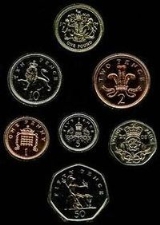
Decimal
Since decimalisationDecimalisation
Decimal currency is the term used to describe any currency that is based on one basic unit of currency and a sub-unit which is a power of 10, most commonly 100....
on "Decimal Day
Decimal Day
Decimal Day was the day the United Kingdom and Ireland decimalised their currencies.-Old system:Under the old currency of pounds, shillings and pence, the pound was made up of 240 pence , with 12 pence in a shilling and 20 shillings in a...
" in 1971, the pound has been divided into 100 pence. Originally the term "new pence" was used; the word "new" was dropped from the coinage in 1982. The old shilling equated to five (new) pence, and, for example, £2 10s 6d became £2.52½. The symbol for the (old) penny, "d", was replaced by "p" (or initially sometimes "np", for new pence). Thus 72 pence can be written as £0.72 or 72p; both would commonly be read as "seventy-two pee".
| Name | Value | Notes |
|---|---|---|
| Half penny British Half Penny coin The British decimal half penny was first issued on 15 February 1971, the day the British currency was decimalised. In practice it had been available from banks in bags for some weeks previously.... |
p | Sometimes written "ha'penny" , but normally called a "half-pee"; demonetised and withdrawn from circulation in December 1984. |
| One penny | 1p | |
| Two pence Two pence (British decimal coin) The British decimal two pence coin – often pronounced "two pee" – was issued by the Royal Mint on 15 February 1971, the day the British currency was decimalised. In practice it had been available from banks in bags of £1 for some weeks previously... |
2p | |
| Five pence | 5p | A direct replacement for the shilling. In 1990 it was reduced in size. |
| Ten pence | 10p | A replacement for the florin British Two Shilling coin The British two shilling coin, also known as the florin or "two bob bit" was issued from 1849 until 1967. It was worth one tenth of a pound, or twenty-four old pence... (two shillings). It was reduced in size in 1992. |
| Twenty pence | 20p | Introduced in 1982. |
| Twenty-five pence British Twenty-Five Pence coin The commemorative British decimal twenty-five pence coin was issued in four designs between 1972 and 1981. These coins were a post-decimalisation continuation of the traditional crown, with the same value of a quarter of a pound sterling. Uniquely in British decimal coinage, the coins do not have... |
25p or "crown". | A commemorative coin issued between 1972 and 1981 as a post-decimal continuation of the old crown. From 1990 it was replaced in the commemorative role by the £5 coin. |
| Fifty pence | 50p | Introduced in 1969, just prior to decimalisation, to replace the ten shilling note ("ten bob note"). It was initially sometimes called a "ten bob bit". The coin was reduced in size in 1997. |
| One pound One pound (British coin) The circulating British one pound coin is minted from a nickel-brass alloy of approximately 70% copper, 24.5% zinc, and 5.5% nickel. The coin weighs 9.50 grams and has a diameter of 22.50 millimetres... |
£1 | Introduced in 1983 to replace the one pound note. |
| Two pounds | £2 | Issued as a commemorative coin from 1986 and in general circulation from 1997. |
| Five pounds | £5 or "crown". | Introduced in 1990 as a commemorative coin, replacing the commemorative role of the twenty-five pence coin. |
| Britannia Britannia coin Britannia coins are British bullion coins issued by the Royal Mint in gold since 1987 and in silver since 1997.Britannia gold coins contain one troy ounce of gold and have a face value of £100. Gold Britannias also are issued in fractional sizes of one-half, one-quarter, and one-tenth of a troy... , sovereign and half sovereign British Half Sovereign coin The half sovereign is an English and British gold coin with a face value half that of a sovereign: equivalent to half a pound sterling, ten shillings, or 120 old pence... |
Bullion coins issued to various values. |
Banknotes
- Main articles: Banknotes of the pound sterling and Bank of England note issuesBank of England note issuesThe Bank of England, which is now the Central Bank of the United Kingdom, has issued banknotes since 1694. Since 1970, its new series of notes have featured portraits of British historical figures. Of the eight banks authorised to issue banknotes in the UK, only the Bank of England can issue...
.
Note: The description of banknotes given here relates to notes issued by the Bank of England
Bank of England
The Bank of England is the central bank of the United Kingdom and the model on which most modern central banks have been based. Established in 1694, it is the second oldest central bank in the world...
. Three banks in Scotland and four banks in Northern Ireland also issue notes, in some or all of the denominations: £1, £5, £10, £20, £50, £100.
| Name | Value | Circulation | Notes |
|---|---|---|---|
| Ten shilling note | 10/- (£0.5) | Issued from World War I World War I World War I , which was predominantly called the World War or the Great War from its occurrence until 1939, and the First World War or World War I thereafter, was a major war centred in Europe that began on 28 July 1914 and lasted until 11 November 1918... until 1969. |
Commonly "ten bob note" or "half a quid" |
| £1 note | £1 | Withdrawn by the Bank of England Bank of England The Bank of England is the central bank of the United Kingdom and the model on which most modern central banks have been based. Established in 1694, it is the second oldest central bank in the world... in 1988 (but still issued by the Royal Bank of Scotland Royal Bank of Scotland The Royal Bank of Scotland Group is a British banking and insurance holding company in which the UK Government holds an 84% stake. This stake is held and managed through UK Financial Investments Limited, whose voting rights are limited to 75% in order for the bank to retain its listing on the... ). Also still used in some of the Channel Islands. |
|
| £5 note | £5 | in circulation | The original "large white fiver" five pound note was known as "five jacks" and replaced in 1957 by the blue £5 note. |
| £10 note | £10 | in circulation | |
| £20 note | £20 | in circulation | |
| £50 note | £50 | in circulation | Also known as a bullseye. |
| £1,000,000 & £100,000,000 notes | £1,000,000 and £100,000,000 | non-circulating | Used as backing for banknotes issued by Scottish & Northern Irish banks when exceeding the value of their 1845 reserves. The amount to be covered is over a billion pounds. |
Bank of England notes are periodically redesigned and reissued, with the old notes being withdrawn from circulation and destroyed. Each redesign is allocated a "Series". Currently, the £50 note is Series E issue, the £5 and £10 notes are Series E Revised issue and the £20 note is Series F issue. Series F is the latest round of redesign, which commenced in March 2007. The £5, £10 and £50 notes will undergo this process in the near future.
Slang terms
- £1 is occasionally referred to as a "nicker", "nugget", "sov" or "quid" and sometimes a "squid".
- Lady GodivaLady GodivaGodiva , often referred to as Lady Godiva , was an Anglo-Saxon noblewoman who, according to legend, rode naked through the streets of Coventry in order to gain a remission of the oppressive taxation imposed by her husband on his tenants...
is rhyming slang for £5, or a "Jacks" – Jacks Alive (extremely rare). - A "Cockle" is £10 – Cock and Hen – ten.
- A "score" is £20.
- A "pony" equals £25.
- A "ton" or "century" is £100.
- A "monkey" is £500.
- A "grand" is £1,000.
- An "Archer" is £2,000, after the sum of money Jeffrey Archer allegedly paid to a prostitute.
- A "oner" (one-er) has referred to various amounts from 1/- to £1 to now meaning £100 or £1,000.
- "Shrapnel" or "Slummy" refers to an inconvenient pocketful of loose change.
- These coins are infrequently referred to by the appearance of their colour:
- "Silver/Light Grey" refers to 5p, 10p, 20p, and 50p coins.
- "Gold/Yellow" refers to £1 (also: GBP1) coin.
- "Bronze/Brown also copper" refers to 1p and 2p coins.
- "Multi-coloured" refers to £2 (also: GBP2) coin.
- These amounts are frequently referred to by words:
- "Grand" refers to £1,000. For example, "2 grand" refers to £2,000. "G" is also used for short – eg. 50G (£50,000), or 50G's worth of something.
- "K" also refers to £1,000. After decimalised units for example 1K is £1,000 – so 3K is £3,000
- "Fiver" refers to £5.
- "Tenner" refers to £10.
- "Quid" refers to £1.