


Lira da braccio

Encyclopedia
Europe
Europe is, by convention, one of the world's seven continents. Comprising the westernmost peninsula of Eurasia, Europe is generally 'divided' from Asia to its east by the watershed divides of the Ural and Caucasus Mountains, the Ural River, the Caspian and Black Seas, and the waterways connecting...
an bowed
Bow (music)
In music, a bow is moved across some part of a musical instrument, causing vibration which the instrument emits as sound. The vast majority of bows are used with string instruments, although some bows are used with musical saws and other bowed idiophones....
string instrument
String instrument
A string instrument is a musical instrument that produces sound by means of vibrating strings. In the Hornbostel-Sachs scheme of musical instrument classification, used in organology, they are called chordophones...
of the Renaissance
Renaissance music
Renaissance music is European music written during the Renaissance. Defining the beginning of the musical era is difficult, given that its defining characteristics were adopted only gradually; musicologists have placed its beginnings from as early as 1300 to as late as the 1470s.Literally meaning...
. It was used by Italian
Italy
Italy , officially the Italian Republic languages]] under the European Charter for Regional or Minority Languages. In each of these, Italy's official name is as follows:;;;;;;;;), is a unitary parliamentary republic in South-Central Europe. To the north it borders France, Switzerland, Austria and...
poet-musicians in court
Noble court
The court of a monarch, or at some periods an important nobleman, is a term for the extended household and all those who regularly attended on the ruler or central figure...
in the 15th and 16th centuries to accompany their improvised
Improvisation
Improvisation is the practice of acting, singing, talking and reacting, of making and creating, in the moment and in response to the stimulus of one's immediate environment and inner feelings. This can result in the invention of new thought patterns, new practices, new structures or symbols, and/or...
recitations of lyric
Lyric poetry
Lyric poetry is a genre of poetry that expresses personal and emotional feelings. In the ancient world, lyric poems were those which were sung to the lyre. Lyric poems do not have to rhyme, and today do not need to be set to music or a beat...
and narrative poetry
Narrative poetry
Narrative poetry is poetry that has a plot. The poems that make up this genre may be short or long, and the story it relates to may be simple or complex. It is usually nondramatic, with objective regular scheme and meter. Narrative poems include epics, ballads, idylls and lays.Some narrative...
. It is most closely related to the medieval fiddle, or vielle
Vielle
The vielle is a European bowed stringed instrument used in the Medieval period, similar to a modern violin but with a somewhat longer and deeper body, five gut strings, and a leaf-shaped pegbox with frontal tuning pegs. The instrument was also known as a fidel or a viuola, although the French...
, and like the vielle had a leaf-shaped pegbox
Pegbox
A pegbox is the part of certain stringed musical instruments that houses the tuning pegs....
with frontal pegs. Fiddles with drone strings are seen beginning in the 9th century (Byzantine lyra
Byzantine lyra
The Byzantine lyra or lira , was a medieval bowed string musical instrument in the Byzantine Empire and is an ancestor of most European bowed instruments, including the violin. In its popular form the lyra was a pear-shaped instrument with three to five strings, held upright and played by stopping...
), and the instrument continued to develop through the 16th century. In many depictions of the instrument, it is being played by mythological characters, frequently members of angel
Angel
Angels are mythical beings often depicted as messengers of God in the Hebrew and Christian Bibles along with the Quran. The English word angel is derived from the Greek ἄγγελος, a translation of in the Hebrew Bible ; a similar term, ملائكة , is used in the Qur'an...
consorts, and most often by Orpheus
Orpheus
Orpheus was a legendary musician, poet, and prophet in ancient Greek religion and myth. The major stories about him are centered on his ability to charm all living things and even stones with his music; his attempt to retrieve his wife from the underworld; and his death at the hands of those who...
and Apollo
Apollo
Apollo is one of the most important and complex of the Olympian deities in Greek and Roman mythology...
. The lira da braccio was occasionally used in ensembles, particularly in the intermedi, and may have acted as a proto-continuo instrument.
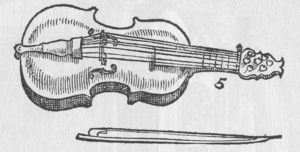
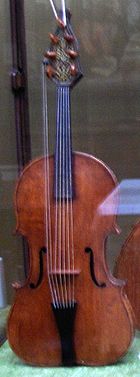
The instrument was shaped essentially like a violin
Violin
The violin is a string instrument, usually with four strings tuned in perfect fifths. It is the smallest, highest-pitched member of the violin family of string instruments, which includes the viola and cello....
, but with a wider fingerboard
Fingerboard
The fingerboard is a part of most stringed instruments. It is a thin, long strip of material, usually wood, that is laminated to the front of the neck of an instrument and above which the strings run...
and flatter bridge
Bridge (instrument)
A bridge is a device for supporting the strings on a stringed instrument and transmitting the vibration of those strings to some other structural component of the instrument in order to transfer the sound to the surrounding air.- Explanation :...
. Generally, it had seven strings, five of them tuned like a violin with a low d added to the bottom (that is,
Drone (music)
In music, a drone is a harmonic or monophonic effect or accompaniment where a note or chord is continuously sounded throughout most or all of a piece. The word drone is also used to refer to any part of a musical instrument that is just used to produce such an effect.-A musical effect:A drone...
and were usually tuned in octaves. Michael Praetorius
Michael Praetorius
Michael Praetorius was a German composer, organist, and music theorist. He was one of the most versatile composers of his age, being particularly significant in the development of musical forms based on Protestant hymns, many of which reflect an effort to make better the relationship between...
shows the instrument with fret
Fret
A fret is a raised portion on the neck of a stringed instrument, that extends generally across the full width of the neck. On most modern western instruments, frets are metal strips inserted into the fingerboard...
s, although he is the only one to do so (see image at right). The wide fingerboard and flat bridge, along with long, strongly curved bows, facilitated chordal playing on the instrument. Although Praetorius depicts the instrument as lyra de bracio with various viol
Viol
The viol is any one of a family of bowed, fretted and stringed musical instruments developed in the mid-late 15th century and used primarily in the Renaissance and Baroque periods. The family is related to and descends primarily from the Renaissance vihuela, a plucked instrument that preceded the...
s "da gamba" (see :Image:Syntagma12.png), it was in fact played on the shoulder, as is implied by its name, which refers to the arm, or braccio in Italian. From the few treatises and compositions which survive, it seems that the lira was played with triple and quadruple stops. The player was somewhat limited in terms of what inversions they could play, and it is believed that the top strings may have been used for melody, and the lower strings for chordal playing. In addition, it is believed that when accompanying singing, the instrument played at a higher pitch than the performer sang. Eventually in the late 16th century a fretted bass version of the lira da braccio with an expanded number of strings was developed, the lirone
Lirone
The lirone, the bass member of the lira family of instruments, is a bowed string instrument with between 9 and 16 gut strings. It is held between the legs in the manner of a cello or viol and like the viol its neck is generally fretted...
, which was played "da gamba", or on the legs.
History
Bow (music)
In music, a bow is moved across some part of a musical instrument, causing vibration which the instrument emits as sound. The vast majority of bows are used with string instruments, although some bows are used with musical saws and other bowed idiophones....
string instrument
String instrument
A string instrument is a musical instrument that produces sound by means of vibrating strings. In the Hornbostel-Sachs scheme of musical instrument classification, used in organology, they are called chordophones...
s was first recorded in the 9th century, as an application of the term lyre
Lyre
The lyre is a stringed musical instrument known for its use in Greek classical antiquity and later. The word comes from the Greek "λύρα" and the earliest reference to the word is the Mycenaean Greek ru-ra-ta-e, meaning "lyrists", written in Linear B syllabic script...
(Greek: λύρα - lūrā) of the classic
Classical antiquity
Classical antiquity is a broad term for a long period of cultural history centered on the Mediterranean Sea, comprising the interlocking civilizations of ancient Greece and ancient Rome, collectively known as the Greco-Roman world...
stringed musical instrument
String instrument
A string instrument is a musical instrument that produces sound by means of vibrating strings. In the Hornbostel-Sachs scheme of musical instrument classification, used in organology, they are called chordophones...
for the bowed musical instrument lyra
Byzantine lyra
The Byzantine lyra or lira , was a medieval bowed string musical instrument in the Byzantine Empire and is an ancestor of most European bowed instruments, including the violin. In its popular form the lyra was a pear-shaped instrument with three to five strings, held upright and played by stopping...
(lūrā) of the Byzantine Empire
Byzantine Empire
The Byzantine Empire was the Eastern Roman Empire during the periods of Late Antiquity and the Middle Ages, centred on the capital of Constantinople. Known simply as the Roman Empire or Romania to its inhabitants and neighbours, the Empire was the direct continuation of the Ancient Roman State...
, equivalent to the rabāb used in the Islamic Empires of that time. The Persian
Persian people
The Persian people are part of the Iranian peoples who speak the modern Persian language and closely akin Iranian dialects and languages. The origin of the ethnic Iranian/Persian peoples are traced to the Ancient Iranian peoples, who were part of the ancient Indo-Iranians and themselves part of...
geographer Ibn Khurradadhbih
Ibn Khordadbeh
Abu'l Qasim Ubaid'Allah ibn Khordadbeh , author of the earliest surviving Arabic book of administrative geography, was a Persian geographer and bureaucrat of the 9th century...
(d. 911) of the 9th century, in his lexicographical discussion of instruments, cited the lyra
Byzantine lyra
The Byzantine lyra or lira , was a medieval bowed string musical instrument in the Byzantine Empire and is an ancestor of most European bowed instruments, including the violin. In its popular form the lyra was a pear-shaped instrument with three to five strings, held upright and played by stopping...
as a typical instrument of the Byzantines along with the urghun (organ), shilyani (probably a type of harp or lyre) and the salandj. The Byzantine lyra
Byzantine lyra
The Byzantine lyra or lira , was a medieval bowed string musical instrument in the Byzantine Empire and is an ancestor of most European bowed instruments, including the violin. In its popular form the lyra was a pear-shaped instrument with three to five strings, held upright and played by stopping...
spread through Europe westward; in the 11th and 12th centuries European writers use the terms fiddle
Fiddle
The term fiddle may refer to any bowed string musical instrument, most often the violin. It is also a colloquial term for the instrument used by players in all genres, including classical music...
and lira interchangeably when referring to bowed instruments . Over the centuries that followed, Europe continued to have two distinct types of bowed instruments: one, relatively square-shaped, more often held in the arms, became known as the lira or lira da braccio (arm viol) family; the other, with sloping shoulders and more often held between the knees, was the viol
Viol
The viol is any one of a family of bowed, fretted and stringed musical instruments developed in the mid-late 15th century and used primarily in the Renaissance and Baroque periods. The family is related to and descends primarily from the Renaissance vihuela, a plucked instrument that preceded the...
or viola da gamba (leg viol) group. During the Renaissance
Renaissance
The Renaissance was a cultural movement that spanned roughly the 14th to the 17th century, beginning in Italy in the Late Middle Ages and later spreading to the rest of Europe. The term is also used more loosely to refer to the historical era, but since the changes of the Renaissance were not...
, the gambas were important and elegant instruments; they eventually lost ground to the louder (and originally less aristocratic) lira family.
The lira da braccio was first cited in 1533 by Giovanni Maria Lanfranco (using the term seven-stringed lyra), also describing its tuning: [d-d' / g-g'-d'-a'-e]. Lira was devised to accompany humanist sung verse by poets, such as the 14th century Petrarch and his later imitators, and was popular in the North Italian city-states such as Florence, Ferrara, Mantua, Venice and so on. In this role, the Lira enjoyed a prestige among instruments that it was never quite to achieve again. Amongst its exponents at the time were several great painters, notably Leonardo, who according to Emmanuel Winternitz, was widely held to be the doyen among performers upon the Lira.
The rise of the Madrigal, and its counterpart, the instrumental consort, as well as the meteoric rise of the more vocal Violin, soon toppled the Lira from its pre-eminent position at court, and by the 1530s it had been relegated to stage use, in the great Renaissance festivals held by the city states and their powerful ruling dynasties. Here it was typically found onstage associated with the presence of the god Apollo, or blended in proto-continuo offstage ensembles.
The Pesaro Manuscript, from the mid-16th century, an important document in the history of the Lira, records a Passemezzo Moderno, (contemporary dance measure) written in lira tablature. Discovered in the town of Pesaro, on the Adriatic coast, this strange, mutilated script is the sole surviving example of written music for the Lira. It suggests at least the possibility that the instrument was being used as a dance instrument by this time. Its harmonic character, and useful range of home keys would have been ideally suited to render the fashionable dance music of the day.
The great Italian musicologist Disertori showed that it was possible to reconstruct highly convincing examples of the Lira da Braccio in its early forms, from the meticulous paintings and drawings of Leonardo, Raphael, Bellini, Carpaccio and many other artists from the late 15th/early 16th century, thus opening many exciting possibilities relating to the re-creation of late 15th century performance practice.
There are up to ten surviving examples of the later, violin-like Lira, though their authenticity is still in, somewhat acrimonious, contention.
The Lira da Braccio fell out of use sometime in the mid-17th century. It last appears in a Dutch allegorical still-life, "Hearing", by Jan Breughel II.