


Lipoma

Encyclopedia
A lipoma is a benign tumor composed of adipose tissue
. It is the most common form of soft tissue
tumor. Lipomas are soft to the touch, usually movable, and are generally painless. Many lipomas are small (under one centimeter diameter) but can enlarge to sizes greater than six centimeters. Lipomas are commonly found in adults from 40 to 60 years of age, but can also be found in children. Some sources claim that malignant transformation can occur,'Obesity Gene' Causes Cancer of Fat Tissue, Schepens Scientists Find Schepens Eye Research Institute (Harvard Medical School affiliate). April 26, 2000 while others say that this has yet to be convincingly documented.
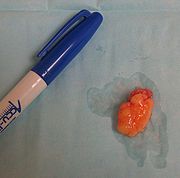 There are several subtypes of lipoma:
.
, may include lipoma development. Genetic studies in mice have shown a correlation between the HMG I-C gene (previously identified as a gene related to obesity) and lipoma development. These studies support prior epidemiologic data in humans showing a correlation between HMG I-C and mesenchymal tumors.
Cases have been reported where minor injuries are alleged to have triggered the growth of a lipoma, called "post-traumatic lipomas." However, the link between trauma and the development of lipomas is controversial.
to check that they are not a more dangerous type of tumor such as a liposarcoma
. This last point can be important as the actual identity of a "bump" is not known until after it is removed and professionally examined.
Lipomas are normally removed by simple excision. The removal can often be done under local anaesthetic, and take less than 30 minutes. This cures the majority of cases, with about 1-2% of lipomas recurring after excision. Liposuction
is another option if the lipoma is soft and has a small connective tissue
component. Liposuction typically results in less scar
ring; however, with large lipomas it may fail to remove the entire tumor, which can lead to re-growth.
There are new methods being developed that are supposed to remove the lipomas without scarring. One of them is removal by the use of injection of compounds that trigger lipolysis
, such as steroid
s or phosphatidylcholine
.
and painful obstructions. Malignant transformation of lipomas into liposarcoma
s is very rare and most liposarcomas are not produced from pre-existing benign lesions, although a few cases of malignant transformation have been described for bone and kidney lipomas. It is possible these few reported cases were well-differentiated liposarcomas in which the subtle malignant
characteristics were missed when the tumour was first examined. Deep lipomas have a greater tendency to recur than superficial lipomas, because complete surgical removal of deep lipomas is not always possible.
is a hereditary condition where multiple lipomas are present on the body.
Adiposis Dolorosa
(Dercum disease), is a rare condition involving multiple painful lipomas, swelling, and fatigue. It is generally seen in obese, post menopausal women.
Benign symmetric lipomatosis
(Madelung disease) is another condition involving lipomatosis. It nearly always appears in middle-aged males after many years of alcoholism, although non-alcoholics and females can also be affected.
Adipose tissue
In histology, adipose tissue or body fat or fat depot or just fat is loose connective tissue composed of adipocytes. It is technically composed of roughly only 80% fat; fat in its solitary state exists in the liver and muscles. Adipose tissue is derived from lipoblasts...
. It is the most common form of soft tissue
Soft tissue
In anatomy, the term soft tissue refers to tissues that connect, support, or surround other structures and organs of the body, not being bone. Soft tissue includes tendons, ligaments, fascia, skin, fibrous tissues, fat, and synovial membranes , and muscles, nerves and blood vessels .It is sometimes...
tumor. Lipomas are soft to the touch, usually movable, and are generally painless. Many lipomas are small (under one centimeter diameter) but can enlarge to sizes greater than six centimeters. Lipomas are commonly found in adults from 40 to 60 years of age, but can also be found in children. Some sources claim that malignant transformation can occur,'Obesity Gene' Causes Cancer of Fat Tissue, Schepens Scientists Find Schepens Eye Research Institute (Harvard Medical School affiliate). April 26, 2000 while others say that this has yet to be convincingly documented.
Types
- AngiolipoleiomyomaAngiolipoleiomyomaAngiolipoleiomyoma is an acquired, solitary, asymptomatic acral nodule, characterized histologically by well-circumscribed subcutaneous tumors composed of smooth muscle cells, blood vessels, connective tissue, and fat....
is an acquired, solitary, asymptomatic acral nodule, characterized histologically by well-circumscribed subcutaneous tumors composed of smooth muscle cells, blood vessels, connective tissue, and fat.
- Angiolipoma is a painful subcutaneous nodule, having all other features of a typical lipoma.
- Chondroid lipomas are deep-seated, firm, yellow tumors that characteristically occur on the legs of women.
- Corpus callosumCorpus callosumThe corpus callosum , also known as the colossal commissure, is a wide, flat bundle of neural fibers beneath the cortex in the eutherian brain at the longitudinal fissure. It connects the left and right cerebral hemispheres and facilitates interhemispheric communication...
lipoma is a rare congenital condition which may or may not present with symptoms. Lipomas are usually relatively small with diameters of about 1–3 cm, but in rare cases they can grow over several years into "giant lipomas" that are 10–20 cm across and weigh up to 4–5 kg.
- HibernomaHibernomaA hibernoma is a benign tumour of brown fat, i.e. adipose tissue , and thus a type of lipoma.They arise when brown fat continue to grow.-Histology:...
is a lipoma of brown fat.
- Intradermal spindle cell lipoma is distinct in that it most commonly affects women, and has a wide distribution, occurring with relatively equal frequency on the head and neck, trunk, and upper and lower extremities.
- Neural fibrolipoma is an overgrowth of fibro-fatty tissue along a nerve trunk that often leads to nerve compression.
- Pleomorphic lipomaPleomorphic lipomaPleomorphic lipomas, like spindle-cell lipomas, occur for the most part on the backs and necks of elderly men, and are characterized by floret giant cells with overlapping nuclei....
s, like spindle-cell lipomaSpindle-cell lipomaSpindle cell lipoma is an asymptomatic, slow-growing subcutaneous tumor that has a predilection for the posterior back, neck, and shoulders of older men....
s, occur for the most part on the backs and necks of elderly men, and are characterized by floret giant cells with overlapping nuclei.
- Spindle-cell lipoma is an asymptomatic, slow-growing subcutaneous tumor that has a predilection for the posterior back, neck, and shoulders of older men.
- Superficial subcutaneous lipoma, the most common type of lipoma, lies just below the surface of the skin. Most occur on the trunkTorsoTrunk or torso is an anatomical term for the central part of the many animal bodies from which extend the neck and limbs. The trunk includes the thorax and abdomen.-Major organs:...
, thighs and the forearms, although they may be found anywhere in the body where fat is located.
Prevalence
Approximately one percent of the general population has a lipoma. These tumors can occur at any age, but are most common in middle age, often appearing in people from 40 to 60 years old. Cutaneous lipomas are rare in children, but these tumors can occur as part of the inherited disease Bannayan-Zonana syndromeBannayan-Zonana syndrome
Bannayan–Riley–Ruvalcaba syndrome is a rare hamartomatous disorder with occurrence of multiple subcutaneous lipomas, macrocephaly and hemangiomas...
.
Causes
The tendency to develop a lipoma is not necessarily hereditary although hereditary conditions, such as familial multiple lipomatosisLipomatosis
Lipomatosis is a hereditary condition where multiple lipomas are present on the body. Many discrete, encapsulated lipomas form on the trunk and extremities, with relatively few on the head and shoulders...
, may include lipoma development. Genetic studies in mice have shown a correlation between the HMG I-C gene (previously identified as a gene related to obesity) and lipoma development. These studies support prior epidemiologic data in humans showing a correlation between HMG I-C and mesenchymal tumors.
Cases have been reported where minor injuries are alleged to have triggered the growth of a lipoma, called "post-traumatic lipomas." However, the link between trauma and the development of lipomas is controversial.
Treatment
Usually, treatment of a lipoma is not necessary, unless the tumor becomes painful or restricts movement. They are usually removed for cosmetic reasons, if they grow very large, or for histopathologyHistopathology
Histopathology refers to the microscopic examination of tissue in order to study the manifestations of disease...
to check that they are not a more dangerous type of tumor such as a liposarcoma
Liposarcoma
Liposarcoma is a malignant tumor that arises in fat cells in deep soft tissue, such as that inside the thigh or in the retroperitoneum.They are typically large bulky tumors which tend to have multiple smaller satellites extending beyond the main confines of the tumor.Liposarcomas, like all...
. This last point can be important as the actual identity of a "bump" is not known until after it is removed and professionally examined.
Lipomas are normally removed by simple excision. The removal can often be done under local anaesthetic, and take less than 30 minutes. This cures the majority of cases, with about 1-2% of lipomas recurring after excision. Liposuction
Liposuction
Liposuction, also known as lipoplasty , liposculpture suction lipectomy or simply lipo is a cosmetic surgery operation that removes fat from many different sites on the human body...
is another option if the lipoma is soft and has a small connective tissue
Connective tissue
"Connective tissue" is a fibrous tissue. It is one of the four traditional classes of tissues . Connective Tissue is found throughout the body.In fact the whole framework of the skeleton and the different specialized connective tissues from the crown of the head to the toes determine the form of...
component. Liposuction typically results in less scar
Scar
Scars are areas of fibrous tissue that replace normal skin after injury. A scar results from the biological process of wound repair in the skin and other tissues of the body. Thus, scarring is a natural part of the healing process. With the exception of very minor lesions, every wound results in...
ring; however, with large lipomas it may fail to remove the entire tumor, which can lead to re-growth.
There are new methods being developed that are supposed to remove the lipomas without scarring. One of them is removal by the use of injection of compounds that trigger lipolysis
Lipolysis
Lipolysis is the breakdown of lipids and involves the hydrolysis of triglycerides into free fatty acids followed by further degradation into acetyl units by beta oxidation. The process produces Ketones, which are found in large quantities in ketosis, a metabolic state that occurs when the liver...
, such as steroid
Steroid
A steroid is a type of organic compound that contains a characteristic arrangement of four cycloalkane rings that are joined to each other. Examples of steroids include the dietary fat cholesterol, the sex hormones estradiol and testosterone, and the anti-inflammatory drug dexamethasone.The core...
s or phosphatidylcholine
Phosphatidylcholine
Phosphatidylcholines are a class of phospholipids that incorporate choline as a headgroup.They are a major component of biological membranes and can be easily obtained from a variety of readily available sources such as egg yolk or soy beans from which they are mechanically extracted or chemically...
.
Prognosis
Lipomas are rarely life-threatening and the common subcutaneous lipomas are not a serious condition. Lipomas growing in internal organs can be more dangerous, for example lipomas in the gastrointestinal tract can cause bleeding, ulcerationPeptic ulcer
A peptic ulcer, also known as PUD or peptic ulcer disease, is the most common ulcer of an area of the gastrointestinal tract that is usually acidic and thus extremely painful. It is defined as mucosal erosions equal to or greater than 0.5 cm...
and painful obstructions. Malignant transformation of lipomas into liposarcoma
Liposarcoma
Liposarcoma is a malignant tumor that arises in fat cells in deep soft tissue, such as that inside the thigh or in the retroperitoneum.They are typically large bulky tumors which tend to have multiple smaller satellites extending beyond the main confines of the tumor.Liposarcomas, like all...
s is very rare and most liposarcomas are not produced from pre-existing benign lesions, although a few cases of malignant transformation have been described for bone and kidney lipomas. It is possible these few reported cases were well-differentiated liposarcomas in which the subtle malignant
Malignant
Malignancy is the tendency of a medical condition, especially tumors, to become progressively worse and to potentially result in death. Malignancy in cancers is characterized by anaplasia, invasiveness, and metastasis...
characteristics were missed when the tumour was first examined. Deep lipomas have a greater tendency to recur than superficial lipomas, because complete surgical removal of deep lipomas is not always possible.
In veterinary medicine
Lipomas occur in many animals, but are most common in older dogs, particularly older Labrador Retrievers, Doberman Pinschers and Miniature Schnauzers. Overweight female dogs are especially prone to developing these tumors and most older or overweight dogs have at least one lipoma. In dogs, lipomas usually occur in the trunk or upper limbs. Lipomas are also found less commonly in cattle and horses, but rarely in cats and pigs.Other conditions involving lipoma
LipomatosisLipomatosis
Lipomatosis is a hereditary condition where multiple lipomas are present on the body. Many discrete, encapsulated lipomas form on the trunk and extremities, with relatively few on the head and shoulders...
is a hereditary condition where multiple lipomas are present on the body.
Adiposis Dolorosa
Adiposis dolorosa
Adiposis dolorosa, also known as Dercum's Disease is a rare condition characterized by multiple, painful lipomas. These lipomas mainly occur on the trunk, the upper arms and upper legs. The diagnosis of Dercum's disease implies a long, chronic pain syndrome of debilitating nature...
(Dercum disease), is a rare condition involving multiple painful lipomas, swelling, and fatigue. It is generally seen in obese, post menopausal women.
Benign symmetric lipomatosis
Benign symmetric lipomatosis
Benign symmetric lipomatosis is a cutaneous condition characterized by extensive symmetric fat deposits in the head, neck, and shoulder girdle area...
(Madelung disease) is another condition involving lipomatosis. It nearly always appears in middle-aged males after many years of alcoholism, although non-alcoholics and females can also be affected.
Images and video
- Illustration from University of Connecticut Health CenterUniversity of Connecticut Health CenterThe University of Connecticut Health Center includes the , School of Dental Medicine, , the UConn Medical Group, UConn Health Partners and . Founded in 1961, the Health Center pursues a mission of providing outstanding health care education in an environment of exemplary patient care, research and...
- Esophageal Lipomatosis MedPix Images from Uniformed Services University of the Health SciencesUniformed Services University of the Health SciencesThe Uniformed Services University of the Health Sciences is a health science university run by the U.S. federal government. The primary mission of the school is to prepare graduates for service to the U.S. at home and abroad in the medical corps....
- Lipoma images from DermAtlasDermAtlasDermAtlas is an open access web site devoted to dermatology that is hosted by Johns Hopkins University's Dr. Bernard A. Cohen and Dr. Christoph U. Lehmann...
- humpath #2626