

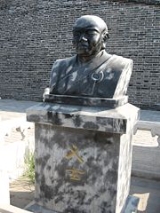
Linji

Encyclopedia
Línjì Yìxuán (died 866 CE) was the founder of the Linji school
of Chán
Buddhism
during Tang Dynasty
China
. Linji was born into a family named Xing (邢) in Caozhou (modern Heze
in Shandong
), which he left at a young age to study Buddhism in many places.
Linji was trained by the Chan master Huángbò Xīyùn
(黃蘗希運) but, according to the Record of Linji, enlightened
while discussing Huángbò's teaching during a conversation with the reclusive monk Dàyú (大愚). Linji then returned to Huángbò to continue his training after awakening. In 851 CE, Linji moved to the Linji temple in Hebei
, where he took his name, which also became the name for the lineage of his form of Chán Buddhism.
that was considered a symbol of a Chán master's authority:
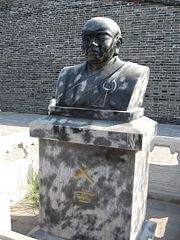 Linji also taught with lectures and sermons, which were collected by his students into the Línjì-lù (臨済錄; Japanese: Rinzai-roku), the Record of Linji, which also contains stories of his interactions with teachers, contemporaries, and students. His lectures were a mixture of the conventional and the iconoclastic
. He is particularly famous for encouraging his students to free themselves from the influence of masters and doctrinal concepts, in order to be able to better discover their own Buddha-nature
.
Famed examples of Linji's iconoclasm include the following:
. The Japanese Zen sect known as the Rinzai school
is a branch of the lineage Linji founded. The smaller Japanese Obaku school came to Japan in the 17th century as a separate Linji lineage and existed in Japan for many years as a culturally Ming Dynasty Chinese Zen within Japan. Later the Obaku school semi-merged into the Rinzai lineage after Hakuin's revival of Rinzai in the 18th century. Today the Rinzai and Obaku schools are closely related. The now-defunct Japanese Fuke school also had close ties to the Rinzai school and claimed affiliation with the Linji lineage.
Rinzai school
The Rinzai school is , one of three sects of Zen in Japanese Buddhism.Rinzai is the Japanese line of the Chinese Linji school, which was founded during the Tang Dynasty by Linji Yixuan...
of Chán
Chan
-People:* Chan Marshall, American musician better known as Cat Power* Chan , Chinese surname; Mandarin transcription of the same name is Chen ** Agnes Chan , Hong Kong singer, also famous in Japan...
Buddhism
Buddhism
Buddhism is a religion and philosophy encompassing a variety of traditions, beliefs and practices, largely based on teachings attributed to Siddhartha Gautama, commonly known as the Buddha . The Buddha lived and taught in the northeastern Indian subcontinent some time between the 6th and 4th...
during Tang Dynasty
Tang Dynasty
The Tang Dynasty was an imperial dynasty of China preceded by the Sui Dynasty and followed by the Five Dynasties and Ten Kingdoms Period. It was founded by the Li family, who seized power during the decline and collapse of the Sui Empire...
China
China
Chinese civilization may refer to:* China for more general discussion of the country.* Chinese culture* Greater China, the transnational community of ethnic Chinese.* History of China* Sinosphere, the area historically affected by Chinese culture...
. Linji was born into a family named Xing (邢) in Caozhou (modern Heze
Heze
Heze is a prefecture-level city in southwestern Shandong province, People's Republic of China. The westernmost prefecture-level city in Shandong, it borders Jining to the east and the provinces of Henan and Anhui to the west and south respectively. The old name of Heze was Caozhou and now a part...
in Shandong
Shandong
' is a Province located on the eastern coast of the People's Republic of China. Shandong has played a major role in Chinese history from the beginning of Chinese civilization along the lower reaches of the Yellow River and served as a pivotal cultural and religious site for Taoism, Chinese...
), which he left at a young age to study Buddhism in many places.
Linji was trained by the Chan master Huángbò Xīyùn
Huangbo Xiyun
Huángbò Xīyùn was an influential Chinese master of Zen Buddhism. He was born in Fujian, China in the Tang Dynasty. Huángbò was a disciple of Baizhang Huaihai and the teacher of Linji Yixuan .-Biography:Very little about Huángbò‘s life is known for certain as, unlike other Transmission of the...
(黃蘗希運) but, according to the Record of Linji, enlightened
Bodhi
Bodhi is both a Pāli and Sanskrit word traditionally translated into English with the word "enlightenment", but which means awakened. In Buddhism it is the knowledge possessed by a Buddha into the nature of things...
while discussing Huángbò's teaching during a conversation with the reclusive monk Dàyú (大愚). Linji then returned to Huángbò to continue his training after awakening. In 851 CE, Linji moved to the Linji temple in Hebei
Hebei
' is a province of the People's Republic of China in the North China region. Its one-character abbreviation is "" , named after Ji Province, a Han Dynasty province that included what is now southern Hebei...
, where he took his name, which also became the name for the lineage of his form of Chán Buddhism.
Linji's teaching style
Linji's own teaching was greatly inspired by his master's, and was characterized by abrupt, harsh encounters with students, aiming to bring about the moment of enlightenment.Shouting and hitting
His methods included shouting and striking, most often using the fly-whiskFly-whisk
A fly-whisk is a tool to swat or disturb flies. It is used as a regalia in some cultures.In Indonesian art, a fly-whisk is one of the items associated with Shiva. The fly-whisk is frequently seen as an attribute of both Hindu, Daoist, and Buddhist deities...
that was considered a symbol of a Chán master's authority:
The Master [Linji] saw a monk coming and held his fly whisk straight up. The monk made a low bow, whereupon the Master struck him a blow. The Master saw another monk coming and again held his fly whisk straight up. The monk paid no attention, whereupon the Master struck him a blow as well.
Discourses
Iconoclasm
Iconoclasm is the deliberate destruction of religious icons and other symbols or monuments, usually with religious or political motives. It is a frequent component of major political or religious changes...
. He is particularly famous for encouraging his students to free themselves from the influence of masters and doctrinal concepts, in order to be able to better discover their own Buddha-nature
Buddha-nature
Buddha-nature, Buddha-dhatu or Buddha Principle , is taught differently in various Mahayana Buddhism traditions. Broadly speaking Buddha-nature is concerned with ascertaining what allows sentient beings to become Buddhas...
.
Famed examples of Linji's iconoclasm include the following:
Followers of the Way [of Chán], if you want to get the kind of understanding that accords with the DharmaDharma (Buddhism)Dhamma or Dharma in Buddhism can have the following meanings:* The state of Nature as it is * The Laws of Nature considered collectively....
, never be misled by others. Whether you're facing inward or facing outward, whatever you meet up with, just kill it! If you meet a buddha, kill the buddha. If you meet a patriarchLineage (Buddhism)An authentic lineage in Buddhism is the uninterrupted transmission of the Buddha's Dharma from teacher to disciple.The transmission itself can be for example oral, scriptural, through signs, or directly from one mind to another....
, kill the patriarch. If you meet an arhat, kill the arhat. If you meet your parents, kill your parents. If you meet your kinfolk, kill your kinfolk. Then for the first time you will gain emancipation, will not be entangled with things, will pass freely anywhere you wish to go.
Those who have fulfilled the ten stagesBhumi (Buddhism)The bodhisattva's path of awakening in the Mahayana tradition progresses through ten hierarchically arranged stages, referred to as the "bodhisattva bhūmis"...
of bodhisattvaBodhisattvaIn Buddhism, a bodhisattva is either an enlightened existence or an enlightenment-being or, given the variant Sanskrit spelling satva rather than sattva, "heroic-minded one for enlightenment ." The Pali term has sometimes been translated as "wisdom-being," although in modern publications, and...
practice are no better than hired field hands; those who have attained the enlightenment of the fifty-first and fifty-second stages are prisoners shackled and bound; arhats and pratyekabuddhaPratyekabuddhaA Pratyekabuddha or Paccekabuddha , literally "a lone buddha" , "a buddha on their own" or "a private buddha", is one of three types of enlightened beings according to some schools of Buddhism. The other two types are the Śrāvakabuddhas and Samyaksambuddhas...
s are so much filth in the latrine; bodhi and nirvanaNirvanaNirvāṇa ; ) is a central concept in Indian religions. In sramanic thought, it is the state of being free from suffering. In Hindu philosophy, it is the union with the Supreme being through moksha...
are hitching posts for donkeys.
Linji's lineage in Japan
When Chinese Chan was brought to Japan it was called ZenZen
Zen is a school of Mahāyāna Buddhism founded by the Buddhist monk Bodhidharma. The word Zen is from the Japanese pronunciation of the Chinese word Chán , which in turn is derived from the Sanskrit word dhyāna, which can be approximately translated as "meditation" or "meditative state."Zen...
. The Japanese Zen sect known as the Rinzai school
Rinzai school
The Rinzai school is , one of three sects of Zen in Japanese Buddhism.Rinzai is the Japanese line of the Chinese Linji school, which was founded during the Tang Dynasty by Linji Yixuan...
is a branch of the lineage Linji founded. The smaller Japanese Obaku school came to Japan in the 17th century as a separate Linji lineage and existed in Japan for many years as a culturally Ming Dynasty Chinese Zen within Japan. Later the Obaku school semi-merged into the Rinzai lineage after Hakuin's revival of Rinzai in the 18th century. Today the Rinzai and Obaku schools are closely related. The now-defunct Japanese Fuke school also had close ties to the Rinzai school and claimed affiliation with the Linji lineage.
See also
- Buddhism in ChinaBuddhism in ChinaChinese Buddhism refers collectively to the various schools of Buddhism that have flourished in China since ancient times. Buddhism has played an enormous role in shaping the mindset of the Chinese people, affecting their aesthetics, politics, literature, philosophy and medicine.At the peak of the...
- Dharma Drum Retreat CenterDharma Drum Retreat CenterDharma Drum Retreat Center was founded by renowned Chinese Ch'an Master, Master Sheng-yen. Its location is at the rural area of Pine Bush, New York, just about two hours drive or northwest of New York City...
Chán Buddhism retreat center founded by Linji heir Sheng-yenSheng-yenSheng-yen was a Buddhist monk, a religious scholar, and one of the mainstream teachers of Chinese Chan Buddhism. He was the 57th generational descendant of Linji in the Linji School and a 3rd generational descendant of Master Hsu Yun... - List of Rinzai Buddhists
External links
- Repository of translations of Linji
- The Zen Teaching of Rinzai (a.k.a. The Record of Rinzai) PDF Text
- Taisho Tripitaka Vol. 47, No. 1985 The Chinese Buddhist Electronic Text Association online Chinese character text of The Record of Linji (臨濟録 Linji Lu)