
All Topics  
Linear programming


   Email Print
   Bookmark   Link


Linear programming


In mathematics
Mathematics

Mathematics is the study of quantity, structure, space, change, and related topics of pattern and form. Mathematicians seek out patterns whether found in numbers, space, natural science, computers, imaginary abstractions, or elsewhere....
, linear programming (LP) is a technique for optimization
Optimization (mathematics)

In mathematics, the simplest case of optimization, or mathematical programming, refers to the study of problems in which one seeks to maxima and minima or maxima and minima a Function of a real variable by systematically choosing the values of Real number or integer variables from within an allowed set....
 of a linear
Linear

The word linear comes from the Latin word linearis, which means created by lines.In mathematics, a linear map or function f is a function which satisfies the following two properties......
 objective function, subject to linear equality and linear inequality
Linear inequality

In mathematics a linear inequality is an inequality which involves a linear function....
 constraints
Constraint (mathematics)

In mathematics, a constraint is a condition that a solution to an optimization problem must satisfy. There are two types of constraints: equality constraints and inequality constraints....
. Informally, linear programming determines the way to achieve the best outcome (such as maximum profit or lowest cost) in a given mathematical model
Mathematical model

A mathematical model uses mathematics language to describe a system. Mathematical models are used not only in the natural sciences and engineering disciplines but also in the social sciences ; physicists, engineers, computer sciences, and economists use mathematical models most extensively....
 and given some list of requirements represented as linear equations.

More formally, given a polytope
Polytope

In geometry, polytope is a generic term that can refer to a two-dimensional polygon, a three-dimensional polyhedron, or any of the various generalizations thereof, including generalizations to higher dimensions and other abstractions ....
 (for example, a polygon
Polygon

In geometry a polygon is traditionally a plane Shape that is bounded by a closed curve path or circuit, composed of a finite sequence of straight line segments ....
 or a polyhedron
Polyhedron

|}A polyhedron is often defined as a geometry object with flat faces and straight edges .This definition of a polyhedron is not very precise, and to a modern mathematician is quite unsatisfactory....
), and a real
Real number

In mathematics, the real numbers may be described informally in several different ways. The real numbers include both rational numbers, such as 42 and −23/129, and irrational numbers, such as pi and the square root of two; or, a real number can be given by an infinite decimal representation, such as 2.4871773339...., where the digits co...
-valued affine function


defined on this polytope, a linear programming method will find a point in the polytope where this function has the smallest (or largest) value.


Discussion
Ask a question about 'Linear programming'
Start a new discussion about 'Linear programming'
Answer questions from other users
Full Discussion Forum


Encyclopedia


In mathematics
Mathematics

Mathematics is the study of quantity, structure, space, change, and related topics of pattern and form. Mathematicians seek out patterns whether found in numbers, space, natural science, computers, imaginary abstractions, or elsewhere....
, linear programming (LP) is a technique for optimization
Optimization (mathematics)

In mathematics, the simplest case of optimization, or mathematical programming, refers to the study of problems in which one seeks to maxima and minima or maxima and minima a Function of a real variable by systematically choosing the values of Real number or integer variables from within an allowed set....
 of a linear
Linear

The word linear comes from the Latin word linearis, which means created by lines.In mathematics, a linear map or function f is a function which satisfies the following two properties......
 objective function, subject to linear equality and linear inequality
Linear inequality

In mathematics a linear inequality is an inequality which involves a linear function....
 constraints
Constraint (mathematics)

In mathematics, a constraint is a condition that a solution to an optimization problem must satisfy. There are two types of constraints: equality constraints and inequality constraints....
. Informally, linear programming determines the way to achieve the best outcome (such as maximum profit or lowest cost) in a given mathematical model
Mathematical model

A mathematical model uses mathematics language to describe a system. Mathematical models are used not only in the natural sciences and engineering disciplines but also in the social sciences ; physicists, engineers, computer sciences, and economists use mathematical models most extensively....
 and given some list of requirements represented as linear equations.

More formally, given a polytope
Polytope

In geometry, polytope is a generic term that can refer to a two-dimensional polygon, a three-dimensional polyhedron, or any of the various generalizations thereof, including generalizations to higher dimensions and other abstractions ....
 (for example, a polygon
Polygon

In geometry a polygon is traditionally a plane Shape that is bounded by a closed curve path or circuit, composed of a finite sequence of straight line segments ....
 or a polyhedron
Polyhedron

|}A polyhedron is often defined as a geometry object with flat faces and straight edges .This definition of a polyhedron is not very precise, and to a modern mathematician is quite unsatisfactory....
), and a real
Real number

In mathematics, the real numbers may be described informally in several different ways. The real numbers include both rational numbers, such as 42 and −23/129, and irrational numbers, such as pi and the square root of two; or, a real number can be given by an infinite decimal representation, such as 2.4871773339...., where the digits co...
-valued affine function


defined on this polytope, a linear programming method will find a point in the polytope where this function has the smallest (or largest) value. Such points may not exist, but if they do, searching through the polytope vertices is guaranteed to find at least one of them.

Linear programs are problems that can be expressed in canonical form
Canonical form

Generally, in mathematics, a canonical form of an object is a standard way of presenting that object.Canonical form can also mean a differential form that is defined in a natural way; #Differential forms....
:
Maximize
Subject to


represents the vector of variables (to be determined), while and are vectors of (known) coefficients and is a (known) matrix of coefficients. The expression to be maximized or minimized is called the objective function ( in this case). The equations are the constraints which specify a convex polyhedron
Convex set

In Euclidean space, an object is convex if for every pair of points within the object, every point on the straight line segment that joins them is also within the object....
 over which the objective function is to be optimized.

Linear programming can be applied to various fields of study. Most extensively it is used in business and economic situations, but can also be utilized for some engineering problems. Some industries that use linear programming models include transportation, energy, telecommunications, and manufacturing. It has proved useful in modeling diverse types of problems in planning, routing, scheduling, assignment, and design.

History of linear programming

The problem of solving a system of linear inequalities dates back at least as far as Fourier
Joseph Fourier

Jean Baptiste Joseph Fourier was a France mathematician and physicist best known for initiating the investigation of Fourier series and their application to problems of heat flow....
, after whom the method of Fourier-Motzkin elimination is named. Linear programming arose as a mathematical model developed during the second world war
World War II

World War II, or the Second World War , was a global military conflict which involved a Participants in World War II, including all of the great powers, organised into two opposing military alliances: the Allies of World War II and the Axis powers....
 to plan expenditures and returns in order to reduce costs to the army and increase losses to the enemy. It was kept secret until 1947. Postwar, many industries found its use in their daily planning.

The founders of the subject are Leonid Kantorovich
Leonid Kantorovich

Leonid Vitaliyevich Kantorovich was a Soviet Union/Russian mathematician and economist, known for his theory and development of techniques for the optimal allocation of resources....
, a Russian mathematician who developed linear programming problems in 1939, George B. Dantzig
George Dantzig

George Bernard Dantzig was an United States mathematician, and the Professor Emeritus of Transportation Sciences and Professor of Operations Research and of Computer Science at Stanford....
, who published the simplex method
Simplex algorithm

In mathematical optimization , the simplex algorithm, created by the United States mathematician George Dantzig in 1947, is a popular algorithm for numerical analysis solution of the linear programming problem....
 in 1947, John von Neumann
John von Neumann

John von Neumann was a Hungarian American mathematician who made major contributions to a vast range of fields, including set theory, functional analysis, quantum mechanics, ergodic theory, continuous geometry, economics and game theory, computer science, numerical analysis, hydrodynamics , and statistics, as well as many other mathematical...
, who developed the theory of the duality in the same year. The linear programming problem was first shown to be solvable in polynomial time by Leonid Khachiyan
Leonid Khachiyan

Leonid Genrikhovich Khachiyan was a Russian mathematician of Armenian descent who taught Computer Science at Rutgers University. He was most famous for his Ellipsoid method for linear programming, which was the first such algorithm known to have a Polynomial time running time....
 in 1979, but a larger theoretical and practical breakthrough in the field came in 1984 when Narendra Karmarkar
Narendra Karmarkar

Narendra K. Karmarkar is an Indian mathematician, renowned for developing Karmarkar's algorithm....
 introduced a new interior point method
Interior point method

Interior point methods are a certain class of algorithms to solve linear and nonlinear convex optimization problems.These algorithms have been inspired by Karmarkar's algorithm, developed by Narendra Karmarkar in 1984 for linear programming....
 for solving linear programming problems.

Dantzig's original example of finding the best assignment of 70 people to 70 jobs exemplifies the usefulness of linear programming. The computing power required to test all the permutations to select the best assignment is vast; the number of possible configurations exceeds the number of particles in the universe. However, it takes only a moment to find the optimum solution by posing the problem as a linear program and applying the Simplex algorithm. The theory behind linear programming drastically reduces the number of possible optimal solutions that must be checked.

Uses

Linear programming is a considerable field of optimization for several reasons. Many practical problems in operations research
Operations research

Operations Research in the USA, South Africa and Australia, and Operational Research in Europe and Canada, is an interdisciplinary branch of applied mathematics and formal science that uses methods such as mathematical modeling, statistics, and algorithms to arrive at optimal or near optimal solutions to complex problems....
 can be expressed as linear programming problems. Certain special cases of linear programming, such as network flow problems and multicommodity flow problems are considered important enough to have generated much research on specialized algorithms for their solution. A number of algorithms for other types of optimization problems work by solving LP problems as sub-problems. Historically, ideas from linear programming have inspired many of the central concepts of optimization theory, such as duality, decomposition, and the importance of convexity and its generalizations. Likewise, linear programming is heavily used in microeconomics
Microeconomics

Microeconomics is a branch of economics that studies how individuals, households and firms and some states make decisions to allocate limited resources, typically in markets where goods or services are being bought and sold....
 and company management, such as planning, production, transportation, technology and other issues. Although the modern management issues are ever-changing, most companies would like to maximize profits or minimize costs with limited resources. Therefore, many issues can boil down to linear programming problems.

Standard form

Standard form is the usual and most intuitive form of describing a linear programming problem. It consists of the following three parts:
  • A linear function to be maximized
e.g. maximize
  • Problem constraints of the following form
e.g.
  • Non-negative variables
e.g.


The problem is usually expressed in matrix
Matrix (mathematics)

In mathematics, a matrix is a rectangular array of numbers, as shown at the right. In addition to a number of elementary, entrywise operations such as matrix addition a key notion is matrix multiplication....
 form
, and then becomes:
maximize
subject to


Other forms, such as minimization problems, problems with constraints on alternative forms, as well as problems involving negative variable
Variable

A variable is a symbol that stands for a value that may vary; the term usually occurs in opposition to constant, which is a symbol for a non-varying value, i.e....
s can always be rewritten into an equivalent problem in standard form.

Example

Suppose that a farmer has a piece of farm land, say A square kilometres large, to be planted with either wheat or barley or some combination of the two. The farmer has a limited permissible amount F of fertilizer and P of insecticide which can be used, each of which is required in different amounts per unit area for wheat (F1, P1) and barley (F2, P2). Let S1 be the selling price of wheat, and S2 the price of barley. If we denote the area planted with wheat and barley by x1 and x2 respectively, then the optimal number of square kilometres to plant with wheat vs barley can be expressed as a linear programming problem:
maximize (maximize the revenue — revenue is the "objective function")
subject to (limit on total area)
  (limit on fertilizer)
  (limit on insecticide)
  (cannot plant a negative area)


Which in matrix form becomes:
maximize
subject to


Augmented form (slack form)

Linear programming problems must be converted into augmented form before being solved by the simplex algorithm
Simplex algorithm

In mathematical optimization , the simplex algorithm, created by the United States mathematician George Dantzig in 1947, is a popular algorithm for numerical analysis solution of the linear programming problem....
. This form introduces non-negative slack variable
Slack variable

In Linear programming a slack variable is a variable which is added to a constraint to turn the inequality into an equation.This is required to turn an inequality into an equality where a linear combination of variables is less than or equal to a given constant in the former....
s
to replace inequalities with equalities in the constraints. The problem can then be written in the following form:
Maximize Z in:
where are the newly introduced slack variables, and Z is the variable to be maximized.

Example

The example above becomes as follows when converted into augmented form:
maximize (objective function)
subject to (augmented constraint)
  (augmented constraint)
  (augmented constraint)
 
where are (non-negative) slack variables.

Which in matrix form becomes:
Maximize Z   in:


Duality

Every linear programming problem, referred to as a primal problem, can be converted into a dual problem
Dual problem

In linear programming, the primary problem and the dual problem are complementary. A solution to either one determines a solution to both....
, which provides an upper bound to the optimal value of the primal problem. In matrix form, we can express the primal problem as:
maximize
subject to
The corresponding dual problem is:
minimize
subject to
where y is used instead of x as variable vector.

There are two ideas fundamental to duality theory. One is the fact that the dual of a dual linear program is the original primal linear program. Additionally, every feasible solution for a linear program gives a bound on the optimal value of the objective function of its dual. The weak duality theorem states that the objective function value of the dual at any feasible solution is always greater than or equal to the objective function value of the primal at any feasible solution. The strong duality theorem states that if the primal has an optimal solution, x*, then the dual also has an optimal solution, y*, such that cTx*=bTy*.

A linear program can also be unbounded or infeasible. Duality theory tells us that if the primal is unbounded then the dual is infeasible by the weak duality theorem. Likewise, if the dual is unbounded, then the primal must be infeasible. However, it is possible for both the dual and the primal to be infeasible (See also Farkas' lemma).

Example

Revisit the above example of the farmer who may grow wheat and barley with the set provision of some A land, F fertilizer and P insecticide. Assume now that unit prices for each of these means of production (inputs) are set by a planning board. The planning board's job is to minimize the total cost of procuring the set amounts of inputs while providing the farmer with a floor on the unit price of each of his crops (outputs), S1 for wheat and S2 for barley. This corresponds to the following linear programming problem:

minimize (minimize the total cost of the means of production as the "objective function")
subject to (the farmer must receive no less than for his wheat)
  (the farmer must receive no less than for his barley)
  (prices cannot be negative)


Which in matrix form becomes:
minimize
subject to


The primal problem deals with physical quantities. With all inputs available in limited quantities, and assuming the unit prices of all outputs is known, what quantities of outputs to produce so as to maximize total revenue? The dual problem deals with economic values. With floor guarantees on all output unit prices, and assuming the available quantity of all inputs is known, what input unit pricing scheme to set so as to minimize total expenditure?

To each variable in the primal space corresponds an inequality to satisfy in the dual space, both indexed by output type. To each inequality to satisfy in the primal space corresponds a variable in the dual space, both indexed by input type.

The coefficients which bound the inequalities in the primal space are used to compute the objective in the dual space, input quantities in this example. The coefficients used to compute the objective in the primal space bound the inequalities in the dual space, output unit prices in this example.

Both the primal and the dual problems make use of the same matrix. In the primal space, this matrix expresses the consumption of physical quantities of inputs necessary to produce set quantities of outputs. In the dual space, it expresses the creation of the economic values associated with the outputs from set input unit prices.

Since each inequality can be replaced by an equality and a slack variable, this means each primal variable corresponds to a dual slack variable, and each dual variable corresponds to a primal slack variable. This relation allows us to complementary slackness.

Special cases

A packing LP is a linear program of the form
maximize
subject to
such that the matrix and the vectors and are non-negative.

The dual of a packing LP is a covering LP, a linear program of the form
minimize
subject to
such that the matrix and the vectors and are non-negative.

Examples

Covering and packing LPs commonly arise as a linear programming relaxation of a combinatorial problem. For example, the LP relaxation of set packing problem
Set packing

Set packing is an NP-complete problem in combinatorics, and was one of Karp's 21 NP-complete problems.Suppose we have a finite set S and a list of subsets of S....
, independent set problem
Independent set problem

In mathematics, the independent set problem is a well-known problem in graph theory and combinatorics. The independent set problem is known to be NP-complete....
, or matching
Matching

In the mathematical discipline of graph theory a matching or edge-independent set in a graph is a set of edges without common vertex . It may also be an entire graph consisting of edges without common vertices....
 is a packing LP. The LP relaxation of set cover problem
Set cover problem

The set covering problem is a classical question in computer science and complexity theory. As input you are given several sets. They may have some elements in common....
, vertex cover problem, or dominating set problem
Dominating set problem

The dominating set problem is an NP-complete problem in graph theory....
 is a covering LP.

Finding a fractional coloring
Fractional coloring

Fractional coloring is a topic in a young branch of graph theory known as fractional graph theory.It differs from the traditional graph coloring in the sense that it assigns sets of colors instead of colors to elements....
 of a graph
Graph (mathematics)

In mathematics a graph is an abstract representation of a set of objects where some pairs of the objects are connected by links. The interconnected objects are represented by mathematical abstractions called vertices, and the links that connect some pairs of vertices are called edges....
 is another example of a covering LP. In this case, there is one constraint for each vertex of the graph and one variable for each independent set
Independent set

In graph theory, an independent set or stable set is a set of Vertex in a graph no two of which are adjacent. That is, it is a set V of vertices such that for every two vertices in , there is no graph theory connecting the two....
 of the graph.

Complementary slackness

It is possible to obtain an optimal solution to the dual when only an optimal solution to the primal is known using the complementary slackness theorem. The theorem states:

Suppose that x = (x1, x2, . . ., xn) is primal feasible and that y = (y1, y2, . . . , ym) is dual feasible. Let (w1, w2, . . ., wm) denote the corresponding primal slack variables, and let (z1, z2, . . . , zn) denote the corresponding dual slack variables. Then x and y are optimal for their respective problems if and only if xjzj = 0, for j = 1, 2, . . . , n, wiyi = 0, for i = 1, 2, . . . , m.

So if the ith slack variable of the primal is not zero, then the ith variable of the dual is equal zero. Likewise, if the jth slack variable of the dual is not zero, then the jth variable of the primal is equal to zero.

Theory

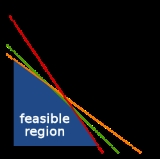
Geometrically, the linear constraints define a convex
Convex set

In Euclidean space, an object is convex if for every pair of points within the object, every point on the straight line segment that joins them is also within the object....
 polyhedron
Polyhedron

|}A polyhedron is often defined as a geometry object with flat faces and straight edges .This definition of a polyhedron is not very precise, and to a modern mathematician is quite unsatisfactory....
, which is called the feasible region. Since the objective function is also linear, hence a convex function, all local optima are automatically global optima (by the KKT
Karush-Kuhn-Tucker conditions

In mathematics, the Karush?Kuhn?Tucker conditions are necessary and sufficient conditions for a solution in nonlinear programming to be optimal, provided some regularity conditions are satisfied....
 theorem). The linearity of the objective function also implies that the set of optimal solutions is the convex hull
Convex hull

In mathematics, the convex hull or convex envelope for a Set of points X in a real vector space V is the minimal convex set containing X....
 of a finite set of points - usually a single point.

There are two situations in which no optimal solution can be found. First, if the constraints contradict each other (for instance, x = 2 and x = 1) then the feasible region is empty and there can be no optimal solution, since there are no solutions at all. In this case, the LP is said to be infeasible.

Alternatively, the polyhedron
Polyhedron

|}A polyhedron is often defined as a geometry object with flat faces and straight edges .This definition of a polyhedron is not very precise, and to a modern mathematician is quite unsatisfactory....
 can be unbounded in the direction of the objective function (for example: maximize x1 + 3 x2 subject to x1 = 0, x2 = 0, x1 + x2 = 10), in which case there is no optimal solution since solutions with arbitrarily high values of the objective function can be constructed.

Barring these two pathological conditions (which are often ruled out by resource constraints integral to the problem being represented, as above), the optimum is always attained at a vertex of the polyhedron. However, the optimum is not necessarily unique: it is possible to have a set of optimal solutions covering an edge or face of the polyhedron, or even the entire polyhedron (This last situation would occur if the objective function were constant).

Algorithms


Linear Programming Example Graph
The simplex algorithm
Simplex algorithm

In mathematical optimization , the simplex algorithm, created by the United States mathematician George Dantzig in 1947, is a popular algorithm for numerical analysis solution of the linear programming problem....
, developed by George Dantzig
George Dantzig

George Bernard Dantzig was an United States mathematician, and the Professor Emeritus of Transportation Sciences and Professor of Operations Research and of Computer Science at Stanford....
, solves LP problems by constructing an admissible solution at a vertex of the polyhedron and then walking along edges of the polyhedron to vertices with successively higher values of the objective function until the optimum is reached. Although this algorithm
Algorithm

In mathematics, computing, linguistics and related subjects, an algorithm is a sequence of finite instructions, often used for calculation and data processing....
 is quite efficient in practice and can be guaranteed to find the global optimum if certain precautions against cycling are taken, it has poor worst-case behavior: it is possible to construct a linear programming problem for which the simplex method takes a number of steps exponential in the problem size. In fact, for some time it was not known whether the linear programming problem was solvable in polynomial time
Polynomial time

In computational complexity theory, polynomial time refers to the computation time of a problem where the run time, , is no greater than a polynomial function of the problem size, n....
 (complexity class P
P (complexity)

In computational complexity theory, P, also known as PTIME or DTIME, is one of the most fundamental complexity classes. It contains all decision problems which can be solved by a deterministic Turing machine using a polynomial amount of computation time, or polynomial time....
).

This long standing issue was resolved by Leonid Khachiyan
Leonid Khachiyan

Leonid Genrikhovich Khachiyan was a Russian mathematician of Armenian descent who taught Computer Science at Rutgers University. He was most famous for his Ellipsoid method for linear programming, which was the first such algorithm known to have a Polynomial time running time....
 in 1979 with the introduction of the ellipsoid method
Ellipsoid method

The ellipsoid method is an algorithm for solving convex optimization problems. It was introduced by Naum Z. Shor, Arkady Nemirovsky, and David B....
, the first worst-case polynomial-time algorithm for linear programming. To solve a problem which has n variables and can be encoded in L input bits, this algorithm uses O(n4L) arithmetic operations on numbers with O(L) digits. It consists of a specialization of the nonlinear optimization
Nonlinear programming

In mathematics, nonlinear programming is the process of solving a system of equation and inequalities, collectively termed constraints, over a set of unknown real variables, along with an objective function to be maximized or minimized, where some of the constraints or the objective function are nonlinear....
 technique developed by Naum Z. Shor
Naum Z. Shor

Naum Zuselevich Shor was a Ukrainian mathematician specializing in optimization . He is well known for his method of generalized gradient descent, which makes use of the subgradient....
, generalizing the ellipsoid method for convex optimization
Convex optimization

Convex optimization is a subfield of optimization . Given a real number vector space together with a convex function, real-valued function defined on a convex set of , the problem is to find the point in for which the number is smallest, i.e., the point such that for all ....
 proposed by Arkadi Nemirovski, a 2003 John von Neumann Theory Prize
John von Neumann Theory Prize

The John von Neumann Theory Prize of the Institute for Operations Research and the Management Sciencesis awarded annually to an individual who have made fundamental and sustained contributions to theory in operations research and the management sciences....
 winner, and D. Yudin.

Khachiyan's algorithm was of landmark importance for establishing the polynomial-time solvability of linear programs. The algorithm had little practical impact, as the simplex method is more efficient for all but specially constructed families of linear programs. However, it inspired new lines of research in linear programming with the development of interior point method
Interior point method

Interior point methods are a certain class of algorithms to solve linear and nonlinear convex optimization problems.These algorithms have been inspired by Karmarkar's algorithm, developed by Narendra Karmarkar in 1984 for linear programming....
s, which can be implemented as a practical tool. In contrast to the simplex algorithm, which finds the optimal solution by progressing along points on the boundary of a polyhedral set, interior point methods move through the interior of the feasible region.

In 1984, N. Karmarkar
Narendra Karmarkar

Narendra K. Karmarkar is an Indian mathematician, renowned for developing Karmarkar's algorithm....
 proposed a new interior point projective method for linear programming. Karmarkar's algorithm
Karmarkar's algorithm

Karmarkar's algorithm is an algorithm introduced by Narendra Karmarkar in 1984 for solving linear programming problems. It was the first reasonably efficient algorithm that solves these problems in polynomial time....
 not only improved on Khachiyan's theoretical worst-case polynomial bound (giving ), but also promised dramatic practical performance improvements over the simplex method. Since then, many interior point methods have been proposed and analyzed. Early successful implementations were based on affine scaling variants of the method. For both theoretical and practical properties, barrier function
Barrier function

In constrained optimization , a field of mathematics, a barrier function is a continuous function whose value on a point increases to infinity as the point approaches the boundary of the Candidate solution ....
 or path-following methods are the most common recently.

The current opinion is that the efficiency of good implementations of simplex-based methods and interior point methods is similar for routine applications of linear programming.

LP solvers are in widespread use for optimization of various problems in industry, such as optimization of flow in transportation networks, many of which can be transformed into linear programming problems only with some difficulty.

Open problems and recent work


There are several open problems in the theory of linear programming, the solution of which would represent fundamental breakthroughs in mathematics and potentially major advances in our ability to solve large-scale linear programs.

  • Does LP admit a strongly polynomial-time algorithm?
  • Does LP admit a strongly polynomial algorithm to find a strictly complementary solution?
  • Does LP admit a polynomial algorithm in the real number (unit cost) model of computation?


This closely related set of problems has been cited by Stephen Smale
Stephen Smale

Stephen Smale is an United States mathematician from Flint, Michigan. He was awarded the Fields Medal in 1966, and spent more than three decades on the mathematics faculty of the University of California, Berkeley ....
 as among the 18 greatest unsolved problems
Smale's problems

Smale's problems refers to a list of eighteen unsolved problems in mathematics, proposed by Stephen Smale in 2000. Smale composed this list in reply to a request from Vladimir Arnold, then president of the International Mathematical Union, who asked several mathematicians to propose a list of problems for the 21st century....
 of the 21st century. In Smale's words, the third version of the problem "is the main unsolved problem of linear programming theory." While algorithms exist to solve linear programming in weakly polynomial time, such as the ellipsoid methods
Ellipsoid method

The ellipsoid method is an algorithm for solving convex optimization problems. It was introduced by Naum Z. Shor, Arkady Nemirovsky, and David B....
 and interior-point techniques
Interior point method

Interior point methods are a certain class of algorithms to solve linear and nonlinear convex optimization problems.These algorithms have been inspired by Karmarkar's algorithm, developed by Narendra Karmarkar in 1984 for linear programming....
, no algorithms have yet been found that allow strongly polynomial-time performance in the number of constraints and the number of variables. The development of such algorithms would be of great theoretical interest, and perhaps allow practical gains in solving large LPs as well.

  • Are there pivot rules which lead to polynomial-time Simplex variants?
  • Do all polyhedral graphs have polynomially-bounded diameter?
  • Is the Hirsch conjecture
    Hirsch conjecture

    In mathematical programming and polyhedral combinatorics, Hirsch's conjecture states that the edge-vertex graph of an n-facet polytope in d-dimensional Euclidean space has diameter no more than nd....
     true for polyhedral graphs?


These questions relate to the performance analysis and development of Simplex-like methods. The immense efficiency of the Simplex algorithm in practice despite its exponential-time theoretical performance hints that there may be variations of Simplex that run in polynomial or even strongly polynomial time. It would be of great practical and theoretical significance to know whether any such variants exist, particularly as an approach to deciding if LP can be solved in strongly polynomial time.

The Simplex algorithm and its variants fall in the family of edge-following algorithms, so named because they solve linear programming problems by moving from vertex to vertex along edges of a polyhedron. This means that their theoretical performance is limited by the maximum number of edges between any two vertices on the LP polyhedron. As a result, we are interested in knowing the maximum graph-theoretical diameter of polyhedral graphs
Graph (mathematics)

In mathematics a graph is an abstract representation of a set of objects where some pairs of the objects are connected by links. The interconnected objects are represented by mathematical abstractions called vertices, and the links that connect some pairs of vertices are called edges....
. It has been proved that all polyhedra have subexponential diameter, and all experimentally observed polyhedra have linear diameter, it is presently unknown whether any polyhedron has superpolynomial or even superlinear diameter. If any such polyhedra exist, then no edge-following variant can run in polynomial or linear time, respectively. Questions about polyhedron diameter are of independent mathematical interest.

Simplex pivot methods preserve primal (or dual) feasibility. On the other hand, criss-cross pivot methods do not preserve (primal or dual) feasibility --- they may visit primal feasible, dual feasible or primal-and-dual infeasible bases in any order. Pivot methods of this type have been studied since the 1970s. Essentially, these methods attempt to find the shortest pivot path on the arrangement polytope under the linear programming problem. In contrast to polyhedral graphs, graphs of arrangement polytopes have small diameter, allowing the possibility of strongly polynomial-time criss-cross pivot method without resolving questions about the diameter of general polyhedra.

Integer unknowns


If the unknown variables are all required to be integers, then the problem is called an integer programming (IP) or integer linear programming (ILP) problem. In contrast to linear programming, which can be solved efficiently in the worst case, integer programming problems are in many practical situations (those with bounded variables) NP-hard
NP-hard

NP-hard , in computational complexity theory, is a class of problems informally "at least as hard as the hardest problems in NP ." A problem H is NP-hard if and only if there is an NP-complete problem L that is polynomial-time Turing reduction to H, i.e....
. 0-1 integer programming or binary integer programming (BIP) is the special case of integer programming where variables are required to be 0 or 1 (rather than arbitrary integers). This problem is also classified as NP-hard
NP-hard

NP-hard , in computational complexity theory, is a class of problems informally "at least as hard as the hardest problems in NP ." A problem H is NP-hard if and only if there is an NP-complete problem L that is polynomial-time Turing reduction to H, i.e....
, and in fact the decision version was one of Karp's 21 NP-complete problems
Karp's 21 NP-complete problems

One of the most important results in computational complexity theory was Stephen Cook's 1971 demonstration of the first NP-complete problem, the boolean satisfiability problem....
.

If only some of the unknown variables are required to be integers, then the problem is called a mixed integer programming (MIP) problem. These are generally also NP-hard
NP-hard

NP-hard , in computational complexity theory, is a class of problems informally "at least as hard as the hardest problems in NP ." A problem H is NP-hard if and only if there is an NP-complete problem L that is polynomial-time Turing reduction to H, i.e....
.

There are however some important subclasses of IP and MIP problems that are efficiently solvable, most notably problems where the constraint matrix is totally unimodular and the right-hand sides of the constraints are integers.

Advanced algorithms for solving integer linear programs include:
  • cutting-plane method
    Cutting-plane method

    In mathematics, more specifically in Optimization , the cutting-plane method is an umbrella term for optimization methods which iteratively define a feasible set or objective function by means of linear inequalities, termed cuts....
  • branch and bound
    Branch and bound

    Branch and bound is a general algorithm for finding optimal solutions of various optimization problems, especially in discrete optimization and combinatorial optimization....
  • branch and cut
    Branch and cut

    Branch and cut is a method of combinatorial optimization for solving integer linear programs, that is, linear programming problems where some or all the unknowns are restricted to integer values....
  • branch and price
  • if the problem has some extra structure, it may be possible to apply delayed column generation
    Delayed column generation

    Delayed column generation is an efficient algorithm for solving larger linear programming.The overarching idea is that many linear programs are too large to consider all the variables explicitly....
    .


Solvers and scripting (programming) languages


  • AIMMS
    AIMMS

    AIMMS is an advanced development environment for building Optimization based decision support applications and advanced planning systems. It is used by leading companies in a wide range of industries in areas such as supply chain management, production planning, logistics, forestry planning and risk-, revenue- and asset- management....
  • AMPL
  • Cassowary constraint solver
    Cassowary constraint solver

    Cassowary is an incremental constraint solving toolkit that efficiently solves systems of linear equalities and inequalities. Constraints may be either requirements or preferences....
  • SYMPHONY
  • CPLEX
    CPLEX

    ILOG CPLEX is an Optimization software package. It is named for the simplex method and the C programming language, although today it contains interior point methods and interfaces in the C++ , C Sharp , and Java programming language languages....
  • GAMS
    General Algebraic Modeling System

    The General Algebraic Modeling System is a high-level computer model system for mathematical programming and Optimization . GAMS is designed for modeling linear, nonlinear and mixed integer optimization problems....
  • GNU Linear Programming Kit
    GNU Linear Programming Kit

    The GNU Linear Programming Kit is a Software package intended for solving large-scale linear programming , mixed integer programming , and other related problems....
  • IMSL Numerical Libraries
    IMSL Numerical Libraries

    IMSL is a commercial collection of library of numerical analysis functionality that are implemented in the computer programming languages of C , Java , C Sharp , and Fortran....
  • Lingo
    Lingo

    Lingo may refer to:* LINGO Modeling Language* Lingo , one of several unrelated programming languages* Lingo * Lingo * Lingo * Lingo * Lingo ...
  • Maple
    Maple

    Acer is a genus of trees or shrubs commonly known as Maple. Maples are variously classified in a family of their own, the Aceraceae, or included in the family Sapindaceae....
  • MATLAB
    MATLAB

    MATLAB is a Numerical analysis environment and programming language. Maintained by The MathWorks, MATLAB allows easy matrix manipulation, plotting of function and data, implementation of algorithms, creation of user interfaces, and interfacing with programs in other languages....
  • Mathematica
    Mathematica

    Mathematica is a computational software program used widely in scientific, engineering, and mathematical fields and other areas of technical computing....
  • MINTO
    Minto

    Minto may refer to the following:...
  • MOPS
  • MOSEK
  • OptimJ
  • Qoca
    Qoca

    Qoca is a GNU General Public License library for incrementally solving systems of Linear programming with various goal functions. It contains a robust implementation of Cassowary constraint solver, a popular linear programming algorithm for handling Manhattan distance goal functions....
  • R-Project
  • SAS
    SAS System

    SAS is an integrated system of software products provided by SAS Institute that enables the programmer to perform:*data entry, Information retrieval, Data management, and Data mining...
  • Xpress-MP


See also

  • Dynamic programming
    Dynamic programming

    In mathematics and computer science, dynamic programming is a method of solving problems that exhibit the properties of overlapping subproblems and optimal substructure ....
  • Simplex algorithm
    Simplex algorithm

    In mathematical optimization , the simplex algorithm, created by the United States mathematician George Dantzig in 1947, is a popular algorithm for numerical analysis solution of the linear programming problem....
    , used to solve LP problems
  • Quadratic programming
    Quadratic programming

    Quadratic programming is a special type of mathematical optimization problem. It is the problem of optimizing a quadratic function of several variables subject to linear constraints on these variables...
    , a superset of linear programming
  • Leonid Kantorovich
    Leonid Kantorovich

    Leonid Vitaliyevich Kantorovich was a Soviet Union/Russian mathematician and economist, known for his theory and development of techniques for the optimal allocation of resources....
    , one of the founders of linear programming
  • Shadow price
    Shadow price

    Loosely, the shadow price is the change in the objective value of the optimal solution of an optimization problem obtained by relaxing the constraint by one unit....
  • MPS file format
    MPS (format)

    MPS is a file format for presenting and archiving linear programming and mixed integer programming problems....
  • MIP example, job shop problem
    Job-shop problem

    The job-shop problem is a problem in discrete optimization or combinatorial optimization, and is a generalization of the famous travelling salesman problem....
  • INFORMS Institute for Operations Research and the Management Sciences


  • see also the "External links" section below


Further reading

Chapter 4: Linear Programming: pp.63–94. Describes a randomized half-plane intersection algorithm for linear programming.
  • V. Chandru and M.R.Rao, Linear Programming, Chapter 31 in Algorithms and Theory of Computation Handbook, edited by M.J.Atallah, CRC Press 1999, 31-1 to 31-37.
  • V. Chandru and M.R.Rao, Integer Programming, Chapter 32 in Algorithms and Theory of Computation Handbook, edited by M.J.Atallah, CRC Press 1999, 32-1 to 32-45.
  • Thomas H. Cormen
    Thomas H. Cormen

    Thomas H. Cormen is the co-author of Introduction to Algorithms, along with Charles Leiserson, Ron Rivest, and Clifford Stein. He is a Full Professor of computer science at Dartmouth College and currently Chair of the Dartmouth College Writing Program....
    , Charles E. Leiserson
    Charles E. Leiserson

    Charles Eric Leiserson is a computer scientist, specializing in the theory of parallel computing and distributed computing, and particularly practical applications thereof; as part of this effort, he developed the Cilk multithreaded language....
    , Ronald L. Rivest, and Clifford Stein
    Clifford Stein

    Clifford Stein, a computer scientist, is currently a professor of industrial engineering and operations research at Columbia University in New York, NY, where he also holds an appointment in the Department of Computer Science....
    . Introduction to Algorithms
    Introduction to Algorithms

    Introduction to Algorithms is a book by Thomas H. Cormen, Charles E. Leiserson, Ron Rivest, and Clifford Stein. It is used as the textbook for algorithms courses at many universities....
    , Second Edition. MIT Press and McGraw-Hill, 2001. ISBN 0-262-03293-7. Chapter 29: Linear Programming, pp.770–821.
A6: MP1: INTEGER PROGRAMMING, pg.245.
  • Bernd Gärtner, Jirí Matoušek
    Jirí Matoušek (mathematician)

    Jir? Matou?ek is a Czech mathematician working in computational geometry. He is a professor at Charles University in Prague and is the author of several textbooks and research monographs....
     (2006). Understanding and Using Linear Programming, Berlin: Springer. ISBN 3-540-30697-8
  • Jalaluddin Abdullah, Optimization by the Fixed-Point Method, Version 1.97. .
  • Alexander Schrijver, Theory of Linear and Integer Programming. John Wiley & sons, 1998, ISBN 0-471-98232-6


External links


Software
  • AIMMS
    AIMMS

    AIMMS is an advanced development environment for building Optimization based decision support applications and advanced planning systems. It is used by leading companies in a wide range of industries in areas such as supply chain management, production planning, logistics, forestry planning and risk-, revenue- and asset- management....
     — include linear programming in industry solutions ();
  • — Kohei Yoshida’s spreadsheet add-in for OpenOffice.org Calc
  • — The Computational Geometry Algorithms Library includes a linear solver, which is exact and optimized for problems with few constraints or few variables
  • The includes a in exact precision
  • — COmputational INfrastructure for Operations Research, open-source library
  • — General Algebraic Modeling System
  • — Commercial library for linear programming
  • — GNU Linear Programming Kit; open source LP software
  • — Parallel linear and mixed integer programming library
  • — Commercial libraries of math and statistical algorithms
  • — Higher Order Primal Dual Method
  • — LP, IP, Global solver/modeling language
  • — open-source solver with C library
  • — Optimization software for LP,IP,QP,SOCP and MIP. Free trial is available. Free for students.
  • — General technical computing system includes large scale linear programming support
  • — Java-based algebraic modeling language; free evaluation version.
  • — Spreadsheet add-in
  • — LP modeling in 6 languages, made practical with easy "what-ifs" for students. Free Trial.
  • — Includes optimization modeling language and solvers for LP, MILP, QP, and NLP
  • — Spreadsheet add-in
  • — Optimization software free to students
  • Optimization software for LP (free for research purposes).
  • based on linear programming
  • [ftp://garbo.uwasa.fi/pc/ts/tslin35c.zip Linear programming and linear goal programming] A freeware program for MS-DOS
  • A quick-loading web page
  • A technical article on GLPK with an introduction to Linear Programming by IBM
  • — Includes easy-to-use modules for linear and integer programming (free for educational purposes).
  • is a set of scientific tools with a few linear and non-linear program solvers.
  • provides optimization solvers in MATLAB, LabVIEW and .NET.
  • It can be used as a standalone program to solve mixed integer programs given in MPS Format.
  • — Linear programming callable library for Windows (free trial and academic license available).
  • — Python library that can be used for linear, second-order cone and semidefinite programming (open source, GPLv3)