
| |
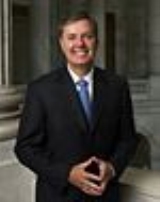
Lindsey Olin Graham (born July 9, 1955) is an American politician from South Carolina. A member of the Republican Party, he is currently the senior United States Senator from that state. He serves on the Armed Services and Judiciary Committees. As a reservist in the U.S. military, Graham is the only U.S. Senator to have served in both the Iraq and Afghanistan conflicts as a military attorney and advisor.
am was born in Central, South Carolina, where his father, Florence James Graham, owned a liquor store.

Discussion
Ask a question about 'Lindsey Graham'
Start a new discussion about 'Lindsey Graham'
Answer questions from other users
|
Quotations
Our footprint will be here for a long time. Were a long way from being able to leave with honor.
Of a visit he made to Iraq in February 2005.
The more you drink, the better youre able to cope in Washington.
January 05, 2005

Encyclopedia
Lindsey Olin Graham (born July 9, 1955) is an American politician from South Carolina. A member of the Republican Party, he is currently the senior United States Senator from that state. He serves on the Armed Services and Judiciary Committees. As a reservist in the U.S. military, Graham is the only U.S. Senator to have served in both the Iraq and Afghanistan conflicts as a military attorney and advisor.
Early life and education
Graham was born in Central, South Carolina, where his father, Florence James Graham, owned a liquor store. After graduating from high school, Graham became the first member of his family to attend college and joined the Reserve Officer Training Corps. When he was 21 his mother died, and his father died 15 months later. Because he and his sister were now left orphaned, the service allowed Graham to attend University of South Carolina in Columbia so he could be near home and care for his sister, whom he adopted. During his studies, he became a member of the fraternity Pi Kappa Phi.
Graham graduated from the University of South Carolina with a B.A. in Psychology in 1977 and from its school of law with a J.D. in 1981. Upon graduating, Graham was sent to Europe as a military prosecutor, and eventually entered private practice as a lawyer.
Military service
Graham decided to join the United States Air Force in 1982, and served on active duty until 1988. Following his departure he stayed in the military, joining the South Carolina Air National Guard and the U.S. Air Force Reserves. During the Gulf War, he was recalled to active duty, serving as a Judge Advocate at McEntire Air National Guard Station in Eastover, South Carolina, where he helped brief departing pilots on the laws of war.
In 2004, Graham received a promotion to Colonel in the U.S. Air Force Reserves at a White House ceremony officiated by President George W. Bush.
Graham served in Iraq as a reservist on active duty for short periods during April and two weeks in August 2007, where he worked on detainee and rule-of-law issues. That makes him the only Iraq war veteran serving in the United States Senate. In December 2008 Graham served 5 days at Camp Eggers in Kabul, Afghanistan, working with military lawyers.
Political career on the national stage
House of Representatives
In 1992, Graham was elected to the South Carolina House of Representatives from a district in Oconee County. After only one term, he was elected to the United States House of Representatives from South Carolina's 3rd congressional district in the northwestern part of the state after 20-year incumbent Butler Derrick retired. With U.S. Senator Strom Thurmond campaining on his behalf, Graham won by a large margin; the 3rd District had never elected a Republican before. In his first reelection bid, in 1996, Debbie Dorn, daughter of longtime 3rd District congressman W.J. Bryan Dorn and Derrick's niece, challenged Graham. However, Graham turned back this challenge fairly easily, winning by almost 20 points. He was unopposed for reelection in 1998 and handily defeated an underfunded Democrat in 2000.
In Congress, Graham quickly became powerful as a member of the Judiciary Committee during the impeachment of President Bill Clinton in 1998. Graham opposed some articles, but vigorously supported others. In January and February 1999, after two impeachment articles had been passed by the full House, he was one of the managers who brought the House's case to Clinton's trial in the Senate. Though the Senate did not convict Clinton, Graham became nationally known.
Senate
In 2002, upon Thurmond's retirement, the much younger Graham defeated his Democratic opponent, Alex Sanders, the president of the College of Charleston. He became South Carolina's first new Senator since 1965, and the state's first freshman Republican Senator since Reconstruction when sanctions were imposed on South Carolina by Radical Republicans. Graham served as Junior Senator for only 2 years, serving with U.S. Senator Ernest "Fritz" Hollings. Graham became Senior Senator in 2005 when Jim DeMint won election to Hollings' seat. In 2008, Graham was easily reelected against North Myrtle Beach native Bob Conley..
Legislative history
Legislative and Congressional committees on which Graham has served
SC House of Representatives: Judiciary Committee
U.S. House of Representatives
U.S. Senate
- Committee on Health, Education, Labor, and Pensions, 2002–2004
- Committee on the Judiciary, 2002–present
- Committee on Armed Services, 2002–present
- Committee on the Budget, 2004–present
- Committee on Veterans' Affairs, 2007-Present
- Committee on Agriculture, Nutrition and Forestry, 2007-Present
- Special Committee on Aging, 2007–present
- Select Committee on Intelligence, 2007–present
Political views
Though Graham's stances are often conservative, he has gained a reputation for sometimes speaking out against or criticizing the party line, as well as being open to making compromises. Graham votes as a conservative roughly 90 percent of the time, roughly the same as Thurmond's record, but is considered to be more independent-minded than his Senate colleague, Jim DeMint.
Graham notably supported John McCain's presidential bid in 2000, and served as national co-chairman of McCain's 2008 presidential bid.
Gang of 14
On May 23 2005, Graham was one of the Gang of 14 senators to forge a compromise that brought a halt to the continued blockage of an up or down vote on judicial nominees. This compromise negated both the Democrats' threatened use of a filibuster and the so-called Republican "nuclear option" as described in the media. Under the agreement, the Democrats would retain the power to filibuster a Bush judicial nominee only in an "extraordinary circumstance", and three conservative Bush appellate court nominees (Janice Rogers Brown, Priscilla Owen and William Pryor) would receive a vote by the full Senate.
Detainee interrogations
In July 2005, Graham secured the declassification and release of memorandums outlining concerns made by senior military lawyers as early as 2003 about the legality of the interrogations of prisoners held at Guantanamo Bay.
In response to this and a June 2004 U.S. Supreme Court decision allowing detainees to file habeas corpus petitions to challenge their detentions, Graham authored an amendment to a Department of Defense Authorization Act attempting to clarify the authority of American courts which passed in November 2005 by a vote of 49-42 in the Senate despite opposition from human rights groups and legal scholars because of the lack of rights it provides detainees.
Graham has said he amended the Department of Defense Authorization Act in order to give military lawyers, as opposed to politically appointed lawyers, a more independent role in the oversight of military commanders. He has argued that two of the largest problems leading to the detainee abuse scandals at Guantanamo Bay and Abu Ghraib were this lack of oversight and troops' confusion over legal boundaries.
Graham further explains that military lawyers had long observed the provisions of the Uniform Code of Military Justice and the Geneva Convention, but that those provisions had not been considered by the Bush administration in decisions regarding the treatment of detainees in Guantanamo Bay. He has claimed that better legal oversight within the military’s chain of command will prevent future detainee abuse.
The Graham amendment was itself amended by Democratic Senator Carl Levin so that it would not strip the courts of their jurisdiction in cases like Hamdan v. Rumsfeld that had already been granted cert; this compromise version passed by a vote of 84-14, though it did little to satisfy many critics of the original language. The Graham-Levin amendment, combined with Republican Senator John McCain's amendment banning torture, became known as the Detainee Treatment Act and attempted to limit interrogation techniques to those in the U.S. Army Field Manual of Interrogation. Verbal statements by Senators at the time of the amendment's passage indicated that Congress believed that Levin's changes would protect the courts' jurisdiction over cases like Hamdan, though Levin and his cosponsor Senator Kyl placed in the Congressional Record a statement indicating that there would be no change.
In February 2006, Graham joined Senator Jon Kyl in filing an amicus brief in the Hamdan v. Rumsfeld case which appears to have been an attempt to mislead the Supreme Court by presenting an “extensive colloquy” added to the Congressional record but not included in the Dec 21 debate as evidence that "Congress was aware" that the Detainee Treatment Act of 2005 would strip the Supreme Court of jurisdiction to hear "pending cases, including this case" brought by the Guantanamo detainees.
Immigration reform
Graham has been an adamant supporter of "comprehensive immigration reform" and of S. 2611, the McCain-Kennedy Immigration Reform Bill of 2006 as well as the equally hotly debated S. 1348 of 2007, the Comprehensive Immigration Reform Act of 2007. Despite Graham's support the bill failed on a key Senate vote on June 28, 2007 and is unlikely to be revived. His view and support of the bill earned him the name Lindsey Grahamnesty by the media and staunch conservatives.
His positions on immigration, and in particular collaborating with Senator Kennedy, earned Graham the ire of conservative activists. Graham responded by saying, "We are going to solve this problem. We're not going to run people down. We're not going to scapegoat people. We're going to tell the bigots to shut up, and we're going to get this right." The controversy prompted conservative activists to support a primary challenge in 2008 by longtime Republican national committeeman Buddy Witherspoon, but Graham won the nomination by a large margin.
Bank Nationalization
On February 18, 2009, Graham was cited in a Reuters interview as supporting the option to nationalize US banks in order to avoid creating the so-call "Zombie Banks" that hampered Japan's economic growth. His announcement coincided with one of the heaviest weekly sell-offs on the US stock markets. The week ended with Citibank stock priced at $1.95 and Bank of America priced at $3.79. Chris Dodd and Alan Greenspan have also publicly condoned bank nationalization, while the Obama administration insists that the nationalization of banks is not in America's best interest.
Alito confirmation hearings
During the Judiciary Committee confirmation hearings for Judge Samuel Alito for a seat on the United States Supreme Court, Graham was accused by Democrats of having coached Alito before the hearings. Graham did express his support for him during the hearings. One of the most controversial moments of the hearings occurred when Graham asked Alito, "Are you really a closet bigot?" Alito answered "I'm not any kind of a bigot, I'm not." and Graham continued his statement by expressing his opinion that Alito definitely was not a bigot. Alito’s wife cried and left the hearing briefly.
Rosemary Alito, the judge's sister, said that her sister-in-law took the comments as a message of support. Rosemary responded with: "Martha understood them to be kind comments." "It was that expression of warmth, the feeling of support for Sam, that triggered an emotional response." After Samuel Alito's participation in the hearings ended, Martha-Ann Alito gave Graham a quick hug and he responded that he planned to give her children a book compiling "all the documents that we have from so many different people saying nice things about her husband."
Electoral history
|+ : Results 1994–2000
!|Year
!
!|Democrat
!|Votes
!|Pct
!
!|Republican
!|Votes
!|Pct
!
!|3rd Party
!|Party
!|Votes
!|Pct
!
|-
|1994
|
| |
| align="right" |59,932
| |40%
|
| |
| align="right" |90,123
| |60%
|
|
|
|
|
| |*
|-
|1996
|
| |Debbie Dorn
| align="right" |73,417
| |39%
|
| |Lindsey Graham
| align="right" |114,273
| |60%
|
| |Lindal Pennington
| |Natural Law
| align="right" |1,835
| align="right" |1%
|
|-
|1998
|
| |(no candidate)
| align="right" |
| |
|
| |Lindsey Graham
| align="right" |129,047
| |100%
|
| |Write-ins
| |
| align="right" |402
| align="right" |<1%
|
|-
|2000
|
| | (On United Citizens line) (Total)
| align="right" |64,917 2,253 67,170
| |29% 1% 30%
|
| |Lindsey Graham
| align="right" |150,180
| |68%
|
| |Adrian Banks
| |Libertarian
| align="right" |3,116
| align="right" |1%
| |*
|+ Senate elections in South Carolina (Class II): Results 2002–2008
!|Year
!
!|Democrat
!|Votes
!|Pct
!
!|Republican
!|Votes
!|Pct
!
!|3rd Party
!|Party
!|Votes
!|Pct
!
!|3rd Party
!|Party
!|Votes
!|Pct
!
|-
|2002
|
| |
| align="right" |487,359
| |44%
|
| |
| align="right" |600,010
| |54%
|
| |Ted Adams
| |Constitution
| align="right" |8,228
| align="right" |1%
|
| |Victor Kocher
| |Libertarian
| align="right" |6,648
| align="right" |1%
| |*
|-
|2008
|
| |
| align="right" |785,559
| |42%
|
| |Lindsey Graham
| align="right" |1,069,137
| |58%
|
| |Write-ins
| |
| align="right" |608
| align="right" |<1%
|
|
|
|
|
|
External links
| |
|
|