
Home      Discussion      Topics      Dictionary      Almanac
Signup       Login
Lincoln Mark series

Lincoln Mark series

Overview
The Lincoln Mark is a personal luxury car
Personal luxury car
A personal luxury car is a highly styled, luxury vehicle with an emphasis on image over practicality and performance. Emphasizing the comfort and satisfaction of its owner above all else, the personal luxury sacrifices passenger capacity, cargo room, and roadability in favor of style...

 manufactured by Lincoln
Lincoln (automobile)
Lincoln is the luxury brand of Ford Motor Company. Founded in 1917 by Henry M. Leland and acquired by Ford in 1922, Lincoln has manufactured vehicles since the 1920s. Leland named the brand after his longtime hero Abraham Lincoln.-History:...

 and offered in seven series from 1956 to 1998.

The Continental name was revived in 1955 as a separate Ford brand to produce the Continental Mark II
Continental Mark II
The Continental Mark II was a personal luxury car produced by the Continental Division of the Ford Motor Company in 1956 through 1957. Many aficionados of the automobile consider the Continental Mark II one of the classics of the postwar period...

. Luxury abound in the new Continental, one of the most exclusive and expensive automobiles made.

When Continental was merged with Lincoln in 1958 and the Lincoln Continental became the flagship model, the Mark continued to be sold as the Continental Mark II.
Discussion
Ask a question about 'Lincoln Mark series'
Start a new discussion about 'Lincoln Mark series'
Answer questions from other users
Full Discussion Forum
 
Encyclopedia
The Lincoln Mark is a personal luxury car
Personal luxury car
A personal luxury car is a highly styled, luxury vehicle with an emphasis on image over practicality and performance. Emphasizing the comfort and satisfaction of its owner above all else, the personal luxury sacrifices passenger capacity, cargo room, and roadability in favor of style...

 manufactured by Lincoln
Lincoln (automobile)
Lincoln is the luxury brand of Ford Motor Company. Founded in 1917 by Henry M. Leland and acquired by Ford in 1922, Lincoln has manufactured vehicles since the 1920s. Leland named the brand after his longtime hero Abraham Lincoln.-History:...

 and offered in seven series from 1956 to 1998.

History


The Continental name was revived in 1955 as a separate Ford brand to produce the Continental Mark II
Continental Mark II
The Continental Mark II was a personal luxury car produced by the Continental Division of the Ford Motor Company in 1956 through 1957. Many aficionados of the automobile consider the Continental Mark II one of the classics of the postwar period...

. Luxury abound in the new Continental, one of the most exclusive and expensive automobiles made.

When Continental was merged with Lincoln in 1958 and the Lincoln Continental became the flagship model, the Mark continued to be sold as the Continental Mark II. The Mark kept the Continental prefix until the introduction of a smaller Continental in 1982, becoming simply the Mark VII in 1984. The Mark VIII (1993–1998) was the last generation of the Mark and Lincoln's last personal luxury car
Personal luxury car
A personal luxury car is a highly styled, luxury vehicle with an emphasis on image over practicality and performance. Emphasizing the comfort and satisfaction of its owner above all else, the personal luxury sacrifices passenger capacity, cargo room, and roadability in favor of style...

.

Except for being offered offered as a Mark VI 4-door sedan between 1980 and 1983, Marks were exclusively 2-door coupes.

It is interesting to note that despite Continental's merging into Lincoln, the Marks (until Mark VII) are not marked as Lincolns except with the four-pointed star logo. Nowhere on the cars' marques, identification plates, or factory paperwork does the name "Lincoln" appear. The rocker panels in the cars, for instance, read "Ford".

Continental Mark II


The Continental Mark II was a unique and exclusive personal luxury car produced by a newly formed Continental Division of the Ford Motor Company
Ford Motor Company
The Ford Motor Company is an American multinational corporation based in Dearborn, Michigan, a suburb of Detroit. The automaker was founded by Henry Ford and incorporated on June 16, 1903. In addition to the Ford, Lincoln, and Mercury brands, Ford also owns Volvo Cars of Sweden, and a small stake...

 during 1956 and 1957. Many aficionados of the automobile consider the Continental Mark II one of the classics of the postwar period.

The new Continental was not intended to be the largest nor the most powerful automobile, but rather the most luxurious and elegant American car available. What emerged was something quite unlike other American cars of the period. While other makes experimented with flamboyant chrome-laden styling, the Continental Mark II sought to evoke a European simplicity of line and understated grace consistent with its name.

The Continental sported a Lincoln style spare tire hump, shared the new Lincoln Lincoln 368 in (6.0 L) V8 and running gear, and was sold and serviced at Lincoln dealerships, causing many to think of the Mark II as a Lincoln when it was technically not.

Most of the car was effectively hand-built to an exacting standard, including multiple coats of paint hand-sanded down and double-lacquered and polished to perfection. Due to this manufacturing process the Continental Mark II
Continental Mark II
The Continental Mark II was a personal luxury car produced by the Continental Division of the Ford Motor Company in 1956 through 1957. Many aficionados of the automobile consider the Continental Mark II one of the classics of the postwar period...

 cost US$10,000, as much as a Rolls-Royce or two top-of-the-line Cadillacs.

Famous owners included Elvis Presley
Elvis Presley
Elvis Aaron Presley was an American singer and actor. A cultural icon, he is commonly known simply as Elvis and is also sometimes referred to as The King of Rock 'n' Roll or The King....

, as well as Frank Sinatra
Frank Sinatra
Francis Albert "Frank" Sinatra was an American singer and actor.Beginning his musical career in the swing era with Harry James and Tommy Dorsey, Sinatra became a successful solo artist in the early to mid-1940s, being the idol of the "bobby soxers." His professional career had stalled by the...

, the Shah of Iran
Mohammad Reza Pahlavi
Mohammad Rezā Shāh Pahlavi, Shah of Iran, , was the emperor of Iran from 16 September 1941, until his overthrow by the Iranian Revolution on 11 February 1979...

, and a cross-section of the richest men in America.

Today, half of the original approximately 3000 cars still exist. Prices range between $8,000 for a running example in poor condition to $70,000 in concours shape.

Continental Mark III


The Lincoln Continental Mark III
Lincoln Continental Mark III
The Lincoln Continental Mark III was a personal luxury car produced by Lincoln and sold in North America in the 1969 through 1971 model years.-Introduction:...

 was manufactured by Lincoln
Lincoln (automobile)
Lincoln is the luxury brand of Ford Motor Company. Founded in 1917 by Henry M. Leland and acquired by Ford in 1922, Lincoln has manufactured vehicles since the 1920s. Leland named the brand after his longtime hero Abraham Lincoln.-History:...

 from 1968 to 1971, and according to Lee Iacocca
Lee Iacocca
Lido Anthony "Lee" Iacocca is an American businessman known for his revival of the Chrysler Corporation in the 1980s, serving as President and CEO from 1978 and additionally as chairman from 1979, until his retirement at the end of 1992. One of the most famous business people in the world, he was...

 in his 1984 autobiography, was created when Iacocca (then a top Ford
Ford Motor Company
The Ford Motor Company is an American multinational corporation based in Dearborn, Michigan, a suburb of Detroit. The automaker was founded by Henry Ford and incorporated on June 16, 1903. In addition to the Ford, Lincoln, and Mercury brands, Ford also owns Volvo Cars of Sweden, and a small stake...

 exec) directed design VP Gene Bordinat to "put a Rolls Royce grille on a Thunderbird."

The Mark III's role was to compete with Cadillac's front wheel drive Eldorado
Cadillac Eldorado
The Eldorado model was part of the Cadillac line from 1953 to 2002. The Cadillac Eldorado was the longest running American personal luxury car as it was the only one sold after the 1999 model year...

, which at the time held the upper rung in the Personal luxury car
Personal luxury car
A personal luxury car is a highly styled, luxury vehicle with an emphasis on image over practicality and performance. Emphasizing the comfort and satisfaction of its owner above all else, the personal luxury sacrifices passenger capacity, cargo room, and roadability in favor of style...

 market. Continental Mark III outsold its Cadillac rival in its first year.

While the Mark III took many of its design cues from the mainstream Ford Thunderbird
Ford Thunderbird
The Thunderbird , is an automobile manufactured by the Ford Motor Company in the United States over thirteen model generations from 1955 through to 2005...

, the ultimate effect was uniquely Lincoln. It featured the hallmark Rolls-Royce like grille, covered headlights, as well as the Continental spare tire hump in the trunk lid. The Mark III
Lincoln Continental Mark III
The Lincoln Continental Mark III was a personal luxury car produced by Lincoln and sold in North America in the 1969 through 1971 model years.-Introduction:...

 was one of the first vehicles to have power-controlled features and anti-lock brakes.
In 1970 the formerly optional vinyl roof
Vinyl roof
Vinyl roof refers to a vinyl covering for an automobile's top. This covering was originally designed to give the appearance of a convertible to models with a fixed roof, but eventually it evolved into a styling statement in its own right. Vinyl roofs were most popular in the American market, and...

 was made standard. Radial tires and tinted windows followed in 1971. The interior woodtrim was also upgraded to real wood in 1970.

Continental Mark IV


While the Mark IV
Lincoln Continental Mark IV
See Lincoln Mark for a complete overview of the Lincoln Mark Series.The Lincoln Continental Mark IV was a luxury car at the top end of the personal luxury car market sold under the Lincoln brand of the Ford Motor Company in North America between 1972 and 1976...

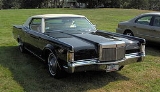
 carried over many design themes of the Mark III, such as the grille and spare-tire hump, it grew both longer and wider. The hallmark opera window
Opera window
Opera Windows are small porthole sized side windows in the C-pillar of some cars. Typically offered in unison with a vinyl roof, they were a very common design feature of American automobiles during the 1970s. The design was new at the time, "... and would prove to be very popular, indicated by its...

s were added for 1972, and in 1973 the front bumper was redesigned for the federally mandated 5 mph (8 km/h) bumper. In 1974 the rear bumper was also redesigned.

Powered by Lincoln's 460cid V8, the Mark was characterized by many standard power accessories and a richly appointed interior. The Mark IV, offered only as a two-door hardtop coupe, was heavier than the standard Continental. The Ford Thunderbird
Ford Thunderbird
The Thunderbird , is an automobile manufactured by the Ford Motor Company in the United States over thirteen model generations from 1955 through to 2005...

 was engineered on the same platform, and shared some of the Mark's styling and features, but for 1977 the Thunderbird was moved to a smaller platform.

Designer Editions


For the 1974 model year, Lincoln introduced the Designer Series; special edition Mark IVs with color, trim and interior choices by famous fashion designers. All carried the designer's signature on the opera windows, and had a 22 karat (92%) gold plated plaque on the instrument panel which could be engraved with the original owner's name. The concept was successful, and future Lincolns would continue to offer designer editions.

For 1974, four designer editions were offered:
  • The Bill Blass
    Bill Blass
    William Ralph "Bill" Blass was an American fashion designer, born in Fort Wayne, Indiana. He is known for his tailoring and his innovative combinations of textures and patterns...

     Edition
    was in dark blue with cream accents. The external finish was dark blue metallic paint, with a cream "Normande Grain" landau vinyl roof, cream and gold pinstriping, and cream or dark blue bodyside moldings. Inside, a blue cloth or leather interior used cream accent straps and buttons.
  • The Cartier
    Cartier SA
    Cartiers SA is a French jeweller and watch manufacturer that is a subsidiary of Switzerland's Compagnie Financière Richemont SA. The corporation carries the name of the Cartier family of jewelers whose control ended in 1964 and who were known for numerous pieces including the "Bestiary" , the diamond...

     Edition
    was in dove grey. The external finish was dove grey paint, with a dove grey "Valino Grain" landau vinyl roof, red and white pinstriping, and dove grey bodyside moldings. The interior was in dove grey cloth or leather.
  • The Givenchy
    Givenchy
    Givenchy is a French brand of clothing, accessories, perfumes and cosmetics with Parfums Givenchy.The house of Givenchy was founded in 1952 by designer Hubert de Givenchy and is a member of Chambre Syndicale de la Haute Couture et du Pret-a-Porter...

     Edition
    was in aqua blue. The external finish was aqua blue "Diamond Fire" paint, with a white "Normande Grain" landau vinyl roof, black and white pinstriping, and white or aqua blue bodyside moldings. The interior was in aqua blue cloth or leather, and the instrument panel was in a special, lighter shade of simulated woodgrain.
  • The Pucci
    Pucci
    Pucci may refer to:*one of several people named Antonio Pucci*Cindy Pucci, American model*Emilio Pucci , Italian fashion designer*Enrico Pucci, fictional character from JoJo's Bizarre Adventure*Lou Taylor Pucci , American actor...

     Edition
    was in red and silver. The external finish was dark red "Moondust Finish" paint with a silver "Normande Grain" landau vinyl roof, silver and lipstick red pinstriping and red or silver bodyside moldings. The interior was in dark red "Majestic" cloth.

Continental Mark V


The behemoth Lincoln Continental Mark V was sold for only three model years: 1977 to 1979. The last of the true highway cruisers, it replaced the Mark IV's more rounded styling with a more sharp-edged look that was then fashionable. Once again, its size increased both in length and width. It no longer shared its platform with the Ford Thunderbird (which was downsized by shifting its nameplate to the smaller Mercury Cougar/Ford LTD II platform.)

The 460 in³ of the Mark IV remained the standard engine of the Mark V for the 1977 model year. In 1978, the Ford 400 in³ (6.6 L) small-block engine replaced the 460 in³ as standard equipment, the latter available as an option everywhere but in California
California
California is the most populous state in the United States, and the third largest by area. California is the second most populous sub-national entity in the Americas, behind only São Paulo, Brazil...

. The 460 made the car's performance aggressive while the 400 gave the car lackluster acceleration, although allowing Ford to meet CAFE
Café
A café , also spelled cafe, is an informal restaurant offering a range of hot meals and made-to-order sandwiches. This differs from a coffee house, which is a limited-menu establishment which focuses on coffee sales. Depending on the jurisdiction, a café may be licensed to serve alcohol. The term...

 requirements for the year. The 460 in³ option was deleted entirely for 1979.

Lincoln, with the Mark V and Continental, held out for the giant American car longer than anyone else, but after 1979 it would not be possible. Ford came dangerously close to violating the Corporate Average Fuel Economy laws that year, and subsequent models would be substantially smaller.

This Mark, which was an updated version of the '72–'76 model, was completely restyled; and to some degree re-engineered. The soft, rounded look of the '72 car was replaced with razor sharp lines. The vinyl top, the opera windows, the spring-loaded hood ornament, the vertical radiator grille, and large whitewall tires were all part of the package. Interior design remained similar to the Mark IV, with variants in the seat patterns and dashboard trim (while retaining the general dashboard layout of the IV) being the primary differences.

The Mark V was larger and more complex than its predecessor, coming just ten inches short of being long, yet, surprisingly nimble for a car of such gargantuan proportions. The electrical system and mechanical componentry shared less in common with other Ford products, and was harder to service than the corresponding equipment on the Mark IV.

The Mark V design proved to be a hit with customers, setting the highest sales record for any Mark edition automobile at the time, a record never ultimately surpassed by any subsequent Mark edition.

Diamond Jubilee Edition for 1978


To observe Ford Motor Company's 75th year in existence as an automobile manufacturer, the company produced two limited edition cars-the Diamond Jubilee Edition Continental Mark V and the Diamond Jubilee Edition Ford Thunderbird. Both cars were equipped with every luxury feature available to the individual models; the only option being a moonroof for both. Naturally, the Mark V was better equipped and also more expensive; even the brochure described it as "the most expensive domestic production car available". The optional package escalated the price to a then-exorbitant
US$23,000. It was available in only two color combinations-a metallic gold or metallic light "diamond" blue with matching velour interior (leather was not offered). The "opera window" featured the title of the car with a fake diamond dotting the "i" in "Diamond". Today these editions are considered quite collectible as an ultimate example of late-seventies automotive excesses.

Collector's Series for 1979


To commemorate a dying breed, Lincoln offered a "Collector's Series" edition for the 1979 Mark V and Continental sedan. This option package was quite extensive offering every Lincoln option available except for a moonroof, an engine block heater, and the choice of leather or velour Twin Comfort Lounge seats. It also offered a leather-bound owner's manual and tool kit. It was available in only three paint combinations-dark blue, white, and a rare medium blue with a dark blue vinyl top. Naturally, this option was quite costly pushing the price of a standard Mark V or Continental to almost US$22,000; an enormous sum for a domestically-produced automobile at the time. These editions today are among the most coveted by collectors of late-seventies model Lincolns.

Continental Mark VI


The 1980 design revision and change to the Panther platform
Ford Panther platform
The Ford Panther platform is one of Ford Motor Company's full-size, rear-wheel drive sedan automobile platforms; the other is the Australian Ford Falcon. It was introduced for the 1979 model year and has been significantly upgraded since then.-Overview:...

 significantly reduced the size of the vehicle—the new model was shorter and rode on a wheelbase shorter than before—and the new car was 500 pounds lighter. Nevertheless, aside from being the only Mark series ever available as a 4-door sedan, the Mark VI retained most of the styling cues of the 1977 Mark V. Even though the car was significantly smaller, it kept the hallmark opera windows, Rolls-Royce style grille and the trademark vestigial spare-tire hump on the deck lid.

As with other 1980 Lincolns, the Mark of that year was available with significantly increased levels of, at the time, high-technology electronic equipment. A digital instrument cluster using Vacuum Fluorescent Display
Vacuum fluorescent display
A vacuum fluorescent display is a display device used commonly on consumer-electronics equipment such as video cassette recorders, car radios, and microwave ovens. Unlike liquid crystal displays, a VFD emits a very bright light with clear contrast and can easily support display elements of...

s, pushbutton keyless entry, Automatic Overdrive (AOD) 4-speed automatic transmission
Automatic transmission
An automatic transmission is an automobile gearbox that can change gear ratios automatically as the vehicle moves, freeing the driver from having to shift gears manually...

, and fuel injection on the 302 in³ (4.9 L) engine were all new introductions for 1980. Reliability of these systems was problematic for the first few years, which earned these cars a poor reliability record for 1980, 1981 and 1982. Revisions and modifications to the electronics improved the cars' reliability record for 1983.

With the Continental and Mark V retired after 1979, the new Lincolns for 1980 were highly anticipated cars. When Ford introduced the downsized Lincolns to the press, they were an immediate hit, being more efficient and more spacious than the corresponding Cadillacs of the same year, which had been downsized for 1977. The new Lincolns used new assembly techniques, and had aluminum pieces in the body and mechanicals to lighten the cars, in addition to the weight loss they received from the redesign. The old 460cid V8 was history, replaced by a fuel-injected version of Ford's 302cid (5.0 liter) V8, and a carbureted version of the 351cid V8, though the latter lasted only for 1980.

The basic body was shared between Town Car
Lincoln Town Car
The Lincoln Town Car is a full-size, rear-wheel drive luxury sedan sold by Ford's upscale Lincoln brand. The Town Car features a V8 engine and large exterior and interior dimensions....

 and Mark VI, but the Mark bore more resemblance to the Mark V, with hidden headlamps, the spare tire bulge on the trunk, the vinyl top and opera windows, etc. For the only time, the Mark series was offered as a four door sedan, but both Marks were dropped after '83 in favor of a new Mark VII, and a small Continental sedan (meant to replace Lincoln's unsuccessful Versailles mid-size). A super-rare car, of potential interest to collectors, is the '80-'81 Town Coupe, which sold only about 3000 copies before being consigned to the pages of history. The Town Car and Town Coupe bore more resemblance to the old standard Continentals of the seventies, but were thoroughly modern. The success of the Mark VI, however, effectively killed off interest in the Town Coupe. The Town Car, however, continued to be Lincoln's best seller for the rest of the 1980s. All told, these Lincolns are quiet, reliable, roomy cars.

Signature Series and Designer Series


Carrying on a tradition it created in the mid-seventies, Lincoln continued to offer designer editions of its cars into the eighties as well. The newly restyled Mark series was no exception. For 1980 a "Signature Series" was available in both coupe and sedan formats. This edition basically copied the option package from 1979's "Collector's Series" including almost every Lincoln option available. These cars were available in either burgundy or silver exterior colors, and the interior was red only, in either leather or velour. Unique features included a rechargeable glove box flashlight, and a leather bound tool kit in the trunk. The Cartier, Pucci, Blass and Givenchy designer series editions were offered in 1980. In 1981 the "Signature Series" edition was offered again in red or silver, with a choice of black or white exterior colors being added near the end of the model year. The interior color on these Signature Series cars was red only. The designer editions were offered for the coupe model only. These designers included Bill Blass, Cartier, Emilio Pucci, and Givenchy. Each designer edition carried exclusive exterior and interior color combinations as well as more optional equipment over the standard model. In 1982 designer editions received a shuffle of sorts as the sedan was now available as an Emilio Pucci edition removing this package from the coupe. The remaining designers-Bill Blass and Givenchy-were available on the coupe; the Cartier edition was no longer offered. The "Signature Series" carried on as well, but lost its exclusive colors, as these cars were now available in any exterior color and any interior color. The tool kit and glove box flashlight were gone as well. For 1983 the Givenchy Edition was dropped and model line-up consisted of the standard coupe/sedan, the "Signature Series" coupe/sedan, the Bill Blass Edition coupe, and the Emilio Pucci Edition sedan. The Blass edition retained its' now iconic "carriage roof" (convertible-look) and a unique exterior paint combination exclusive to the model. The Emilio Pucci Edition shared this roof treatment for 1983 and had a unique exterior color as well. The coupe version of the Emilio Pucci Designer edition was a mid-year introduction.

Mark VII


The Continental Mark VII, later just called the Mark VII, was introduced in 1984. The Continental Mark VII used the Ford Fox platform
Ford Fox platform
The Ford Fox platform is a rear wheel drive, unitized-chassis, automobile architecture that Ford used for 16 years in the North American market...

, which was originally used by the 1978 Ford Fairmont
Ford Fairmont
The Ford Fairmont was a North American compact car, produced between 1978 and 1983.The 1978 Ford Fairmont was the first vehicle built on the Ford Fox platform, which would be the basis for a variety of other models, including the 1980 to 1988 Thunderbird, the 1981 to 1982 American Ford Granada, the...

 and Mercury Zephyr
Mercury Zephyr
The Mercury Zephyr was a compact car sold by the Lincoln-Mercury division of Ford Motor Company in the North American market from 1978 to 1983. Along with its corporate cousin the Ford Fairmont, it was the first use of Ford's long-lived unibody Fox platform, which did not completely leave...

. It was manufactured at the Wixom Assembly Plant in Wixom, Michigan
Wixom, Michigan
Wixom is a city in Oakland County in the U.S. state of Michigan. The population was 13,263 at the 2000 census. The city was home to the former Wixom Assembly Plant, which produced the Lincoln LS, the Ford Thunderbird, the Ford GT, and the Lincoln Town Car...

 through 1992.

The Mark VII had most comfort/convenience/performance options that were available in the 1980s. This included all power accessories, leather seating, keyless entry, an onboard computer/message center, digital instruments (on all except the LSC models after 1986). All Mark VIIs came with full air suspension
Air suspension
Air suspension is a type of vehicle suspension powered by an engine driven or electric air pump or compressor. This pump pressurizes the air, using compressed air as a spring. Air suspension replaces conventional steel springs. If the engine is left off for an extended period, the car will settle...

 with an electronic ride control
Ride quality
Ride quality refers to the degree of protection offered vehicle occupants from uneven elements in the road surface, or the terrain if driving off-road. A car with very good ride quality is also a comfortable car to ride in. Cars which disturb vehicle occupants with major or minor road...

 system. Mark VIIs also came with a 4-speed automatic transmission, stainless steel tubular headers, dual exhaust, and either SEFI or throttle body fuel injection (dependent on model). Some 1987 models and all 1988 models got a horsepower and torque boost thanks to a larger throttle body and better flowing cylinder heads.

The Mark VII was also the first American vehicle with electronic 4-channel anti-lock brakes (November 1984, six months before the Corvette). It was also the first American vehicle with composite headlights. The vehicle also featured a unique four-wheel air suspension which while being quite reliable for the most part, received a poor reputation for the simple fact that most Lincoln dealership personnel were unfamiliar with diagnosing and repairing the system if a customer returned a malfunctioning car to the dealership for service to the air suspension. The typical repair usually consisted of the dealer mechanics recommending the wholesale replacement of most major components of the air suspension system, often priced at upwards of $2000-$3000...a repair price that easily would send the typical owner of a 5 year (or so) Mark VII into fits of apoplexy. A quick sale of the car to the first buyer that came along was often the result. Unfortunate, really for the Mark VII air suspension is in fact quite a reliable and effective system, and many Mark VII enthusiasts have discovered just how simple to work on and gratifying to own and experience this feature is on these particular cars.

Lincoln once again downsized the Mark series in 1984. As it had in the mid-seventies, the Mark shared a platform with the Ford Thunderbird
Ford Thunderbird
The Thunderbird , is an automobile manufactured by the Ford Motor Company in the United States over thirteen model generations from 1955 through to 2005...

. Though the Mark VII featured substantially different styling, the resemblance to the Thunderbird was apparent. The Mark was one of the first cars in the US to use headlamps that were flush with the body, creating a very aerodynamic look that the Thunderbird didn't receive until 1987. The standard engine was Ford's 302cid V8, equipped with fuel injection. For enthusiasts, a high-output version of this engine was available in the Mk VII LSC. The LSC model also included sport-tuned suspension and gearing. As the appeal of "personal luxury" coupes declined, the initially strong sales of the Mark VII declined as well. While the Thunderbird was completely redesigned in 1989, the Mark was unchanged until 1992, by which time sales had slowed considerably.

Trim levels

  • 1984–1987 Continental Mark VII (base)
  • 1984–1985 Versace Designer Edition
  • 1984–1992 Bill Blass Designer Edition
  • 1984–1992 LSC (Luxury Sport Coupe)
  • 1990–1992 LSC SE (Monochromatic paint and trim, Black, Garnet Red Metallic, Electric Current Red Metallic and Titanium Metallic)

Mark VIII


The Mark VIII
Lincoln Mark VIII
Introduced for the 1993 model year, the completely new Lincoln Mark VIII was a large, rear-wheel drive grand touring luxury coupe that was the successor to the Mark VII. The Mark VIII was built at Ford's Wixom, Michigan assembly plant and was based on the FN10 platform, a relative of the MN12...

 was Lincoln's last Personal luxury car
Personal luxury car
A personal luxury car is a highly styled, luxury vehicle with an emphasis on image over practicality and performance. Emphasizing the comfort and satisfaction of its owner above all else, the personal luxury sacrifices passenger capacity, cargo room, and roadability in favor of style...

, sold between 1993 and 1998. The Mark VIII was assembled at Ford's Wixom, Michigan assembly plant and was based on the FN10 platform. The 1996 LSC model got 10 hp (7.5 kW) more, true dual exhaust, lower (3.27) gearing and other luxury features. The 1996 LSC was the first car from an American automaker to be equipped with HID headlights, and the 1997 to 1998 models continued the groundbreaking lighting trend with even larger housings for the HID system, and an innovative neon third brakelight across the entire rear decklid.
See also Lincoln Mark VIII
Lincoln Mark VIII
Introduced for the 1993 model year, the completely new Lincoln Mark VIII was a large, rear-wheel drive grand touring luxury coupe that was the successor to the Mark VII. The Mark VIII was built at Ford's Wixom, Michigan assembly plant and was based on the FN10 platform, a relative of the MN12...

 for a more in-depth view.

See also

  • Continental Mark II
    Continental Mark II
    The Continental Mark II was a personal luxury car produced by the Continental Division of the Ford Motor Company in 1956 through 1957. Many aficionados of the automobile consider the Continental Mark II one of the classics of the postwar period...

  • Lincoln Continental Mark III
    Lincoln Continental Mark III
    The Lincoln Continental Mark III was a personal luxury car produced by Lincoln and sold in North America in the 1969 through 1971 model years.-Introduction:...

  • Lincoln Continental Mark IV
    Lincoln Continental Mark IV
    See Lincoln Mark for a complete overview of the Lincoln Mark Series.The Lincoln Continental Mark IV was a luxury car at the top end of the personal luxury car market sold under the Lincoln brand of the Ford Motor Company in North America between 1972 and 1976...

  • Lincoln Continental Mark V
    Lincoln Continental Mark V
    See Lincoln Mark for a complete overview of the Lincoln Mark Series.The Lincoln Continental Mark V was a large coupe sold by Lincoln, the Ford Motor Company's luxury division, between the 1977 and 1979 model years. The Mark V was a restyled Mark IV, replacing that car's more rounded styling with a...

  • Lincoln Continental Mark VII
    Lincoln Continental Mark VII
    See Lincoln Mark for a complete overview of the Lincoln Mark Series.The Continental Mark VII, later shortened to just Mark VII, was a rear wheel drive luxury coupe from Lincoln...