

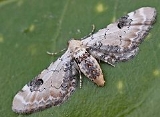
Lime-speck Pug

Encyclopedia
The Lime-speck Pug is a moth
of the family Geometridae
. It is a common species throughout the Palearctic
region, the Near East
and North Africa
.
This is a distinctive species, all the wings being white except for a black blotch on the costa
of the forewing. The wingspan
is 20–24 mm. Often two broods are produced each year and the adults can be seen at any time during the summer and autumn. The species flies at night and is attracted to light and nectar-rich flower
s.
The larva
is rather variable but is usually green or yellow, often with red markings. It feeds on the flowers of a variety of plant
s (see list below). The species overwinters as a pupa
.
Moth
A moth is an insect closely related to the butterfly, both being of the order Lepidoptera. Moths form the majority of this order; there are thought to be 150,000 to 250,000 different species of moth , with thousands of species yet to be described...
of the family Geometridae
Geometer moth
The geometer moths or Geometridae are a family of the order Lepidoptera...
. It is a common species throughout the Palearctic
Palearctic
The Palearctic or Palaearctic is one of the eight ecozones dividing the Earth's surface.Physically, the Palearctic is the largest ecozone...
region, the Near East
Near East
The Near East is a geographical term that covers different countries for geographers, archeologists, and historians, on the one hand, and for political scientists, economists, and journalists, on the other...
and North Africa
Africa
Africa is the world's second largest and second most populous continent, after Asia. At about 30.2 million km² including adjacent islands, it covers 6% of the Earth's total surface area and 20.4% of the total land area...
.
This is a distinctive species, all the wings being white except for a black blotch on the costa
Glossary of Lepidopteran terms
This glossary describes the terms used in the formal descriptions of insect species, jargon used mostly by professionals or entomologist....
of the forewing. The wingspan
Wingspan
The wingspan of an airplane or a bird, is the distance from one wingtip to the other wingtip. For example, the Boeing 777 has a wingspan of about ; and a Wandering Albatross caught in 1965 had a wingspan of , the official record for a living bird.The term wingspan, more technically extent, is...
is 20–24 mm. Often two broods are produced each year and the adults can be seen at any time during the summer and autumn. The species flies at night and is attracted to light and nectar-rich flower
Flower
A flower, sometimes known as a bloom or blossom, is the reproductive structure found in flowering plants . The biological function of a flower is to effect reproduction, usually by providing a mechanism for the union of sperm with eggs...
s.
The larva
Larva
A larva is a distinct juvenile form many animals undergo before metamorphosis into adults. Animals with indirect development such as insects, amphibians, or cnidarians typically have a larval phase of their life cycle...
is rather variable but is usually green or yellow, often with red markings. It feeds on the flowers of a variety of plant
Plant
Plants are living organisms belonging to the kingdom Plantae. Precise definitions of the kingdom vary, but as the term is used here, plants include familiar organisms such as trees, flowers, herbs, bushes, grasses, vines, ferns, mosses, and green algae. The group is also called green plants or...
s (see list below). The species overwinters as a pupa
Pupa
A pupa is the life stage of some insects undergoing transformation. The pupal stage is found only in holometabolous insects, those that undergo a complete metamorphosis, going through four life stages; embryo, larva, pupa and imago...
.
Recorded food plants
- Achillea - YarrowYarrowAchillea millefolium or yarrow is a flowering plant in the family Asteraceae, native to the Northern Hemisphere. In New Mexico and southern Colorado, it is called plumajillo, or "little feather", for the shape of the leaves. In antiquity, yarrow was known as herbal militaris, for its use in...
- AngelicaAngelicaAngelica is a genus of about 60 species of tall biennial and perennial herbs in the family Apiaceae, native to temperate and subarctic regions of the Northern Hemisphere, reaching as far North as Iceland and Lapland...
- Arctium - BurdockBurdockBurdock is any of a group of biennial thistles in the genus Arctium, family Asteraceae. Native to the Old World, several species have been widely introduced worldwide....
- ArtemisiaArtemisia (plant)Artemisia is a large, diverse genus of plants with between 200 to 400 species belonging to the daisy family Asteraceae. It comprises hardy herbs and shrubs known for their volatile oils. They grow in temperate climates of the Northern Hemisphere and Southern Hemisphere, usually in dry or semi-dry...
- CallunaCallunaCalluna vulgaris is the sole species in the genus Calluna in the family Ericaceae. It is a low-growing perennial shrub growing to tall, or rarely to and taller, and is found widely in Europe and Asia Minor on acidic soils in open sunny situations and in moderate shade...
- Heather - CampanulaCampanulaCampanula is one of several genera in the family Campanulaceae with the common name bellflower. It takes its name from their bell-shaped flowers—campanula is Latin for "little bell"....
- CentaureaCentaureaCentaurea is a genus of between 350 and 600 species of herbaceous thistle-like flowering plants in the family Asteraceae. Members of the genus are found only north of the equator, mostly in the Eastern Hemisphere; the Middle East and surrounding regions are particularly species-rich...
- CirsiumCirsiumCirsium is a genus of perennial and biennial flowering plants in the Asteraceae, one of several genera known commonly as thistles. They are more accurately known as Plume thistles. These differ from other thistle genera in having feathered hairs to their achenes...
- Thistle - CrambeCrambeCrambe is a genus of Brassicaceae native to Europe, southwest and central Asia and eastern Africa. It includes among its species seakale , grown as a leaf vegetable, Crambe cordifolia which is grown as an herbaceous border perennial, and Crambe abyssinica, which is grown for an oil from the seeds...
- Filipendula - MeadowsweetMeadowsweetFilipendula ulmaria, commonly known as Meadowsweet, is a perennial herb in the family Rosaceae that grows in damp meadows. It is native throughout most of Europe and Western Asia...
- GaliumGaliumGalium is a large genus of annual and perennial herbaceous plants in the family Rubiaceae, with 617 known species occurring in the temperate zones of both the Northern and Southern Hemispheres. Most species are known as bedstraw. G...
- Bedstraw - Hieracium - HawkweedHawkweedHawkweed refers to any species in the very large genus Hieracium and its segregate genus Pilosella, in the sunflower family ....
- LotusLotus (genus)Lotus is a genus that includes bird's-foot trefoils and deervetches and contains many dozens of species distributed world-wide. Depending on the taxonomic authority, roughly between 70 and 150 are accepted. Lotus is a genus of legume and its members are adapted to a wide range of habitats, from...
- Bird's-foot Trefoil - LysimachiaLysimachiaLysimachia is a genus of flowering plants. It is traditionally classified in the family Primulaceae but should, according to molecular phylogenetic study, be placed to the family Myrsinaceae .-Characteristics:...
- Yellow Loosestrife - Matricaria - MayweedMayweedMatricaria is a genus of flowering plants in the sunflower family . Some of the species have the common name of "mayweed," but this name also refers to plants not in this genus....
- Medicago - AlfalfaAlfalfaAlfalfa is a flowering plant in the pea family Fabaceae cultivated as an important forage crop in the US, Canada, Argentina, France, Australia, the Middle East, South Africa, and many other countries. It is known as lucerne in the UK, France, Australia, South Africa and New Zealand, and known as...
- Pimpinella - Burnet SaxifrageBurnet SaxifrageBurnet Saxifrage is a plant, Pimpinella saxifraga of the family Umbelliferae a native of the British Isles and temperate Europe and Western Asia...
- RumexRumexThe docks and sorrels, genus Rumex L., are a genus of about 200 species of annual, biennial and perennial herbs in the buckwheat family Polygonaceae....
- Sorrel - Selinum - Milk-parsley
- SileneSileneSilene is a genus of flowering plants in the family Caryophyllaceae. Common names include campion and catchfly....
- Bladder Campion - Solidago - GoldenrodGoldenrodSolidago, commonly called goldenrods, is a genus of about 100 species of flowering plants in the family Asteraceae. Most are herbaceous perennial species found in the meadows and pastures, along roads, ditches and waste areas in North America. There are also a few species native to Mexico, South...
- Tanacetum - TansyTansyTansy is a perennial, herbaceous flowering plant of the aster family, native to temperate Europe and Asia. It has been introduced to other parts of the world and in some areas has become invasive...
- Trifolium - Red CloverRed cloverTrifolium pratense is a species of clover, native to Europe, Western Asia and northwest Africa, but planted and naturalised in many other regions....
- Vicia - Tufted VetchTufted VetchVicia cracca , is a species of vetch native to Europe and Asia. It occurs on other continents as an introduced species, including North America, where it is a common weed...
Subspecies
There are two regognised subspecies:- Eupithecia centaureata centaureata
- Eupithecia centaureata centralisata