


Ligule

Encyclopedia
A ligule — is a thin outgrowth at the junction of leaf
and leafstalk of many grasses (Poaceae)
and sedges
or a strap-shaped corolla, such as that of a ray floret in plants in the daisy
family.
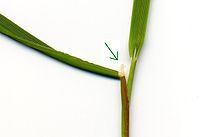 The ligule is found at the inner base of the leaf between where the leaf attaches to the main stem and the stem itself. It may take several forms but is commonly some form of translucent membrane or a fringe of hairs. The membranous ligule can be very short 1–2 mm (Kentucky Bluegrass, Poa pratensis) to very long 10–20 mm (Johnson grass
, Sorghum halepense), it can also be smooth on the edge or very ragged. Some grasses do not have a ligule, for example barnyardgrass (Echinochloa crus-galli
).
A ligule can also be defined as a membrane-like tissue or row of delicate hairs typically found in grasses at the junction of the leaf sheath and blade. The ligule appears to be a continuation of the leaf sheath and encircles or clasps the stem as does the leaf sheath. There are three basic types of ligules: membranous, a fringe of hairs (ciliate), and absent or lacking. Most grasses have ligules, and the shape, length, and appearance of the ligule margin provide consistent characters for separating genera and some species of grasses.
In grass-like plants such as sedges (Cyperaceae
) and rushes (Juncaceae
), ligules are usually absent or poorly developed.
 In members of Asteraceae
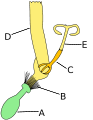
, "ligule" can also refer to the corolla of a ligulate floret.
Leaf
A leaf is an organ of a vascular plant, as defined in botanical terms, and in particular in plant morphology. Foliage is a mass noun that refers to leaves as a feature of plants....
and leafstalk of many grasses (Poaceae)
Poaceae
The Poaceae is a large and nearly ubiquitous family of flowering plants. Members of this family are commonly called grasses, although the term "grass" is also applied to plants that are not in the Poaceae lineage, including the rushes and sedges...
and sedges
Cyperaceae
Cyperaceae are a family of monocotyledonous graminoid flowering plants known as sedges, which superficially resemble grasses or rushes. The family is large, with some 5,500 species described in about 109 genera. These species are widely distributed, with the centers of diversity for the group...
or a strap-shaped corolla, such as that of a ray floret in plants in the daisy
Asteraceae
The Asteraceae or Compositae , is an exceedingly large and widespread family of vascular plants. The group has more than 22,750 currently accepted species, spread across 1620 genera and 12 subfamilies...
family.
Poaceae and Cyperaceae
Johnson grass
Sorghum halepense, commonly called Johnsongrass, is a plant in the grass family, Poaceae, native to the Mediterranean region, but growing throughout Europe and the Middle East. The plant has been introduced to all continents except Antarctica and most larger islands and archipelagos...
, Sorghum halepense), it can also be smooth on the edge or very ragged. Some grasses do not have a ligule, for example barnyardgrass (Echinochloa crus-galli
Echinochloa crus-galli
Echinochloa crus-galli is a type of wild grass originating from tropical Asia that was formerly classified as a type of panicum grass. It is commonly known as Cockspur , Common Barnyard Grass, or simply "barnyard grass"...
).
A ligule can also be defined as a membrane-like tissue or row of delicate hairs typically found in grasses at the junction of the leaf sheath and blade. The ligule appears to be a continuation of the leaf sheath and encircles or clasps the stem as does the leaf sheath. There are three basic types of ligules: membranous, a fringe of hairs (ciliate), and absent or lacking. Most grasses have ligules, and the shape, length, and appearance of the ligule margin provide consistent characters for separating genera and some species of grasses.
In grass-like plants such as sedges (Cyperaceae
Cyperaceae
Cyperaceae are a family of monocotyledonous graminoid flowering plants known as sedges, which superficially resemble grasses or rushes. The family is large, with some 5,500 species described in about 109 genera. These species are widely distributed, with the centers of diversity for the group...
) and rushes (Juncaceae
Juncaceae
Juncaceae, the rush family, are a monocotyledonous family of flowering plants. There are eight genera and about 400 species. Members of the Juncaceae are slow-growing, rhizomatous, herbaceous plants, and they may superficially resemble grasses. They often grow on infertile soils in a wide range...
), ligules are usually absent or poorly developed.
Asteraceae
Asteraceae
The Asteraceae or Compositae , is an exceedingly large and widespread family of vascular plants. The group has more than 22,750 currently accepted species, spread across 1620 genera and 12 subfamilies...
, "ligule" can also refer to the corolla of a ligulate floret.