
All Topics  
Light meter

 
Light Meter

   Email Print
   Bookmark   Link


Light meter


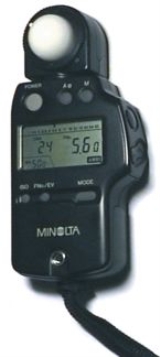
A light meter is a device used to measure the amount of light
Light

Light, or visible light, is electromagnetic radiation of a wavelength that is Visible spectrum to the human eye , or up to 380?750 nm. In the broader field of physics, light is sometimes used to refer to electromagnetic radiation of all wavelengths, whether visible or not....
. In photography
Photography

Photography is the process, activity and art of creating still or moving by recording radiation on a sensitive medium, such as a photographic film, or an ....
, a light meter is often used to determine the proper exposure
Exposure (photography)

In photography, exposure is the total amount of light allowed to fall on the photographic medium during the process of taking a photograph. Exposure is measured in lux seconds, and can be computed from exposure value and scene luminance over a specified area....
 for a photograph. Typically a light meter will include a computer, either digital or analogue, which allows the photographer to determine which shutter speed
Shutter speed

File:Sparklers with a slow shutter speed.JPGIn photography, shutter speed is a common term used to discuss exposure time, the effective length of time a shutter is open; the total Exposure is proportional to this exposure time, or duration of light reaching the Photographic film or ....
 and f-number
F-number

In optics, the f-number of an optical system expresses the diameter of the entrance pupil in terms of the focal length of the photographic lens; in simpler terms, the f-number is the focal length divided by the "effective" aperture diameter....
 should be selected for an optimum exposure, given a certain lighting situation and film speed
Film speed

Film speed is the measure of a photographic film sensitivity to light. Film with lower sensitivity requires a longer exposure and is thus called a slow film, while stock with higher sensitivity can shoot the same scene with a shorter exposure and is called a fast film....
.

Light meters are also used in the fields of cinematography
Cinematography

Cinematography , is the making of Stage lighting and camera choices when recording photographic s for the film. It is closely related to the art of photography....
 and scenic design
Scenic design

File:Robert Edmond Jones.jpgScenic design is the creation of Theatre, as well as film or television theatrical scenery. Scenic designers have traditionally come from a variety of artistic backgrounds, but nowadays, generally speaking, they are trained professionals, often with Master of Fine Arts degrees in theatre arts....
, in order to determine the optimum light level for a scene.


Discussion
Ask a question about 'Light meter'
Start a new discussion about 'Light meter'
Answer questions from other users
Full Discussion Forum


Encyclopedia


A light meter is a device used to measure the amount of light
Light

Light, or visible light, is electromagnetic radiation of a wavelength that is Visible spectrum to the human eye , or up to 380?750 nm. In the broader field of physics, light is sometimes used to refer to electromagnetic radiation of all wavelengths, whether visible or not....
. In photography
Photography

Photography is the process, activity and art of creating still or moving by recording radiation on a sensitive medium, such as a photographic film, or an ....
, a light meter is often used to determine the proper exposure
Exposure (photography)

In photography, exposure is the total amount of light allowed to fall on the photographic medium during the process of taking a photograph. Exposure is measured in lux seconds, and can be computed from exposure value and scene luminance over a specified area....
 for a photograph. Typically a light meter will include a computer, either digital or analogue, which allows the photographer to determine which shutter speed
Shutter speed

File:Sparklers with a slow shutter speed.JPGIn photography, shutter speed is a common term used to discuss exposure time, the effective length of time a shutter is open; the total Exposure is proportional to this exposure time, or duration of light reaching the Photographic film or ....
 and f-number
F-number

In optics, the f-number of an optical system expresses the diameter of the entrance pupil in terms of the focal length of the photographic lens; in simpler terms, the f-number is the focal length divided by the "effective" aperture diameter....
 should be selected for an optimum exposure, given a certain lighting situation and film speed
Film speed

Film speed is the measure of a photographic film sensitivity to light. Film with lower sensitivity requires a longer exposure and is thus called a slow film, while stock with higher sensitivity can shoot the same scene with a shorter exposure and is called a fast film....
.

Light meters are also used in the fields of cinematography
Cinematography

Cinematography , is the making of Stage lighting and camera choices when recording photographic s for the film. It is closely related to the art of photography....
 and scenic design
Scenic design

File:Robert Edmond Jones.jpgScenic design is the creation of Theatre, as well as film or television theatrical scenery. Scenic designers have traditionally come from a variety of artistic backgrounds, but nowadays, generally speaking, they are trained professionals, often with Master of Fine Arts degrees in theatre arts....
, in order to determine the optimum light level for a scene. They are used in the general field of lighting
Illumination

Illumination may refer to:*Illumination , the use of light sources*Illumination , the use of light and shadow in art*Illumination , the artistic decoration of hand-written texts...
, where they can help to reduce the amount of waste light used in the home, light pollution
Light pollution

Light pollution, also known as photopollution or luminous pollution, is excessive or obtrusive artificial light. The International Dark-Sky Association , "The Light Pollution Authority," defines light pollution as: It obscures the stars in the night sky for city dwellers, interferes with astronomy observatory, and, like an...
 outdoors, and plant growing to ensure proper light levels.

Use in photography


Digital Ambient Light Meter
The earliest type of light meters were called extinction
Extinction coefficient

Extinction coefficient refers to several different measures of the absorption of light in a medium:*In chemistry, the mass attenuation coefficient and the molar extinction coefficient are parameters defining how strongly a substance absorbs light at a given wavelength, per Mole or per molar concentration, respectively....
 meters
and contained a numbered or lettered row of neutral density filter
Neutral density filter

File:Strickland Falls Shadows Lifted.jpgIn photography and optics, a neutral density filter or ND filter is a "grey" filter. An ideal neutral density filter reduces light of all wavelengths or colors equally....
s of increasing density. The photographer would position the meter in front of their subject and note the filter with the greatest density that still allowed incident light to pass through. The letter or number corresponding to the filter was used as an index into a chart of appropriate aperture and shutter speed combinations for a given film speed
Film speed

Film speed is the measure of a photographic film sensitivity to light. Film with lower sensitivity requires a longer exposure and is thus called a slow film, while stock with higher sensitivity can shoot the same scene with a shorter exposure and is called a fast film....
.

Extinction meters suffered from the problem that they depended on the light sensitivity of the human eye
Luminosity function

The luminosity function or luminous efficiency function describes the average sensitivity of the human eye to light of different wavelengths....
 (which can vary from person to person) and subjective interpretation.

Later meters removed the human element and relied on technologies incorporating selenium
Selenium

Selenium is a chemical element with the atomic number 34, represented by the chemical symbol Se, an atomic mass of 78.96. It is a nonmetal, chemically related to sulfur and tellurium, and rarely occurs in its elemental state in nature....
, CdS
Cadmium sulfide

Cadmium Sulfur is a chemical compound with the formula CdS. Cadmium sulfide is yellow in colour and is a semiconductor. It exists in nature as two different minerals, greenockite and hawleyite....
, and silicon
Silicon

Silicon is the most common metalloid. It is a chemical element, which has the symbol Si and atomic number 14. The atomic mass is 28.0855....
 photodetector
Photodetector

Photosensors or photodetectors are sensors of light or other electromagnetic energy. There are several varieties:*optics detectors, which are mostly quantum devices in which an individual photon produces a discrete effect....
s.
Swiatlomierz1968rok Leningrad4
Autoexpmeter
Selenium and silicon light meters use sensors that are photovoltaic. These sensors generate a voltage proportional to light exposure. Selenium sensors generate enough voltage for direct connection to a meter. Silicon sensors need an amplification circuit and require a power source such as batteries
Battery (electricity)

In electronics, a battery or voltaic cell is a combination of one or more electrochemical cell Galvanic cells which store chemical energy that can be converted into electric potential energy, creating electricity....
 to operate. CdS light meters use a sensor based on photoresistance
Photoresistor

A photoresistor or light dependent resistor or cadmium sulfide cell is a resistor whose electrical resistance decreases with increasing incident light intensity....
. These also require a battery to operate. Most modern light meters use silicon or CdS sensors. They indicate the exposure either with a needle galvanometer
Galvanometer

A galvanometer is a type of ammeter: an instrument for detecting and measuring electric current. It is an Analogue electronics electromechanical transducer that produces a rotary deflection, through a limited arc, in response to electric current flowing through its coil....
 or on an LCD screen.

Many modern consumer still and video camera
Camera

A camera is a device that records images, either as a still photograph or as moving images known as videos or movies. The term comes from the camera obscura , an early mechanism of projecting images where an entire room functioned as a real-time imaging system; the modern camera evolved from the camera obscura....
s include a built-in meter that measures a scene-wide light level and are able to make an approximate measure of appropriate exposure based on that. Photographers working with controlled lighting and cinematographer
Cinematographer

A cinematographer is one photography with a motion picture camera . The title is generally equivalent to director of photography , used to designate a chief over the camera and lighting film crews working on a film, responsible for achieving artistic and technical decisions related to the image....
s use handheld light meters to precisely measure the light falling on various parts of their subjects and use suitable lighting to produce the desired exposure levels.

There are two general types of light meters: reflected-light and incident-light. Reflected-light meters measure the light reflected by the scene to be photographed. All in-camera meters are reflected-light meters. Reflected-light meters are calibrated to show the appropriate exposure for “average” scenes. An unusual scene with a preponderance of light colors or specular highlights would have a higher reflectance; a reflected-light meter taking a reading would incorrectly compensate for the difference in reflectance and lead to underexposure.

This pitfall is avoided by incident-light meters which measure the amount of light falling on the subject using an integrating sphere
Integrating sphere

An Integrating sphere is an optical component consisting of a hollow cavity with its interior coated for high diffuse reflection reflectivity , having relatively small holes as needed for entrance and exit ports....
 (usually, a translucent hemispherical plastic dome is used to approximate this). Because the incident-light reading is independent of the subject's reflectance, it is less likely to lead to incorrect exposures for subjects with unusual average reflectance. Taking an incident-light reading requires placing the meter at the subject's position and pointing it in the general direction of the camera, something not always achievable in practice, e.g., in landscape photography where the subject is at infinity.

Another way to avoid under- or over-exposure for subjects with unusual reflectance is to use a spot meter: a reflected-light meter that measures light in a very tight cone, typically with a one degree angle. An experienced photographer can take multiple readings over the shadows, midrange and highlights of the scene to determine optimal exposure, using systems like the Zone System
Zone system

The Zone System is a photography technique for determining optimal photographic film exposure and Photographic processing, formulated by Ansel Adams and Fred Archer in 1941....
. Many modern cameras include sophisticated multi-segment metering
Metering mode

In photography, the metering mode refers to the way in which a camera determines the exposure ....
 systems that measure the luminance
Luminance

Luminance is a Photometry measure of the luminous intensity per unit area of light travelling in a given direction. It describes the amount of light that passes through or is emitted from a particular area, and falls within a given solid angle....
 of different parts of the scene to determine the optimal exposure.

When using a film whose spectral sensitivity is not a good match to that of the light meter, for example orthochromatic
Orthochromatic

Orthochromatic refers to any spectrum of light that is devoid of red light....
 black-and-white or infrared film, the meter may require special filters and re-calibration to match the sensitivity of the film.

There are other types of specialized photographic light meters. Flash meters are used in flash photography to verify correct exposure. Color meters are used where high fidelity in color reproduction is required. Densitometer
Densitometer

A densitometer is a Measuring instrument that measures the degree of darkness of a photographic or semitransparent material or of a reflecting surface....
s are used in photographic reproduction.

Exposure meter calibration


In most cases, an incident-light meter will cause a medium tone to be recorded as a medium tone, and a reflected-light meter will cause whatever is metered to be recorded as a medium tone. What constitutes a “medium tone” depends on meter calibration and several other factors, including film processing or digital image conversion.

Meter calibration establishes the relationship between subject lighting and recommended camera settings. The calibration of photographic light meters is covered by ISO 2720:1974.

Exposure equations


For reflected-light meters, camera settings are related to ISO speed and subject luminance by the reflected-light exposure equation:

where

  • is the relative aperture
    Aperture

    In optics, an aperture is a hole or an opening through which light is admitted. More specifically, the aperture of an optical system is the opening that determines the cone angle of a bundle of ray that come to a focus in the ....
     (f-number
    F-number

    In optics, the f-number of an optical system expresses the diameter of the entrance pupil in terms of the focal length of the photographic lens; in simpler terms, the f-number is the focal length divided by the "effective" aperture diameter....
    )
  • is the exposure time (“shutter speed
    Shutter speed

    File:Sparklers with a slow shutter speed.JPGIn photography, shutter speed is a common term used to discuss exposure time, the effective length of time a shutter is open; the total Exposure is proportional to this exposure time, or duration of light reaching the Photographic film or ....
    ”) in seconds
  • is the average scene luminance
    Luminance

    Luminance is a Photometry measure of the luminous intensity per unit area of light travelling in a given direction. It describes the amount of light that passes through or is emitted from a particular area, and falls within a given solid angle....
  • is the ISO arithmetic speed
    Film speed

    Film speed is the measure of a photographic film sensitivity to light. Film with lower sensitivity requires a longer exposure and is thus called a slow film, while stock with higher sensitivity can shoot the same scene with a shorter exposure and is called a fast film....
  • is the reflected-light meter calibration constant


For incident-light meters, camera settings are related to ISO speed and subject illuminance by the incident-light exposure equation:

where

  • is the illuminance
    Illuminance

    In photometry , illuminance is the total luminous flux incident on a surface, per unit area. It is a measure of the intensity of the incident light, wavelength-weighted by the luminosity function to correlate with human brightness perception....
  • is the incident-light meter calibration constant


Calibration constants


Determination of calibration constants has been largely subjective; ISO 2720:1974 states that

The constants and shall be chosen by statistical analysis of the results of a large number of tests carried out to determine the acceptability to a large number of observers, of a number of photographs, for which the exposure was known, obtained under various conditions of subject manner and over a range of luminances.


In practice, the variation of the calibration constants among manufacturers is considerably less than this statement might imply, and values have changed little since the early 1970s.

ISO 2720:1974 recommends a range for of 10.6 to 13.4 with luminance in cd/m˛. Two values for are in common use: 12.5 (Canon
Canon Inc.

is a Japanese multinational corporation that specialises in the manufacture of imaging and optical products, including cameras, Photocopying and computer printers....
, Nikon
Nikon

, also known as Nikon or Nikon Corp., is a multinational corporation headquartered in Tokyo, Japan specializing in optics and imaging....
, and Sekonic) and 14 (Kenko and Pentax
Pentax

is a wholly owned division and brand name of Hoya Corporation. It succeeds to the business operations of , which was merged with and into Hoya on March 31, 2008....
); the difference between the two values is approximately 1/6 EV
Exposure value

In photography, exposure value denotes all combinations ofcamera shutter speed and relative aperture that give the sameexposure . The concept was developed in Germany in the 1950s...
.

The earliest calibration standards were developed for use with wide-angle averaging reflected-light meters (Jones and Condit 1941). Although wide-angle average metering has largely given way to other metering sensitivity patterns (e.g., spot, center-weighted, and multi-segment), the values for determined for wide-angle averaging meters have remained.

The incident-light calibration constant depends on the type of light receptor. Two receptor types are common: flat (cosine-responding) and hemispherical (cardioid
Cardioid

A cardioid is closed curve with one Cusp ....
-responding). With a flat receptor, ISO 2720:1974 recommends a range for of 240 to 400 with illuminance in lux; a value of 250 is commonly used. A flat receptor typically is used for measurement of lighting ratios, for measurement of illuminance, and occasionally, for determining exposure for a flat subject.

For determining practical photographic exposure, a hemispherical receptor has proven more effective. Don Norwood, inventor of incident-light exposure meter with a hemispherical receptor, thought that a sphere was a reasonable representation of a photographic subject. According to his patent (Norwood 1938), the objective was

to provide an exposure meter which is substantially uniformly responsive to light incident upon the photographic subject from practically all directions which would result in the reflection of light to the camera or other photographic register.


and the meter provided for "measurement of the effective illumination obtaining at the position of the subject."

With a hemispherical receptor, ISO 2720:1974 recommends a range for of 320 to 540 with illuminance in lux; in practice, values typically are between 320 (Minolta) and 340 (Sekonic). The relative responses of flat and hemispherical receptors depend upon the number and type of light sources; when each receptor is pointed at a small light source, a hemispherical receptor with = 330 will indicate an exposure approximately 0.40 step greater than that indicated by a flat receptor with = 250. With a slightly revised definition of illuminance, measurements with a hemispherical receptor indicate “effective scene illuminance.”

Calibrated reflectance


It is commonly stated that reflected-light meters are calibrated to an 18% reflectance, but the calibration has nothing to do with reflectance, as should be evident from the exposure formulas. However, some notion of reflectance is implied by a comparison of incident- and reflected-light meter calibration.

Combining the reflected-light and incident-light exposure equations and rearranging gives

Reflectance is defined as

A uniform perfect diffuser (i.e., one following Lambert's cosine law
Lambert's cosine law

Lambert's cosine law in optics says that the radiant intensity observed from a "Lambertian" surface is directly proportional to the cosine of the angle ? between the observer's line of sight and the surface normal....
) of luminance emits a flux density of ; reflectance then is

Illuminance is measured with a flat receptor. It is straightforward to compare an incident-light measurement using a flat receptor with a reflected-light measurement of a uniformly illuminated flat surface of constant reflectance. Using values of 12.5 for and 250 for gives

With a of 14, the reflectance would be 17.6%, close to that of a standard 18% neutral test card. In theory, an incident-light measurement should agree with a reflected-light measurement of a test card of suitable reflectance that is perpendicular to the direction to the meter. However, a test card seldom is a uniform diffuser, so incident- and reflected-light measurements might differ slightly.

In a typical scene, many elements are not flat and are at various orientations to the camera, so that for practical photography, a hemispherical receptor usually has proven more effective for determining exposure. Using values of 12.5 for and 330 for gives

With a slightly revised definition of reflectance, this result can be taken as indicating that the average scene reflectance is approximately 12%. A typical scene includes shaded areas as well as areas that receive direct illumination, and a wide-angle averaging reflected-light meter responds to these differences in illumination as well as differing reflectances of various scene elements. Average scene reflectance then would be

where “effective scene illuminance” is that measured by a meter with a hemispherical receptor.

ISO 2720:1974 calls for reflected-light calibration to be measured by aiming the receptor at a transilluminated diffuse surface, and for incident-light calibration to be measured by aiming the receptor at a point source in a darkened room. For a perfectly diffusing test card and perfectly diffusing flat receptor, the comparison between a reflected-light measurement and an incident-light measurement is valid for any position of the light source. However, the response of a hemispherical receptor to an off-axis light source is approximately that of a cardioid
Cardioid

A cardioid is closed curve with one Cusp ....
 rather than a cosine, so the 12% “reflectance” determined for an incident-light meter with a hemispherical receptor is valid only when the light source is on the receptor axis.

Cameras with internal meters


Calibration of cameras with internal meters is covered by ISO 2721:1982; nonetheless, many manufacturers specify (though seldom state) exposure calibration in terms of , and many calibration instruments (e.g., Kyoritsu-Arrowin multi-function camera testers ) use the specified to set the test parameters.

Exposure determination with a neutral test card


If a scene differs considerably from a statistically average scene, a wide-angle averaging reflected-light measurement may not indicate the correct exposure. To simulate an average scene, a substitute measurement sometimes is made of a neutral test card, or gray card
Gray card

Gray cards are used, together with reflective light meters, as a way to produce consistent images in film and photography.A gray card is a flat object of a neutral gray color that derives from a flat reflectance spectrum....
.

At best, a flat card is an approximation to a three-dimensional scene, and measurement of a test card may lead to underexposure unless adjustment is made. The instructions for a Kodak neutral test card recommend that the indicated exposure be increased by ˝ step for a frontlighted scene in sunlight. The instructions also recommend that the test card be held vertically and faced in a direction midway between the Sun and the camera; similar directions are also given in the Kodak Professional Photoguide. The combination of exposure increase and the card orientation gives recommended exposures that are reasonably close to those given by an incident-light meter with a hemispherical receptor when metering with an off-axis light source.

In practice, additional complications may arise. Many neutral test cards are far from perfectly diffuse reflectors, and specular reflections can cause increased reflected-light meter readings that, if followed, would result in underexposure. It is possible that the neutral test card instructions include a correction for specular reflections.

Use in illumination

Light meters or light detectors are also used in illumination
Lighting

File:Gare de l'Est Paris 2007 033.jpgLighting is the deliberate application of light to achieve some aesthetic or practical effect. Lighting includes use of both artificial light sources such as lamps and natural illumination of interiors from daylight....
. Their purpose is to measure the illumination level in the interior and to switch off or reduce the output level of luminaires. This can greatly reduce the energy burden of the building by significantly increasing the efficiency of its lighting system. It is therefore recommended to use light meters in lighting systems, especially in rooms where one cannot expect users to pay attention to manually switching off the lights. Examples include hallways, stairs, and big halls.

There are, however, significant obstacles to overcome in order to achieve a successful implementation of light meters in lighting systems, of which user acceptance is by far the most formidable. Unexpected or too frequent switching and too bright or too dark rooms are very annoying and disturbing for users of the rooms. Therefore, different switching algorithms have been developed:
  • difference algorithm, where light switch on lower light level than they switch off, thus taking care that the difference between the light level of the 'on' state and 'off' state is not too big
  • time delay algorithms:
    • certain amount of time must pass since the last switch
    • certain amount of time of sufficient illumination.


See also


  • Selenium meter
    Selenium meter

    A selenium meter is a light-measuring instrument based on the photoelectric properties of selenium. The most common use of such light meters is measuring the exposure value for photography....
  • Photometer
    Photometer

    In its widest sense, a photometer is an instrument for measuring Light intensity or optical properties of solutions or surfaces. Photometers are used to measure:...
     | Photodetector
    Photodetector

    Photosensors or photodetectors are sensors of light or other electromagnetic energy. There are several varieties:*optics detectors, which are mostly quantum devices in which an individual photon produces a discrete effect....
  • Colorimetry
    Colorimetry

    Colorimetrycan refer to:* the quantitative study of color perception. It is similar to spectrophotometry, but may be distinguished by its interest in reducing spectra to tristimulus values, from which the perception of color derives....
     | Photometry
    Photometry (optics)

    Photometry is the science of measurement of light, in terms of its perceived brightness to the human eye. It is distinct from radiometry, which is the science of measurement of radiant energy in terms of absolute power; rather, in photometry, the radiant power at each wavelength is weighted by a luminosity function that models human b...
     | Radiometry
    Radiometry

    In optics, radiometry is the field that studies the measurement of electromagnetic radiation, including visible light. Note that light is also measured using the techniques of photometry_, which deal with brightness as perceived by the human eye, rather than absolute power....
  • Light value
    Light value

    In photography, light value has been used to refer to a“light level” for either incident or reflected light, often on a base-2 logarithmic scale....
  • Photomultiplier
    Photomultiplier

    Photomultiplier tubes , members of the class of vacuum tubes, and more specifically phototubes, are extremely sensitive detectors of light in the ultraviolet, visible light, and near-infrared ranges of the electromagnetic spectrum....
     tubes for detecting light at very low levels.
  • PIN diode
    PIN diode

    A PiN diode is a diode with a wide, lightly doped 'near' intrinsic semiconductor region between a p-type semiconductor and an n-type semiconductor regions....
     solid state electronic devices for detecting incident light.


External links

  • An article suggesting that photographic light meters are calibrated for 12% average reflectance.
  • (PDF) A discussion of meter calibration and its practical effects.
  • A Kodak guide to using a camera's exposure meter. Also available .