


Life on Mars (TV series)

Encyclopedia
Life on Mars is a British television series broadcast on BBC One
between January 2006 and April 2007. The series combines elements of science fiction and police procedural
.
An American version of the series
was produced by ABC
and ran for one season from October 2008 to April 2009. A Spanish version of the show
was also broadcast from April to June 2009.
A sequel to the series, Ashes to Ashes
, also referencing another David Bowie
song, began airing on BBC One in February 2008, followed by a second series in 2009 and a third and final series in 2010.
(John Simm
), a policeman in service with the Greater Manchester Police
. After being hit by a car in 2006, Tyler awakes in 1973 and finds himself working for the predecessor of the GMP, the Manchester and Salford Police
at the same station
and location as in 2006. Early on in the series, it becomes apparent to Tyler that he awakes as a Detective Inspector, one rank lower than his 2006 rank of Detective Chief Inspector. As part of the Criminal Investigation Department
, Tyler finds himself working under the command of Gene Hunt
(Philip Glenister
).
Throughout the two series, the central plot centres on the ambiguity concerning Tyler's predicament of it being unclear to both the audience and the character whether he has died, gone mad
, is in a coma or has actually travelled back in time
.
Matthew Graham
, Tony Jordan
and Ashley Pharoah
were sent on a break to the English seaside resort of Blackpool
by Kudos Film & Television
to think up programme ideas. Originally titled Ford Granada after the 1970s car
, the series was rejected by the BBC
. In response, Graham stated: "Back then, broadcasters just weren't comfortable with something like that, something that wasn't set in the real world and that had a fantasy element to it." According to Graham, the initial idea was for a humorous, pre-watershed
programme that overtly mocked the styles and attitudes of the 1970s, with the comic actor Neil Morrissey
envisaged as the central character.
Later, Channel 4
drama executive, John Yorke substantially redeveloped the original script, focusing on a double act between Sam Tyler and Gene Hunt. Senior management eventually decided not to pursue the idea, with Graham stating that the reaction to the idea was: "It's going to be silly", as told to Radio Times
. The series eventually attracted the attention of BBC Wales
' Julie Gardner
, who persuaded the Head of Drama for the BBC, Jane Tranter
, to commission the programme from BBC Wales
for BBC One. John Yorke left Channel 4 to rejoin the BBC and together with Julie Gardner, he acted as joint commissioning editor on the show for its entire run.
The programme's central character was originally to have been named "Sam Williams", but Kudos felt this to not be striking enough and requested Graham devise an alternative surname. Graham asked his young daughter for her opinion and she suggested "Sam Tyler", which became the character's name. Graham subsequently discovered that his daughter had named him after the Doctor Who
character Rose Tyler
. The initial geographical setting was to be London; this was then changed to Leeds
and finally to Manchester
, as part of a BBC initiative to make more programmes in the city. The name Sam Williams was subsequently used as a plot point in the second series.
as the fourth writer for the first series. For the second series, Graham, Pharoah and Chibnall returned to write episodes, joined by Julie Rutterford
, Guy Jenkin
and Mark Greig.
The second series was broadcast weekly at the same time as the first, with the only difference being the change of transmission day from Monday to Tuesday. According to Jane Featherstone, the show's executive producer
, speaking in February 2006, a film version of the show was also a possibility: "Life on Mars was a very high concept
idea and there was no doubt it would work on the big screen."
On 9 October 2006, it was confirmed that the second series of Life on Mars would be the last. Matthew Graham stated: "We decided that Sam's journey should have a finite life span and a clear-cut ending and we feel that we have now reached that point after two series." Graham's claim that two separate endings had been filmed was later revealed to be a ruse.
The second series had a distinctive style of introduction on BBC One: after a brief collage of momentary images, such as several test cards and the late comedy writer and broadcaster Barry Took
, a mock-up version of BBC1's 1970s blue-on-black rotating globe ident was used, although the design had to be modified to fit widescreen
sets. This was accompanied by a bass-voiced continuity announcer in the style of that era. Viewers in Wales saw an original 'BBC Cymru Wales' mechanical globe with introductions provided by former BBC Wales announcers. Trailers for the show also used the 1970s style, including the rhombus-style BBC logo.
was produced by ABC
, and ran for one season from October 2008 to April 2009.
In February 2007, The Guardian
s media site
reported that producer David E Kelley was to develop an American version of the series for the ABC
network. Kelley was involved in the production of the pilot, but handed duties over to others for the eventual production. The series was broadcast to critical and minor public acclaim, but declining numbers led to cancellation after 17 episodes, but with sufficient lead to allow the series to be wrapped up.
The first series of the original Life on Mars was broadcast in the United States on BBC America
from July 2006 to August 2007 and was broadcast in 2010 on some public television stations, with the second series being broadcast from December 2007 to January 2008. Acorn Media released both series on DVD in 2008.
The original version also was broadcast in Canada
from September 2006 to April 2007 on BBC Canada
, and from 8 January 2008 to 23 April 2008 on Télé-Québec
in French
and Showcase in English
.
In New Zealand
the original series was broadcast on TV ONE from February 2007, being described as "sensationally well-made" by an NZ website. Series two was broadcast from June 2008, with the final screening on 4 August 2008.
In Australia the original British version was broadcast on ABC1
from 20 May 2007, with the second following during February 2008. The US version broadcast on 5 February 2009 on Network Ten
.
In the Republic of Ireland
RTÉ Two
broadcast the series from June 2007 in a late evening slot, following RTÉ News on Two
.
The show has also been transmitted in Croatia, (Croatian Radiotelevision
), Sweden (a cut version on SVT 2
), Netherlands (Nederland 3
), in Germany (Kabel 1
), Spain (Antena.neox
), Israel
(Hot
), Italy (Rai Due
), Japan, Serbia
(B92
), Norway (NRK) and Estonia
(ERR
). Sub
began broadcasting Life on Mars in Finland in April 2008, and ATV World
started broadcasting the show in Hong Kong on 13 July 2008.), France (13ème Rue). In Hungary (Duna TV
) Life on Mars started on March 2011.
Spanish Television network Antena 3
bought the rights from the BBC and has remade the show as La Chica de Ayer
(English: The Girl from Yesterday), set in 1977 post-Franco
Spain. The Russian broadcaster Channel One
is also planning a re-make of the show, re-locating the events to Soviet era Moscow.
song, "Life on Mars?
", which plays on an iPod
in Sam's car while he is run over, and on an 8-track tape
in a Rover P6
when he awakes in 1973; it is used again at the climax of the final episode, and fleeting moments of the song are periodically used throughout the third series of the programme's sequel, Ashes to Ashes to allude to Sam Tyler's fate.
Matthew Graham stated that initially there were some concerns over whether the production team would be able to license the song, which, had they been denied, would have necessitated retitling the series. Another Bowie song, "Space Oddity", is used in BBC trailers advertising the series. In several episodes, Gene Hunt
adopts the name "Gene Genie", in reference to yet another Bowie song, "The Jean Genie
", used in the fourth episode
. Another Bowie track, "Changes
", is played over the end credits
of the second series finale
.
The show's creators were initially refused permission to use "Live and Let Die
" by Paul McCartney
and Wings
but, according to Graham in the Radio Times, "We sent the episode directly to Paul McCartney. Almost immediately, his assistant phoned back and said, 'Paul loves it. You can go ahead and use it.'"
David Bowie
– "Life on Mars?
" (Episodes 1 & 8)
The Who
– "Baba O'Riley
" (Episode 1)
Cream
- "White Room
" (Episode 1)
Thin Lizzy
- "Saga of the Ageing Orphan" (Episode 2)
Paul McCartney
and Wings
– "Live and Let Die
" (Episode 2)
Pink Floyd
- "One Of These Days" (Episode 2)
Lee "Scratch" Perry and The Upsetters
– "Jungle Lion" (Episode 2)
Sweet
– "Ballroom Blitz
" (Episode 3)
Free
– "Wishing Well" (Episode 3)
Sweet
– "Blockbuster!" (Episode 4)
Frankie Miller
– "I Can't Change It" (Episode 4)
Thin Lizzy
- "Call The Police" (Episode 5)
Thin Lizzy
- "Rocker" (Episode 5)
Nina Simone
– "I Wish I Knew How It Would Feel to Be Free
" (Episode 5)
Louis Armstrong
- "What A Wonderful World
" (Episode 6)
Britney Spears
- "Toxic
" (Episode 7)
Peters and Lee
- "Welcome Home" (Episode 7)
Pulp
- "Disco 2000
" (Episode 7)
Nina Simone
– "Sinnerman" (Episode 7)
John Kongos
– "Tokoloshe Man" (Episode 8)
Atomic Rooster
– "Devil's Answer" (Episode 8)
Wizzard
– "See My Baby Jive
" (Episode 8)
Free
– "Little Bit of Love" (Episode 8)
Lindisfarne
– "Meet Me on the Corner" (Episode 8)
Season 2
Roxy Music
– "Street Life" (Episode 1)
Three Degrees - "Everybody Gets To Go To The Moon" (Episode 1)
The Moody Blues
– "The Story in Your Eyes" (Episode 4)
Slade
– "Coz I Luv You
" (Episode 4)
T.Rex – "Rock On" (Episode 4)
Gilbert O'Sullivan
- " Alone Again (Naturally)" (Episode 4)
Electric Light Orchestra
– "10538 Overture
" (Episode 5)
Ananda Shankar
– "Snow Flower" (Episode 6)
Thin Lizzy
– "Whiskey in the Jar
" (Episode 6)
Audience
– "I Had a Dream" (Episode 6)
Elton John
- "Rocketman" (Episode 6)
Uriah Heep
– "Traveller in Time" (Episode 6)
Faces
– "Cindy Incidentally" (Episode 7)
Mott the Hoople
– "One of the Boys" (Episodes 7 & 8)
Israel Kamakawiwo'ole
- "Over the Rainbow" (Episode 8)
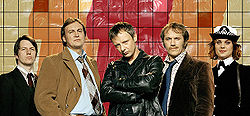 The methodology and techniques of modern policing that Sam Tyler employs during Life on Mars lead him into frequent clashes with other characters. Gene Hunt and the rest of the CID appear to favour brutality
and corruption
in order to secure convictions, as shown by their willingness to physically coerce confessions and fabricate evidence. Throughout both series, Tyler clashes with Hunt the most frequently, usually because Tyler values forensic evidence whereas Hunt often resorts to traditional methods. In one episode during Series 1, in which doubt is cast on several suspects, Hunt insists that "the first to speak is guilty."
Sam describes Hunt as an "overweight, over-the-hill, nicotine-stained, borderline alcoholic homophobe with a superiority complex and an unhealthy obsession with male bonding." Hunt is supported by his fiercely loyal subordinates, Chris Skelton
and Ray Carling
, with the latter portrayed as a character similar to Hunt. Ray and Sam often disagree with each other, and Sam and Gene have a love-hate relationship. Chris, in contrast, becomes friendly with Sam and respects his modern methods, finding his loyalty torn between Gene and Sam.
Given Sam's predicament, he avoids revealing his suspicion that he may have travelled back in time, for fear that others will think he is insane. The only person in 1973 to whom Sam fully reveals his story is Annie Cartwright
. According to Liz White
, the actress who played Cartwright, "She gets very tired of his constant talk about how this situation is not real, that they are all figments of his imagination – she can only explain it as psychological trauma from his car crash.".
in which Sam repeats, as part of the moving imagery of the title sequence:
This questioning is a central plot device throughout the series, displaying both the character's and the audience's uncertainty about what has happened.
Throughout the course of Life on Mars, Sam's uncertainty is reinforced by frequent paranormal
phenomena, such as hearing voices and seeing images from 2006 on radios, telephones, and televisions. The voices discuss his medical condition, leading him to partially believe that he is in a coma. Other elements suggest to him that he is insane, such as his frequent and unexpected encounters with the Test Card Girl from Test Card F
, who speaks directly to him. Annie Cartwright partially persuades Sam that he is truly in 1973, arguing that his mind would be unable to fabricate the amount of detail and tangibility in the world where he finds himself, evidence that he is in fact in 1973.
However, Sam's uncertain situation is not the focal point of most episodes, remaining a sub-plot. In most episodes, the main plot centres on a particular crime or case relating to the police, such as drug trafficking
, a hostage situation
, murders
and robberies
. For this reason, most episodes follow a conventional police drama format. As the series progresses, Sam focuses on how he will get home in almost every episode.
A recurring motif throughout the series is the overlapping of the past and present. For example, during Series 1: Episode 6 Sam hears the voice of his mother in 2006, telling him his life-support will be switched off at 2:00 pm. At the same time he is called into a hostage
-taking situation, where the perpetrator states that he will kill his victims at precisely the same hour. Sam also encounters people whom he knows in the future as their younger selves, including suspects, friends, his own parents, and himself as a child.
Sam comes from a politically correct
and scientifically advanced era, in which suspects' rights and the preservation of forensic evidence are stringently observed. His background leads Sam into conflict, as other characters exhibit openly sexist
, homophobic
, disablist
and racist
behaviour, and often indulge all these prejudices while carrying out their police duties.
The series frequently makes use of Gene Hunt
's comical rudeness in the form of jokes and dramatic irony about a future which the audience already knows, but which the characters in 1973 do not. For example, in Series 1: Episode 5, Hunt declares, "There will never be a woman prime minister
as long as I have a hole in my arse."
Another running joke in the show is Sam's confusion about police work in 1973, as he often mistakenly mentions techniques and technologies that were not used in 1973, such as two-way mirrors. One such running joke is that Sam continually gives criminals the updated version of the Right to Silence warning, which was changed in 1994. When he does so, someone around him usually points out that he is giving the warning incorrectly.
) to bring Hunt down. While Tyler and the team are engaged in a firefight with armed robbers, Sam returns to 2008. He eventually comes to realise that he has become used to, and enjoys, the 1970s, seeing it as his "real world". In an attempt to get back to 1973 to save Annie and the rest of the team from death, Sam leaps off of the roof of the police station
, arriving back in 1973 and saving the team, promising never to leave them again. Writer Matthew Graham wrote the scene to indicate that Sam is now in the afterlife, but acknowledged that the ending is ambiguous and open to other interpretations, such as lead actor John Simm's belief that Sam may not have returned to the present. In the final scene, the team drive off, with Sam and Gene bickering as usual. Children run past, including the girl from Test Card F
. She looks directly into the camera before reaching out and "switching off" the television the viewer is watching, signifying that the story has come to an end.
The first episode of sequel series
Ashes to Ashes shows that DI Alex Drake
of the Metropolitan Police has been studying Tyler's notes and 2008-era personnel file, in which his photograph is overstamped with the word "SUICIDE
". Ashes to Ashes, which implies that Gene Hunt's world is in some sense real, states that Sam lived another seven years in that world, during which time he married Annie but had no children. Drake speculates that this happened while, in reality, he was in his dying moments, and fears that the same may be happening to her. As far as Hunt and his colleagues are concerned, Tyler apparently died in a car chase in 1980.
In the final episode of Ashes to Ashes it is revealed that the world of Life on Mars/Ashes to Ashes is in fact a purgatory for dead police officers. The Railway Arms pub seen throughout Life on Mars is shown to be the entry point to Heaven, and Gene Hunt
mentions how he sent Sam in once he was ready.
, Deputy Chief Constable
of Greater Manchester in the early 1980s and himself a Detective Inspector in 1973, has stated that the depiction of the police "has got nothing to do with real policing in the 1970s. It could not be more inaccurate in terms of procedure, the way they talk or the way they dress. In all the time I was in the CID in the 1970s I never saw a copper in a leather bomber jacket and I never heard an officer call anyone 'guv'. ... Actually, there were a few police officers in London who started to behave like Regan and Carter in The Sweeney
, but that was a case of life following art, not the other way round." The journalist
who interviewed Stalker, Ray King, remarks that the depiction of the police can be defended if we assume that Sam is indeed in a coma and that we are seeing his imaginary idea of 1973, filtered through 1970s cop shows.
Upon Sam Tyler awaking in 1973, he finds himself on a building site, beneath a large advertising board
, proclaiming the construction of a new motorway, the Mancunian Way
. In reality, construction of Mancunian Way was completed in 1967. According to Matthew Graham, writing in the Radio Times, the error was deliberate. "We knew that this road was built in the 1960s, but we took a bit of artistic licence
." Minor historical anachronisms such as this are present throughout Life on Mars. Some, as above, were made out of artistic licence whilst others were deliberately inserted to confuse the issue of whether Sam Tyler was in a coma, mad
or really back in time
. Many inaccuracies were visible such as modern street furniture, cable television cabinets, satellite television dishes, CCTV
cameras, LCD digital watches and double-glazed uPVC window frames which were all unintentional. During DVD commentaries for the series, the programme makers acknowledge these as errors but also point out they are in fact perfectly feasible, given Sam's situation. As the popularity of the series grew, the hunting of such anachronisms became a favourite pastime among Life on Mars fans.
exist. Such as, when Sam Tyler tentatively asks if Gene Hunt is able to send Sam back home, he is mockingly told "The Wizard'll sort it out. It's because of the wonderful things he does". The quote "Follow the yellow brick road" can be heard at least once, in episode 4 of season 1. Gene also occasionally refers to Sam as "Dorothy
", ostensibly as a reference to what Gene perceives as Sam's effeminacy ("Friend of Dorothy
"), but also as a nod to Sam's belief that he is living some kind of Oz-like fantasy. The pivotal character, Frank Morgan (Ralph Brown
) is both Gene's nemesis in 1973 and Sam's surgeon in 2006. This echoes the similar dual roles played by actors in the Oz and Kansas sequences of the 1939 Judy Garland
film, The Wizard of Oz
; principally, actor Frank Morgan
who portrayed Professor Marvel in the Kansas sequences and the Wizard
in the Oz sequences.
In the final episode of the series, the song "Over the Rainbow
" features prominently upon Sam's return to 2006 and later, when Sam and Annie kiss, a rainbow
can be seen in the distant sky.
The East Manchester town of Hyde
is used as Sam's former police division
as a clue that his 1973 self is an alter ego
, as in Robert Louis Stevenson
's The Strange Case of Dr Jekyll and Mr Hyde
. When Sam wakes up in 2006, his comatose body was revealed to have been kept in Hyde ward, from the sign on the door as he exits in street clothes. The Room number shown as 2612, this being the telephone number (Hyde 2612) that Frank Morgan had contacted him from in episode 1 of season 2.
commented, "Theoretically, this should add up to a right old mess. In practice, it makes for a thumpingly enjoyable piece of television – not least because everybody involved was obviously having such a great time." Sam Wollaston of The Guardian
wrote: "Life on Mars was more than just a jolly, tongue-in-cheek romp into the past ... Once there, in 1973, we find ourselves immersed in a reasonably gripping police drama – yes, The Sweeney
, perhaps, with better production values ... Or put another – undeniably laboured – way, as poor Sam Tyler walks through his sunken dream, I'm hooked to the silver screen." Although Peter Paterson of the Daily Mail
reflected the views of many other commentators on the first episode when he wondered, "Can its intriguing conceit be sustained over eight one-hour episodes?", Critical reaction remained generally positive throughout the programme's run. Of the second series, Alison Graham believed that "Sam Tyler and Gene Hunt are shaping up nicely as one of the great TV detective partnerships ... It's vastly enjoyable and manages to stay just about believable thanks to some strong writing and, of course, the two marvellous central performances."
Nancy Banks-Smith
, in The Guardian, felt that the time-paradox aspect of the programme had become somewhat confusing. Banks-Smith summed up the programme's success as "an inspired take on the usual formula of Gruff Copper of the old school, who solves cases by examining the entrails of a chicken, and Sensitive Sidekick, who has a degree in detection."
Two days after the final episode's transmission, Life on Mars was attacked in the British press by the National Association of Schoolmasters Union of Women Teachers
, who claimed that Gene Hunt's use of homophobic insults in the programme could encourage copycat bullying in schools. The BBC stated that Life on Mars was targeted at an adult audience, and argued that Hunt's characterisation was "extreme and tongue-in-cheek
".
. The first series' finale
gained 7.1 million viewers and a 28% audience share.
Viewing figures for the second series were initially low, with the first episode
only attracting 5.7 million viewers, slumping to 4.8 million viewers by episode three, despite being heavily trailed and publicised. These figures were blamed by The Stage
on "poor scheduling and unfortunate sporting fixtures, possibly combined with high expectation". Audience figures picked up during the second series' run, however, with the final episode
gaining an average of seven million viewers (a 28% audience share), despite competition from UEFA Champions League
football on ITV1.
s, which was held in November. In January 2007, it won the Best New Programme category as part of the Broadcast Magazine
awards. In March 2007 it won two categories, Best Drama Series and the Writers' Award, at the Broadcasting Press Guild
Awards.
The first series was nominated for a British Academy Television Award (BAFTA) in the Best Drama Series
category. John Simm was also nominated as Best Actor for his work on the show. The programme won the audience-voted Pioneer Award
.
In October 2007, series two was nominated as the Most Popular Drama at the 2007 National Television Awards
.
BBC One
BBC One is the flagship television channel of the British Broadcasting Corporation in the United Kingdom. It was launched on 2 November 1936 as the BBC Television Service, and was the world's first regular television service with a high level of image resolution...
between January 2006 and April 2007. The series combines elements of science fiction and police procedural
Police procedural
The police procedural is a subgenre of detective fiction which attempts to convincingly depict the activities of a police force as they investigate crimes. While traditional detective novels usually concentrate on a single crime, police procedurals frequently depict investigations into several...
.
An American version of the series
Life on Mars (U.S. TV series)
Life on Mars was a science fiction crime drama television series which originally aired on ABC from October 9, 2008 to April 1, 2009. It is an adaptation of the BAFTA-winning original UK series of the same name produced by the BBC...
was produced by ABC
American Broadcasting Company
The American Broadcasting Company is an American commercial broadcasting television network. Created in 1943 from the former NBC Blue radio network, ABC is owned by The Walt Disney Company and is part of Disney-ABC Television Group. Its first broadcast on television was in 1948...
and ran for one season from October 2008 to April 2009. A Spanish version of the show
La Chica de Ayer (TV series)
La Chica de Ayer is a Spanish television series which first aired on the channel Antena 3 between 26 April and 14 June 2009. A detective show, it was based on the British series Life on Mars which featured a policeman suddenly transported back to 1973...
was also broadcast from April to June 2009.
A sequel to the series, Ashes to Ashes
Ashes to Ashes (TV series)
Ashes to Ashes is a British science fiction and police procedural drama television series, serving as the sequel to Life on Mars.The series began airing on BBC One in February 2008. A second series began broadcasting in April 2009...
, also referencing another David Bowie
David Bowie
David Bowie is an English musician, actor, record producer and arranger. A major figure for over four decades in the world of popular music, Bowie is widely regarded as an innovator, particularly for his work in the 1970s...
song, began airing on BBC One in February 2008, followed by a second series in 2009 and a third and final series in 2010.
Plot
Life on Mars tells the fictional story of Sam TylerSam Tyler
DCI/DI Sam Tyler is a fictional character in BBC One's science fiction/police procedural drama, Life on Mars.In the original British version of Life on Mars, Tyler is played by John Simm and in the American version he is played by Jason O'Mara....
(John Simm
John Simm
John Simm is an English stage and screen actor. In recent years he is best known for his roles as Sam Tyler in the detective drama Life on Mars and as The Master in the revival of the science fiction series Doctor Who, but he has also starred in many highly acclaimed award-winning television...
), a policeman in service with the Greater Manchester Police
Greater Manchester Police
Greater Manchester Police is the police force responsible for law enforcement within the metropolitan county of Greater Manchester in North West England...
. After being hit by a car in 2006, Tyler awakes in 1973 and finds himself working for the predecessor of the GMP, the Manchester and Salford Police
Manchester and Salford Police
Manchester and Salford Police was, from June 1, 1968 to April 1, 1974, a police force in England. It was created as a merger of the Manchester City Police and Salford City Police, and covered the adjacent county boroughs of Manchester and Salford...
at the same station
Police station
A police station or station house is a building which serves to accommodate police officers and other members of staff. These buildings often contain offices and accommodation for personnel and vehicles, along with locker rooms, temporary holding cells and interview/interrogation rooms.- Facilities...
and location as in 2006. Early on in the series, it becomes apparent to Tyler that he awakes as a Detective Inspector, one rank lower than his 2006 rank of Detective Chief Inspector. As part of the Criminal Investigation Department
Criminal Investigation Department
The Crime Investigation Department is the branch of all Territorial police forces within the British Police and many other Commonwealth police forces, to which plain clothes detectives belong. It is thus distinct from the Uniformed Branch and the Special Branch.The Metropolitan Police Service CID,...
, Tyler finds himself working under the command of Gene Hunt
Gene Hunt
DCI Gene Hunt is a fictional character in BBC One's science fiction/police procedural drama Life on Mars and its sequel, Ashes to Ashes. The character is portrayed by Philip Glenister in both Life on Mars and Ashes to Ashes, whereas in the American version he is portrayed by Harvey Keitel.The...
(Philip Glenister
Philip Glenister
Philip Haywood Glenister is an English actor, known for his role as DCI Gene Hunt in British television series Life On Mars and its sequel Ashes To Ashes.-Television and films:...
).
Throughout the two series, the central plot centres on the ambiguity concerning Tyler's predicament of it being unclear to both the audience and the character whether he has died, gone mad
Insanity
Insanity, craziness or madness is a spectrum of behaviors characterized by certain abnormal mental or behavioral patterns. Insanity may manifest as violations of societal norms, including becoming a danger to themselves and others, though not all such acts are considered insanity...
, is in a coma or has actually travelled back in time
Time travel
Time travel is the concept of moving between different points in time in a manner analogous to moving between different points in space. Time travel could hypothetically involve moving backward in time to a moment earlier than the starting point, or forward to the future of that point without the...
.
Origins
The programme was originally conceived in 1998, when screenwritersScreenwriting
Screenwriting is the art and craft of writing scripts for mass media such as feature films, television productions or video games. It is a freelance profession....
Matthew Graham
Matthew Graham
Matthew Graham is a British television writer, and the co-creator of the BBC/Kudos Film and Television science fiction series Life on Mars, which debuted in 2006 on BBC One and has received international critical acclaim....
, Tony Jordan
Tony Jordan
Tony Jordan is a British television writer. He was listed as the number 1 television screen writer in the UK by Broadcast magazine and among British Broadcastings Top 20 in The Stage ., He currently resides in Hertfordshire, UK.For many years, he was lead writer and series consultant for BBC One...
and Ashley Pharoah
Ashley Pharoah
Ashley Pharoah is a British Television writer, co-creator of the successful drama series Life on Mars, which began on BBC One in 2006....
were sent on a break to the English seaside resort of Blackpool
Blackpool
Blackpool is a borough, seaside town, and unitary authority area of Lancashire, in North West England. It is situated along England's west coast by the Irish Sea, between the Ribble and Wyre estuaries, northwest of Preston, north of Liverpool, and northwest of Manchester...
by Kudos Film & Television
Kudos (production company)
Kudos Film and Television is a British independent film and television production company. It has produced television series for the BBC, ITV and Channel 4, and its productions include Spooks , Hustle, Life on Mars and its spin-off Ashes to Ashes, The Amazing Mrs Pritchard and M.I. High...
to think up programme ideas. Originally titled Ford Granada after the 1970s car
Ford Granada (Europe)
The March 1972 released Granada succeeded the British Ford Zephyr, and the German P7-series as Ford's European executive car offering. At first, lower models in the range were called the Ford Consul, but from 1975 on they were all called Granadas. The car soon became popular for taxi, fleet and...
, the series was rejected by the BBC
BBC
The British Broadcasting Corporation is a British public service broadcaster. Its headquarters is at Broadcasting House in the City of Westminster, London. It is the largest broadcaster in the world, with about 23,000 staff...
. In response, Graham stated: "Back then, broadcasters just weren't comfortable with something like that, something that wasn't set in the real world and that had a fantasy element to it." According to Graham, the initial idea was for a humorous, pre-watershed
Watershed (television)
In television, the term watershed denotes the time period in a television schedule during which programs with adult content can air....
programme that overtly mocked the styles and attitudes of the 1970s, with the comic actor Neil Morrissey
Neil Morrissey
Neil Anthony Morrissey is an English actor, media personality and businessman. He is best known for his role as Tony in Men Behaving Badly....
envisaged as the central character.
Later, Channel 4
Channel 4 programming
Channel 4, in common with the other main British stations broadcast on analogue, airs a highly comprehensive range of programming. It was established in 1982 with a specific intention of providing programming to groups of minority interests, not catered for by its competitors, which at the time...
drama executive, John Yorke substantially redeveloped the original script, focusing on a double act between Sam Tyler and Gene Hunt. Senior management eventually decided not to pursue the idea, with Graham stating that the reaction to the idea was: "It's going to be silly", as told to Radio Times
Radio Times
Radio Times is a UK weekly television and radio programme listings magazine, owned by the BBC. It has been published since 1923 by BBC Magazines, which also provides an on-line listings service under the same title...
. The series eventually attracted the attention of BBC Wales
BBC Wales
BBC Cymru Wales is a division of the British Broadcasting Corporation for Wales. Based at Broadcasting House in the Llandaff area of Cardiff, it directly employs over 1200 people, and produces a broad range of television, radio and online services in both the Welsh and English languages.Outside...
' Julie Gardner
Julie Gardner
Julie Gardner is a Welsh television producer. Her most prominent work has been serving as executive producer on the 2005 revival of Doctor Who and its spin-off shows Torchwood and The Sarah Jane Adventures...
, who persuaded the Head of Drama for the BBC, Jane Tranter
Jane Tranter
Jane Tranter is an English television executive who has been the executive vice-president of programming and production at BBC Worldwide's Los Angeles base since January 2009...
, to commission the programme from BBC Wales
BBC Wales
BBC Cymru Wales is a division of the British Broadcasting Corporation for Wales. Based at Broadcasting House in the Llandaff area of Cardiff, it directly employs over 1200 people, and produces a broad range of television, radio and online services in both the Welsh and English languages.Outside...
for BBC One. John Yorke left Channel 4 to rejoin the BBC and together with Julie Gardner, he acted as joint commissioning editor on the show for its entire run.
The programme's central character was originally to have been named "Sam Williams", but Kudos felt this to not be striking enough and requested Graham devise an alternative surname. Graham asked his young daughter for her opinion and she suggested "Sam Tyler", which became the character's name. Graham subsequently discovered that his daughter had named him after the Doctor Who
Doctor Who
Doctor Who is a British science fiction television programme produced by the BBC. The programme depicts the adventures of a time-travelling humanoid alien known as the Doctor who explores the universe in a sentient time machine called the TARDIS that flies through time and space, whose exterior...
character Rose Tyler
Rose Tyler
Rose Marion Tyler is a fictional character portrayed by Billie Piper in the long-running British science fiction television series Doctor Who, and was created by series producer Russell T Davies...
. The initial geographical setting was to be London; this was then changed to Leeds
Leeds
Leeds is a city and metropolitan borough in West Yorkshire, England. In 2001 Leeds' main urban subdivision had a population of 443,247, while the entire city has a population of 798,800 , making it the 30th-most populous city in the European Union.Leeds is the cultural, financial and commercial...
and finally to Manchester
Manchester
Manchester is a city and metropolitan borough in Greater Manchester, England. According to the Office for National Statistics, the 2010 mid-year population estimate for Manchester was 498,800. Manchester lies within one of the UK's largest metropolitan areas, the metropolitan county of Greater...
, as part of a BBC initiative to make more programmes in the city. The name Sam Williams was subsequently used as a plot point in the second series.
Production and transmission
Eight one-hour episodes of Life on Mars were broadcast weekly on Monday nights at 9:00 pm by the BBC. The series episodes were mostly written by its creators Jordan, Graham and Pharoah, later joined by Chris ChibnallChris Chibnall
Chris Chibnall is a British playwright, television writer and producer. He is best known for his work on the science-fiction series Torchwood....
as the fourth writer for the first series. For the second series, Graham, Pharoah and Chibnall returned to write episodes, joined by Julie Rutterford
Julie Rutterford
Julie Rutterford is a British film and television screenwriter. She shared a BAFTA Award for Best Short Film with producer Janey de Nordwall and director Brian Percival in 2001 for their film About a Girl...
, Guy Jenkin
Guy Jenkin
Guy Jenkin is a comedy writer who is best known for working on sitcoms and comedies such as Drop the Dead Donkey, Jeffrey Archer: The Truth and Outnumbered...
and Mark Greig.
The second series was broadcast weekly at the same time as the first, with the only difference being the change of transmission day from Monday to Tuesday. According to Jane Featherstone, the show's executive producer
Executive producer
An executive producer is a producer who is not involved in any technical aspects of the film making or music process, but who is still responsible for the overall production...
, speaking in February 2006, a film version of the show was also a possibility: "Life on Mars was a very high concept
High concept
High concept is a term used to refer to an artistic work that can be easily described by a succinctly stated premise.-Terminology:High concept narratives are typically characterised by an over-arching "what if?" scenario that acts as a catalyst for the following events...
idea and there was no doubt it would work on the big screen."
On 9 October 2006, it was confirmed that the second series of Life on Mars would be the last. Matthew Graham stated: "We decided that Sam's journey should have a finite life span and a clear-cut ending and we feel that we have now reached that point after two series." Graham's claim that two separate endings had been filmed was later revealed to be a ruse.
The second series had a distinctive style of introduction on BBC One: after a brief collage of momentary images, such as several test cards and the late comedy writer and broadcaster Barry Took
Barry Took
Barry Took was an English comedian, writer and television presenter. He is best remembered in the UK for his weekly role as presenter of Points of View, a BBC TV programme in which viewers' letters criticising or praising the BBC were broadcast...
, a mock-up version of BBC1's 1970s blue-on-black rotating globe ident was used, although the design had to be modified to fit widescreen
Widescreen
Widescreen images are a variety of aspect ratios used in film, television and computer screens. In film, a widescreen film is any film image with a width-to-height aspect ratio greater than the standard 1.37:1 Academy aspect ratio provided by 35mm film....
sets. This was accompanied by a bass-voiced continuity announcer in the style of that era. Viewers in Wales saw an original 'BBC Cymru Wales' mechanical globe with introductions provided by former BBC Wales announcers. Trailers for the show also used the 1970s style, including the rhombus-style BBC logo.
Overseas sales
An American version of the showLife on Mars (U.S. TV series)
Life on Mars was a science fiction crime drama television series which originally aired on ABC from October 9, 2008 to April 1, 2009. It is an adaptation of the BAFTA-winning original UK series of the same name produced by the BBC...
was produced by ABC
American Broadcasting Company
The American Broadcasting Company is an American commercial broadcasting television network. Created in 1943 from the former NBC Blue radio network, ABC is owned by The Walt Disney Company and is part of Disney-ABC Television Group. Its first broadcast on television was in 1948...
, and ran for one season from October 2008 to April 2009.
In February 2007, The Guardian
The Guardian
The Guardian, formerly known as The Manchester Guardian , is a British national daily newspaper in the Berliner format...
s media site
Guardian Unlimited
guardian.co.uk, formerly known as Guardian Unlimited, is a British website owned by the Guardian Media Group. Georgina Henry is the editor...
reported that producer David E Kelley was to develop an American version of the series for the ABC
American Broadcasting Company
The American Broadcasting Company is an American commercial broadcasting television network. Created in 1943 from the former NBC Blue radio network, ABC is owned by The Walt Disney Company and is part of Disney-ABC Television Group. Its first broadcast on television was in 1948...
network. Kelley was involved in the production of the pilot, but handed duties over to others for the eventual production. The series was broadcast to critical and minor public acclaim, but declining numbers led to cancellation after 17 episodes, but with sufficient lead to allow the series to be wrapped up.
The first series of the original Life on Mars was broadcast in the United States on BBC America
BBC America
BBC America is an American television network, owned and operated by BBC Worldwide, and available on both cable and satellite.-History:The channel launched on March 29, 1998, broadcasting comedy, drama and lifestyle programs from BBC Television and other British television broadcasters like ITV and...
from July 2006 to August 2007 and was broadcast in 2010 on some public television stations, with the second series being broadcast from December 2007 to January 2008. Acorn Media released both series on DVD in 2008.
The original version also was broadcast in Canada
Canada
Canada is a North American country consisting of ten provinces and three territories. Located in the northern part of the continent, it extends from the Atlantic Ocean in the east to the Pacific Ocean in the west, and northward into the Arctic Ocean...
from September 2006 to April 2007 on BBC Canada
BBC Canada
BBC Canada is a Canadian English language Category B specialty channel. It presents programming primarily from the BBC. BBC Canada is a joint venture between Shaw Media and BBC Worldwide.-Programming:Main article: List of programs broadcast by BBC Canada...
, and from 8 January 2008 to 23 April 2008 on Télé-Québec
Télé-Québec
Télé-Québec is a French language public educational television network in the Canadian province of Quebec. Known legally as Société de télédiffusion du Québec , it is a provincial crown corporation owned by the Government of Quebec...
in French
French language
French is a Romance language spoken as a first language in France, the Romandy region in Switzerland, Wallonia and Brussels in Belgium, Monaco, the regions of Quebec and Acadia in Canada, and by various communities elsewhere. Second-language speakers of French are distributed throughout many parts...
and Showcase in English
English language
English is a West Germanic language that arose in the Anglo-Saxon kingdoms of England and spread into what was to become south-east Scotland under the influence of the Anglian medieval kingdom of Northumbria...
.
In New Zealand
New Zealand
New Zealand is an island country in the south-western Pacific Ocean comprising two main landmasses and numerous smaller islands. The country is situated some east of Australia across the Tasman Sea, and roughly south of the Pacific island nations of New Caledonia, Fiji, and Tonga...
the original series was broadcast on TV ONE from February 2007, being described as "sensationally well-made" by an NZ website. Series two was broadcast from June 2008, with the final screening on 4 August 2008.
In Australia the original British version was broadcast on ABC1
ABC1
ABC1 was a United Kingdom based television channel from Disney using the branding of the Disney owned American network, ABC.The channel initially launched exclusively on the British digital terrestrial television platform Freeview on 27 September 2004. On 10 December 2004 it was launched on...
from 20 May 2007, with the second following during February 2008. The US version broadcast on 5 February 2009 on Network Ten
Network Ten
Network Ten , is one of Australia's three major commercial television networks. Owned-and-operated stations can be found in Sydney, Melbourne, Brisbane, Adelaide and Perth, while affiliates extend the network to cover most of the country...
.
In the Republic of Ireland
Republic of Ireland
Ireland , described as the Republic of Ireland , is a sovereign state in Europe occupying approximately five-sixths of the island of the same name. Its capital is Dublin. Ireland, which had a population of 4.58 million in 2011, is a constitutional republic governed as a parliamentary democracy,...
RTÉ Two
RTÉ Two
RTÉ Two is a free-to-air general entertainment channel operated by Irish state broadcaster Raidió Teilifís Éireann. RTÉ Two is available throughout the island of Ireland through digital terrestrial service Saorview, VHF and UHF bands, and is also available via satellite to Irish subscribers of...
broadcast the series from June 2007 in a late evening slot, following RTÉ News on Two
RTÉ News on Two
RTÉ News on Two is RTÉ's late evening news programme. The program is broadcast Monday-Thursday on the Irish RTÉ Two TV channel. It does not have a regular time slot, but is usually broadcast at some point between 22:45 and 23:30. It runs for 22 minutes....
.
The show has also been transmitted in Croatia, (Croatian Radiotelevision
Croatian Radiotelevision
Croatian Radiotelevision is a Croatian public broadcasting company. It operates several radio and television channels, over a domestic transmitter network as well as satellite...
), Sweden (a cut version on SVT 2
Sveriges Television
Sveriges Television AB , Sweden's Television, is a national television broadcaster based in Sweden, funded by a compulsory fee to be paid by all television owners...
), Netherlands (Nederland 3
Nederland 3
Nederland 3 is the third and youngest of the terrestrial television channels operated by the Dutch public-broadcasting organization NPO in the Netherlands and carries programs provided by member-based non-profit broadcasting associations. It is oriented towards children, youth and innovative...
), in Germany (Kabel 1
Kabel 1
kabel eins is a commercial television channel in Germany. It started business on 29 February 1992, as the Kabelkanal and belongs to the ProSiebenSat.1 Media AG. The channel is largely known for showing classic American films as well as series and documentaries...
), Spain (Antena.neox
Antena.neox
Neox is a Spanish television channel run by Antena 3 de Televisión.Generally, the channel shows children's programming during the morning and late afternoon, extreme sports and motoring during the day, and films and series during the night...
), Israel
Israel
The State of Israel is a parliamentary republic located in the Middle East, along the eastern shore of the Mediterranean Sea...
(Hot
Hot (Israel)
HOT Telecommunication Systems Ltd. is a company that provides cable television, last-mile Internet access, broadband and telecommunication services in Israel. It also provides various data transmission services and network services at different rates, services to the business sector and other...
), Italy (Rai Due
Rai Due
Rai 2 is one of the three main television channels broadcast by Italian public television company RAI alongside with Rai 1 and Rai 3. Rai 2 first started transmissions on November 4, 1961...
), Japan, Serbia
Serbia
Serbia , officially the Republic of Serbia , is a landlocked country located at the crossroads of Central and Southeast Europe, covering the southern part of the Carpathian basin and the central part of the Balkans...
(B92
B92
B92 is a radio and television broadcaster with national coverage headquartered in Belgrade, Serbia. The network's key demographic is chiefly urban and young audience. Its programs, including the news cover topics with fairly liberal political painted attitudes...
), Norway (NRK) and Estonia
Estonia
Estonia , officially the Republic of Estonia , is a state in the Baltic region of Northern Europe. It is bordered to the north by the Gulf of Finland, to the west by the Baltic Sea, to the south by Latvia , and to the east by Lake Peipsi and the Russian Federation . Across the Baltic Sea lies...
(ERR
Err
Err is the verb form of error or mistake.Err may also refer to:* Err, a character of the Aqua Teen Hunger Force animated comedy* Err, Pyrénées-Orientales, a commune in the Pyrénées-Orientales department in southern France...
). Sub
Sub (TV channel)
Sub is a Finnish TV channel owned by Bonnier. The previous owner Alma Media sold Sub and its sister channels to Swedish Bonnier and Proventus in 2005.-Programs and audience:...
began broadcasting Life on Mars in Finland in April 2008, and ATV World
ATV World
ATV World , is one of the free-to-air English language television channels in Hong Kong, the other being its arch-rival TVB Pearl. Its sister station, ATV Home, broadcasts in Cantonese language...
started broadcasting the show in Hong Kong on 13 July 2008.), France (13ème Rue). In Hungary (Duna TV
Duna TV
Duna TV or Duna Televízió is one of two public television services in Hungary. "Duna" is the Hungarian name for the Danube. Duna TV operates two channels: Channel 1 and Channel 2-Autonómia....
) Life on Mars started on March 2011.
Spanish Television network Antena 3
Antena 3 (Spain)
Antena 3 is a Spanish terrestrial television channel owned by Antena 3 de Televisión. Some of the more popular programmes broadcast by Antena 3 include Aquí no hay quien viva, El Barco, Los Protegidos, Los Simpson and El Internado....
bought the rights from the BBC and has remade the show as La Chica de Ayer
La Chica de Ayer (TV series)
La Chica de Ayer is a Spanish television series which first aired on the channel Antena 3 between 26 April and 14 June 2009. A detective show, it was based on the British series Life on Mars which featured a policeman suddenly transported back to 1973...
(English: The Girl from Yesterday), set in 1977 post-Franco
Francisco Franco
Francisco Franco y Bahamonde was a Spanish general, dictator and head of state of Spain from October 1936 , and de facto regent of the nominally restored Kingdom of Spain from 1947 until his death in November, 1975...
Spain. The Russian broadcaster Channel One
Channel One (Russia)
Channel One is the first television channel to broadcast in the Soviet Union. The channel was renamed Ostankino Channel 1 in 1991, after the Soviet Union broke up and the Russian SFSR became the Russian Federation. According to a recent government publication, the Russian government controls 51%...
is also planning a re-make of the show, re-locating the events to Soviet era Moscow.
Music
The programme's soundtrack features many early 1970s songs which were played as part of Life on Mars, as well as an original score of the theme music as part of the title sequence composed by Edmund Butt. The show's title is in reference to the David BowieDavid Bowie
David Bowie is an English musician, actor, record producer and arranger. A major figure for over four decades in the world of popular music, Bowie is widely regarded as an innovator, particularly for his work in the 1970s...
song, "Life on Mars?
Life on Mars?
"Life on Mars?" is a song by David Bowie first released in 1971 on the album Hunky Dory. The song—which BBC Radio 2 later called "a cross between a Broadway musical and a Salvador Dalí painting"—featured guest piano work by keyboardist Rick Wakeman. When released as a single in 1973,...
", which plays on an iPod
IPod
iPod is a line of portable media players created and marketed by Apple Inc. The product line-up currently consists of the hard drive-based iPod Classic, the touchscreen iPod Touch, the compact iPod Nano, and the ultra-compact iPod Shuffle...
in Sam's car while he is run over, and on an 8-track tape
8-track cartridge
Stereo 8, commonly known as the eight-track cartridge, eight-track tape, or simply eight-track, is a magnetic tape sound recording technology. It was popular in the United States from the mid-1960s through the late 1970s, but was relatively unknown in many European countries...
in a Rover P6
Rover P6
The first P6 used a 2.0 L engine designed specifically for the P6. Although it was announced towards the end of 1963, the car had been in "pilot production" since the beginning of the year, therefore deliveries were able to begin immediately. Original output was in the order of . At the...
when he awakes in 1973; it is used again at the climax of the final episode, and fleeting moments of the song are periodically used throughout the third series of the programme's sequel, Ashes to Ashes to allude to Sam Tyler's fate.
Matthew Graham stated that initially there were some concerns over whether the production team would be able to license the song, which, had they been denied, would have necessitated retitling the series. Another Bowie song, "Space Oddity", is used in BBC trailers advertising the series. In several episodes, Gene Hunt
Gene Hunt
DCI Gene Hunt is a fictional character in BBC One's science fiction/police procedural drama Life on Mars and its sequel, Ashes to Ashes. The character is portrayed by Philip Glenister in both Life on Mars and Ashes to Ashes, whereas in the American version he is portrayed by Harvey Keitel.The...
adopts the name "Gene Genie", in reference to yet another Bowie song, "The Jean Genie
The Jean Genie
"The Jean Genie" is a song by David Bowie, originally released as a single in November 1972. According to Bowie, it was "a smorgasbord of imagined Americana", with a protagonist inspired by Iggy Pop, and the title being a pun on author Jean Genet. One of Bowie’s most famous tracks, it was the lead...
", used in the fourth episode
Series 1: Episode 4 (Life on Mars)
The fourth episode of the first series of the British time travel police procedural television series, Life on Mars, was first broadcast on 30 January 2006. It was produced by Kudos Film & Television for BBC One.-Synopsis:...
. Another Bowie track, "Changes
Changes (David Bowie song)
"Changes" is a song by David Bowie, originally released on the album Hunky Dory in December 1971 and as a single in January 1972. Despite missing the Top 40, "Changes" became one of Bowie's best-known songs. The lyrics are often seen as a manifesto for his chameleonic personality, sexual ambiguity,...
", is played over the end credits
Closing credits
Closing credits or end credits are added at the end of a motion picture, television program, or video game to list the cast and crew involved in the production. They usually appear as a list of names in small type, which either flip very quickly from page to page, or move smoothly across the...
of the second series finale
Series 2: Episode 8 (Life on Mars)
The eighth episode of the second series, and overall finale of the British time travel police procedural television series, Life on Mars, was first broadcast on 10 April 2007...
.
The show's creators were initially refused permission to use "Live and Let Die
Live and Let Die (song)
"Live and Let Die" is the main theme song of the 1973 James Bond film Live and Let Die and was performed by Paul McCartney & Wings for the movie soundtrack and appears on the soundtrack album. The song was one of Wings' most successful singles, and the most successful Bond theme to that point...
" by Paul McCartney
Paul McCartney
Sir James Paul McCartney, MBE, Hon RAM, FRCM is an English musician, singer-songwriter and composer. Formerly of The Beatles and Wings , McCartney is listed in Guinness World Records as the "most successful musician and composer in popular music history", with 60 gold discs and sales of 100...
and Wings
Wings (band)
Wings were a British-American rock group formed in 1971 by Paul McCartney, Denny Laine and Linda McCartney that remained active until 1981....
but, according to Graham in the Radio Times, "We sent the episode directly to Paul McCartney. Almost immediately, his assistant phoned back and said, 'Paul loves it. You can go ahead and use it.'"
Music used
Season 1David Bowie
David Bowie
David Bowie is an English musician, actor, record producer and arranger. A major figure for over four decades in the world of popular music, Bowie is widely regarded as an innovator, particularly for his work in the 1970s...
– "Life on Mars?
Life on Mars?
"Life on Mars?" is a song by David Bowie first released in 1971 on the album Hunky Dory. The song—which BBC Radio 2 later called "a cross between a Broadway musical and a Salvador Dalí painting"—featured guest piano work by keyboardist Rick Wakeman. When released as a single in 1973,...
" (Episodes 1 & 8)
The Who
The Who
The Who are an English rock band formed in 1964 by Roger Daltrey , Pete Townshend , John Entwistle and Keith Moon . They became known for energetic live performances which often included instrument destruction...
– "Baba O'Riley
Baba O'Riley
"Baba O'Riley" is a song written by Pete Townshend for the English rock band The Who. Roger Daltrey sings most of the song, with Pete Townshend singing the middle eight: "Don't cry/don't raise your eye/it's only teenaged wasteland"...
" (Episode 1)
Cream
Cream (band)
Cream were a 1960s British rock supergroup consisting of bassist/vocalist Jack Bruce, guitarist/vocalist Eric Clapton, and drummer Ginger Baker...
- "White Room
White Room
"White Room" is a song by British "supergroup" Cream. The song was a psychedelic rock number written by bassist Jack Bruce and poet Pete Brown. It originally appeared on the US release of their double album, Wheels of Fire, by Atco Records in July 1968 and was released as a single in September 1968...
" (Episode 1)
Thin Lizzy
Thin Lizzy
Thin Lizzy are an Irish hard rock band formed in Dublin in 1969. Two of the founding members, drummer Brian Downey and bass guitarist/vocalist Phil Lynott met while still in school. Lynott assumed the role of frontman and led them throughout their recording career of thirteen studio albums...
- "Saga of the Ageing Orphan" (Episode 2)
Paul McCartney
Paul McCartney
Sir James Paul McCartney, MBE, Hon RAM, FRCM is an English musician, singer-songwriter and composer. Formerly of The Beatles and Wings , McCartney is listed in Guinness World Records as the "most successful musician and composer in popular music history", with 60 gold discs and sales of 100...
and Wings
Wings (band)
Wings were a British-American rock group formed in 1971 by Paul McCartney, Denny Laine and Linda McCartney that remained active until 1981....
– "Live and Let Die
Live and Let Die (song)
"Live and Let Die" is the main theme song of the 1973 James Bond film Live and Let Die and was performed by Paul McCartney & Wings for the movie soundtrack and appears on the soundtrack album. The song was one of Wings' most successful singles, and the most successful Bond theme to that point...
" (Episode 2)
Pink Floyd
Pink Floyd
Pink Floyd were an English rock band that achieved worldwide success with their progressive and psychedelic rock music. Their work is marked by the use of philosophical lyrics, sonic experimentation, innovative album art, and elaborate live shows. Pink Floyd are one of the most commercially...
- "One Of These Days" (Episode 2)
Lee "Scratch" Perry and The Upsetters
The Upsetters
The Upsetters was the name given to the house band for Jamaican reggae producer Lee "Scratch" Perry. The name of the band comes from Perry's nickname of Upsetter, after his song "I Am The Upsetter", a musical dismissal of his former boss Coxsone Dodd....
– "Jungle Lion" (Episode 2)
Sweet
Sweet (band)
Sweet was a British rock band that rose to worldwide fame in the 1970s as one of the most prominent glam rock acts, with the classic line-up of lead vocalist Brian Connolly, bass player Steve Priest, guitarist Andy Scott, and drummer Mick Tucker.Sweet was formed in 1968 and achieved their first...
– "Ballroom Blitz
Ballroom Blitz
"The Ballroom Blitz" is a song written by Nicky Chinn and Mike Chapman and originally recorded by the English rock band Sweet ....
" (Episode 3)
Free
Free (band)
Free were an English rock band, formed in London in 1968, best known for their 1970 signature song "All Right Now". They disbanded in 1973 and lead singer Paul Rodgers went on to become a frontman of the band Bad Company along with Simon Kirke on drums; lead guitarist Paul Kossoff died from a...
– "Wishing Well" (Episode 3)
Sweet
Sweet (band)
Sweet was a British rock band that rose to worldwide fame in the 1970s as one of the most prominent glam rock acts, with the classic line-up of lead vocalist Brian Connolly, bass player Steve Priest, guitarist Andy Scott, and drummer Mick Tucker.Sweet was formed in 1968 and achieved their first...
– "Blockbuster!" (Episode 4)
Frankie Miller
Frankie Miller
Frankie Miller is a Scottish rock singer-songwriter, who had his biggest success in the 1970s. Miller was raised at Colvend Street, Glasgow with his parents, Cathy and Frank, and elder sisters Letty and Anne. Miller attended Sacred Heart Primary school. He was an altar boy in Sacred Heart Chapel...
– "I Can't Change It" (Episode 4)
Thin Lizzy
Thin Lizzy
Thin Lizzy are an Irish hard rock band formed in Dublin in 1969. Two of the founding members, drummer Brian Downey and bass guitarist/vocalist Phil Lynott met while still in school. Lynott assumed the role of frontman and led them throughout their recording career of thirteen studio albums...
- "Call The Police" (Episode 5)
Thin Lizzy
Thin Lizzy
Thin Lizzy are an Irish hard rock band formed in Dublin in 1969. Two of the founding members, drummer Brian Downey and bass guitarist/vocalist Phil Lynott met while still in school. Lynott assumed the role of frontman and led them throughout their recording career of thirteen studio albums...
- "Rocker" (Episode 5)
Nina Simone
Nina Simone
Eunice Kathleen Waymon , better known by her stage name Nina Simone , was an American singer, songwriter, pianist, arranger, and civil rights activist widely associated with jazz music...
– "I Wish I Knew How It Would Feel to Be Free
I Wish I Knew How It Would Feel to Be Free (song)
"I Wish I Knew How It Would Feel to Be Free" is a song written by Billy Taylor & Dick Dallas, most well known for the recording by Nina Simone in 1967 on her Silk & Soul album. Billy Taylor's original version was recorded November 12, 1963 and released on his Right Here, Right Now album the...
" (Episode 5)
Louis Armstrong
Louis Armstrong
Louis Armstrong , nicknamed Satchmo or Pops, was an American jazz trumpeter and singer from New Orleans, Louisiana....
- "What A Wonderful World
What a Wonderful World
"What a Wonderful World" is a song written by Bob Thiele and George David Weiss. It was first recorded by Louis Armstrong and released as a single in 1968. Thiele and Weiss were both prominent in the music world . Armstrong's recording was inducted in the Grammy Hall of Fame in 1999...
" (Episode 6)
Britney Spears
Britney Spears
Britney Jean Spears is an American recording artist and entertainer. Born in McComb, Mississippi, and raised in Kentwood, Louisiana, Spears began performing as a child, landing acting roles in stage productions and television shows. She signed with Jive Records in 1997 and released her debut album...
- "Toxic
Toxic (song)
"Toxic" is a song by American recording artist Britney Spears, co-written and produced by Bloodshy & Avant, from her fourth album, In the Zone. It was released on January 12, 2004, by Jive Records as the second single from the album. After trying to choose between " Boom Boom" and "Outrageous" to...
" (Episode 7)
Peters and Lee
Peters and Lee
Peters and Lee were a successful British folk/pop duo of the 1970s, comprising Lennie Peters and Dianne Lee .-Background:...
- "Welcome Home" (Episode 7)
Pulp
Pulp (band)
Pulp are an English alternative rock band formed in Sheffield in 1978. Their lineup consists of Jarvis Cocker , Russell Senior , Candida Doyle , Mark Webber , Steve Mackey and Nick Banks ....
- "Disco 2000
Disco 2000 (song)
"Disco 2000" is a hit single by British band Pulp, released in 1995. It reached #7 in the UK Singles Chart. It was the third single from the album Different Class, following "Common People" and the double A-side "Mis-Shapes"/"Sorted for E's & Wizz", both of which reached #2.The song tells the story...
" (Episode 7)
Nina Simone
Nina Simone
Eunice Kathleen Waymon , better known by her stage name Nina Simone , was an American singer, songwriter, pianist, arranger, and civil rights activist widely associated with jazz music...
– "Sinnerman" (Episode 7)
John Kongos
John Kongos
John Kongos is a singer-songwriter. He is best known for his 1971 Top 10 hit single, "He's Gonna Step On You Again".-Career:...
– "Tokoloshe Man" (Episode 8)
Atomic Rooster
Atomic Rooster
Atomic Rooster were an English progressive rock band, composed of former members of the The Crazy World of Arthur Brown. Throughout their history, keyboardist Vincent Crane was the only constant member, and wrote the majority of their material. Their history is defined by two periods, in the early...
– "Devil's Answer" (Episode 8)
Wizzard
Wizzard
Wizzard was a Birmingham-based band formed by Roy Wood, former member of The Move and co-founder of Electric Light Orchestra. The Guinness Book of 500 Number One Hits states, "Wizzard was Roy Wood just as much as Wings were Paul McCartney."-Biography:...
– "See My Baby Jive
See My Baby Jive
See My Baby Jive was a song by the British glam rock band Wizzard.Written and produced by Roy Wood, See My Baby Jive was the second single by Wood's band and their first to reach number one in the UK, spending four weeks at the top of the chart in May 1973...
" (Episode 8)
Free
Free (band)
Free were an English rock band, formed in London in 1968, best known for their 1970 signature song "All Right Now". They disbanded in 1973 and lead singer Paul Rodgers went on to become a frontman of the band Bad Company along with Simon Kirke on drums; lead guitarist Paul Kossoff died from a...
– "Little Bit of Love" (Episode 8)
Lindisfarne
Lindisfarne (band)
Lindisfarne were a British folk/rock group from Newcastle upon Tyne established in 1970 and fronted by singer/songwriter Alan Hull. Their music combined a strong sense of yearning with an even stronger sense of fun...
– "Meet Me on the Corner" (Episode 8)
Season 2
Roxy Music
Roxy Music
Roxy Music was a British art rock band formed in 1971 by Bryan Ferry, who became the group's lead vocalist and chief songwriter, and bassist Graham Simpson. The other members are Phil Manzanera , Andy Mackay and Paul Thompson . Former members include Brian Eno , and Eddie Jobson...
– "Street Life" (Episode 1)
Three Degrees - "Everybody Gets To Go To The Moon" (Episode 1)
The Moody Blues
The Moody Blues
The Moody Blues are an English rock band. Among their innovations was a fusion with classical music, most notably in their 1967 album Days of Future Passed....
– "The Story in Your Eyes" (Episode 4)
Slade
Slade
Slade are an English rock band from Wolverhampton, who rose to prominence during the glam rock era of the early 1970s. With 17 consecutive Top 20 hits and six number ones, the British Hit Singles & Albums names them as the most successful British group of the 1970s based on sales of singles...
– "Coz I Luv You
Coz I Luv You
"Coz I Luv You" is a song by Slade, written by Noddy Holder and Jim Lea and produced by Chas Chandler. It was the band's second hit single in the UK and the first of six number one singles. It was released on 30/10/1971 and was last seen on the charts on 05/02/1972 at #44...
" (Episode 4)
T.Rex – "Rock On" (Episode 4)
Gilbert O'Sullivan
Gilbert O'Sullivan
Gilbert O'Sullivan is an Irish-English singer-songwriter, best known for his early 1970s hits "Alone Again ", "Clair" and "Get Down". The music magazine, Record Mirror, voted him the No...
- " Alone Again (Naturally)" (Episode 4)
Electric Light Orchestra
Electric Light Orchestra
Electric Light Orchestra were a British rock group from Birmingham who released eleven studio albums between 1971 and 1986 and another album in 2001. ELO were formed to accommodate Roy Wood and Jeff Lynne's desire to create modern rock and pop songs with classical overtones...
– "10538 Overture
10538 Overture
-Song history:The song, written by Jeff Lynne, was intended to be a B-side on one of The Move's singles. Rick Price of The Move played bass on the track originally but was never credited, apparently with all the overdubs and layers that were added to the track the bass line 'got lost' in the mix...
" (Episode 5)
Ananda Shankar
Ananda Shankar
Ananda Shankar was a Bengali musician best known for fusing Western and Eastern musical styles. He was married to Tanusree Shankar.-Early life:...
– "Snow Flower" (Episode 6)
Thin Lizzy
Thin Lizzy
Thin Lizzy are an Irish hard rock band formed in Dublin in 1969. Two of the founding members, drummer Brian Downey and bass guitarist/vocalist Phil Lynott met while still in school. Lynott assumed the role of frontman and led them throughout their recording career of thirteen studio albums...
– "Whiskey in the Jar
Whiskey in the Jar
"Whiskey in the Jar" is a famous Irish traditional song, set in the southern mountains of Ireland, with specific mention of counties Cork and Kerry, as well as Fenit, a village in county Kerry. It is about a Rapparee , who is betrayed by his wife or lover, and is one of the most widely performed...
" (Episode 6)
Audience
Audience (band)
Audience is a cult British art rock band which existed between 1969 and 1972, and reformed in 2004.The original band consisted of Howard Werth on nylon-strung electric acoustic guitar and vocals, Keith Gemmell on tenor...
– "I Had a Dream" (Episode 6)
Elton John
Elton John
Sir Elton Hercules John, CBE, Hon DMus is an English rock singer-songwriter, composer, pianist and occasional actor...
- "Rocketman" (Episode 6)
Uriah Heep
Uriah Heep (band)
Uriah Heep are an English rock band formed in London in 1969 and regarded as a seminal classic hard rock act of the 1970s. Uriah Heep's progressive/art rock/heavy metal fusion's distinctive features have always been massive keyboards sound, strong vocal harmonies and David Byron's operatic vocals...
– "Traveller in Time" (Episode 6)
Faces
Faces (band)
Faces are an English rock band formed in 1969 by members of the Small Faces after Steve Marriott left that group to form Humble Pie...
– "Cindy Incidentally" (Episode 7)
Mott the Hoople
Mott the Hoople
Mott the Hoople were a British rock band with strong R&B roots, popular in the glam rock era of the early to mid 1970s. They are popularly known for the song "All the Young Dudes", written for them by David Bowie and appearing on their 1972 album of the same name.-The early years:Mott The Hoople...
– "One of the Boys" (Episodes 7 & 8)
Israel Kamakawiwo'ole
Israel Kamakawiwo'ole
Israel "IZ" Kaʻanoʻi Kamakawiwoʻole was a Hawaiian musician.He became famous outside Hawaii when his album Facing Future was released in 1993...
- "Over the Rainbow" (Episode 8)
Soundtrack CD Track listing
Characters
Police brutality
Police brutality is the intentional use of excessive force, usually physical, but potentially also in the form of verbal attacks and psychological intimidation, by a police officer....
and corruption
Police corruption
Police corruption is a specific form of police misconduct designed to obtain financial benefits, other personal gain, or career advancement for a police officer or officers in exchange for not pursuing, or selectively pursuing, an investigation or arrest....
in order to secure convictions, as shown by their willingness to physically coerce confessions and fabricate evidence. Throughout both series, Tyler clashes with Hunt the most frequently, usually because Tyler values forensic evidence whereas Hunt often resorts to traditional methods. In one episode during Series 1, in which doubt is cast on several suspects, Hunt insists that "the first to speak is guilty."
Sam describes Hunt as an "overweight, over-the-hill, nicotine-stained, borderline alcoholic homophobe with a superiority complex and an unhealthy obsession with male bonding." Hunt is supported by his fiercely loyal subordinates, Chris Skelton
Chris Skelton
PC/DC Christopher "Chris" Skelton is a fictional character in BBC One's science fiction/police procedural drama, Life on Mars and its spin-off Ashes to Ashes.- Life on Mars :...
and Ray Carling
Ray Carling
DC/DS/DI Raymond Milton "Ray" Carling is a fictional character in BBC One's science fiction/police procedural drama, Life on Mars and its spin-off Ashes to Ashes.-Life on Mars:...
, with the latter portrayed as a character similar to Hunt. Ray and Sam often disagree with each other, and Sam and Gene have a love-hate relationship. Chris, in contrast, becomes friendly with Sam and respects his modern methods, finding his loyalty torn between Gene and Sam.
Given Sam's predicament, he avoids revealing his suspicion that he may have travelled back in time, for fear that others will think he is insane. The only person in 1973 to whom Sam fully reveals his story is Annie Cartwright
Annie Cartwright
WPC/DC Annie Cartwright is a fictional character in BBC One's science fiction/police procedural drama, Life on Mars. The character is portrayed by Liz White...
. According to Liz White
Liz White (actress)
Liz White is an English actress, best known for her regular role as WPC/WDC Annie Cartwright in the BBC time travel drama Life on Mars, which began in January 2006...
, the actress who played Cartwright, "She gets very tired of his constant talk about how this situation is not real, that they are all figments of his imagination – she can only explain it as psychological trauma from his car crash.".
Themes and storyline
After the premiere, each of the remaining fifteen episodes begins with a short teaser before a monologueMonologue
In theatre, a monologue is a speech presented by a single character, most often to express their thoughts aloud, though sometimes also to directly address another character or the audience. Monologues are common across the range of dramatic media...
in which Sam repeats, as part of the moving imagery of the title sequence:
My name is Sam Tyler. I had an accident and I woke up in 1973. Am I madInsanityInsanity, craziness or madness is a spectrum of behaviors characterized by certain abnormal mental or behavioral patterns. Insanity may manifest as violations of societal norms, including becoming a danger to themselves and others, though not all such acts are considered insanity...
, in a coma, or back in timeTime travelTime travel is the concept of moving between different points in time in a manner analogous to moving between different points in space. Time travel could hypothetically involve moving backward in time to a moment earlier than the starting point, or forward to the future of that point without the...
? Whatever's happened, it's like I've landed on a different planet. Now, maybe if I can work out the reason, I can get home.
This questioning is a central plot device throughout the series, displaying both the character's and the audience's uncertainty about what has happened.
Throughout the course of Life on Mars, Sam's uncertainty is reinforced by frequent paranormal
Paranormal
Paranormal is a general term that designates experiences that lie outside "the range of normal experience or scientific explanation" or that indicates phenomena understood to be outside of science's current ability to explain or measure...
phenomena, such as hearing voices and seeing images from 2006 on radios, telephones, and televisions. The voices discuss his medical condition, leading him to partially believe that he is in a coma. Other elements suggest to him that he is insane, such as his frequent and unexpected encounters with the Test Card Girl from Test Card F
Test Card F
Test Card F is a test card that was created by the BBC and used on television in the United Kingdom and in countries elsewhere in the world for more than four decades...
, who speaks directly to him. Annie Cartwright partially persuades Sam that he is truly in 1973, arguing that his mind would be unable to fabricate the amount of detail and tangibility in the world where he finds himself, evidence that he is in fact in 1973.
However, Sam's uncertain situation is not the focal point of most episodes, remaining a sub-plot. In most episodes, the main plot centres on a particular crime or case relating to the police, such as drug trafficking
Series 2: Episode 6 (Life on Mars)
The sixth episode of the second series of the British time travel police procedural television series, Life on Mars, was first broadcast on 27 March 2007...
, a hostage situation
Series 1: Episode 6 (Life on Mars)
The sixth episode of the first series of the British time travel police procedural television series, Life on Mars, was first broadcast on 13 February 2006. It was produced by Kudos Film & Television for BBC One.-Synopsis:...
, murders
Series 1: Episode 3 (Life on Mars)
The third episode of the first series of the British time travel police procedural television series, Life on Mars, was first broadcast on 23 January 2006. It was produced by Kudos Film & Television for BBC One.-Synopsis:...
and robberies
Series 2: Episode 2 (Life on Mars)
The second episode of the second series of the British time travel police procedural television series, Life on Mars, was first broadcast on 20 February 2007. It was produced by Kudos Film & Television for BBC One.-Synopsis:...
. For this reason, most episodes follow a conventional police drama format. As the series progresses, Sam focuses on how he will get home in almost every episode.
A recurring motif throughout the series is the overlapping of the past and present. For example, during Series 1: Episode 6 Sam hears the voice of his mother in 2006, telling him his life-support will be switched off at 2:00 pm. At the same time he is called into a hostage
Hostage
A hostage is a person or entity which is held by a captor. The original definition meant that this was handed over by one of two belligerent parties to the other or seized as security for the carrying out of an agreement, or as a preventive measure against certain acts of war...
-taking situation, where the perpetrator states that he will kill his victims at precisely the same hour. Sam also encounters people whom he knows in the future as their younger selves, including suspects, friends, his own parents, and himself as a child.
Sam comes from a politically correct
Political correctness
Political correctness is a term which denotes language, ideas, policies, and behavior seen as seeking to minimize social and institutional offense in occupational, gender, racial, cultural, sexual orientation, certain other religions, beliefs or ideologies, disability, and age-related contexts,...
and scientifically advanced era, in which suspects' rights and the preservation of forensic evidence are stringently observed. His background leads Sam into conflict, as other characters exhibit openly sexist
Sexism
Sexism, also known as gender discrimination or sex discrimination, is the application of the belief or attitude that there are characteristics implicit to one's gender that indirectly affect one's abilities in unrelated areas...
, homophobic
Homophobia
Homophobia is a term used to refer to a range of negative attitudes and feelings towards lesbian, gay and in some cases bisexual, transgender people and behavior, although these are usually covered under other terms such as biphobia and transphobia. Definitions refer to irrational fear, with the...
, disablist
Ableism
Ableism is a form of discrimination or social prejudice against people with disabilities. It is known by many names, including disability discrimination, physicalism, handicapism, and disability oppression...
and racist
Racism
Racism is the belief that inherent different traits in human racial groups justify discrimination. In the modern English language, the term "racism" is used predominantly as a pejorative epithet. It is applied especially to the practice or advocacy of racial discrimination of a pernicious nature...
behaviour, and often indulge all these prejudices while carrying out their police duties.
The series frequently makes use of Gene Hunt
Gene Hunt
DCI Gene Hunt is a fictional character in BBC One's science fiction/police procedural drama Life on Mars and its sequel, Ashes to Ashes. The character is portrayed by Philip Glenister in both Life on Mars and Ashes to Ashes, whereas in the American version he is portrayed by Harvey Keitel.The...
's comical rudeness in the form of jokes and dramatic irony about a future which the audience already knows, but which the characters in 1973 do not. For example, in Series 1: Episode 5, Hunt declares, "There will never be a woman prime minister
Margaret Thatcher
Margaret Hilda Thatcher, Baroness Thatcher, was Prime Minister of the United Kingdom from 1979 to 1990...
as long as I have a hole in my arse."
Another running joke in the show is Sam's confusion about police work in 1973, as he often mistakenly mentions techniques and technologies that were not used in 1973, such as two-way mirrors. One such running joke is that Sam continually gives criminals the updated version of the Right to Silence warning, which was changed in 1994. When he does so, someone around him usually points out that he is giving the warning incorrectly.
Finale
It is revealed in the final episode that Sam's coma had lasted so long because he had a tumour of the brain. Tyler comes to believe the tumour is embodied by Hunt, and begins to think that by bringing Hunt down, his own body can recover. To this end, Tyler begins to collaborate with Frank Morgan (Ralph BrownRalph Brown
Ralph William John Brown is an English actor and writer, known for playing Danny the drug dealer in Withnail and I, the security guard Aaron in Alien 3, DJ Bob Silver in The Boat That Rocked, and the pilot Ric Olié in Star Wars Episode I: The Phantom Menace...
) to bring Hunt down. While Tyler and the team are engaged in a firefight with armed robbers, Sam returns to 2008. He eventually comes to realise that he has become used to, and enjoys, the 1970s, seeing it as his "real world". In an attempt to get back to 1973 to save Annie and the rest of the team from death, Sam leaps off of the roof of the police station
Police station
A police station or station house is a building which serves to accommodate police officers and other members of staff. These buildings often contain offices and accommodation for personnel and vehicles, along with locker rooms, temporary holding cells and interview/interrogation rooms.- Facilities...
, arriving back in 1973 and saving the team, promising never to leave them again. Writer Matthew Graham wrote the scene to indicate that Sam is now in the afterlife, but acknowledged that the ending is ambiguous and open to other interpretations, such as lead actor John Simm's belief that Sam may not have returned to the present. In the final scene, the team drive off, with Sam and Gene bickering as usual. Children run past, including the girl from Test Card F
Test Card F
Test Card F is a test card that was created by the BBC and used on television in the United Kingdom and in countries elsewhere in the world for more than four decades...
. She looks directly into the camera before reaching out and "switching off" the television the viewer is watching, signifying that the story has come to an end.
The first episode of sequel series
Spin-off (media)
In media, a spin-off is a radio program, television program, video game, or any narrative work, derived from one or more already existing works, that focuses, in particular, in more detail on one aspect of that original work...
Ashes to Ashes shows that DI Alex Drake
Alex Drake
DI Alexandra "Alex" Drake is a fictional character in BBC One's science fiction/police procedural drama, Ashes to Ashes. The character is portrayed by Keeley Hawes and as a child by Lucy Cole.-Character history:...
of the Metropolitan Police has been studying Tyler's notes and 2008-era personnel file, in which his photograph is overstamped with the word "SUICIDE
Suicide
Suicide is the act of intentionally causing one's own death. Suicide is often committed out of despair or attributed to some underlying mental disorder, such as depression, bipolar disorder, schizophrenia, alcoholism, or drug abuse...
". Ashes to Ashes, which implies that Gene Hunt's world is in some sense real, states that Sam lived another seven years in that world, during which time he married Annie but had no children. Drake speculates that this happened while, in reality, he was in his dying moments, and fears that the same may be happening to her. As far as Hunt and his colleagues are concerned, Tyler apparently died in a car chase in 1980.
In the final episode of Ashes to Ashes it is revealed that the world of Life on Mars/Ashes to Ashes is in fact a purgatory for dead police officers. The Railway Arms pub seen throughout Life on Mars is shown to be the entry point to Heaven, and Gene Hunt
Gene Hunt
DCI Gene Hunt is a fictional character in BBC One's science fiction/police procedural drama Life on Mars and its sequel, Ashes to Ashes. The character is portrayed by Philip Glenister in both Life on Mars and Ashes to Ashes, whereas in the American version he is portrayed by Harvey Keitel.The...
mentions how he sent Sam in once he was ready.
Depiction of 1973
During an interview John StalkerJohn Stalker
John Stalker is a former Deputy Chief Constable of Greater Manchester Police, now residing in Lymm. He headed the Stalker Inquiry that investigated the shooting of suspected members of the Provisional Irish Republican Army in 1982. He has also had a television and literary career.-Career:Stalker...
, Deputy Chief Constable
Deputy Chief Constable
Deputy chief constable is the second highest rank in all territorial police forces in the United Kingdom , as well as the British Transport Police, Ministry of Defence Police and Civil Nuclear...
of Greater Manchester in the early 1980s and himself a Detective Inspector in 1973, has stated that the depiction of the police "has got nothing to do with real policing in the 1970s. It could not be more inaccurate in terms of procedure, the way they talk or the way they dress. In all the time I was in the CID in the 1970s I never saw a copper in a leather bomber jacket and I never heard an officer call anyone 'guv'. ... Actually, there were a few police officers in London who started to behave like Regan and Carter in The Sweeney
The Sweeney
The Sweeney is a 1970s British television police drama focusing on two members of the Flying Squad, a branch of the Metropolitan Police specialising in tackling armed robbery and violent crime in London...
, but that was a case of life following art, not the other way round." The journalist
Journalism
Journalism is the practice of investigation and reporting of events, issues and trends to a broad audience in a timely fashion. Though there are many variations of journalism, the ideal is to inform the intended audience. Along with covering organizations and institutions such as government and...
who interviewed Stalker, Ray King, remarks that the depiction of the police can be defended if we assume that Sam is indeed in a coma and that we are seeing his imaginary idea of 1973, filtered through 1970s cop shows.
Upon Sam Tyler awaking in 1973, he finds himself on a building site, beneath a large advertising board
Advertising board
An advertising board, or A-board, is usually a term reserved for the advertising hoardings seen at association football matches, although there are other more general forms such as billboards and posters....
, proclaiming the construction of a new motorway, the Mancunian Way
A57(M) motorway
The Mancunian Way, officially the A57, is a two mile long motorway in Manchester, England. It is part of the A57, which runs east-west through Greater Manchester and links the M602 and M67 motorways.-Route:...
. In reality, construction of Mancunian Way was completed in 1967. According to Matthew Graham, writing in the Radio Times, the error was deliberate. "We knew that this road was built in the 1960s, but we took a bit of artistic licence
Artistic licence
Artistic licence is a colloquial term, sometimes euphemism, used to denote the distortion of fact, alteration of the conventions of grammar or language, or rewording of pre-existing text made by an artist to improve a piece of...
." Minor historical anachronisms such as this are present throughout Life on Mars. Some, as above, were made out of artistic licence whilst others were deliberately inserted to confuse the issue of whether Sam Tyler was in a coma, mad
Insanity
Insanity, craziness or madness is a spectrum of behaviors characterized by certain abnormal mental or behavioral patterns. Insanity may manifest as violations of societal norms, including becoming a danger to themselves and others, though not all such acts are considered insanity...
or really back in time
Time travel
Time travel is the concept of moving between different points in time in a manner analogous to moving between different points in space. Time travel could hypothetically involve moving backward in time to a moment earlier than the starting point, or forward to the future of that point without the...
. Many inaccuracies were visible such as modern street furniture, cable television cabinets, satellite television dishes, CCTV
Closed-circuit television
Closed-circuit television is the use of video cameras to transmit a signal to a specific place, on a limited set of monitors....
cameras, LCD digital watches and double-glazed uPVC window frames which were all unintentional. During DVD commentaries for the series, the programme makers acknowledge these as errors but also point out they are in fact perfectly feasible, given Sam's situation. As the popularity of the series grew, the hunting of such anachronisms became a favourite pastime among Life on Mars fans.
Cultural references
Throughout Life on Mars, many references to the 1939 MGM production of The Wizard of OzThe Wizard of Oz (1939 film)
The Wizard of Oz is a 1939 American musical fantasy film produced by Metro-Goldwyn-Mayer. It was directed primarily by Victor Fleming. Noel Langley, Florence Ryerson and Edgar Allan Woolf received credit for the screenplay, but there were uncredited contributions by others. The lyrics for the songs...
exist. Such as, when Sam Tyler tentatively asks if Gene Hunt is able to send Sam back home, he is mockingly told "The Wizard'll sort it out. It's because of the wonderful things he does". The quote "Follow the yellow brick road" can be heard at least once, in episode 4 of season 1. Gene also occasionally refers to Sam as "Dorothy
Dorothy Gale
Dorothy Gale is the protagonist of many of the Oz novels by American author L. Frank Baum, and the best friend of Oz's ruler Princess Ozma. Dorothy first appears in Baum's classic children's novel The Wonderful Wizard of Oz and reappears in most of its sequels...
", ostensibly as a reference to what Gene perceives as Sam's effeminacy ("Friend of Dorothy
Friend of Dorothy
In gay slang, a "friend of Dorothy" is a term for a gay man. The phrase dates back to at least World War II, when homosexual acts were illegal in the United States. Stating that, or asking if, someone was a "friend of Dorothy" was a euphemism used for discussing sexual orientation without others...
"), but also as a nod to Sam's belief that he is living some kind of Oz-like fantasy. The pivotal character, Frank Morgan (Ralph Brown
Ralph Brown
Ralph William John Brown is an English actor and writer, known for playing Danny the drug dealer in Withnail and I, the security guard Aaron in Alien 3, DJ Bob Silver in The Boat That Rocked, and the pilot Ric Olié in Star Wars Episode I: The Phantom Menace...
) is both Gene's nemesis in 1973 and Sam's surgeon in 2006. This echoes the similar dual roles played by actors in the Oz and Kansas sequences of the 1939 Judy Garland
Judy Garland
Judy Garland was an American actress and singer. Through a career that spanned 45 of her 47 years and for her renowned contralto voice, she attained international stardom as an actress in musical and dramatic roles, as a recording artist and on the concert stage...
film, The Wizard of Oz
The Wizard of Oz (1939 film)
The Wizard of Oz is a 1939 American musical fantasy film produced by Metro-Goldwyn-Mayer. It was directed primarily by Victor Fleming. Noel Langley, Florence Ryerson and Edgar Allan Woolf received credit for the screenplay, but there were uncredited contributions by others. The lyrics for the songs...
; principally, actor Frank Morgan
Frank Morgan
Frank Morgan was an American actor. He was best known for his portrayal of the title character in the film The Wizard of Oz.-Early life:...
who portrayed Professor Marvel in the Kansas sequences and the Wizard
Wizard (Oz)
The Wizard of Oz, known during his reign as The Great and Powerful Oz, is the epithet of Oscar Zoroaster Phadrig Isaac Norman Henkel Emmannuel Ambroise Diggs, a fictional character in the Land of Oz, created by American author L...
in the Oz sequences.
In the final episode of the series, the song "Over the Rainbow
Over the Rainbow
"Over the Rainbow" is a classic Academy Award-winning ballad song with music by Harold Arlen and lyrics by E.Y. Harburg. It was written for the movie The Wizard of Oz, and was sung by Judy Garland in the movie...
" features prominently upon Sam's return to 2006 and later, when Sam and Annie kiss, a rainbow
Rainbow
A rainbow is an optical and meteorological phenomenon that causes a spectrum of light to appear in the sky when the Sun shines on to droplets of moisture in the Earth's atmosphere. It takes the form of a multicoloured arc...
can be seen in the distant sky.
The East Manchester town of Hyde
Hyde, Greater Manchester
Hyde is a town in the Metropolitan Borough of Tameside, Greater Manchester, England. As of the 2001 census, the town had a population of 31,253. Historically part of Cheshire, it is northeast of Stockport, west of Glossop and east of Manchester....
is used as Sam's former police division
Police division
A division was the usual term for the largest territorial subdivision of most British police forces. In major reforms of police organisation in the 1990s divisions of many forces were restructured and retitled Basic Command Units , although some forces continue to refer to them as divisions.The...
as a clue that his 1973 self is an alter ego
Alter ego
An alter ego is a second self, which is believe to be distinct from a person's normal or original personality. The term was coined in the early nineteenth century when dissociative identity disorder was first described by psychologists...
, as in Robert Louis Stevenson
Robert Louis Stevenson
Robert Louis Balfour Stevenson was a Scottish novelist, poet, essayist and travel writer. His best-known books include Treasure Island, Kidnapped, and Strange Case of Dr Jekyll and Mr Hyde....
's The Strange Case of Dr Jekyll and Mr Hyde
The Strange Case of Dr Jekyll and Mr Hyde
Strange Case of Dr Jekyll and Mr Hyde is the original title of a novella written by the Scottish author Robert Louis Stevenson that was first published in 1886. The original pronunciation of Jekyll was "Jeekul" which was the pronunciation used in Stevenson's native Scotland...
. When Sam wakes up in 2006, his comatose body was revealed to have been kept in Hyde ward, from the sign on the door as he exits in street clothes. The Room number shown as 2612, this being the telephone number (Hyde 2612) that Frank Morgan had contacted him from in episode 1 of season 2.
Critical reaction
Critical reaction to the first series of Life on Mars was extremely positive. Steve O'Brien, writing for SFX, declared, "It looks like BBC One has ... a monster hit on its hands ... It's funny ... and dramatic and exciting, and we're really not getting paid for saying this." Alison Graham, television editor for the Radio Times, described the series as "a genuinely innovative and imaginative take on an old genre." James Walton of The Daily TelegraphThe Daily Telegraph
The Daily Telegraph is a daily morning broadsheet newspaper distributed throughout the United Kingdom and internationally. The newspaper was founded by Arthur B...
commented, "Theoretically, this should add up to a right old mess. In practice, it makes for a thumpingly enjoyable piece of television – not least because everybody involved was obviously having such a great time." Sam Wollaston of The Guardian
The Guardian
The Guardian, formerly known as The Manchester Guardian , is a British national daily newspaper in the Berliner format...
wrote: "Life on Mars was more than just a jolly, tongue-in-cheek romp into the past ... Once there, in 1973, we find ourselves immersed in a reasonably gripping police drama – yes, The Sweeney
The Sweeney
The Sweeney is a 1970s British television police drama focusing on two members of the Flying Squad, a branch of the Metropolitan Police specialising in tackling armed robbery and violent crime in London...
, perhaps, with better production values ... Or put another – undeniably laboured – way, as poor Sam Tyler walks through his sunken dream, I'm hooked to the silver screen." Although Peter Paterson of the Daily Mail
Daily Mail
The Daily Mail is a British daily middle-market tabloid newspaper owned by the Daily Mail and General Trust. First published in 1896 by Lord Northcliffe, it is the United Kingdom's second biggest-selling daily newspaper after The Sun. Its sister paper The Mail on Sunday was launched in 1982...
reflected the views of many other commentators on the first episode when he wondered, "Can its intriguing conceit be sustained over eight one-hour episodes?", Critical reaction remained generally positive throughout the programme's run. Of the second series, Alison Graham believed that "Sam Tyler and Gene Hunt are shaping up nicely as one of the great TV detective partnerships ... It's vastly enjoyable and manages to stay just about believable thanks to some strong writing and, of course, the two marvellous central performances."
Nancy Banks-Smith
Nancy Banks-Smith
Nancy Banks-Smith is a British television critic; she began writing for The Guardian in 1969. In 1970 she was recommended for the Order of the British Empire, which she declined.*1951- 1955: Northern Daily Telegraph, reporter...
, in The Guardian, felt that the time-paradox aspect of the programme had become somewhat confusing. Banks-Smith summed up the programme's success as "an inspired take on the usual formula of Gruff Copper of the old school, who solves cases by examining the entrails of a chicken, and Sensitive Sidekick, who has a degree in detection."
Two days after the final episode's transmission, Life on Mars was attacked in the British press by the National Association of Schoolmasters Union of Women Teachers
National Association of Schoolmasters Union of Women Teachers
The NASUWT is a trade union representing teachers, including headteachers, throughout the United Kingdom....
, who claimed that Gene Hunt's use of homophobic insults in the programme could encourage copycat bullying in schools. The BBC stated that Life on Mars was targeted at an adult audience, and argued that Hunt's characterisation was "extreme and tongue-in-cheek
Tongue-in-cheek
Tongue-in-cheek is a phrase used as a figure of speech to imply that a statement or other production is humorously intended and it should not be taken at face value. The facial expression typically indicates that one is joking or making a mental effort. In the past, it may also have indicated...
".
Ratings
Life on Mars was also a success in terms of ratings. The first series achieved an average audience figure of 6.8 million viewers and regularly won its timeslot, despite competition from ITV1's comedy-drama series Northern LightsNorthern Lights (TV series)
Northern Lights is a 2006 comedy-drama broadcast on ITV starring Mark Benton and Robson Green. It is a spin-off of the 2004 Christmas special Christmas Lights....
. The first series' finale
Series 1: Episode 8 (Life on Mars)
The eighth, and final, episode of the first series of the British time travel police procedural television series, Life on Mars, was first broadcast on 27 February 2006...
gained 7.1 million viewers and a 28% audience share.
Viewing figures for the second series were initially low, with the first episode
Series 2: Episode 1 (Life on Mars)
The first episode of the second series of the British time travel police procedural television series, Life on Mars, was first broadcast on 13 February 2007. It was produced by Kudos Film & Television for BBC One.-Synopsis:...
only attracting 5.7 million viewers, slumping to 4.8 million viewers by episode three, despite being heavily trailed and publicised. These figures were blamed by The Stage
The Stage
The Stage is a weekly British newspaper founded in 1880, available nationally and published on Thursdays. Covering all areas of the entertainment industry but focused primarily on theatre, it contains news, reviews, opinion, features and other items of interest, mainly to those who work within the...
on "poor scheduling and unfortunate sporting fixtures, possibly combined with high expectation". Audience figures picked up during the second series' run, however, with the final episode
Series 2: Episode 2 (Life on Mars)
The second episode of the second series of the British time travel police procedural television series, Life on Mars, was first broadcast on 20 February 2007. It was produced by Kudos Film & Television for BBC One.-Synopsis:...
gaining an average of seven million viewers (a 28% audience share), despite competition from UEFA Champions League
UEFA Champions League
The UEFA Champions League, known simply the Champions League and originally known as the European Champion Clubs' Cup or European Cup, is an annual international club football competition organised by the Union of European Football Associations since 1955 for the top football clubs in Europe. It...
football on ITV1.
| Episode Order | Viewers (millions) |
|---|---|
| 8 | 7.10 |
| 9 | 5.70 |
| 11 | 4.80 |
| 16 | 7.15 |
Awards
During November 2006, the first series of Life on Mars won the International Emmy Award for Best Drama Series. The same award also went to the second series of the programme in the 2008 Emmy AwardEmmy Award
An Emmy Award, often referred to simply as the Emmy, is a television production award, similar in nature to the Peabody Awards but more focused on entertainment, and is considered the television equivalent to the Academy Awards and the Grammy Awards .A majority of Emmys are presented in various...
s, which was held in November. In January 2007, it won the Best New Programme category as part of the Broadcast Magazine
Broadcast magazine
Broadcast is a weekly magazine for the United Kingdom television and radio industry. It covers a wide range of news and issues affecting the professional broadcast market in the UK. Broadcast has regular weekly sections covering News, Commissioning, Facilities, Analysis, Opinion, Interview,...
awards. In March 2007 it won two categories, Best Drama Series and the Writers' Award, at the Broadcasting Press Guild
Broadcasting Press Guild
The Broadcasting Press Guild is a British association of journalists who specialise in writing and broadcasting about television, radio and the media generally....
Awards.
The first series was nominated for a British Academy Television Award (BAFTA) in the Best Drama Series
British Academy Television Award for Best Drama Series
The British Academy Television Award for Best Drama Series is one of the major categories of the British Academy Television Awards , the primary awards ceremony of the British television industry...
category. John Simm was also nominated as Best Actor for his work on the show. The programme won the audience-voted Pioneer Award
Pioneer Award
Pioneer Award may refer to:*EFF Pioneer Award presented by the Electronic Frontier Foundation*SFRA Pioneer Award presented by the Science Fiction Research Association*INCOSE Pioneer Award presented by the International Council on Systems Engineering...
.
In October 2007, series two was nominated as the Most Popular Drama at the 2007 National Television Awards
National Television Awards
The National Television Awards is a British television awards ceremony, broadcast by the ITV network and initiated in 1995. The National Television Awards are the most prominent ceremony for which the results are voted on by the general public. Because of the way the awards are decided, winners are...
.
DVD
| DVD release name | Episodes | Years of Series | UK Release Date (Region 2) |
North American Release Date (Region 1) |
Australian Release Date (Region 4) |
|---|---|---|---|---|---|
| Life On Mars: Series 1 | 1–8 | 2006 | 15 May 2006 Re-released 28 February 2011 |
28 July 2009 | 3 December 2009 |
| Life on Mars: Series 2 | 9–16 | 2007 | 16 April 2007 Re-released 28 February 2011 |
24 November 2009 | 5 November 2009 |
| Life on Mars: Series 1 & 2 | 1–16 | 2006–2007 | 10 September 2007 Re-released 28 February 2011 |
N/A | N/A |
Blu-ray
| Blu-ray release name | UK Release Date (Region B) |
North American Release Date (Region A) |
Australian Release Date (Region B) |
|---|---|---|---|
| Life On Mars: Series 1 | 27 October 2008 | N/A | N/A |
| Life On Mars: Series 2 | 27 October 2008 | N/A | N/A |
- Note Due to the popularity of the show, Blu-ray editions of both series were released on 27 October 2008. However since the show's various effects were originally edited and mastered in standard definitionStandard-definition televisionSorete-definition television is a television system that uses a resolution that is not considered to be either enhanced-definition television or high-definition television . The term is usually used in reference to digital television, in particular when broadcasting at the same resolution as...
, a true HD version would require a near-total overhaul. The Blu-ray editions therefore contained studio-upscaled footage of the original SD content, providing some improvement. This pseudo-HD version is not known to have been broadcast on television.