


Liber Abaci

Encyclopedia
Arithmetic
Arithmetic or arithmetics is the oldest and most elementary branch of mathematics, used by almost everyone, for tasks ranging from simple day-to-day counting to advanced science and business calculations. It involves the study of quantity, especially as the result of combining numbers...
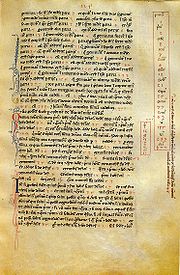
by Leonardo of Pisa, known later by his nickname Fibonacci
Fibonacci
Leonardo Pisano Bigollo also known as Leonardo of Pisa, Leonardo Pisano, Leonardo Bonacci, Leonardo Fibonacci, or, most commonly, simply Fibonacci, was an Italian mathematician, considered by some "the most talented western mathematician of the Middle Ages."Fibonacci is best known to the modern...
. In this work, Fibonacci introduced to Europe the Hindu-Arabic numerals
Arabic numerals
Arabic numerals or Hindu numerals or Hindu-Arabic numerals or Indo-Arabic numerals are the ten digits . They are descended from the Hindu-Arabic numeral system developed by Indian mathematicians, in which a sequence of digits such as "975" is read as a numeral...
, a major element of our decimal system
Decimal system
Decimal system may refer to:* The decimal number system, used in mathematics for writing numbers and performing arithmetic.* The Dewey Decimal System, a subject classification system used in libraries....
, which he had learned by studying with Arab
Arab
Arab people, also known as Arabs , are a panethnicity primarily living in the Arab world, which is located in Western Asia and North Africa. They are identified as such on one or more of genealogical, linguistic, or cultural grounds, with tribal affiliations, and intra-tribal relationships playing...
s while living in North Africa
North Africa
North Africa or Northern Africa is the northernmost region of the African continent, linked by the Sahara to Sub-Saharan Africa. Geopolitically, the United Nations definition of Northern Africa includes eight countries or territories; Algeria, Egypt, Libya, Morocco, South Sudan, Sudan, Tunisia, and...
with his father, Guglielmo Bonaccio, who wished for him to become a merchant.
Liber Abaci was among the first Western books to describe Arabic numerals, the first being the Codex Vigilanus
Codex Vigilanus
The Codex Vigilanus or Códice Albeldense , full name Codex Conciliorum Albeldensis seu Vigilanus, is an illuminated compilation of various historical documents from the Visigothic period in Spain...
completed in 976; another pivotal work followed by Pope Silvester II
Pope Silvester II
Pope Sylvester II , born Gerbert d'Aurillac, was a prolific scholar, teacher, and Pope. He endorsed and promoted study of Arab/Greco-Roman arithmetic, mathematics, and astronomy, reintroducing to Europe the abacus and armillary sphere, which had been lost to Europe since the end of the Greco-Roman...
in 999. By addressing tradesmen and academics, it began to convince the public of the superiority of the new numerals.
The title of Liber Abaci means "The Book of Calculation". Although it has also been translated as "The Book of the Abacus", writes that this is an error: the intent of the book is to describe methods of doing calculations without aid of an abacus
Abacus
The abacus, also called a counting frame, is a calculating tool used primarily in parts of Asia for performing arithmetic processes. Today, abaci are often constructed as a bamboo frame with beads sliding on wires, but originally they were beans or stones moved in grooves in sand or on tablets of...
, and as confirms, for centuries after its publication the algorism
Algorism
Algorism is the technique of performing basic arithmetic by writing numbers in place value form and applying a set of memorized rules and facts to the digits. One who practices algorism is known as an algorist...
ists (followers of the style of calculation demonstrated in Liber Abaci) remained in conflict with the abacists (traditionalists who continued to use the abacus in conjunction with Roman numerals).
Summary of sections
The first section introduces the Arabic numeral system, including lattice multiplication and methods for converting between different representation systems.The second section presents examples from commerce, such as conversions of currency
Currency
In economics, currency refers to a generally accepted medium of exchange. These are usually the coins and banknotes of a particular government, which comprise the physical aspects of a nation's money supply...
and measurements, and calculations of profit
Profit (accounting)
In accounting, profit can be considered to be the difference between the purchase price and the costs of bringing to market whatever it is that is accounted as an enterprise in terms of the component costs of delivered goods and/or services and any operating or other expenses.-Definition:There are...
and interest
Interest
Interest is a fee paid by a borrower of assets to the owner as a form of compensation for the use of the assets. It is most commonly the price paid for the use of borrowed money, or money earned by deposited funds....
.
The third section discusses a number of mathematical problems; for instance, it includes (ch. II.12) the Chinese remainder theorem
Chinese remainder theorem
The Chinese remainder theorem is a result about congruences in number theory and its generalizations in abstract algebra.In its most basic form it concerned with determining n, given the remainders generated by division of n by several numbers...
, perfect number
Perfect number
In number theory, a perfect number is a positive integer that is equal to the sum of its proper positive divisors, that is, the sum of its positive divisors excluding the number itself . Equivalently, a perfect number is a number that is half the sum of all of its positive divisors i.e...
s and Mersenne prime
Mersenne prime
In mathematics, a Mersenne number, named after Marin Mersenne , is a positive integer that is one less than a power of two: M_p=2^p-1.\,...
s as well as formulas for arithmetic series
Arithmetic progression
In mathematics, an arithmetic progression or arithmetic sequence is a sequence of numbers such that the difference between the consecutive terms is constant...
and for square pyramidal number
Square pyramidal number
In mathematics, a pyramid number, or square pyramidal number, is a figurate number that represents the number of stacked spheres in a pyramid with a square base...
s. Another example in this chapter, describing the growth of a population of rabbits, was the origin of the Fibonacci sequence for which the author is most famous today.
The fourth section derives approximations, both numerical and geometrical, of irrational number
Irrational number
In mathematics, an irrational number is any real number that cannot be expressed as a ratio a/b, where a and b are integers, with b non-zero, and is therefore not a rational number....
s such as square roots.
The book also includes proofs in Euclidean geometry
Euclidean geometry
Euclidean geometry is a mathematical system attributed to the Alexandrian Greek mathematician Euclid, which he described in his textbook on geometry: the Elements. Euclid's method consists in assuming a small set of intuitively appealing axioms, and deducing many other propositions from these...
. Fibonacci's method of solving algebraic equations shows the influence of the early 10th century Egyptian mathematician Abū Kāmil Shujāʿ ibn Aslam.
Fibonacci's notation for fractions
In reading Liber Abaci, it is helpful to understand Fibonacci's notation for rational numbers, a notation that is intermediate in form between the Egyptian fractions commonly used until that time and the vulgar fractions still in use today. There are three key differences between Fibonacci's notation and modern fraction notation.- Where we generally write a fraction to the right of the whole number to which it is added, Fibonacci would write the same fraction to the left. That is, we write 7/3 as
 , while Fibonacci would write the same number as
  .
. - Fibonacci used a composite fraction notation in which a sequence of numerators and denominators shared the same fraction bar; each such term represented an additional fraction of the given numerator divided by the product of all the denominators below and to the right of it. That is,
 , and
, and  . The notation was read from right to left. For example, 29/30 could be written as
  , representing the value
  . This can be viewed as a form of mixed radixMixed radixMixed radix numeral systems are non-standard positional numeral systems in which the numerical base varies from position to position. Such numerical representation applies when a quantity is expressed using a sequence of units that are each a multiple of the next smaller one, but not by the same...
notation, and was very convenient for dealing with traditional systems of weights, measures, and currency. For instance, for units of length, a foot is 1/3 of a yardYardA yard is a unit of length in several different systems including English units, Imperial units and United States customary units. It is equal to 3 feet or 36 inches...
, and an inchInchAn inch is the name of a unit of length in a number of different systems, including Imperial units, and United States customary units. There are 36 inches in a yard and 12 inches in a foot...
is 1/12 of a foot, so a quantity of 5 yards, 2 feet, and inches could be represented as a composite fraction:
  yards. However, typical notations for traditional measures, while similarly based on mixed radixes, do not write out the denominators explicitly; the explicit denominators in Fibonacci's notation allow him to use different radixes for different problems when convenient. Sigler also points out an instance where Fibonacci uses composite fractions in which all denominators are 10, prefiguring modern decimal notation for fractions.
 - Fibonacci sometimes wrote several fractions next to each other, representing a sum of the given fractions. For instance, 1/3+1/4 = 7/12, so a notation like
 would represent the number that would now more commonly be written
  , or simply the vulgar fraction
 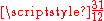 . Notation of this form can be distinguished from sequences of numerators and denominators sharing a fraction bar by the visible break in the bar. If all numerators are 1 in a fraction written in this form, and all denominators are different from each other, the result is an Egyptian fraction representation of the number. This notation was also sometimes combined with the composite fraction notation: two composite fractions written next to each other would represent the sum of the fractions.
The complexity of this notation allows numbers to be written in many different ways, and Fibonacci described several methods for converting from one style of representation to another. In particular, chapter II.7 contains a list of methods for converting a vulgar fraction to an Egyptian fraction, including the greedy algorithm for Egyptian fractions
Greedy algorithm for Egyptian fractions
In mathematics, the greedy algorithm for Egyptian fractions is a greedy algorithm, first described by Fibonacci, for transforming rational numbers into Egyptian fractions. An Egyptian fraction is a representation of an irreducible fraction as a sum of unit fractions, as e.g. 5/6 = 1/2 + 1/3...
, also known as the Fibonacci–Sylvester expansion.
Modus Indorum
In the Liber Abaci, Fibonacci says the following introducing the so-called "Modus Indorum" or the method of the Indians, today known as Arabic numerals.- After my father's appointment by his homeland as state official in the customs house of Bugia for the Pisan merchants who thronged to it, he took charge; and in view of its future usefulness and convenience, had me in my boyhood come to him and there wanted me to devote myself to and be instructed in the study of calculation for some days.
- There, following my introduction, as a consequence of marvelous instruction in the art, to the nine digits of the Hindus, the knowledge of the art very much appealed to me before all others, and for it I realized that all its aspects were studied in Egypt, Syria, Greece, Sicily, and Provence, with their varying methods; and at these places thereafter, while on business.
- I pursued my study in depth and learned the give-and-take of disputation. But all this even, and the algorism, as well as the art of Pythagoras, I considered as almost a mistake in respect to the method of the Hindus. (Modus Indorum). Therefore, embracing more stringently that method of the Hindus, and taking stricter pains in its study, while adding certain things from my own understanding and inserting also certain things from the niceties of Euclid's geometric art, I have striven to compose this book in its entirety as understandably as I could, dividing it into fifteen chapters.
- Almost everything which I have introduced I have displayed with exact proof, in order that those further seeking this knowledge, with its pre-eminent method, might be instructed, and further, in order that the Latin people might not be discovered to be without it, as they have been up to now. If I have perchance omitted anything more or less proper or necessary, I beg indulgence, since there is no one who is blameless and utterly provident in all things.
- The nine Indian figures are:
- 9 8 7 6 5 4 3 2 1
- With these nine figures, and with the sign 0 ... any number may be written. ( and )
In other words, in his book he advocated the use of the digits 0–9, and of place value.
In this book he showed the practical importance of the new numeral system
Numeral system
A numeral system is a writing system for expressing numbers, that is a mathematical notation for representing numbers of a given set, using graphemes or symbols in a consistent manner....
by applying it to commercial bookkeeping
Bookkeeping
Bookkeeping is the recording of financial transactions. Transactions include sales, purchases, income, receipts and payments by an individual or organization. Bookkeeping is usually performed by a bookkeeper. Bookkeeping should not be confused with accounting. The accounting process is usually...
, conversion of weights and measures, the calculation of interests, money-changing, and numerous other applications. The book made an important contribution to the spread of decimal numerals, although as Ore writes this process was "long-drawn-out" and did not become complete until the later part of the 16th century.