

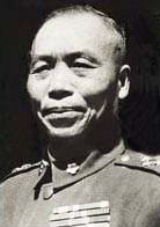
Li Zongren

Encyclopedia
Li Zongren or Li Tsung-jen (13 August 1890 – 30 January 1969), courtesy name Delin (德鄰), was a prominent Guangxi
warlord
and Kuomintang
(KMT) military commander during the Northern Expedition, Second Sino-Japanese War
and Chinese Civil War
. He served as vice-president and acting
president of the Republic of China
under the 1947 Chinese Constitution.
in Guangxi Province, the second eldest in a family of five boys and three girls. Li's father, Li Beiying (李培英), was a village schoolmaster. After a patchy education Li enrolled in a provincial military school. Li joined the Tongmenghui
, the revolutionary party of Sun Yatsen, in 1910, but had little understanding at that time of Sun's wider goals of reform and national reunification. Li's native province of Guangxi was also the home province of the Taiping
general Li Xiucheng
, who Li's family claimed to be related to.
, Li graduated from the Guilin Military Cadre Training School and in 1916 became a platoon commander in the army of the Guanxi warlord Lu Rongting
's army. Li's direct superior was Lin Hu
. Lu, the governor of Guangxi, was a former bandit who had ambitions to expand into neighboring provinces, especially Guangdong
. For the next few years the warlords of Guangxi and Guangdong were involved in mutually destructive battles, and both occupied portions of each other's territory at various times. Lu and his closest associates were collectively known as the Old Guangxi Clique
. During a battle with a rival warlord in Hunan
in 1918, Li's bravery earned him a promotion to battalion commander.
In 1921 Li Zongren accompanied Lin Hu and Lu Rongting in Lu's second invasion of Guangdong
, attacking forces under the command of Chen Jiongming
. When Lu's invasion suffered a disastrous defeat, Li led the rear guard when the Old Guangxi Clique
forces retreated. Most of Lin Hu's officers were former bandits and militia recruited earlier by Lin from the Zhuang
areas of Guangdong
. During the campaign, many of Lin's officers defected to the Guangdong forces, taking their units with them. In the face of defeat Li Zongren's battalion shrunk to about one thousand men and "sank into the grasses" in order to escape.
after Sun established a base in Guangdong.
As chaos became the norm in Guangxi, Li became the independent commander of an area several counties large on the Guangdong border, and was joined by his old friend and colleague, Huang Shaoxiong
. The administration of Li and Huang was credited with keeping the area that they controlled relatively free of the bandits and petty battles that plagued Guanxi at the time. In 1924, while Lu was besieged by rebels in Guilin, Li and his colleagues peacefully occupied the provincial capital, Nanning
. Lu then fled and took refuge in French Indochina
. The next month Sun Yat-sen, from his base of operations in Guangdong, recognized Li Zongren and his allies, Huang Shaoxing and Bai Chongxi, as the rulers of Guangxi. Together they became known as the New Guangxi Clique
.
In 1926 Li allowed his soldiers to enroll in Kuomintang armies, but kept personal control of his troops. A Soviet adviser was sent to Guangxi, and Li's forces were renamed the Seventh Army Corps. Li went on to be a commanding general in the Northern Expedition, during which Li was appointed commander of the 4th Army Group, composed of the Guangxi Army and other provincial forces amounting to 16 corps and six independent divisions.
Li's first victories as a Nationalist general were in Hunan
, where he defeated the rival warlord Wu Peifu
in two successive battles and captured the provincial capital, Wuhan
, in 1926. After these victories Li became a famous and popular general within the KMT, and his army became variously known as the "Flying Army" and the "Army of Steel". When Wang Jingwei
installed a left-leaning KMT faction in Wuhan, Borodin
attempted to recruit Li to join the Communists, but Li was loyal to Chiang Kai-shek
, and refused.
Against the advice of his Soviet advisors, Li then marched up the north side of the Yangze to attack the forces of the warlord Sun Chuanfang
. Sun was the leader of the "League of Five Provinces" (Zhejiang
, Fujian
, Jiangsu
, Anhui
, and Jiangxi
), and successfully halted Chiang's advance into his territory in Jiangxi. Li went on to defeat Sun in three successive battles, securing his territories for the KMT.
By the time that Zi Zongren defeated Sun Chanfang, Li had gained a reputation as being strongly opposed to communism and highly suspicious of the Comintern
in China, and his army was one of the few KMT detachments free from serious communist influence. After being assured of his support, Chiang had Li's units redeployed to the new capital of Nanjing
. Chiang then used Li's Guangxi armies to purge his own First Division of Communists. In the resulting White Terror, thousands of suspected Communists were summarily executed. Li's close subordinate, Bai Chongxi, was notable for his important role in this purge.
In April, 1928, Li Zongren, with Bai Chongxi, led the Fourth Army group to advance on Beijing
, capturing Handan
, Baoding
, and Shijiazhuang
by June 1. Zhang Zuolin
withdrew from Beijing
on June 3, and Li's army seized Beijing and Tianjin
.
After the fall of Wang Jingwei's government in Wuhan and the expulsion of all Soviet advisors from KMT-held territories, Li was put in charge of one of five KMT political councils set up to administer KMT-controlled territories, based in Wuhan. In January 1929 Li dismissed Nanjing's appointee to the Hunan provincial committee; and, fearing retribution, uncharacteristically fled to the foreign concessions in Shanghai
. Chiang then arranged for Li and his two closest subordinates to be stripped of their posts within the government and expelled from the Party for life.
warlord Yan Xishan
in Yan's attempt to form an alternative central government based in Beijing, leading to the Central Plains War
. Li led troops to (re-) conquer Hunan as far north as Yueyang
, before Chiang's decisive defeat of Yan and his ally, Feng Yuxiang
, forced Li to withdraw back to Guangxi.
Following Yan's defeat in the Central Plains War, Li allied with Chen Jitang
after Chen became the chairman of the government of Guangdong in 1931, and prepared to battle Chiang Kai-shek. Another civil war would have broken out if Japan had not Invaded Manchuria
, prompting Li and Chiang to end their hostilities and unite against the Empire of Japan
.
(1937–1945). Chiang Kai-shek attempted to make use of Li's military experience by promoting him to be the director of the KMT Fifth War Zone. Li's first action against the Japanese came in the 1938 Battle of Taierzhuang
, after the Communist Zhou Enlai
(who was aiding the Nationalists as part of the United Front), recognized Li as the most capable Nationalist general available and used his influence to have Li appointed overall commander, despite Chiang's reservations about Li's loyalty.
Under Li's command the defense of Tai'erzhuang was a major victory for the Nationalists, killing 20,000-30,000 Japanese soldiers and capturing a large amount of supplies and equipment. The victory at Taierzhuang was principally credited to Li's planning and use of tactics, luring the Japanese into a trap and then annihilating them. The battle of Taierzhuang was one of the first major Chinese victories in the war against Japan, proving that with good weapons and inspired leadership Chinese armies could hold their own. Li also participated in the Battle of Xuzhou
, Battle of Wuhan
, Battle of Suixian-Zaoyang
, 1939-40 Winter Offensive
, Battle of Zaoyang-Yichang
, Central Hopei Operation, and Battle of South Henan
.
From 1943 to 1945 Li was made Director of the Generalissimo's Headquarters. This was a virtual and unwanted retirement from active command after his earlier successes. Li spent the last years of the war grumbling about his enforced inactivity.
.
On 28 April 1948, Li was elected by the National Assembly
as the vice-president, five days after his political opponent, Chiang Kai-shek
became the president. (Chiang had opposed Li's appointment, supporting Sun Fo's candidacy instead.) Chiang resigned the next year, on 21 January 1949, as a response to several serious Chinese Communist victories in northern China, and Li became the acting president the next day.
After the resignation of Chiang from the presidency, Mao Zedong
momentarily halted attacks against Kuomintang territories, attempting to negotiate a KMT surrender. Mao's Eight Points, the conditions that he demanded for an end to the civil war, were:
Recognizing that agreeing to these points would effectively surrender control of China to the CCP, Li attempted to negotiate milder conditions that might have led to an end to the civil war, but in vain. In April 1949, when the Communists recognized that Li was unlikely to accept their conditions, they offered Li an ultimatum to accept within five days. When Li refused, the Communists resumed their campaign.
Li's attempts to negotiate with the Communists were interpreted by some in the KMT as "pacifist attacks", and increased tensions between Li and Chiang (whose relationship was already strained). Li attempted to negotiate with the Communists a settlement based on the implementation of Li's Seven Great Peace Policies. The policies that Li wanted to carry out were:
Li's attempts to carry out his policies faced varying degrees of opposition from Chiang's supporters, and were generally unsuccessful. Chiang especially antagonized Li by taking possession of (and moving to Taiwan) US$200 million of gold and US dollars belonging to the central government that Li desperately needed to cover the government's soaring expenses. When the Communists captured the Nationalist capital of Nanjing in April 1949, Li refused to accompany the central government as it fled to Guangdong
, instead expressing his dissatisfaction with Chiang by retiring to Guangxi.
The former warlord Yan Xishan, who had fled to Nanking only one month before, quickly insinuated himself within the Li-Chiang rivalry, attempting to have Li and Chiang reconcile their differences in the effort to resist the Communists. At Chiang's request Yan visited Li in order to convince Li not to withdraw from public life. Yan broke down in tears while talking of the loss of his home province of Shanxi to the Communists, and warned Li that the Nationalist cause was doomed unless Li went to Guangdong. Li agreed to return under the condition that Chiang surrender most of the gold and US dollars in his possession that belonged to the central government, and that Chiang stop overriding Li's authority. After Yan communicated these demands and Chiang agreed to comply with them, Li departed for Guangdong.
In Guangdong, Li attempted to create a new government composed of both Chiang supporters and those opposed to Chiang. Li's first choice of premier was Chu Cheng, a veteran member of the Kuomintang who had been virtually driven into exile due to his strong opposition to Chiang. After the Legislative Yuan rejected Chu, Li was obliged to choose Yan Xishan instead. By this time Yan was well-known for his adaptability, and Chiang welcomed his appointment.
Conflict between Chiang and Li persisted. Although he had agreed to do so as a prerequisite of Li's return, Chiang refused to surrender more than a fraction of the wealth that he had sent to Taiwan. Without being backed by gold or foreign currency, the money issued by Li and Yan quickly declined in value until it became virtually worthless.
Although he did not hold a formal executive position in the government, Chiang continued to issue orders to the army, and many officers continued to obey Chiang rather than Li. The inability of Li to coordinate KMT military forces led him to put into effect a plan of defense that he had contemplated as early as 1948. Instead of attempting to defend all of southern China, Li ordered what remained of the Nationalist armies to withdraw to Guangxi and Guangdong, hoping that he could concentrate all available defenses on this smaller, and more easily defensible, area. The object of this strategy was to maintain a foothold on the Chinese mainland in the hope that the United States would eventually be compelled to enter the war in China on the Nationalist side.
Chiang opposed Li's plan of defense because it would have placed most of the troops still loyal to Chiang under the control of Li and Chiang's other opponents in the central government. To overcome Chiang's intransigence Li began ousting Chiang's supporters within the central government. Yan Xishan continued in his attempts to work with both sides, creating the impression among Li's supporters that he was a "stooge" of Chiang, while those who supported Chiang began to bitterly resent Yan for his willingness to work with Li. Because of the rivalry between Chiang and Li, Chiang refused to allow Nationalist troops loyal to him to aid in the defense of Guangxi and Guangdong, with the result that Communist forces occupied Guangdong in October 1949.
, while Li effectively surrendered his powers and flew to New York
for treatment of his chronic duodenum
illness at the Hospital of Columbia University
. Li visited the President of the United States, Harry S. Truman
, and denounced Chiang as a "dictator" and an "usurper." Li vowed that he would "return to crush" Chiang's movements once he returned to China.
The Kuomintang defenses continued to fall apart. General Hu Zongnan
ignored Li's orders, and the Muslim General Ma Hongkui
was furious at this. Ma Hongkui sent a telegram to Li to submit his resignation from all positions he held, then Ma Hongkui fled to Taiwan, and his cousin Ma Hongbin
took charge of his positions.
In December 1949, Chongqing fell too, and Chiang relocated his government to Taipei
, but he did not formally re-assume the presidency until March 1, 1950. On January 1952, Chiang commanded the Control Yuan
, now in Taiwan, to impeach Li in the "Case of Li Zongren's Failure to carry out Duties due to Illegal Conduct" (李宗仁違法失職案), and officially relieved Li of the position as vice-president in the National Assembly
on March 1954.
cancer in Beijing
at 78, in the darkest period of Mao Zedong
's Cultural Revolution
.
Li's residence in mainland China
is viewed by some Chinese Communists as Li's "patriotic return to the embrace of his Motherland with smiles", something similar to the former Qing
Emperor Puyi
's "reformation". To this day, some Nationalists supporters view him as a traitor to the democratic cause.
, seeing it as a solution to the problems of a once proud nation humbled by internal dissension and external weakness. His ethical attitudes were self-consciously drawn from Confucianism
. After his falling out with Chiang Kai-shek in 1929, Li often expressed himself in terms of frustrated patriotism. Li was am admirer of the British historian Edward Gibbon
(1737–94) and his monumental historical work, The Decline and Fall of the Roman Empire
.
Li and his close staff member, the Muslim General Bai Chongxi
, were powerful partners in politics and military affairs. They were once nicknamed them Li Bai
(李白), after the famous poet.
Li was married to Li Xiuwen (李秀文) at 20 in an arranged marriage, but they separated soon afterwards. Li Zongren and Li Xiuwen had a son, Li Youlin (李幼鄰). In 1924, Li married Guo Dejie (郭德潔), who died of breast cancer
soon after returning with Li to Beijing. Li and Guo had one son: Li Zhisheng (李志聖). Li then remarried, to Hu Yousong (胡友松), who was 48 years younger than Li. Hu changed her name to Wang Xi (王曦) after Li died, and remarried.
Li co-wrote Memoirs of Li Zongren with historian Te-Kong Tang (唐德剛). Li's memoir is notable for its vehement criticism of Chiang Kai-shek and its analysis of Japan's strategic failure to conquer China. A more detailed account of Li's life is depicted in the less popular biography My Trusted Aide (Wode Gugong), written by Li's distant relative Namgo Chai.
Guangxi
Guangxi, formerly romanized Kwangsi, is a province of southern China along its border with Vietnam. In 1958, it became the Guangxi Zhuang Autonomous Region of the People's Republic of China, a region with special privileges created specifically for the Zhuang people.Guangxi's location, in...
warlord
Warlord
A warlord is a person with power who has both military and civil control over a subnational area due to armed forces loyal to the warlord and not to a central authority. The term can also mean one who espouses the ideal that war is necessary, and has the means and authority to engage in war...
and Kuomintang
Kuomintang
The Kuomintang of China , sometimes romanized as Guomindang via the Pinyin transcription system or GMD for short, and translated as the Chinese Nationalist Party is a founding and ruling political party of the Republic of China . Its guiding ideology is the Three Principles of the People, espoused...
(KMT) military commander during the Northern Expedition, Second Sino-Japanese War
Second Sino-Japanese War
The Second Sino-Japanese War was a military conflict fought primarily between the Republic of China and the Empire of Japan. From 1937 to 1941, China fought Japan with some economic help from Germany , the Soviet Union and the United States...
and Chinese Civil War
Chinese Civil War
The Chinese Civil War was a civil war fought between the Kuomintang , the governing party of the Republic of China, and the Communist Party of China , for the control of China which eventually led to China's division into two Chinas, Republic of China and People's Republic of...
. He served as vice-president and acting
Acting president
An Acting President is a person who temporarily fills the role of an organization's or country's president, either when the real president is unavailable or when the post is vacant .-See also:*Acting *Acting President of Pakistan*Acting President of Malta*Acting President of...
president of the Republic of China
President of the Republic of China
The President of the Republic of China is the head of state and commander-in-chief of the Republic of China . The Republic of China was founded on January 1, 1912, to govern all of China...
under the 1947 Chinese Constitution.
Early life
Li Zongren was born in Xixiang Village (西鄉村), near GuilinGuilin
Guilin is a prefecture-level city in the northeast of the Guangxi Zhuang Autonomous Region of far southern China, sitting on the west bank of the Li River. Its name means "forest of Sweet Osmanthus", owing to the large number of fragrant Sweet Osmanthus trees located in the city...
in Guangxi Province, the second eldest in a family of five boys and three girls. Li's father, Li Beiying (李培英), was a village schoolmaster. After a patchy education Li enrolled in a provincial military school. Li joined the Tongmenghui
Tongmenghui
The Tongmenghui, also known as the Chinese United League, United League, Chinese Revolutionary Alliance, Chinese Alliance and United Allegiance Society, was a secret society and underground resistance movement formed when merging many Chinese revolutionary groups together by Sun Yat-sen, Song...
, the revolutionary party of Sun Yatsen, in 1910, but had little understanding at that time of Sun's wider goals of reform and national reunification. Li's native province of Guangxi was also the home province of the Taiping
Taiping Rebellion
The Taiping Rebellion was a widespread civil war in southern China from 1850 to 1864, led by heterodox Christian convert Hong Xiuquan, who, having received visions, maintained that he was the younger brother of Jesus Christ, against the ruling Manchu-led Qing Dynasty...
general Li Xiucheng
Li Xiucheng
Li Xiucheng was an eminent military leader of the Taiping Rebellion, and known during his military tenure as the Loyal King . This title was given because a Qing general attempted to bribe him to kill Hong Xiuquan, but he refused and told Hong Xiuquan. His many victories also made Hong very happy...
, who Li's family claimed to be related to.
Early military service
Schooled under Cai ECai E
Cai E or Tsai Ao was a Chinese revolutionary leader and warlord. He was born Cai Genyin in Shaoyang, Hunan, and his courtesy name was Songpo...
, Li graduated from the Guilin Military Cadre Training School and in 1916 became a platoon commander in the army of the Guanxi warlord Lu Rongting
Lu Rongting
Lu Rongting was born in Wuming, Guangxi, China. Originating as a common bandit, Lu became a military commander in Guangxi in the Qing dynasty and suppressed the revolutionary uprising at Zhennan Pass on the Sino-Vietnam border in Pingxiang, Guangxi led by Sun Yat-sen and Huang Xing.However, when...
's army. Li's direct superior was Lin Hu
Lin Hu
Lin Hu, 林虎, was a member of the Old Guangxi Clique and military governor of Guangdong province from May 1924 to July 1925.-Early life and career:...
. Lu, the governor of Guangxi, was a former bandit who had ambitions to expand into neighboring provinces, especially Guangdong
Guangdong
Guangdong is a province on the South China Sea coast of the People's Republic of China. The province was previously often written with the alternative English name Kwangtung Province...
. For the next few years the warlords of Guangxi and Guangdong were involved in mutually destructive battles, and both occupied portions of each other's territory at various times. Lu and his closest associates were collectively known as the Old Guangxi Clique
Old Guangxi clique
After the founding of the Republic of China, Guangxi served as the base for one of the most powerful warlord cliques of China: the Old Guangxi Clique. Led by Lu Rongting, the clique was able to take control of neighbouring Hunan and Guangdong provinces as well...
. During a battle with a rival warlord in Hunan
Hunan
' is a province of South-Central China, located to the south of the middle reaches of the Yangtze River and south of Lake Dongting...
in 1918, Li's bravery earned him a promotion to battalion commander.
In 1921 Li Zongren accompanied Lin Hu and Lu Rongting in Lu's second invasion of Guangdong
Guangdong
Guangdong is a province on the South China Sea coast of the People's Republic of China. The province was previously often written with the alternative English name Kwangtung Province...
, attacking forces under the command of Chen Jiongming
Chen Jiongming
Chen Jiongming was a revolutionary figure in the early periods of the Republic of China. Chen Jiongming was born in 1878 at Haifeng, Guangdong, China....
. When Lu's invasion suffered a disastrous defeat, Li led the rear guard when the Old Guangxi Clique
Old Guangxi clique
After the founding of the Republic of China, Guangxi served as the base for one of the most powerful warlord cliques of China: the Old Guangxi Clique. Led by Lu Rongting, the clique was able to take control of neighbouring Hunan and Guangdong provinces as well...
forces retreated. Most of Lin Hu's officers were former bandits and militia recruited earlier by Lin from the Zhuang
Zhuang
The Zhuang are an ethnic group of people who mostly live in the Guangxi Zhuang Autonomous Region in southern China. Some also live in the Yunnan, Guangdong, Guizhou and Hunan provinces...
areas of Guangdong
Guangdong
Guangdong is a province on the South China Sea coast of the People's Republic of China. The province was previously often written with the alternative English name Kwangtung Province...
. During the campaign, many of Lin's officers defected to the Guangdong forces, taking their units with them. In the face of defeat Li Zongren's battalion shrunk to about one thousand men and "sank into the grasses" in order to escape.
Rise to power
After Lu's defeat most of his army dissolved into independent bands of soldiers, many of which resorted to banditry in order to survive. Foreign missionaries and aid workers active in Guangxi at this time reported that banditry in Guangxi was extremely common and severe, with bandits commonly looting all food and valuables from undefended villages and resorting to murder and public cannibalism in order to extort ransoms from the relatives of people whom they kidnapped. Li, intending to become more than a bandit, began building a personal military force of professional soldiers that became the equal of any number of bandits or Zhuang irregulars that Lu Rongting drew on in his war to re-establish his power in Guangxi. Li joined Sun Yat-sen's KuomintangKuomintang
The Kuomintang of China , sometimes romanized as Guomindang via the Pinyin transcription system or GMD for short, and translated as the Chinese Nationalist Party is a founding and ruling political party of the Republic of China . Its guiding ideology is the Three Principles of the People, espoused...
after Sun established a base in Guangdong.
As chaos became the norm in Guangxi, Li became the independent commander of an area several counties large on the Guangdong border, and was joined by his old friend and colleague, Huang Shaoxiong
Huang Shaoxiong
Huang Shaoxiong or Huang Shaohong was a warlord in Guangxi province, and governed Guangxi as part of the New Guangxi Clique, though the later part of the Warlord era and a leader in the later years of the Republic of China.-Biography:...
. The administration of Li and Huang was credited with keeping the area that they controlled relatively free of the bandits and petty battles that plagued Guanxi at the time. In 1924, while Lu was besieged by rebels in Guilin, Li and his colleagues peacefully occupied the provincial capital, Nanning
Nanning
Nanning is the capital of the Guangxi Zhuang Autonomous Region in southern China. It is known as the "Green City" because of its abundance of lush tropical foliage.-History:...
. Lu then fled and took refuge in French Indochina
French Indochina
French Indochina was part of the French colonial empire in southeast Asia. A federation of the three Vietnamese regions, Tonkin , Annam , and Cochinchina , as well as Cambodia, was formed in 1887....
. The next month Sun Yat-sen, from his base of operations in Guangdong, recognized Li Zongren and his allies, Huang Shaoxing and Bai Chongxi, as the rulers of Guangxi. Together they became known as the New Guangxi Clique
New Guangxi clique
After the founding of the Republic of China, Guangxi served as the base for one of the most powerful warlord cliques of China: the Old Guangxi clique. Led by Lu Rongting and others, the clique was able to take control of neighbouring Hunan and Guangdong provinces as well...
.
Kuomintang general
Li reorganized his forces as the "Guangxi Pacification Army". Li Zongren was named the Commander in Chief, Huang Shaohong the deputy Commander, and Bai Chongxi the Chief-of-Staff. By August they had driven all other contenders out of the province. Li Zongren was military governor of Guangxi from 1924–25, and from 1925-49 Guangxi remained under Li Zongren's influence.In 1926 Li allowed his soldiers to enroll in Kuomintang armies, but kept personal control of his troops. A Soviet adviser was sent to Guangxi, and Li's forces were renamed the Seventh Army Corps. Li went on to be a commanding general in the Northern Expedition, during which Li was appointed commander of the 4th Army Group, composed of the Guangxi Army and other provincial forces amounting to 16 corps and six independent divisions.
Li's first victories as a Nationalist general were in Hunan
Hunan
' is a province of South-Central China, located to the south of the middle reaches of the Yangtze River and south of Lake Dongting...
, where he defeated the rival warlord Wu Peifu
Wu Peifu
Wu Peifu or Wu P'ei-fu , was a major figure in the struggles between the warlords who dominated Republican China from 1916 to 1927.- Early career :...
in two successive battles and captured the provincial capital, Wuhan
Wuhan
Wuhan is the capital of Hubei province, People's Republic of China, and is the most populous city in Central China. It lies at the east of the Jianghan Plain, and the intersection of the middle reaches of the Yangtze and Han rivers...
, in 1926. After these victories Li became a famous and popular general within the KMT, and his army became variously known as the "Flying Army" and the "Army of Steel". When Wang Jingwei
Wang Jingwei
Wang Jingwei , alternate name Wang Zhaoming, was a Chinese politician. He was initially known as a member of the left wing of the Kuomintang , but later became increasingly anti-Communist after his efforts to collaborate with the CCP ended in political failure...
installed a left-leaning KMT faction in Wuhan, Borodin
Borodin
Borodin , or Borodina is a Russian last name and may refer to:*Alexander Borodin , Russian composer and chemist*Alexander Parfeniyevich Borodin, Russian scientist in the field of rail transport...
attempted to recruit Li to join the Communists, but Li was loyal to Chiang Kai-shek
Chiang Kai-shek
Chiang Kai-shek was a political and military leader of 20th century China. He is known as Jiǎng Jièshí or Jiǎng Zhōngzhèng in Mandarin....
, and refused.
Against the advice of his Soviet advisors, Li then marched up the north side of the Yangze to attack the forces of the warlord Sun Chuanfang
Sun Chuanfang
Sun Chuanfang aka the "Nanking Warlord" or leader of the "League of Five Provinces" was a Zhili clique warlord and protege of the "Jade Marshal" Wu Peifu .- Biography :Sun Chuanfang was born in Lichen, Shandong...
. Sun was the leader of the "League of Five Provinces" (Zhejiang
Zhejiang
Zhejiang is an eastern coastal province of the People's Republic of China. The word Zhejiang was the old name of the Qiantang River, which passes through Hangzhou, the provincial capital...
, Fujian
Fujian
' , formerly romanised as Fukien or Huguing or Foukien, is a province on the southeast coast of mainland China. Fujian is bordered by Zhejiang to the north, Jiangxi to the west, and Guangdong to the south. Taiwan lies to the east, across the Taiwan Strait...
, Jiangsu
Jiangsu
' is a province of the People's Republic of China, located along the east coast of the country. The name comes from jiang, short for the city of Jiangning , and su, for the city of Suzhou. The abbreviation for this province is "苏" , the second character of its name...
, Anhui
Anhui
Anhui is a province in the People's Republic of China. Located in eastern China across the basins of the Yangtze River and the Huai River, it borders Jiangsu to the east, Zhejiang to the southeast, Jiangxi to the south, Hubei to the southwest, Henan to the northwest, and Shandong for a tiny...
, and Jiangxi
Jiangxi
' is a southern province in the People's Republic of China. Spanning from the banks of the Yangtze River in the north into hillier areas in the south, it shares a border with Anhui to the north, Zhejiang to the northeast, Fujian to the east, Guangdong to the south, Hunan to the west, and Hubei to...
), and successfully halted Chiang's advance into his territory in Jiangxi. Li went on to defeat Sun in three successive battles, securing his territories for the KMT.
By the time that Zi Zongren defeated Sun Chanfang, Li had gained a reputation as being strongly opposed to communism and highly suspicious of the Comintern
Comintern
The Communist International, abbreviated as Comintern, also known as the Third International, was an international communist organization initiated in Moscow during March 1919...
in China, and his army was one of the few KMT detachments free from serious communist influence. After being assured of his support, Chiang had Li's units redeployed to the new capital of Nanjing
Nanjing
' is the capital of Jiangsu province in China and has a prominent place in Chinese history and culture, having been the capital of China on several occasions...
. Chiang then used Li's Guangxi armies to purge his own First Division of Communists. In the resulting White Terror, thousands of suspected Communists were summarily executed. Li's close subordinate, Bai Chongxi, was notable for his important role in this purge.
In April, 1928, Li Zongren, with Bai Chongxi, led the Fourth Army group to advance on Beijing
Beijing
Beijing , also known as Peking , is the capital of the People's Republic of China and one of the most populous cities in the world, with a population of 19,612,368 as of 2010. The city is the country's political, cultural, and educational center, and home to the headquarters for most of China's...
, capturing Handan
Handan
Handan is a prefecture-level city located in the southwestern part of Hebei Province of China.- History :Handan was the capital of the State of Zhao during the Warring States period , after the capital moved from Zhongmu. The city was conquered by the State of Qin after the virtual annexation of...
, Baoding
Baoding
-Administrative divisions:Baoding prefecture-level city consists of 3 municipal districts, 4 county-level cities, 18 counties:-Demographics:The Baoding urban area has a population of around 1,006,000 . The population of the Baoding administrative area is 10,890,000. The considerable majority are...
, and Shijiazhuang
Shijiazhuang
Shijiazhuang is the capital and largest city of North China's Hebei province. Administratively a prefecture-level city, it is about south of Beijing...
by June 1. Zhang Zuolin
Zhang Zuolin
Zhang Zuolin was the warlord of Manchuria from 1916 to 1928 . He successfully invaded China proper in October 1924 in the Second Zhili-Fengtian War. He gained control of Peking, including China's internationally recognized government, in April 1926...
withdrew from Beijing
Beijing
Beijing , also known as Peking , is the capital of the People's Republic of China and one of the most populous cities in the world, with a population of 19,612,368 as of 2010. The city is the country's political, cultural, and educational center, and home to the headquarters for most of China's...
on June 3, and Li's army seized Beijing and Tianjin
Tianjin
' is a metropolis in northern China and one of the five national central cities of the People's Republic of China. It is governed as a direct-controlled municipality, one of four such designations, and is, thus, under direct administration of the central government...
.
After the fall of Wang Jingwei's government in Wuhan and the expulsion of all Soviet advisors from KMT-held territories, Li was put in charge of one of five KMT political councils set up to administer KMT-controlled territories, based in Wuhan. In January 1929 Li dismissed Nanjing's appointee to the Hunan provincial committee; and, fearing retribution, uncharacteristically fled to the foreign concessions in Shanghai
Shanghai
Shanghai is the largest city by population in China and the largest city proper in the world. It is one of the four province-level municipalities in the People's Republic of China, with a total population of over 23 million as of 2010...
. Chiang then arranged for Li and his two closest subordinates to be stripped of their posts within the government and expelled from the Party for life.
Return to Guangxi
After his falling out with Chiang Kai-shek, Li Zongren returned to Guanxi and devoted himself to that province's internal administration with some success. In 1929 Li supported the ShanxiShanxi
' is a province in Northern China. Its one-character abbreviation is "晋" , after the state of Jin that existed here during the Spring and Autumn Period....
warlord Yan Xishan
Yan Xishan
Yan Xishan, was a Chinese warlord who served in the government of the Republic of China. Yan effectively controlled the province of Shanxi from the 1911 Xinhai Revolution to the 1949 Communist victory in the Chinese Civil War...
in Yan's attempt to form an alternative central government based in Beijing, leading to the Central Plains War
Central Plains War
Central Plains War was a civil war within the factionalised Kuomintang that broke out in 1930. It was fought between the forces of Chiang Kai-shek and the coalition of three military commanders who had previously allied with Chiang: Yan Xishan, Feng Yuxiang, and Li Zongren...
. Li led troops to (re-) conquer Hunan as far north as Yueyang
Yueyang
Yueyang is a prefecture-level city at the northeastern corner of Hunan province, South Central China, on the southern shores of Dongting Lake.The Yueyang metropolitan area occupies 14,896 km². and the city proper occupies 304 km²...
, before Chiang's decisive defeat of Yan and his ally, Feng Yuxiang
Feng Yuxiang
Feng Yuxiang was a warlord and leader in Republican China. He was also known as the Christian General for his zeal to convert his troops and the Betrayal General for his penchant to break with the establishment. In 1911, he was an officer in the ranks of Yuan Shikai's Beiyang Army but joined...
, forced Li to withdraw back to Guangxi.
Following Yan's defeat in the Central Plains War, Li allied with Chen Jitang
Chen Jitang
Chen Jitang , also spelled Chen Chi-tang, was born into a Hakka family in Fangcheng, Guangxi, China. He joined the Chinese Revolutionary Alliance in 1908 and began serving in the Guangdong Army in 1920, rising from battalion to brigade commander...
after Chen became the chairman of the government of Guangdong in 1931, and prepared to battle Chiang Kai-shek. Another civil war would have broken out if Japan had not Invaded Manchuria
Mukden Incident
The Mukden Incident, also known as the Manchurian Incident, was a staged event that was engineered by Japanese military personnel as a pretext for invading the northern part of China known as Manchuria in 1931....
, prompting Li and Chiang to end their hostilities and unite against the Empire of Japan
Empire of Japan
The Empire of Japan is the name of the state of Japan that existed from the Meiji Restoration on 3 January 1868 to the enactment of the post-World War II Constitution of...
.
Second Sino-Japanese War
In 1937 full-scale war between Japan and China broke out, beginning the Second Sino-Japanese WarSecond Sino-Japanese War
The Second Sino-Japanese War was a military conflict fought primarily between the Republic of China and the Empire of Japan. From 1937 to 1941, China fought Japan with some economic help from Germany , the Soviet Union and the United States...
(1937–1945). Chiang Kai-shek attempted to make use of Li's military experience by promoting him to be the director of the KMT Fifth War Zone. Li's first action against the Japanese came in the 1938 Battle of Taierzhuang
Battle of Taierzhuang
The Battle of Tai'erzhuang was a battle of the Second Sino-Japanese War in 1938, between armies of Chinese Kuomintang and Japan, and is sometimes considered as a part of Battle of Xuzhou....
, after the Communist Zhou Enlai
Zhou Enlai
Zhou Enlai was the first Premier of the People's Republic of China, serving from October 1949 until his death in January 1976...
(who was aiding the Nationalists as part of the United Front), recognized Li as the most capable Nationalist general available and used his influence to have Li appointed overall commander, despite Chiang's reservations about Li's loyalty.
Under Li's command the defense of Tai'erzhuang was a major victory for the Nationalists, killing 20,000-30,000 Japanese soldiers and capturing a large amount of supplies and equipment. The victory at Taierzhuang was principally credited to Li's planning and use of tactics, luring the Japanese into a trap and then annihilating them. The battle of Taierzhuang was one of the first major Chinese victories in the war against Japan, proving that with good weapons and inspired leadership Chinese armies could hold their own. Li also participated in the Battle of Xuzhou
Battle of Xuzhou
The Battle of Xuzhou was fought between Japanese and Chinese forces in May 1938 during Second Sino-Japanese War. In contemporary accounts in English, the event was usually referred to as the "Battle of Hsuchow", using the Chinese Postal Map Romanization....
, Battle of Wuhan
Battle of Wuhan
The Battle of Wuhan, popularly known to the Chinese as the Defence of Wuhan, and to the Japanese as the Capture of Wuhan, was a large-scale battle of the Second Sino-Japanese War...
, Battle of Suixian-Zaoyang
Battle of Suixian-Zaoyang
The Battle of Suixian–Zaoyang , also known as the Battle of Suizao was one of the 22 major engagements between the National Revolutionary Army and Imperial Japanese Army during the Second Sino-Japanese War.- The battle :...
, 1939-40 Winter Offensive
1939-40 Winter Offensive
The 1939–40 Winter Offensive was one of the major engagements between the National Revolutionary Army and Imperial Japanese Army during the Second Sino-Japanese War...
, Battle of Zaoyang-Yichang
Battle of Zaoyang-Yichang
The Battle of Zaoyang–Yichang , also known as the Battle of Zaoyi was one of the 22 major engagements between the National Revolutionary Army and Imperial Japanese Army during the Second Sino-Japanese War....
, Central Hopei Operation, and Battle of South Henan
Battle of South Henan
The Battle of South Henan , was one of the 22 major engagements between the National Revolutionary Army and Imperial Japanese Army during the Second Sino-Japanese War.This battle was the first time the NRA engaged the Japanese in southern Henan....
.
From 1943 to 1945 Li was made Director of the Generalissimo's Headquarters. This was a virtual and unwanted retirement from active command after his earlier successes. Li spent the last years of the war grumbling about his enforced inactivity.
Chinese Civil War
After the war, Li was given the post of Director of the Peiping Field Headquarters from 1945 to 1947. This was a post without effective power, and he was sidelined from command in the early part of the Chinese Civil WarChinese Civil War
The Chinese Civil War was a civil war fought between the Kuomintang , the governing party of the Republic of China, and the Communist Party of China , for the control of China which eventually led to China's division into two Chinas, Republic of China and People's Republic of...
.
On 28 April 1948, Li was elected by the National Assembly
National Assembly of the Republic of China
The National Assembly of the Republic of China refers to several parliamentary bodies that existed in the Republic of China. The National Assembly was originally founded in 1913 as the first legislature in Chinese history, but was disbanded less than a year later as President Yuan Shikai assumed...
as the vice-president, five days after his political opponent, Chiang Kai-shek
Chiang Kai-shek
Chiang Kai-shek was a political and military leader of 20th century China. He is known as Jiǎng Jièshí or Jiǎng Zhōngzhèng in Mandarin....
became the president. (Chiang had opposed Li's appointment, supporting Sun Fo's candidacy instead.) Chiang resigned the next year, on 21 January 1949, as a response to several serious Chinese Communist victories in northern China, and Li became the acting president the next day.
After the resignation of Chiang from the presidency, Mao Zedong
Mao Zedong
Mao Zedong, also transliterated as Mao Tse-tung , and commonly referred to as Chairman Mao , was a Chinese Communist revolutionary, guerrilla warfare strategist, Marxist political philosopher, and leader of the Chinese Revolution...
momentarily halted attacks against Kuomintang territories, attempting to negotiate a KMT surrender. Mao's Eight Points, the conditions that he demanded for an end to the civil war, were:
- Punish all war criminals (Chiang Kai-shek was considered "number one")
- Abolish the invalid 1947 constitution;
- Abolish the KMT legal system;
- Reorganize the Nationalist armies;
- Confiscate all bureaucratic capital;
- Reform the land-tenure system;
- Abolish all treasonous treaties; and,
- Convene a full Political Consultative Conference to form a democratic coalition government.
Recognizing that agreeing to these points would effectively surrender control of China to the CCP, Li attempted to negotiate milder conditions that might have led to an end to the civil war, but in vain. In April 1949, when the Communists recognized that Li was unlikely to accept their conditions, they offered Li an ultimatum to accept within five days. When Li refused, the Communists resumed their campaign.
Li's attempts to negotiate with the Communists were interpreted by some in the KMT as "pacifist attacks", and increased tensions between Li and Chiang (whose relationship was already strained). Li attempted to negotiate with the Communists a settlement based on the implementation of Li's Seven Great Peace Policies. The policies that Li wanted to carry out were:
- "Bandit pacification commands" (剿總) to be controlled by military officers
- Overly strict orders are to be more lenient
- Eliminate anti-communist special commando units (戡亂建國總隊)
- Release political prisonerPolitical prisonerAccording to the Longman Dictionary of Contemporary English, a political prisoner is ‘someone who is in prison because they have opposed or criticized the government of their own country’....
s - Allow press freedom
- Eliminate unusual cruelty in punishmentCruel and unusual punishmentCruel and unusual punishment is a phrase describing criminal punishment which is considered unacceptable due to the suffering or humiliation it inflicts on the condemned person...
- Eliminate arrest of civilians without proper reasonsArbitrary arrest and detentionArbitrary arrest and arbitrary detention are the arrest or detention of an individual in a case in which there is no likelihood or evidence that they committed a crime against legal statute, or in which there has been no proper due process of law...
Li's attempts to carry out his policies faced varying degrees of opposition from Chiang's supporters, and were generally unsuccessful. Chiang especially antagonized Li by taking possession of (and moving to Taiwan) US$200 million of gold and US dollars belonging to the central government that Li desperately needed to cover the government's soaring expenses. When the Communists captured the Nationalist capital of Nanjing in April 1949, Li refused to accompany the central government as it fled to Guangdong
Guangdong
Guangdong is a province on the South China Sea coast of the People's Republic of China. The province was previously often written with the alternative English name Kwangtung Province...
, instead expressing his dissatisfaction with Chiang by retiring to Guangxi.
The former warlord Yan Xishan, who had fled to Nanking only one month before, quickly insinuated himself within the Li-Chiang rivalry, attempting to have Li and Chiang reconcile their differences in the effort to resist the Communists. At Chiang's request Yan visited Li in order to convince Li not to withdraw from public life. Yan broke down in tears while talking of the loss of his home province of Shanxi to the Communists, and warned Li that the Nationalist cause was doomed unless Li went to Guangdong. Li agreed to return under the condition that Chiang surrender most of the gold and US dollars in his possession that belonged to the central government, and that Chiang stop overriding Li's authority. After Yan communicated these demands and Chiang agreed to comply with them, Li departed for Guangdong.
In Guangdong, Li attempted to create a new government composed of both Chiang supporters and those opposed to Chiang. Li's first choice of premier was Chu Cheng, a veteran member of the Kuomintang who had been virtually driven into exile due to his strong opposition to Chiang. After the Legislative Yuan rejected Chu, Li was obliged to choose Yan Xishan instead. By this time Yan was well-known for his adaptability, and Chiang welcomed his appointment.
Conflict between Chiang and Li persisted. Although he had agreed to do so as a prerequisite of Li's return, Chiang refused to surrender more than a fraction of the wealth that he had sent to Taiwan. Without being backed by gold or foreign currency, the money issued by Li and Yan quickly declined in value until it became virtually worthless.
Although he did not hold a formal executive position in the government, Chiang continued to issue orders to the army, and many officers continued to obey Chiang rather than Li. The inability of Li to coordinate KMT military forces led him to put into effect a plan of defense that he had contemplated as early as 1948. Instead of attempting to defend all of southern China, Li ordered what remained of the Nationalist armies to withdraw to Guangxi and Guangdong, hoping that he could concentrate all available defenses on this smaller, and more easily defensible, area. The object of this strategy was to maintain a foothold on the Chinese mainland in the hope that the United States would eventually be compelled to enter the war in China on the Nationalist side.
Chiang opposed Li's plan of defense because it would have placed most of the troops still loyal to Chiang under the control of Li and Chiang's other opponents in the central government. To overcome Chiang's intransigence Li began ousting Chiang's supporters within the central government. Yan Xishan continued in his attempts to work with both sides, creating the impression among Li's supporters that he was a "stooge" of Chiang, while those who supported Chiang began to bitterly resent Yan for his willingness to work with Li. Because of the rivalry between Chiang and Li, Chiang refused to allow Nationalist troops loyal to him to aid in the defense of Guangxi and Guangdong, with the result that Communist forces occupied Guangdong in October 1949.
Exile
After Guangdong fell to the Communists, Chiang relocated the government to ChongqingChongqing
Chongqing is a major city in Southwest China and one of the five national central cities of China. Administratively, it is one of the PRC's four direct-controlled municipalities , and the only such municipality in inland China.The municipality was created on 14 March 1997, succeeding the...
, while Li effectively surrendered his powers and flew to New York
New York
New York is a state in the Northeastern region of the United States. It is the nation's third most populous state. New York is bordered by New Jersey and Pennsylvania to the south, and by Connecticut, Massachusetts and Vermont to the east...
for treatment of his chronic duodenum
Duodenum
The duodenum is the first section of the small intestine in most higher vertebrates, including mammals, reptiles, and birds. In fish, the divisions of the small intestine are not as clear and the terms anterior intestine or proximal intestine may be used instead of duodenum...
illness at the Hospital of Columbia University
Columbia University
Columbia University in the City of New York is a private, Ivy League university in Manhattan, New York City. Columbia is the oldest institution of higher learning in the state of New York, the fifth oldest in the United States, and one of the country's nine Colonial Colleges founded before the...
. Li visited the President of the United States, Harry S. Truman
Harry S. Truman
Harry S. Truman was the 33rd President of the United States . As President Franklin D. Roosevelt's third vice president and the 34th Vice President of the United States , he succeeded to the presidency on April 12, 1945, when President Roosevelt died less than three months after beginning his...
, and denounced Chiang as a "dictator" and an "usurper." Li vowed that he would "return to crush" Chiang's movements once he returned to China.
The Kuomintang defenses continued to fall apart. General Hu Zongnan
Hu Zongnan
Hu Zongnan , courtesy name Shoushan , native of Zhenhai, Ningbo, born May 16, 1896. A general in the National Revolutionary Army and then the Republic of China Army. Together with Chen Cheng and Tang Enbo, he formed the triumvirate of Chiang Kai-shek's most trusted generals during the Second...
ignored Li's orders, and the Muslim General Ma Hongkui
Ma Hongkui
Ma Hongkui , was a prominent warlord in China during the Republic of China era, ruling the northwestern province of Ningxia. His rank was Lieutenant-general. His courtesy name was Shao-yun .- Life :...
was furious at this. Ma Hongkui sent a telegram to Li to submit his resignation from all positions he held, then Ma Hongkui fled to Taiwan, and his cousin Ma Hongbin
Ma Hongbin
Ma Hongbin , was a prominent muslim Ma clique warlord in China during the Republic of China era. He was the acting Chairman of Gansu and Ningxia Provinces for a short period.- Life :...
took charge of his positions.
In December 1949, Chongqing fell too, and Chiang relocated his government to Taipei
Taipei
Taipei City is the capital of the Republic of China and the central city of the largest metropolitan area of Taiwan. Situated at the northern tip of the island, Taipei is located on the Tamsui River, and is about 25 km southwest of Keelung, its port on the Pacific Ocean...
, but he did not formally re-assume the presidency until March 1, 1950. On January 1952, Chiang commanded the Control Yuan
Control Yuan
The Control Yuan , one of the five branches of the Republic of China government in Taipei, is an investigatory agency that monitors the other branches of government...
, now in Taiwan, to impeach Li in the "Case of Li Zongren's Failure to carry out Duties due to Illegal Conduct" (李宗仁違法失職案), and officially relieved Li of the position as vice-president in the National Assembly
National Assembly of the Republic of China
The National Assembly of the Republic of China refers to several parliamentary bodies that existed in the Republic of China. The National Assembly was originally founded in 1913 as the first legislature in Chinese history, but was disbanded less than a year later as President Yuan Shikai assumed...
on March 1954.
Return to China
Li remained in exile until July 20, 1965, when he caused a sensation by returning to Communist-held China with the support of Zhou Enlai. Li's return to China was used as propaganda by the Chinese government to encourage other KMT members to return to China, regardless of their politics. Li died of duodenumDuodenum
The duodenum is the first section of the small intestine in most higher vertebrates, including mammals, reptiles, and birds. In fish, the divisions of the small intestine are not as clear and the terms anterior intestine or proximal intestine may be used instead of duodenum...
cancer in Beijing
Beijing
Beijing , also known as Peking , is the capital of the People's Republic of China and one of the most populous cities in the world, with a population of 19,612,368 as of 2010. The city is the country's political, cultural, and educational center, and home to the headquarters for most of China's...
at 78, in the darkest period of Mao Zedong
Mao Zedong
Mao Zedong, also transliterated as Mao Tse-tung , and commonly referred to as Chairman Mao , was a Chinese Communist revolutionary, guerrilla warfare strategist, Marxist political philosopher, and leader of the Chinese Revolution...
's Cultural Revolution
Cultural Revolution
The Great Proletarian Cultural Revolution, commonly known as the Cultural Revolution , was a socio-political movement that took place in the People's Republic of China from 1966 through 1976...
.
Li's residence in mainland China
Mainland China
Mainland China, the Chinese mainland or simply the mainland, is a geopolitical term that refers to the area under the jurisdiction of the People's Republic of China . According to the Taipei-based Mainland Affairs Council, the term excludes the PRC Special Administrative Regions of Hong Kong and...
is viewed by some Chinese Communists as Li's "patriotic return to the embrace of his Motherland with smiles", something similar to the former Qing
Qing Dynasty
The Qing Dynasty was the last dynasty of China, ruling from 1644 to 1912 with a brief, abortive restoration in 1917. It was preceded by the Ming Dynasty and followed by the Republic of China....
Emperor Puyi
Puyi
Puyi , of the Manchu Aisin Gioro clan, was the last Emperor of China, and the twelfth and final ruler of the Qing Dynasty. He ruled as the Xuantong Emperor from 1908 until his abdication on 12 February 1912. From 1 to 12 July 1917 he was briefly restored to the throne as a nominal emperor by the...
's "reformation". To this day, some Nationalists supporters view him as a traitor to the democratic cause.
Personal life
During the course of his career Li gained a reputation as an ardent militarist and confirmed anti-intellectual, but with a rugged sense of integrity. He was known for disliking music. Like many Chinese leaders in the 1930s, Li was once an admirer of European FascismFascism
Fascism is a radical authoritarian nationalist political ideology. Fascists seek to rejuvenate their nation based on commitment to the national community as an organic entity, in which individuals are bound together in national identity by suprapersonal connections of ancestry, culture, and blood...
, seeing it as a solution to the problems of a once proud nation humbled by internal dissension and external weakness. His ethical attitudes were self-consciously drawn from Confucianism
Confucianism
Confucianism is a Chinese ethical and philosophical system developed from the teachings of the Chinese philosopher Confucius . Confucianism originated as an "ethical-sociopolitical teaching" during the Spring and Autumn Period, but later developed metaphysical and cosmological elements in the Han...
. After his falling out with Chiang Kai-shek in 1929, Li often expressed himself in terms of frustrated patriotism. Li was am admirer of the British historian Edward Gibbon
Edward Gibbon
Edward Gibbon was an English historian and Member of Parliament...
(1737–94) and his monumental historical work, The Decline and Fall of the Roman Empire
The History of the Decline and Fall of the Roman Empire
The History of the Decline and Fall of the Roman Empire is a non-fiction history book written by English historian Edward Gibbon and published in six volumes. Volume I was published in 1776, and went through six printings. Volumes II and III were published in 1781; volumes IV, V, VI in 1788–89...
.
Li and his close staff member, the Muslim General Bai Chongxi
Bai Chongxi
Bai Chongxi , , also spelled Pai Chung-hsi, was a Chinese general in the National Revolutionary Army of the Republic of China and a prominent Chinese Nationalist Muslim leader. He was of Hui ethnicity and of the Muslim faith...
, were powerful partners in politics and military affairs. They were once nicknamed them Li Bai
Li Bai
Li Bai , also known in the West by various other transliterations, especially Li Po, was a major Chinese poet of the Tang dynasty poetry period. He has been regarded as one of the greatest poets in China's Tang period, which is often called China's "golden age" of poetry. Around a thousand existing...
(李白), after the famous poet.
Li was married to Li Xiuwen (李秀文) at 20 in an arranged marriage, but they separated soon afterwards. Li Zongren and Li Xiuwen had a son, Li Youlin (李幼鄰). In 1924, Li married Guo Dejie (郭德潔), who died of breast cancer
Breast cancer
Breast cancer is cancer originating from breast tissue, most commonly from the inner lining of milk ducts or the lobules that supply the ducts with milk. Cancers originating from ducts are known as ductal carcinomas; those originating from lobules are known as lobular carcinomas...
soon after returning with Li to Beijing. Li and Guo had one son: Li Zhisheng (李志聖). Li then remarried, to Hu Yousong (胡友松), who was 48 years younger than Li. Hu changed her name to Wang Xi (王曦) after Li died, and remarried.
Li co-wrote Memoirs of Li Zongren with historian Te-Kong Tang (唐德剛). Li's memoir is notable for its vehement criticism of Chiang Kai-shek and its analysis of Japan's strategic failure to conquer China. A more detailed account of Li's life is depicted in the less popular biography My Trusted Aide (Wode Gugong), written by Li's distant relative Namgo Chai.
See also
- Second Sino-Japanese WarSecond Sino-Japanese WarThe Second Sino-Japanese War was a military conflict fought primarily between the Republic of China and the Empire of Japan. From 1937 to 1941, China fought Japan with some economic help from Germany , the Soviet Union and the United States...
- National Revolutionary ArmyNational Revolutionary ArmyThe National Revolutionary Army , pre-1928 sometimes shortened to 革命軍 or Revolutionary Army and between 1928-1947 as 國軍 or National Army was the Military Arm of the Kuomintang from 1925 until 1947, as well as the national army of the Republic of China during the KMT's period of party rule...
- Military of the Republic of ChinaMilitary of the Republic of ChinaThe Republic of China Armed Forces encompass the Army, Navy, Air Force, and Military Police Force of the Republic of China . It is a military establishment, which accounted for 16.8% of the central budget in the fiscal year of 2003...
- History of the Republic of ChinaHistory of the Republic of ChinaThe History of the Republic of China begins after the Qing Dynasty in 1912, when the formation of the Republic of China put an end to over two thousand years of Imperial rule. The Qing Dynasty, also known as the Manchu Dynasty, ruled from 1644 to 1912...
- Chiang Kai-shekChiang Kai-shekChiang Kai-shek was a political and military leader of 20th century China. He is known as Jiǎng Jièshí or Jiǎng Zhōngzhèng in Mandarin....
- He was portrayed by Wang XueqiWang XueqiWang Xueqi is a Chinese film actor whose career has spanned over 25 years. He was often cast in early Fifth Generation films, such as Chen Kaige's Yellow Earth and The Big Parade , Huang Jianxin's Samsara, and Zhang Yimou's Codename Cougar...
in the 2009 movie The Founding of a Republic.
Sources
- Barnouin, Barbara and Yu Changgen. Zhou Enlai: A Political Life. Hong Kong: Chinese University of Hong Kong, 2006. ISBN 962-996-280-2. Retrieved at
- Bonavia, David. China's Warlords. New York: Oxford University Press. 1995. ISBN 0-19-586179-5
- 陈贤庆 (Chen Xianqing), 民国军阀派系谈 (The Republic of China warlord cliques discussed), 2007 revised edition
- Gillin, Donald G. "Portrait of a Warlord: Yen Hsi-shan in Shansi Province, 1911-1930." The Journal of Asian Studies. Vol. 19, No. 3, May, 1960. Retrieved at:
- Gillin, Donald G. Warlord: Yen Hsi-shan in Shansi Province 1911-1949. Princeton, New Jersey: Princeton University Press. 1967.
- Li Zongren, Li Tsung-jen, Tong Te-kong. The memoirs of Li Tsung-jen. Boulder, Colo.: Westview Press. 1979. ISBN 0891583432.
- Spence, Jonathan D. The Search for Modern China, W.W. Norton and Company. 1999. ISBN 0-393-97351-4.
- "CHINA: Return of the Gimo". TIME Magazine. Monday, Mar. 13, 1950. Retrieved at
- Jeffrey G. Barlow, THE ZHUANG: ETHNOGENESIS, December 12, 2005 COPYRIGHT, JEFFREY G. BARLOW, Department of History, Pacific University, 2043 College Way, Forest Grove, Oregon, 97116, EMAIL barlowj@pacificu.edu