

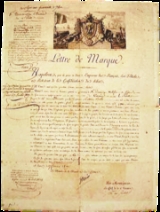
Letter of marque

Encyclopedia

Privateer
A privateer is a private person or ship authorized by a government by letters of marque to attack foreign shipping during wartime. Privateering was a way of mobilizing armed ships and sailors without having to spend public money or commit naval officers...
) to attack and capture enemy vessels, and bring them before admiralty courts for condemnation and sale. Cruising for prizes with a Letter of Marque was considered an honorable calling combining patriotism and profit, in contrast to unlicensed piracy
Piracy
Piracy is an act of robbery or criminal violence at sea. The term can include acts committed on land, in the air, or in other major bodies of water or on a shore. It does not normally include crimes committed against persons traveling on the same vessel as the perpetrator...
which was universally reviled. The French used the term lettre de course for their letters of marque, giving rise to the term corsair
Corsair
Corsairs were privateers, authorized to conduct raids on shipping of a nation at war with France, on behalf of the French Crown. Seized vessels and cargo were sold at auction, with the corsair captain entitled to a portion of the proceeds...
. Letter of Marque can sometimes describe the vessel itself: a "Letter of Marque" generally refers to a lumbering square-rigged cargo carrier that might pick up a prize if the opportunity arose, whereas a "privateer" was a fast and weatherly fore-and-aft rigged vessel heavily armed and heavily crewed, intended exclusively for fighting.
A "letter of marque and reprisal" would involve permission to cross an international border to effect a reprisal (take some action against an attack or injury) authorized by an issuing jurisdiction to conduct reprisal operations outside its borders.
Etymology
Old English mearc, from Germanic *mark- ‘boundary; boundary marker’, from Proto-Indo-European *merǵ- ‘boundary, border’.French, from Provençal marca, from marcar ‘seize as a pledge‘
Nomenclature history
According to the Oxford English DictionaryOxford English Dictionary
The Oxford English Dictionary , published by the Oxford University Press, is the self-styled premier dictionary of the English language. Two fully bound print editions of the OED have been published under its current name, in 1928 and 1989. The first edition was published in twelve volumes , and...
, 2nd ed. (Clarendon Press, 1989) ( def. 1 of "marque" & def. 2a of "marque" defining "letter of marque"), the first recorded use of "letters of marque and reprisal" was in an English statute in 1354 during the reign of Edward III. The phrase referred to "a licen[s]e granted by a sovereign to a subject, authorizing him to make reprisals on the subjects of a hostile state for injuries alleged to have been done to him by the enemy's army."
Early history
During the Middle AgesMiddle Ages
The Middle Ages is a periodization of European history from the 5th century to the 15th century. The Middle Ages follows the fall of the Western Roman Empire in 476 and precedes the Early Modern Era. It is the middle period of a three-period division of Western history: Classic, Medieval and Modern...
, armed private vessels enjoying their sovereign's tacit consent, if not always an explicit formal commission, regularly raided shipping of other nations, as in the case of Francis Drake
Francis Drake
Sir Francis Drake, Vice Admiral was an English sea captain, privateer, navigator, slaver, and politician of the Elizabethan era. Elizabeth I of England awarded Drake a knighthood in 1581. He was second-in-command of the English fleet against the Spanish Armada in 1588. He also carried out the...
's attacks on Spanish shipping of which Elizabeth I (despite protestations of innocence) took a share. Grotius's 1604 seminal work on international law called De Iure Praedae (Of The law of Prize and Booty) was an advocate's brief defending Dutch raids on Spanish and Portuguese shipping.
King Henry III of England first issued what later became known as privateering commissions in 1243. These early licences were granted to specific individuals to seize the king’s enemies at sea in return for splitting the proceeds between the privateers and the crown.
The letter of marque and reprisal first arose in 1295, 50 years after wartime privateer licenses were first issued. According to Grotis, letters of marque and reprisal were akin to a "private war", a concept alien to modern sensibilities but perhaps understandable if one recalls a more muscular and self-reliant age when the ocean was lawless and all merchant vessels sailed armed for self defense. A reprisal involved seeking the sovereign's permission to exact private retribution against some foreign prince or subject. The earliest instance of a licensed reprisal recorded in England was in the year 1295 under the reign of Edward I. The notion of reprisal, and behind it that just war involved avenging a wrong, clung to the letter of marque until 1620 in England, where to apply for one a shipowner had to submit to the Admiralty Court an estimate of actual losses.
Licensing privateers during wartime became widespread by the 16th Century Europe, when most countries began to enact laws regulating the granting of letters of marque and reprisal.
Although privateering commissions and letters of marque were originally distinct legal concepts, such distinctions became purely technical by the eighteenth century. The United States Constitution, for instance, states that "The Congress shall have Power To ... grant Letters of marque and reprisal ...”, without separately addressing privateer commissions.
During the Napoleonic Wars
Napoleonic Wars
The Napoleonic Wars were a series of wars declared against Napoleon's French Empire by opposing coalitions that ran from 1803 to 1815. As a continuation of the wars sparked by the French Revolution of 1789, they revolutionised European armies and played out on an unprecedented scale, mainly due to...
and the War of 1812
War of 1812
The War of 1812 was a military conflict fought between the forces of the United States of America and those of the British Empire. The Americans declared war in 1812 for several reasons, including trade restrictions because of Britain's ongoing war with France, impressment of American merchant...
, it was common to distinguish verbally between privateers (also known as private ships of war) on the one hand, and armed merchantmen, which were referred to as "letters of marque", on the other, though both received the same commission. The Sir John Sherbrooke (Halifax) was a privateer; the Sir John Sherbrooke (Saint John)
Sir John Sherbrooke (Saint John)
The Sir John Sherbooke of Saint John, New Brunswick was a letter of marque brig named after Sir John Coape Sherbrooke, Governor of Nova Scotia. Though technically a privateer, she was actually an armed merchantman. She was commissioned on 27 November 1812 and carried ten guns and a crew of 30 men...
was an armed merchantman. The East India Company
East India Company
The East India Company was an early English joint-stock company that was formed initially for pursuing trade with the East Indies, but that ended up trading mainly with the Indian subcontinent and China...
arranged for letters of marque for its East Indiamen such as the Lord Nelson
Lord Nelson (East Indiaman)
Lord Nelson was an East Indiaman, launched in late 1799, sailing for the East India Company. She made five voyages, of which she completed four. On her second voyage the French privateer Bellone captured her, but the Royal Navy recaptured her within about two weeks...
, not so that they could carry cannons to fend off warships, privateers and pirates on their voyages to India and China, that they could do without permission, but so that should they have the opportunity to take a prize they could do so without being guilty of piracy. Similarly, the Earl of Mornington
Earl of Mornington (East Indiaman)
Earl of Mornington was an East India Company packet ship built in 1799 by Perry, Wells & Green of Blackwall. She performed one voyage for the East India Company, sailing from England to India and returning...
, an East India Company packet ship
Packet ship
A "packet ship" was originally a vessel employed to carry post office mail packets to and from British embassies, colonies and outposts. In sea transport, a packet service is a regular, scheduled service, carrying freight and passengers...
of only six guns too carried a letter of marque.
In July 1793, the East Indiamen Royal Charlotte, Triton, and Warley
HMS Calcutta (1795)
HMS Calcutta was an East Indiaman converted to a Royal Navy 56-gun fourth rate. This ship of the line served for a time as an armed transport. She also transported convicts to Australia in a voyage that became a circumnavigation of the world. The French 74-gun Magnanime captured Calcutta in 1805...
participated in the capture of Pondicherry by maintaining a blockade of the port. Afterwards, as they were on their way to China, the same three East Indiamen participated in an action in the Straits of Malacca. They came upon a French frigate, with some six or seven of her prizes, replenishing her water casks ashore. The three British vessels immediately gave chase. The frigate fled towards the Sunda Strait
Sunda Strait
The Sunda Strait is the strait between the Indonesian islands of Java and Sumatra. It connects the Java Sea to the Indian Ocean...
. The Indiamen were able to catch up with a number of the prizes, and after a few cannon shots, were able to retake them. Had they not carried letters of marque, such behavior might well have qualified as piracy. Similarly, on 10 November 1800 the East Indiaman Phoenix captured the French privateer General Malartic, an action made legal by a letter of marque.
Applying for, and legal effect of, letter of marque
The procedure for issuing Letters of Marque and the issuing authority varied by time and circumstance. In Colonial America for instance, colonial governors issued them in the name of the King. During the American Revolution first the state legislatures, then both the states and the Continental Congress, then after ratification of the ConstitutionConstitution
A constitution is a set of fundamental principles or established precedents according to which a state or other organization is governed. These rules together make up, i.e. constitute, what the entity is...
, Congress authorized and the President signed Letters of Marque. A ship owner would send in an application stating the name, description, tonnage and force (armaments) of the vessel, the name and residence of the owner, the intended number of crew, and tendered a bond promising strict observance of the country's laws and treaties, and of international laws and customs. The commission was granted to the vessel, not to its captain, often for a limited time or specified area, and stated the enemy upon whom attacks were permitted. For instance during the Second Barbary War
Second Barbary War
The Second Barbary War , also known as the Algerine or Algerian War, was the second of two wars fought between the United States and the Ottoman Empire's North African regencies of Tripoli, Tunis, and Algeria known collectively as the Barbary states. The war between the Barbary States and the U.S...
President James Madison authorized the Salem, Mass. brig Grand Turk to cruise against "Algerine vessels, public or private, goods and effects, of or belonging to the Dey of Algiers". (Interestingly, this particular commission was never put to use as it was issued the same day the treaty was signed ending the U.S. involvement in the war—July 3, 1815.)
A Letter of Marque and Reprisal in effect converted a private merchant vessel into a naval auxiliary. A commissioned privateer enjoyed the protection of the laws of war. If captured, the crew was entitled to honorable treatment as prisoners of war, while without the license they were deemed mere pirates "at war with all the world," criminals who were properly hanged.
For this reason enterprising maritime raiders commonly took advantage of "flag of convenience
Flag of convenience
The term flag of convenience describes the business practice of registering a merchant ship in a sovereign state different from that of the ship's owners, and flying that state's civil ensign on the ship. Ships are registered under flags of convenience to reduce operating costs or avoid the...
" Letters of Marque, shopping for cooperative governments to license and legitimize their depredations. French/Irishman Luke Ryan and his lieutenants in just over two years commanded six vessels under the flags of three different nations and on opposite sides in the same war. Likewise the notorious Lafitte brothers in New Orleans cruised under letters of marque secured by bribery from corrupt officials of tenuous Central American governments, or the briefly sovereign nation of Texas
Texas
Texas is the second largest U.S. state by both area and population, and the largest state by area in the contiguous United States.The name, based on the Caddo word "Tejas" meaning "friends" or "allies", was applied by the Spanish to the Caddo themselves and to the region of their settlement in...
, to cloak plunder with a thin veil of legality.
Adjudicating captures, invalid letter of marque, or illegal cruelty
The Letter of Marque by its terms required privateers to bring captured vessels and their cargoes before admiralty courts of their own or allied countries for condemnation. Applying the rules and customs of prize lawPrize (law)
Prize is a term used in admiralty law to refer to equipment, vehicles, vessels, and cargo captured during armed conflict. The most common use of prize in this sense is the capture of an enemy ship and its cargo as a prize of war. In the past, it was common that the capturing force would be allotted...
the courts decided whether the Letter of Marque was valid and current, and whether the captured vessel or its cargo in fact belonged to the enemy (not always easy when flying false flags was common practice), and if so the prize and its cargo were "condemned", to be sold at auction with the proceeds divided among the privateer's owner and crew. A prize court's formal condemnation was required to transfer title; otherwise the vessel's previous owners might well reclaim her on her next voyage, and seek damages for the confiscated cargo.
Often questions arose as to the legitimacy of the Letter of Marque in the case of divided sovereignty during civil wars. An English court, for instance, refused to recognize the Letters of Marque issued by rebellious Ireland under James II
James II of England
James II & VII was King of England and King of Ireland as James II and King of Scotland as James VII, from 6 February 1685. He was the last Catholic monarch to reign over the Kingdoms of England, Scotland, and Ireland...
, and hanged eight privateer captains as pirates. Seventy-nine years later during the American Civil War, the Union charged officers and crew of the Confederate privateer
Confederate privateer
The Confederate privateers were privately owned ships that were authorized by the government of the Confederate States of America to attack the shipping of the United States...
Savannah with piracy, calling their Letter of Marque invalid since the Union refused to acknowledge the breakaway Confederacy as a sovereign nation. The case resulted in a hung jury, and after Confederate President Jefferson Davis threatened to retaliate by hanging one Union officer for each executed Confederate privateer, the Union relented and thereafter treated Confederate privateersmen honorably as prisoners of war.
Privateers were also required by the terms of their Letters of Marque to obey the laws of war, honor treaty obligations (avoid attacking neutrals) and in particular to treat captives as courteously and kindly as they safely could. If they failed to live up to their obligations the Admiralty Courts could and did revoke the Letter of Marque, refuse to award prize money, forfeit bonds, even award tort
Tort
A tort, in common law jurisdictions, is a wrong that involves a breach of a civil duty owed to someone else. It is differentiated from a crime, which involves a breach of a duty owed to society in general...
(personal injury) damages as against the privateer's officers and crew.
Abolition of privateering
Nations often by treaty agreed to forego privateering, as England and France repeatedly did starting with the diplomatic overtures of Edward III in 1324; privateering nonetheless recurred in every war between them for the next 500 years. Benjamin FranklinBenjamin Franklin
Dr. Benjamin Franklin was one of the Founding Fathers of the United States. A noted polymath, Franklin was a leading author, printer, political theorist, politician, postmaster, scientist, musician, inventor, satirist, civic activist, statesman, and diplomat...
in 1792 attempted to persuade the French to lead by example and stop issuing Letters of Marque to their corsairs, but the effort floundered when war loomed with Britain once again. Finally after the Congress of Paris at the end of the Crimean War
Crimean War
The Crimean War was a conflict fought between the Russian Empire and an alliance of the French Empire, the British Empire, the Ottoman Empire, and the Kingdom of Sardinia. The war was part of a long-running contest between the major European powers for influence over territories of the declining...
, seven European nations signed the Paris Declaration of 1856 renouncing privateering, and forty-five more eventually joined them, which in effect abolished privateering worldwide. The United States was not a signatory to that declaration. Despite the attempt to end privateering around the world, nations still continued issuing letters of marque. In 1879 at the beginning of the War of the Pacific
War of the Pacific
The War of the Pacific took place in western South America from 1879 through 1883. Chile fought against Bolivia and Peru. Despite cooperation among the three nations in the war against Spain, disputes soon arose over the mineral-rich Peruvian provinces of Tarapaca, Tacna, and Arica, and the...
, Bolivia
Bolivia
Bolivia officially known as Plurinational State of Bolivia , is a landlocked country in central South America. It is the poorest country in South America...
issued letters of marque to any vessels willing to fight for them. At the time Bolivia had no navy and was under threat from Chile's fleet.
21st-century American reconsideration of Letters of Marque
Article 1Article One of the United States Constitution
Article One of the United States Constitution describes the powers of Congress, the legislative branch of the federal government. The Article establishes the powers of and limitations on the Congress, consisting of a House of Representatives composed of Representatives, with each state gaining or...
of the United States Constitution
United States Constitution
The Constitution of the United States is the supreme law of the United States of America. It is the framework for the organization of the United States government and for the relationship of the federal government with the states, citizens, and all people within the United States.The first three...
lists issuing letters of marque and reprisal in Section 8 as one of the enumerated powers
Enumerated powers
The enumerated powers are a list of items found in Article I, section 8 of the US Constitution that set forth the authoritative capacity of the United States Congress. In summary, Congress may exercise the powers that the Constitution grants it, subject to explicit restrictions in the Bill of...
of Congress
United States Congress
The United States Congress is the bicameral legislature of the federal government of the United States, consisting of the Senate and the House of Representatives. The Congress meets in the United States Capitol in Washington, D.C....
, alongside the power of taxation and the ability to "declare War." However, since the American Civil War, the United States has consistently agreed to be bound by the terms of the 1856 Paris Declaration forbidding the practice, and the ban is today considered part of the customary laws of war
Laws of war
The law of war is a body of law concerning acceptable justifications to engage in war and the limits to acceptable wartime conduct...
. Although technically permitted under the US constitution, issuing a valid letter of marque is a war crime
War crime
War crimes are serious violations of the laws applicable in armed conflict giving rise to individual criminal responsibility...
under both US and international law. The United States has not legally commissioned any privateers since 1815, although the status of submarine-hunting Goodyear airships in the early days of World War II
World War II
World War II, or the Second World War , was a global conflict lasting from 1939 to 1945, involving most of the world's nations—including all of the great powers—eventually forming two opposing military alliances: the Allies and the Axis...
has created significant confusion. Various accounts refer to airships Resolute and Volunteer as operating under a "privateer status", but Congress never authorized a commission, nor did the President sign one.
The issue of marque and reprisal was raised before Congress after the September 11 attacks and again on July 21, 2007, by Congressman Ron Paul
Ron Paul
Ronald Ernest "Ron" Paul is an American physician, author and United States Congressman who is seeking to be the Republican Party candidate in the 2012 presidential election. Paul represents Texas's 14th congressional district, which covers an area south and southwest of Houston that includes...
. The attacks were defined as acts of "air piracy" and the Marque and Reprisal Act of 2001 was introduced, which would have granted the president the authority to use letters of marque and reprisal against the specific terrorists, instead of warring against a foreign state. The terrorists were compared to pirates in that they are difficult to fight by traditional military means. Congressman Paul also advocated the use of letters of marque to address the issue of Somali pirates
Piracy in Somalia
Piracy off the coast of Somalia has been a threat to international shipping since the second phase of the Somali Civil War in the early 21st century...
operating in the Gulf of Aden on April 15, 2009. However, the bills Congressman Paul introduced were not enacted into law.