

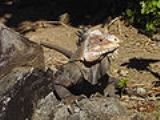
Lesser Antillean Iguana

Encyclopedia
The Lesser Antillean Iguana (Iguana delicatissima) is a large arboreal lizard
endemic to the Lesser Antilles
. It is one of two species of lizard
of the genus Iguana
and is in severe decline due to habitat destruction, feral predators, hunting, and hybridization with its sister species the Green iguana
. Successful captive breeding of this species has been limited to only two instances as most captive laid eggs tend to be infertile.
It is sometimes named the West Indian iguana, a name more commonly used for species of the genus Cyclura
.
name for the species. Its specific name delicatissima is Latin
for "extraordinary". The species was first officially described by Austrian naturalist
Josephus Nicolaus Laurenti
in 1768.
The Lesser Antillean Iguana varies in color between different island populations, but the base color tends to be gray, with green splotching on the underside. They have large pale, ivory colored scales on their heads. The jowls of males are pink and the scales around the eyes are blue. Males also have femoral pores along each inner thigh that exude pheromones during breeding season. Males are larger than females and are 40cm (16in) long, with an 80cm (32in) tail when full-grown. Females are two-thirds this size.
, and mangrove
throughout the Lesser Antilles
on Saint Barth, Anguilla
, St. Martin, St. Eustatius, Antigua
, Guadeloupe
, Dominica
, and Martinique
.
s, feeding on leaves, flowers, fruit, and growing shoots of upwards of 100 different species of plant. This presents a problem for osmoregulation
: vegetable matter contains more potassium
and has less nutritional content per gram, so more must be eaten to meet the animal's metabolic needs. Like most reptiles, Lesser Antillean iguanas are not capable of creating liquid urine more concentrated than their bodily fluids, like birds they excrete nitrogenous wastes as urate salts through a specially evolved nasal
salt gland
. As a result, the iguanas have developed this lateral nasal gland to supplement renal salt secretion by expelling excess potassium and sodium chloride.
 The Lesser Antillean Iguana is a vulnerable species and is found on the IUCN Red List
. The Lesser Antillean iguana is legally protected from hunting throughout its range, but enforcement of these regulations is extremely difficult and therefore limited. Other threats include habitat loss to agriculture and development and the introduction of feral
predators such as dog
s, cat
s, and the mongoose
.
The species greatest threat is from its own genus. The Green iguana has been introduced to the Lesser Antilles as an invasive species
and directly competes with the Lesser Antillean Iguana for food and resources. In addition the Green iguana has been interbreeding with the Lesser Antillean Iguana and this hybridization has been the number one reason for decline on at least three of the islands: Les Iles des Saintes, Basse Terre (Guadeloupe) and St. Barthélemy.
Captive Lesser Antillean iguanas are currently kept at the Jersey Wildlife Preservation Trust, Chester Zoo
, Memphis Zoo
and the San Diego Zoo
’s Center for Reproduction of Endangered Species. All individuals originate from the Commonwealth of Dominica
. Breeding and keeping the species in captivity is difficult. Mating and egg laying have occurred at each institution but most of the eggs have been infertile, a single individual was successfully hatched at the Jersey Wildlife Preservation Trust in 1997 and in 2000 eight iguanas were hatched.
Lizard
Lizards are a widespread group of squamate reptiles, with nearly 3800 species, ranging across all continents except Antarctica as well as most oceanic island chains...
endemic to the Lesser Antilles
Lesser Antilles
The Lesser Antilles are a long, partly volcanic island arc in the Western Hemisphere. Most of its islands form the eastern boundary of the Caribbean Sea with the Atlantic Ocean, with the remainder located in the southern Caribbean just north of South America...
. It is one of two species of lizard
Lizard
Lizards are a widespread group of squamate reptiles, with nearly 3800 species, ranging across all continents except Antarctica as well as most oceanic island chains...
of the genus Iguana
Iguana
Iguana is a herbivorous genus of lizard native to tropical areas of Central America and the Caribbean. The genus was first described in 1768 by Austrian naturalist Josephus Nicolaus Laurenti in his book Specimen Medicum, Exhibens Synopsin Reptilium Emendatam cum Experimentis circa Venena...
and is in severe decline due to habitat destruction, feral predators, hunting, and hybridization with its sister species the Green iguana
Green Iguana
The Green Iguana or Common Iguana is a large, arboreal herbivorous species of lizard of the genus Iguana native to Central and South America...
. Successful captive breeding of this species has been limited to only two instances as most captive laid eggs tend to be infertile.
It is sometimes named the West Indian iguana, a name more commonly used for species of the genus Cyclura
Cyclura
Cyclura is a genus of lizards from the family Iguanidae. Members of this genus are known as "cyclurids" or more commonly as rock iguanas and only occur on islands in the West Indies...
.
Etymology and taxonomy
The generic name Iguana is derived from Iwana, a Spanish form of the TainoTaíno people
The Taínos were pre-Columbian inhabitants of the Bahamas, Greater Antilles, and the northern Lesser Antilles. It is thought that the seafaring Taínos are relatives of the Arawak people of South America...
name for the species. Its specific name delicatissima is Latin
Latin
Latin is an Italic language originally spoken in Latium and Ancient Rome. It, along with most European languages, is a descendant of the ancient Proto-Indo-European language. Although it is considered a dead language, a number of scholars and members of the Christian clergy speak it fluently, and...
for "extraordinary". The species was first officially described by Austrian naturalist
Naturalist
Naturalist may refer to:* Practitioner of natural history* Conservationist* Advocate of naturalism * Naturalist , autobiography-See also:* The American Naturalist, periodical* Naturalism...
Josephus Nicolaus Laurenti
Josephus Nicolaus Laurenti
Josephus Nicolaus Laurenti was an Austrian naturalist of Italian origin.Laurenti is considered the auctor of the class Reptilia through his authorship of on the poisonous function of reptiles and amphibians...
in 1768.
Anatomy and morphology
The Lesser Antilles Iguana has a more blocky, shortened face than the Green Iguana and lacks the distinctive stripe pattern present along the Green Iguana's tail. The feature that most easily distinguishes these two species is the large, round scale that the Green iguana has below each ear hole but which the Lesser Antillean Iguana lacks.The Lesser Antillean Iguana varies in color between different island populations, but the base color tends to be gray, with green splotching on the underside. They have large pale, ivory colored scales on their heads. The jowls of males are pink and the scales around the eyes are blue. Males also have femoral pores along each inner thigh that exude pheromones during breeding season. Males are larger than females and are 40cm (16in) long, with an 80cm (32in) tail when full-grown. Females are two-thirds this size.
Habitat and distribution
The Lesser Antillean iguana is found in scrub woodland, rainforestRainforest
Rainforests are forests characterized by high rainfall, with definitions based on a minimum normal annual rainfall of 1750-2000 mm...
, and mangrove
Mangrove
Mangroves are various kinds of trees up to medium height and shrubs that grow in saline coastal sediment habitats in the tropics and subtropics – mainly between latitudes N and S...
throughout the Lesser Antilles
Lesser Antilles
The Lesser Antilles are a long, partly volcanic island arc in the Western Hemisphere. Most of its islands form the eastern boundary of the Caribbean Sea with the Atlantic Ocean, with the remainder located in the southern Caribbean just north of South America...
on Saint Barth, Anguilla
Anguilla
Anguilla is a British overseas territory and overseas territory of the European Union in the Caribbean. It is one of the most northerly of the Leeward Islands in the Lesser Antilles, lying east of Puerto Rico and the Virgin Islands and directly north of Saint Martin...
, St. Martin, St. Eustatius, Antigua
Antigua
Antigua , also known as Waladli, is an island in the West Indies, in the Leeward Islands in the Caribbean region, the main island of the country of Antigua and Barbuda. Antigua means "ancient" in Spanish and was named by Christopher Columbus after an icon in Seville Cathedral, Santa Maria de la...
, Guadeloupe
Guadeloupe
Guadeloupe is an archipelago located in the Leeward Islands, in the Lesser Antilles, with a land area of 1,628 square kilometres and a population of 400,000. It is the first overseas region of France, consisting of a single overseas department. As with the other overseas departments, Guadeloupe...
, Dominica
Dominica
Dominica , officially the Commonwealth of Dominica, is an island nation in the Lesser Antilles region of the Caribbean Sea, south-southeast of Guadeloupe and northwest of Martinique. Its size is and the highest point in the country is Morne Diablotins, which has an elevation of . The Commonwealth...
, and Martinique
Martinique
Martinique is an island in the eastern Caribbean Sea, with a land area of . Like Guadeloupe, it is an overseas region of France, consisting of a single overseas department. To the northwest lies Dominica, to the south St Lucia, and to the southeast Barbados...
.
Ecology
Lesser Antillean iguanas are primarily herbivoreHerbivore
Herbivores are organisms that are anatomically and physiologically adapted to eat plant-based foods. Herbivory is a form of consumption in which an organism principally eats autotrophs such as plants, algae and photosynthesizing bacteria. More generally, organisms that feed on autotrophs in...
s, feeding on leaves, flowers, fruit, and growing shoots of upwards of 100 different species of plant. This presents a problem for osmoregulation
Osmoregulation
Osmoregulation is the active regulation of the osmotic pressure of an organism's fluids to maintain the homeostasis of the organism's water content; that is it keeps the organism's fluids from becoming too diluted or too concentrated. Osmotic pressure is a measure of the tendency of water to move...
: vegetable matter contains more potassium
Potassium
Potassium is the chemical element with the symbol K and atomic number 19. Elemental potassium is a soft silvery-white alkali metal that oxidizes rapidly in air and is very reactive with water, generating sufficient heat to ignite the hydrogen emitted in the reaction.Potassium and sodium are...
and has less nutritional content per gram, so more must be eaten to meet the animal's metabolic needs. Like most reptiles, Lesser Antillean iguanas are not capable of creating liquid urine more concentrated than their bodily fluids, like birds they excrete nitrogenous wastes as urate salts through a specially evolved nasal
Nose
Anatomically, a nose is a protuberance in vertebrates that houses the nostrils, or nares, which admit and expel air for respiration in conjunction with the mouth. Behind the nose are the olfactory mucosa and the sinuses. Behind the nasal cavity, air next passes through the pharynx, shared with the...
salt gland
Salt gland
The salt gland is an organ for excreting excess salts. It is found in elasmobranchs, seabirds, and some reptiles. In sharks, salt glands are found in the rectum, but in birds and reptiles, they are found in or on the skull, in the area of the eyes, nostrils or mouth. In crocodiles, the salt is...
. As a result, the iguanas have developed this lateral nasal gland to supplement renal salt secretion by expelling excess potassium and sodium chloride.
Conservation
IUCN Red List
The IUCN Red List of Threatened Species , founded in 1963, is the world's most comprehensive inventory of the global conservation status of biological species. The International Union for Conservation of Nature is the world's main authority on the conservation status of species...
. The Lesser Antillean iguana is legally protected from hunting throughout its range, but enforcement of these regulations is extremely difficult and therefore limited. Other threats include habitat loss to agriculture and development and the introduction of feral
Feral
A feral organism is one that has changed from being domesticated to being wild or untamed. In the case of plants it is a movement from cultivated to uncultivated or controlled to volunteer. The introduction of feral animals or plants to their non-native regions, like any introduced species, may...
predators such as dog
Dog
The domestic dog is a domesticated form of the gray wolf, a member of the Canidae family of the order Carnivora. The term is used for both feral and pet varieties. The dog may have been the first animal to be domesticated, and has been the most widely kept working, hunting, and companion animal in...
s, cat
Feral cat
A feral cat is a descendant of a domesticated cat that has returned to the wild. It is distinguished from a stray cat, which is a pet cat that has been lost or abandoned, while feral cats are born in the wild; the offspring of a stray cat can be considered feral if born in the wild.In many parts of...
s, and the mongoose
Mongoose
Mongoose are a family of 33 living species of small carnivorans from southern Eurasia and mainland Africa. Four additional species from Madagascar in the subfamily Galidiinae, which were previously classified in this family, are also referred to as "mongooses" or "mongoose-like"...
.
The species greatest threat is from its own genus. The Green iguana has been introduced to the Lesser Antilles as an invasive species
Invasive species
"Invasive species", or invasive exotics, is a nomenclature term and categorization phrase used for flora and fauna, and for specific restoration-preservation processes in native habitats, with several definitions....
and directly competes with the Lesser Antillean Iguana for food and resources. In addition the Green iguana has been interbreeding with the Lesser Antillean Iguana and this hybridization has been the number one reason for decline on at least three of the islands: Les Iles des Saintes, Basse Terre (Guadeloupe) and St. Barthélemy.
Captive Lesser Antillean iguanas are currently kept at the Jersey Wildlife Preservation Trust, Chester Zoo
Chester Zoo
Chester Zoo is a zoological garden at Upton-by-Chester, in Cheshire, England. It was opened in 1931 by George Mottershead and his family, who used as a basis some animals reported to have come from an earlier zoo in Shavington. It is one of the UK's largest zoos at...
, Memphis Zoo
Memphis Zoo
The Memphis Zoo, located in Midtown Memphis, Tennessee, is home to more than 3,500 animals representing over 500 different species. Created in April 1906, the zoo has been a major tenant of Overton Park for more than 100 years. The land currently designated to the Memphis Zoo was defined by the...
and the San Diego Zoo
San Diego Zoo
The San Diego Zoo in Balboa Park, San Diego, California, is one of the most progressive zoos in the world, with over 4,000 animals of more than 800 species...
’s Center for Reproduction of Endangered Species. All individuals originate from the Commonwealth of Dominica
Dominica
Dominica , officially the Commonwealth of Dominica, is an island nation in the Lesser Antilles region of the Caribbean Sea, south-southeast of Guadeloupe and northwest of Martinique. Its size is and the highest point in the country is Morne Diablotins, which has an elevation of . The Commonwealth...
. Breeding and keeping the species in captivity is difficult. Mating and egg laying have occurred at each institution but most of the eggs have been infertile, a single individual was successfully hatched at the Jersey Wildlife Preservation Trust in 1997 and in 2000 eight iguanas were hatched.
External links
- Iguana delicatissima at the Encyclopedia of LifeEncyclopedia of LifeThe Encyclopedia of Life is a free, online collaborative encyclopedia intended to document all of the 1.9 million living species known to science. It is compiled from existing databases and from contributions by experts and non-experts throughout the world...
- Saint Barth Fauna & Flora
- Iguana delicatissima at Global Biodiversity Information FacilityGlobal Biodiversity Information FacilityThe Global Biodiversity Information Facility is an international organisation that focuses on making scientific data on biodiversity available via the Internet using web services. The data are provided by many institutions from around the world; GBIF's information architecture makes these data...