


Legends of Dune

Encyclopedia
Prequel
A prequel is a work that supplements a previously completed one, and has an earlier time setting.The widely recognized term was a 20th-century neologism, and a portmanteau from pre- and sequel...
trilogy
Trilogy
A trilogy is a set of three works of art that are connected, and that can be seen either as a single work or as three individual works. They are commonly found in literature, film, or video games...
of novels written by Brian Herbert
Brian Herbert
Brian Patrick Herbert is an American author who lives in Washington state. He is the elder son of science fiction author Frank Herbert....
and Kevin J. Anderson
Kevin J. Anderson
Kevin J. Anderson is an American science fiction author with over forty bestsellers. He has written spin-off novels for Star Wars, StarCraft, Titan A.E., and The X-Files, and with Brian Herbert is the co-author of the Dune prequels...
, set in Frank Herbert
Frank Herbert
Franklin Patrick Herbert, Jr. was a critically acclaimed and commercially successful American science fiction author. Although a short story author, he is best known for his novels, most notably Dune and its five sequels...
's Dune universe
Dune universe
Dune is a science fiction franchise which originated with the 1965 novel Dune by Frank Herbert. Considered by many to be the greatest science fiction novel of all time, Dune is frequently cited as the best-selling science fiction novel in history...
.
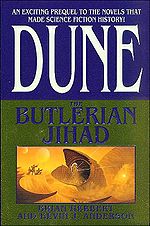
- Dune: The Butlerian JihadDune: The Butlerian JihadDune: The Butlerian Jihad is a 2002 science fiction novel by Brian Herbert and Kevin J. Anderson, set in the fictional Dune universe created by Frank Herbert. It is the first book in the Legends of Dune prequel trilogy, which takes place over 10,000 years before the events of Frank Herbert's...
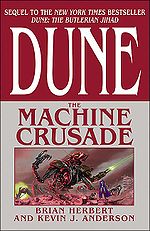
(2002) - Dune: The Machine CrusadeDune: The Machine CrusadeDune: The Machine Crusade is a 2003 science fiction novel by Brian Herbert and Kevin J. Anderson, set in the fictional Dune universe created by Frank Herbert. It is the second book in the Legends of Dune prequel trilogy, which takes place over 10,000 years before the events of Frank Herbert's...
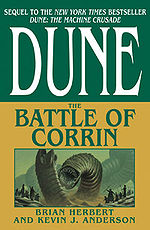
(2003) - Dune: The Battle of CorrinDune: The Battle of CorrinDune: The Battle of Corrin is a 2004 science fiction novel by Brian Herbert and Kevin J. Anderson, set in the fictional Dune universe created by Frank Herbert. It is the third book in the Legends of Dune prequel trilogy, which takes place over 10,000 years before the events of Frank Herbert's...
(2004)
This trilogy takes place over 10,000 years before the events of the 1965 novel Dune
Dune (novel)
Dune is a science fiction novel written by Frank Herbert, published in 1965. It won the Hugo Award in 1966, and the inaugural Nebula Award for Best Novel...
, and chronicles the universe-spanning war against thinking machines
Thinking machines (Dune)
Thinking machines is a collective term for artificial intelligence in the Dune universe created by Frank Herbert. The Butlerian Jihad a human crusade against thinking machines is an epic turning point in the back-story of the Dune universe...
that would eventually become known as the Butlerian Jihad
Butlerian Jihad
The Butlerian Jihad is an event in the back-story of Frank Herbert's fictional Dune universe. Occurring over 10,000 years before the events chronicled in his 1965 novel Dune, this jihad leads to the outlawing of certain technologies, primarily "thinking machines", a collective term for computers...
. It also explores the origins of the families and organizations that populate this distinctive universe in other Dune works.
In a July 15, 2010 blog post, Anderson announced a future novel called The Sisterhood of Dune, due out in 2012 and the first in a trilogy set in the time period closely following that of the Legends of Dune series.
Setting
The series explains that mankind had become entirely complacent and dependent upon thinking machines; recognizing this weakness, a group of ambitious, militant humans calling themselves the TitansTitan (Dune)
The Titans are a group of fictional characters in the Legends of Dune series of novels, written by Brian Herbert and Kevin J. Anderson and set in the Dune universe created by Frank Herbert...
use this widespread reliance on machine intelligence to seize control of the entire universe. The Titans soon make the transition into cyborg
Cyborg
A cyborg is a being with both biological and artificial parts. The term was coined in 1960 when Manfred Clynes and Nathan S. Kline used it in an article about the advantages of self-regulating human-machine systems in outer space. D. S...
s called cymeks; through the use of specialized interfaces, their brains are installed inside giant, mobile, mechanized "bodies." These fearsome, weaponized bodies make the Titans virtually immortal — and unstoppable. They later convert a number of subservient humans into an army of "neo-cymeks" to enforce their rule over the universe, and this so-called "Time of Titans" lasts for a century.
Eventually the Titan Xerxes lazily grants too much access and power to the AI program Omnius, which usurps control from the Titans themselves. Seeing no value in human life, the thinking machines – now including armies of robot soldiers and other aggressive machines, with the Titans as their commanders – dominate and enslave nearly all of humanity in the universe for 900 years of machine rule
Machine Rule
The concept of machine rule is a common theme in science fiction stories and film, in which an artificially created lifeform takes over the naturally evolved beings that created them....
. A jihad is ignited by the independent robot Erasmus's murder of Manion Butler, the young son of Serena Butler
Serena Butler
Serena Butler is a character in Brian Herbert and Kevin J. Anderson's Legends of Dune series, a trilogy of novels set during the Butlerian Jihad, the war against thinking machines only vaguely referred to in Frank Herbert's original Dune series....
. This crusade against the machines lasts for nearly a century, with much loss of human life, ending in human victory at the Battle of Corrin. The Jihad also gives rise to the Bene Gesserit, the Spacing Guild, the Sardaukar
Sardaukar
The Sardaukar are a fictional fanatical army from Frank Herbert's Dune universe, primarily featured in the 1965 science fiction novel Dune, as well as Brian Herbert and Kevin J...
army, the Landsraad
Landsraad
The Landsraad is a fictional organization in Frank Herbert's Dune universe. It is the assembly of all noble Houses in the Imperium.-Overview:...
, and even House Corrino
House Corrino
Imperial House Corrino is a fictional noble family from the Dune universe created by Frank Herbert. The Corrinos come to power after mankind's victory against the thinking machines at the Battle of Corrin , and rule until deposed by Paul Atreides approximately 10,000 years later during the events...
, whose Padishah Emperor
Padishah Emperor
Padishah Emperor is the title given to the hereditary rulers of the Old Empire in the science fiction Dune universe created by Frank Herbert.-Original series:...
s rule the universe for the next 10,000 years, until the events of Dune and the ascension of Paul Atreides
Paul Atreides
Paul Atreides is a fictional character in the Dune universe created by Frank Herbert. Paul is a prominent character in the first two novels in the series, Dune and Dune Messiah , and returns in Children of Dune . The character is brought back as two different gholas in the Brian Herbert/Kevin J...
.
The universe at the time of Legends of Dune consists of essentially three groups of populated planets: League Worlds, Synchronized Worlds and Unallied Planets.
League worlds
The League of Nobles is the system of government employed by the remaining free humans. The predecessor of the LandsraadLandsraad
The Landsraad is a fictional organization in Frank Herbert's Dune universe. It is the assembly of all noble Houses in the Imperium.-Overview:...
and the Imperium
Padishah Emperor
Padishah Emperor is the title given to the hereditary rulers of the Old Empire in the science fiction Dune universe created by Frank Herbert.-Original series:...
, the League is feudal
Feudalism
Feudalism was a set of legal and military customs in medieval Europe that flourished between the 9th and 15th centuries, which, broadly defined, was a system for ordering society around relationships derived from the holding of land in exchange for service or labour.Although derived from the...
at its core but slightly more democratic than the Landsraad, as the League members vote for which Viceroy they prefer to govern them. The planets controlled and protected by the League are:
|
Kaitain (Dune) Kaitain is a fictional planet in the Dune universe created by Frank Herbert.In Herbert's 1965 novel Dune, it is mentioned briefly as the seat of power of Padishah Emperor Shaddam Corrino IV, the Royal Court being previously located on the planet Salusa Secundus.The Prelude to Dune prequel trilogy ... |
Salusa Secundus Salusa Secundus is a fictional planet appearing in Frank Herbert's Dune universe. With harsh conditions rivaling those of the desert planet Arrakis, Salusa is used as the Imperial Prison Planet, and is one of two planets on which shigawire is grown .-Dune:In "Terminology of the Imperium," the... |
Synchronized Worlds
The planets completely under Machine control are known as the Synchronized Worlds. They are each ruled by a copy of Machine leader Omnius, and these copies are periodically updated by the collective network of Everminds with which they also share their own information. The former human inhabitants of these worlds have been enslaved or killed.
|
|
|
When the Great Purge is initiated in Dune: The Battle of Corrin
Dune: The Battle of Corrin
Dune: The Battle of Corrin is a 2004 science fiction novel by Brian Herbert and Kevin J. Anderson, set in the fictional Dune universe created by Frank Herbert. It is the third book in the Legends of Dune prequel trilogy, which takes place over 10,000 years before the events of Frank Herbert's...
, it is mentioned that at that point there are 543 Synchronized Worlds:
Quentin considered, mentally doing the math. "We know from captured update ships that there are five hundred forty-three Synchronized Worlds. We will need to send a large enough battle group to every single one of those planets in order to insure victory there. Just because they have moved their heavy ships to Corrin doesn't mean they won't put up a fight."
Unallied planets
|
Caladan Caladan is a fictional planet in the Dune universe created by Frank Herbert, first mentioned in the 1965 novel Dune.-Overview:Caladan, the third planet of Delta Pavonis, is the ancestral fiefdom of House Atreides, who have ruled it for twenty-six generations, from the ancient Castle Caladan... |
|
Other planets
Other planets are mentioned in the Legends of Dune series, but their exact status is not specified. For example:- Kolhar ~ Site of the first shipyard to produce space-folding ships (eventually called heighliners).
Themes
One theme of the series is the fragile nature of history; the events from the first two books are later altered by the passage of time, both intentionally and unintentionally. One of the epigraphEpigraph (literature)
In literature, an epigraph is a phrase, quotation, or poem that is set at the beginning of a document or component. The epigraph may serve as a preface, as a summary, as a counter-example, or to link the work to a wider literary canon, either to invite comparison or to enlist a conventional...
s in the book refers to Mao Zedong
Mao Zedong
Mao Zedong, also transliterated as Mao Tse-tung , and commonly referred to as Chairman Mao , was a Chinese Communist revolutionary, guerrilla warfare strategist, Marxist political philosopher, and leader of the Chinese Revolution...
as a 'Philosopher of Old Earth'. Xavier Harkonnen
Xavier Harkonnen
Xavier Harkonnen is a character in the fictional Dune universe. Xavier's role existed in the Legends of Dune series, in the books Dune: The Butlerian Jihad and Dune: The Machine Crusade. He was also referenced in Dune: The Battle of Corrin....
begins as a legitimately idolized hero, and eventually becomes unjustifiably demonized as a villain. One of the protagonists, Vorian Atreides
Vorian Atreides
Vorian Atreides is a fictional character in the Dune universe created by Frank Herbert. The ancestor of Paul Atreides, Vorian is a key character in the Legends of Dune trilogy created by Brian Herbert and Kevin J. Anderson.-Family history:...
, remarks at one point, "Don't quote history books to me. You have no right: you weren't there. I was."
In addition, a state-sanctioned religion builds up around the 'Three Martyrs': Serena Butler
Serena Butler
Serena Butler is a character in Brian Herbert and Kevin J. Anderson's Legends of Dune series, a trilogy of novels set during the Butlerian Jihad, the war against thinking machines only vaguely referred to in Frank Herbert's original Dune series....
, Iblis Ginjo, and Manion Butler. They form a mother-father-child trinity, which has become accepted as actual religious truth by the time of the events depicted in Dune. One of the more philosophical characters in the series points out that, throughout human history, leaders have harnessed the collective madness of holy war for their own purposes. The power of religion, and its manipulation, is itself a major theme in Frank Herbert's original Dune series.
One of the few characters to survive the entire series is Vorian Atreides. Shocked by the things he has seen and done over the course of the war, he decides that he deserves an indefinite holiday. Using the ship he began the series in, the Dream Voyager, he sets off through the stars. That is one final theme of the series: those who try to leave a mark on history succeed as often as they fail.