

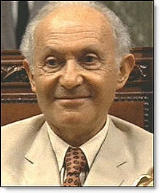
Lee Strasberg

Encyclopedia
Lee Strasberg was an American
actor, director and acting teacher. He cofounded, with directors Harold Clurman
and Cheryl Crawford
, the Group Theatre in 1931, which was hailed as "America's first true theatrical collective
". In 1951, he became director of the non-profit Actors Studio
, in New York City
, considered "the nation's most prestigious acting school". In 1969, Strasberg founded the Lee Strasberg Theatre and Film Institute
in New York City and in Hollywood to teach the work he pioneered.
He is considered the "father of method acting
in America," according to author Mel Gussow
, and from the 1920s until his death in 1982 "he revolutionized the art of acting by having a profound influence on performance in American theater and movies". From his base in New York, he trained several generations of theatre and film's most illustrious talents, including Anne Bancroft
, Dustin Hoffman
, Montgomery Clift
, James Dean
, Marilyn Monroe
, Julie Harris
, Paul Newman
, Al Pacino
, Robert De Niro
and director Elia Kazan
.
Former student Elia Kazan
directed James Dean
in East of Eden (1955), for which Kazan and Dean were nominated for Academy Awards. As a student, Dean wrote that Actors Studio was "the greatest school of the theater [and] the best thing that can happen to an actor". Playwright Tennessee Williams
, writer of A Streetcar Named Desire
, said of Strasberg's actors, "They act from the inside out. They communicate emotions they really feel. They give you a sense of life." Directors like Sidney Lumet
, a former student, have intentionally used actors skilled in Strasberg's "Method".
Kazan, in his autobiography, wrote, "He carried with him the aura of a prophet, a magician, a witch doctor
, a psychoanalyst
, and a feared father of a Jewish home.... [H]e was the force that held the thirty-odd members of the theatre together, and made them 'permanent.'" Today, Ellen Burstyn
, Al Pacino
, and Harvey Keitel
lead this nonprofit studio dedicated to the development of actors, playwrights, and directors.
in the former Austro-Hungarian Empire (now in Ukraine
) to Jewish parents, Baruch Meyer Strassberg and Ida Diner, and was the youngest of three sons. His father emigrated to New York while his family remained in their home village with an uncle, a rabbi
nical teacher. His father, who worked as a presser in the garment industry, sent first for his eldest son and his daughter. Finally, enough money was saved to bring over his wife and his two remaining sons. In 1909, the family was reunited on Manhattan
's Lower East Side, where they lived until the early twenties. Young Strasberg took refuge in voracious reading and the companionship of his older brother, Zalmon, whose death in the influenza epidemic of 1918 was so traumatic
for the young Strasberg that, despite being a straight-A student, he dropped out of high school. A relative introduced him to the theater by giving him a small part in a Yiddish-language production that was being performed by the Progressive Drama Club. He later joined the Chrystie Street Settlement House's drama club. Philip Loeb
, casting director of the Theater Guild, sensed that Strasberg could act, although he was not yet thinking of a fulltime acting career, and was still working as a shipping clerk and bookkeeper for a wig company. When he was 23 years old he enrolled in the Clare Tree Major School of the Theater.
described Strasberg's first experiences to the "art" of acting:
Strasberg eventually left the Clare Tree Major School to study with students of Stanislavsky – Maria Ouspenskaya
and Richard Boleslavsky – at the American Laboratory Theater. In 1925, Strasberg had his first professional appearance in Processional, a play produced by the Theater Guild.
According to Schickel:
of interpretation
in acting. He began by directing, but his time was gradually taken up by the training of actors. Called "America’s first true theatrical collective," the Lab immediately offered a few tuition-free scholarships for its three-year program to "promising students".
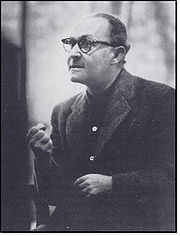 Publishers Weekly
wrote "The Group Theatre... [w]ith its self-defined mission to reconnect theater to the world of ideas and actions, staged plays that confronted social and moral issues... [w]ith members Harold Clurman
, Lee Strasberg, Stella and Luther Adler, Clifford Odets
, Elia Kazan
and an ill-assorted band of idealistic actors living hand to mouth are seen welded in a collective of creativity that was also a tangle of jealousies, love affairs and explosive feuds." Playwright Arthur Miller
said "the Group Theatre was unique and probably will never be repeated. For awhile it was literally the voice of Depression America".
Co-founder Harold Clurman
, in describing what Strasberg brought to the Group Theater, wrote:
Strasberg, Kazan, Clurman, and others with the Group Theater spent summers at Pine Brook Country Club
located in the countryside of Nichols, Connecticut
.
, Robert Lewis, and Cheryl Crawford
, also members of the Group Theatre , started the Actors Studio
as a non-profit workshop for professional and aspiring actors to concentrate on their craft away from the pressures of the commercial theatre. Strasberg assumed leadership of the studio in 1951 as its artistic director. "As a teacher and acting theorist, he revolutionized American actor training and engaged such remarkable performers as Kim Hunter
, Marilyn Monroe
, Julie Harris
, Paul Newman
, Geraldine Page
, Ellen Burstyn
, and Al Pacino
." Since its inception the Studio has been a nonprofit educational corporation chartered by the state of New York, and has been supported entirely by contributions and benefits.... We have here the possibility of creating a kind of theatre that would be a shining medal for our country", Strasberg said in 1959. UCLA acting teacher Robert Hethmon writes, "The Actors Studio is a refuge. Its privacy is guarded ferociously against the casual intruder, the seeker of curiousities, and the exploiter... [T]he Studio helps actors to meet the enemy within... and contributes greatly to Strasberg's utterly pragmatic views on training the actor and solving his problems ... [and] is kept deliberately modest in its circumstances, its essence being the private room where Lee Strasberg and some talented actors can work."
Strasberg wrote, "At the studio, we do not sit around and feed each other's egos. People are shocked how severe we are on each other." Admission to the Actors Studio was usually by audition with more than a thousand actors auditioning each year and the directors usually conferring membership on only five or six each year. "The Studio was, and is sui generis
", said Elia Kazan
, proudly. Beginning in a small, private way, with a strictly off-limits-to-outsiders policy, the Studio quickly earned a high reputation in theatre circles. "It became the place to be, the forum where all the most promising and unconventional young actors were being cultivated by sharp young directors..." Actors who have worked at the studio include Julie Harris
, Paul Newman
, Joanne Woodward
, Geraldine Page
, Maureen Stapleton
, Anne Bancroft
, Dustin Hoffman
, Patricia Neal
, Rod Steiger
, Mildred Dunnock
, Eva Marie Saint
, Eli Wallach
, Anne Jackson
, Ben Gazzara
, Sidney Poitier
, Karl Malden
, Gene Wilder
, Shelley Winters
, Dennis Hopper
and Sally Field
.
Movie historian James Lipton
writes that the Actors Studio became "one of the most prestigious institutions in the world" as a result of its desire to set a higher "standard" in acting. The founders, including Strasberg, demanded total commitment and extreme talent from aspiring students. Jack Nicholson
auditioned five times before he was accepted; Dustin Hoffman
, six times, and Harvey Keitel
, eleven times. After each rejection, a candidate had to wait as long as a year to try again. Martin Landau
and Steve McQueen
were the only two students admitted one year, out of two thousand candidates who auditioned.
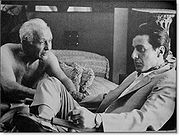 Al Pacino:"The Actors Studio meant so much to me in my life. Lee Strasberg hasn't been given the credit he deserves. Brando doesn't give Lee any credit ... Next to Charlie (Charles Laughton), it sort of launched me. It really did. That was a remarkable turning point in my life. It was directly responsible for getting me to quit all those jobs and just stay acting."
Marlon Brando: Movie stars spawned by Strasberg's Actors Studio were of a new type which is often labeled the "rebel hero", wrote Pamela Wojcik. Historian Sam Staggs writes that "Marlon Brando
was the hot, sleek engine on the Actors Studio express", and called him "[the] embodiment of Method acting
", but Brando was trained primarily by Stella Adler
, a former member of the Group Theatre who had a falling out with Strasberg over his interpretations of Stanislavsky's ideas." He based his acting technique on the Method, once stating, "[I]t made me a real actor. The idea is you learn to use everything that happened in your life and you learn to use it in creating the character you're working on. You learn to dig into your unconscious and make use of every experience you ever had."
In Brando's autobiography, "Songs My Mother Taught Me," the actor claimed that he learned nothing from Strasberg: "After I had some success, Lee Strasberg tried to take credit for teaching me how to act. He never taught me anything. He would have claimed credit for the sun and the moon if he believed he could get away with it. He tried to project himself as an acting oracle and guru. Some people worshiped him, but I never knew why. I sometimes went to the Actors Studio on Saturday mornings because Elia Kazan was teaching, and there were usually a lot of good-looking girls, but Strasberg never taught me acting. Stella did--and later Kazan."
James Dean
According to James Dean
biographer W. Bast,
"Proud of this accomplishment, Dean referred to the studio in a 1952 letter, when he was 21 years old, to his family as 'The greatest school of the theater. It houses great people like Marlon Brando, Julie Harris, Arthur Kennedy, Mildred Dunnock ... [V]ery few get into it.... It is the best thing that can happen to an actor. I am one of the youngest to belong.'"
Marilyn Monroe
Film author Maurice Zolotow
wrote: "Between The Seven Year Itch
and Some Like it Hot
only four years elapsed, but her world had changed. She had become one of the most celebrated personalities in the world. She had divorced Joe Di Maggio. She had married Arthur Miller
. She had become a disciple of Lee Strasberg. She was seriously studying acting. She was reading good books."
Tennessee Williams
Tennessee Williams
' plays have been populated by graduates of the studio, where he felt that "studio actors had a more intense and honest style of acting". He wrote, "They act from the inside out. They communicate emotions they really feel. They give you a sense of life." Williams was also a founder of the group and a key member of its playwright's wing, and later wrote A Streetcar Named Desire, Brando's greatest early role.
Jane Fonda
Jane Fonda
recalled that at the age of five, she and her brother, actor Peter Fonda
, acted out Western stories similar to those her father, Henry Fonda
, played in the movies. She attended Vassar College and went to Paris for two years to study art. Upon returning, she met Lee Strasberg and the meeting changed the course of her life, Fonda saying, "I went to the Actors Studio and Lee Strasberg told me I had talent. Real talent. It was the first time that anyone, except my father--who had to say so--told me I was good. At anything. It was a turning point in my life. I went to bed thinking about acting. I woke up thinking about acting. It was like the roof had come off my life!"
, Strasberg required that an actor, when preparing for a role, delve not only into the character's life in the play, but also, "[F]ar more importantly, into the character's life before the curtain rises. In rehearsal, the character's prehistory, perhaps going back to childhood, is discussed and even acted out. The play became the climax of the character's existence."
's autobiography, the Academy Award-winning director wrote about his earliest memories of Strasberg as teacher:
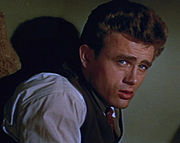 In 1955, Strasberg student James Dean
, already nominated for two Oscars, died in a sports-car accident, aged 24. Strasberg, during a regular lecture shortly after this accident, discussed Dean. The following are excerpts from a transcription of the recorded lecture:
.jpg)
, died at the age of 36 from a reported suicide. Strasberg once claimed that out of all the actors he had worked with, she was the one who stood out way above the rest, second only to Marlon Brando. At the time of her death, she was at the height of her career. In 1999 she was ranked the sixth greatest female star of all time by the American Film Institute
. Strasberg gave the eulogy at her funeral.
His first marriage was to Nora Krecaun in 1926 until her death three years later in 1929. In 1934, he married actress and drama coach Paula Miller
(1909–1966) until her death from cancer in 1966. They were the parents of actress Susan Strasberg
(1938–1999) and acting teacher John Strasberg
(b. 1941). His third wife was the former Anna Mizrahi (b. April 16, 1939) and the mother of his two youngest children, Adam Lee Strasberg and David Lee Israel Strasberg.
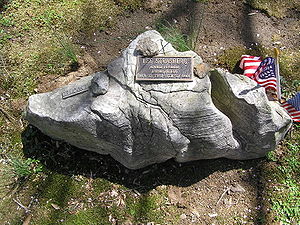 On February 17, 1982, Lee Strasberg died from a heart attack
in New York City, aged 80. With him at his death at the hospital were his wife, Anna, and their two sons. He was interred at Westchester Hills Cemetery
in Hastings-on-Hudson, New York
. A day before his unexpected death, he was officially notified that he had been elected to the American Theatre Hall of Fame
. His last public appearance was on February 14, 1982 at Night of 100 Stars in the Radio City Music Hall
, a benefit for the Actors Fund. Along with Al Pacino and Robert De Niro, he danced in the chorus line with the Rockettes
.
Actress Ellen Burstyn
recalled that evening:
In an 80th birthday interview, he said that he was looking forward to his next 20 years in the theater. According to friends, he was healthy until the day he died. "It was so unexpected", Al Pacino said. "What stood out was how youthful he was. He never seemed as old as his years. He was an inspiration." Actress Jane Fonda
said after hearing of his death, "I'm not sure I even would have become an actress were it not for him. He will be missed, but he leaves behind a great legacy."
"Whether directly influenced by Strasberg or not", wrote acting author Pamela Wojcik, "the new male stars all to some degree or other adapted Method techniques to support their identification as rebels... He recreates romance as a drama of male neuroticism and also invests his characterization 'with an unprecedented aura of verisimilitude'." Acting teacher and author Alison Hodge explains: "Seemingly spontaneous, intuitive, brooding, 'private', lit with potent vibrations from an inner life of conflict and contradiction, their work exemplified the style of heightened naturalism which (whether Brando agrees or not) Lee Strasberg devoted his life to exploring and promoting."
Pamela Wojcik adds:
. In 1969, he founded the Lee Strasberg Theatre and Film Institute
in New York and Los Angeles. Ellen Burstyn
, Al Pacino
, and Harvey Keitel
lead this nonprofit studio dedicated to the development of actors, playwrights, and directors. In 1974, at the suggestion of his former student Al Pacino
, Strasberg acted in a key supporting role alongside Pacino in Godfather II and again in the 1979 film, ...And Justice for All
.
United States
The United States of America is a federal constitutional republic comprising fifty states and a federal district...
actor, director and acting teacher. He cofounded, with directors Harold Clurman
Harold Clurman
Harold Edgar Clurman was a visionary American theatre director and drama critic, "one of the most influential in the United States". He was most notable as one of the three founders of the New York City's Group Theatre...
and Cheryl Crawford
Cheryl Crawford
Cheryl Crawford was an American theatre producer and director.Born in Akron, Ohio, Crawford majored in drama at Smith College. Following graduation, she moved to New York City and enrolled at the Theatre Guild's school...
, the Group Theatre in 1931, which was hailed as "America's first true theatrical collective
Collective
A collective is a group of entities that share or are motivated by at least one common issue or interest, or work together on a specific project to achieve a common objective...
". In 1951, he became director of the non-profit Actors Studio
Actors Studio
The Actors Studio is a membership organization for professional actors, theatre directors and playwrights at 432 West 44th Street in the Clinton neighborhood of Manhattan in New York City. It was founded October 5, 1947, by Elia Kazan, Cheryl Crawford, Robert Lewis and Anna Sokolow who provided...
, in New York City
New York City
New York is the most populous city in the United States and the center of the New York Metropolitan Area, one of the most populous metropolitan areas in the world. New York exerts a significant impact upon global commerce, finance, media, art, fashion, research, technology, education, and...
, considered "the nation's most prestigious acting school". In 1969, Strasberg founded the Lee Strasberg Theatre and Film Institute
Lee Strasberg Theatre and Film Institute
__notoc__The Lee Strasberg Theatre and Film Institute is an acting school located at 115 East 15th Street between Union Square East and Irving Place in the Union Square neighborhood of Manhattan, New York City, as well as at 7936 Santa Monica Boulevard in West Hollywood, California...
in New York City and in Hollywood to teach the work he pioneered.
He is considered the "father of method acting
Method acting
Method acting is a phrase that loosely refers to a family of techniques used by actors to create in themselves the thoughts and emotions of their characters, so as to develop lifelike performances...
in America," according to author Mel Gussow
Mel Gussow
Melvyn H. Gussow was an American theater critic, movie critic, and author who wrote for The New York Times for 35 years.-Biography:...
, and from the 1920s until his death in 1982 "he revolutionized the art of acting by having a profound influence on performance in American theater and movies". From his base in New York, he trained several generations of theatre and film's most illustrious talents, including Anne Bancroft
Anne Bancroft
Anne Bancroft was an American actress associated with the Method acting school, which she had studied under Lee Strasberg....
, Dustin Hoffman
Dustin Hoffman
Dustin Lee Hoffman is an American actor with a career in film, television, and theatre since 1960. He has been known for his versatile portrayals of antiheroes and vulnerable characters....
, Montgomery Clift
Montgomery Clift
Edward Montgomery Clift was an American film and stage actor. The New York Times’ obituary noted his portrayal of "moody, sensitive young men"....
, James Dean
James Dean
James Byron Dean was an American film actor. He is a cultural icon, best embodied in the title of his most celebrated film, Rebel Without a Cause , in which he starred as troubled Los Angeles teenager Jim Stark...
, Marilyn Monroe
Marilyn Monroe
Marilyn Monroe was an American actress, singer, model and showgirl who became a major sex symbol, starring in a number of commercially successful motion pictures during the 1950s....
, Julie Harris
Julie Harris
Julia Ann "Julie" Harris is an American stage, screen, and television actress. She has won five Tony Awards, three Emmy Awards and a Grammy Award, and was nominated for an Academy Award. In 1994, she was awarded the National Medal of Arts. She is a member of the American Theatre Hall of Fame...
, Paul Newman
Paul Newman
Paul Leonard Newman was an American actor, film director, entrepreneur, humanitarian, professional racing driver and auto racing enthusiast...
, Al Pacino
Al Pacino
Alfredo James "Al" Pacino is an American film and stage actor and director. He is famous for playing mobsters, including Michael Corleone in The Godfather trilogy, Tony Montana in Scarface, Alphonse "Big Boy" Caprice in Dick Tracy and Carlito Brigante in Carlito's Way, though he has also appeared...
, Robert De Niro
Robert De Niro
Robert De Niro, Jr. is an American actor, director and producer. His first major film roles were in Bang the Drum Slowly and Mean Streets, both in 1973...
and director Elia Kazan
Elia Kazan
Elia Kazan was an American director and actor, described by the New York Times as "one of the most honored and influential directors in Broadway and Hollywood history". Born in Istanbul, the capital of the Ottoman Empire, to Greek parents originally from Kayseri in Anatolia, the family emigrated...
.
Former student Elia Kazan
Elia Kazan
Elia Kazan was an American director and actor, described by the New York Times as "one of the most honored and influential directors in Broadway and Hollywood history". Born in Istanbul, the capital of the Ottoman Empire, to Greek parents originally from Kayseri in Anatolia, the family emigrated...
directed James Dean
James Dean
James Byron Dean was an American film actor. He is a cultural icon, best embodied in the title of his most celebrated film, Rebel Without a Cause , in which he starred as troubled Los Angeles teenager Jim Stark...
in East of Eden (1955), for which Kazan and Dean were nominated for Academy Awards. As a student, Dean wrote that Actors Studio was "the greatest school of the theater [and] the best thing that can happen to an actor". Playwright Tennessee Williams
Tennessee Williams
Thomas Lanier "Tennessee" Williams III was an American writer who worked principally as a playwright in the American theater. He also wrote short stories, novels, poetry, essays, screenplays and a volume of memoirs...
, writer of A Streetcar Named Desire
A Streetcar Named Desire (play)
A Streetcar Named Desire is a 1947 play written by American playwright Tennessee Williams for which he received the Pulitzer Prize for Drama in 1948. The play opened on Broadway on December 3, 1947, and closed on December 17, 1949, in the Ethel Barrymore Theatre. The Broadway production was...
, said of Strasberg's actors, "They act from the inside out. They communicate emotions they really feel. They give you a sense of life." Directors like Sidney Lumet
Sidney Lumet
Sidney Lumet was an American director, producer and screenwriter with over 50 films to his credit. He was nominated for the Academy Award as Best Director for 12 Angry Men , Dog Day Afternoon , Network and The Verdict...
, a former student, have intentionally used actors skilled in Strasberg's "Method".
Kazan, in his autobiography, wrote, "He carried with him the aura of a prophet, a magician, a witch doctor
Witch doctor
A witch doctor originally referred to a type of healer who treated ailments believed to be caused by witchcraft. It is currently used to refer to healers in some third world regions, who use traditional healing rather than contemporary medicine...
, a psychoanalyst
Psychoanalysis
Psychoanalysis is a psychological theory developed in the late 19th and early 20th centuries by Austrian neurologist Sigmund Freud. Psychoanalysis has expanded, been criticized and developed in different directions, mostly by some of Freud's former students, such as Alfred Adler and Carl Gustav...
, and a feared father of a Jewish home.... [H]e was the force that held the thirty-odd members of the theatre together, and made them 'permanent.'" Today, Ellen Burstyn
Ellen Burstyn
Ellen Burstyn is a leading American actress of film, stage, and television. Burstyn's career began in theatre during the late 1950s, and over the next ten years she appeared in several films and television series before joining the Actors Studio in 1967...
, Al Pacino
Al Pacino
Alfredo James "Al" Pacino is an American film and stage actor and director. He is famous for playing mobsters, including Michael Corleone in The Godfather trilogy, Tony Montana in Scarface, Alphonse "Big Boy" Caprice in Dick Tracy and Carlito Brigante in Carlito's Way, though he has also appeared...
, and Harvey Keitel
Harvey Keitel
Harvey Keitel is an American actor. Some of his most notable starring roles were in Martin Scorsese's Mean Streets and Taxi Driver, Ridley Scott's The Duellists and Thelma and Louise, Ettore Scola's That Night in Varennes, Quentin Tarantino's Reservoir Dogs and Pulp Fiction, Jane Campion's The...
lead this nonprofit studio dedicated to the development of actors, playwrights, and directors.
Early years
Lee Strasberg was born Israel Strassberg in BudanivBudaniv
Budaniv is a village in Ternopil Oblast, Western Ukraine, near Chortkiv, Buchach Raion. Population: 1,634 ....
in the former Austro-Hungarian Empire (now in Ukraine
Ukraine
Ukraine is a country in Eastern Europe. It has an area of 603,628 km², making it the second largest contiguous country on the European continent, after Russia...
) to Jewish parents, Baruch Meyer Strassberg and Ida Diner, and was the youngest of three sons. His father emigrated to New York while his family remained in their home village with an uncle, a rabbi
Rabbi
In Judaism, a rabbi is a teacher of Torah. This title derives from the Hebrew word רבי , meaning "My Master" , which is the way a student would address a master of Torah...
nical teacher. His father, who worked as a presser in the garment industry, sent first for his eldest son and his daughter. Finally, enough money was saved to bring over his wife and his two remaining sons. In 1909, the family was reunited on Manhattan
Manhattan
Manhattan is the oldest and the most densely populated of the five boroughs of New York City. Located primarily on the island of Manhattan at the mouth of the Hudson River, the boundaries of the borough are identical to those of New York County, an original county of the state of New York...
's Lower East Side, where they lived until the early twenties. Young Strasberg took refuge in voracious reading and the companionship of his older brother, Zalmon, whose death in the influenza epidemic of 1918 was so traumatic
Psychological trauma
Psychological trauma is a type of damage to the psyche that occurs as a result of a traumatic event...
for the young Strasberg that, despite being a straight-A student, he dropped out of high school. A relative introduced him to the theater by giving him a small part in a Yiddish-language production that was being performed by the Progressive Drama Club. He later joined the Chrystie Street Settlement House's drama club. Philip Loeb
Philip Loeb
Philip Loeb , was an American stage, film, and television actor who was blacklisted under McCarthyism and committed suicide.- Background :...
, casting director of the Theater Guild, sensed that Strasberg could act, although he was not yet thinking of a fulltime acting career, and was still working as a shipping clerk and bookkeeper for a wig company. When he was 23 years old he enrolled in the Clare Tree Major School of the Theater.
Life-shaping revelation
Kazan biographer Richard SchickelRichard Schickel
Richard Warren Schickel is an American author, journalist, and documentary filmmaker. He is a film critic for Time magazine, having also written for Life magazine and the Los Angeles Times Book Review....
described Strasberg's first experiences to the "art" of acting:
He dropped out of high school, worked in a shop that made hairpieces, drifted into the theater via a settlement house company and … had his life-shaping revelation when Stanislavski brought his Moscow Art TheatreMoscow Art TheatreThe Moscow Art Theatre is a theatre company in Moscow that the seminal Russian theatre practitioner Constantin Stanislavski, together with the playwright and director Vladimir Nemirovich-Danchenko, founded in 1898. It was conceived as a venue for naturalistic theatre, in contrast to the melodramas...
to the United States in 1923. He had seen good acting before, of course, but never an ensemble like this with actors completely surrendering their egos to the work.... [H]e observed, first of all, that all the actors, whether they were playing leads or small parts, worked with the same commitment and intensity. No actors idled about posing and preening (or thinking about where they might dine after the performance). More important, every actor seemed to project some sort of unspoken, yet palpable, inner life for his or her character. This was acting of a sort that one rarely saw on the American stage ... [w]here there was little stress on the psychology of the characters or their interactions.... Strasberg was galvanized. He knew that his own future as an actor – he was a slight and unhandsome man – was limited. But he soon perceived that as a theoretician and teacher of this new 'system' it might become a major force in American theater.
Strasberg eventually left the Clare Tree Major School to study with students of Stanislavsky – Maria Ouspenskaya
Maria Ouspenskaya
Maria Alekseyevna Ouspenskaya was a Russian actress and acting teacher. She achieved success as a stage actress as a young woman in Russia, and as an elderly woman in Hollywood films.-Life and career:...
and Richard Boleslavsky – at the American Laboratory Theater. In 1925, Strasberg had his first professional appearance in Processional, a play produced by the Theater Guild.
According to Schickel:
What Strasberg... took away from the Actor's Lab was a belief that just as an actor could be prepared physically for his work with dance, movement and fencingFencingFencing, which is also known as modern fencing to distinguish it from historical fencing, is a family of combat sports using bladed weapons.Fencing is one of four sports which have been featured at every one of the modern Olympic Games...
classes, he could be mentally prepared by resort to analogous mental exercises. They worked on relaxation as well as concentration. They worked with nonexistent objects that helped prepare them for the exploration of equally ephemeral emotions. They learned to use “affective memory”, as Strasberg called the most controversial aspect of his teaching — summoning emotions from their own lives to illuminate their stage roles.... Strasberg believed he could codify this system, a necessary precursor to teaching it to anyone who wanted to learn it... [H]e became a director more preoccupied with getting his actors to work in the “correct” way than he was in shaping the overall presentation.
Group Theater
He gained a reputation with the Theater Guild of New York and helped form the Group Theater in New York in 1931. There he created a technique which became known as "the Method" or "method acting." His teaching style owed much to the Russian director, Stanislavsky, whose book, An Actor Prepares, dealt with the psychologyPsychology
Psychology is the study of the mind and behavior. Its immediate goal is to understand individuals and groups by both establishing general principles and researching specific cases. For many, the ultimate goal of psychology is to benefit society...
of interpretation
Psychoanalysis
Psychoanalysis is a psychological theory developed in the late 19th and early 20th centuries by Austrian neurologist Sigmund Freud. Psychoanalysis has expanded, been criticized and developed in different directions, mostly by some of Freud's former students, such as Alfred Adler and Carl Gustav...
in acting. He began by directing, but his time was gradually taken up by the training of actors. Called "America’s first true theatrical collective," the Lab immediately offered a few tuition-free scholarships for its three-year program to "promising students".
Publishers Weekly
Publishers Weekly, aka PW, is an American weekly trade news magazine targeted at publishers, librarians, booksellers and literary agents...
wrote "The Group Theatre... [w]ith its self-defined mission to reconnect theater to the world of ideas and actions, staged plays that confronted social and moral issues... [w]ith members Harold Clurman
Harold Clurman
Harold Edgar Clurman was a visionary American theatre director and drama critic, "one of the most influential in the United States". He was most notable as one of the three founders of the New York City's Group Theatre...
, Lee Strasberg, Stella and Luther Adler, Clifford Odets
Clifford Odets
Clifford Odets was an American playwright, screenwriter, socialist, and social protester.-Early life:Odets was born in Philadelphia to Romanian- and Russian-Jewish immigrant parents, Louis Odets and Esther Geisinger, and raised in Philadelphia and the Bronx, New York. He dropped out of high...
, Elia Kazan
Elia Kazan
Elia Kazan was an American director and actor, described by the New York Times as "one of the most honored and influential directors in Broadway and Hollywood history". Born in Istanbul, the capital of the Ottoman Empire, to Greek parents originally from Kayseri in Anatolia, the family emigrated...
and an ill-assorted band of idealistic actors living hand to mouth are seen welded in a collective of creativity that was also a tangle of jealousies, love affairs and explosive feuds." Playwright Arthur Miller
Arthur Miller
Arthur Asher Miller was an American playwright and essayist. He was a prominent figure in American theatre, writing dramas that include plays such as All My Sons , Death of a Salesman , The Crucible , and A View from the Bridge .Miller was often in the public eye,...
said "the Group Theatre was unique and probably will never be repeated. For awhile it was literally the voice of Depression America".
Co-founder Harold Clurman
Harold Clurman
Harold Edgar Clurman was a visionary American theatre director and drama critic, "one of the most influential in the United States". He was most notable as one of the three founders of the New York City's Group Theatre...
, in describing what Strasberg brought to the Group Theater, wrote:
Lee Strasberg is one of the few artists among American theater directors. He is the director of introverted feeling, of strong emotion curbed by ascetic control, sentiment of great intensity muted by delicacy, pride, fear, shame. The effect he produces is a classic hush, tense and tragic, a constant conflict so held in check that a kind of beautiful spareness results. The roots are clearly in the intimate experience of a complex psychology, an acute awareness of human contradiction and suffering.
Strasberg, Kazan, Clurman, and others with the Group Theater spent summers at Pine Brook Country Club
Pine Brook Country Club
-Introduction:Pine Brook Country Club began when Benjamin Plotkin purchased Pinewood Lake and the surrounding countryside on Mischa Hill in the historic village of Nichols, Connecticut. Plotkin built an auditorium with a revolving stage and forty rustic cabins and incorporated as the Pine Brook...
located in the countryside of Nichols, Connecticut
Nichols, Connecticut
Nichols, a historic village in southeastern Trumbull on the Gold Coast of Fairfield County, was named after the family who maintained a large farm in its center for almost 300 years. The Nichols Farms Historic District, which encompasses part of the village, is listed on the National Register of...
.
Actors Studio
In 1947, Elia KazanElia Kazan
Elia Kazan was an American director and actor, described by the New York Times as "one of the most honored and influential directors in Broadway and Hollywood history". Born in Istanbul, the capital of the Ottoman Empire, to Greek parents originally from Kayseri in Anatolia, the family emigrated...
, Robert Lewis, and Cheryl Crawford
Cheryl Crawford
Cheryl Crawford was an American theatre producer and director.Born in Akron, Ohio, Crawford majored in drama at Smith College. Following graduation, she moved to New York City and enrolled at the Theatre Guild's school...
, also members of the Group Theatre , started the Actors Studio
Actors Studio
The Actors Studio is a membership organization for professional actors, theatre directors and playwrights at 432 West 44th Street in the Clinton neighborhood of Manhattan in New York City. It was founded October 5, 1947, by Elia Kazan, Cheryl Crawford, Robert Lewis and Anna Sokolow who provided...
as a non-profit workshop for professional and aspiring actors to concentrate on their craft away from the pressures of the commercial theatre. Strasberg assumed leadership of the studio in 1951 as its artistic director. "As a teacher and acting theorist, he revolutionized American actor training and engaged such remarkable performers as Kim Hunter
Kim Hunter
Kim Hunter was an American film, theatre, and television actress. She won both an Academy Award and a Golden Globe Award, each as Best Supporting Actress, for her performance as Stella Kowalski in the 1951 film A Streetcar Named Desire...
, Marilyn Monroe
Marilyn Monroe
Marilyn Monroe was an American actress, singer, model and showgirl who became a major sex symbol, starring in a number of commercially successful motion pictures during the 1950s....
, Julie Harris
Julie Harris
Julia Ann "Julie" Harris is an American stage, screen, and television actress. She has won five Tony Awards, three Emmy Awards and a Grammy Award, and was nominated for an Academy Award. In 1994, she was awarded the National Medal of Arts. She is a member of the American Theatre Hall of Fame...
, Paul Newman
Paul Newman
Paul Leonard Newman was an American actor, film director, entrepreneur, humanitarian, professional racing driver and auto racing enthusiast...
, Geraldine Page
Geraldine Page
Geraldine Sue Page was an American actress. Although she starred in at least two dozen feature films, she is primarily known for her celebrated work in the American theater...
, Ellen Burstyn
Ellen Burstyn
Ellen Burstyn is a leading American actress of film, stage, and television. Burstyn's career began in theatre during the late 1950s, and over the next ten years she appeared in several films and television series before joining the Actors Studio in 1967...
, and Al Pacino
Al Pacino
Alfredo James "Al" Pacino is an American film and stage actor and director. He is famous for playing mobsters, including Michael Corleone in The Godfather trilogy, Tony Montana in Scarface, Alphonse "Big Boy" Caprice in Dick Tracy and Carlito Brigante in Carlito's Way, though he has also appeared...
." Since its inception the Studio has been a nonprofit educational corporation chartered by the state of New York, and has been supported entirely by contributions and benefits.... We have here the possibility of creating a kind of theatre that would be a shining medal for our country", Strasberg said in 1959. UCLA acting teacher Robert Hethmon writes, "The Actors Studio is a refuge. Its privacy is guarded ferociously against the casual intruder, the seeker of curiousities, and the exploiter... [T]he Studio helps actors to meet the enemy within... and contributes greatly to Strasberg's utterly pragmatic views on training the actor and solving his problems ... [and] is kept deliberately modest in its circumstances, its essence being the private room where Lee Strasberg and some talented actors can work."
Strasberg wrote, "At the studio, we do not sit around and feed each other's egos. People are shocked how severe we are on each other." Admission to the Actors Studio was usually by audition with more than a thousand actors auditioning each year and the directors usually conferring membership on only five or six each year. "The Studio was, and is sui generis
Sui generis
Sui generis is a Latin expression, literally meaning of its own kind/genus or unique in its characteristics. The expression is often used in analytic philosophy to indicate an idea, an entity, or a reality which cannot be included in a wider concept....
", said Elia Kazan
Elia Kazan
Elia Kazan was an American director and actor, described by the New York Times as "one of the most honored and influential directors in Broadway and Hollywood history". Born in Istanbul, the capital of the Ottoman Empire, to Greek parents originally from Kayseri in Anatolia, the family emigrated...
, proudly. Beginning in a small, private way, with a strictly off-limits-to-outsiders policy, the Studio quickly earned a high reputation in theatre circles. "It became the place to be, the forum where all the most promising and unconventional young actors were being cultivated by sharp young directors..." Actors who have worked at the studio include Julie Harris
Julie Harris
Julia Ann "Julie" Harris is an American stage, screen, and television actress. She has won five Tony Awards, three Emmy Awards and a Grammy Award, and was nominated for an Academy Award. In 1994, she was awarded the National Medal of Arts. She is a member of the American Theatre Hall of Fame...
, Paul Newman
Paul Newman
Paul Leonard Newman was an American actor, film director, entrepreneur, humanitarian, professional racing driver and auto racing enthusiast...
, Joanne Woodward
Joanne Woodward
Joanne Gignilliat Trimmier Woodward is an American actress, television and theatrical producer, and widow of Paul Newman...
, Geraldine Page
Geraldine Page
Geraldine Sue Page was an American actress. Although she starred in at least two dozen feature films, she is primarily known for her celebrated work in the American theater...
, Maureen Stapleton
Maureen Stapleton
Maureen Stapleton was an American actress in film, theater and television.-Early life:Stapleton was born Lois Maureen Stapleton in Troy, New York, the daughter of Irene and John P. Stapleton, and grew up in a strict Irish American Catholic family...
, Anne Bancroft
Anne Bancroft
Anne Bancroft was an American actress associated with the Method acting school, which she had studied under Lee Strasberg....
, Dustin Hoffman
Dustin Hoffman
Dustin Lee Hoffman is an American actor with a career in film, television, and theatre since 1960. He has been known for his versatile portrayals of antiheroes and vulnerable characters....
, Patricia Neal
Patricia Neal
Patricia Neal was an American actress of stage and screen. She was best known for her film roles as World War II widow Helen Benson in The Day the Earth Stood Still , wealthy matron Emily Eustace Failenson in Breakfast at Tiffany's , middle-aged housekeeper Alma Brown in Hud , for which she won...
, Rod Steiger
Rod Steiger
Rodney Stephen "Rod" Steiger was an Academy Award-winning American actor known for his performances in such films as On the Waterfront, The Big Knife, Oklahoma!, The Harder They Fall, Across the Bridge, The Pawnbroker, Doctor Zhivago, In the Heat of the Night, and Waterloo as well as the...
, Mildred Dunnock
Mildred Dunnock
Mildred Dunnock was an American theater, film and television actress.- Early life :Born in Baltimore, Maryland and graduated from Western Senior High School, Dunnock was a school teacher who did not start acting until she was in her early thirties...
, Eva Marie Saint
Eva Marie Saint
Eva Marie Saint is an American actress who has starred in films, on Broadway, and on television in a career spanning seven decades. She won an Academy Award for Best Supporting Actress for her performance in the drama film On the Waterfront , and later starred in the thriller film North by...
, Eli Wallach
Eli Wallach
Eli Herschel Wallach is an American film, television and stage actor, who gained fame in the late 1950s. For his performance in Baby Doll he won a BAFTA Award for Best Newcomer and a Golden Globe nomination. One of his most famous roles is that of Tuco in The Good, the Bad and the Ugly...
, Anne Jackson
Anne Jackson
Anne Jackson is an American actress of television, stage, and screen.-Life and career:Jackson, the youngest of three sisters, was born in Millvale, Pennsylvania, the daughter of Stella Germaine and John Ivan Jackson, a barber who ran a beauty parlor...
, Ben Gazzara
Ben Gazzara
-Early life:Gazzara was born Biagio Anthony Gazzara in New York City, the son of Italian immigrants Angelina and Antonio Gazzara, who was a laborer and carpenter. Gazzara grew up on New York's tough Lower East Side. He actually lived on E. 29th Street and participated in the drama program at...
, Sidney Poitier
Sidney Poitier
Sir Sidney Poitier, KBE is a Bahamian American actor, film director, author, and diplomat.In 1963, Poitier became the first black person to win an Academy Award for Best Actor for his role in Lilies of the Field...
, Karl Malden
Karl Malden
Karl Malden was an American actor. In a career that spanned more than seven decades, he performed in such classic films as A Streetcar Named Desire, for which he won the Academy Award for Best Supporting Actor, On the Waterfront and One-Eyed Jacks...
, Gene Wilder
Gene Wilder
Gene Wilder is an American stage and screen actor, director, screenwriter, and author.Wilder began his career on stage, making his screen debut in the film Bonnie and Clyde in 1967. His first major role was as Leopold Bloom in the 1968 film The Producers...
, Shelley Winters
Shelley Winters
Shelley Winters was an American actress who appeared in dozens of films, as well as on stage and television; her career spanned over 50 years until her death in 2006...
, Dennis Hopper
Dennis Hopper
Dennis Lee Hopper was an American actor, filmmaker and artist. As a young man, Hopper became interested in acting and eventually became a student of the Actors' Studio. He made his first television appearance in 1954 and appeared in two films featuring James Dean, Rebel Without a Cause and Giant...
and Sally Field
Sally Field
Sally Margaret Field is an American actress, singer, producer, director, and screenwriter. In each decade of her career, she has been known for major roles in American TV/film culture, including: in the 1960s, for Gidget or Sister Bertrille on The Flying Nun ; in the 1970s, for Sybil , Smokey and...
.
Movie historian James Lipton
James Lipton
James Lipton is an American writer, poet, composer, actor and dean emeritus of the Actors Studio Drama School at Pace University in New York City. He is the executive producer, writer and host of the Bravo cable television series Inside the Actors Studio, which debuted in 1994...
writes that the Actors Studio became "one of the most prestigious institutions in the world" as a result of its desire to set a higher "standard" in acting. The founders, including Strasberg, demanded total commitment and extreme talent from aspiring students. Jack Nicholson
Jack Nicholson
John Joseph "Jack" Nicholson is an American actor, film director, producer and writer. He is renowned for his often dark portrayals of neurotic characters. Nicholson has been nominated for an Academy Award twelve times, and has won the Academy Award for Best Actor twice: for One Flew Over the...
auditioned five times before he was accepted; Dustin Hoffman
Dustin Hoffman
Dustin Lee Hoffman is an American actor with a career in film, television, and theatre since 1960. He has been known for his versatile portrayals of antiheroes and vulnerable characters....
, six times, and Harvey Keitel
Harvey Keitel
Harvey Keitel is an American actor. Some of his most notable starring roles were in Martin Scorsese's Mean Streets and Taxi Driver, Ridley Scott's The Duellists and Thelma and Louise, Ettore Scola's That Night in Varennes, Quentin Tarantino's Reservoir Dogs and Pulp Fiction, Jane Campion's The...
, eleven times. After each rejection, a candidate had to wait as long as a year to try again. Martin Landau
Martin Landau
Martin Landau is an American film and television actor. Landau began his career in the 1950s. His early films include a supporting role in Alfred Hitchcock's North by Northwest . He played continuing roles in the television series Mission: Impossible and Space:1999...
and Steve McQueen
Steve McQueen
Terrence Steven "Steve" McQueen was an American movie actor. He was nicknamed "The King of Cool." His "anti-hero" persona, which he developed at the height of the Vietnam counterculture, made him one of the top box-office draws of the 1960s and 1970s. McQueen received an Academy Award nomination...
were the only two students admitted one year, out of two thousand candidates who auditioned.
Marlon Brando: Movie stars spawned by Strasberg's Actors Studio were of a new type which is often labeled the "rebel hero", wrote Pamela Wojcik. Historian Sam Staggs writes that "Marlon Brando
Marlon Brando
Marlon Brando, Jr. was an American movie star and political activist. "Unchallenged as the most important actor in modern American Cinema" according to the St...
was the hot, sleek engine on the Actors Studio express", and called him "[the] embodiment of Method acting
Method acting
Method acting is a phrase that loosely refers to a family of techniques used by actors to create in themselves the thoughts and emotions of their characters, so as to develop lifelike performances...
", but Brando was trained primarily by Stella Adler
Stella Adler
Stella Adler was an American actress and an acclaimed acting teacher, who founded the Stella Adler Studio of Acting in New York City and the The Stella Adler Academy of Acting in Los Angeles with long-time protege Joanne Linville, who continues to teach and furthers Adler's legacy...
, a former member of the Group Theatre who had a falling out with Strasberg over his interpretations of Stanislavsky's ideas." He based his acting technique on the Method, once stating, "[I]t made me a real actor. The idea is you learn to use everything that happened in your life and you learn to use it in creating the character you're working on. You learn to dig into your unconscious and make use of every experience you ever had."
In Brando's autobiography, "Songs My Mother Taught Me," the actor claimed that he learned nothing from Strasberg: "After I had some success, Lee Strasberg tried to take credit for teaching me how to act. He never taught me anything. He would have claimed credit for the sun and the moon if he believed he could get away with it. He tried to project himself as an acting oracle and guru. Some people worshiped him, but I never knew why. I sometimes went to the Actors Studio on Saturday mornings because Elia Kazan was teaching, and there were usually a lot of good-looking girls, but Strasberg never taught me acting. Stella did--and later Kazan."
James Dean
According to James Dean
James Dean
James Byron Dean was an American film actor. He is a cultural icon, best embodied in the title of his most celebrated film, Rebel Without a Cause , in which he starred as troubled Los Angeles teenager Jim Stark...
biographer W. Bast,
"Proud of this accomplishment, Dean referred to the studio in a 1952 letter, when he was 21 years old, to his family as 'The greatest school of the theater. It houses great people like Marlon Brando, Julie Harris, Arthur Kennedy, Mildred Dunnock ... [V]ery few get into it.... It is the best thing that can happen to an actor. I am one of the youngest to belong.'"
Marilyn Monroe
Film author Maurice Zolotow
Maurice Zolotow
Maurice Zolotow was a show business biographer. He wrote books and magazine articles. His articles appeared in publications including Life, Collier's Weekly, Reader's Digest, Look , Los Angeles, and many others...
wrote: "Between The Seven Year Itch
The Seven Year Itch
The Seven Year Itch is a 1955 American film based on a three-act play with the same name by George Axelrod. The film was co-written and directed by Billy Wilder, and starred Marilyn Monroe and Tom Ewell, reprising his Broadway role...
and Some Like it Hot
Some Like It Hot
Some Like It Hot is an American comedy film, made in 1958 and released in 1959, which was directed by Billy Wilder and starred Marilyn Monroe, Tony Curtis, Jack Lemmon and George Raft. The supporting cast includes Joe E. Brown, Pat O'Brien and Nehemiah Persoff. The film is a remake by Wilder and I....
only four years elapsed, but her world had changed. She had become one of the most celebrated personalities in the world. She had divorced Joe Di Maggio. She had married Arthur Miller
Arthur Miller
Arthur Asher Miller was an American playwright and essayist. He was a prominent figure in American theatre, writing dramas that include plays such as All My Sons , Death of a Salesman , The Crucible , and A View from the Bridge .Miller was often in the public eye,...
. She had become a disciple of Lee Strasberg. She was seriously studying acting. She was reading good books."
Tennessee Williams
Tennessee Williams
Tennessee Williams
Thomas Lanier "Tennessee" Williams III was an American writer who worked principally as a playwright in the American theater. He also wrote short stories, novels, poetry, essays, screenplays and a volume of memoirs...
' plays have been populated by graduates of the studio, where he felt that "studio actors had a more intense and honest style of acting". He wrote, "They act from the inside out. They communicate emotions they really feel. They give you a sense of life." Williams was also a founder of the group and a key member of its playwright's wing, and later wrote A Streetcar Named Desire, Brando's greatest early role.
Jane Fonda
Jane Fonda
Jane Fonda
Jane Fonda is an American actress, writer, political activist, former fashion model, and fitness guru. She rose to fame in the 1960s with films such as Barbarella and Cat Ballou. She has won two Academy Awards and received several other movie awards and nominations during more than 50 years as an...
recalled that at the age of five, she and her brother, actor Peter Fonda
Peter Fonda
Peter Henry Fonda is an American actor. He is the son of Henry Fonda, brother of Jane Fonda, and father of Bridget and Justin Fonda...
, acted out Western stories similar to those her father, Henry Fonda
Henry Fonda
Henry Jaynes Fonda was an American film and stage actor.Fonda made his mark early as a Broadway actor. He also appeared in 1938 in plays performed in White Plains, New York, with Joan Tompkins...
, played in the movies. She attended Vassar College and went to Paris for two years to study art. Upon returning, she met Lee Strasberg and the meeting changed the course of her life, Fonda saying, "I went to the Actors Studio and Lee Strasberg told me I had talent. Real talent. It was the first time that anyone, except my father--who had to say so--told me I was good. At anything. It was a turning point in my life. I went to bed thinking about acting. I woke up thinking about acting. It was like the roof had come off my life!"
Teaching methods and philosophy
In describing his teaching philosophy, Strasberg wrote, "The two areas of discovery that were of primary importance in my work at the Actors Studio and in my private classes were improvisation and affective memory. It is finally by using these techniques that the actor can express the appropriate emotions demanded of the character".Methods of teaching
Strasberg demanded great discipline of his actors as well as great depths of psychological truthfulness. He once explained his approach in this way:The human being who acts is the human being who lives. That is a terrifying circumstance. Essentially the actor acts a fiction, a dream; in life the stimuli to which we respond are always real. The actor must constantly respond to stimuli that are imaginary. And yet this must happen not only just as it happens in life, but actually more fully and more expressively. Although the actor can do things in life quite easily, when he has to do the same thing on the stage under fictitious conditions he has difficulty because he is not equipped as a human being merely to playact at imitating life. He must somehow believe. He must somehow be able to convince himself of the rightness of what he is doing in order to do things fully on the stage.According to film critic/author Mel Gussow
Mel Gussow
Melvyn H. Gussow was an American theater critic, movie critic, and author who wrote for The New York Times for 35 years.-Biography:...
, Strasberg required that an actor, when preparing for a role, delve not only into the character's life in the play, but also, "[F]ar more importantly, into the character's life before the curtain rises. In rehearsal, the character's prehistory, perhaps going back to childhood, is discussed and even acted out. The play became the climax of the character's existence."
Elia Kazan as student
In Elia KazanElia Kazan
Elia Kazan was an American director and actor, described by the New York Times as "one of the most honored and influential directors in Broadway and Hollywood history". Born in Istanbul, the capital of the Ottoman Empire, to Greek parents originally from Kayseri in Anatolia, the family emigrated...
's autobiography, the Academy Award-winning director wrote about his earliest memories of Strasberg as teacher:
He carried with him the aura of a prophet, a magician, a witch doctor, a psychoanalyst, and a feared father of a Jewish home. He was the center of the camp's activities that summer, the core of the vortex. Everything in camp revolved around him. Preparing to direct the play that was to open the coming season, as he had the three plays of the season before, he would also give the basic instruction in acting, laying down the principles of the art by which the Group worked, the guides to their artistic training. He was the force that held the thirty-odd members of the theatre together, made them 'permanent'. He did this not only by his superior knowledge but by the threat of his anger... [H]e enjoyed his eminence just as the admiral would. Actors are as self-favoring as the rest of humanity, and perhaps the only way they could be held together to do their work properly was by the threat of an authority they respected. And feared. No one questioned his dominance – he spoke holy writ – his leading role in that summer's activities, and his right to all power. To win his favor became everyone's goal. His explosions of temper maintained the discipline of this camp of high-strung people. I came to believe that without their fear of this man, the Group would fly apart, everyone going in different directions instead of to where he was pointing.... I was afraid of him too. Even as I admired him. Lee was making an artistic revolution and knew it. An organization such as the Group – then in its second year, which is to say still beginning, still being shaped – lives only by the will of a fanatic and the drive with which he propels his vision. He has to be unswerving, uncompromising, and unadjustable. Lee knew this. He'd studied other revolutions, political and artistic. He knew what was needed, and he was fired up by his mission and its importance.
Classroom settings
Kazan also described his classes:At his classes in the technique of acting, Lee laid down the rules, supervised the first exercises. These were largely concerned with the actor's arousing his inner temperament. The essential and rather simple technique, which has since then been complicated by teachers of acting who seek to make the Method more recondite for their commercial advantage, consists of recalling the circumstances, physical and personal, surrounding an intensely emotional experience in the actor’s past. It is the same as when we accidentally hear a tune we may have heard at a stormy or an ecstatic moment in our lives, and find, to our surprise, that we are reexperiencing the emotion we felt then, feeling ecstasy again or rage and the impulse to kill. The actor becomes aware that he has emotional resources; that he can awaken, by this self-stimulation, a great number of very intense feelings; and that these emotions are the materials of his art.... Lee taught his actors to launch their work on every scene by taking a minute to remember the details surrounding the emotional experience in their lives that would correspond to the emotion of the scene they were about to play. 'Take a minute!' became the watchword of that summer, the phrase heard most often, just as this particular kind of inner concentration became the trademark of Lee's own work when he directed a production. His actors often appeared to be in a state of self-hypnosis.
On James Dean
James Dean
James Byron Dean was an American film actor. He is a cultural icon, best embodied in the title of his most celebrated film, Rebel Without a Cause , in which he starred as troubled Los Angeles teenager Jim Stark...
, already nominated for two Oscars, died in a sports-car accident, aged 24. Strasberg, during a regular lecture shortly after this accident, discussed Dean. The following are excerpts from a transcription of the recorded lecture:
(In the middle of his lecture on another topic) To hell with it! I hadn't planned to say this, because I don't know how I'll behave when I say it; I don't think it will bother me. But I saw Jimmy Dean in Giant the other night, and I must say that – (he weeps.) You see, that's what I was afraid of. (A long pause.) When I got in the cab, I cried.... [W]hat I cried at was the waste, the waste.... If there is anything in the theatre to which I respond more than anything else – maybe I'm getting old, or maybe I'm getting sentimental – it is the waste in the theatre, the talent that gets up and the work that goes into getting it up and getting it where it should be. And then when it gets there, what the hell happens with it? The senseless destruction, the senseless waste, the hopping about from one thing to the next, the waste of the talent, the waste of your lives, the strange kind of behavior that not just Jimmy had, you see, but that a lot of you here have and a lot of other actors have that are going through exactly the same thing.... As soon as you grow up as actors, as soon as you reach a certain place, there it goes, the drunkenness and the rest of it, as if, now that you've really made it, the incentive goes, and something happens which to me is just terrifying. I don't know what to do.... The only answer possibly is that we somehow here find a way, a means, an organization, a plan which should really contribute to the theatre, so that there should not only be the constant stimulus to your individual development, which I think we have provided, but also that once your individual development is established, it should then actually contribute to the theatre, rather than to an accidental succession of good, bad, or indifferent things. But I am very, very scared that despite how strongly I feel, or despite how stimulated you become, nothing will be done….and we will just continue to get so caught up that in a strange way we do not really live our lives.... [To] me that is the future of the Studio, that a unified body of people should somehow be connected with a tangible, consistent, and continuous effort. That is the dream I have always had. That is what got me into theatre in the first place. That was the thing that got me involved in The Actors Studio... [a]nd now it becomes time to think a little bit more about our responsibility for that individual talent.... I'm stuck. I don't know. And this is really the problem of the Studio.
On Marilyn Monroe
In 1962, one of Strasberg's most successful students, Marilyn MonroeMarilyn Monroe
Marilyn Monroe was an American actress, singer, model and showgirl who became a major sex symbol, starring in a number of commercially successful motion pictures during the 1950s....
, died at the age of 36 from a reported suicide. Strasberg once claimed that out of all the actors he had worked with, she was the one who stood out way above the rest, second only to Marlon Brando. At the time of her death, she was at the height of her career. In 1999 she was ranked the sixth greatest female star of all time by the American Film Institute
American Film Institute
The American Film Institute is an independent non-profit organization created by the National Endowment for the Arts, which was established in 1967 when President Lyndon B. Johnson signed the National Foundation on the Arts and the Humanities Act...
. Strasberg gave the eulogy at her funeral.
For us, Marilyn was a devoted and loyal friend – a colleague constantly reaching for perfection. We shared her pain and difficulties, and some of her joys. She was a member of our family.... It is difficult to accept the fact that her zest for life has been ended by this dreadful accident. Despite the heights and brilliance she had attained on the screen, she was planning for the future. She was looking forward to participating in the many exciting things. In her eyes, and in mine, her career was just beginning.... She had a luminous quality. A combination of wistfulness, radiance, and yearning that set her apart and made everyone wish to be part of it - to share in the childish naivete which was at once so shy and yet so vibrant.
Personal life
MarriagesHis first marriage was to Nora Krecaun in 1926 until her death three years later in 1929. In 1934, he married actress and drama coach Paula Miller
Paula Strasberg
Paula Miller Strasberg was a former stage actress who became actor and teacher Lee Strasberg's second wife, mother of actors John and Susan Strasberg as well as Marilyn Monroe's acting coach and confidante....
(1909–1966) until her death from cancer in 1966. They were the parents of actress Susan Strasberg
Susan Strasberg
Susan Elizabeth Strasberg was an American film and stage actress.-Background and career:Strasberg was born in New York City, New York, the daughter of theatre director and drama coach Lee Strasberg of the Actors Studio and former actress Paula Strasberg...
(1938–1999) and acting teacher John Strasberg
John Strasberg
John Strasberg is the son of Lee and Paula Strasberg of the Actors Studio, and brother of actress Susan Strasberg....
(b. 1941). His third wife was the former Anna Mizrahi (b. April 16, 1939) and the mother of his two youngest children, Adam Lee Strasberg and David Lee Israel Strasberg.
Death and commemoration
Myocardial infarction
Myocardial infarction or acute myocardial infarction , commonly known as a heart attack, results from the interruption of blood supply to a part of the heart, causing heart cells to die...
in New York City, aged 80. With him at his death at the hospital were his wife, Anna, and their two sons. He was interred at Westchester Hills Cemetery
Westchester Hills Cemetery
The Westchester Hills Cemetery, approximately 20 miles north of New York City, was established at 400 Saw Mill River Road in Hastings-on-Hudson, Westchester County, New York. It welcomes the burial of Christians and Jews, and many well-known entertainers and performers are interred there...
in Hastings-on-Hudson, New York
Hastings-on-Hudson, New York
Hastings-on-Hudson is a village in Westchester County, New York, United States. It is located in the southwest part of the town of Greenburgh. As of the 2010 census, it had a population of 7,849. It lies on U.S. Route 9, "Broadway" in Hastings...
. A day before his unexpected death, he was officially notified that he had been elected to the American Theatre Hall of Fame
American Theatre Hall of Fame
The American Theatre Hall of Fame in New York City was founded in 1972. Earl Blackwell was the first head of the Executive Committee. In an announcement at a luncheon meeting on March 1972, he said that the new Theater Hall of Fame would be located in the Uris Theatre . James M...
. His last public appearance was on February 14, 1982 at Night of 100 Stars in the Radio City Music Hall
Radio City Music Hall
Radio City Music Hall is an entertainment venue located in New York City's Rockefeller Center. Its nickname is the Showplace of the Nation, and it was for a time the leading tourist destination in the city...
, a benefit for the Actors Fund. Along with Al Pacino and Robert De Niro, he danced in the chorus line with the Rockettes
The Rockettes
The Rockettes are a precision dance company performing out of the Radio City Music Hall in Manhattan, New York City. During the Christmas season, the Rockettes have performed five shows a day, seven days a week, for 77 years...
.
Actress Ellen Burstyn
Ellen Burstyn
Ellen Burstyn is a leading American actress of film, stage, and television. Burstyn's career began in theatre during the late 1950s, and over the next ten years she appeared in several films and television series before joining the Actors Studio in 1967...
recalled that evening:
Late in the evening, I wandered into the greenroom and saw Lee sitting next to Anna, watching the taping on the monitor. I sat next to him and we chatted a little. Lee wasn't one for small talk, so I didn't stay long. But before I got up, I said, 'Lee, I've been asked to run for president of Actors Equity.' He reached over and patted me on the back, 'That's wonderful, dahling. Congratulations.' Those were the last words he ever said to me.... Two days later, early in the morning, I was still asleep when the door to my bedroom opened. I woke up and saw my friend and assistant, Katherine Cortez, enter the room and walk toward me.... 'We just got a call. Lee Strasberg died.' No, no, no, I wailed, over and over. 'I'm not ready', and pulled the covers over my head. I had told myself that I must be prepared for this, but I was not prepared. What was I to do now? Who would I work for when I was preparing for a role? Who would I go to when I was in trouble?.... His memorial service was held at the Shubert TheaterShubert Theatre (Broadway)The Shubert Theatre is a Broadway theatre located at 225 West 44th Street in midtown-Manhattan, New York, United States.Designed by architect Henry Beaumont Herts, it was named after Sam S. Shubert, the second oldest of the three brothers of the theatrical producing family...
where A Chorus LineA Chorus LineA Chorus Line is a 1975 musical about Broadway dancers auditioning for spots on a chorus line. The book was authored by James Kirkwood, Jr. and Nicholas Dante, lyrics were written by Edward Kleban, and music was composed by Marvin Hamlisch....
was playing. Lee's coffin was brought down the aisle and placed center stage. Everybody in the theater world came – actors, writers, directors, producers, and most, if not all, his students. He was a giant of the theater and was deeply mourned. Those of us who had the great good fortune to be fertilized and quickened by his genius would feel the loss of him for the rest of our lives.
In an 80th birthday interview, he said that he was looking forward to his next 20 years in the theater. According to friends, he was healthy until the day he died. "It was so unexpected", Al Pacino said. "What stood out was how youthful he was. He never seemed as old as his years. He was an inspiration." Actress Jane Fonda
Jane Fonda
Jane Fonda is an American actress, writer, political activist, former fashion model, and fitness guru. She rose to fame in the 1960s with films such as Barbarella and Cat Ballou. She has won two Academy Awards and received several other movie awards and nominations during more than 50 years as an...
said after hearing of his death, "I'm not sure I even would have become an actress were it not for him. He will be missed, but he leaves behind a great legacy."
Legacy
Influence on American films"Whether directly influenced by Strasberg or not", wrote acting author Pamela Wojcik, "the new male stars all to some degree or other adapted Method techniques to support their identification as rebels... He recreates romance as a drama of male neuroticism and also invests his characterization 'with an unprecedented aura of verisimilitude'." Acting teacher and author Alison Hodge explains: "Seemingly spontaneous, intuitive, brooding, 'private', lit with potent vibrations from an inner life of conflict and contradiction, their work exemplified the style of heightened naturalism which (whether Brando agrees or not) Lee Strasberg devoted his life to exploring and promoting."
Pamela Wojcik adds:
Because of their tendency to substitute their personal feelings for those of the characters they were playing, Actors Studio performers were well suited to become Hollywood stars.... In short, Lee Strasberg transformed a socialistic, egalitarian theory of acting into a celebrity-making machine.... It does not matter who 'invented' Marlon BrandoMarlon BrandoMarlon Brando, Jr. was an American movie star and political activist. "Unchallenged as the most important actor in modern American Cinema" according to the St...
or how regularly or faithfully he, Dean, or Clift attended the Studio or studied the Method at the feet of Lee Strasberg. In their signature roles – the most influential performances in the history of American films – these three performers revealed new kinds of body language and new ways of delivering dialogue. In the pauses between words, in the language 'spoken' by their eyes and faces, they gave psychological realism an unprecedented charge. Verbally inarticulate, they were eloquent 'speakers' of emotion. Far less protective of their masculinity than earlier film actors, they enacted emotionally wounded and vulnerable outsiders struggling for self-understanding, and their work shimmered with a mercurial neuroticism... [T]he Method-trained performers in films of the fifties added an enhanced verbal and gesture naturalism and a more vivid inner life.
Actors Studio West
In 1966, Strasberg established Actors Studio West in Los AngelesLos Ángeles
Los Ángeles is the capital of the province of Biobío, in the commune of the same name, in Region VIII , in the center-south of Chile. It is located between the Laja and Biobío rivers. The population is 123,445 inhabitants...
. In 1969, he founded the Lee Strasberg Theatre and Film Institute
Lee Strasberg Theatre and Film Institute
__notoc__The Lee Strasberg Theatre and Film Institute is an acting school located at 115 East 15th Street between Union Square East and Irving Place in the Union Square neighborhood of Manhattan, New York City, as well as at 7936 Santa Monica Boulevard in West Hollywood, California...
in New York and Los Angeles. Ellen Burstyn
Ellen Burstyn
Ellen Burstyn is a leading American actress of film, stage, and television. Burstyn's career began in theatre during the late 1950s, and over the next ten years she appeared in several films and television series before joining the Actors Studio in 1967...
, Al Pacino
Al Pacino
Alfredo James "Al" Pacino is an American film and stage actor and director. He is famous for playing mobsters, including Michael Corleone in The Godfather trilogy, Tony Montana in Scarface, Alphonse "Big Boy" Caprice in Dick Tracy and Carlito Brigante in Carlito's Way, though he has also appeared...
, and Harvey Keitel
Harvey Keitel
Harvey Keitel is an American actor. Some of his most notable starring roles were in Martin Scorsese's Mean Streets and Taxi Driver, Ridley Scott's The Duellists and Thelma and Louise, Ettore Scola's That Night in Varennes, Quentin Tarantino's Reservoir Dogs and Pulp Fiction, Jane Campion's The...
lead this nonprofit studio dedicated to the development of actors, playwrights, and directors. In 1974, at the suggestion of his former student Al Pacino
Al Pacino
Alfredo James "Al" Pacino is an American film and stage actor and director. He is famous for playing mobsters, including Michael Corleone in The Godfather trilogy, Tony Montana in Scarface, Alphonse "Big Boy" Caprice in Dick Tracy and Carlito Brigante in Carlito's Way, though he has also appeared...
, Strasberg acted in a key supporting role alongside Pacino in Godfather II and again in the 1979 film, ...And Justice for All
...And Justice for All (film)
...And Justice For All is a 1979 courtroom drama film, directed by Norman Jewison. The movie stars Al Pacino, John Forsythe, Jack Warden, Lee Strasberg, Jeffrey Tambor, Christine Lahti, Craig T. Nelson and Thomas G. Waites. It was also 75-year-old character actor Sam Levene's final film...
.
Work on Broadway
Note: All works are plays and the original productions unless otherwise noted.- Four Walls (1927) - ActorActorAn actor is a person who acts in a dramatic production and who works in film, television, theatre, or radio in that capacity...
- The Vegetable (1929) - Director
- Red Rust (1929) - Actor
- Green Grow the LilacsGreen Grow the Lilacs (play)Green Grow the Lilacs is a 1930 play by Lynn Riggs named for the popular folk song of the same name. It was performed 64 times on Broadway, opening on January 26, 1931 and closing March 21, 1931. It also played January 19, 1931 through January 24, 1931 at the National Theatre in Washington, D.C. It...
(1931) - Actor - The House of Connelly (1931) - Co-Director
- 1931 (1931) - Director
- Success Story (1932) - Director
- Men in White (1933) - Director
- Gentlewoman (1934) - Director
- Gold Eagle Guy (1934) - Director
- Paradise Lost (1935) - ProducedTheatrical producerA theatrical producer is the person ultimately responsible for overseeing all aspects of mounting a theatre production. The independent producer will usually be the originator and finder of the script and starts the whole process...
by Group Theatre - Case of Clyde Griffiths (1936) - Director, Produced by Group Theatre
- Johnny JohnsonJohnny Johnson (musical)Johnny Johnson is a musical with a book and lyrics by Paul Green and music by Kurt Weill.Based on Jaroslav Hašek's satiric novel The Good Soldier Švejk, it focuses on a naive and idealistic young man who, despite his pacifist views, leaves his sweetheart Minny Belle Tompkins to fight in Europe in...
(1936) - Director, Produced by Group Theatre - Many Mansions (1937) - Director
- Golden Boy (1937) - Produced by Group Theatre
- Roosty (1938) - Director
- Casey JonesCasey Jones (play)Casey Jones is a 1938 play by Robert Ardrey.Casey Jones was produced in the United States by the Group Theater in 1938, and directed by Elia Kazan. Kazan also directed Ardrey's play Thunder Rock for the Group Theater in 1939.-References:* * ]]...
(1938) - Produced by Group Theatre - All the Living (1938) - Director
- Dance Night (1938) - Director
- Rocket to the Moon (1938) - Produced by Group Theatre
- The Gentle People (1939) - Produced by Group Theatre
- Awake and Sing! (1939), revivalRevival (play)A revival is a restaging of a stage production after its original run has closed. New material may be added. A filmed version is said to be an adaptation and requires writing of a screenplay....
- Produced by Group Theatre - Summer Night (1939) - Director
- Night Music (1940) - Produced by Group Theatre
- The Fifth Column (1940) - Director
- Clash by NightClash by NightClash by Night is a black-and-white drama with some film noir aspects, directed by Fritz Lang and starring Barbara Stanwyck, Paul Douglas, Marilyn Monroe and Robert Ryan. The movie was based on the play by Clifford Odets, adapted by writer Alfred Hayes...
(1941) - Director - A Kiss for Cinderella (1942), revival - Director
- R.U.R. (Rossum's Universal Robots)R.U.R. (Rossum's Universal Robots)R.U.R. is a 1920 science fiction play in the Czech language by Karel Čapek. R.U.R. stands for Rossum's Universal Robots, an English phrase used as the subtitle in the Czech original. It premiered in 1921 and introduced the word "robot" to the English language and to science fiction as a whole.The...
(1942), revival - Director - Apology (1943) - ProducerTheatrical producerA theatrical producer is the person ultimately responsible for overseeing all aspects of mounting a theatre production. The independent producer will usually be the originator and finder of the script and starts the whole process...
and Director - South Pacific (1943, apparently no relation to the Broadway musical South PacificSouth Pacific (musical)South Pacific is a musical with music by Richard Rodgers, lyrics by Oscar Hammerstein II and book by Hammerstein and Joshua Logan. The story draws from James A. Michener's Pulitzer Prize-winning 1947 book Tales of the South Pacific, weaving together characters and elements from several of its...
) - Director - Skipper Next to God (1948) - Director
- The Big Knife (1949) - Director
- The Closing Door (1949) - Director
- The Country Girl (1950) - Co-Producer
- Peer GyntPeer GyntPeer Gynt is a five-act play in verse by the Norwegian dramatist Henrik Ibsen, loosely based on the fairy tale Per Gynt. It is the most widely performed Norwegian play. According to Klaus Van Den Berg, the "cinematic script blends poetry with social satire and realistic scenes with surreal ones"...
(1951), (revival) - Director - Strange InterludeStrange InterludeStrange Interlude is an experimental play by American playwright Eugene O'Neill. O'Neill finished the play in 1923, but it was not produced on Broadway until 1928, when it won the Pulitzer Prize for Drama. Lynn Fontanne originated the central role of Nina Leeds on Broadway...
(1963), (revival) - Produced by The Actors Studio - Tony AwardTony AwardThe Antoinette Perry Award for Excellence in Theatre, more commonly known as a Tony Award, recognizes achievement in live Broadway theatre. The awards are presented by the American Theatre Wing and The Broadway League at an annual ceremony in New York City. The awards are given for Broadway...
Co-nomination for Best Producer of a Play - Marathon '33 (1963) - Production supervisor
- The Three Sisters (1964), (revival) - Director, Produced by The Actors Studio
Film acting credits
- China Venture (1953)
- The Godfather Part IIThe Godfather Part IIThe Godfather Part II is a 1974 American gangster film directed by Francis Ford Coppola from a script co-written with Mario Puzo. The film is both a sequel and a prequel to The Godfather, chronicling the story of the Corleone family following the events of the first film while also depicting the...
(1974; Academy Award nomination: Best Actor in a Supporting RoleAcademy Award for Best Supporting ActorPerformance by an Actor in a Supporting Role is one of the Academy Awards of Merit presented annually by the Academy of Motion Picture Arts and Sciences to recognize an actor who has delivered an outstanding performance while working within the film industry. Since its inception, however, the...
) - The Cassandra CrossingThe Cassandra CrossingThe Cassandra Crossing is a 1976 British disaster film directed by George Pan Cosmatos and starring Richard Harris, Ava Gardner, Sophia Loren, Martin Sheen, Burt Lancaster, Lee Strasberg and O. J. Simpson.-Plot:...
(1976) - ... And Justice for All...And Justice for All (film)...And Justice For All is a 1979 courtroom drama film, directed by Norman Jewison. The movie stars Al Pacino, John Forsythe, Jack Warden, Lee Strasberg, Jeffrey Tambor, Christine Lahti, Craig T. Nelson and Thomas G. Waites. It was also 75-year-old character actor Sam Levene's final film...
(1979) - Going in StyleGoing in StyleGoing in Style is a 1979 caper film written and directed by Martin Brest. It stars George Burns, Art Carney, Lee Strasberg and Charles Hallahan. The casino scenes were shot at the Aladdin Hotel & Casino on the Las Vegas Strip.- Plot synopsis :...
(1979) - BoardwalkBoardwalk (film)Boardwalk is a 1979 American drama film written by Stephen Verona and Leigh Chapman and directed by Verona. It stars Ruth Gordon, Lee Strasberg and Janet Leigh....
(1979)
See also
- Method actingMethod actingMethod acting is a phrase that loosely refers to a family of techniques used by actors to create in themselves the thoughts and emotions of their characters, so as to develop lifelike performances...
- Notable alumni of the Lee Strasberg Theatre and Film Institute