


Le Puy-en-Velay

Encyclopedia
Le Puy-en-Velay is a commune
in the Haute-Loire
department in south-central France.
Its inhabitants are called Ponots.
in medieval France, founded early, though its early history is legendary. According to a martyrology
compiled by Ado of Vienne and published in many copies in 858, which was supplemented in the mid-10th century by Gauzbert of Limoges, a certain priest named George accompanied a certain Front, the first Bishop of Périgueux, when they were sent to proselytize in Gaul
. Front was added to the list of the apostles to Gaul, traditionally sent out to reorganize Christians after the persecutions that are associated with Decius
and Gratian
, circa 250. As with others of the group, notably Saint Martial
of Limoges
, later mythology
pushed Saint Front and the priest George back in time, and tells how George had been restored to life with a touch of Saint Peter
's staff. The expanding legend of this St. George, which, according to the Church historian Duchesne is not earlier than the eleventh century, then makes that saint one of the Seventy Apostles of the Gospel of Luke
, and tells how he founded the church of the [civitas] que dicitur Vetula in pago Vellavorum— as Ruessium began to be called during the fourth century: the city "called Vetula in the pays of the Vellavi
" a document of 1004 termed it. Vetula means "the old woman": pagans were still making small images of her as late as the sixth century in Flanders, according to the vita of Saint Eligius
. This was the first cathedral at Le Puy.
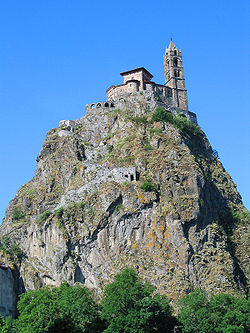 Following St. George the founder, later medieval local traditions evoke a legendary list of bishops at this chief town of the pays of Le Velay: Macarius, Marcellinus, Roricius, Eusebius, Paulianus, and Vosy (Evodius), all of them canonized by local veneration. It will have been from Bishop Paulianus that the Gaulish settlement of Ruessium/Vellavorum received its Christianizing name, Saint-Paulien. A bishop Evodius attended the Council of Valence in 374.
 The Christianization
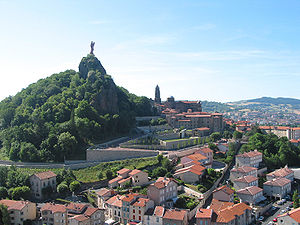
legends of Mons Anicius relate that at the request of Bishop Martial of Limoges, Bishop Evodius/Vosy caused an altar to the Virgin Mary to be erected on the pinnacle that surmounts Mont Anis. Some such beginning of the shrine Christianized the pagan site that became the altar site of the cathedral
of Le Puy. It marked one starting-point for the pilgrim route to Santiago de Compostela
, a walk of some 1600 km, as it still does today. The old town of Le Puy gathered round the base of the cathedral.
The pilgrims came early to Le Puy, and no French pilgrimage was more frequented in the Middle Ages. Charlemagne
came twice, in 772 and 800; there is a legend that in 772 he established a foundation at the cathedral for ten poor canons (chanoines de paupérie), and he chose Le Puy, with Aachen
and Saint-Gilles
, as a center for the collection of Peter's Pence
. Charles the Bald
visited Le Puy in 877, Odo, count of Paris
in 892, Robert II
in 1029, Philip Augustus in 1183. Louis IX
met James I of Aragon
here in 1245; and in 1254 passing through Le Puy on his return from the Holy Land, he gave to the cathedral an ebony image of the Blessed Virgin clothed in gold brocade, one of the many dozens of venerable "Black Virgins" of France: it was destroyed at the Revolution, but replaced at the Restoration with a copy that continues to be venerated. After him, Le Puy was visited by Philip the Bold
in 1282, by Philip the Fair
in 1285, by Charles VI
in 1394, by Charles VII
in 1420, and by Isabelle Romée
, the mother of Joan of Arc
in 1429. Louis XI
made the pilgrimage in 1436 and 1475, and in 1476 halted three leagues from the city and went to the cathedral barefooted. Charles VIII
visited it in 1495, Francis I
in 1533.
The legendary early shrine on the summit of Mons Anicius that drew so many would seem to predate the founding of an early church of Our Lady of Le Puy at Anicium, which was attributed to Bishop Vosy, who transferred the episcopal see from Ruessium to Anicium. Crowning the hill there was a megalith
ic dolmen
. A local tradition rededicated the curative virtue of the sacred site to Mary, who cured ailments by contact with the standing stone. When the founding bishop Vosy climbed the hill, he found that it was snow-covered in July; in the snowfall the tracks of a deer round the dolmen outlined the foundations of the future church. The Bishop was apprised in a vision that the angels themselves had dedicated the future cathedral to the Blessed Virgin, whence the epithet "Angelic" given to the cathedral of Le Puy. The great dolmen
was left standing in the center of the Christian sanctuary, which was constructed around it; the stone was re-consecrated as the Throne of Mary. By the eighth century, however, the stone, popularly known as the "stone of visions," was taken down and broken up. Its pieces were incorporated into the floor of a particular section of the church that came to be called the Chambre Angélique, or the "angels' chamber."
It is impossible to say whether this St. Evodius is the same who signed the decrees of the Council of Valence in 374. Neither can it be affirmed that St. Benignus, who in the seventh century founded a hospital at the gates of the basilica, and St. Agrevius, the 7th-century martyr from whom the town of Saint-Agrève Chiniacum took its name, were really bishops. Duchesne thinks that the chronology of these early bishops rests on very little evidence and that very ill-supported by documents; before the 10th century only six individuals appear of whom it can be said with certainty that they were bishops of Le Puy. The first of these, Scutarius, the legendary architect of the first cathedral, dates, if we may trust the inscription which bears his name, from the end of the 4th century.
Adhemar, bishop of Le Puy
was a central figure in the First Crusade
. Pope Clement IV
was also bishop of Le Puy.
Though the ancient diocese
was suppressed by the Concordat of 1801
, it was re-erected in 1823.
 Le Puy-en-Velay's most striking attraction is the Cathédrale Notre-Dame du Puy
, dating chiefly from the first half of the 12th century. The façade, striped in courses of white sandstone and black volcanic breccia, is reached by a flight of sixty steps, and consists of three orders: the lowest composed of three high arcades opening into the porch, which extends beneath the first bays
of the nave
; above are three central windows that light the nave; above are three gables on the gable-end of the nave, flanked by two openwork screening gables. The south transept
doorway is sheltered by a fine Romanesque porch. Behind the choir rises a separate Romanesque bell-tower in seven storeys.
The bays of the nave are roofed by octagonal cupolas, the cupola at the crossing
forming a lantern; the choir and transepts are barrel vault
ed. The striking parti-colored cloister is connected to remains of fortifications of the 13th century that separated the cathedral precincts from the rest of the city. Near the cathedral, the 11-century baptistery
of St John is built on Roman foundations.
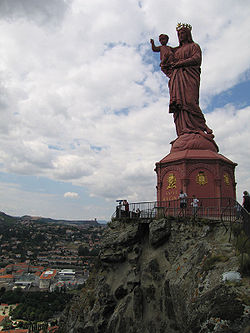
The bronze
statue of Notre-Dame de France(The Virgin Mary) overlooking the town was designed by French sculptor Jean-Marie Bonnassieux
, and is made from 213 Russia
n cannon
s taken in the Siege of Sevastopol (1854–1855). It was presented to the town on 12 September 1860 in front of 120,000 people.
Pilgrims starting their journey to Santiago de Compostela gather to be blessed each morning. The cathedral has been a Unesco World Heritage Site since 1998, as part of the "Routes of Santiago de Compostela in France
". Fountain Crozatier is also a beautiful sight in the centre of the town.
, Germany Tonbridge
, United Kingdom Tortosa
, Spain Brugherio
, Italy Mangualde, Portugal
s, for its lace-making, and for its green liqueur "Verveine" flavored with verbena
.
The lentils, grown on the thin soils of the area, are very small and almost black in colour. Their unique quality and flavour derive from their high protein and relatively low carbohydrate content. They are widely used in soups and also to accompany goose, duck and sausage dishes. Le Puy Green lentil
(Lentille Verte du Puy) is an appellation recognised throughout the European Union (Protected Designation of Origin
).
falls on Good Friday
.
The Jubilee of Le Puy in French Wikipedia. This occurred last in 2005, will occur next in 2025 but the subsequent occurrence will not be until 2157. The Jubilee of Le Puy is the oldest aside from those of Rome and Jerusalem, taking its original cue from the predictions of a monk Bernhard who predicted the end of the world
in 992 when the feast of the Annunciation
would fall on Good Friday
. The number of pilgrims to Le Puy was so remarkable that, after the dread date had safely passed, Pope John XV
declared that each such date would be marked by a Jubilee.The first such anniversary occurred in 1065. In the Jubilee of 1407, the press of the crowd was so great that two hundred pilgrims suffocated. Of three Jubilees in the twentieth century, the Jubilee of 1932 attracted over 300,000 pilgrims.
Le Puy has hosted Le Tour de France on six occasions. In 1954, it was the finish town of stage 15, from Millau
, which was won by Dominique Forlini. The next day, Jean Forestier won the race from Le Puy to Lyon
. The race would not return until 1990, when the riders retraced their predecessors steps towards Millau. Marino Lejarreta won the day. In 1996 the town would again host two stages, stage 12 from Valence, won by Pascal Richard
, and stage 13 to Super-Besse, won by Rolf Sorensen. Most recently, Giuseppe Guerini
won the stage from Issoire
in 2005.
Communes of France
The commune is the lowest level of administrative division in the French Republic. French communes are roughly equivalent to incorporated municipalities or villages in the United States or Gemeinden in Germany...
in the Haute-Loire
Haute-Loire
Haute-Loire is a department in south-central France named after the Loire River.-History:Haute-Loire is one of the original 83 departments created during the French Revolution on 4 March 1790...
department in south-central France.
Its inhabitants are called Ponots.
History
Le Puy-en-Velay was a major bishopricDiocese
A diocese is the district or see under the supervision of a bishop. It is divided into parishes.An archdiocese is more significant than a diocese. An archdiocese is presided over by an archbishop whose see may have or had importance due to size or historical significance...
in medieval France, founded early, though its early history is legendary. According to a martyrology
Martyrology
A martyrology is a catalogue or list of martyrs , arranged in the calendar order of their anniversaries or feasts. Local martyrologies record exclusively the custom of a particular Church. Local lists were enriched by names borrowed from neighbouring churches...
compiled by Ado of Vienne and published in many copies in 858, which was supplemented in the mid-10th century by Gauzbert of Limoges, a certain priest named George accompanied a certain Front, the first Bishop of Périgueux, when they were sent to proselytize in Gaul
Gaul
Gaul was a region of Western Europe during the Iron Age and Roman era, encompassing present day France, Luxembourg and Belgium, most of Switzerland, the western part of Northern Italy, as well as the parts of the Netherlands and Germany on the left bank of the Rhine. The Gauls were the speakers of...
. Front was added to the list of the apostles to Gaul, traditionally sent out to reorganize Christians after the persecutions that are associated with Decius
Decius
Trajan Decius , was Roman Emperor from 249 to 251. In the last year of his reign, he co-ruled with his son Herennius Etruscus until they were both killed in the Battle of Abrittus.-Early life and rise to power:...
and Gratian
Gratian
Gratian was Roman Emperor from 375 to 383.The eldest son of Valentinian I, during his youth Gratian accompanied his father on several campaigns along the Rhine and Danube frontiers. Upon the death of Valentinian in 375, Gratian's brother Valentinian II was declared emperor by his father's soldiers...
, circa 250. As with others of the group, notably Saint Martial
Saint Martial
Saint Martial was the first bishop of Limoges in today's France, according to a lost vita of Saturnin, first bishop of Toulouse, which Gregory of Tours quotes in his History of the Franks.-Life:...
of Limoges
Limoges
Limoges |Limousin]] dialect of Occitan) is a city and commune, the capital of the Haute-Vienne department and the administrative capital of the Limousin région in west-central France....
, later mythology
Christian mythology
Christian mythology is the body of myths associated with Christianity. In the study of mythology, the term "myth" refers to a traditional story, often one which is regarded as sacred and which explains how the world and its inhabitants came to have their present form.Classicist G.S. Kirk defines a...
pushed Saint Front and the priest George back in time, and tells how George had been restored to life with a touch of Saint Peter
Saint Peter
Saint Peter or Simon Peter was an early Christian leader, who is featured prominently in the New Testament Gospels and the Acts of the Apostles. The son of John or of Jonah and from the village of Bethsaida in the province of Galilee, his brother Andrew was also an apostle...
's staff. The expanding legend of this St. George, which, according to the Church historian Duchesne is not earlier than the eleventh century, then makes that saint one of the Seventy Apostles of the Gospel of Luke
Gospel of Luke
The Gospel According to Luke , commonly shortened to the Gospel of Luke or simply Luke, is the third and longest of the four canonical Gospels. This synoptic gospel is an account of the life and ministry of Jesus of Nazareth. It details his story from the events of his birth to his Ascension.The...
, and tells how he founded the church of the [civitas] que dicitur Vetula in pago Vellavorum— as Ruessium began to be called during the fourth century: the city "called Vetula in the pays of the Vellavi
Vellavi
The Vellavi were a Gaulish people in the region of Le Puy-en-Velay in the region of the Auvergne, which, at the time of Julius Caesar's campaigns against the Gaul lay on the border of Gallia Narbonensis...
" a document of 1004 termed it. Vetula means "the old woman": pagans were still making small images of her as late as the sixth century in Flanders, according to the vita of Saint Eligius
Eligius
Eligius may refer to:* Eligius Franz Joseph von Münch-Bellinghausen , known als Friedrich Halm, Austrian dramatist, poet and short-story writer* Eligius Fromentin , American politician...
. This was the first cathedral at Le Puy.
Our Lady of Le Puy
Christianization
The historical phenomenon of Christianization is the conversion of individuals to Christianity or the conversion of entire peoples at once...
legends of Mons Anicius relate that at the request of Bishop Martial of Limoges, Bishop Evodius/Vosy caused an altar to the Virgin Mary to be erected on the pinnacle that surmounts Mont Anis. Some such beginning of the shrine Christianized the pagan site that became the altar site of the cathedral
Cathedral
A cathedral is a Christian church that contains the seat of a bishop...
of Le Puy. It marked one starting-point for the pilgrim route to Santiago de Compostela
Santiago de Compostela
Santiago de Compostela is the capital of the autonomous community of Galicia, Spain.The city's Cathedral is the destination today, as it has been throughout history, of the important 9th century medieval pilgrimage route, the Way of St. James...
, a walk of some 1600 km, as it still does today. The old town of Le Puy gathered round the base of the cathedral.
The pilgrims came early to Le Puy, and no French pilgrimage was more frequented in the Middle Ages. Charlemagne
Charlemagne
Charlemagne was King of the Franks from 768 and Emperor of the Romans from 800 to his death in 814. He expanded the Frankish kingdom into an empire that incorporated much of Western and Central Europe. During his reign, he conquered Italy and was crowned by Pope Leo III on 25 December 800...
came twice, in 772 and 800; there is a legend that in 772 he established a foundation at the cathedral for ten poor canons (chanoines de paupérie), and he chose Le Puy, with Aachen
Aachen
Aachen has historically been a spa town in North Rhine-Westphalia, Germany. Aachen was a favoured residence of Charlemagne, and the place of coronation of the Kings of Germany. Geographically, Aachen is the westernmost town of Germany, located along its borders with Belgium and the Netherlands, ...
and Saint-Gilles
Saint-Gilles
Saint-Gilles is the name of several places, most of them named after Saint Giles.-Belgium:* Saint-Gilles is the French name for a municipality in the bilingual Brussels-Capital Region...
, as a center for the collection of Peter's Pence
Peter's Pence
Peter's Pence is payment made more or less voluntarily to the Roman Catholic Church. It began under the Saxons in England and is seen in other countries. Though formally discontinued in England at the time of the Reformation, a post-Reformation payment of uncertain characteristics is seen in some...
. Charles the Bald
Charles the Bald
Charles the Bald , Holy Roman Emperor and King of West Francia , was the youngest son of the Emperor Louis the Pious by his second wife Judith.-Struggle against his brothers:He was born on 13 June 823 in Frankfurt, when his elder...
visited Le Puy in 877, Odo, count of Paris
Odo, Count of Paris
Odo was a King of Western Francia, reigning from 888 to 898. He was a son of Robert the Strong, count of Anjou, whose branch of the family is known as the Robertians....
in 892, Robert II
Robert II of France
Robert II , called the Pious or the Wise , was King of France from 996 until his death. The second reigning member of the House of Capet, he was born in Orléans to Hugh Capet and Adelaide of Aquitaine....
in 1029, Philip Augustus in 1183. Louis IX
Louis IX of France
Louis IX , commonly Saint Louis, was King of France from 1226 until his death. He was also styled Louis II, Count of Artois from 1226 to 1237. Born at Poissy, near Paris, he was an eighth-generation descendant of Hugh Capet, and thus a member of the House of Capet, and the son of Louis VIII and...
met James I of Aragon
James I of Aragon
James I the Conqueror was the King of Aragon, Count of Barcelona, and Lord of Montpellier from 1213 to 1276...
here in 1245; and in 1254 passing through Le Puy on his return from the Holy Land, he gave to the cathedral an ebony image of the Blessed Virgin clothed in gold brocade, one of the many dozens of venerable "Black Virgins" of France: it was destroyed at the Revolution, but replaced at the Restoration with a copy that continues to be venerated. After him, Le Puy was visited by Philip the Bold
Philip the Bold
Philip the Bold , also Philip II, Duke of Burgundy , was the fourth and youngest son of King John II of France and his wife, Bonne of Luxembourg. By his marriage to Margaret III, Countess of Flanders, he also became Count Philip II of Flanders, Count Philip IV of Artois and Count-Palatine Philip IV...
in 1282, by Philip the Fair
Philip IV of France
Philip the Fair was, as Philip IV, King of France from 1285 until his death. He was the husband of Joan I of Navarre, by virtue of which he was, as Philip I, King of Navarre and Count of Champagne from 1284 to 1305.-Youth:A member of the House of Capet, Philip was born at the Palace of...
in 1285, by Charles VI
Charles VI of France
Charles VI , called the Beloved and the Mad , was the King of France from 1380 to 1422, as a member of the House of Valois. His bouts with madness, which seem to have begun in 1392, led to quarrels among the French royal family, which were exploited by the neighbouring powers of England and Burgundy...
in 1394, by Charles VII
Charles VII of France
Charles VII , called the Victorious or the Well-Served , was King of France from 1422 to his death, though he was initially opposed by Henry VI of England, whose Regent, the Duke of Bedford, ruled much of France including the capital, Paris...
in 1420, and by Isabelle Romée
Isabelle Romée
Isabelle Romée, also known as Isabelle de Vouthon and Isabelle d'Arc and Ysabeau Romee, was the mother of Joan of Arc. She was a native of Vouthon-Bas, a village near Domrémy-la-Pucelle where she and her husband Jacques d'Arc settled. Together they owned about of land and a modest house...
, the mother of Joan of Arc
Joan of Arc
Saint Joan of Arc, nicknamed "The Maid of Orléans" , is a national heroine of France and a Roman Catholic saint. A peasant girl born in eastern France who claimed divine guidance, she led the French army to several important victories during the Hundred Years' War, which paved the way for the...
in 1429. Louis XI
Louis XI of France
Louis XI , called the Prudent , was the King of France from 1461 to 1483. He was the son of Charles VII of France and Mary of Anjou, a member of the House of Valois....
made the pilgrimage in 1436 and 1475, and in 1476 halted three leagues from the city and went to the cathedral barefooted. Charles VIII
Charles VIII of France
Charles VIII, called the Affable, , was King of France from 1483 to his death in 1498. Charles was a member of the House of Valois...
visited it in 1495, Francis I
Francis I of France
Francis I was King of France from 1515 until his death. During his reign, huge cultural changes took place in France and he has been called France's original Renaissance monarch...
in 1533.
The legendary early shrine on the summit of Mons Anicius that drew so many would seem to predate the founding of an early church of Our Lady of Le Puy at Anicium, which was attributed to Bishop Vosy, who transferred the episcopal see from Ruessium to Anicium. Crowning the hill there was a megalith
Megalith
A megalith is a large stone that has been used to construct a structure or monument, either alone or together with other stones. Megalithic describes structures made of such large stones, utilizing an interlocking system without the use of mortar or cement.The word 'megalith' comes from the Ancient...
ic dolmen
Dolmen
A dolmen—also known as a portal tomb, portal grave, dolmain , cromlech , anta , Hünengrab/Hünenbett , Adamra , Ispun , Hunebed , dös , goindol or quoit—is a type of single-chamber megalithic tomb, usually consisting of...
. A local tradition rededicated the curative virtue of the sacred site to Mary, who cured ailments by contact with the standing stone. When the founding bishop Vosy climbed the hill, he found that it was snow-covered in July; in the snowfall the tracks of a deer round the dolmen outlined the foundations of the future church. The Bishop was apprised in a vision that the angels themselves had dedicated the future cathedral to the Blessed Virgin, whence the epithet "Angelic" given to the cathedral of Le Puy. The great dolmen
Dolmen
A dolmen—also known as a portal tomb, portal grave, dolmain , cromlech , anta , Hünengrab/Hünenbett , Adamra , Ispun , Hunebed , dös , goindol or quoit—is a type of single-chamber megalithic tomb, usually consisting of...
was left standing in the center of the Christian sanctuary, which was constructed around it; the stone was re-consecrated as the Throne of Mary. By the eighth century, however, the stone, popularly known as the "stone of visions," was taken down and broken up. Its pieces were incorporated into the floor of a particular section of the church that came to be called the Chambre Angélique, or the "angels' chamber."
It is impossible to say whether this St. Evodius is the same who signed the decrees of the Council of Valence in 374. Neither can it be affirmed that St. Benignus, who in the seventh century founded a hospital at the gates of the basilica, and St. Agrevius, the 7th-century martyr from whom the town of Saint-Agrève Chiniacum took its name, were really bishops. Duchesne thinks that the chronology of these early bishops rests on very little evidence and that very ill-supported by documents; before the 10th century only six individuals appear of whom it can be said with certainty that they were bishops of Le Puy. The first of these, Scutarius, the legendary architect of the first cathedral, dates, if we may trust the inscription which bears his name, from the end of the 4th century.
Adhemar, bishop of Le Puy
Adhemar of Le Puy
Adhemar de Monteil , one of the principal figures of the First Crusade, was bishop of Puy-en-Velay from before 1087...
was a central figure in the First Crusade
First Crusade
The First Crusade was a military expedition by Western Christianity to regain the Holy Lands taken in the Muslim conquest of the Levant, ultimately resulting in the recapture of Jerusalem...
. Pope Clement IV
Pope Clement IV
Pope Clement IV , born Gui Faucoi called in later life le Gros , was elected Pope February 5, 1265, in a conclave held at Perugia that took four months, while cardinals argued over whether to call in Charles of Anjou, the youngest brother of Louis IX of France...
was also bishop of Le Puy.
Though the ancient diocese
Diocese
A diocese is the district or see under the supervision of a bishop. It is divided into parishes.An archdiocese is more significant than a diocese. An archdiocese is presided over by an archbishop whose see may have or had importance due to size or historical significance...
was suppressed by the Concordat of 1801
Concordat of 1801
The Concordat of 1801 was an agreement between Napoleon and Pope Pius VII, signed on 15 July 1801. It solidified the Roman Catholic Church as the majority church of France and brought back most of its civil status....
, it was re-erected in 1823.
Main sights
Le Puy Cathedral
Le Puy Cathedral is a Roman Catholic cathedral, and a national monument of France, in Le Puy-en-Velay, Auvergne. It has been a centre of pilgrimage in its own right since before the time of Charlemagne, as well as forming part of the pilgrimage route to Santiago de Compostela...
, dating chiefly from the first half of the 12th century. The façade, striped in courses of white sandstone and black volcanic breccia, is reached by a flight of sixty steps, and consists of three orders: the lowest composed of three high arcades opening into the porch, which extends beneath the first bays
Bay (architecture)
A bay is a unit of form in architecture. This unit is defined as the zone between the outer edges of an engaged column, pilaster, or post; or within a window frame, doorframe, or vertical 'bas relief' wall form.-Defining elements:...
of the nave
Nave
In Romanesque and Gothic Christian abbey, cathedral basilica and church architecture, the nave is the central approach to the high altar, the main body of the church. "Nave" was probably suggested by the keel shape of its vaulting...
; above are three central windows that light the nave; above are three gables on the gable-end of the nave, flanked by two openwork screening gables. The south transept
Transept
For the periodical go to The Transept.A transept is a transverse section, of any building, which lies across the main body of the building. In Christian churches, a transept is an area set crosswise to the nave in a cruciform building in Romanesque and Gothic Christian church architecture...
doorway is sheltered by a fine Romanesque porch. Behind the choir rises a separate Romanesque bell-tower in seven storeys.
The bays of the nave are roofed by octagonal cupolas, the cupola at the crossing
Crossing (architecture)
A crossing, in ecclesiastical architecture, is the junction of the four arms of a cruciform church.In a typically oriented church , the crossing gives access to the nave on the west, the transept arms on the north and south, and the choir on the east.The crossing is sometimes surmounted by a tower...
forming a lantern; the choir and transepts are barrel vault
Barrel vault
A barrel vault, also known as a tunnel vault or a wagon vault, is an architectural element formed by the extrusion of a single curve along a given distance. The curves are typically circular in shape, lending a semi-cylindrical appearance to the total design...
ed. The striking parti-colored cloister is connected to remains of fortifications of the 13th century that separated the cathedral precincts from the rest of the city. Near the cathedral, the 11-century baptistery
Baptistery
In Christian architecture the baptistry or baptistery is the separate centrally-planned structure surrounding the baptismal font. The baptistry may be incorporated within the body of a church or cathedral and be provided with an altar as a chapel...
of St John is built on Roman foundations.
The bronze
Bronze
Bronze is a metal alloy consisting primarily of copper, usually with tin as the main additive. It is hard and brittle, and it was particularly significant in antiquity, so much so that the Bronze Age was named after the metal...
statue of Notre-Dame de France(The Virgin Mary) overlooking the town was designed by French sculptor Jean-Marie Bonnassieux
Jean-Marie Bonnassieux
Jean-Marie Bienaimé Bonnassieux was a French sculptor.The son of a cabinet maker from Lyon, Bonnassieux showed talent as a boy and was educated at the Ecole des Beaux-Arts, Paris, under Augustin-Alexandre Dumont...
, and is made from 213 Russia
Russia
Russia or , officially known as both Russia and the Russian Federation , is a country in northern Eurasia. It is a federal semi-presidential republic, comprising 83 federal subjects...
n cannon
Cannon
A cannon is any piece of artillery that uses gunpowder or other usually explosive-based propellents to launch a projectile. Cannon vary in caliber, range, mobility, rate of fire, angle of fire, and firepower; different forms of cannon combine and balance these attributes in varying degrees,...
s taken in the Siege of Sevastopol (1854–1855). It was presented to the town on 12 September 1860 in front of 120,000 people.
Pilgrims starting their journey to Santiago de Compostela gather to be blessed each morning. The cathedral has been a Unesco World Heritage Site since 1998, as part of the "Routes of Santiago de Compostela in France
World Heritage Sites of the Routes of Santiago de Compostela in France
In 1998, several sites in France were added to the UNESCO World Heritage Sites under the description: Routes of Santiago de Compostela in France....
". Fountain Crozatier is also a beautiful sight in the centre of the town.
Sights
Three miles from Le Puy are the ruins of the Château de Polignac, one of the most important feudal strongholds.Notable people
- Peire CardenalPeire CardenalPeire Cardenal was a troubadour known for his satirical sirventes and his dislike of the clergy...
, (1180–1278), Occitan troubadourTroubadourA troubadour was a composer and performer of Old Occitan lyric poetry during the High Middle Ages . Since the word "troubadour" is etymologically masculine, a female troubadour is usually called a trobairitz.... - Marquis de La Fayette, 1757–1834, born at the Château de Chavagnac a few kilometres away from Le-Puy-en-Velay. He is known, among other things, for his action during the War of Independence of the United States of America.
- Pierre JulienPierre JulienPierre Julien was a French sculptor who worked in a full range of rococo and neoclassical styles.He served an early apprenticeship at Le Puy-en-Velay, near his natal village of Saint-Paulien, then at the École de dessin of Lyon, then entered the Parisian atelier of Guillaume Coustou the Younger...
, (1731–1804), French neoclassicalNeoclassicismNeoclassicism is the name given to Western movements in the decorative and visual arts, literature, theatre, music, and architecture that draw inspiration from the "classical" art and culture of Ancient Greece or Ancient Rome...
sculptor. - Charles DupuyCharles DupuyCharles Alexandre Dupuy was a French statesman, three times prime minister.-Biography:He was born in Le Puy-en-Velay, Haute-Loire, Auvergne, where his father was a minor official. After a period as a professor of philosophy in the provinces, he was appointed a school inspector, thus obtaining a...
, (1851–1923), French politician, president of the Concil at several times during the Third RepublicFrench Third RepublicThe French Third Republic was the republican government of France from 1870, when the Second French Empire collapsed due to the French defeat in the Franco-Prussian War, to 1940, when France was overrun by Nazi Germany during World War II, resulting in the German and Italian occupations of France...
. - Émile Reynaud, whose family comes from Le-Puy-en-Velay, settled there during many years and did lectures of scientific vulgarisation with projections in 1875 there which were very appreciated by the local population.
- Courtol, (1834–1902), hunter of viperViperidaeThe Viperidae are a family of venomous snakes found all over the world, except in Antarctica, Australia, Ireland, Madagascar, Hawaii, various other isolated islands, and above the Arctic Circle. All have relatively long, hinged fangs that permit deep penetration and injection of venom. Four...
s. - Jules VallèsJules VallèsJules Vallès was a French journalist and author.-Early life:Vallès was born in Le Puy-en-Velay, Haute-Loire. His father was a supervisor of studies , later a teacher, and unfaithful to Jules' mother. Jules was a brilliant student...
, (1832–1885), born in Le Puy. He was a writer and a journalist. His most famous book is L'Enfant. - Grégory CoupetGrégory CoupetGrégory Coupet is a retired French association football goalkeeper who last played for Paris Saint-Germain. He has played for clubs such as Saint-Étienne, Lyon, Atlético Madrid. He has also played for the France national team....
, football player, goalkeeper of Paris Saint Germain and of the French national team. - Sidney GovouSidney GovouSidney Rodrigue Noukpo Govou is a French international footballer of Beninese descent who currently plays for Évian Thonon Gaillard FC. Govou is a naturally attacking player but rarely plays as a striker, he is more commonly deployed as a winger. His main attribute is his pace...
, football player at Panathinaikos F.C. and selected in the French national team. - Jérémy PerbetJérémy PerbetJérémy Perbet is a French football striker. He currently plays for Belgian club R.A.E.C. Mons.-Initial career:...
, football player. Plays for the RC StrasbourgRC StrasbourgRacing Club de Strasbourg is a French association football club founded in 1906 and professional since 1933, based in the city of Strasbourg, in Alsace...
in the French Ligue 2Ligue 2Ligue 2 , formerly known as Division 2, is a French professional football league. The league serves as the second division of French football and is one of two divisions making up the Ligue de Football Professionnel , the other being Ligue 1, the country's top football division...
. - Julien MalzieuJulien MalzieuJulien Malzieu born 4 May 1983 in Le Puy-en-Velay, Auvergne, France is a rugby union and sevens player for ASM Clermont Auvergne in the Top 14 competition.-Career:...
, rugby union player with ASM Clermont AuvergneASM Clermont AuvergneAssociation Sportive Montferrandaise Clermont Auvergne are a French rugby union club from Clermont-Ferrand in Auvergne that currently competes in Top 14, the top level of the French league system, ASMCA are the were the 2010 France Top 14 Champions. It is the rugby section of the multi-sport club...
and the French national teamFrance national rugby union teamThe France national rugby union team represents France in rugby union. They compete annually against England, Ireland, Italy, Scotland and Wales in the Six Nations Championship. They have won the championship outright sixteen times, shared it a further eight times, and have completed nine grand slams...
. - Bruno JulliardBruno JulliardBruno Julliard is the former chairman of the UNEF, the main student union in France. He studies public law at the University of Lyon....
, chairman of the UNEFUnion nationale des étudiants de franceThe National Union of Students of France is the main national students' union in France....
who was put in the spotlight during the national social movement of French students against the CPEFirst Employment ContractThe contrat première embauche was a new form of employment contract pushed in spring 2006 in France by Prime Minister Dominique de Villepin...
law in 2006. The former mayor of Le Puy-en-Velay, Arlette Arnaud-Landau, is his mother. - Marion BartoliMarion BartoliMarion Bartoli is a French professional tennis player and the current French no. 1. She has won seven Women's Tennis Association singles titles and three doubles titles. She was also a runner-up at the 2007 Wimbledon Championships....
, tennis player, 2007 Wimbledon finalist and top 10 player.
Twin cities
Le-Puy-en-Velay is twinned with the following towns: MeschedeMeschede
Meschede is a town in the Hochsauerland district, in North Rhine-Westphalia, Germany. It is the capital of the district Hochsauerlandkreis.-Geography:Meschede is situated in the Ruhr valley, near to the Hennesee, south of the nature-park Arnsberger Wald...
, Germany Tonbridge
Tonbridge
Tonbridge is a market town in the English county of Kent, with a population of 30,340 in 2007. It is located on the River Medway, approximately 4 miles north of Tunbridge Wells, 12 miles south west of Maidstone and 29 miles south east of London...
, United Kingdom Tortosa
Tortosa
-External links:* *** * * *...
, Spain Brugherio
Brugherio
Brugherio is a comune in the Province of Monza and Brianza in the Italian region Lombardy, located about 14 km northeast of Milan...
, Italy Mangualde, Portugal
Gastronomy
Le Puy is famous for a particular strain of green lentilLentil
The lentil is an edible pulse. It is a bushy annual plant of the legume family, grown for its lens-shaped seeds...
s, for its lace-making, and for its green liqueur "Verveine" flavored with verbena
Verbena
Verbena , verbenas or vervains, is a genus in the family Verbenaceae. It contains about 250 species of annual and perennial herbaceous or semi-woody flowering plants. The majority of the species are native to the New World from Canada south to southern Chile, but some are also native in the Old...
.
The lentils, grown on the thin soils of the area, are very small and almost black in colour. Their unique quality and flavour derive from their high protein and relatively low carbohydrate content. They are widely used in soups and also to accompany goose, duck and sausage dishes. Le Puy Green lentil
Le Puy Green lentil
The "Le Puy Green Lentil" is a lentil cultivated from the "Lens esculenta puyensis" variety in the region of Le Puy. Its gastronomic qualities come from the "terroir" : soil, micro-climate, ......
(Lentille Verte du Puy) is an appellation recognised throughout the European Union (Protected Designation of Origin
Protected designation of origin
Protected Geographical Status is a legal framework defined in European Union law to protect the names of regional foods. Protected Designation of Origin , Protected Geographical Indication and Traditional Speciality Guaranteed are distinct regimes of geographical indications within the framework...
).
Miscellaneous
The town holds a famous Jubilee in years when the feast of the AnnunciationAnnunciation
The Annunciation, also referred to as the Annunciation to the Blessed Virgin Mary or Annunciation of the Lord, is the Christian celebration of the announcement by the angel Gabriel to Virgin Mary, that she would conceive and become the mother of Jesus the Son of God. Gabriel told Mary to name her...
falls on Good Friday
Good Friday
Good Friday , is a religious holiday observed primarily by Christians commemorating the crucifixion of Jesus Christ and his death at Calvary. The holiday is observed during Holy Week as part of the Paschal Triduum on the Friday preceding Easter Sunday, and may coincide with the Jewish observance of...
.
The Jubilee of Le Puy in French Wikipedia. This occurred last in 2005, will occur next in 2025 but the subsequent occurrence will not be until 2157. The Jubilee of Le Puy is the oldest aside from those of Rome and Jerusalem, taking its original cue from the predictions of a monk Bernhard who predicted the end of the world
Eschatology
Eschatology is a part of theology, philosophy, and futurology concerned with what are believed to be the final events in history, or the ultimate destiny of humanity, commonly referred to as the end of the world or the World to Come...
in 992 when the feast of the Annunciation
Annunciation
The Annunciation, also referred to as the Annunciation to the Blessed Virgin Mary or Annunciation of the Lord, is the Christian celebration of the announcement by the angel Gabriel to Virgin Mary, that she would conceive and become the mother of Jesus the Son of God. Gabriel told Mary to name her...
would fall on Good Friday
Good Friday
Good Friday , is a religious holiday observed primarily by Christians commemorating the crucifixion of Jesus Christ and his death at Calvary. The holiday is observed during Holy Week as part of the Paschal Triduum on the Friday preceding Easter Sunday, and may coincide with the Jewish observance of...
. The number of pilgrims to Le Puy was so remarkable that, after the dread date had safely passed, Pope John XV
Pope John XV
Pope John XV , Pope from 985 to 996, succeeding Boniface VII . He was said to have been Pope after another Pope John that reigned four months after Pope John XIV and was named "Papa Ioannes XIV Bis" or "Pope John XIVb"...
declared that each such date would be marked by a Jubilee.The first such anniversary occurred in 1065. In the Jubilee of 1407, the press of the crowd was so great that two hundred pilgrims suffocated. Of three Jubilees in the twentieth century, the Jubilee of 1932 attracted over 300,000 pilgrims.
Le Puy has hosted Le Tour de France on six occasions. In 1954, it was the finish town of stage 15, from Millau
Millau
Millau is a commune in the Aveyron department in southern France. It is located at the confluence of the Tarn and Dourbie rivers.-History:...
, which was won by Dominique Forlini. The next day, Jean Forestier won the race from Le Puy to Lyon
Lyon
Lyon , is a city in east-central France in the Rhône-Alpes region, situated between Paris and Marseille. Lyon is located at from Paris, from Marseille, from Geneva, from Turin, and from Barcelona. The residents of the city are called Lyonnais....
. The race would not return until 1990, when the riders retraced their predecessors steps towards Millau. Marino Lejarreta won the day. In 1996 the town would again host two stages, stage 12 from Valence, won by Pascal Richard
Pascal Richard
Pascal Richard is a French-speaking Swiss former racing cyclist. He is most notable as a former King of the Mountains winner at the Giro d'Italia and Olympic Games gold medalist.-Biography:...
, and stage 13 to Super-Besse, won by Rolf Sorensen. Most recently, Giuseppe Guerini
Giuseppe Guerini
Giuseppe Guerini is an Italian professional road bicycle racer.A native of Gazzaniga, Lombardy, he currently rides with the T-Mobile Team and has done so since 1999. He has, however, been a professional cyclist since 1993 - being a member of two other teams: Navigare and Polti...
won the stage from Issoire
Issoire
Issoire is a commune in the Puy-de-Dôme department in Auvergne in central France.-Geography:Issoire is located on the Couze River, near its junction with the Allier, SSE of Clermont-Ferrand on the Paris-Lyon-Méditerranée railway to Nîmes...
in 2005.
External links
- Le Puy en Velay Hiking Trails: St James of Compostela Way, GR65 (in English)
- Robert Louis Stevenson Trail GR70 (in English)
- Regordane Info – The independent portal for The Regordane Way or St Gilles Trail (in English and French)
- GR700 Regordane Way or St Gilles Trail (in English)
- City council website (in French)
- Tourist Office website
- Catholic Encyclopedia: Le Puy
- Jean Daugis, "À propos du Velay" historical notes (in French)
- Le-Puy-en-Velay's page on French Wikipédia
- Sacred Sites: Cathedral of Notre Dame at Le Puy
- Encyclopaedia Britannica 1911: Le Puy