


Larne Gun Running

Encyclopedia
The Larne gun-running was a major gun smuggling operation organised in Ireland
by Major Frederick H. Crawford and Captain Wilfrid Spender
for the Ulster Unionist Council to equip the Ulster Volunteer Force. The operation involved the smuggling of almost twenty-five thousand rifles and three million rounds of ammunition from Germany
, with the shipments landing in Larne
, Donaghadee
, and Bangor
in the early hours between Friday 24 and Saturday 25 April 1914. The Larne gun-running may have been the first time in history motor-vehicles had been used "on a large scale for a military-purpose, and with striking success".
to fight against the imposition of Home Rule. It approached Major Frederick Crawford to act as its agent to purchase the guns needed to equip such an army. Major Crawford wrote to five arms manufacturers including the Austrian Steyr
and the German Deutsche Waffen und Munitionsfabriken
, seeking quotations for the purchase of twenty thousand rifles and a million rounds of ammunition.
In January 1913, the Ulster Unionist Council instituted the Ulster Volunteer Force consisting of people who had signed the Ulster Covenant
. This was an attempt to co-ordinate the paramilitary activities of Ulster’s unionists, as well as to give real military backing to the threats of the Ulster Covenant in resisting the implementation of the Third Home Rule Bill
introduced on 11 April 1912 by then Prime Minister H. H. Asquith
. These threats had been regarded as a "gigantic game of bluff and blackmail" by Irish nationalist leader John Redmond
as well as most Liberal MPs including Winston Churchill
. UVF membership grew to around 90,000 members, led by retired officers of the British army
, with the organisation under the charge of Lieutenant-General Sir George Richardson
KCB, a veteran of the Afghan Wars
. By 1913 the UVF had over £1 million pledged to it, and £70,000 invested in attempts to import arms.
Throughout 1913 Major Crawford, with the use of aliases and disguises, had attempted to smuggle in arms bought in Britain
and Imperial Germany, however these attempts failed when vigilant customs officials seized the goods at the docks. In one instance patrol boats thwarted a gun-running attempt to Carrigart
in northern County Donegal
carried out by Lord Leitrim
.
Major Crawford however would convince the Ulster Unionist Council that he could provide the weapons and ammunition needed "to equip the entire UVF". Thus the stage was set for what would become known as the Larne gun-running, with Edward Carson in response proclaiming;
. Included in this cache was; 11,000 M1904 Mannlicher
rifles brought from the Steyr works in Austria
; 9,000 ex-German army M1888 Commission Rifles; 4,600 Italian Vetterli-Vitali
rifles; and 5 million rounds of ammunition in clips of five — much of which was transported from Hamburg via the Kiel Canal
.
On 30 March 1914, these weapons were being loaded onto the SS Fanny on the Baltic island of Langeland
when Danish
customs officials seized the papers of the ship. The customs officials suspected that the cargo might contain weapons to arm militant Iceland
ic home rulers who sought independence from Denmark, however the SS Fanny managed to escape into a gale and sailed outside of Danish territorial waters. On 1 April, The Times
newspaper had correctly claimed that the guns were destined for Ulster rather than Iceland.
In a bid to evade the authorities as the SS Fanny neared Ireland, Major Crawford purchased the SS Clyde Valley in Glasgow. On 19–20 April off Tuskar Rock, County Wexford
, the entire cache of weapons was transported from the SS Fanny onto the SS Clyde Valley. On 24 April, the SS Clyde Valley was renamed the "Mountjoy II", with the use of 6 feet (1.8 m) strips of canvas painted with white letters on a black background. This was a direct reference to the Mountjoy that broke the boom across the River Foyle
during the Siege of Derry
in 1689, which gave it a historic symbolism for unionists.
Back in Ulster on the same date, the UVF were given instructions for a full test-mobilisation. The UVF Motor Corps was summoned by the County Antrim
commander, General Sir William Adair
, and given the following instructions:
This was all part of a "meticulous" and "elaborate" plan to ensure that the operation succeeded with only 12 people knowing the real details of, and reasons for, it; with the mobilisation of the UVF members still officially only a "test mobilisation". Captain F. Hall, the military secretary to the UVF had recorded details of these plans in a memorandum. It included details of the tapping of the private telephone line connecting Hollywood Barracks to Exchange, as well as the short-circuiting of phone and telegraph wires into Larne after the last train, and the "shorting" of the main rail lines.
On the date of the landings, members of the UVF are stated as having manned pickets and patrols along the length of the coast road between Belfast and Larne, as well as the roads leading to the towns of Ballyclare
, Ballymena
, and Glenarm
amongst others. The men at these pickets were to give directions to any who needed them and were provided with reserve supplies of petrol and tools for repairing any vehicle that had problems. In Larne itself, UVF members wearing armlets stood "in line silent as soldiers on parade", and manned cordons that blocked the roads preventing vehicles without a special permit being able to enter or depart Larne.
Captain James Craig
would take command of the operations in Bangor, with Adair taking command in Larne. The commander of the UVF, Sir George Richardson, would remain in Belfast on the night of the landings and was kept fully informed of proceedings by dispatch-riders.
so that the authorities would investigate it for smuggled armaments in what the UVF leadership called the Hoax
.
The Hoax involved a large truck waiting at the Belfast docks in an intentional bid to make it appear as if it was awaiting an incoming load. The captain of the SS Balmerino ensured that by making his ship's approach as suspicious as possible, the authorities would be alerted. Once the ship was docked, the captain set about stalling the authorities for as long as possible with excuses, which further convinced the authorities that they had intercepted the real cargo. Eventually the authorities searched the ship's contents and discovered that its papers were in order and that it was only carrying coal.
Whilst this was happening, twenty miles away the "Mountjoy II" brought the real arms cache into Larne harbour unhindered. After the "Mountjoy II" docked a motor-boat sailed up alongside and cranes transported "thousands" of rifles to it. After it had sailed away a second vessel sailed up to take away more arms. These vessels would transport their loads to Donaghadee.
As the weapons were unloaded onto the motor vehicles, each batch was counted and its destination noted by counting clerks. Due to the volume of weapons, temporary arms-dumps had been set up in the surrounding districts so that the vehicles could return as quickly as possible to receive another load. The Belfast Evening Telegraph remarked that all present "put their backs into it" and that it "illustrated the old adage, 'One Volunteer is worth three pressed men'" and they "toiled like galley slaves". The local population of Larne were noted as having lined the streets exchanging salutes and running make-shift canteens to supply the workers with refreshments throughout the night.
At 5 am the ship set sail from Larne harbour for Bangor to unload the rest of its cargo. Three cheers for "The King" and three more for "the Volunteers" were let out by the ships skipper and its crew as they stood to attention, with the cheers allegedly reciprocated by all those ashore.
By 7:30 am the "Mountjoy II" had completed its mission, and a course was set for the River Clyde
to confuse any coast-guards. On its way, the canvas sheets that bore the name Mountjoy II were cut, revealing the ship's real name, and it then proceeded down the Irish sea. After offloading Major Crawford at Rosslare
, County Wexford, the SS Clyde Valley set sail for the Baltic sea, travelling along the coasts of France and Denmark. Here it would rendezvous with the SS Fanny to bring back the Ulstermen contingent of its crew. Once this had been done, the SS Fanny was disposed of at Hamburg.
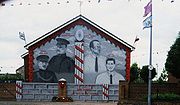 One of the key figures in the operation was Captain Wilfred Spender, a member of the UVF headquarters staff who is credited with having been responsible for originally drawing up the scheme and helped in the Hoax masquerade. His wife recorded details of the landing itself in her diary for the dates 24–25 April:
The Belfast Evening Telegraph would report on April 25 that:
For the Unionist leaders the Larne gun-running was in the end more of a political coup than a military feat. This was primarily due to the fact the Ulster Volunteers remained inadequately armed as the weapons shipment contained three different types of weapon along with a lack of proper ammunition for them. Combined with the many other much smaller weapons purchases, acquisitions amounted to just over 37,000 rifles in the hands of the Ulster Volunteers by June 1914.
The Larne gun-running also returned the gun to the centre of Irish politics. It also increased Irish nationalist suspicions, already aroused by the Curragh Incident
of the previous month, that the authorities were acquiescent towards unionist militants in Ulster. After the events in Larne, the nationalist Irish Volunteers
, which had been formed in late 1913 in response to the formation of the UVF, saw its membership soar.
The UVF's weapons and ammunitions were requested by the government on the outbreak of the First World War. By 1916 the ammunition had largely been transferred, but none of the rifles. In 1920 after the outbreak of the Irish war of Independence
the rifles were used to arm the new Ulster Special Constabulary
that was formed up (by the same Wilfrid Spender), and the USC was largely recruited from former Ulster Volunteers. In 1940 the rifles were released to arm the British Home Guard after the Battle of France
. They were first fired in anger during the East African Campaign
of 1940-41, arming the militias of Haile Selassie I.
The Irish Volunteers themselves would import a boat-load of arms in the Howth gun-running
of July 1914. The Dublin Metropolitan Police
(DMP), aided by troops of the 2nd King's Own Scottish Borderers
, tried—unsuccessfully—to confiscate the weapons. On their return to their barracks in Dublin, some troops baited by a hostile crowd, killed three people and wounded 38. The contrast between the inactivity of the police and military in Larne and the heavy-handed response in Dublin further convinced nationalists of official bias in favour of the UVF. The whole episode saw Ireland draw closer to the brink of civil war
. The Howth rifles were used in the 1916 Dublin Easter Rising
.
The events of the Larne gun-running and the voyages of the SS Fanny and SS Clyde Valley are remembered in the loyalist songs; "Gunrunners" and "Gallant Clyde Valley".
Ireland
Ireland is an island to the northwest of continental Europe. It is the third-largest island in Europe and the twentieth-largest island on Earth...
by Major Frederick H. Crawford and Captain Wilfrid Spender
Wilfrid Spender
Sir Wilfrid Bliss Spender, KCB, DSO, MC was an army officer, colonial administrator and civil servant - being responsible for laying the foundations for the civil service of Northern Ireland. He served as Secretary to the Northern Ireland Cabinet, 1921-1925, Permanent Secretary to the Ministry of...
for the Ulster Unionist Council to equip the Ulster Volunteer Force. The operation involved the smuggling of almost twenty-five thousand rifles and three million rounds of ammunition from Germany
German Empire
The German Empire refers to Germany during the "Second Reich" period from the unification of Germany and proclamation of Wilhelm I as German Emperor on 18 January 1871, to 1918, when it became a federal republic after defeat in World War I and the abdication of the Emperor, Wilhelm II.The German...
, with the shipments landing in Larne
Larne
Larne is a substantial seaport and industrial market town on the east coast of County Antrim, Northern Ireland with a population of 18,228 people in the 2001 Census. As of 2011, there are about 31,000 residents in the greater Larne area. It has been used as a seaport for over 1,000 years, and is...
, Donaghadee
Donaghadee
Donaghadee is a small town in County Down, Northern Ireland. It lies on the northeast coast of the Ards Peninsula, about east of Belfast and about six miles south east of Bangor. It had a population of 6,470 people in the 2001 Census...
, and Bangor
Bangor, County Down
Bangor is a large town in County Down, Northern Ireland. It is a seaside resort on the southern side of Belfast Lough and within the Belfast Metropolitan Area. Bangor Marina is one of the largest in Ireland, and holds Blue Flag status...
in the early hours between Friday 24 and Saturday 25 April 1914. The Larne gun-running may have been the first time in history motor-vehicles had been used "on a large scale for a military-purpose, and with striking success".
Background to the gun-running
In November 1910 the Ulster Unionist Council formed a secret committee to oversee the creation of an army in UlsterUlster
Ulster is one of the four provinces of Ireland, located in the north of the island. In ancient Ireland, it was one of the fifths ruled by a "king of over-kings" . Following the Norman invasion of Ireland, the ancient kingdoms were shired into a number of counties for administrative and judicial...
to fight against the imposition of Home Rule. It approached Major Frederick Crawford to act as its agent to purchase the guns needed to equip such an army. Major Crawford wrote to five arms manufacturers including the Austrian Steyr
Steyr Mannlicher
Steyr Mannlicher is a firearms manufacturer based in the city of Steyr, Austria. Originally a part of the Steyr-Daimler-Puch manufacturing conglomerate, it became independent when the conglomerate was broken in 1990.-History:...
and the German Deutsche Waffen und Munitionsfabriken
Deutsche Waffen und Munitionsfabriken
Deutsche Waffen- und Munitionsfabriken Aktien-Gesellschaft , known as DWM, was an arms company in Imperial Germany created in 1896 when Ludwig Loewe & Company united its weapons and ammunition production facilities within one company...
, seeking quotations for the purchase of twenty thousand rifles and a million rounds of ammunition.
In January 1913, the Ulster Unionist Council instituted the Ulster Volunteer Force consisting of people who had signed the Ulster Covenant
Ulster Covenant
The Ulster Covenant was signed by just under half a million of men and women from Ulster, on and before September 28, 1912, in protest against the Third Home Rule Bill, introduced by the Government in that same year...
. This was an attempt to co-ordinate the paramilitary activities of Ulster’s unionists, as well as to give real military backing to the threats of the Ulster Covenant in resisting the implementation of the Third Home Rule Bill
Home Rule Act 1914
The Government of Ireland Act 1914 , also known as the Third Home Rule Bill, was an Act passed by the Parliament of the United Kingdom intended to provide self-government for Ireland within the United Kingdom of Great Britain and Ireland.The Act was the first law ever passed by the Parliament of...
introduced on 11 April 1912 by then Prime Minister H. H. Asquith
H. H. Asquith
Herbert Henry Asquith, 1st Earl of Oxford and Asquith, KG, PC, KC served as the Liberal Prime Minister of the United Kingdom from 1908 to 1916...
. These threats had been regarded as a "gigantic game of bluff and blackmail" by Irish nationalist leader John Redmond
John Redmond
John Edward Redmond was an Irish nationalist politician, barrister, MP in the House of Commons of the United Kingdom of Great Britain and Ireland and leader of the Irish Parliamentary Party from 1900 to 1918...
as well as most Liberal MPs including Winston Churchill
Winston Churchill
Sir Winston Leonard Spencer-Churchill, was a predominantly Conservative British politician and statesman known for his leadership of the United Kingdom during the Second World War. He is widely regarded as one of the greatest wartime leaders of the century and served as Prime Minister twice...
. UVF membership grew to around 90,000 members, led by retired officers of the British army
British Army
The British Army is the land warfare branch of Her Majesty's Armed Forces in the United Kingdom. It came into being with the unification of the Kingdom of England and Scotland into the Kingdom of Great Britain in 1707. The new British Army incorporated Regiments that had already existed in England...
, with the organisation under the charge of Lieutenant-General Sir George Richardson
Sir George Richardson
Lieutenant General Sir George Lloyd Reilly Richardson KCB served in the British Indian Army until he retired in 1909. He served across southern Asia, becoming a veteran of the Second Anglo-Afghan War and Boxer Rebellion, and later as commander of the Ulster Volunteer Force in...
KCB, a veteran of the Afghan Wars
Second Anglo-Afghan War
The Second Anglo-Afghan War was fought between the United Kingdom and Afghanistan from 1878 to 1880, when the nation was ruled by Sher Ali Khan of the Barakzai dynasty, the son of former Emir Dost Mohammad Khan. This was the second time British India invaded Afghanistan. The war ended in a manner...
. By 1913 the UVF had over £1 million pledged to it, and £70,000 invested in attempts to import arms.
Throughout 1913 Major Crawford, with the use of aliases and disguises, had attempted to smuggle in arms bought in Britain
United Kingdom
The United Kingdom of Great Britain and Northern IrelandIn the United Kingdom and Dependencies, other languages have been officially recognised as legitimate autochthonous languages under the European Charter for Regional or Minority Languages...
and Imperial Germany, however these attempts failed when vigilant customs officials seized the goods at the docks. In one instance patrol boats thwarted a gun-running attempt to Carrigart
Carrigart
Carraig Airt is a small Gaeltacht village in the Barony of Kilmacrenan to the north of County Donegal, Republic of Ireland.The village is on the R245 route between Letterkenny and Creeslough...
in northern County Donegal
County Donegal
County Donegal is a county in Ireland. It is part of the Border Region and is also located in the province of Ulster. It is named after the town of Donegal. Donegal County Council is the local authority for the county...
carried out by Lord Leitrim
Charles Clements, 5th Earl of Leitrim
Charles Clements, 5th Earl of Leitrim , styled Viscount Clements until 1892, was an Irish nobleman.Clements was the only son of Robert Clements, 4th Earl of Leitrim, whom he succeeded in 1892. He was educated at Eton and Christ Church, Oxford...
.
Major Crawford however would convince the Ulster Unionist Council that he could provide the weapons and ammunition needed "to equip the entire UVF". Thus the stage was set for what would become known as the Larne gun-running, with Edward Carson in response proclaiming;
Preparations and transport
Crawford secured the services of the SS Fanny to transport 216 tons of guns and ammunition he had purchased from Benny Spiro, an arms dealer in HamburgHamburg
-History:The first historic name for the city was, according to Claudius Ptolemy's reports, Treva.But the city takes its modern name, Hamburg, from the first permanent building on the site, a castle whose construction was ordered by the Emperor Charlemagne in AD 808...
. Included in this cache was; 11,000 M1904 Mannlicher
Ferdinand Mannlicher
Ferdinand Ritter von Mannlicher was an engineer and small armaments designer. Along with James Paris Lee, Mannlicher was particularly noted for inventing the en-bloc clip charger-loading magazine system...
rifles brought from the Steyr works in Austria
Austria
Austria , officially the Republic of Austria , is a landlocked country of roughly 8.4 million people in Central Europe. It is bordered by the Czech Republic and Germany to the north, Slovakia and Hungary to the east, Slovenia and Italy to the south, and Switzerland and Liechtenstein to the...
; 9,000 ex-German army M1888 Commission Rifles; 4,600 Italian Vetterli-Vitali
Vetterli rifle
The Vetterli rifles were a series of Swiss army service rifles in use from 1869 to circa 1890, when they were replaced with the Schmidt-Rubin rifles. Modified Vetterli rifles were also used by the Italian Army....
rifles; and 5 million rounds of ammunition in clips of five — much of which was transported from Hamburg via the Kiel Canal
Kiel Canal
The Kiel Canal , known as the Kaiser-Wilhelm-Kanal until 1948, is a long canal in the German state of Schleswig-Holstein.The canal links the North Sea at Brunsbüttel to the Baltic Sea at Kiel-Holtenau. An average of is saved by using the Kiel Canal instead of going around the Jutland Peninsula....
.
On 30 March 1914, these weapons were being loaded onto the SS Fanny on the Baltic island of Langeland
Langeland
Langeland is a Danish island located between the Great Belt and Bay of Kiel. The island measures 285 km² and, as of 1 January 2010, has a population of 13,277. The island produces grain and is known as a recreational area. A bridge connects it to Tåsinge via Siø - a small island with a...
when Danish
Denmark
Denmark is a Scandinavian country in Northern Europe. The countries of Denmark and Greenland, as well as the Faroe Islands, constitute the Kingdom of Denmark . It is the southernmost of the Nordic countries, southwest of Sweden and south of Norway, and bordered to the south by Germany. Denmark...
customs officials seized the papers of the ship. The customs officials suspected that the cargo might contain weapons to arm militant Iceland
Iceland
Iceland , described as the Republic of Iceland, is a Nordic and European island country in the North Atlantic Ocean, on the Mid-Atlantic Ridge. Iceland also refers to the main island of the country, which contains almost all the population and almost all the land area. The country has a population...
ic home rulers who sought independence from Denmark, however the SS Fanny managed to escape into a gale and sailed outside of Danish territorial waters. On 1 April, The Times
The Times
The Times is a British daily national newspaper, first published in London in 1785 under the title The Daily Universal Register . The Times and its sister paper The Sunday Times are published by Times Newspapers Limited, a subsidiary since 1981 of News International...
newspaper had correctly claimed that the guns were destined for Ulster rather than Iceland.
In a bid to evade the authorities as the SS Fanny neared Ireland, Major Crawford purchased the SS Clyde Valley in Glasgow. On 19–20 April off Tuskar Rock, County Wexford
County Wexford
County Wexford is a county in Ireland. It is part of the South-East Region and is also located in the province of Leinster. It is named after the town of Wexford. In pre-Norman times it was part of the Kingdom of Uí Cheinnselaig, whose capital was at Ferns. Wexford County Council is the local...
, the entire cache of weapons was transported from the SS Fanny onto the SS Clyde Valley. On 24 April, the SS Clyde Valley was renamed the "Mountjoy II", with the use of 6 feet (1.8 m) strips of canvas painted with white letters on a black background. This was a direct reference to the Mountjoy that broke the boom across the River Foyle
River Foyle
The River Foyle is a river in west Ulster in the northwest of Ireland, which flows from the confluence of the rivers Finn and Mourne at the towns of Lifford in County Donegal, Republic of Ireland, and Strabane in County Tyrone, Northern Ireland. From here it flows to the City of Derry, where it...
during the Siege of Derry
Siege of Derry
The Siege of Derry took place in Ireland from 18 April to 28 July 1689, during the Williamite War in Ireland. The city, a Williamite stronghold, was besieged by a Jacobite army until it was relieved by Royal Navy ships...
in 1689, which gave it a historic symbolism for unionists.
Back in Ulster on the same date, the UVF were given instructions for a full test-mobilisation. The UVF Motor Corps was summoned by the County Antrim
County Antrim
County Antrim is one of six counties that form Northern Ireland, situated in the north-east of the island of Ireland. Adjoined to the north-east shore of Lough Neagh, the county covers an area of 2,844 km², with a population of approximately 616,000...
commander, General Sir William Adair
General Sir William Adair
General Sir William Thompson Adair KCB was a Royal Marine officer and Ulster Unionist.Educated at Cheltenham, he entered the Royal Marine Light Infantry in 1867 and served in South Africa during the Second Boer War....
, and given the following instructions:
This was all part of a "meticulous" and "elaborate" plan to ensure that the operation succeeded with only 12 people knowing the real details of, and reasons for, it; with the mobilisation of the UVF members still officially only a "test mobilisation". Captain F. Hall, the military secretary to the UVF had recorded details of these plans in a memorandum. It included details of the tapping of the private telephone line connecting Hollywood Barracks to Exchange, as well as the short-circuiting of phone and telegraph wires into Larne after the last train, and the "shorting" of the main rail lines.
On the date of the landings, members of the UVF are stated as having manned pickets and patrols along the length of the coast road between Belfast and Larne, as well as the roads leading to the towns of Ballyclare
Ballyclare
Ballyclare is a small town in County Antrim, Northern Ireland. It had a population of 8,770 people in the 2001 Census...
, Ballymena
Ballymena
Ballymena is a large town in County Antrim, Northern Ireland and the seat of Ballymena Borough Council. Ballymena had a population of 28,717 people in the 2001 Census....
, and Glenarm
Glenarm
Glenarm is a village in County Antrim, Northern Ireland. It lies on the North Channel coast north of the town of Larne and the village of Ballygalley, and south of the village of Carnlough. It had a population of 582 people in the 2001 Census. Glenarm takes it name from the glen in which it lies,...
amongst others. The men at these pickets were to give directions to any who needed them and were provided with reserve supplies of petrol and tools for repairing any vehicle that had problems. In Larne itself, UVF members wearing armlets stood "in line silent as soldiers on parade", and manned cordons that blocked the roads preventing vehicles without a special permit being able to enter or depart Larne.
Captain James Craig
James Craig, 1st Viscount Craigavon
James Craig, 1st Viscount Craigavon, PC, PC , was a prominent Irish unionist politician, leader of the Ulster Unionist Party and the first Prime Minister of Northern Ireland...
would take command of the operations in Bangor, with Adair taking command in Larne. The commander of the UVF, Sir George Richardson, would remain in Belfast on the night of the landings and was kept fully informed of proceedings by dispatch-riders.
The Hoax and real landings
On the arranged date that the UVF Motor Corps had been given for their "test" operation, a decoy ship, the tramp steamer SS Balmerino, was intentionally dispatched into Belfast LoughBelfast Lough
Belfast Lough is a large, natural intertidal sea lough at the mouth of the River Lagan on the east coast of Northern Ireland. The inner part of the lough comprises a series of mudflats and lagoons. The outer lough is restricted to mainly rocky shores with some small sandy bays...
so that the authorities would investigate it for smuggled armaments in what the UVF leadership called the Hoax
Hoax
A hoax is a deliberately fabricated falsehood made to masquerade as truth. It is distinguishable from errors in observation or judgment, or rumors, urban legends, pseudosciences or April Fools' Day events that are passed along in good faith by believers or as jokes.-Definition:The British...
.
The Hoax involved a large truck waiting at the Belfast docks in an intentional bid to make it appear as if it was awaiting an incoming load. The captain of the SS Balmerino ensured that by making his ship's approach as suspicious as possible, the authorities would be alerted. Once the ship was docked, the captain set about stalling the authorities for as long as possible with excuses, which further convinced the authorities that they had intercepted the real cargo. Eventually the authorities searched the ship's contents and discovered that its papers were in order and that it was only carrying coal.
Whilst this was happening, twenty miles away the "Mountjoy II" brought the real arms cache into Larne harbour unhindered. After the "Mountjoy II" docked a motor-boat sailed up alongside and cranes transported "thousands" of rifles to it. After it had sailed away a second vessel sailed up to take away more arms. These vessels would transport their loads to Donaghadee.
As the weapons were unloaded onto the motor vehicles, each batch was counted and its destination noted by counting clerks. Due to the volume of weapons, temporary arms-dumps had been set up in the surrounding districts so that the vehicles could return as quickly as possible to receive another load. The Belfast Evening Telegraph remarked that all present "put their backs into it" and that it "illustrated the old adage, 'One Volunteer is worth three pressed men'" and they "toiled like galley slaves". The local population of Larne were noted as having lined the streets exchanging salutes and running make-shift canteens to supply the workers with refreshments throughout the night.
At 5 am the ship set sail from Larne harbour for Bangor to unload the rest of its cargo. Three cheers for "The King" and three more for "the Volunteers" were let out by the ships skipper and its crew as they stood to attention, with the cheers allegedly reciprocated by all those ashore.
By 7:30 am the "Mountjoy II" had completed its mission, and a course was set for the River Clyde
River Clyde
The River Clyde is a major river in Scotland. It is the ninth longest river in the United Kingdom, and the third longest in Scotland. Flowing through the major city of Glasgow, it was an important river for shipbuilding and trade in the British Empire....
to confuse any coast-guards. On its way, the canvas sheets that bore the name Mountjoy II were cut, revealing the ship's real name, and it then proceeded down the Irish sea. After offloading Major Crawford at Rosslare
Rosslare Harbour
The village of Rosslare Harbour grew up to serve the needs of the harbour of the same name , first developed in 1906 by the Great Western Railway and the Great Southern and Western Railway to accommodate steamferry traffic between Great Britain and Ireland...
, County Wexford, the SS Clyde Valley set sail for the Baltic sea, travelling along the coasts of France and Denmark. Here it would rendezvous with the SS Fanny to bring back the Ulstermen contingent of its crew. Once this had been done, the SS Fanny was disposed of at Hamburg.
Aftermath and consequences
The Belfast Evening Telegraph would report on April 25 that:
For the Unionist leaders the Larne gun-running was in the end more of a political coup than a military feat. This was primarily due to the fact the Ulster Volunteers remained inadequately armed as the weapons shipment contained three different types of weapon along with a lack of proper ammunition for them. Combined with the many other much smaller weapons purchases, acquisitions amounted to just over 37,000 rifles in the hands of the Ulster Volunteers by June 1914.
The Larne gun-running also returned the gun to the centre of Irish politics. It also increased Irish nationalist suspicions, already aroused by the Curragh Incident
Curragh Incident
The Curragh Incident of 20 March 1914, also known as the Curragh Mutiny, occurred in the Curragh, County Kildare, Ireland. The Curragh Camp was then the main base for the British Army in Ireland, which at the time formed part of the United Kingdom....
of the previous month, that the authorities were acquiescent towards unionist militants in Ulster. After the events in Larne, the nationalist Irish Volunteers
Irish Volunteers
The Irish Volunteers was a military organisation established in 1913 by Irish nationalists. It was ostensibly formed in response to the formation of the Ulster Volunteers in 1912, and its declared primary aim was "to secure and maintain the rights and liberties common to the whole people of Ireland"...
, which had been formed in late 1913 in response to the formation of the UVF, saw its membership soar.
The UVF's weapons and ammunitions were requested by the government on the outbreak of the First World War. By 1916 the ammunition had largely been transferred, but none of the rifles. In 1920 after the outbreak of the Irish war of Independence
Irish War of Independence
The Irish War of Independence , Anglo-Irish War, Black and Tan War, or Tan War was a guerrilla war mounted by the Irish Republican Army against the British government and its forces in Ireland. It began in January 1919, following the Irish Republic's declaration of independence. Both sides agreed...
the rifles were used to arm the new Ulster Special Constabulary
Ulster Special Constabulary
The Ulster Special Constabulary was a reserve police force in Northern Ireland. It was set up in October 1920, shortly before the founding of Northern Ireland. It was an armed corps, organised partially on military lines and called out in times of emergency, such as war or insurgency...
that was formed up (by the same Wilfrid Spender), and the USC was largely recruited from former Ulster Volunteers. In 1940 the rifles were released to arm the British Home Guard after the Battle of France
Battle of France
In the Second World War, the Battle of France was the German invasion of France and the Low Countries, beginning on 10 May 1940, which ended the Phoney War. The battle consisted of two main operations. In the first, Fall Gelb , German armoured units pushed through the Ardennes, to cut off and...
. They were first fired in anger during the East African Campaign
East African Campaign (World War II)
The East African Campaign was a series of battles fought in East Africa during World War II by the British Empire, the British Commonwealth of Nations and several allies against the forces of Italy from June 1940 to November 1941....
of 1940-41, arming the militias of Haile Selassie I.
The Irish Volunteers themselves would import a boat-load of arms in the Howth gun-running
Howth gun-running
The Howth gun running took place in Ireland on 26 July 1914. It was a key step in providing arms to the Irish Volunteers, and played a role in the run-up to the Easter Rising of 1916.- The gun-running plan :...
of July 1914. The Dublin Metropolitan Police
Dublin Metropolitan Police
The Dublin Metropolitan Police was the police force of Dublin, Ireland, from 1836 to 1925, when it amalgamated into the new Garda Síochána.-19th century:...
(DMP), aided by troops of the 2nd King's Own Scottish Borderers
King's Own Scottish Borderers
The King's Own Scottish Borderers was an infantry regiment of the British Army, part of the Scottish Division.-History:It was raised on 18 March 1689 by the Earl of Leven to defend Edinburgh against the Jacobite forces of James II. It is said that 800 men were recruited within the space of two hours...
, tried—unsuccessfully—to confiscate the weapons. On their return to their barracks in Dublin, some troops baited by a hostile crowd, killed three people and wounded 38. The contrast between the inactivity of the police and military in Larne and the heavy-handed response in Dublin further convinced nationalists of official bias in favour of the UVF. The whole episode saw Ireland draw closer to the brink of civil war
Civil war
A civil war is a war between organized groups within the same nation state or republic, or, less commonly, between two countries created from a formerly-united nation state....
. The Howth rifles were used in the 1916 Dublin Easter Rising
Easter Rising
The Easter Rising was an insurrection staged in Ireland during Easter Week, 1916. The Rising was mounted by Irish republicans with the aims of ending British rule in Ireland and establishing the Irish Republic at a time when the British Empire was heavily engaged in the First World War...
.
The events of the Larne gun-running and the voyages of the SS Fanny and SS Clyde Valley are remembered in the loyalist songs; "Gunrunners" and "Gallant Clyde Valley".
See also
- Ulster Unionist Council
- Ulster Volunteers
- Ulster Solemn League and CovenantUlster CovenantThe Ulster Covenant was signed by just under half a million of men and women from Ulster, on and before September 28, 1912, in protest against the Third Home Rule Bill, introduced by the Government in that same year...
- Home ruleHome ruleHome rule is the power of a constituent part of a state to exercise such of the state's powers of governance within its own administrative area that have been devolved to it by the central government....
- Irish VolunteersIrish VolunteersThe Irish Volunteers was a military organisation established in 1913 by Irish nationalists. It was ostensibly formed in response to the formation of the Ulster Volunteers in 1912, and its declared primary aim was "to secure and maintain the rights and liberties common to the whole people of Ireland"...
- Howth gun-runningHowth gun-runningThe Howth gun running took place in Ireland on 26 July 1914. It was a key step in providing arms to the Irish Volunteers, and played a role in the run-up to the Easter Rising of 1916.- The gun-running plan :...