
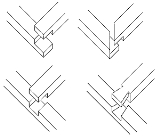
In woodworking or metal fitting, a
lap joint describes a technique for joining two pieces of material by overlapping them. A lap may be a
full lap or
half lap.
In a full lap, no material is removed from either of the members to be joined, resulting in a joint which is the combined thickness of the two members. In a half lap joint, material is removed from each of the members so that the resulting joint is the thickness of the thickest member. Most commonly in half lap joints, the members are of the same thickness and half the thickness of each is removed.
Full lap
The full lap is a very basic method of joining two members and requires little or no joinery skills to make. It requires some form of mechanical
fastenerA fastener is a hardware device that mechanically joins or affixes two or more objects together.Fasteners can also be used to close a container such as a bag, a box, or an envelope; or they may involve keeping together the sides of an opening of flexible material, attaching a lid to a container,...
, such as a nail or screw, to be effective. It offers no resistance to racking but some resistance to twisting and
shearingA shear stress, denoted , is defined as a stress which is applied parallel or tangential to a face of a material, as opposed to a normal stress which is applied perpendicularly.-General shear stress:...
depending upon the fastener used.
Large framing members in light frame construction are often joined by lapping - for example bearers supporting joists.
Applications
- Bracing where bracing members overlap
- Temporary framing
- Some applications in timber frame construction
Half lap
Half lap joints are used extensively in
constructionIn the fields of architecture and civil engineering, construction is a process that consists of the building or assembling of infrastructure. Far from being a single activity, large scale construction is a feat of multitasking...
and cabinetry for framing. They are quick and easy to make and provide reasonable strength through good long grain to long grain gluing surface. The shoulders provide some resistance to racking. They may be reinforced with
dowelA dowel is a solid cylindrical rod, usually made of wood, plastic or metal. In its original manufactured form, dowel is called dowel rod....
s or mechanical
fastenerA fastener is a hardware device that mechanically joins or affixes two or more objects together.Fasteners can also be used to close a container such as a bag, a box, or an envelope; or they may involve keeping together the sides of an opening of flexible material, attaching a lid to a container,...
s to resist twisting.
Applications
- Frame assembly in cabinet making
Cabinet making is the practice of using various woodworking skills to create cabinets, shelving and furniture.Cabinet making involves techniques such as creating appropriate joints, dados, bevels, chamfers and shelving systems, the use of finishing tools such as routers to create decorative...
- particularly when frame members are to be shaped after joining.
End lap
Also known simply as a
full lap, it is the basic form of the lap joint and is used when joining members end to end either parallel or at right angles. When the joint forms a corner, as in a rectangular frame, the joint is often called a
corner lap. This is the most common form of end lap and is used most in framing.
For a half lap in which the members are parallel, the joint may be known as a
half lap splice. This is a
splice jointA splice joint is a method of joining two members end to end in woodworking. The splice joint is used when the material being joined is not available in the length required. It is an alternative to other joints such as the butt joint and the scarf joint. Splice joints are stronger than unreinforced...
and is an alternative to
scarfingA scarf joint is a method of joining two members end to end in woodworking or metalworking. The scarf joint is used when the material being joined is not available in the length required...
when joining shorter members end to end.
Both members in an end lap have one
shoulder-Parts of joints:When material is removed to create a joint, the resulting surfaces have the following names:* Cheek - the flat surface parallel to the face of the joint member which exposes long grain....
and one
cheek-Parts of joints:When material is removed to create a joint, the resulting surfaces have the following names:* Cheek - the flat surface parallel to the face of the joint member which exposes long grain....
each.
Use for:
- Internal cabinet frames
- Visible frames when the frame members are to be shaped
shuuup
Cross lap
This form of the half lap is used when one member crosses the other. The main difference between this and the basic half lap is that the joint occurs in the middle of one or both members, rather than at the end. The two members are at right angles to each other and one member may terminate at the joint, or it may carry on beyond it. When one of the members terminates at the joint, it is often referred to as a
Tee lap or
middle lap. In a cross lap where both members continue beyond the joint, each member has two shoulders and one cheek. For a Tee lap, one of the members has only one shoulder.
Use for:
- Internal cabinet frames
- Simple framing and bracing
Dovetail lap
This is a lap in which the housing has been cut at an angle which resists withdrawal of the stem from the cross-piece.
Use for:
- Framing applications where tension forces could pull the joint apart
Mitred half lap
This is a variation of the end lap which shows a
mitreA mitre or miter joint is a joint made by bevelling each of two parts to be joined, usually at a 45° angle, to form a corner, usually a 90° angle. It is often used in making picture frames....
on the face of the finished work.
The mitred half lap is the weakest version of the joint because of the reduced gluing surface.
Use for:
- Visible framing applications where a mitred corner is desired
External links