


Lao people

Encyclopedia
The Lao are an ethnic subgroup
of Tai/Dai
in Southeast Asia
.
of the word Lao is uncertain, although it may be related to tribes known as the Ai Lao (Lao: ອ້າຽລາວ, Isan: อ้ายลาว, , Vietnamese
: ai lao) who appear in Han Dynasty
records in China
and Vietnam
as a people of what is now Yunan Province. Tribes descended from the Ai Lao included the Tai tribes that migrated to Southeast Asia
. The English word Laotian, used interchangeably with Lao in most contexts, comes from French laotien/laotienne. The Lao people, like many other Tai peoples also refer to themselves as Tai (Lao: ໄທ, Isan: ไท, IPA: tʰáj) and more specifically Tai Lao (ໄທລາວ, ไทลาว). In Thailand, the local Lao people are differentiated from the Lao of Laos and by the Thais by the term Thai Isan (Lao: ໄທຍ໌ອີສານ, Isan: ไทยอีสาน, IPA: i: să:n), a Sanskrit-derived term meaning northeast, but 'Lao' is still used.
, or city-states, across South-East Asia and southern China. Descended from ancient peoples known to the Chinese as the Yue and the Ai Lao, the Tai tribes began migrating into South-East Asia by the beginning of the 1st millennium, but large-scale migrations took place between the 7th and 13th centuries AD, especially from what is now Sipsongbanna, Yunnan Province and Guangxi
. The reasons for Tai migration include pressures from Han Chinese
expansion, Mongol invasions, suitable land for wet rice cultivation and the fall of states such as Nanzhao that the Tais inhabited.
The Tai assimilated or pushed out indigenonus Austroasiatic Mon–Khmer peoples, and settled on the fringes of the Indianised kingdoms of the Mon
and Khmer Empire
. The blending of peoples and the influx of Indian philosophy, religion, language, culture and customs via and alongside some Austroasiatic element enriched the Tai peoples, but the Tais remained in contact with the other Tai mueang
.
and emerged independent. The Lao reckon the beginnings of their national history to this time, as many important monuments, temples, artwork, and other aspects of classical Lao culture harken back to this time period. From this point, one can refer to the Tai states of the Chao Phraya River valley as Siam and Lan Xang as Laos, albeit quite anachronistically. The Kingdom of Lanxang
(ອານາຈັກລ້ານຊ້າງ, อาณาจักรล้านช้าง, ʔaː náː tʃák lâːn sâːŋ), the Land of One Million Elephants, began in 1354 AD, when Somdej Phra Chao Fa Ngum
(ສົມເດດພຣະເຈົ້າຝ້າງູ່ມ, สมเด็จพระเจ้าฝ้างู่ม) (1354 - 1373 AD) returned to Mueang Sua (ເມືອງຊວາ, เมืองซวา), thence renamed Xieng Thong (ຊຽງທອງ, เซียงทอง). From his base, all of modern-day Laos and the Khorat Plateau
as well as parts of Sipsongbanna (ສິບສອງພັນນາ, สิบสองพันนา), Sipsong Chu Tai (ສິບສອງຈຸໃທ, สิบสองจุไทย), Xieng Tung (ຊຽງຕຸງ, เซียงตุง), and Xieng Taeng
(ຊຽງແຕງ, เซียงแตรง) and parts of northwestern Vietnam.
The kingdom prospered with riverine traffic along the Mekong
and over-land caravan routes to the ports of Siam, which had emerged as a bustling entrepôt of sea-bourne trade, and to southern China and other Tai
mueang
. The first Western visitors during the reign of Phra Chao Sourigna Vongsa
(ພຣະເຈົ້າສຸຣິຍະວົງສາທັມມິກຣາດ,พระเจ้าสุริยวงศาธรรมิกราช) (1634 - 1697 AD) noted how the kingdom prospered off exports of gold, benzoin resin, lac
and lacquer ware, medicinal herbs, ivory, silk and silk clothing, and wood. Numerous temples, especially in Xieng Thong (now Luang Phrabang) and Vientiane
attest this. During this time, the legends of Khun Borom
were recorded on palm-leaf manuscripts and the Lao classical epic Sin Xay was composed. Therevada Buddhism was the state religion, and Vientiane was an important city of Buddhist learning. Cultural influences, besides Buddhism, included the Mon
outposts later assimilated into the kingdom and the Khmer
. A brief union of the crowns of Lannathai and Lanxang under Phra Chao Sai Sethathirath
(ພຣະເຈົ້າໄຊເສດຖາທິຣາດ, พระเจ้าไชยเชษฐาธิราช) (1548 - 1572 AD) introduced many architectural and artistic developments, in imitation of Lannathai style, but intellectual as well. The libraries of Lannathai were copied, including much religious literature. This may have led to the adoption, or possibly re-adoption of the Mon
-based Tua Tham
, or 'dharma script' for religious writings
The kingdom split into three rival factions, ruling from Luang Phra Bang, Vientiane, and Champasak
(ຈຳປາສັກ, จำปาศักดิ์). The kingdoms quickly fell under Siamese rule. The remnants of Lan Xang received their final blows in the 18th and 19th centuries, during the campaigns of Taksin
, and retribution for the Laotian Rebellion of Chao Anouvong (ເຈົ້າອນຸວົງ, เจ้าอนุวงศ์) against Siamese rule during the reign of Rama III. During both these periods, Vientiane and other cities were looted and their Buddha images and artwork moved to Thailand. The cities and much of the population was forcibly removed and settled in the lesser populated regions of Isan
and central Thailand
and others were enslaved to do corvée
projects By the time the French
reached Laos in 1868, they had only found a depopulated region with even the great city of Vientiane disappearing into the forest.
, the French were keen to control the Mekong
. The French, as overlords of Vietnam, wanted all the tributaries of Vietnam, including the remnant territories of Lanxang
. This led to French gunboat diplomacy
and border skirmishes known as the Franco-Siamese War of 1893, which forced Siam to cede its claims to most of what constitutes modern-day Laos.
_bf_1923.jpg) The French prevented and preserved the Lao from becoming a regional sub-category of the Thai nation, much like their brethren in Isan
The French prevented and preserved the Lao from becoming a regional sub-category of the Thai nation, much like their brethren in Isan
, also known as the 'North-Eastern Thai'. Like former historical rivalries between the kings of Luang Phrabang, Champasak and Vientiane, post-independence Laos was quickly divided between the royalists under Prince Boun Oum
of Champasak (ເຈົ້າບຸນອຸ້ມ ນະ ຈຳປາສັກ, เจ้าบุญอุ้ม ณ จำปาศักดิ์), the neutralists under Prince Souvanna Phouma
(ເຈົ້າສວັນນະພູມາ, เจ้าสุวรรณภูมา), and the communist Pathet Lao
(ປະເທດລາວ, ประเทศลาว, pá tʰêːt lá:w) under his half-brother Prince Souphanouvong
(ເຈົ້າສຸພານນະວົງ, เจ้าสุภานุวงศ์). These internal divisions, with the Cold War
and the region quickly being drawn into the Vietnam War
, led to a protracted battle for government control that would not end until the communist victory in 1975.
The Laotian Civil War was disastrous for the country. The royal family
was forced to abdicate and sent to a labour camp and as much as ten percent of the population fled to Thailand
and elsewhere, including much of the intellectual élite. Laos became one of the poorest nations in the world, heavily reliant on foreign aid. The country has since relaxed many of its restrictions, which has opened up the country to trade and business, but the country is still plagued with small coffers, little infrastructure, and over-dependence on Thailand
for business, education, and media
was built to Nakhon Ratchasima
. The region's rurality, poverty, isolation, large numbers, and attachment to their unique culture helped preserve Lao culture.
Various Thaification
policies were enacted to finally integrate the Lao into Thailand. 'Lao' was removed as a category in the census, and heavy-handed policies were enacted. References to Lao people or its past were removed and the language was banned from schools and books, and overt prejudice towards Isan people for their darker complexions, different language, and the agricultural base was commonplace.
Although the region remains mainly agricultural and poorer compared to other regions of Thailand, and many leave the region to find work in Bangkok or abroad, the region has enjoyed a renewed interest in traditional culture which is quite distinct although similar to Thai culture. The region is becoming increasingly more urban, and many large cities have sprung up. Due to the large population and Isan's important function as a voting bloc in elections, more attention to improving the region's infrastructure, business and education has come from the national government although poverty and regionalism are still impediments to Isan's development.
(the remainder are largely hill tribe people). The ethnic Lao of Laos form the bulk of the Lao Loum
("Lowland Laotians") (Lao: ລາວລຸ່ມ, Thai: ลาวลุ่ม, IPA: laːw lum). Small Lao communities exist in Thailand
and Cambodia
, residing primarily in the former Lao territory of Stung Treng
(Xieng Teng in Lao), and Vietnam
. There are also substantial, unknown numbers of Lao overseas perhaps as many as 500,000 people. Most of the latter were refugee
s from Laos
who fled during the Vietnam War
(Second Indochina War) from the Pathet Lao
. Places of asylum for the Lao refugees are the United States
, France
, Japan
, Australia
, Germany
, Canada
, Singapore
, and the United Kingdom
; many also live in Argentina
, India
, Bangladesh
, Pakistan
, Switzerland
, Burma and Brazil
.
The 2000 United States census figure of 168,707 Laotians and the 2005 figure of 200,000 exclude Hmong, but include Mien
, Tai Dam
, Khmu
and other groups in addition to the Lao.
and Sanskrit
as well as Mon–Khmer languages. The alphabet is an indic-based alphabet. Although the Lao have five major dialects, they are all mutually intelligible and Lao people believe they all speak variations of one language.
and therefore most of the Lao population, the language is enshrined as the dominant language of education, government, and official use. Numerous minority languages are spoken by roughly half the population, and include languages of the Austro-Asiatic, Sino-Tibetan, Austronesian and Hmong–Mien language families. Although spelling is not fully uniform, despite several reforms to move the language closer to phonetical systems, it has helped stabilise the language. No official standard exists, but the dialect of Vientiane
is considered de facto
official.
, but the Lao spoken in Thailand as a whole can be differentiated by adoption of much Thai vocabulary and code-switching
. The language is not taught or used in schools, government, and most media outlets. Thaification policies removed the alphabet and now the language is written in the Thai alphabet, if at all, and the name changed to Isan to sever the political connection with Laos. Despite this, the Lao language is spoken by almost a third of the population of Thailand and is the primary language of 88% of Isan households. It continues to serve as an important regional language and a badge of Isan (hence Lao) identity, but it is experiencing a decline in the advance of Thai
Buddhists, many traditions are derived from Hindu and Buddhist practises.
(ພຣະພຸດທະສາສນາ, พุทธศาสนา, pʰā pʰūt tʰāʔ sàːt sáʔ nǎː) is the most popular and state religion in Laos, practised by 67% of the country, and nearly all of the ethnic Lao. The numbers could be much higher, as Buddhism has also influenced many other ethnic groups that are generally considered animist. It is also the predominant religion of Isan
and most of the nations beyond Laos' frontiers. Of these, most are of the Therevada Sect (ເຖຣະວາດ, เถรวาท, [tʰěː rā wâːt]) although historical influences of Mahayana Buddhism remain and it is the main sect of Vietnamese
and Chinese
minorities that have settled amongst the Lao and it has become syncretic with animistic practices.
The temple in a Lao community is the centre of community affairs, where villagers gather to discuss concerns or ask monks for their wisdom and guidance, and most men are expected to enter the monastery at some point to further their religious knowledge and make merit.
Paramount to religious living are the five Buddhist precepts (ປັນຈະສິນ, ban tʃaʔ sin, เบญจศีล, [beːn tʃaʔ sin]), viz., to abstain from killing, stealing, sexual misconduct, lying and intoxication. Lao cultural and behavioural traits that stem from Buddhist belief include tolerance, respect for elders and family hiearchy, selflessness, detachment to worldly good and concerns, caring for younger siblings, politeness, self-negation, and modesty. Basic beliefs include re-incarnation and karma
.
Important holidays related to Buddhism include Boun Phra Vet (ບຸນພຣະເວດ, บุญพระเวส, [bun pʰaʔ vet]), Magha Puja
(ມະຄະບູຊາ, มาฆบูชา), Songkhan
(ສັງຂານ, สงกรานต์), Vesak
(ວິສາຂະບູຊາ, วิศาขบูซา), Vassa
(ວັນເຂົ້າພັນສາ, วันเข้าพรรษา), Wan Awk Pansa
(ວັນອອກພັນສາ วันออกพรรษา), Kathina
, (ກະຖິນ, กฐิน). In addition to these days, the Buddhist sabbath days (ວັນພຣະ, วันพระ, [van pʰaʔ]), during the phases of the moon, and temple fairs are also regular times to visit the temples, pray, ask advice of the monks for spiritual concerns, and donate food, money, or help out with temple chores, known in Lao as tambun (ທຳບຸນ, ทำบุญ, [tʰam bun]).
Lao people believe in thirty-two spirits known as khwan (ຂວັນ, ขวัญ, kʰwan) that protect the body, and basi (ບາສີ, [baː siː], ใบสี, [bɑj siː]) ceremonies are undertaken during momentous occasions or times of anxiety to bind the spirits to the body, as their absence is believed to invite illness or harm. In addition, there are the other spirits, known as phi (ຜີ, ผี, [pʰiː]); namely those that guard buildings or territories, those that are of natural places, things or phenomenon; ancestral spirits and other spirits that protect people; and malevolent spirits. Guardian spirits of places, such as the phi wat (ຜີວັດ, ผีวัด) of temples and the lak mueang (ຫລັກເມືອງ, หลักเมือง, [lak mɯːaŋ]) of towns are celebrated with communal gatherings and offerings of food.
In daily life, most people pay respect to the phi that reside in spirit house
s, who are thought to prect the vicinity from harm. Offerings of flowers, incense
, and candles are given, and the spirits are consulted during changes or times of duress for protection and assistance. Natural spirits include those that reside in trees, mountains, or forests. Guardian spirits of people often include ancestors or angelic-beings who arrive at various points in life, better known as thewada. Malevolent spirits include those of people who were bad in past lives or died tragic deaths, such as the ghastly phi pob (ຜີປອບ, ผีปอบ) and the vampirical phi dip (ຜີດິບ, ผีดิบ). Some of the phi are also include the indigenous
, non-Hindu gods, the phi thaen (ຜີແຖນ, ผีแถน)
Spirit shamans (ໝໍຜີ,หมอผี) are locally trained people in the rituals and in communication with their personal spirits and spirits in general. Using trances
, sacred objects imbued with supernatural power, or saksit
, possessions, and rituals like lam phi fa (ລຳຜີຟ້າ, ลำผีฟ้า, [lam pʰiː faː]) or basi, the shaman is often consulted during times of trouble, hauntings, and illness or other misfortune that might be caused by malevolent or unhappy spirits. They are also usually present during animist festivals.
from that era. Temples were often built over the sites of ancient Hindu shrines, and statues or motifs of Hindu gods are commonly found outside temples. Although important influences can be traced to Hindu
rituals, the Lao people are not as overtly influenced by Hinduism
as their neighbours the Tai Thai
.
The Lao have adopted and adapted the Ramayana
into the local version, known as Phra Lak Phra Ram
(ພຣະລັກພຣະຣາມ, พระลักษมณ์พระราม, [pʰaʔ lak pʰaʔ laːm]). The Lao version was interwoven with the Lao creation myth and is also, mistakenly, though of as a Jataka
story so is held in high esteem. Many court dances were based on the events of the story. Hinduism blended easily into both animism and Buddhism, so many Hindu gods are considered Thaen and Buddhist monks have incorporated much of Brahmanic rituals. Peculiar to Lao people are reverence for Nāga
s, snake-like demigods that rule the waterways.
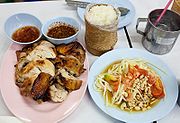 The cuisine of Laos is similar to other regional cuisines such as Thai and Cambodian cuisines, but has several unique distinguishing traits. The cuisines of the Lao in Laos and Isan have diverged only minutely, with the key differences is that Lao cuisine lacks the influences of Thai cuisine and Isan cuisine lacks many of the Vietnamese and French
influences in Laos. Rice is the staple, and the main variety is glutinous rice
or khao nio (ເຂົ້າຫນຽວ, ข้าวเหนียว, kʰàw nǐw), which is also a feature on Isan and Northern Thai
tables. Although sometimes replaced by noodles or other, less popular varieties of rice, it is commonly served with an accompaniment of various dips and sauces, raw vegetables, and several dishes that are shared together. Many dishes are very spicy, fiered by the numerous varieties of chillies and made pungent by the strong herbs and fermented fish sauces.
The tropical climate and mountainous areas gives Laos a wide variety of climates and also a rich bounty of edibles, so much of traditional Lao cuisine is composed of vegetables and herbs gathered from the wild, weeds from the rice fields, as well as vegetable plots. A rich plethora of vegetable and fruit varieties are grown, including cucumbers, gourds, cabbage, snakebeans, winged beans, yams, water spinach, mangoes, pomelos, papayas, and sugarcane. Raw vegetables often accompany a meal to help cool the tongue. The most popular meat is freshwater fish, which is also used to make two flavourings, fish sauce
(ນ້ຳປາ, [nâm paː]) and padaek
(ປາແດກ, ปาแดก, [paː dèːk]). Other common meats include pork, chicken, duck, beef, eggs, water buffalo
. Protein intake includes a wide range of delicacies, including lizards, insects, frogs, and wild deer that also come from the forests. Common beverages are tea, coffee
, and alcohol, including the native rice wine, lao lao (ເຫລົ້າລາວ, เหล้าลาว, [làu láːw]). The cuisine is noted for its use of mint and dill, relatively rare in surrounding cuisines, and the relative absence, especially compared to Thai cuisine, of Chinese and Indian influences, such as curries and stir-fry, and dry spices such as cumin, coriander seeds, cinnamon, anise, or fennel.
Laos is generally very rural areas, and most of the people support themselves by agriculture, with rice being the most important crop. As inhabitants of river valleys and lowlands that have been long-settled, ethnic Lao do not practise swidden agriculture like upland peoples.
The traditional folk music is lam lao (ລຳລາວ, ลำลาว, lám láːw), although it is also known as morlam (Lao: ໝໍລຳ, หมอลำ, [mɔ̌ːlám]) which is the preferred term in Isan language
. Artists from Thailand
are also popular in Laos and vice versa, which has re-enforced Lao culture in Isan despite heavy Thaification
. The music is noted for the use of the khene
(Lao: ແຄນ, Isan: แคน, [kʰɛːn]) instrument.
, little distinction is made between the Lao and other closely related Tai peoples
with mutually intelligible languages who are grouped together as Lao Loum or 'Lowland Lao' (Lao: ລາວລຸ່ມ láːu lūm , Thai: ลาวลุ่ม, IPA: laːw lum). Most of these groups share many common cultural traits and speak dialects or languages that are very similar, with only minor differences in tones, vocabulary, and pronunciation of certain words, but usually not enough to impede conversation, but many of these groups, such as the Nyaw and Phuthai consider themselves distinct, and often have differences in clothing that differentiate them.
Ethnic group
An ethnic group is a group of people whose members identify with each other, through a common heritage, often consisting of a common language, a common culture and/or an ideology that stresses common ancestry or endogamy...
of Tai/Dai
Tai peoples
The Tai ethnicity refers collectively to the ethnic groups of southern China and Southeast Asia, stretching from Hainan to eastern India and from southern Sichuan to Laos, Thailand, and parts of Vietnam, which speak languages in the Tai family and share similar traditions and festivals, including...
in Southeast Asia
Southeast Asia
Southeast Asia, South-East Asia, South East Asia or Southeastern Asia is a subregion of Asia, consisting of the countries that are geographically south of China, east of India, west of New Guinea and north of Australia. The region lies on the intersection of geological plates, with heavy seismic...
.
Names
The etymologyEtymology
Etymology is the study of the history of words, their origins, and how their form and meaning have changed over time.For languages with a long written history, etymologists make use of texts in these languages and texts about the languages to gather knowledge about how words were used during...
of the word Lao is uncertain, although it may be related to tribes known as the Ai Lao (Lao: ອ້າຽລາວ, Isan: อ้ายลาว, , Vietnamese
Vietnamese language
Vietnamese is the national and official language of Vietnam. It is the mother tongue of 86% of Vietnam's population, and of about three million overseas Vietnamese. It is also spoken as a second language by many ethnic minorities of Vietnam...
: ai lao) who appear in Han Dynasty
Han Dynasty
The Han Dynasty was the second imperial dynasty of China, preceded by the Qin Dynasty and succeeded by the Three Kingdoms . It was founded by the rebel leader Liu Bang, known posthumously as Emperor Gaozu of Han. It was briefly interrupted by the Xin Dynasty of the former regent Wang Mang...
records in China
China
Chinese civilization may refer to:* China for more general discussion of the country.* Chinese culture* Greater China, the transnational community of ethnic Chinese.* History of China* Sinosphere, the area historically affected by Chinese culture...
and Vietnam
Vietnam
Vietnam – sometimes spelled Viet Nam , officially the Socialist Republic of Vietnam – is the easternmost country on the Indochina Peninsula in Southeast Asia. It is bordered by China to the north, Laos to the northwest, Cambodia to the southwest, and the South China Sea –...
as a people of what is now Yunan Province. Tribes descended from the Ai Lao included the Tai tribes that migrated to Southeast Asia
Southeast Asia
Southeast Asia, South-East Asia, South East Asia or Southeastern Asia is a subregion of Asia, consisting of the countries that are geographically south of China, east of India, west of New Guinea and north of Australia. The region lies on the intersection of geological plates, with heavy seismic...
. The English word Laotian, used interchangeably with Lao in most contexts, comes from French laotien/laotienne. The Lao people, like many other Tai peoples also refer to themselves as Tai (Lao: ໄທ, Isan: ไท, IPA: tʰáj) and more specifically Tai Lao (ໄທລາວ, ไทลาว). In Thailand, the local Lao people are differentiated from the Lao of Laos and by the Thais by the term Thai Isan (Lao: ໄທຍ໌ອີສານ, Isan: ไทยอีสาน, IPA: i: să:n), a Sanskrit-derived term meaning northeast, but 'Lao' is still used.
Tai Migration Period
According to a shared legend amongst various Tai tribes, a possibly mythical king, Khun Borom Rachathiriat (ຂຸນບໍຣົມຣາຊາທິຣາດ, ขุนบรมราชาธิราช, kʰǔn bɔ̄ː lóm láː sáː tʰī lâːt) of Mueang Thaen (ເມືອງແຖນ, เมืองแถน, [mɯ́əŋ tʰɛ̌ːn]) (modern-day Điện Biên Phủ) begot several sons that settled and ruled other mueangMueang
Mueang were historical semi-independent city-states or principalities in present-day Thailand, Laos, parts of northern Vietnam and the Shan State of Myanmar. Smaller Mueang were subordinate to more powerful neighboring Mueang, which in turn were subordinate to the central king, as described in...
, or city-states, across South-East Asia and southern China. Descended from ancient peoples known to the Chinese as the Yue and the Ai Lao, the Tai tribes began migrating into South-East Asia by the beginning of the 1st millennium, but large-scale migrations took place between the 7th and 13th centuries AD, especially from what is now Sipsongbanna, Yunnan Province and Guangxi
Guangxi
Guangxi, formerly romanized Kwangsi, is a province of southern China along its border with Vietnam. In 1958, it became the Guangxi Zhuang Autonomous Region of the People's Republic of China, a region with special privileges created specifically for the Zhuang people.Guangxi's location, in...
. The reasons for Tai migration include pressures from Han Chinese
Han Chinese
Han Chinese are an ethnic group native to China and are the largest single ethnic group in the world.Han Chinese constitute about 92% of the population of the People's Republic of China , 98% of the population of the Republic of China , 78% of the population of Singapore, and about 20% of the...
expansion, Mongol invasions, suitable land for wet rice cultivation and the fall of states such as Nanzhao that the Tais inhabited.
The Tai assimilated or pushed out indigenonus Austroasiatic Mon–Khmer peoples, and settled on the fringes of the Indianised kingdoms of the Mon
Mon people
The Mon are an ethnic group from Burma , living mostly in Mon State, Bago Division, the Irrawaddy Delta, and along the southern Thai–Burmese border. One of the earliest peoples to reside in Southeast Asia, the Mon were responsible for the spread of Theravada Buddhism in Burma and Thailand...
and Khmer Empire
Khmer Empire
The Khmer Empire was one of the most powerful empires in Southeast Asia. The empire, which grew out of the former kingdom of Chenla, at times ruled over and/or vassalized parts of modern-day Laos, Thailand, Vietnam, Burma, and Malaysia. Its greatest legacy is Angkor, the site of the capital city...
. The blending of peoples and the influx of Indian philosophy, religion, language, culture and customs via and alongside some Austroasiatic element enriched the Tai peoples, but the Tais remained in contact with the other Tai mueang
Mueang
Mueang were historical semi-independent city-states or principalities in present-day Thailand, Laos, parts of northern Vietnam and the Shan State of Myanmar. Smaller Mueang were subordinate to more powerful neighboring Mueang, which in turn were subordinate to the central king, as described in...
.
Lanxang
The Tai states took advantage of the waning Khmer EmpireKhmer Empire
The Khmer Empire was one of the most powerful empires in Southeast Asia. The empire, which grew out of the former kingdom of Chenla, at times ruled over and/or vassalized parts of modern-day Laos, Thailand, Vietnam, Burma, and Malaysia. Its greatest legacy is Angkor, the site of the capital city...
and emerged independent. The Lao reckon the beginnings of their national history to this time, as many important monuments, temples, artwork, and other aspects of classical Lao culture harken back to this time period. From this point, one can refer to the Tai states of the Chao Phraya River valley as Siam and Lan Xang as Laos, albeit quite anachronistically. The Kingdom of Lanxang
Lan Xang
The Lao kingdom of Lan Xang Hom Kao was established in 1354 by Fa Ngum.Exiled as an infant to Cambodia, Prince Fa Ngum of Xieng Dong Xieng Thong married a daughter of the Khmer king. In 1349 he set out from Angkor at the head of a 10,000-man army to establish his own country...
(ອານາຈັກລ້ານຊ້າງ, อาณาจักรล้านช้าง, ʔaː náː tʃák lâːn sâːŋ), the Land of One Million Elephants, began in 1354 AD, when Somdej Phra Chao Fa Ngum
Fa Ngum
Somdetch Brhat-Anya Fa Ladhuraniya Sri Sadhana Kanayudha Maharaja Brhat Rajadharana Sri Chudhana Negara better known as Fa Ngum established the Lao kingdom of Lan Xang in 1354....
(ສົມເດດພຣະເຈົ້າຝ້າງູ່ມ, สมเด็จพระเจ้าฝ้างู่ม) (1354 - 1373 AD) returned to Mueang Sua (ເມືອງຊວາ, เมืองซวา), thence renamed Xieng Thong (ຊຽງທອງ, เซียงทอง). From his base, all of modern-day Laos and the Khorat Plateau
Khorat Plateau
The Khorat Plateau also Korat Plateau, is a plateau in the northeastern region of Thailand, named for the short form of Nakhon Ratchasima, an historical stronghold controlling access to and from the plateau.-Geography:...
as well as parts of Sipsongbanna (ສິບສອງພັນນາ, สิบสองพันนา), Sipsong Chu Tai (ສິບສອງຈຸໃທ, สิบสองจุไทย), Xieng Tung (ຊຽງຕຸງ, เซียงตุง), and Xieng Taeng
Stung Treng Province
Stung Treng is a northern province of Cambodia.-Description:The Cambodia/Lao border is located in the north of Stung Treng Province. The Mekong river crosses the province roughly in its midst.-History of stung treng:...
(ຊຽງແຕງ, เซียงแตรง) and parts of northwestern Vietnam.
The kingdom prospered with riverine traffic along the Mekong
Mekong
The Mekong is a river that runs through China, Burma, Laos, Thailand, Cambodia and Vietnam. It is the world's 10th-longest river and the 7th-longest in Asia. Its estimated length is , and it drains an area of , discharging of water annually....
and over-land caravan routes to the ports of Siam, which had emerged as a bustling entrepôt of sea-bourne trade, and to southern China and other Tai
Tai peoples
The Tai ethnicity refers collectively to the ethnic groups of southern China and Southeast Asia, stretching from Hainan to eastern India and from southern Sichuan to Laos, Thailand, and parts of Vietnam, which speak languages in the Tai family and share similar traditions and festivals, including...
mueang
Mueang
Mueang were historical semi-independent city-states or principalities in present-day Thailand, Laos, parts of northern Vietnam and the Shan State of Myanmar. Smaller Mueang were subordinate to more powerful neighboring Mueang, which in turn were subordinate to the central king, as described in...
. The first Western visitors during the reign of Phra Chao Sourigna Vongsa
Sourigna Vongsa
Sourigna Vongsa was the last king of Lan Xang and during his period, it considered the golden age of Laos. He ascended to the throne in 1637.-King of Lan Xang:...
(ພຣະເຈົ້າສຸຣິຍະວົງສາທັມມິກຣາດ,พระเจ้าสุริยวงศาธรรมิกราช) (1634 - 1697 AD) noted how the kingdom prospered off exports of gold, benzoin resin, lac
Lac
Lac is the scarlet resinous secretion of a number of species of insects, namely some of the species of the genera Metatachardia, Laccifer, Tachordiella, Austrotacharidia, Afrotachardina, and Tachardina of the superfamily Coccoidea, of which the most commonly cultivated species is Kerria lacca.The...
and lacquer ware, medicinal herbs, ivory, silk and silk clothing, and wood. Numerous temples, especially in Xieng Thong (now Luang Phrabang) and Vientiane
Vientiane
-Geography:Vientiane is situated on a bend of the Mekong river, which forms the border with Thailand at this point.-Climate:Vientiane features a tropical wet and dry climate with a distinct monsoon season and a dry season. Vientiane’s dry season spans from November through March. April marks the...
attest this. During this time, the legends of Khun Borom
Khun Borom
Khun Borom Rachathirath is the legendary progenitor of the Tai-speaking peoples, considered by the Lao and others to be the father of their race....
were recorded on palm-leaf manuscripts and the Lao classical epic Sin Xay was composed. Therevada Buddhism was the state religion, and Vientiane was an important city of Buddhist learning. Cultural influences, besides Buddhism, included the Mon
Mon people
The Mon are an ethnic group from Burma , living mostly in Mon State, Bago Division, the Irrawaddy Delta, and along the southern Thai–Burmese border. One of the earliest peoples to reside in Southeast Asia, the Mon were responsible for the spread of Theravada Buddhism in Burma and Thailand...
outposts later assimilated into the kingdom and the Khmer
Khmer people
Khmer people are the predominant ethnic group in Cambodia, accounting for approximately 90% of the 14.8 million people in the country. They speak the Khmer language, which is part of the larger Mon–Khmer language family found throughout Southeast Asia...
. A brief union of the crowns of Lannathai and Lanxang under Phra Chao Sai Sethathirath
Setthathirath
Setthathirath is considered one of the great leaders in Lao history. Throughout 1560s up until his death, he successfully defended his kingdom of Lan Xang against military campaigns of Burmese conqueror Bayinnaung, who had already subdued Xieng Mai in 1558 and Ayutthaya in 1564...
(ພຣະເຈົ້າໄຊເສດຖາທິຣາດ, พระเจ้าไชยเชษฐาธิราช) (1548 - 1572 AD) introduced many architectural and artistic developments, in imitation of Lannathai style, but intellectual as well. The libraries of Lannathai were copied, including much religious literature. This may have led to the adoption, or possibly re-adoption of the Mon
Mon language
The Mon language is an Austroasiatic language spoken by the Mon, who live in Burma and Thailand. Mon, like the related language Cambodian—but unlike most languages in Mainland Southeast Asia—is not tonal. Mon is spoken by more than a million people today. In recent years, usage of Mon has...
-based Tua Tham
Tua Tham
Tua Tham or Akson Tham or Tua Mueang is a Mon-derived script used in Isan and Northern Thailand, as well as Laos. It was originally used for the writing of religious texts, and was an important medium of education when monks were in charge of education in these areas.The script was introduced to...
, or 'dharma script' for religious writings
The kingdom split into three rival factions, ruling from Luang Phra Bang, Vientiane, and Champasak
Champasak
Champasak may refer to* Champasak Province* Champasak * Kingdom of Champasak* Na Champassak family...
(ຈຳປາສັກ, จำปาศักดิ์). The kingdoms quickly fell under Siamese rule. The remnants of Lan Xang received their final blows in the 18th and 19th centuries, during the campaigns of Taksin
Taksin
Taksin ; was the only King of the Thonburi Kingdom...
, and retribution for the Laotian Rebellion of Chao Anouvong (ເຈົ້າອນຸວົງ, เจ้าอนุวงศ์) against Siamese rule during the reign of Rama III. During both these periods, Vientiane and other cities were looted and their Buddha images and artwork moved to Thailand. The cities and much of the population was forcibly removed and settled in the lesser populated regions of Isan
Isan
Isan is the northeastern region of Thailand. It is located on the Khorat Plateau, bordered by the Mekong River to the north and east, by Cambodia to the southeast and the Prachinburi mountains south of Nakhon Ratchasima...
and central Thailand
Thailand
Thailand , officially the Kingdom of Thailand , formerly known as Siam , is a country located at the centre of the Indochina peninsula and Southeast Asia. It is bordered to the north by Burma and Laos, to the east by Laos and Cambodia, to the south by the Gulf of Thailand and Malaysia, and to the...
and others were enslaved to do corvée
Corvée
Corvée is unfree labour, often unpaid, that is required of people of lower social standing and imposed on them by the state or a superior . The corvée was the earliest and most widespread form of taxation, which can be traced back to the beginning of civilization...
projects By the time the French
French people
The French are a nation that share a common French culture and speak the French language as a mother tongue. Historically, the French population are descended from peoples of Celtic, Latin and Germanic origin, and are today a mixture of several ethnic groups...
reached Laos in 1868, they had only found a depopulated region with even the great city of Vientiane disappearing into the forest.
Lao in Laos
The area of Laos, now annexed by Siam, was explored by the French and, under Auguste PavieAuguste Pavie
Auguste Jean-Marie Pavie was a French colonial civil servant, explorer and diplomat who was instrumental in establishing French control over Laos in the last two decades of the 19th century...
, the French were keen to control the Mekong
Mekong
The Mekong is a river that runs through China, Burma, Laos, Thailand, Cambodia and Vietnam. It is the world's 10th-longest river and the 7th-longest in Asia. Its estimated length is , and it drains an area of , discharging of water annually....
. The French, as overlords of Vietnam, wanted all the tributaries of Vietnam, including the remnant territories of Lanxang
Lan Xang
The Lao kingdom of Lan Xang Hom Kao was established in 1354 by Fa Ngum.Exiled as an infant to Cambodia, Prince Fa Ngum of Xieng Dong Xieng Thong married a daughter of the Khmer king. In 1349 he set out from Angkor at the head of a 10,000-man army to establish his own country...
. This led to French gunboat diplomacy
Gunboat diplomacy
In international politics, gunboat diplomacy refers to the pursuit of foreign policy objectives with the aid of conspicuous displays of military power — implying or constituting a direct threat of warfare, should terms not be agreeable to the superior force....
and border skirmishes known as the Franco-Siamese War of 1893, which forced Siam to cede its claims to most of what constitutes modern-day Laos.
Isan
Isan is the northeastern region of Thailand. It is located on the Khorat Plateau, bordered by the Mekong River to the north and east, by Cambodia to the southeast and the Prachinburi mountains south of Nakhon Ratchasima...
, also known as the 'North-Eastern Thai'. Like former historical rivalries between the kings of Luang Phrabang, Champasak and Vientiane, post-independence Laos was quickly divided between the royalists under Prince Boun Oum
Boun Oum
Prince Boun Oum was the son of King Ratsadanay, and was the hereditary prince of Champassack and also Prime Minister of Laos.-Early life:...
of Champasak (ເຈົ້າບຸນອຸ້ມ ນະ ຈຳປາສັກ, เจ้าบุญอุ้ม ณ จำปาศักดิ์), the neutralists under Prince Souvanna Phouma
Souvanna Phouma
Prince Souvanna Phouma was the leader of the neutralist faction and prime minister of the Kingdom of Laos several times, from 1951–1952, 1956–1958, 1960 and 1962-1975.-Early life:...
(ເຈົ້າສວັນນະພູມາ, เจ้าสุวรรณภูมา), and the communist Pathet Lao
Pathet Lao
The Pathet Lao was a communist political movement and organization in Laos, formed in the mid-20th century. The group was ultimately successful in assuming political power after the Laotian Civil War. The Pathet Lao were always closely associated with Vietnamese communists...
(ປະເທດລາວ, ประเทศลาว, pá tʰêːt lá:w) under his half-brother Prince Souphanouvong
Souphanouvong
Prince Souphanouvong was, along with his half-brother Prince Souvanna Phouma and Prince Boun Oum of Champasak, one of the “Three Princes” who represented respectively the communist , neutralist, and royalist political factions in Laos...
(ເຈົ້າສຸພານນະວົງ, เจ้าสุภานุวงศ์). These internal divisions, with the Cold War
Cold War
The Cold War was the continuing state from roughly 1946 to 1991 of political conflict, military tension, proxy wars, and economic competition between the Communist World—primarily the Soviet Union and its satellite states and allies—and the powers of the Western world, primarily the United States...
and the region quickly being drawn into the Vietnam War
Vietnam War
The Vietnam War was a Cold War-era military conflict that occurred in Vietnam, Laos, and Cambodia from 1 November 1955 to the fall of Saigon on 30 April 1975. This war followed the First Indochina War and was fought between North Vietnam, supported by its communist allies, and the government of...
, led to a protracted battle for government control that would not end until the communist victory in 1975.
The Laotian Civil War was disastrous for the country. The royal family
Royal family
A royal family is the extended family of a king or queen regnant. The term imperial family appropriately describes the extended family of an emperor or empress, while the terms "ducal family", "grand ducal family" or "princely family" are more appropriate to describe the relatives of a reigning...
was forced to abdicate and sent to a labour camp and as much as ten percent of the population fled to Thailand
Thailand
Thailand , officially the Kingdom of Thailand , formerly known as Siam , is a country located at the centre of the Indochina peninsula and Southeast Asia. It is bordered to the north by Burma and Laos, to the east by Laos and Cambodia, to the south by the Gulf of Thailand and Malaysia, and to the...
and elsewhere, including much of the intellectual élite. Laos became one of the poorest nations in the world, heavily reliant on foreign aid. The country has since relaxed many of its restrictions, which has opened up the country to trade and business, but the country is still plagued with small coffers, little infrastructure, and over-dependence on Thailand
Thailand
Thailand , officially the Kingdom of Thailand , formerly known as Siam , is a country located at the centre of the Indochina peninsula and Southeast Asia. It is bordered to the north by Burma and Laos, to the east by Laos and Cambodia, to the south by the Gulf of Thailand and Malaysia, and to the...
for business, education, and media
Lao in Thailand
Although parts of Isan were settled and were part of Lanxang, many of the Lao were forcibly settled in the lesser populated southern and western regions or sent to boost the populations of Lao mueang loyal to the Siamese. The area was relatively isolated from the rest of Thailand by the Petchabun mountains until the beginning of the 20th century, when a direct rail linkRail transport in Thailand
The railway network of Thailand is currently managed and operated by the State Railway of Thailand .-History:Interest in rail transport in Thailand can be traced to when King Rama IV was given a gift of a model railway from Queen Victoria...
was built to Nakhon Ratchasima
Nakhon Ratchasima
Nakhon Ratchasima or is a city in the north-east of Thailand and gateway to Isan. It is the capital of the Nakhon Ratchasima Province and Nakhon Ratchasima district...
. The region's rurality, poverty, isolation, large numbers, and attachment to their unique culture helped preserve Lao culture.
Various Thaification
Thaification
Thaification is the process by which people of different cultural and ethnic origins living in Thailand become assimilated to the dominant Thai culture, or more precisely, to the culture of the Central Thais...
policies were enacted to finally integrate the Lao into Thailand. 'Lao' was removed as a category in the census, and heavy-handed policies were enacted. References to Lao people or its past were removed and the language was banned from schools and books, and overt prejudice towards Isan people for their darker complexions, different language, and the agricultural base was commonplace.
Although the region remains mainly agricultural and poorer compared to other regions of Thailand, and many leave the region to find work in Bangkok or abroad, the region has enjoyed a renewed interest in traditional culture which is quite distinct although similar to Thai culture. The region is becoming increasingly more urban, and many large cities have sprung up. Due to the large population and Isan's important function as a voting bloc in elections, more attention to improving the region's infrastructure, business and education has come from the national government although poverty and regionalism are still impediments to Isan's development.
Distribution
There are around 3.6 million Laotians in Laos, constituting approximately 68% of the populationPopulation
A population is all the organisms that both belong to the same group or species and live in the same geographical area. The area that is used to define a sexual population is such that inter-breeding is possible between any pair within the area and more probable than cross-breeding with individuals...
(the remainder are largely hill tribe people). The ethnic Lao of Laos form the bulk of the Lao Loum
Lao Loum
The Lao Loum is an official Laos PDR designation for lowland dwelling Tai peoples, including the majority Lao people. The Lao Loum, literally meaning "lowland Lao," are the inhabitants of the river valleys and lowlands along the Mekong River and make up over 68% of the population of Laos, of...
("Lowland Laotians") (Lao: ລາວລຸ່ມ, Thai: ลาวลุ่ม, IPA: laːw lum). Small Lao communities exist in Thailand
Thailand
Thailand , officially the Kingdom of Thailand , formerly known as Siam , is a country located at the centre of the Indochina peninsula and Southeast Asia. It is bordered to the north by Burma and Laos, to the east by Laos and Cambodia, to the south by the Gulf of Thailand and Malaysia, and to the...
and Cambodia
Cambodia
Cambodia , officially known as the Kingdom of Cambodia, is a country located in the southern portion of the Indochina Peninsula in Southeast Asia...
, residing primarily in the former Lao territory of Stung Treng
Stung Treng
Stung Treng is the capital of Stung Treng Province, Cambodia. It is located in the western part of the Virachey National Park.It is the major city of both the district and province and has a population of 29,665 ....
(Xieng Teng in Lao), and Vietnam
Vietnam
Vietnam – sometimes spelled Viet Nam , officially the Socialist Republic of Vietnam – is the easternmost country on the Indochina Peninsula in Southeast Asia. It is bordered by China to the north, Laos to the northwest, Cambodia to the southwest, and the South China Sea –...
. There are also substantial, unknown numbers of Lao overseas perhaps as many as 500,000 people. Most of the latter were refugee
Refugee
A refugee is a person who outside her country of origin or habitual residence because she has suffered persecution on account of race, religion, nationality, political opinion, or because she is a member of a persecuted 'social group'. Such a person may be referred to as an 'asylum seeker' until...
s from Laos
Laos
Laos Lao: ສາທາລະນະລັດ ປະຊາທິປະໄຕ ປະຊາຊົນລາວ Sathalanalat Paxathipatai Paxaxon Lao, officially the Lao People's Democratic Republic, is a landlocked country in Southeast Asia, bordered by Burma and China to the northwest, Vietnam to the east, Cambodia to the south and Thailand to the west...
who fled during the Vietnam War
Vietnam War
The Vietnam War was a Cold War-era military conflict that occurred in Vietnam, Laos, and Cambodia from 1 November 1955 to the fall of Saigon on 30 April 1975. This war followed the First Indochina War and was fought between North Vietnam, supported by its communist allies, and the government of...
(Second Indochina War) from the Pathet Lao
Pathet Lao
The Pathet Lao was a communist political movement and organization in Laos, formed in the mid-20th century. The group was ultimately successful in assuming political power after the Laotian Civil War. The Pathet Lao were always closely associated with Vietnamese communists...
. Places of asylum for the Lao refugees are the United States
United States
The United States of America is a federal constitutional republic comprising fifty states and a federal district...
, France
France
The French Republic , The French Republic , The French Republic , (commonly known as France , is a unitary semi-presidential republic in Western Europe with several overseas territories and islands located on other continents and in the Indian, Pacific, and Atlantic oceans. Metropolitan France...
, Japan
Japan
Japan is an island nation in East Asia. Located in the Pacific Ocean, it lies to the east of the Sea of Japan, China, North Korea, South Korea and Russia, stretching from the Sea of Okhotsk in the north to the East China Sea and Taiwan in the south...
, Australia
Australia
Australia , officially the Commonwealth of Australia, is a country in the Southern Hemisphere comprising the mainland of the Australian continent, the island of Tasmania, and numerous smaller islands in the Indian and Pacific Oceans. It is the world's sixth-largest country by total area...
, Germany
Germany
Germany , officially the Federal Republic of Germany , is a federal parliamentary republic in Europe. The country consists of 16 states while the capital and largest city is Berlin. Germany covers an area of 357,021 km2 and has a largely temperate seasonal climate...
, Canada
Canada
Canada is a North American country consisting of ten provinces and three territories. Located in the northern part of the continent, it extends from the Atlantic Ocean in the east to the Pacific Ocean in the west, and northward into the Arctic Ocean...
, Singapore
Singapore
Singapore , officially the Republic of Singapore, is a Southeast Asian city-state off the southern tip of the Malay Peninsula, north of the equator. An island country made up of 63 islands, it is separated from Malaysia by the Straits of Johor to its north and from Indonesia's Riau Islands by the...
, and the United Kingdom
United Kingdom
The United Kingdom of Great Britain and Northern IrelandIn the United Kingdom and Dependencies, other languages have been officially recognised as legitimate autochthonous languages under the European Charter for Regional or Minority Languages...
; many also live in Argentina
Argentina
Argentina , officially the Argentine Republic , is the second largest country in South America by land area, after Brazil. It is constituted as a federation of 23 provinces and an autonomous city, Buenos Aires...
, India
India
India , officially the Republic of India , is a country in South Asia. It is the seventh-largest country by geographical area, the second-most populous country with over 1.2 billion people, and the most populous democracy in the world...
, Bangladesh
Bangladesh
Bangladesh , officially the People's Republic of Bangladesh is a sovereign state located in South Asia. It is bordered by India on all sides except for a small border with Burma to the far southeast and by the Bay of Bengal to the south...
, Pakistan
Pakistan
Pakistan , officially the Islamic Republic of Pakistan is a sovereign state in South Asia. It has a coastline along the Arabian Sea and the Gulf of Oman in the south and is bordered by Afghanistan and Iran in the west, India in the east and China in the far northeast. In the north, Tajikistan...
, Switzerland
Switzerland
Switzerland name of one of the Swiss cantons. ; ; ; or ), in its full name the Swiss Confederation , is a federal republic consisting of 26 cantons, with Bern as the seat of the federal authorities. The country is situated in Western Europe,Or Central Europe depending on the definition....
, Burma and Brazil
Brazil
Brazil , officially the Federative Republic of Brazil , is the largest country in South America. It is the world's fifth largest country, both by geographical area and by population with over 192 million people...
.
The 2000 United States census figure of 168,707 Laotians and the 2005 figure of 200,000 exclude Hmong, but include Mien
Mien
Mień is a village in the administrative district of Gmina Brańsk, within Bielsk County, Podlaskie Voivodeship, in north-eastern Poland. It lies approximately west of Brańsk, west of Bielsk Podlaski, and south-west of the regional capital Białystok....
, Tai Dam
Tai Dam
The Tai Dam or Tai Dum are an ethnic group of Laos, Vietnam, China, and Thailand.Tai Dam speakers in China are classified as part of the Dai nationality along with almost all the other Tai peoples...
, Khmu
Khmu people
The Khmu is one of the largest ethnic groups based in northern Laos. They can also be found in Burma, southwest China , Thailand, and Vietnam, where they are an officially recognized ethnic group...
and other groups in addition to the Lao.
Language
The Lao language is a tonal, analytic, right-branching, pronoun pro-drop language of the Tai–Kadai language family, closely related to Thai and other languages of Tai peoples. Most of the vocabulary is of native Tai origin, although important contributions have come from PaliPáli
- External links :* *...
and Sanskrit
Sanskrit
Sanskrit , is a historical Indo-Aryan language and the primary liturgical language of Hinduism, Jainism and Buddhism.Buddhism: besides Pali, see Buddhist Hybrid Sanskrit Today, it is listed as one of the 22 scheduled languages of India and is an official language of the state of Uttarakhand...
as well as Mon–Khmer languages. The alphabet is an indic-based alphabet. Although the Lao have five major dialects, they are all mutually intelligible and Lao people believe they all speak variations of one language.
Lao in Laos
The Lao language (ພາສາລາວ) is the official language of the Lao People's Democratic Republic and its official script is the Lao alphabet. As the dominant language of most of the Lao LoumLao Loum
The Lao Loum is an official Laos PDR designation for lowland dwelling Tai peoples, including the majority Lao people. The Lao Loum, literally meaning "lowland Lao," are the inhabitants of the river valleys and lowlands along the Mekong River and make up over 68% of the population of Laos, of...
and therefore most of the Lao population, the language is enshrined as the dominant language of education, government, and official use. Numerous minority languages are spoken by roughly half the population, and include languages of the Austro-Asiatic, Sino-Tibetan, Austronesian and Hmong–Mien language families. Although spelling is not fully uniform, despite several reforms to move the language closer to phonetical systems, it has helped stabilise the language. No official standard exists, but the dialect of Vientiane
Vientiane
-Geography:Vientiane is situated on a bend of the Mekong river, which forms the border with Thailand at this point.-Climate:Vientiane features a tropical wet and dry climate with a distinct monsoon season and a dry season. Vientiane’s dry season spans from November through March. April marks the...
is considered de facto
De facto
De facto is a Latin expression that means "concerning fact." In law, it often means "in practice but not necessarily ordained by law" or "in practice or actuality, but not officially established." It is commonly used in contrast to de jure when referring to matters of law, governance, or...
official.
Lao in Thailand
The boundaries of Lao dialects also extend into the North-East of Thailand, known as IsanIsan
Isan is the northeastern region of Thailand. It is located on the Khorat Plateau, bordered by the Mekong River to the north and east, by Cambodia to the southeast and the Prachinburi mountains south of Nakhon Ratchasima...
, but the Lao spoken in Thailand as a whole can be differentiated by adoption of much Thai vocabulary and code-switching
Code-switching
In linguistics, code-switching is the concurrent use of more than one language, or language variety, in conversation. Multilinguals—people who speak more than one language—sometimes use elements of multiple languages in conversing with each other...
. The language is not taught or used in schools, government, and most media outlets. Thaification policies removed the alphabet and now the language is written in the Thai alphabet, if at all, and the name changed to Isan to sever the political connection with Laos. Despite this, the Lao language is spoken by almost a third of the population of Thailand and is the primary language of 88% of Isan households. It continues to serve as an important regional language and a badge of Isan (hence Lao) identity, but it is experiencing a decline in the advance of Thai
Religion
Religion in Laos is highly syncretic, and has drawn from three primary sources, although most Lao people claim to be TheravadaTheravada
Theravada ; literally, "the Teaching of the Elders" or "the Ancient Teaching", is the oldest surviving Buddhist school. It was founded in India...
Buddhists, many traditions are derived from Hindu and Buddhist practises.
Buddhism
BuddhismBuddhism
Buddhism is a religion and philosophy encompassing a variety of traditions, beliefs and practices, largely based on teachings attributed to Siddhartha Gautama, commonly known as the Buddha . The Buddha lived and taught in the northeastern Indian subcontinent some time between the 6th and 4th...
(ພຣະພຸດທະສາສນາ, พุทธศาสนา, pʰā pʰūt tʰāʔ sàːt sáʔ nǎː) is the most popular and state religion in Laos, practised by 67% of the country, and nearly all of the ethnic Lao. The numbers could be much higher, as Buddhism has also influenced many other ethnic groups that are generally considered animist. It is also the predominant religion of Isan
Isan
Isan is the northeastern region of Thailand. It is located on the Khorat Plateau, bordered by the Mekong River to the north and east, by Cambodia to the southeast and the Prachinburi mountains south of Nakhon Ratchasima...
and most of the nations beyond Laos' frontiers. Of these, most are of the Therevada Sect (ເຖຣະວາດ, เถรวาท, [tʰěː rā wâːt]) although historical influences of Mahayana Buddhism remain and it is the main sect of Vietnamese
Vietnamese people
The Vietnamese people are an ethnic group originating from present-day northern Vietnam and southern China. They are the majority ethnic group of Vietnam, comprising 86% of the population as of the 1999 census, and are officially known as Kinh to distinguish them from other ethnic groups in Vietnam...
and Chinese
Chinese people
The term Chinese people may refer to any of the following:*People with Han Chinese ethnicity ....
minorities that have settled amongst the Lao and it has become syncretic with animistic practices.
The temple in a Lao community is the centre of community affairs, where villagers gather to discuss concerns or ask monks for their wisdom and guidance, and most men are expected to enter the monastery at some point to further their religious knowledge and make merit.
Paramount to religious living are the five Buddhist precepts (ປັນຈະສິນ, ban tʃaʔ sin, เบญจศีล, [beːn tʃaʔ sin]), viz., to abstain from killing, stealing, sexual misconduct, lying and intoxication. Lao cultural and behavioural traits that stem from Buddhist belief include tolerance, respect for elders and family hiearchy, selflessness, detachment to worldly good and concerns, caring for younger siblings, politeness, self-negation, and modesty. Basic beliefs include re-incarnation and karma
Karma
Karma in Indian religions is the concept of "action" or "deed", understood as that which causes the entire cycle of cause and effect originating in ancient India and treated in Hindu, Jain, Buddhist and Sikh philosophies....
.
Important holidays related to Buddhism include Boun Phra Vet (ບຸນພຣະເວດ, บุญพระเวส, [bun pʰaʔ vet]), Magha Puja
Magha Puja
Māgha Pūjā or Makha Bucha is an important Buddhist festival celebrated in Thailand, Cambodia, and Laos on the full moon day of the third lunar month . The third lunar month is known in the Thai language as Makha ; Bucha is also a Thai word , meaning "to venerate" or "to honor"...
(ມະຄະບູຊາ, มาฆบูชา), Songkhan
Lao New Year
Lao New Year, called Bpee Mai or Songkan , is celebrated every year from April 13th to April 15th.- History :Lao New Year is the most widely celebrated festival in Laos. The festival is also celebrated by Laotians in the United States of America, Canada, France, and Australia...
(ສັງຂານ, สงกรานต์), Vesak
Vesak
Vesākha is a holiday observed traditionally by Buddhists in Bangladesh, India, Nepal, Sri Lanka, and the South East Asian countries of Singapore, Vietnam, Thailand, Cambodia, Laos, Malaysia, Burma, and Indonesia...
(ວິສາຂະບູຊາ, วิศาขบูซา), Vassa
Vassa
Vassa , also called Rains Retreat, or Buddhist Lent, is the three-month annual retreat observed by Theravada practitioners...
(ວັນເຂົ້າພັນສາ, วันเข้าพรรษา), Wan Awk Pansa
Wan Awk Pansa
Wan Awk Pansa is the last day of the Thai/Laos observance of vassa. It occurs in October, three lunar months after Wan Kao Pansa.The day is celebrated in Isan by illuminated boat processions , notably in Nakhon Phanom on the Mekong river, and in Ubon Ratchathani on the Mun.The main ceremonies...
(ວັນອອກພັນສາ วันออกพรรษา), Kathina
Kathina
Kathina is a Buddhist festival which comes at the end of Vassa, the three-month rainy season retreat for Theravada Buddhists. The season during which a monastery may hold a Kathina festival is one month long, beginning after the full moon of the eleventh month in the Lunar calendar .It is a time...
, (ກະຖິນ, กฐิน). In addition to these days, the Buddhist sabbath days (ວັນພຣະ, วันพระ, [van pʰaʔ]), during the phases of the moon, and temple fairs are also regular times to visit the temples, pray, ask advice of the monks for spiritual concerns, and donate food, money, or help out with temple chores, known in Lao as tambun (ທຳບຸນ, ทำบุญ, [tʰam bun]).
Animism
Animism is the native religion of most of the Mon–Khmer and more recent Hmong–Mien and Tibeto-Burman minorities, as well as the traditional religion of the Tais before Buddhism, although some Tai tribes to this day are still animist. For the ethnic Lao, animism has become interwoven with Buddhism and some Hindu elements. Despite suppression at various points in time, it continues to be a large part of Lao religious tradition.Lao people believe in thirty-two spirits known as khwan (ຂວັນ, ขวัญ, kʰwan) that protect the body, and basi (ບາສີ, [baː siː], ใบสี, [bɑj siː]) ceremonies are undertaken during momentous occasions or times of anxiety to bind the spirits to the body, as their absence is believed to invite illness or harm. In addition, there are the other spirits, known as phi (ຜີ, ผี, [pʰiː]); namely those that guard buildings or territories, those that are of natural places, things or phenomenon; ancestral spirits and other spirits that protect people; and malevolent spirits. Guardian spirits of places, such as the phi wat (ຜີວັດ, ผีวัด) of temples and the lak mueang (ຫລັກເມືອງ, หลักเมือง, [lak mɯːaŋ]) of towns are celebrated with communal gatherings and offerings of food.
In daily life, most people pay respect to the phi that reside in spirit house
Spirit house
A spirit house or san phra phum is a shrine to the protective spirit of a place that are found in the Southeast Asian countries of Burma, Cambodia, Laos, and Thailand. Most houses and businesses have a spirit house placed in an auspicious spot, most often in a corner of the property. The...
s, who are thought to prect the vicinity from harm. Offerings of flowers, incense
Incense
Incense is composed of aromatic biotic materials, which release fragrant smoke when burned. The term "incense" refers to the substance itself, rather than to the odor that it produces. It is used in religious ceremonies, ritual purification, aromatherapy, meditation, for creating a mood, and for...
, and candles are given, and the spirits are consulted during changes or times of duress for protection and assistance. Natural spirits include those that reside in trees, mountains, or forests. Guardian spirits of people often include ancestors or angelic-beings who arrive at various points in life, better known as thewada. Malevolent spirits include those of people who were bad in past lives or died tragic deaths, such as the ghastly phi pob (ຜີປອບ, ผีปอบ) and the vampirical phi dip (ຜີດິບ, ผีดิบ). Some of the phi are also include the indigenous
Indigenous peoples
Indigenous peoples are ethnic groups that are defined as indigenous according to one of the various definitions of the term, there is no universally accepted definition but most of which carry connotations of being the "original inhabitants" of a territory....
, non-Hindu gods, the phi thaen (ຜີແຖນ, ผีแถน)
Spirit shamans (ໝໍຜີ,หมอผี) are locally trained people in the rituals and in communication with their personal spirits and spirits in general. Using trances
Trances
Trances is the second album by the American ambient musician Robert Rich. Like his first album Sunyata, this album consists of slow, textural drone music....
, sacred objects imbued with supernatural power, or saksit
Saksit
Saksit is a term for supernatural powers used in Laos and Thailand. The belief in such powers originates in the animistic religion which existed before the Buddhism was adopted and merged into the traditional religion.-External links:*...
, possessions, and rituals like lam phi fa (ລຳຜີຟ້າ, ลำผีฟ้า, [lam pʰiː faː]) or basi, the shaman is often consulted during times of trouble, hauntings, and illness or other misfortune that might be caused by malevolent or unhappy spirits. They are also usually present during animist festivals.
Hinduism
Hinduism was the primary influence over much of the Khmer Empire, and examples of Hindu themes can be found on their temples, such as Vat PhouVat Phou
Vat Phou or Wat Phu is a ruined Khmer temple complex in southern Laos. It is located at the base of mount Phu Kao, some 6 km from the Mekong river in Champasak province. There was a temple on the site as early as the 5th century, but the surviving structures date from the 11th to 13th centuries...
from that era. Temples were often built over the sites of ancient Hindu shrines, and statues or motifs of Hindu gods are commonly found outside temples. Although important influences can be traced to Hindu
Hindu
Hindu refers to an identity associated with the philosophical, religious and cultural systems that are indigenous to the Indian subcontinent. As used in the Constitution of India, the word "Hindu" is also attributed to all persons professing any Indian religion...
rituals, the Lao people are not as overtly influenced by Hinduism
Hinduism
Hinduism is the predominant and indigenous religious tradition of the Indian Subcontinent. Hinduism is known to its followers as , amongst many other expressions...
as their neighbours the Tai Thai
Thai people
The Thai people, or Siamese, are the main ethnic group of Thailand and are part of the larger Tai ethnolinguistic peoples found in Thailand and adjacent countries in Southeast Asia as well as southern China. Their language is the Thai language, which is classified as part of the Kradai family of...
.
The Lao have adopted and adapted the Ramayana
Ramayana
The Ramayana is an ancient Sanskrit epic. It is ascribed to the Hindu sage Valmiki and forms an important part of the Hindu canon , considered to be itihāsa. The Ramayana is one of the two great epics of India and Nepal, the other being the Mahabharata...
into the local version, known as Phra Lak Phra Ram
Phra Lak Phra Lam
Phra Lak Phra Lam is the national epic of the Lao people, and is adapted from Valmiki's Hindu epic, the Ramayana. Similar to some Malay versions of the Hikayat Seri Rama, the epic has lost the association with Hinduism and is instead considered a Jataka Story, a previous lifetime of the Buddha...
(ພຣະລັກພຣະຣາມ, พระลักษมณ์พระราม, [pʰaʔ lak pʰaʔ laːm]). The Lao version was interwoven with the Lao creation myth and is also, mistakenly, though of as a Jataka
Jataka
The Jātakas refer to a voluminous body of literature native to India concerning the previous births of the Buddha....
story so is held in high esteem. Many court dances were based on the events of the story. Hinduism blended easily into both animism and Buddhism, so many Hindu gods are considered Thaen and Buddhist monks have incorporated much of Brahmanic rituals. Peculiar to Lao people are reverence for Nāga
Naga
Naga or NAGA may refer to:* Nāga, a group of serpent deities in Hindu and Buddhist mythology.-People:* Nayan / Nayar/Nair people of Kerala Society* Naga people, a diverse ethnic identity in Northeast India...
s, snake-like demigods that rule the waterways.
Lao Cuisine
French cuisine
French cuisine is a style of food preparation originating from France that has developed from centuries of social change. In the Middle Ages, Guillaume Tirel , a court chef, authored Le Viandier, one of the earliest recipe collections of Medieval France...
influences in Laos. Rice is the staple, and the main variety is glutinous rice
Glutinous rice
Glutinous rice is a type of short-grained Asian rice that is especially sticky when cooked. It is called glutinous Glutinous rice (Oryza sativa var. glutinosa or Oryza glutinosa; also called sticky rice, sweet rice, waxy rice, botan rice, biroin chal, mochi rice, and pearl rice, and pulut) is a...
or khao nio (ເຂົ້າຫນຽວ, ข้าวเหนียว, kʰàw nǐw), which is also a feature on Isan and Northern Thai
Northern Thailand
Thailand's northern region is geographically characterised by multiple mountain ranges which continue from the Shan Hills in bordering Myanmar and Laos, and the river valleys which cut through them...
tables. Although sometimes replaced by noodles or other, less popular varieties of rice, it is commonly served with an accompaniment of various dips and sauces, raw vegetables, and several dishes that are shared together. Many dishes are very spicy, fiered by the numerous varieties of chillies and made pungent by the strong herbs and fermented fish sauces.
The tropical climate and mountainous areas gives Laos a wide variety of climates and also a rich bounty of edibles, so much of traditional Lao cuisine is composed of vegetables and herbs gathered from the wild, weeds from the rice fields, as well as vegetable plots. A rich plethora of vegetable and fruit varieties are grown, including cucumbers, gourds, cabbage, snakebeans, winged beans, yams, water spinach, mangoes, pomelos, papayas, and sugarcane. Raw vegetables often accompany a meal to help cool the tongue. The most popular meat is freshwater fish, which is also used to make two flavourings, fish sauce
Fish sauce
Fish sauce is a condiment that is derived from fish that have been allowed to ferment. It is an essential ingredient in many curries and sauces. Fish sauce is a staple ingredient in numerous cultures in Southeast Asia and the coastal regions of East Asia, and features heavily in Thai and Vietnamese...
(ນ້ຳປາ, [nâm paː]) and padaek
Padaek
Padaek, sometimes Padek, Lao bagoong, is a traditional Laotian condiment made from pickled or fermented fish that has been cured. Often known as Laotian fish sauce, it is a thicker, seasoned fish sauce that often contains chunks of fish in it...
(ປາແດກ, ปาแดก, [paː dèːk]). Other common meats include pork, chicken, duck, beef, eggs, water buffalo
Water buffalo
The water buffalo is a domesticated bovid widely kept in Asia, Europe and South America.Water buffalo can also refer to:*Wild water buffalo , the wild ancestor of the domestic water buffalo...
. Protein intake includes a wide range of delicacies, including lizards, insects, frogs, and wild deer that also come from the forests. Common beverages are tea, coffee
Coffee
Coffee is a brewed beverage with a dark,init brooo acidic flavor prepared from the roasted seeds of the coffee plant, colloquially called coffee beans. The beans are found in coffee cherries, which grow on trees cultivated in over 70 countries, primarily in equatorial Latin America, Southeast Asia,...
, and alcohol, including the native rice wine, lao lao (ເຫລົ້າລາວ, เหล้าลาว, [làu láːw]). The cuisine is noted for its use of mint and dill, relatively rare in surrounding cuisines, and the relative absence, especially compared to Thai cuisine, of Chinese and Indian influences, such as curries and stir-fry, and dry spices such as cumin, coriander seeds, cinnamon, anise, or fennel.
Laos is generally very rural areas, and most of the people support themselves by agriculture, with rice being the most important crop. As inhabitants of river valleys and lowlands that have been long-settled, ethnic Lao do not practise swidden agriculture like upland peoples.
The traditional folk music is lam lao (ລຳລາວ, ลำลาว, lám láːw), although it is also known as morlam (Lao: ໝໍລຳ, หมอลำ, [mɔ̌ːlám]) which is the preferred term in Isan language
Isan
Isan is the northeastern region of Thailand. It is located on the Khorat Plateau, bordered by the Mekong River to the north and east, by Cambodia to the southeast and the Prachinburi mountains south of Nakhon Ratchasima...
. Artists from Thailand
Thailand
Thailand , officially the Kingdom of Thailand , formerly known as Siam , is a country located at the centre of the Indochina peninsula and Southeast Asia. It is bordered to the north by Burma and Laos, to the east by Laos and Cambodia, to the south by the Gulf of Thailand and Malaysia, and to the...
are also popular in Laos and vice versa, which has re-enforced Lao culture in Isan despite heavy Thaification
Thaification
Thaification is the process by which people of different cultural and ethnic origins living in Thailand become assimilated to the dominant Thai culture, or more precisely, to the culture of the Central Thais...
. The music is noted for the use of the khene
Khene
The khene is a mouth organ of Lao origin whose pipes, which are usually made of bamboo, are connected with a small, hollowed-out hardwood reservoir into which air is blown, creating a sound similar to that of the violin...
(Lao: ແຄນ, Isan: แคน, [kʰɛːn]) instrument.
Subdivisions of the Lao people
In LaosLaos
Laos Lao: ສາທາລະນະລັດ ປະຊາທິປະໄຕ ປະຊາຊົນລາວ Sathalanalat Paxathipatai Paxaxon Lao, officially the Lao People's Democratic Republic, is a landlocked country in Southeast Asia, bordered by Burma and China to the northwest, Vietnam to the east, Cambodia to the south and Thailand to the west...
, little distinction is made between the Lao and other closely related Tai peoples
Tai peoples
The Tai ethnicity refers collectively to the ethnic groups of southern China and Southeast Asia, stretching from Hainan to eastern India and from southern Sichuan to Laos, Thailand, and parts of Vietnam, which speak languages in the Tai family and share similar traditions and festivals, including...
with mutually intelligible languages who are grouped together as Lao Loum or 'Lowland Lao' (Lao: ລາວລຸ່ມ láːu lūm , Thai: ลาวลุ่ม, IPA: laːw lum). Most of these groups share many common cultural traits and speak dialects or languages that are very similar, with only minor differences in tones, vocabulary, and pronunciation of certain words, but usually not enough to impede conversation, but many of these groups, such as the Nyaw and Phuthai consider themselves distinct, and often have differences in clothing that differentiate them.
Popular culture
- Laotian-American BadmintonBadmintonBadminton is a racquet sport played by either two opposing players or two opposing pairs , who take positions on opposite halves of a rectangular court that is divided by a net. Players score points by striking a shuttlecock with their racquet so that it passes over the net and lands in their...
star Khan MalaythongKhan MalaythongKhan "Bob" Malaythong is an American badminton player. He qualified for the U.S. badminton team as a doubles competitor at the 2008 Summer Olympics....
, athlete. He portrayed a Chinese badminton player in a Vitamin Water commercial starring David Ortiz and Brian Urlacher and played in the 2008 Summer Olympics2008 Summer OlympicsThe 2008 Summer Olympics, officially known as the Games of the XXIX Olympiad, was a major international multi-sport event that took place in Beijing, China, from August 8 to August 24, 2008. A total of 11,028 athletes from 204 National Olympic Committees competed in 28 sports and 302 events...
in Beijing, China. - Kahn Souphanousinphone, a character from King of the HillKing of the HillKing of the Hill is an American animated dramedy series created by Mike Judge and Greg Daniels, that ran from January 12, 1997, to May 6, 2010, on Fox network. It centers on the Hills, a working-class Methodist family in the fictional small town of Arlen, Texas...
, along with his family are famous for being the only cartoons who are Laotian-descent.
See also
- Canadians of Laotian descent
- Laotian AmericanLaotian AmericanA Laotian American is a resident of the United States who was originally from Laos, a person of Laotian descent residing in America, or a citizen born in the United States whose parents were originally from Laos. Laotian Americans are included in the larger category of Asian Americans...
- Laotians in France
Other sources
- Lao settlement patterns in the U.S.
- Reports on languages spoken in Laos and Thailand, from Ethnologue.com
- Thongchai Winichakul. Siam Mapped. University of Hawaii Press, 1984. ISBN 0-8248-1974-8
- Wyatt, David. Thailand: A Short History (2nd edition). Yale University Press, 2003. ISBN 0-300-08475-7
- Xaixana Champanakone "Lao Cooking and The Essence of Life". Vientiane Publishing 2010. ISBN 978-9932-00-001-2