


Lankaran

Encyclopedia
History
The city was built on a swamp along the northern bank of the river bearing the city's name. There are remains of human settlements in the area dating back to the Neolithic period as well as ruins of fortified villages from the Bronze and Iron Ages. Lankaran's history is rather recent, dating from the 16th century. Lankaran was for a long time the capital of the Talysh KhanateTalysh Khanate
The Talysh Khanate was one of many self-ruling principalities that existed on the territory of modern Azerbaijan Republic between 1747 and 1813, which was Safavi territory at that time...
, which enjoyed variable degrees of independence throughout history. It was first held by Russia
Russia
Russia or , officially known as both Russia and the Russian Federation , is a country in northern Eurasia. It is a federal semi-presidential republic, comprising 83 federal subjects...
from 1728 to 1735, but only fell definitively to Russia's General Kotlyarevsky in 1813, that status having been confirmed by the Treaty of Turkmenchay
Treaty of Turkmenchay
The Treaty of Turkmenchay was a treaty negotiated in Turkmenchay by which the Qajar Empire recognized Russian suzerainty over the Erivan khanate, the Nakhchivan khanate, and the remainder of the Talysh khanate, establishing the Aras River as the common boundary between the empires, after its...
in 1828.
In 2011, Lankaran became a sister city to US California city of Monterey.
Economy
Dominating spheres in Lankaran economy are vegetable-growing, tea-growing, paddy cultivating, cattle-breeding, citrus plants, beekeepingBeekeeping
Beekeeping is the maintenance of honey bee colonies, commonly in hives, by humans. A beekeeper keeps bees in order to collect honey and other products of the hive , to pollinate crops, or to produce bees for sale to other beekeepers...
, fishing
Fishing
Fishing is the activity of trying to catch wild fish. Fish are normally caught in the wild. Techniques for catching fish include hand gathering, spearing, netting, angling and trapping....
, and grain farming. Favourable humid subtropical climate, availability of good arable land, water and sufficient labour resources of city provides a good basis for agricultural activities as well as development of agro-processing enterprises. The city is also home of Azerbaijan's first tea
Tea
Tea is an aromatic beverage prepared by adding cured leaves of the Camellia sinensis plant to hot water. The term also refers to the plant itself. After water, tea is the most widely consumed beverage in the world...
plant, built in 1937.
Demographics
Lankaran is home to Azerbaijan's largest TalyshTalysh people
Talysh are an Iranian people indigenous to a region shared between Azerbaijan and Iran which spans the South Caucasus and the southwestern shore of the Caspian Sea. They speak the Talysh language, one of the Northwestern Iranian languages...
community.
- AzerbaijanisAzerbaijani peopleThe Azerbaijanis are a Turkic-speaking people living mainly in northwestern Iran and the Republic of Azerbaijan, as well as in the neighbourhood states, Georgia, Russia and formerly Armenia. Commonly referred to as Azeris or Azerbaijani Turks , they also live in a wider area from the Caucasus to...
62.1% (31.151) - TalyshTalysh peopleTalysh are an Iranian people indigenous to a region shared between Azerbaijan and Iran which spans the South Caucasus and the southwestern shore of the Caspian Sea. They speak the Talysh language, one of the Northwestern Iranian languages...
35.9% (17.935) - Others 2% (1.024)
Education
The following universities are located in Lankaran:- Lankaran State UniversityLankaran State UniversityLankaran State University, also spelled as Lenkaran State University is a public university located in Lankaran, Azerbaijan...
- Founded in 1991, Lankaran State UniversityLankaran State UniversityLankaran State University, also spelled as Lenkaran State University is a public university located in Lankaran, Azerbaijan...
is Lankaran's first university to start courses.
Performing arts
Lankaran is home to several national folk performers, including the Bacılar (The Sisters) national TalyshTalysh people
Talysh are an Iranian people indigenous to a region shared between Azerbaijan and Iran which spans the South Caucasus and the southwestern shore of the Caspian Sea. They speak the Talysh language, one of the Northwestern Iranian languages...
folk and dance collective.
Cuisine
Lankaran's cuisine has largely been affected by its multicultural history, hence the large variety of food originating during Talysh KhanateTalysh Khanate
The Talysh Khanate was one of many self-ruling principalities that existed on the territory of modern Azerbaijan Republic between 1747 and 1813, which was Safavi territory at that time...
. Lankaran’s signature cuisine includes lavangi, Lankaran kulcha, marji plov, white plov, pumpkin plov and turshu kebab.
Main sights
- Lankaran Fortress - built in 18th century.
- Boyuk Bazar Mosque
- Kichik Bazar Mosque
Sports
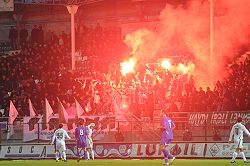
Football (soccer)
Association football, more commonly known as football or soccer, is a sport played between two teams of eleven players with a spherical ball...
team competing in the top-flight of Azerbaijan
Azerbaijan
Azerbaijan , officially the Republic of Azerbaijan is the largest country in the Caucasus region of Eurasia. Located at the crossroads of Western Asia and Eastern Europe, it is bounded by the Caspian Sea to the east, Russia to the north, Georgia to the northwest, Armenia to the west, and Iran to...
i football - Khazar Lankaran, currently playing in the Azerbaijan Premier League
Azerbaijan Premier League
-Attendance:- Records :Players in the Premier League compete for the Azerbaijan Premier League Golden Boot, awarded to the top scorer at the end of each season. Nazim Aliyev is the league's all-time top scorer with 183 goals, including 39 in the 1992 season.During the 1995–96 season he became the...
.
15,000 capacity Lankaran City Stadium
Lankaran City Stadium
Lankaran City Stadium is a multi-use stadium in Lankaran, Azerbaijan. It is currently used mostly for football matches and is the home stadium of FK Khazar Lankaran. The stadium holds 15,000 people and opened in 2006...
regularly hosts, apart from Azerbaijan Premier League games, many other Lankaran-based teams and Azerbaijan national football team
Azerbaijan national football team
The Azerbaijan national football team is the national football team of Azerbaijan and is controlled by Association of Football Federations of Azerbaijan...
matches.
In 2012, the city won to host European Masters Weightlifting Championship.
Transportation
Lankaran is served by national and international flights through the Lankaran International Airport.Connection with other cities and countries
- Air: The Lankaran International Airport is well served with connections to Turkish and international destinations. Its new international terminal was opened in September 2008 and the airport is set on its way for becoming one of the busiest hubs in Azerbaijan.
- Rail: The city has rail service from historic terminals in downtown to BakuBakuBaku , sometimes spelled as Baki or Bakou, is the capital and largest city of Azerbaijan, as well as the largest city on the Caspian Sea and of the Caucasus region. It is located on the southern shore of the Absheron Peninsula, which projects into the Caspian Sea. The city consists of two principal...
in the east and AstaraAstara, AzerbaijanAstara, also, Azerbaycan Astarasi is a city in and the capital of the Astara Rayon of Azerbaijan. Astara is a short walk across the border from Astara, Iran.- The TV Tower :There is a 243.9 metre tall lattice steel TV tower, built in 1981...
in the south.
Notable natives
- Jahan TalyshinskayaJahan TalyshinskayaJahan Mir Rzakhan qizi Talyshinskaya was an Azerbaijani folk singer and theatre actress.-Early career:...
— folk singer and theatre actress. - Hazi Aslanov — twice Hero of the Soviet UnionHero of the Soviet UnionThe title Hero of the Soviet Union was the highest distinction in the Soviet Union, awarded personally or collectively for heroic feats in service to the Soviet state and society.-Overview:...
. - Mikhail Pavlov — Hero of Socialist LaborHero of Socialist LaborHero of Socialist Labour was an honorary title in the Soviet Union and other Warsaw Pact countries. It was the highest degree of distinction for exceptional achievements in national economy and culture...
. - Pasha Tahmazov — National Hero of Azerbaijan.
- Samedbey MehmandarovSamedbey MehmandarovSamadbey Mehmandarov Sadykhbey oglu was an Azerbaijani General of the Artillery in the Imperial Russian Army and served as the Minister of Defense of Azerbaijan Democratic Republic.-Early life:...
— Russian army general, Minister of Defense of Azerbaijan Democratic RepublicAzerbaijan Democratic RepublicThe Azerbaijan Democratic Republic was the first successful attempt to establish a democratic and secular republic in the Muslim world . The ADR was founded on May 28, 1918 after the collapse of the Russian Empire that began with the Russian Revolution of 1917 by Azerbaijani National Council in...
.
