


Languages using Cyrillic

Encyclopedia
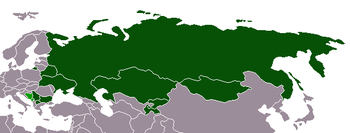
This is a list of languages that have been written in the Cyrillic script at one time or another. See also early Cyrillic alphabet
.
Early Cyrillic alphabet
The Early Cyrillic alphabet is a writing system developed in the First Bulgarian Empire in the 9th or 10th century to write the Old Church Slavonic liturgical language...
.
Indo-European languages
- Indo-Iranian languagesIndo-Iranian languagesThe Indo-Iranian language group constitutes the easternmost extant branch of the Indo-European family of languages. It consists of three language groups: the Indo-Aryan, Iranian and Nuristani...
- Indo-Aryan languagesIndo-Aryan languagesThe Indo-Aryan languages constitutes a branch of the Indo-Iranian languages, itself a branch of the Indo-European language family...
- RomaniRomani languageRomani or Romany, Gypsy or Gipsy is any of several languages of the Romani people. They are Indic, sometimes classified in the "Central" or "Northwestern" zone, and sometimes treated as a branch of their own....
(in SerbiaSerbiaSerbia , officially the Republic of Serbia , is a landlocked country located at the crossroads of Central and Southeast Europe, covering the southern part of the Carpathian basin and the central part of the Balkans...
, MontenegroMontenegroMontenegro Montenegrin: Crna Gora Црна Гора , meaning "Black Mountain") is a country located in Southeastern Europe. It has a coast on the Adriatic Sea to the south-west and is bordered by Croatia to the west, Bosnia and Herzegovina to the northwest, Serbia to the northeast and Albania to the...
, BulgariaBulgariaBulgaria , officially the Republic of Bulgaria , is a parliamentary democracy within a unitary constitutional republic in Southeast Europe. The country borders Romania to the north, Serbia and Macedonia to the west, Greece and Turkey to the south, as well as the Black Sea to the east...
and former USSRSoviet UnionThe Soviet Union , officially the Union of Soviet Socialist Republics , was a constitutionally socialist state that existed in Eurasia between 1922 and 1991....
)
- Romani
- Iranian languagesIranian languagesThe Iranian languages form a subfamily of the Indo-Iranian languages which in turn is a subgroup of Indo-European language family. They have been and are spoken by Iranian peoples....
- KurdishKurdish languageKurdish is a dialect continuum spoken by the Kurds in western Asia. It is part of the Iranian branch of the Indo-Iranian group of Indo-European languages....
(living in former USSRSoviet UnionThe Soviet Union , officially the Union of Soviet Socialist Republics , was a constitutionally socialist state that existed in Eurasia between 1922 and 1991....
) - OsseticOssetic languageOssetian , also sometimes called Ossete, is an East Iranian language spoken in Ossetia, a region on the slopes of the Caucasus Mountains....
(since 18th century, modern alphabet since 1938) - ShughniShughni languageShughni is one of the Pamir languages of the Southeastern Iranian language group. Its distribution is in the Gorno-Badakhshan Autonomous Province in Tajikistan and Badakhshan Province in Afghanistan....
- TajikTajik languageTajik, Tajik Persian, or Tajiki, is a variety of modern Persian spoken in Central Asia. Historically Tajiks called their language zabani farsī , meaning Persian language in English; the term zabani tajikī, or Tajik language, was introduced in the 20th century by the Soviets...
- Tat (Judeo-Tat)
- YaghnobiYaghnobi languageThe Yaghnobi language is a living East Iranian language . Yaghnobi is spoken in the upper valley of the Yaghnob River in the Zarafshan area of Tajikistan by the Yaghnobi people...
- Kurdish
- Indo-Aryan languages
- Romance languagesRomance languagesThe Romance languages are a branch of the Indo-European language family, more precisely of the Italic languages subfamily, comprising all the languages that descend from Vulgar Latin, the language of ancient Rome...
- RomanianRomanian languageRomanian Romanian Romanian (or Daco-Romanian; obsolete spellings Rumanian, Roumanian; self-designation: română, limba română ("the Romanian language") or românește (lit. "in Romanian") is a Romance language spoken by around 24 to 28 million people, primarily in Romania and Moldova...
(up to the 19th century, and a different form of Cyrillic in MoldovaMoldovaMoldova , officially the Republic of Moldova is a landlocked state in Eastern Europe, located between Romania to the West and Ukraine to the North, East and South. It declared itself an independent state with the same boundaries as the preceding Moldavian Soviet Socialist Republic in 1991, as part...
from 1940–89 exclusively; now Cyrillic is used in TransnistriaTransnistriaTransnistria is a breakaway territory located mostly on a strip of land between the Dniester River and the eastern Moldovan border to Ukraine...
officially and in the rest of the country in everyday communication by some groups of people; see Moldovan alphabetMoldovan alphabetThe Moldovan Cyrillic alphabet is a Cyrillic alphabet designed for the Moldovan language in the Soviet Union and used from 1938 to 1989 . Its introduction was decided by the Central Executive Committee of the Moldavian Autonomous Soviet Socialist Republic on May 19, 1938...
) - Ladino in occasional Bulgarian Sephardic publications.
- Romanian
- Slavic languagesSlavic languagesThe Slavic languages , a group of closely related languages of the Slavic peoples and a subgroup of Indo-European languages, have speakers in most of Eastern Europe, in much of the Balkans, in parts of Central Europe, and in the northern part of Asia.-Branches:Scholars traditionally divide Slavic...
- Old Church SlavonicOld Church SlavonicOld Church Slavonic or Old Church Slavic was the first literary Slavic language, first developed by the 9th century Byzantine Greek missionaries Saints Cyril and Methodius who were credited with standardizing the language and using it for translating the Bible and other Ancient Greek...
- Church Slavonic
- BelarusianBelarusian languageThe Belarusian language , sometimes referred to as White Russian or White Ruthenian, is the language of the Belarusian people...
, now almost exclusively in Cyrillic, although there was a Roman version of the language in the Polish-Lithuanian CommonwealthPolish-Lithuanian CommonwealthThe Polish–Lithuanian Commonwealth was a dualistic state of Poland and Lithuania ruled by a common monarch. It was the largest and one of the most populous countries of 16th- and 17th‑century Europe with some and a multi-ethnic population of 11 million at its peak in the early 17th century...
. The Belarusian Roman script was called Łacinka - BosnianBosnian languageBosnian is a South Slavic language, spoken by Bosniaks. As a standardized form of the Shtokavian dialect, it is one of the three official languages of Bosnia and Herzegovina....
, (Bosnian CyrillicBosnian CyrillicBosnian Cyrillic or Croatian Cyrillic, widely known as Bosančica, is an extinct Cyrillic script, that originated in Bosnia and Herzegovina. It was widely used in Bosnia and Croatia . Its name in Bosnian and Croatian is bosančica or bosanica, which can literally be translated as Bosnian script...
was used in the Bosnian language until the late 18th century.) - BulgarianBulgarian languageBulgarian is an Indo-European language, a member of the Slavic linguistic group.Bulgarian, along with the closely related Macedonian language, demonstrates several linguistic characteristics that set it apart from all other Slavic languages such as the elimination of case declension, the...
- MacedonianMacedonian languageMacedonian is a South Slavic language spoken as a first language by approximately 2–3 million people principally in the region of Macedonia but also in the Macedonian diaspora...
- MontenegrinMontenegrin languageMontenegrin is a name used for the Serbo-Croatian language as spoken by Montenegrins; it also refers to an incipient standardized form of the Shtokavian dialect of Serbo-Croatian used as the official language of Montenegro...
- RussianRussian languageRussian is a Slavic language used primarily in Russia, Belarus, Uzbekistan, Kazakhstan, Tajikistan and Kyrgyzstan. It is an unofficial but widely spoken language in Ukraine, Moldova, Latvia, Turkmenistan and Estonia and, to a lesser extent, the other countries that were once constituent republics...
- RusynRusyn languageRusyn , also known in English as Ruthenian, is an East Slavic language variety spoken by the Rusyns of Central Europe. Some linguists treat it as a distinct language and it has its own ISO 639-3 code; others treat it as a dialect of Ukrainian...
- SerbianSerbian languageSerbian is a form of Serbo-Croatian, a South Slavic language, spoken by Serbs in Serbia, Bosnia and Herzegovina, Montenegro, Croatia and neighbouring countries....
- UkrainianUkrainian languageUkrainian is a language of the East Slavic subgroup of the Slavic languages. It is the official state language of Ukraine. Written Ukrainian uses a variant of the Cyrillic alphabet....
- Old Church Slavonic
Languages of the Caucasus
(This group is not assumed to comprise genetically related subgroups.)- Northeast Caucasian languagesNortheast Caucasian languagesThe Northeast Caucasian languages constitute a language family spoken in the Russian republics of Dagestan, Chechnya, Ingushetia, northern Azerbaijan, and in northeastern Georgia, as well as in diaspora populations in Russia, Turkey, and the Middle East...
:- AvarAvar languageThe modern Avar language belongs to the Avar–Andic group of the Northeast Caucasian language family....
- ChechenChechen languageThe Chechen language is spoken by more than 1.5 million people, mostly in Chechnya and by Chechen people elsewhere. It is a member of the Northeast Caucasian languages.-Classification:...
(since 1938, also with Roman 1991–2000) - DargwaDargwa languageThe Dargwa or Dargin language is spoken by the Dargin people of Dagestan. It is the literary and main dialect of the dialect continuum constituting the Dargin languages. The four other languages in this dialect continuum are often considered variants of Dargwa...
- LakLak languageThe Lak language is a Northeast Caucasian language forming its own branch within this family. It is the language of the Lak people from the Russian autonomous republic of Dagestan, where it is one of six standardized languages...
- LezgianLezgi languageLezgian, also called Lezgi or Lezgin, is a language that belongs to the Lezgic languages. It is spoken by the Lezgins, who live in southern Dagestan and northern Azerbaijan. Lezgian is a literary language and an official language of Dagestan. It is classified as "vulnerable" by UNESCO's Atlas of...
- Tabassaran
- Avar
- Northwest Caucasian languagesNorthwest Caucasian languagesThe Northwest Caucasian languages, also called Abkhazo-Adyghean, or sometimes Pontic as opposed to Caspian for the Northeast Caucasian languages, are a group of languages spoken in the Caucasus region, chiefly in Russia , the disputed territory of Abkhazia, and Turkey, with smaller communities...
:- AbazaAbaza languageThe Abaza language is a language of the Caucasus mountains in the Russian Karachay-Cherkess Republic by the Abazins...
- AbkhazAbkhaz languageAbkhaz is a Northwest Caucasian language spoken mainly by the Abkhaz people. It is the official language of Abkhazia where around 100,000 people speak it. Furthermore, it is spoken by thousands of members of the Abkhazian diaspora in Turkey, Georgia's autonomous republic of Adjara, Syria, Jordan...
- AdygheAdyghe languageAdyghe language , also known as West Circassian , is one of the two official languages of the Republic of Adygea in the Russian Federation, the other being Russian. It is spoken by various tribes of the Adyghe people: Abzekh, Adamey, Bzhedugh; Hatukuay, Kemirgoy, Makhosh; Natekuay, Shapsigh; Zhane,...
- KabardianKabardian languageThe Kabardian language, also known as East Circassian , is a Northwest Caucasian language, closely related to the Adyghe language. It is spoken mainly in the Russian republics of Kabardino-Balkaria and Karachay-Cherkessia and in Turkey and the Middle East...
- Abaza
Chukotko-Kamchatkan languages
- ChukchiChukchi languageThe Chukchi language is a Palaeosiberian language spoken by Chukchi people in the easternmost extremity of Siberia, mainly in Chukotka Autonomous Okrug...
(since 1936) - KoryakKoryak languageKoryak is a Chukotko-Kamchatkan language spoken by circa 3,000 people in the easternmost extremity of Siberia, mainly in Koryak Okrug. It is mostly a language spoken by Koryaks. Its close relative, the Chukchi language, is spoken by about twice that number. The language together with Chukchi,...
(since 1936) - ItelmenItelmen languageItelmen, also known as Western Itelmen and formerly known as Kamchadal, is a language belonging to the Chukotko-Kamchatkan family traditionally spoken in the Kamchatka Peninsula. Fewer than a hundred native speakers, mostly elderly, in a few settlements in the southwest of Koryak Autonomous Okrug,...
Mongolian languages
- BuryatBuryat languageBuryat is a Mongolic variety spoken by the Buryats that is either classified as a language or as a major dialect group of Mongolian. The majority of Buryat speakers live in Russia along the northern border of Mongolia where it is an official language in the Buryat Republic, Ust-Orda Buryatia and...
- KalmykKalmyk languageThe Kalmyk language , or Russian Oirat, is the native speech of the Kalmyk people of the Republic of Kalmykia, a federal subject of the Russian Federation. In Russia, it is the normative form of the Oirat language , which belongs to the Mongolic language family...
- MongolianMongolian languageThe Mongolian language is the official language of Mongolia and the best-known member of the Mongolic language family. The number of speakers across all its dialects may be 5.2 million, including the vast majority of the residents of Mongolia and many of the Mongolian residents of the Inner...
Tungusic languages
- EvenEven languageThe Even language is a Tungusic language spoken by the Evens in Siberia. It is spoken by widely scattered communities of reindeer herders from Kamchatka and the Sea of Okhotsk in the east to the River Lena in the west, and from the Arctic coast in the north to the River Aldan in the south...
- EvenkEvenk languageEvenki is the largest member of the northern group of Tungusic languages, a group which also includes Even, Negidal, and Oroqen language...
(since 1937) - NanaiNanai languageThe Nanai language is spoken by the Nanai people in Siberia, and to a much smaller extent in China's Heilongjiang province, where it is known as Hezhe...
- UdiheUdege languageThe Udege language is the language of the Udege people. It is a member of the Tungusic family.-Vocabulary:...
(Udekhe) (writing recently is not used)
Turkic languages
- AltayAltay languageAltay is a language of the Turkic group of languages. It is an official language of Altai Republic, Russia. The language was called Oyrot prior to 1948. There were ca...
- AzerbaijaniAzerbaijani languageAzerbaijani or Azeri or Torki is a language belonging to the Turkic language family, spoken in southwestern Asia by the Azerbaijani people, primarily in Azerbaijan and northwestern Iran...
/Azeri (1939–91, exclusively in Cyrillic, since 1991 officially in Roman) - BalkarKarachay-Balkar languageThe Karachay-Balkar language is a Turkic language spoken by the Karachays and Balkars. It is divided into two dialects: Karachay-Baksan-Chegem which pronounces two phonemes as and , and Balkar, which pronounces the corresponding phonemes as and .- Alphabet :Modern Karachay-Balkar Cyrillic...
- BashkirBashkir languageThe Bashkir language is a Turkic language, and is the language of the Bashkirs. It is co-official with Russian in the Republic of Bashkortostan.-Speakers:...
- ChuvashChuvash languageChuvash is a Turkic language spoken in central Russia, primarily in the Chuvash Republic and adjacent areas. It is the only surviving member of the Oghur branch of Turkic languages....
- Crimean TatarCrimean Tatar languageThe Crimean Tatar language is the language of the Crimean Tatars. It is a Turkic language spoken in Crimea, Central Asia , and the Crimean Tatar diasporas in Turkey, Romania, Bulgaria...
(1938–91) - GagauzGagauz languageThe Gagauz language is a Turkic language, spoken by the Gagauz people, and the official language of Gagauzia, Moldova. There are two dialects, Bulgar Gagauzi and Maritime Gagauzi. This is a different language from Balkan Gagauz Turkish....
(1957-1990s, exclusively in Cyrillic, since 1990s officially in Roman, but in reality in everyday communication Cyrillic is used alongside with Roman script) - KazakhKazakh languageKazakh is a Turkic language which belongs to the Kipchak branch of the Turkic languages, closely related to Nogai and Karakalpak....
- KarachayKarachay-Balkar languageThe Karachay-Balkar language is a Turkic language spoken by the Karachays and Balkars. It is divided into two dialects: Karachay-Baksan-Chegem which pronounces two phonemes as and , and Balkar, which pronounces the corresponding phonemes as and .- Alphabet :Modern Karachay-Balkar Cyrillic...
- KarakalpakKarakalpak languageKarakalpak is a Turkic language mainly spoken by Karakalpaks in Karakalpakstan , as well as by Bashkirs and Nogay. Ethnic Karakalpaks who live in the viloyatlar of Uzbekistan tend to speak local Uzbek dialects.-Classification:...
(1940s–1990s) - Karaim languageKaraim languageThe Karaim language is a Turkic language with Hebrew influences, in a similar manner to Yiddish or Ladino. It is spoken by Crimean Karaites – ethnic Turkic adherents of Karaite Judaism in Crimea, Lithuania, Poland and western Ukraine...
(20-th century) - KhakasKhakas languageKhakas is a Turkic language spoken by the Khakas people, who mainly live in the southern Siberian Khakas Republic, or Khakassia, in Russia...
- KumykKumyk languageKumyk is a Turkic language, spoken by about 365,000 speakers in the Dagestan republic of Russian Federation....
- KyrgyzKyrgyz languageKyrgyz or Kirgiz, also Kirghiz, Kyrghiz, Qyrghiz is a Turkic language and, together with Russian, an official language of Kyrgyzstan...
- NogaiNogai languageNogai , is a Turkic language spoken in southwestern Russia. Three distinct dialects are recognized: Qara-Nogay , spoken in Dagestan; Nogai Proper, in Stavropol; and Aqnogay , by the Kuban River, its tributaries in Karachay-Cherkessia, and in the Mineralnye Vody District...
- TatarTatar languageThe Tatar language , or more specifically Kazan Tatar, is a Turkic language spoken by the Tatars of historical Kazan Khanate, including modern Tatarstan and Bashkiria...
(since 1939) - TurkmenTurkmen languageTurkmen is the national language of Turkmenistan...
(1940–94 exclusively in Cyrillic, since 1994 officially in Roman, but in reality in everyday communication Cyrillic is used alongside with Roman script) - TuvanTuvan languageTuvan , also known as Tuvinian, Tyvan or Tuvin, is a Turkic language spoken in the Republic of Tuva in south-central Siberia in Russia. The language has borrowed a great number of roots from the Mongolian language and more recently from the Russian language...
- UyghurUyghur languageUyghur , formerly known as Eastern Turk, is a Turkic language with 8 to 11 million speakers, spoken primarily by the Uyghur people in the Xinjiang Uyghur Autonomous Region of Western China. Significant communities of Uyghur-speakers are located in Kazakhstan and Uzbekistan, and various other...
(Called Uyghur Siril YëziqiUyghur Siril YéziqiThe Uyghur Cyrillic alphabet is a Cyrillic-derived alphabet used for writing the Uyghur language, primarily by Uyghurs living in Kazakhstan and former CIS countries....
. Used along with Uyghur Ereb YëziqiUyghur Ereb YéziqiUyghur Arabic script is an Arabic alphabet used for writing the Uyghur language, primarily by Uyghurs living in China. It is one of several Uyghur alphabets....
, Uyghur Latin YëziqiUyghur Latin YéziqiUyghur Latin script is an auxiliary alphabet for the Uyghur language based on the Latin script. Uyghur is primarily written in a Arabic alphabet and sometimes in a Cyrillic alphabet.- Construction :...
and Uyghur Pinyin Yëziqi) - UzbekUzbek languageUzbek is a Turkic language and the official language of Uzbekistan. It has about 25.5 million native speakers, and it is spoken by the Uzbeks in Uzbekistan and elsewhere in Central Asia...
(1941–98 exclusively in Cyrillic, since 1998 Cyrillic is used alongside with Roman script, which was prescribed as the future alphabet of Uzbek) - Yakut
Uralic languages
- Samoyedic languagesSamoyedic languagesThe Samoyedic languages are spoken on both sides of the Ural mountains, in northernmost Eurasia, by approximately 30,000 speakers altogether....
- Nenets (since 1937)
- SelkupSelkup languageSelkup language is a language of the Selkups, belonging to the Samoyedic group of the Uralic language family. It is spoken by some 1,570 people in the region between the Ob and Yenisei Rivers . The language name Selkup comes from the Russian "" , based on the native name used in the Taz dialect, ...
(since 1950s writing recently is not used)
- Uralic languagesUralic languagesThe Uralic languages constitute a language family of some three dozen languages spoken by approximately 25 million people. The healthiest Uralic languages in terms of the number of native speakers are Hungarian, Finnish, Estonian, Mari and Udmurt...
- KarelianKarelian languageKarelian language is a Finnic language spoken mainly in the Russian Republic of Karelia. Linguistically Karelian is closely related to the Finnish dialects spoken in eastern Finland and some Finnish linguists even classified Karelian as a dialect of Finnish...
(until 1921 and 1937–1940) - KhantyKhanty languageKhanty or Xanty language, also known previously as the Ostyak language, is a language of the Khant peoples. It is spoken in Khanty-Mansi and Yamalo-Nenets Autonomous okrugs, as well as in Aleksandrovsky and Kargosoksky districts of Tomsk Oblast in Russia...
- MansiMansi languageThe Mansi language is a language of the Mansi people. It is spoken in territories of Russia along the Ob River and its tributaries, including the Khanty-Mansi Autonomous Okrug and the Sverdlovsk Oblast...
(since 1937 writing has not received distribution) - KomiKomi languageThe Komi language is a Finno-Permic language spoken by the Komi peoples in the northeastern European part of Russia. Komi is one of the two members of the Permic subgroup of the Finno-Ugric branch...
- Komi-ZyrianKomi-Zyrian languageKomi-Zyrian language, or simply Komi, Zyrian or Zyryan, is one of the two regional varieties of the pluricentrical Komi language, the other regional variety being Komi-Permyak....
(since 17th century, modern alphabet since 1930s) - Komi-PermyakKomi-Permyak languageKomi-Permyak language is one of two regional varieties of the pluricentrical Komi language, the other variety being Komi-Zyrian.Komi is a Uralic language closely related to Udmurt....
- Komi-Zyrian
- MariMari languageThe Mari language , spoken by more than 600,000 people, belongs to the Uralic language family. It is spoken primarily in the Mari Republic of the Russian Federation as well as in the area along the Vyatka river basin and eastwards to the Urals...
(since 19th century) - Mordvin languages
- ErzyaErzya languageThe Erzya language is spoken by about 500,000 people in the northern and eastern and north-western parts of the Republic of Mordovia and adjacent regions of Nizhniy Novgorod, Chuvashia, Penza, Samara, Saratov, Orenburg, Ulyanovsk, Tatarstan and Bashkortostan in Russia...
(since 18th century) - MokshaMoksha languageThe Moksha language is a member of the Finno-Volgaic subdivision of the Uralic languages with about 500,000 native speakers. Moksha is the majority language in the western part of Mordovia....
(since 18th century)
- Erzya
- SamiSami languagesSami or Saami is a general name for a group of Uralic languages spoken by the Sami people in parts of northern Finland, Norway, Sweden and extreme northwestern Russia, in Northern Europe. Sami is frequently and erroneously believed to be a single language. Several names are used for the Sami...
(in Russia, since 1980s)- Kildin Sami
- UdmurtUdmurt languageUdmurt is an Uralic language, part of the Permic subgroup, spoken by the Udmurt natives of the Russian constituent republic of Udmurtia, where it is coofficial with Russian. It is written in the Cyrillic script with five additional characters. Together with Komi and Komi-Permyak languages, it...
- Karelian
Eskimo-Aleut languages
- AleutAleut languageAleut is a language of the Eskimo–Aleut language family. It is the heritage language of the Aleut people living in the Aleutian Islands, Pribilof Islands, and Commander Islands. As of 2007 there were about 150 speakers of Aleut .- Dialects :Aleut is alone with the Eskimo languages in the...
- AlutiiqAlutiiq languageThe Alutiiq language is a close relative to the Central Alaskan Yup'ik language spoken in the western and southwestern Alaska, but is considered a distinct language...
- Central Siberian Yupik (Yuit)Siberian Yupik languageSiberian Yupik is one of the four Yupik languages:* Central Siberian Yupik,...
Other languages
- KetKet languageThe Ket language, formerly known as Yenisei Ostyak, is a Siberian language long thought to be an isolate, the sole surviving language of a Yeniseian language family...
- Padonkaffsky jargonPadonkaffsky jargonPadonkaffsky jargon or Olbanian language is a cant language developed by padonki of Runet. It started as an Internet slang language originally used in the Russian Internet community...
- NivkhNivkh languageNivkh or Gilyak is a language spoken in Outer Manchuria, in the basin of the Amgun , along the lower reaches of the Amur itself, and on the northern half of Sakhalin. 'Gilyak' is the Manchu appellation...
- TlingitTlingit languageThe Tlingit language ) is spoken by the Tlingit people of Southeast Alaska and Western Canada. It is a branch of the Na-Dené language family. Tlingit is very endangered, with fewer than 140 native speakers still living, all of whom are bilingual or near-bilingual in English...
- Yukaghir
- Russian sign languageRussian Sign LanguageRussian Sign Language is the sign language of the deaf community in Russia. It has a grammar unlike the Russian language, with much stricter word order and word formation rules. Russian sign language belongs to a family of French sign language and is similar to American sign language...
(uses the Cyrillic script via the Russian Manual AlphabetRussian Manual AlphabetThe Russian Manual Alphabet is used for fingerspelling in Russian sign language. The alphabet consists of Cyrillic letters, the same used in Russian and other languages....
) - Constructed languages
- International auxiliary languageInternational auxiliary languageAn international auxiliary language or interlanguage is a language meant for communication between people from different nations who do not share a common native language...
s- Lingua Franca NovaLingua Franca NovaLingua Franca Nova is an auxiliary constructed language created by Dr. C. George Boeree of Shippensburg University, Pennsylvania. Its vocabulary is based on the Romance languages French, Italian, Portuguese, Spanish, and Catalan. The grammar is highly reduced and similar to the Romance creoles...
- SlovianskiSlovianskiSlovianski is a Slavic interlanguage, created in 2006 by a group of language creators from different countries. Its purpose is to facilitate communication between representatives of different Slavic nations, as well as to allow people who don't know any Slavic language to communicate with Slavs...
- Lingua Franca Nova
- Fictional languageFictional languageFictional languages are by far the largest group of artistic languages. Fictional languages are intended to be the languages of a fictional world and are often designed with the intent of giving more depth and an appearance of plausibility to the fictional worlds with which they are associated, and...
s- Brutopian (Donald DuckDonald DuckDonald Fauntleroy Duck is a cartoon character created in 1934 at Walt Disney Productions and licensed by The Walt Disney Company. Donald is an anthropomorphic white duck with a yellow-orange bill, legs, and feet. He typically wears a sailor suit with a cap and a black or red bow tie. Donald is most...
stories) - SyldavianSyldavianSyldavian is a fictional West Germanic language created by Hergé as the national language of Syldavia, a small fictional Balkan kingdom that serves as a major setting in some Tintin stories. Hergé modeled the language on Marols, a dialect of Dutch spoken in and around Brussels...
(The Adventures of TintinThe Adventures of TintinThe Adventures of Tintin is a series of classic comic books created by Belgian artist , who wrote under the pen name of Hergé...
)
- Brutopian (Donald Duck
- International auxiliary language
See also
- Cyrillic script
- Cyrillic alphabets
- List of Cyrillic letters
- Appendix:Cyrillic scripts
- :Category:Cyrillic alphabets
- Cyrillization of Chinese (Palladiy system)
- Cyrillization of Japanese (Polivanov system)Cyrillization of JapaneseCyrillization of Japanese is the practice of expressing Japanese sounds using Cyrillic characters. It is commonly accepted in Russia.Below is a cyrillization system for the Japanese language known as the Yevgeny Polivanov system...
- Cyrillization of Korean (Kontsevich system)Kontsevich systemThe Kontsevich system for the Cyrillization of the Korean language was created by the Russian scholar Lev Kontsevitch on the basis of the earlier system designed by Aleksandr Kholodovich...