

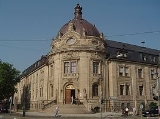
Landau

Encyclopedia
Landau or Landau in der Pfalz (pop. 41,821) is an autonomous (kreisfrei) city surrounded by the Südliche Weinstraße
("Southern Wine Route") district of southern Rhineland-Palatinate
, Germany
. It is a university town (since 1990), a long-standing cultural centre, and a market and shopping town, surrounded by vineyards and wine-growing villages of the Palatinate wine region
. Landau lies east of the Palatinate forest, Europe's largest contiguous forest, direct on the German Wine Route.
, King of Germany, who declared the city an Imperial Free City in 1291; nevertheless the bishop of Speyer
, a major landowner in the district, seized the city in 1324. The city did not regain its ancient rights until 1511, through the offices of Maximilian I
.
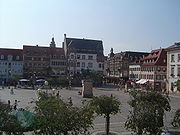 An Augustinian monastery was founded in 1276.
Landau was later occupied by the French
from 1680 to 1815, when it was one of the Décapole
, the ten free cities of Alsace
, and received its modern fortifications by Louis XIV's military architect Vauban
in 1688–99, making the little city (population in 1789 was still only approximately 5,000) one of Europe's strongest citadels. After Napoleon's Hundred Days
following his escape from Elba, Landau, which had remained French, was granted to the Kingdom of Bavaria
in 1816 and became the capital of one of the thirteen Bezirksämter (counties) of the Bavarian Rheinpfalz.In 1840 famous political cartoonist Thomas Nast
was born in Landau. Following World War II
, Landau was an important barracks city for the French occupation
.
style, 1905–07 on a rise overlooking the city park and facing the modernist Bundesamt, the regional government building.
" was invented in the city.
A prayer room is known to have existed since the 16th century: the first actual synagogue
was built in 1648, rebuilt in 1691 after a fire. The Great Synagogue (350 sq. m., 16 m. high) was dedicated in 1884: it was burned down during the Kristallnacht
, and only its charred remains can now be seen. The historic Frank-Loeb house is another relic of the Jewish presence in Landau: its proprietor in the late 19th Century was Zacharias Frank, great-grandfather of Anne Frank
.
Südliche Weinstraße
Südliche Weinstraße is a district in the south of Rhineland-Palatinate, Germany. Neighboring districts are Südwestpfalz, Bad Dürkheim, the district-free city Neustadt , Rhein-Pfalz-Kreis, Germersheim, and the French département Bas-Rhin...
("Southern Wine Route") district of southern Rhineland-Palatinate
Rhineland-Palatinate
Rhineland-Palatinate is one of the 16 states of the Federal Republic of Germany. It has an area of and about four million inhabitants. The capital is Mainz. English speakers also commonly refer to the state by its German name, Rheinland-Pfalz ....
, Germany
Germany
Germany , officially the Federal Republic of Germany , is a federal parliamentary republic in Europe. The country consists of 16 states while the capital and largest city is Berlin. Germany covers an area of 357,021 km2 and has a largely temperate seasonal climate...
. It is a university town (since 1990), a long-standing cultural centre, and a market and shopping town, surrounded by vineyards and wine-growing villages of the Palatinate wine region
Palatinate (wine region)
Palatinate is a German wine-growing region in the area of Bad Dürkheim, Neustadt an der Weinstraße, and Landau in Rhineland-Palatinate. Before 1993, it was known as Rhine Palatinate . With under cultivation in 2008, the region is the second largest wine region in Germany after Rheinhessen...
. Landau lies east of the Palatinate forest, Europe's largest contiguous forest, direct on the German Wine Route.
History
Landau was first mentioned as a settlement in 1106. It was in the possession of the counts of Leiningen-Dagsburg-Landeck, whose arms, differenced by an escutcheon of the Imperial eagle, served as the arms of Landau until 1955 http://www.ngw.nl/int/dld/kreis/landaup.htm. The city was granted a charter in 1274 by Rudolf I of HabsburgRudolph I of Germany
Rudolph I was King of the Romans from 1273 until his death. He played a vital role in raising the Habsburg dynasty to a leading position among the Imperial feudal dynasties...
, King of Germany, who declared the city an Imperial Free City in 1291; nevertheless the bishop of Speyer
Bishop of Speyer
The Bishop of Speyer is the Ordinary of the Roman Catholic Diocese of Speyer, which is a suffragan see of the Archdiocese of Bamberg.The diocese covers an area of 5,893 km².The current bishop is Karl-Heinz Wiesemann.-List of bishops:-References:...
, a major landowner in the district, seized the city in 1324. The city did not regain its ancient rights until 1511, through the offices of Maximilian I
Maximilian I, Holy Roman Emperor
Maximilian I , the son of Frederick III, Holy Roman Emperor and Eleanor of Portugal, was King of the Romans from 1486 and Holy Roman Emperor from 1493 until his death, though he was never in fact crowned by the Pope, the journey to Rome always being too risky...
.
Landau was later occupied by the French
France
The French Republic , The French Republic , The French Republic , (commonly known as France , is a unitary semi-presidential republic in Western Europe with several overseas territories and islands located on other continents and in the Indian, Pacific, and Atlantic oceans. Metropolitan France...
from 1680 to 1815, when it was one of the Décapole
Décapole
The Décapole was an alliance formed in 1354 by ten Imperial cities of the Holy Roman Empire in the Alsace region to maintain their rights, it was disbanded in 1679....
, the ten free cities of Alsace
Alsace
Alsace is the fifth-smallest of the 27 regions of France in land area , and the smallest in metropolitan France. It is also the seventh-most densely populated region in France and third most densely populated region in metropolitan France, with ca. 220 inhabitants per km²...
, and received its modern fortifications by Louis XIV's military architect Vauban
Vauban
Sébastien Le Prestre, Seigneur de Vauban and later Marquis de Vauban , commonly referred to as Vauban, was a Marshal of France and the foremost military engineer of his age, famed for his skill in both designing fortifications and breaking through them...
in 1688–99, making the little city (population in 1789 was still only approximately 5,000) one of Europe's strongest citadels. After Napoleon's Hundred Days
Hundred Days
The Hundred Days, sometimes known as the Hundred Days of Napoleon or Napoleon's Hundred Days for specificity, marked the period between Emperor Napoleon I of France's return from exile on Elba to Paris on 20 March 1815 and the second restoration of King Louis XVIII on 8 July 1815...
following his escape from Elba, Landau, which had remained French, was granted to the Kingdom of Bavaria
Kingdom of Bavaria
The Kingdom of Bavaria was a German state that existed from 1806 to 1918. The Bavarian Elector Maximilian IV Joseph of the House of Wittelsbach became the first King of Bavaria in 1806 as Maximilian I Joseph. The monarchy would remain held by the Wittelsbachs until the kingdom's dissolution in 1918...
in 1816 and became the capital of one of the thirteen Bezirksämter (counties) of the Bavarian Rheinpfalz.In 1840 famous political cartoonist Thomas Nast
Thomas Nast
Thomas Nast was a German-born American caricaturist and editorial cartoonist who is considered to be the "Father of the American Cartoon". He was the scourge of Boss Tweed and the Tammany Hall machine...
was born in Landau. Following World War II
World War II
World War II, or the Second World War , was a global conflict lasting from 1939 to 1945, involving most of the world's nations—including all of the great powers—eventually forming two opposing military alliances: the Allies and the Axis...
, Landau was an important barracks city for the French occupation
History of Germany since 1945
As a consequence of the defeat of Nazi Germany in World War II Germany was split between the two global blocs in the East and West, a period known as the division of Germany. While seven million prisoners and forced laborers left Germany, over 10 million German speaking refugees arrived there from...
.
Main sights
Landau's giant main square (Rathausplatz) is dominated by the city hall (Rathaus) and the market hall (Altes Kaufhaus). The former fortifications gave way in the 19th-century to a Hauptring that encircles the old town centre, from which the old industrial buildings have been excluded. A convention hall, the Festhalle, was built in Art NouveauArt Nouveau
Art Nouveau is an international philosophy and style of art, architecture and applied art—especially the decorative arts—that were most popular during 1890–1910. The name "Art Nouveau" is French for "new art"...
style, 1905–07 on a rise overlooking the city park and facing the modernist Bundesamt, the regional government building.
Culture
The familiar luxury open carriage called the "landauLandau (carriage)
A landau is a coachbuilding term for a type of four-wheeled, convertible carriage. See also Landau .It is lightweight and suspended on elliptical springs. It was invented in the 18th century and was named after the German city of Landau in the Rhenish Palatinate where they were first produced...
" was invented in the city.
Jewish history
With a brief interruption in the mid-15th Century, Landau had a sizable Jewish community from the Middle Ages until the Nazi Era, at one point the largest in the Rhineland-Palatinate, as well as one of its most prosperous (many Jews were wine merchants). This accounts for 'Landau' and 'Landauer' being a common Ashkenazi Jewish family name.A prayer room is known to have existed since the 16th century: the first actual synagogue
Synagogue
A synagogue is a Jewish house of prayer. This use of the Greek term synagogue originates in the Septuagint where it sometimes translates the Hebrew word for assembly, kahal...
was built in 1648, rebuilt in 1691 after a fire. The Great Synagogue (350 sq. m., 16 m. high) was dedicated in 1884: it was burned down during the Kristallnacht
Kristallnacht
Kristallnacht, also referred to as the Night of Broken Glass, and also Reichskristallnacht, Pogromnacht, and Novemberpogrome, was a pogrom or series of attacks against Jews throughout Nazi Germany and parts of Austria on 9–10 November 1938.Jewish homes were ransacked, as were shops, towns and...
, and only its charred remains can now be seen. The historic Frank-Loeb house is another relic of the Jewish presence in Landau: its proprietor in the late 19th Century was Zacharias Frank, great-grandfather of Anne Frank
Anne Frank
Annelies Marie "Anne" Frank is one of the most renowned and most discussed Jewish victims of the Holocaust. Acknowledged for the quality of her writing, her diary has become one of the world's most widely read books, and has been the basis for several plays and films.Born in the city of Frankfurt...
.