
All Topics  
Land of Oz

 
Land of Oz

   Email Print
   Bookmark   Link


Land of Oz


Oz is a fairy country (fantasy region
Fantasy world

A fantasy world is a type of imaginary world, part of a fictional universe used in fantasy novels and games. Typical worlds involve magic or magical abilities and often, but not always, either a medieval or futuristic theme....
) containing four lands under the rule of one monarch
High king

A high king is a Monarch who holds a position of seniority over a group of other kings, without the title of Emperor; compare King of Kings.Rulers who have been termed "high king" include:...
.

It was first introduced in The Wonderful Wizard of Oz
The Wonderful Wizard of Oz

The Wonderful Wizard of Oz is a children's literature novel written by L. Frank Baum and illustrated by W.W. Denslow. It was originally published by the George M....
 (1900) by L. Frank Baum
L. Frank Baum

Lyman Frank Baum was an United States author, poet, playwright, actor and independent filmmaker, best known today as the creator, along with illustrator W....
, one of many fairy countries that he created for his books. It achieved a popularity that none of his other works attained, and after four years, he returned to it. The land was described and expanded upon in the Oz Books
The Oz books

The Oz books form a book series that begins with The Wonderful Wizard of Oz, and that relates the "history" of the Land of Oz....
. An attempt to cut off the production of the series with The Emerald City of Oz
The Emerald City of Oz

The Emerald City of Oz is the sixth of L. Frank Baum's fourteen Land of Oz books. It was also adapted into a Canadian animated film in 1987....
, by ending the story with Oz being isolated from the rest of the world, did not succeed owing to readers' reactions and Baum's financial need to write successful books.

The land of Oz is depicted as real in the books, unlike the 1939 movie adaptation
The Wizard of Oz (1939 film)

The Wizard of Oz is a 1939 in film Cinema of the United States musical film-fantasy film mainly directed by Victor Fleming and based on the 1900 Children's literature novel The Wonderful Wizard of Oz by L....
, which transformed it into an ambiguous dream of Dorothy's.

In all, Baum wrote fourteen children's books about Oz and its odd inhabitants, as well as six shorter books
Little Wizard Stories of Oz

Little Wizard Stories of Oz is a set of six short stories written for young children by L. Frank Baum, the creator of the Land of Oz books. The six tales were published in separate small booklets, "Oz books in miniature," in 1913 in literature, and then in a collected edition in 1914 in literature....
 intended for younger readers.


Discussion
Ask a question about 'Land of Oz'
Start a new discussion about 'Land of Oz'
Answer questions from other users
Full Discussion Forum


Encyclopedia


Oz is a fairy country (fantasy region
Fantasy world

A fantasy world is a type of imaginary world, part of a fictional universe used in fantasy novels and games. Typical worlds involve magic or magical abilities and often, but not always, either a medieval or futuristic theme....
) containing four lands under the rule of one monarch
High king

A high king is a Monarch who holds a position of seniority over a group of other kings, without the title of Emperor; compare King of Kings.Rulers who have been termed "high king" include:...
.

It was first introduced in The Wonderful Wizard of Oz
The Wonderful Wizard of Oz

The Wonderful Wizard of Oz is a children's literature novel written by L. Frank Baum and illustrated by W.W. Denslow. It was originally published by the George M....
 (1900) by L. Frank Baum
L. Frank Baum

Lyman Frank Baum was an United States author, poet, playwright, actor and independent filmmaker, best known today as the creator, along with illustrator W....
, one of many fairy countries that he created for his books. It achieved a popularity that none of his other works attained, and after four years, he returned to it. The land was described and expanded upon in the Oz Books
The Oz books

The Oz books form a book series that begins with The Wonderful Wizard of Oz, and that relates the "history" of the Land of Oz....
. An attempt to cut off the production of the series with The Emerald City of Oz
The Emerald City of Oz

The Emerald City of Oz is the sixth of L. Frank Baum's fourteen Land of Oz books. It was also adapted into a Canadian animated film in 1987....
, by ending the story with Oz being isolated from the rest of the world, did not succeed owing to readers' reactions and Baum's financial need to write successful books.

The land of Oz is depicted as real in the books, unlike the 1939 movie adaptation
The Wizard of Oz (1939 film)

The Wizard of Oz is a 1939 in film Cinema of the United States musical film-fantasy film mainly directed by Victor Fleming and based on the 1900 Children's literature novel The Wonderful Wizard of Oz by L....
, which transformed it into an ambiguous dream of Dorothy's.

In all, Baum wrote fourteen children's books about Oz and its odd inhabitants, as well as six shorter books
Little Wizard Stories of Oz

Little Wizard Stories of Oz is a set of six short stories written for young children by L. Frank Baum, the creator of the Land of Oz books. The six tales were published in separate small booklets, "Oz books in miniature," in 1913 in literature, and then in a collected edition in 1914 in literature....
 intended for younger readers. After his death, Ruth Plumly Thompson
Ruth Plumly Thompson

Ruth Plumly Thompson was an American writer of children's stories. She is best known for continuing the children's fantasy Land of Oz series after L....
 and other writers continued the series.

"Oz as History"

In Baum's time, it was common for authors to present works of fiction as true accounts (compare Sherlock Holmes
Sherlock Holmes

Sherlock Holmes is a fictional character of the late nineteenth and early twentieth centuries, who first appeared in publication in 1887. He is the creation of Scotland-born author and physician Sir Arthur Conan Doyle....
 and Tarzan
Tarzán

Tarz?n was a half-hour syndicated series that aired 1991 in television?1994 in television. In this version of the show, Tarzan was portrayed as a blond environmentalist, with Jane turned into a French ecologist....
 for other examples). While Baum presented Oz as fiction in some of his forewords such as that of the first book, in other books he presented it as a true account related to him by those involved. Most notably, in The Emerald City of Oz
The Emerald City of Oz

The Emerald City of Oz is the sixth of L. Frank Baum's fourteen Land of Oz books. It was also adapted into a Canadian animated film in 1987....
 he attempted to end the series on the basis of a letter he had claimed to have received from Dorothy Gale
Dorothy Gale

Dorothy Gale is a fictional character, the protagonist of many of the Land of Oz novels by United States author L. Frank Baum and best friend of Oz's ruler, Princess Ozma....
, the main character. In the following book, The Patchwork Girl of Oz
The Patchwork Girl of Oz

The Patchwork Girl of Oz by L. Frank Baum, is a children's novel, the seventh set in the Land of Oz. Characters include the Woozy , Ojo the Lucky "the Unlucky", Unc Nunkie, Dr....
, he explained that after some difficulty he had re-established communication with the characters by wireless telegraph. Baum also began signing himself as "Royal Historian of Oz," a title which several other authors of the series have taken on after his death.

Because Baum himself wrote from an in-universe standpoint, many fans of the series treat the books as if they were true, known among the fans as the "Oz as History
HIStory

HIStory: Past, Present and Future, Book I is a double album by Michael Jackson, released on June 20, 1995, and is Jackson's ninth. The first disc, named "HIStory Begins" consists of a selection of Jackson's greatest hits from the singer's past fifteen years, while the second, named "HIStory Continues" features new songs, with the...
" standpoint. Any confusion or contradiction between the different versions of their histories is said to be the fault of the historian making an honest mistake, of the editors for removing parts which they did not consider suitable for the child audience, of the characters involved who reported the incidents in question back to the historian, or explained by the concept that many alternate versions of Oz co-exist simultaneously.

There are many discussions founded on clues in the series in Oz fan group Regalia (and previously Nonestica and the Ozzy Digest) on how large Oz is, its population, and many other details not addressed explicitly in the books themselves. Articles of the sort frequently appear in The Baum Bugle
The Baum Bugle

The Baum Bugle: A Journal of Oz is the official journal of The International Wizard of Oz Club. The journal was founded in 1957, with its first issue released in June of that year ....
 as well.

While some fans enjoy trying to explain the various inconsistencies in the books, others prefer to ignore them, since apparently the inconsistencies weren't important to Baum himself. These fans prefer to view Oz from the contrasting, but more traditional, Oz as Literature
Literature

Literature is the art of written works. Literally translated, the word means "acquaintance with letters" . In Western culture the most basic written literary types include fiction and non-fiction....
 standpoint. Many fans enjoy both standpoints, and it is not uncommon for new ideas about Oz to be examined from both standpoints by the same people.

Characteristics

Oz is, in the first book The Wonderful Wizard of Oz
The Wonderful Wizard of Oz

The Wonderful Wizard of Oz is a children's literature novel written by L. Frank Baum and illustrated by W.W. Denslow. It was originally published by the George M....
, distinguished from Dorothy's native Kansas by not being civilized; this explains why Kansas does not have witches and wizards, while Oz does. In the third book, Ozma of Oz
Ozma of Oz

Ozma of Oz, published on July 29, 1907, was the third book of L. Frank Baum's The Oz books series. It was the first in which Baum was clearly intending a series of Oz books....
, Oz is described as a "fairy country", new terminology that remained to explain its wonders.

Geography


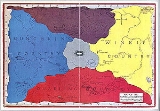
The Land of Oz

Map of Oz
Oz is roughly rectangular in shape, and divided along the diagonals into four countries: Munchkin Country
Munchkin Country

Munchkin Country is a region in the fictional Land of Oz in L. Frank Baum's Oz books, first described in The Wonderful Wizard of Oz. In Wizard it was originally called "the land of Munchkins," and "Munchkin Country" in all subsequent Oz books....
 (but commonly referred to as 'Munchkinland' in adaptations) in the East, Winkie Country
Winkie Country

The Winkie Country is a division of the fictional Land of Oz. It is distinguished by the color yellow which is worn by most of the local inhabitants as well as the color of their surroundings....
 (called 'The Vinkus' in Gregory Maguire
Gregory Maguire

Gregory Maguire is an United States author. He is the author of the novels Wicked: The Life and Times of the Wicked Witch of the West, Confessions of an Ugly Stepsister, and many other novels for adults and children....
's Wicked and its sequel Son of a Witch
Son of a Witch

Son of a Witch is a fantasy literature novel written by Gregory Maguire. The book is Maguire?s fifth Fictional revisionism story and the second set in the land of land of Oz originally conceived by L....
) in the West, (sometimes West and East are reversed on maps of Oz, see West and East
Land of Oz

Oz is a fairy country containing four lands under the rule of high king.It was first introduced in The Wonderful Wizard of Oz by L. Frank Baum, one of many fairy countries that he created for his books....
 below) Gillikin Country
Gillikin Country

The Gillikin Country is the northern division of L. Frank Baum's land of Oz. It is distinguished by the color purple worn by most of the local inhabitants as well as the color of their surroundings....
 in the North, and Quadling Country
Quadling Country

The Quadling Country is the southern division of L. Frank Baum's Land of Oz. It is distinguished by the color red, worn by most of the local inhabitants as well as the color of their surroundings....
 in the South. In the center of Oz, where the diagonals cross, is the fabled Emerald City
Emerald City

The Emerald City is the fictional capital city of the Land of Oz in L. Frank Baum's Oz books, first described in The Wonderful Wizard of Oz....
, capital of the land of Oz and seat to the monarch of Oz, Princess Ozma
Princess Ozma

Princess Ozma is a fictional character in the Land of Oz universe created by L. Frank Baum. She appears in every book of the series except The Wonderful Wizard of Oz ....
.

The regions have a color schema: blue for Munchkins, yellow for Winkies, red for Quadlings, green for the Emerald city, and (in works after the first) purple for the Gillikins, which region was also not named in the first book. (This contrasts with Kansas; Baum, describing it, used "gray" nine times in four paragraphs.) In The Wonderful Wizard of Oz, this is merely the favorite color, used for clothing and other man-made objects, and having some influence on their choice of crops, but the basic colors of the world are natural colors. The effect is less consistent in later works. In The Marvelous Land of Oz
The Marvelous Land of Oz

The Marvelous Land of Oz, commonly shortened to The Land of Oz, published on July 5, 1904 in literature, is the second of L. Frank Baum's books set in the Land of Oz, and the sequel to The Wonderful Wizard of Oz....
, the book states that everything in the land of the Gillikins is purple, including the plants and mud, and a character can see that he is leaving when the grass turns from purple to green, but it also describes pumpkins as orange and corn as green in that land. Baum, indeed, never used the color schema consistently; in many books, he alluded to the colors to orient the characters and readers to their location, and then did not refer to it again. His most common technique was to depict the man-made articles and flowers as the color of the country, leaving leaves, grass, and fruit their natural colors.

Most of these regions are settled with prosperous and contented people. However, this naturally is lacking in scope for plot. Numerous pockets throughout the land of Oz are cut off from the main culture, for geographic or cultural reasons. Many have never heard of Ozma, making it impossible for them to acknowledge her as their rightful queen. These regions are concentrated around the edges of the country, and constitute the main settings for books that are set entirely within Oz. The Lost Princess of Oz
The Lost Princess of Oz

The Lost Princess of Oz is the eleventh canonical List of Oz books written by L. Frank Baum. Published on June 5, 1917, it begins with the disappearance of Princess Ozma, the ruler of Land of Oz and covers Dorothy Gale and the Wizard 's efforts to find her....
, for instance is set entirely in rough country in Winkie Country, between two settled areas. In Glinda of Oz
Glinda of Oz

Glinda of Oz is the fourteenth Land of Oz book written by children's author L. Frank Baum, published on July 10, 1920. Like most of the Oz books, the plot features a journey through some of the remoter regions of Oz; though in this case the pattern is doubled: Dorothy and Ozma travel to stop a war between the Flatheads and Skeezers; then...
, Ozma speaks of her duty to discover all these stray corners of Oz.

In The Wonderful Wizard of Oz, a yellow brick road
Yellow brick road

The road of yellow brick is an element in the novel The Wonderful Wizard of Oz by L. Frank Baum, with additional such roads appearing in The Marvelous Land of Oz and The Patchwork Girl of Oz....
 leads from the lands of the Munchkins to the Emerald City. Other such roads featured in other works: one from Gillikin Country in The Marvelous Land of Oz, and a second one from Munchkin Land in The Patchwork Girl of Oz.

Oz is completely surrounded on all four sides by a desert, which insulates the citizens of Oz from discovery and invasion. In the first two books, this is merely a desert, with only its extent to make it dangerous to the traveler. Indeed, in The Marvelous Land of Oz, Mombi tries to escape through it and Glinda chases her over the sands. Still, it is the dividing land between the magic of Oz and the outside world, and the Winged Monkeys
Winged monkeys

Winged monkeys are characters from The Wonderful Wizard of Oz, of enough impact between the books and the The Wizard of Oz to have taken their own place in popular culture, regularly referenced in comedic or ironic situations as a source of evil or fear....
 can not obey Dorothy's command to carry her home because it would take them outside the lands of Oz. In Ozma of Oz
Ozma of Oz

Ozma of Oz, published on July 29, 1907, was the third book of L. Frank Baum's The Oz books series. It was the first in which Baum was clearly intending a series of Oz books....
, it has become a magical desert, the Deadly Desert
Deadly Desert

The Deadly Desert is the magical desert that completely surrounds the Land of Oz. On maps, the Eastern quadrant of the desert is called the Deadly Desert, while the other three quadrants of desert are called the Shifting Sands, the Impassable Desert, and the Great Sandy Waste....
 with life-destroying sands (no destruction is depicted in the Oz books, unlike in the film, Return to Oz
Return to Oz

Return to Oz is a 1985 in film which is the semi-sequel to The Wizard of Oz . It was made by Walt Disney Pictures without the involvement of Metro-Goldwyn-Mayer, the studio that made the 1939 film....
), a feature that remained constant through the rest of the series. The desert has nonetheless been breached numerous times, both by children from our world (mostly harmless), by the Wizard of Oz himself, and by more sinister characters, such as the Nome King
Nome King

The Nome King is a fictional character in L. Frank Baum's List of Oz books books. Although the Wicked Witch of the West is the most famous of Oz's villains , the Nome King is the closest the book series has to a main antagonist....
, who attempted to conquer Oz. After such an attempt in The Emerald City of Oz
The Emerald City of Oz

The Emerald City of Oz is the sixth of L. Frank Baum's fourteen Land of Oz books. It was also adapted into a Canadian animated film in 1987....
, the book ends with Glinda
Glinda

Glinda is a fictional character in the Land of Oz created by United States author L. Frank Baum. She is the most powerful Magic of Oz, although a fairy in later books, ruler of the Quadling Country south of the Emerald City, and protector of Princess Ozma....
 creating a barrier of invisibility around the Land of Oz, for further protection. This was, indeed, an earnest effort on Baum's part to escape the series, but the insistence of the readers meant the continuation of the series, and therefore the discovery of many ways for people to pass through this barrier as well as over the sands. Despite this continual evasion, the barrier itself remained; nowhere in any Oz book did Baum hint that the inhabitants were even considering removing the magical barrier.

West and East

The first known map of Oz was a glass slide used in Baum's Fairylogue and Radio-Play traveling show, showing the blue land of the Munchkins in the east and the yellow land of the Winkies in the west. These directions are confirmed by the text of all of Baum's Oz books, especially the first, in which The Wicked Witch of the East rules over the Munchkins
Munchkin Country

Munchkin Country is a region in the fictional Land of Oz in L. Frank Baum's Oz books, first described in The Wonderful Wizard of Oz. In Wizard it was originally called "the land of Munchkins," and "Munchkin Country" in all subsequent Oz books....
, and The Wicked Witch of the West rules over the Winkies
Winkie Country

The Winkie Country is a division of the fictional Land of Oz. It is distinguished by the color yellow which is worn by most of the local inhabitants as well as the color of their surroundings....
.

Like traditional western maps, the Fairylogue and Radio-Play map showed the west on the left, and the east on the right. However, the first map of Oz to appear in an Oz book had those directions reversed, and the compass rose
Compass rose

For Compass Airlines, an Airline in the US using the Callsign "Compass Rose," See Compass Airlines A compass rose is a figure displaying the Orientation of the Cardinal directions, north, south, east and west on a map or nautical chart....
 adjusted accordingly. It is believed that this is a result of Baum copying the map from the wrong side of the glass slide, effectively getting a mirror image of his intended map. When he realized he was copying the slide backward, he reversed the compass rose to make the directions correct. However, an editor at Reilly and Lee reversed the compass rose, thinking he was fixing an error and resulting in further confusion. Most notably, this confused Ruth Plumly Thompson, who frequently reversed directions in her own Oz books as a result.

Another speculation stems from the original conception of Oz, which at first appeared to be situated in an American desert. If Baum thought of the country of the Munchkins as the nearest region to him, it would have been in the east while he lived in Chicago, but when he moved to California, it would have be in the west.

Modern maps of Oz are almost universally drawn with the Winkies in the west and the Munchkins in the east, although west and east often appear reversed. Many Oz fans believe this is the correct orientation, perhaps as a result of Glinda's spell, which has the effect of confusing most standard compasses; perhaps resembling its similarity to the world Alice found through the looking glass in which everything was a mirror image; or perhaps just reflecting the alien nature of Oz. In Robert A. Heinlein
Robert A. Heinlein

Robert Anson Heinlein was an United States novelist and science fiction writer. Often called "the dean of science fiction writers", he is one of the most popular, influential, and controversial authors of the genre....
's book The Number of the Beast
The Number of the Beast (novel)

The Number of the Beast is a science fiction novel by Robert A. Heinlein published in 1980. The first edition featured a cover and interior illustrations by Richard M....
 he explains that Oz is on a retrograde
Retrograde and direct motion

Direct motion is the motion of planetary body in a direction similar to that of other bodies within its system, and is sometimes called prograde motion....
 planet, meaning that it spins in the opposite direction of Earth so that the sun seems to rise on one's left as one faces north. March Laumer's The Magic Mirror of Oz attribues the changes to a character named Till Orangespiegel attempting to turn the Land of Oz orange.

Location

Oz, like all of Baum's fantasy countries, was presented as existing as part of the real world, albeit protected from civilization by natural barriers. Indeed, in the first books, nothing indicated that it was not hidden in the deserts of the United States. It gradually acquired neighboring magical countries, often from works of Baum's that had been independent, as Ix
Ix (Oz)

Ix is a fictional region neighboring the Land of Oz and Noland . Is it ruled by the witch-queen Zixi, who is centuries old.Ix is one of the locations where Queen Zixi of Ix and the movie take place....
 from Queen Zixi of Ix
Queen Zixi of Ix

'Queen Zixi of Ix, or The Story of the Magic Cloak' is a children's book written by L. Frank Baum and illustrated by Frederick Richardson. It was originally serialized in the early 20th century American children's magazine St....
, and Mo
Mo (Oz)

Mo is a fictional region neighboring the Land of Oz.Mo is the setting of the book The Magical Monarch of Mo by L. Frank Baum. In the first edition of the book, titled A New Wonderland, the country is known as Phunniland....
 from The Magical Monarch of Mo
The Magical Monarch of Mo

The Magical Monarch of Mo is the first full-length children's literature fantasy book by L. Frank Baum. Originally published in 1899 as A New Wonderland, the book was reissued in 1903 with a new title in order to capitalize upon the alliterative title of Baum's successful The Wonderful Wizard of Oz....
. The first of these is Ev
Land of Ev

The Land of Ev is a fictional country in the List of Oz books of L. Frank Baum and his successors. Its exact location is unclear between text and maps....
, introduced in Ozma of Oz
Ozma of Oz

Ozma of Oz, published on July 29, 1907, was the third book of L. Frank Baum's The Oz books series. It was the first in which Baum was clearly intending a series of Oz books....
.

Oz and Surrounding Countrie
In Tik-Tok of Oz
Tik-Tok of Oz

Tik-Tok of Oz is the eighth Land of Oz book written by L. Frank Baum. Published on June 19, 1914, the book actually has little to do with Tik-Tok and is primarily the quest of the Shaggy Man to rescue his brother, and his resulting conflict with the Nome King....
, Baum included maps in the endpapers which definitively situated Oz in a continent with its neighboring countries. Oz is the largest country on the continent unofficially known as Nonestica
Nonestica

Nonestica, also known as the Continent of Imagination, is a fictional continent within L. Frank Baum's The Wonderful Wizard of Oz universe on which the Land of Oz is located....
 (this name was proposed by Robert R. Pattrick in The Unexplored Territory in Oz for the whole of the countries surrounding Oz. Pattrick proposed "Ozeria" for the whole continent, but that name is generally unused in fan discussions), which also includes the countries of Ev, Ix, and Mo, which has also been known as Phunniland, among others. Nonestica is, according to the map, in the Nonestic Ocean. A fair amount of evidence in the books point to this continent as being envisioned as somewhere in the southern Pacific Ocean
Pacific Ocean

The Pacific Ocean is the largest of the Earth's oceanic divisions. Its name is derived from the Latin name Mare Pacificum, "peaceful sea", bestowed upon it by the Portugal explorer Ferdinand Magellan....
. At the opening of Ozma of Oz
Ozma of Oz

Ozma of Oz, published on July 29, 1907, was the third book of L. Frank Baum's The Oz books series. It was the first in which Baum was clearly intending a series of Oz books....
,
Dorothy Gale
Dorothy Gale

Dorothy Gale is a fictional character, the protagonist of many of the Land of Oz novels by United States author L. Frank Baum and best friend of Oz's ruler, Princess Ozma....
 is sailing to Australia
Australia

Australia, officially the Commonwealth of Australia, is a country in the southern hemisphere comprising the Australia of the world's smallest continent, the major island of Tasmania, and numerous list of islands of Australia in the Indian Ocean and Pacific Oceans....
 with her Uncle Henry
Uncle Henry (Oz)

Uncle Henry is a fictional character from The Oz Books by L. Frank Baum. He is the uncle of Dorothy Gale and husband of Aunt Em, and lived with them on a farm in Kansas....
 when she is washed overboard (in a chicken coop, with Billina
Billina

Billina is a character in the List of Oz books of L. Frank Baum.She is a yellow chicken tossed overboard in a storm with Dorothy Gale in the novel Ozma of Oz, the third Oz book, and a sequel to L....
 the yellow hen), and lands on the shore of Ev—a rare instance in which an outsider reaches the Oz landmass through non-magical (or apparently non-magical) means. Palm trees grow outside the Royal Palace in the Emerald City, and horses are not native to Oz, both points of consistency with a South-Pacific location; illustrations and descriptions of round-shaped and domed Ozian houses suggest a non-Western architecture. Conversely, Oz has technological, architectural, and urban elements typical of Europe and North America around the turn of the twentieth century; but this may involve cultural input from unusual external sources (see History below). Ruth Plumly Thompson asserts in her first Oz book, The Royal Book of Oz
The Royal Book of Oz

The Royal Book of Oz is the fifteenth in the series of List of Oz books, and the first to be written by Ruth Plumly Thompson after L. Frank Baum's death....
, that the language of Oz is English, which also suggests European or American influence.

An argument against the South Pacific is that the seasons in Oz are shown as the same seasons in the United States at the same time. In addition, in The Wishing Horse of Oz
The Wishing Horse of Oz

The Wishing Horse of Oz is the twenty-ninth of the The Oz books created by L. Frank Baum and the fifteenth written by Ruth Plumly Thompson....
, Pigasus
Pigasus (literature)

The Pigasus was used by John Steinbeck as a personal stamp with the Latin motto Ad astra per alia porci . The pigasus was supposed to symbolize Steinbeck as "earthbound but aspiring.......
 follows the North Star
North Star

The North Star is the prominent pole star that lies closest in the sky to the celestial pole and which appears directly overhead to an observer at the Earth's North Pole; currently, this is Polaris....
 when he flies to Thunder Mountain, which could only be done in the Northern Hemisphere.

Inspiration

Baum's creation of the Emerald City may have been inspired by the White City of the World Columbian Exposition, which he visited frequently. Its quick building, in less than a year, may have been an element in the quick construction of the Emerald City in the first book.

Schematically, Oz is much like the United States, with the Emerald City taking the place of Chicago: to the East, mixed forest and farmland; to the West, treeless plains and fields of wheat; to the South, warmth and lush growth, and red earth.

It has also been speculated since The Wizard of Oz was first written that Oz may have been based on China. Either way, the oriental influence on Oz has been noted by more than one scholar.

Ruth Plumly Thompson took a different direction with her Oz books, introducing European elements such as the title character of The Yellow Knight of Oz
The Yellow Knight of Oz

The Yellow Knight of Oz is the twenty-fourth in the series of The Oz books created by L. Frank Baum and his successors, and the tenth written by Ruth Plumly Thompson....
, a knight straight out of Arthurian Legend.

Inhabitants


Immortals

The world of the Oz books is ruled (and presumably created) by the immortals. These include fairies, nomes, mermaids, nymphs, and several races created by Baum himself, including ryls, knooks, gigans, and rampsies.

All of the immortals are ruled over three immortal "masters", described in Baum's The Life and Adventures of Santa Claus
The Life and Adventures of Santa Claus

The Life and Adventures of Santa Claus is a 1902 children's book, written by L. Frank Baum and illustrated by Mary Cowles Clark.Story...
:

But in the center of the circle sat three others who possessed powers so great that all the Kings and Queens showed them reverence.


These were Ak, the Master Woodsman of the World, who rules the forests and the orchards and the groves; and Kern, the Master Husbandman of the World, who rules the grain fields and the meadows and the gardens; and Bo, the Master Mariner of the World, who rules the seas and all the craft that float thereon. And all other immortals are more or less subject to these three.


Fairies
The word "fairy" is used in several ways throughout the Oz books. "Fairy people" is often used to describe the people of Oz, who seem to be nothing more than human inhabitants of a fairy country. A number of supernatural creatures are also called fairies, from female spirits of nature who live in mist and on the rainbow, to the nomes, who are seemingly all male, yet also described as earth fairies.

The most powerful kind of fairy is never known by any other name in the books, although Baum sometimes differentiated them by spelling Fairy with a capital F. The Fairies seem to be the most powerful race, with seemingly limitless power. They travel in bands ruled over by Fairy Queens, and spend their time primarily in helping mortals and dancing.

Lurline is a Fairy Queen, and she and her band were the ones who made Oz a fairyland. According to Baum's later books, Ozma is a member of Lurline's band. There are no other Fairies of the highest sort in the Oz books, although The Life and Adventures of Santa Claus
The Life and Adventures of Santa Claus

The Life and Adventures of Santa Claus is a 1902 children's book, written by L. Frank Baum and illustrated by Mary Cowles Clark.Story...
 and Queen Zixi of Ix
Queen Zixi of Ix

'Queen Zixi of Ix, or The Story of the Magic Cloak' is a children's book written by L. Frank Baum and illustrated by Frederick Richardson. It was originally serialized in the early 20th century American children's magazine St....
, which take place in lands neighboring Oz, both mention other Fairy Queens and their bands.

Nomes/Gnomes
Baum introduced the Nomes in Ozma of Oz, and they served as antagonists throughout the rest of the series. Baum always spelled their name without the traditional silent G, perhaps to Americanize the name, or to make it easier for his child audience to pronounce. Thompson later "corrected" Baum's spelling in her first book, and retained it throughout all the Oz books she wrote.

The Nomes are subterranean people who spend their time mining precious stones from the earth. They consider all of the mineral wealth of the world to be their own rightful property, which often leads to conflicts with other races; as, for instance, when the Shaggy Man
Shaggy Man

Shaggy Man is also the name of a DC Comics character.The Shaggy Man is a character in the Oz books by L. Frank Baum. He first appeared in the book The Road to Oz in 1909....
's brother disappears in a mine, it is because the Nomes have captured him. They have a massive army, but not much innate magical ability. Although they play a major role in the Oz series, throughout a major part of the series, there are no Nomes actually living in Oz.

Others
The other immortal races of the world of the Oz books play less significant roles, largely appearing in the "borderlands" books by Baum that occur outside of Oz.

The mermaids care for all life in the ocean, and the nymphs serve a similar function under the Fairies in the forests. The nymphs are helped by the ryls, who color the flowers and care for all plants; and the knooks, who are crooked creatures who govern the beasts.

The massive gigans also served the Fairies until Fairy Queen Lulea, becoming annoyed with their large forms, transformed them into the tiny rampsies, smallest of all immortals. Whatever function they served is unknown, for they're only mentioned in Baum's short story Nelebel's Fairyland, in which the gigans reshape the land in their boredom.

Mortals

Although Baum did not often use the word "mortal," Thompson seemed far more fond of it as a way of describing the people who had come to Oz from the great outside world. Since Oz was a land much like any other prior to Lurline's enchantment, it seems that the only mortals in Oz are those who were not in Oz at the time it was enchanted, and were not born in Oz thereafter.

The Wizard was the first mortal in Oz described in Baum's books, followed by Dorothy and all the characters she met in her travels. Apart from the Wizard, the only mortals who originally found their way to Oz without Dorothy in Baum's books were Trot, Cap'n Bill, and Betsy Bobbin.

Witches and wizards

At the time of The Wonderful Wizard of Oz
The Wonderful Wizard of Oz

The Wonderful Wizard of Oz is a children's literature novel written by L. Frank Baum and illustrated by W.W. Denslow. It was originally published by the George M....
, the lands in the North, South, East and West of Oz are each ruled by a witch; the Witches of the North and South are Good, while the Witches of the East and West are Wicked. Glinda
Glinda

Glinda is a fictional character in the Land of Oz created by United States author L. Frank Baum. She is the most powerful Magic of Oz, although a fairy in later books, ruler of the Quadling Country south of the Emerald City, and protector of Princess Ozma....
, the Good Witch of the South, is later revealed to be the most powerful of the four. After Dorothy's house crushes the Wicked Witch of the East
Wicked Witch of the East

The Wicked Witch of the East is a character in the fictional Land of Oz created by United States author L. Frank Baum in his classic books. Although not verifiably seen , the 1939 film helped to further the popularity of the character....
, thereby liberating the Munckins from bondage, the Good Witch of the North
Good Witch of the North

The Good Witch of the North is a fictional character in the Land of Oz, created by United States author L. Frank Baum....
 tells Dorothy that she (the Witch of the North) is not as powerful as the Wicked Witch of the East had been, or she would have freed the Munchkins herself.

During the first scene in Oz in The Wonderful Wizard of Oz, the Good Witch of the North (Locasta or Tattypoo) explains to Dorothy that Oz still has witches and wizards, not being civilized, and goes on to explain that witches and wizards can be both good and evil, unlike the evil witches that Dorothy had been told of. That book contained only the four witches (besides the humbug wizard), but despite Ozma's prohibition on magic, many more magicians feature in later works.

Baum tended to capitalise the word "Witch" when referring to the Witches of the North, South, East or West, but did not do so when referring to witches in general (eg. In the afore-mentioned first scene of The Wonderful Wizard of Oz, Locasta (or Tattypoo) thanks Dorothy for killing the "Wicked Witch of the East", and introduces herelf as "the Witch of the North", with the word "Witch" capitalised in both cases. However, when she goes on to tell Dorothy that "I (the Witch of the North) am a good witch, and the people love me", the word "witch" is not capitalised).

White is the traditional color of witches in Oz. The Good Witch of the North wears a pointed white hat and a white gown decorated with stars, while Glinda, the Good Witch of the South (called a "sorceress" in later books), wears a pure white dress. Dorothy is taken for a witch not only because she had killed the Wicked Witch of the East, but because her dress is blue and white checked.

Ozma, once on the throne, prohibits the use of magic by anyone other than Glinda
Glinda

Glinda is a fictional character in the Land of Oz created by United States author L. Frank Baum. She is the most powerful Magic of Oz, although a fairy in later books, ruler of the Quadling Country south of the Emerald City, and protector of Princess Ozma....
 the Good, the Wizard
Wizard (Oz)

The Wizard of Oz is a fictional character in the Land of Oz created by United States author L. Frank Baum and further popularized by the classic 1939 movie....
, and herself—as, earlier, the Good Witch of the North had prohibited magic by any other witch in her domains. The illicit use of magic is a frequent feature of villains in later works in the series, appearing in The Scarecrow of Oz
The Scarecrow of Oz

The Scarecrow of Oz is the ninth book set in the Land of Oz written by L. Frank Baum. Published on July 16, 1915, it was Baum's personal favorite of the Oz books and tells of Cap'n Bill and Trot journeying to Oz and, with the help of the Scarecrow , overthrowing the cruel King Krewl of Jinxland....
, Rinkitink in Oz
Rinkitink in Oz

Rinkitink in Oz is the tenth The Oz books in the Land of Oz series written by L. Frank Baum. Published on June 20, 1916, with full-color and black-and-white illustrations by artist John R....
, The Lost Princess of Oz
The Lost Princess of Oz

The Lost Princess of Oz is the eleventh canonical List of Oz books written by L. Frank Baum. Published on June 5, 1917, it begins with the disappearance of Princess Ozma, the ruler of Land of Oz and covers Dorothy Gale and the Wizard 's efforts to find her....
, The Tin Woodman of Oz
The Tin Woodman of Oz

The Tin Woodman of Oz is the twelfth Land of Oz book written by L. Frank Baum and was originally published on May 13, 1918. The Tin Woodman is unexpectedly reunited with his Munchkin sweetheart Nimmie Amee from the days when he was flesh and blood....
, and The Magic of Oz
The Magic of Oz

The Magic of Oz: A Faithful Record of the Remarkable Adventures of Dorothy and Trot and the Wizard of Oz, Together with the Cowardly Lion, the Hungry Tiger, and Cap'n Bill, in Their Successful Search for a Magical and Beautiful Birthday Present for Princess Ozma of Oz is the thirteenth Land of Oz book written by L....
.

Other races

There is a multitude of other races living in the land of Oz, many of which only appear once. Among these are:

  • The Flatheads - Humans who carry their brains in cans
  • The Cuttenclips - Living paper dolls
  • The Hammerheads - An armless race with extensible necks
  • The bun people of Bunbury
  • The bunnies of Bunnybury
  • The living kitchen utensils of Utensia
  • The Fuddles - Anthropomorphic jigsaw puzzles


Outside of them are many other strange races who are often found living in the wilderness of Oz. Despite the overlordship of Ozma, many of the communities live autonomously; Oz has great tolerance for eccentricity and oddness.

Many characters in Oz are animated objects. Such figures as the Glass Cat and the Scarecrow
Scarecrow (Oz)

The Scarecrow is a character in the fictional Land of Oz created by United States author L. Frank Baum and illustrator William Wallace Denslow. In his first appearance, the Scarecrow reveals that he lacks a brain and desires above all else to have one....
 are common. Entire regions are the homes of such animated beings. The Dainty China Country is entirely filled with creatures of china, who would freeze into figurines if removed; the China princess lives in fear of breaking, because she would never be as pretty even if repaired.

Many other characters are highly individual, even unique members of a species. Many such people from the outer worlds find refuge in Oz, which is highly tolerant of eccentricity.

History


Prehistory

The history of Oz prior to The Wonderful Wizard of Oz (often called the prehistory of Oz as it takes place before Baum's "histories") is often the subject of dispute, as Baum himself gave conflicting accounts. In The Wonderful Wizard of Oz, the title character recounts that he was a ventriloquist and a circus balloonist from Omaha
Omaha, Nebraska

Omaha is the largest city in the state of Nebraska, United States, and is the county seat of Douglas County, Nebraska. It is located in the Midwestern United States on the Missouri River, about 20 miles north of the mouth of the Platte River....
, and during one flight the rope for his parachute vent became tangled, preventing him from descending until the next morning, when he awoke floating over a strange land. When he landed, the people thought he was a great wizard because of his ability to fly. He didn't disabuse them of this notion, and with his new power over them, he had them build a city with a palace in the center of Oz. He also ordered them to wear green glasses so it would appear to be made entirely of emeralds. However, in the later Oz books the city is depicted as actually being made of emerald or other green materials. The Wizard was a young man when he first arrived in Oz, and grew old while he was there. Afraid of the Wicked Witches of the West and the East, who, unlike him, could do real magic, the Wizard hid away in a room of his palace and refused to see visitors. He lived in this way until the arrival of Dorothy in the first book.

In The Marvelous Land of Oz
The Marvelous Land of Oz

The Marvelous Land of Oz, commonly shortened to The Land of Oz, published on July 5, 1904 in literature, is the second of L. Frank Baum's books set in the Land of Oz, and the sequel to The Wonderful Wizard of Oz....
 the prehistory was changed slightly. Glinda, the Good Witch of the South, reveals that the Wizard usurped the previous king of Oz, Pastoria
Pastoria

Pastoria is a fictional character mentioned in the Oz books by L. Frank Baum and his successors, and a major character in The Lost King of Oz by Ruth Plumly Thompson....
, and hid away his daughter Ozma. This was Baum's reaction to the popular 1903 Broadway extravaganza Baum adapted from his book, The Wonderful Wizard of Oz, in which the Wizard took the role of the main antagonist and the Wicked Witch of the West was left out.

The wizard, however, had been more popular with his readers than he thought. In Ozma of Oz
Ozma of Oz

Ozma of Oz, published on July 29, 1907, was the third book of L. Frank Baum's The Oz books series. It was the first in which Baum was clearly intending a series of Oz books....
, he omitted any mention of the Wizard's having usurped the throne of Ozma's father, but the largest changes occurred in the next book.

In the preface to Dorothy and the Wizard in Oz
Dorothy and the Wizard in Oz

Dorothy and the Wizard in Oz is the fourth book set in the Land of Oz written by L. Frank Baum and illustrated by John R. Neill. It was published on June 18, 1908 and reunites Dorothy with the humbug Wizard from The Wonderful Wizard of Oz....
 Baum remarks that the Wizard had turned out to be a popular character with the children who had read the first book, and so he brought the Wizard back. During it, the Wizard relates yet another account of his history in Oz, telling Ozma that his birth name was Oscar Zoroaster Phadrig Isaac Norman Henkle Emmanuel Ambroise Diggs, which, being a very long and cumbersome name, and as his other initials spelled out "PINHEAD," he preferred to leave just as O.Z. The balloon part of his story was unchanged, except for the detail added by Ozma, that the people probably saw his initials on his balloon and took them as a message that he was to be their king. She relates that the country was already named Oz (a word which in their language means "great and good"), and that it was typical for the rulers to have names that are variations of Oz (King Pastoria being a notable exception to this rule).

Ozma elaborates further, saying that there were once four Wicked Witches in Oz, who leagued together to depose the King, but the Witches of the North and South were conquered by Good Witches before the Wizard arrived in Oz. According to this version, the King at the time was Ozma's grandfather. This version of prehistory restores the Wizard's reputation, but adds the awkwardness of both Ozma and her father having been born in captivity.

In The Tin Woodman of Oz
The Tin Woodman of Oz

The Tin Woodman of Oz is the twelfth Land of Oz book written by L. Frank Baum and was originally published on May 13, 1918. The Tin Woodman is unexpectedly reunited with his Munchkin sweetheart Nimmie Amee from the days when he was flesh and blood....
 Baum writes how Oz came to be a fairyland:
Oz was not always a fairyland, I am told. Once it was much like other lands, except it was shut in by a dreadful desert of sandy wastes that lay all around it, thus preventing its people from all contact with the rest of the world. Seeing this isolation, the fairy band of Queen Lurline, passing over Oz while on a journey, enchanted the country and so made it a Fairyland. And Queen Lurline left one of her fairies to rule this enchanted Land of Oz, and then passed on and forgot all about it.
Thenceforward, no one in Oz would ever age, get sick, or die. After becoming a fairyland, Oz harbored many Witches, Magicians and Sorcerers until the time when Ozma made magic illegal without a permit. In yet another inconsistency, it is implied that Ozma was the fairy left behind by Queen Lurline to rule the country, contradicting the story where she was Pastoria's daughter. This is later confirmed in Glinda of Oz
Glinda of Oz

Glinda of Oz is the fourteenth Land of Oz book written by children's author L. Frank Baum, published on July 10, 1920. Like most of the Oz books, the plot features a journey through some of the remoter regions of Oz; though in this case the pattern is doubled: Dorothy and Ozma travel to stop a war between the Flatheads and Skeezers; then...
:
"If you are really Princess Ozma of Oz," the Flathead said, "you are one of that band of fairies who, under Queen Lurline, made all Oz a Fairyland. I have heard that Lurline left one of her own fairies to rule Oz, and gave the fairy the name of Ozma."
While this explains why no one dies or ages, and nevertheless there are people of differing ages in Oz, it is completely inconsistent with the earlier versions of the prehistory.

Maguire, author of Wicked
Wicked (novel)

This article is about the book Wicked. For the musical see Wicked .Wicked: The Life and Times of the Wicked Witch of the West, is a parallel novel published in 1995 in literature....
 addresses this inconsistency by saying that the people of Oz believe that Ozma is reincarnated—that her spirit was left behind by Lurline, but her body is reborn to different mortal queens.

In Jack Snow
Jack Snow (writer)

John Frederick "Jack" Snow was an United States radio writer and scholar, primarily of the works of L. Frank Baum. When Baum died in 1919, the twelve-year-old Snow offered to be the next Royal Historian of Oz, but was politely turned down by a staffer at Baum's publisher, Reilly & Britton....
's The Magical Mimics in Oz
The Magical Mimics in Oz

The Magical Mimics in Oz is the thirty-seventh of the The Oz books series begun by L. Frank Baum, and the first written by Jack Snow . It was illustrated by Frank Kramer ....
, the prehistory story is retold. This version relates that Ozma was given to the king of Oz as an adoptive daughter, for he was old and had no children.

History through the first six books

Eventually, Dorothy Gale and her whole house are blown into Oz from Kansas
Kansas

The State of Kansas is a Midwestern U.S. state in the Central United States of the United States of America, an area often referred to as the United States "Heartland"....
 by a tornado. When the house lands, it crushes the Wicked Witch of the East
Wicked Witch of the East

The Wicked Witch of the East is a character in the fictional Land of Oz created by United States author L. Frank Baum in his classic books. Although not verifiably seen , the 1939 film helped to further the popularity of the character....
 (in Gregory Maguire's book, Wicked: The Life and Times of the Wicked Witch of the West, she is given a name, Nessarose), ruler of the Munchkins. In an attempt to get back to her home, she journeys to the Emerald City. Along the way, she meets the Tin Woodman
Tin Woodman

The Tin Woodman is a character in the fictional Land of Oz created by United States author L. Frank Baum. Baum's Tin Woodman first appeared in his classic 1900 book, The Wonderful Wizard of Oz, and reappeared in many other The Oz Books....
, the Cowardly Lion
Cowardly Lion

The Cowardly Lion is a character in the fictional Land of Oz created by United States author L. Frank Baum. He is a lion, but he talks and interacts with humans....
, and the Scarecrow
Scarecrow (Oz)

The Scarecrow is a character in the fictional Land of Oz created by United States author L. Frank Baum and illustrator William Wallace Denslow. In his first appearance, the Scarecrow reveals that he lacks a brain and desires above all else to have one....
, all of whom accompany her. Once there, they become the first people to gain an audience with the Wizard since he went into seclusion, although he disguises himself because Dorothy now has the Wicked Witch of the East's magic silver slippers, and he is afraid of her. The Wizard sends Dorothy and her party to destroy the Wicked Witch of the West
Wicked Witch of the West

The Wicked Witch of the West is a fictional character in the fictional Land of Oz created by United States author L. Frank Baum in his children's book, The Wonderful Wizard of Oz....
 and in exchange promises to grant her request to be sent home as a way of disposing of a political rival. Surprisingly, Dorothy destroys the Witch by throwing a pail of water on her. Defeated, the Wizard reveals to the group that he is in fact not a real wizard and has no magical powers, but he promises to grant Dorothy's wish and take her home himself in his balloon. He leaves the Scarecrow in his place to rule Oz.

Finally, it is discovered that the wizard had given the daughter of the last king of Oz, Princess Ozma, to the old witch Mombi
Mombi

Mombi is a character from the L. Frank Baum Oz Books series. She appears in the book The Marvelous Land of Oz and is alluded to in other works....
 to have her hidden away. Mombi had turned Ozma into a boy named Tip, whom she raised. When all of this is revealed Tip is turned back into Ozma and takes her rightful place as the benevolent ruler of all of Oz. Ozma successfully wards off several attempts by various armies to overthrow her. To prevent any upheaval of her rule over Oz, she outlaws the practice of all magic in Oz except by herself, the returned and reformed wizard, and by Glinda, and she has Glinda make all of Oz invisible to outsiders. Ozma remains the ruler of Oz for the entirety of the series.

Economy and politics


Some political analysts have claimed that Oz is a thinly disguised socialist
Socialism

Socialism refers to a broad set of economic theories of social organization advocating public or state ownership and administration of the means of production and distribution of goods, and a society characterized by equality for all individuals, with a fair or Egalitarianism method of compensation....
 utopia
Utopia

Utopia is a name for an ideal community or society, taken from the Utopia written in 1516 by Sir Thomas More describing a fictional island in the Atlantic Ocean, possessing a seemingly perfect social system-politics-legal system....
, though some Baum scholars disagree. Advocates of this theory support it using this quotation from The Emerald City of Oz
The Emerald City of Oz

The Emerald City of Oz is the sixth of L. Frank Baum's fourteen Land of Oz books. It was also adapted into a Canadian animated film in 1987....
:

"There were no poor people in the land of Oz, because there was no such thing as money, and all property of every sort belonged to the Ruler. Each person was given freely by his neighbors whatever he required for his use, which is as much as anyone may reasonably desire. Every one worked half the time and played half the time, and the people enjoyed the work as much as they did the play, because it is good to be occupied and to have something to do. There were no cruel overseers set to watch them, and no one to rebuke them or to find fault with them. So each one was proud to do all he could for his friends and neighbors, and was glad when they would accept the things he produced."


This is a revision of the original society: in the first two books, the people of Oz lived in a money-based economy. For instance, the people of the Emerald City use "green pennies" as coinage. Money was not abolished in the course of the series, but excised from the conception of Oz. Indeed, in The Magic of Oz
The Magic of Oz

The Magic of Oz: A Faithful Record of the Remarkable Adventures of Dorothy and Trot and the Wizard of Oz, Together with the Cowardly Lion, the Hungry Tiger, and Cap'n Bill, in Their Successful Search for a Magical and Beautiful Birthday Present for Princess Ozma of Oz is the thirteenth Land of Oz book written by L....
, a character from Oz gets into trouble when he goes to Ev because he was unaware of the concept of money. This decision to remove money from Oz may reflect Baum's own financial difficulties in the times when he was writing these books.

Since Oz is ruled by a monarch, benevolent though she may be, Oz is closer in nature to a benevolent dictatorship
Enlightened absolutism

Enlightened absolutism is a form of absolute monarchy or despotism in which rulers were influenced by the Age of Enlightenment. Enlightened monarchs embraced the principles of the Enlightenment, especially its emphasis upon rationality, and applied them to their territories....
 than a welfare state or a Marxist one. When she was first introduced, Ozma was the monarch specifically of the Emerald City, but in the description of Ozma of Oz, Oz is presented as a federal state, rather like the United States, in monarchies rather than republics: having an overall ruler
High king

A high king is a Monarch who holds a position of seniority over a group of other kings, without the title of Emperor; compare King of Kings.Rulers who have been termed "high king" include:...
 in Ozma, and individual kings and queens of smaller portions.

The society grew steadily more Utopian, in that its peace and prosperity were organized, but from the first book, it was a stupendously wealthy country, in contrast to Kansas's crop failures, droughts, and mortgages -- just as it also is colorful to contrast with Kansas's gray. On the other hand, despite the presence of the Emerald City, Oz is an agrarian country, similar to Kansas; the story has been interpreted as a Populist
Populism

Populism is a discourse which supports "the people" versus "the elites." Populism may involve either a philosophy urging social and political system changes and/or a rhetorical style deployed by members of political or social movements competing for advantage within the existing party system....
 parable, and certainly contains many Populist themes.

In The Wonder City of Oz
The Wonder City of Oz

The Wonder City of Oz is the thirty-fourth in the series of The Oz books created by L. Frank Baum and his successors, and the first written and illustrated solely by John R....
 Princess Ozma (called "Queen Ozma" in this book) is seen running for election ("ozlection") to her office as ruler against Jenny Jump, a half-fairy newcomer from New Jersey
New Jersey

New Jersey is a state in the Mid-Atlantic States and Northeastern United States regions of the United States. It is bordered on the north by New York, on the east by the Hudson River and the Atlantic Ocean, on the southwest by Delaware, and on the west by Pennsylvania....
. However, this book was not written by Baum, but by John R. Neill, Baum's second successor. Further, the concept of the "ozlection" was not in Neill's manuscript for the book, but was added by an editor at Reilly and Lee, the publisher.

At times the rulers of Oz's territories have grander titles than would normally be customary, but this is done mostly for the satisfaction of the incumbents. The ruler of the Winkie Country is the Emperor, the Tin Woodman. The ruler of the Quadling Country
Quadling Country

The Quadling Country is the southern division of L. Frank Baum's Land of Oz. It is distinguished by the color red, worn by most of the local inhabitants as well as the color of their surroundings....
 is Glinda the Good.

The Royal Flag of Oz is based on the map of the Land of Oz, the four colors represent the four countries, and the green star represents the Emerald City.

Defense

Oz is mostly a peaceful land and the idea of subversion is largely unknown to its people. Most military positions are only formal. This has caused many problems, such as in the The Marvelous Land of Oz
The Marvelous Land of Oz

The Marvelous Land of Oz, commonly shortened to The Land of Oz, published on July 5, 1904 in literature, is the second of L. Frank Baum's books set in the Land of Oz, and the sequel to The Wonderful Wizard of Oz....
 when the Emerald City, which was only guarded by an elderly doorman and one soldier who was the entire Army of Oz at the time, was easily conquered by the Army of Revolt led by General Jinjur
Jinjur

Jinjur is a character in the List of Oz books books by L. Frank Baum and his successors. She first appears in The Marvelous Land of Oz as a self-appointed general leading an "Army of Revolt"?an all-woman force seeking to end the reign of the Scarecrow and take over Emerald City....
. This army was in turn overwhelmed by another army of girls, led by Glinda.

Security of Oz is mostly maintained by magic, such as Glinda's spell making Oz completely invisible. Oz also has a natural barrier in the form of a desert that surrounds the land: anyone who touches the desert turns to sand. The Nome King
Nome King

The Nome King is a fictional character in L. Frank Baum's List of Oz books books. Although the Wicked Witch of the West is the most famous of Oz's villains , the Nome King is the closest the book series has to a main antagonist....
 has tried to conquer Oz on several occasions. A nominal army once existed, but it had an extremely large officers/privates ratio, other than its commander the Tin Woodman and one private, the portion of it seen in Ozma of Oz was composed entirely of cowardly officers. In the end of the book it was said that there are three privates all in all, and it is unknown how many - if any - officers were left at home during Ozma's travel to Ev. The private seen in the book, named Omby Amby, is later promoted to Captain General.

In the movie Return to Oz
Return to Oz

Return to Oz is a 1985 in film which is the semi-sequel to The Wizard of Oz . It was made by Walt Disney Pictures without the involvement of Metro-Goldwyn-Mayer, the studio that made the 1939 film....
,
the mechanical man Tik-Tok
Tik-Tok

Tik-Tok is a fictional character from the Land of Oz books by L. Frank Baum. He is widely considered to be the first robot to appear in modern literature, though that R.U.R....
 is the entire royal army of Oz.

Attempts by outsiders to conquer the Land of Oz are frequent, particularly in the Oz books by Ruth Plumly Thompson. But these attempts are always successfully thwarted in the end, usually by Ozma or by forces sympathetic to her.

Characters

Recurring characters in the series include:
  • Dorothy Gale
    Dorothy Gale

    Dorothy Gale is a fictional character, the protagonist of many of the Land of Oz novels by United States author L. Frank Baum and best friend of Oz's ruler, Princess Ozma....
    , a girl from Kansas
    Kansas

    The State of Kansas is a Midwestern U.S. state in the Central United States of the United States of America, an area often referred to as the United States "Heartland"....
  • The Tin Woodman
    Tin Woodman

    The Tin Woodman is a character in the fictional Land of Oz created by United States author L. Frank Baum. Baum's Tin Woodman first appeared in his classic 1900 book, The Wonderful Wizard of Oz, and reappeared in many other The Oz Books....
     (Nick Chopper), an enchanted man, made entirely out of tin, and the current Emperor of the Winkies
  • The Scarecrow
    Scarecrow (Oz)

    The Scarecrow is a character in the fictional Land of Oz created by United States author L. Frank Baum and illustrator William Wallace Denslow. In his first appearance, the Scarecrow reveals that he lacks a brain and desires above all else to have one....
    , a living man made of straw and briefly King of the Emerald City
    Emerald City

    The Emerald City is the fictional capital city of the Land of Oz in L. Frank Baum's Oz books, first described in The Wonderful Wizard of Oz....
    .
  • The Wizard
    Wizard (Oz)

    The Wizard of Oz is a fictional character in the Land of Oz created by United States author L. Frank Baum and further popularized by the classic 1939 movie....
    , the former ruler of Oz, originally Oscar Diggs from Omaha, Nebraska
    Omaha, Nebraska

    Omaha is the largest city in the state of Nebraska, United States, and is the county seat of Douglas County, Nebraska. It is located in the Midwestern United States on the Missouri River, about 20 miles north of the mouth of the Platte River....
     and now a skilled wizard
    Magician (fantasy)

    A magician, sorcerer, wizard, or a person known under one of Magician #Names and terminology in fiction is someone who uses or practices Magic that derives from supernatural or occult sources....
  • The Cowardly Lion
    Cowardly Lion

    The Cowardly Lion is a character in the fictional Land of Oz created by United States author L. Frank Baum. He is a lion, but he talks and interacts with humans....
    , the timid King of Beasts
  • Princess Ozma
    Princess Ozma

    Princess Ozma is a fictional character in the Land of Oz universe created by L. Frank Baum. She appears in every book of the series except The Wonderful Wizard of Oz ....
    , the rightful ruler of Oz.
  • Jack Pumpkinhead
    Jack Pumpkinhead

    Jack Pumpkinhead is a fictional character from the Land of Oz book series by L. Frank Baum....
    , a man made out of branches with a carved pumpkin for a head
  • Tik-Tok
    Tik-Tok

    Tik-Tok is a fictional character from the Land of Oz books by L. Frank Baum. He is widely considered to be the first robot to appear in modern literature, though that R.U.R....
    , a super-intelligent, clockwork
    Clockwork

    A clockwork is the inner workings of either a mechanical clock or a device that operates in a similar fashion. Specifically, the term refers to a device powered by the energy of a wound spring released through a series of gears....
     robot
    Robot

    A robot is a virtual or mechanical artificial agent. In practice, it is usually an Electromechanics which, by its appearance or movements, conveys a sense that it has Intention or Agency of its own....
     (one of the first robots in literature)
  • The Patchwork Girl
    Patchwork Girl

    The Patchwork Girl is a character from the fantasy The Oz books Book series by L. Frank Baum. She first appeared in The Patchwork Girl of Oz....
    , (a.k.a. "Scraps") a living patchwork doll
    Doll

    A doll is an object that represents a baby or other human being, but includes likenesses of animals and imaginary creatures. Dolls have been around since the dawn of human civilization, and have been fashioned from a vast array of materials, ranging from stone, clay, wood, bone, cloth and paper, to porcelain, china, rubber and plastic....
  • The Shaggy Man
    Shaggy Man

    Shaggy Man is also the name of a DC Comics character.The Shaggy Man is a character in the Oz books by L. Frank Baum. He first appeared in the book The Road to Oz in 1909....
    , another human from "the real world"
  • Glinda
    Glinda

    Glinda is a fictional character in the Land of Oz created by United States author L. Frank Baum. She is the most powerful Magic of Oz, although a fairy in later books, ruler of the Quadling Country south of the Emerald City, and protector of Princess Ozma....
    , the good witch of the South, or Quadling Country
    Quadling Country

    The Quadling Country is the southern division of L. Frank Baum's Land of Oz. It is distinguished by the color red, worn by most of the local inhabitants as well as the color of their surroundings....
    , and its benevolent ruler (although in the 1939 MGM movie, she was the Good Witch of the North)


See also: List of characters in the Oz books
List of characters in the Oz books

This is a list of characters in the Oz books of L. Frank Baum, Ruth Plumly Thompson, John R. Neill, Jack Snow , Rachel Cosgrove Payes, Eloise Jarvis McGraw and Lauren McGraw, Dick Martin , Eric Shanower, and Sherwood Smith....


Alternate Lands/Versions of Oz


The 1939 MGM film's Oz

The Land of Oz as portrayed in the 1939 MGM film
The Wizard of Oz (1939 film)

The Wizard of Oz is a 1939 in film Cinema of the United States musical film-fantasy film mainly directed by Victor Fleming and based on the 1900 Children's literature novel The Wonderful Wizard of Oz by L....
 is quite different from that portrayed in the books. The most notable difference is that in the film the entire land of Oz appears to be dreamed up by Dorothy (thus making it a dream world
Dream world (plot device)

Dream world is a commonly used plot device in fictional works, most notably in science fiction and fantasy fiction. The use of a dream world creates a situation whereby a Fictional character is placed in a marvellous and unpredictable environment and must overcome several personal problems to leave it....
), although, Dorothy earnestly corrects the adults at the end that she was indeed there. The apparent message is that one should appreciate one's home, no matter how dull it may be. This contrasts sharply with the books, in which Dorothy and her family are eventually invited to move to Oz due to a bank foreclosure on the farm, showing both that Oz is a real place, and that it is a Utopia compared to Kansas.

There are many other small differences between the books and the movie. For example, the first witch Dorothy meets in Oz in the book is the Good Witch of the North, a minor character that only had one other appearance in Baum's books. In the movie this character is conflated with Glinda, who is the Good Witch of the South in the book.

It is also worthy of note that the Dorothy of the books is brave and resourceful, only crying when faced with despair, whereas the older Dorothy of the movie (portrayed as a twelve-year-old by sixteen-year-old Judy Garland) spends several portions of the film crying and being told by others what to do. This is more consistent with Thompson's portrayal of Dorothy—Baum is known for his strong female characters.

The Wicked Witch of the West also changes significantly between books and movie. In the books no mention is ever made of her skin color, whereas in the movie she is green without explanation, although the Winkies she has enslaved are also green. In the book she is portrayed as having only one eye, which could see distant objects like a telescope, but in the movie she uses a crystal ball to watch Dorothy from afar. The 1939 MGM film makes the first reference to The Witches of the East and West being sisters, which was not the case in the book.

The Wizard of Oz doesn't resort to anywhere near as much trickery in the movie as the book. In the book he entertains each member of Dorothy's party on a different day, and takes a different form for each. In the movie he takes only one false form—that of a giant head.

The nature of the Emerald City is changed in the film. In the book, the city is not actually green, but everyone is forced to wear green spectacles (ostensibly to protect their eyes from the dazzling splendor of the city), thus making everything appear green. In the film, the city is actually green. The architecture of the Emerald City in the movie uses a much more contemporary Art Deco style than Baum could have imagined.

The movie replaces the silver shoes of the book with ruby slippers. This was because full color motion pictures were still a relatively new technology in 1939, and MGM wanted to show off the process. Shiny red shoes were more impressive in a color motion picture than silver ones.Due to the popularity of the movie, the green witch and the ruby slippers are more well known to the general public than their book counterparts, and are even considered iconic.

Gregory Maguire's revisionist Oz

In his revisionist Oz novels Wicked: The Life and Times of the Wicked Witch of the West and Son of a Witch
Son of a Witch

Son of a Witch is a fantasy literature novel written by Gregory Maguire. The book is Maguire?s fifth Fictional revisionism story and the second set in the land of land of Oz originally conceived by L....
, Gregory Maguire
Gregory Maguire

Gregory Maguire is an United States author. He is the author of the novels Wicked: The Life and Times of the Wicked Witch of the West, Confessions of an Ugly Stepsister, and many other novels for adults and children....
 portrays a very different version of the Land of Oz. Maguire's Oz is not Baum's utopia, but a land troubled by political unrest and economic hardship. One political issue in Maguire's novels is the oppression of the Animals (Maguire distinguishes speaking Animals from non-speaking animals by the use of initial capital letters). There are many religious traditions in Maguire's Oz, including Lurlinism (which regards the Fairy Lurline as Oz's creator), Unionism, which worships the Unnamed God, and the pleasure faiths which had swept Oz during the time that the witches were at Shiz. An example of the pleasure faiths were tic-toc (where creatures were enchanted to tell secrets or the future and run by clockwork), and sorcery.

Maguire's presentation of Oz's geography is also politically tinged. A large political prison, Southstairs, exists in caverns below the Emerald City. Gillikin, home of Shiz University
Shiz University

Shiz University is a fictional university in Gregory Maguire's revisionist novel Wicked: The Life and Times of the Wicked Witch of the West....
, has more industrial development than other parts of Oz. Munchkinland is Oz's breadbasket and at one point declares its independence from the rule of the Emerald City. Quadling Country is largely marshland, inhabited by the artistic and sexually free Quadlings. And the Vinkus (Maguire's name for Winkie Country) is largely open grassland, populated by semi-nomadic tribes.

The musical Wicked
Wicked (musical)

Wicked is a musical theatre with songs and lyrics by Stephen Schwartz and a book by Winnie Holzman. The story is based on the best-selling novel Wicked: The Life and Times of the Wicked Witch of the West by Gregory Maguire, a parallel novel of L....
, based on Maguire's first Oz novel, portrays an Oz slightly closer to the version seen in Baum's novels and the 1939 film
The Wizard of Oz (1939 film)

The Wizard of Oz is a 1939 in film Cinema of the United States musical film-fantasy film mainly directed by Victor Fleming and based on the 1900 Children's literature novel The Wonderful Wizard of Oz by L....
. The oppression of the Animals is still a theme, but the geographical and religious divisions portrayed in Maguire's novel are barely present.

In both the book and musical, several characters from the traditional Oz stories are present, but named differently, Glinda is originally called Galinda, before changing her name to Glinda, The Wicked Witch of the West is called Elphaba
Elphaba

Elphaba Thropp is the name given to the Wicked Witch of the West in Wicked: The Life and Times of the Wicked Witch of the West by Gregory Maguire, as well as in the more popular Broadway adaptation, Wicked ....
, the Wicked Witch of the East is called Nessarose. In the musical, Boq
BOQ

BOQ is an abbreviation for:* Bachelor Officer Quarters, which are buildings on U.S. Military bases for quartering commissioned officers .* Bitter Old Queen, humorous gay slang...
 becomes the Tin Man, and Fiyero
Fiyero

Fiyero is a character in Gregory Maguire's novel Wicked: The Life and Times of the Wicked Witch of the West, as well as in the Broadway theatre musical Wicked , which is based on the novel....
 becomes the Scarecrow, but this only happens in the musical not the book.

Alexander Melentyevich Volkov's Magic Land

Alexander Melentyevich Volkov was a Russian author best known for his translation of The Wizard of Oz into Russian, and for writing his own original sequels, which were based only loosely on Baum's. Volkov's books have been translated into many other languages, and are better known than Baum's in some countries. The books, while still aimed at children, feature many mature political and ethical elements. They have been retranslated into English, partially by March Laumer, who used elements of them in his own books.

March Laumer's Oz

March Laumer was one of the first authors to continue the Oz series after the Famous Forty. His books were written with the permission of Contemporary Books, who owned Reilly & Lee, the original publisher. His canon includes everything he knew of that was set in the land of Oz, including Volkov's Russian Oz, the MGM movie, the Disney sequel, and many of Baum's own books that most fans do not consider canonical.

Laumer also made several controversial changes to Oz. He married off several of the major characters, often to unlikely prospects. For example, the intelligent and mature sorceress Glinda was married to Button Bright, who had been a small and dim-witted child throughout Baum's books. He also aged Dorothy to a teenager to make her a romantic prospect for several characters, made Ozma a lesbian
Lesbian

File:Lesbian Couple from back holding hands.jpgLesbian is a term most widely used in the English language to describe sexual and romantic desire between females....
 based on her upbringing as a boy, and made the Shaggy Man an ephebophile based on his frequent travels with young girls.

Laumer's books do not portray one consistent version of Oz. Because most of his books were collaborations, he often included elements of other author's visions of Oz which may have been inconsistent with his own. For example, while he explicitly made Dorothy sixteen in A Fairy Queen in Oz, he had her physically eight in Aunt Em and Uncle Henry in Oz; and while he portrayed Volkov's Oz as a parallel universe in Farewell to Oz he also showed Volkov's characters living in Baum's Oz in many of his other books, such as Aunt Em and Uncle Henry in Oz. Despite these discrepancies, many of his books are consistent with each other, and characters introduced in some often appear in others.

Philip José Farmer's Oz

Philip José Farmer
Philip José Farmer

Philip Jos? Farmer was an United States author, principally known for his science fiction and fantasy fiction novels and short story.Farmer is best known for his Riverworld series and the earlier World of Tiers series....
 portrays a very different Oz in his book A Barnstormer in Oz
A Barnstormer in Oz

A Barnstormer in Oz: A Rationalization and Extrapolation of the Split-Level Continuum is a 1982 novel by Philip Jos? Farmer and is based on the setting and characters of L....
. The premise is that nothing after the first book occurred--Dorothy never returned to Oz, and instead grew up, got married, and had a son. Her son, Hank Stover, is the main character, a World War I veteran flier and the titular barnstormer. While flying in his Curtiss JN-4
Curtiss JN-4

The Curtiss JN-4 "Jenny" is a series of biplane aircraft built by the Curtiss Aeroplane Company of Hammondsport, New York, later the Curtiss Aeroplane and Motor Company....
 biplane
Biplane

A biplane is a fixed-wing aircraft with two main wings. The Wright brothers Wright Flyer used a biplane design, as did most aircraft in the early years of aviation....
 he enters a green haze and emerges in the civil war-stricken land of Oz.

Farmer portrays the land of Oz as a science fiction
Science fiction

Science fiction is a broad genre of fiction that often involves speculations based on current or future science or technology. Science fiction is found in books, art, television, films, games, theatre, and other media....
 author, attempting to explain scientifically many of the "magical" elements of Baum's story.

Robert A. Heinlein's Oz

Robert A. Heinlein
Robert A. Heinlein

Robert Anson Heinlein was an United States novelist and science fiction writer. Often called "the dean of science fiction writers", he is one of the most popular, influential, and controversial authors of the genre....
's book, The Number of the Beast
The Number of the Beast (novel)

The Number of the Beast is a science fiction novel by Robert A. Heinlein published in 1980. The first edition featured a cover and interior illustrations by Richard M....
 passes through many famous fictional worlds including those of Alice in Wonderland, Gulliver's Travels
Gulliver's Travels

Gulliver's Travels , officially Travels into Several Remote Nations of the World, in Four Parts. By Lemuel Gulliver, First a Surgeon, and then a Captain of several Ships, is a novel by Jonathan Swift that is both a satire on human nature and a parody of the "travellers' tales" literary sub-genre....
, and Ringworld
Ringworld

Ringworld is a Hugo Award and Nebula Award award-winning 1970 in literature science fiction novel by Larry Niven, set in his Known Space universe and considered a classic of science fiction literature....
, as well as some of Heinlein's own works, and of course the land of Oz.

The Oz portrayed in the book is very close to Baum's Oz, although Heinlein does make an attempt to explain some things from the standpoint of a science fiction author. He explains that Oz is on a retrograde planet, where the direction of rotation relative of the poles is reversed, resulting in the sun seeming to rise in what would normally be the west.

Heinlein also explains that the population remains steady in Oz despite the lack of death because it is impossible for children to be born in Oz. When the population does increase through immigration, Glinda just extends the borders an inch or two in each direction, which makes more than enough space for all additional people.

L. Sprague de Camp's Oz

In his originally collaborative Harold Shea
Harold Shea (fictional series)

The "Harold Shea" Stories is a name given to a series of five science fantasy stories by the collaborative team of L. Sprague de Camp and Fletcher Pratt and to its later continuation by de Camp alone, Christopher Stasheff, Holly Lisle, John Maddox Roberts, Roland J....
 series, L. Sprague de Camp, like Heinlein before him, brings his own characters to Oz from their own universe in his book Sir Harold and the Gnome King
Sir Harold and the Gnome King

Sir Harold and the Gnome King is a fantasy novella written by science fiction and fantasy author L. Sprague de Camp as part of the Harold Shea series he originated in collaboration with Fletcher Pratt and later continued with Christopher Stasheff....
. Unlike Heinlein, he does not rewrite Oz as science fiction, but he does deviate from the original books. He follows Thompson's Oz books, thus using her spelling of "Gnome" and her final fate of the character, but he makes several changes to the world, including aging Ozma and Dorothy and marrying them both.

Tad Williams' Otherland
Otherland

Otherland is a series of four science fiction novels written by Tad Williams. The story is set in the mid-to-late 21st century where technology has advanced somewhat from the modern day....
 Oz

In the Otherland
Otherland

Otherland is a series of four science fiction novels written by Tad Williams. The story is set in the mid-to-late 21st century where technology has advanced somewhat from the modern day....
 series, by Tad Williams
Tad Williams

Robert Paul "Tad" Williams is the author of several fantasy and science fiction novels, including Tailchaser's Song, the Memory, Sorrow, and Thorn series, the Otherland series, and The War of the Flowers....
, a virtual reality version of Oz exists, wherein real-world antagonists play sadistic versions of the roles of the Tin Man, The Scarecrow, and the Cowardly Lion, in a twisted, martial, and post-apocalyptic version of Oz, populated both by characters from the novels, and a large quantity of male and female humans who go by the names "Henry" and "Em" respectively. The humans, computer-generated characters based on the lost minds of children drawn into the Otherland program, look forward to a messianic prophecy fortelling the coming of "The Dorothy," where a child would be born among them.

The Outer Zone (Tin Man)

The 2007 Sci Fi television miniseries
Television miniseries

A television miniseries is a term used for television programs created in the U.S. or Canada and structured to be broadcast in a fixed and limited number of episodes, sometimes of varying length; the number is usually more than two and less than thirteen of various lengths....
 Tin Man
Tin Man (TV miniseries)

Tin Man is a 2007 six-hour miniseries co-produced by RHI Entertainment and Sci Fi Channel that was broadcast in the United States on the Sci Fi Channel in three parts....
 reinvents Oz as the Outer Zone (O.Z.), a parallel universe that was first visited by Dorothy Gale
Dorothy Gale

Dorothy Gale is a fictional character, the protagonist of many of the Land of Oz novels by United States author L. Frank Baum and best friend of Oz's ruler, Princess Ozma....
 during the latter Victorian Era
Victorian era

The Victorian Era of the United Kingdom of Great Britain and Ireland was the period of Victoria of the United Kingdom reign from June 1837 to January 1901....
 and is ruled over by her descendants. It is implied, by reference to centuries having elapsed since Dorothy came to the O.Z., that time has progressed at different rates in the O.Z. and "the other side". The re-imagined Oz is described as a place where "the paint has peeled, and what was once the goodness of Oz has become the horrible bleakness of the O.Z." The scenic design
Scenic design

File:Robert Edmond Jones.jpgScenic design is the creation of Theatre, as well as film or television theatrical scenery. Scenic designers have traditionally come from a variety of artistic backgrounds, but nowadays, generally speaking, they are trained professionals, often with Master of Fine Arts degrees in theatre arts....
 of the O.Z. features elements of steampunk
Steampunk

Steampunk is a sub-genre of fantasy fiction and speculative fiction that came into prominence in the 1980s and early 1990s. The term denotes works set in an era or world where steam power is still widely used?usually the 19th century, and often set in Victorian era England?but with prominent elements of either science fiction or fantasy, suc...
, particularly the "1930's fascist realist" decor of the evil sorceress's
Azkadellia

Azkadellia is a fictional character played by actor Kathleen Robertson and Alexia Fast in the SCI FI channel miniseries Tin Man , which is a reimagining of L....
 palace and the computer-generated
Computer-generated

The term computer-generated most often refers to a sound or visual that has been created in whole or in part with the aid of computer software....
 Central City, analogue of the Emerald City
Emerald City

The Emerald City is the fictional capital city of the Land of Oz in L. Frank Baum's Oz books, first described in The Wonderful Wizard of Oz....
.

Emerald City Confidential


2009 point-and-click adventure video game Emerald City Confidential
Emerald City Confidential

Emerald City Confidential is a 2009 computer adventure game conceived by Dave Gilbert , developed by Wadjet Eye Games and published through PlayFirst....
 reinvents Oz in a film noir
Film noir

Film noir is a film term used primarily to describe stylish cinema of the United States Crime film, particularly those that emphasize moral ambiguity and sexual motivation....
 style, with Dorothy Gale
Dorothy Gale

Dorothy Gale is a fictional character, the protagonist of many of the Land of Oz novels by United States author L. Frank Baum and best friend of Oz's ruler, Princess Ozma....
 as a femme fatale, the Lion as a corrupt lawyer and some other changes.

Magic


Being a fantasy series Oz is rich in magic. In particular, there are many magic items which play an important role in the series.

Silver Shoes

The Silver Shoes
Silver Shoes

The Silver Shoes are the magical shoes that appear in the book The Wonderful Wizard of Oz as Dorothy Gale transport home. They were originally owned by the Wicked Witch of the East but passed to Dorothy when her house landed on the Witch....
 originally belonged to the Wicked Witch of the East and transported Dorothy back to Kansas in the first book.

Powder of Life

Powder of Life is a magic substance from the book series The substance first appears in The Marvelous Land of Oz
The Marvelous Land of Oz

The Marvelous Land of Oz, commonly shortened to The Land of Oz, published on July 5, 1904 in literature, is the second of L. Frank Baum's books set in the Land of Oz, and the sequel to The Wonderful Wizard of Oz....
 .

It is a magical powder that brings inanimate objects to life. The witch
Witchcraft

Witchcraft, in various historical, anthropological, religious and mythological contexts, is the use of certain kinds of supernatural or Magic powers....
 Mombi
Mombi

Mombi is a character from the L. Frank Baum Oz Books series. She appears in the book The Marvelous Land of Oz and is alluded to in other works....
 first obtained it from a "crooked magician." Later in the series it is revealed that the substance is made by a Dr. Pipt
Dr. Pipt

Dr. Pipt, sometimes called "The Crooked magician ," is a fictional character from The Oz books by L. Frank Baum. He first appears in The Patchwork Girl of Oz....
. In order to make the substance, Dr. Pipt had to stir four large cauldron
Cauldron

A cauldron or caldron is a large metal Cooking pot for cooking and/or boiling over an open fire, with a large mouth and frequently with an arc-shaped hanger....
s for six years. Only a few grains of the powder could be made at a time. It is always described as being carried in a pepper
Black pepper

Black pepper is a flowering plant vine in the family Piperaceae, cultivated for its fruit, which is usually dried and used as a spice and seasoning....
 box.

Mombi's shaker also contained three "wishing pills" fabricated by Dr. Nikidik.

Magic Belt

The Magic Belt is first introduced in Ozma of Oz
Ozma of Oz

Ozma of Oz, published on July 29, 1907, was the third book of L. Frank Baum's The Oz books series. It was the first in which Baum was clearly intending a series of Oz books....
. The belt is a magical tool with seemingly limitless powers. It is generally used as a universal problem solver, and functions as a deus ex machina
Deus ex machina

A deus ex machina is a plot device in which a surprising or unexpected event occurs in a story's plot, often to resolve flaws or tie up loose ends in the narrative....
 solution in several of the books. Originally the belt belonged to the Nome King
Nome King

The Nome King is a fictional character in L. Frank Baum's List of Oz books books. Although the Wicked Witch of the West is the most famous of Oz's villains , the Nome King is the closest the book series has to a main antagonist....
 but was stolen away from him by Dorothy Gale
Dorothy Gale

Dorothy Gale is a fictional character, the protagonist of many of the Land of Oz novels by United States author L. Frank Baum and best friend of Oz's ruler, Princess Ozma....
 and given to Ozma
Princess Ozma

Princess Ozma is a fictional character in the Land of Oz universe created by L. Frank Baum. She appears in every book of the series except The Wonderful Wizard of Oz ....
. Ozma uses the belt several times to magically transport people, and most notably to make all of Oz invisible to outsiders. It gives the wearer protection from harm.

In the Oz books, this object is always identified as the Magic Belt—in capitals—to distinguish it from any generic magical belts that may exist in the fantasy universe.

In The Lost Princess of Oz
The Lost Princess of Oz

The Lost Princess of Oz is the eleventh canonical List of Oz books written by L. Frank Baum. Published on June 5, 1917, it begins with the disappearance of Princess Ozma, the ruler of Land of Oz and covers Dorothy Gale and the Wizard 's efforts to find her....
, Dorothy states that the Magic Belt only grants one wish a day: she used yesterday's wish on a box of caramels, but saved today's for an emergency. Baum's decision to ration the Magic Belt to one wish a day may be a retcon
Retcon

Retroactive continuity is the deliberate changing of previously established facts in a work of serial fiction. The change is informally referred to as a "retcon", and producing a retcon is called "retconning"....
 attempt to limit the Belt's otherwise infinite ability to get his characters out of predicaments; at any rate, this one-per-day wish limit is never mentioned again in any other Oz book.

Magic Picture

In Ozma's boudoir hangs a picture in a radium frame. This picture usually appears to be of a pleasant countryside, but when anyone wishes for the picture to show a particular person or place, the scene will display what is wished for. Sometimes the onlooker is able to hear sounds from the scene within the Magic Picture and sometimes an additional device is necessary to transmit sound.

Great Book of Records

Glinda's Great Book of Records is introduced in the thirteenth chapter of The Scarecrow of Oz
The Scarecrow of Oz

The Scarecrow of Oz is the ninth book set in the Land of Oz written by L. Frank Baum. Published on July 16, 1915, it was Baum's personal favorite of the Oz books and tells of Cap'n Bill and Trot journeying to Oz and, with the help of the Scarecrow , overthrowing the cruel King Krewl of Jinxland....
: "In this book is inscribed everything that takes place in all the world, just the instant it happens; so that by referring to its pages Glinda knows what is taking place far and near, in every country that exists." The Book proves useful in The Scarecrow of Oz and Glinda of Oz
Glinda of Oz

Glinda of Oz is the fourteenth Land of Oz book written by children's author L. Frank Baum, published on July 10, 1920. Like most of the Oz books, the plot features a journey through some of the remoter regions of Oz; though in this case the pattern is doubled: Dorothy and Ozma travel to stop a war between the Flatheads and Skeezers; then...
; and it recurs in many of the stories of Baum's successors and imitators. It is one of the prime magic devices of Oz; villains steal it when they can (as in The Lost Princess of Oz
The Lost Princess of Oz

The Lost Princess of Oz is the eleventh canonical List of Oz books written by L. Frank Baum. Published on June 5, 1917, it begins with the disappearance of Princess Ozma, the ruler of Land of Oz and covers Dorothy Gale and the Wizard 's efforts to find her....
 or in Handy Mandy in Oz
Handy Mandy in Oz

Handy Mandy in Oz is the thirty-first of the The Oz books created by L. Frank Baum and his successors, and the seventeenth written by Ruth Plumly Thompson....
). Since it covers the planet and not merely Oz, the Book's entries are compressed and sometimes cryptic, and difficult to decipher (as in Paradox in Oz
Paradox in Oz

Paradox in Oz is a 1999 in literature novel written by Edward Einhorn. As its title indicates, the book is an entry in the List of Oz books about the Land of Oz written by L....
 or Queen Ann in Oz
Queen Ann in Oz

Queen Ann in Oz is a 1993 in literature children's novel written by Karyl Carlson and Eric Gjovaag, and illustrated by William Campbell and Irwin Terry....
).

Miscellaneous


Death in Oz

In the later Oz books, no one can die. One of the books assures us that while you are in the Land of Oz, you can't die. Unfortunately, this information comes after characters in the books have been chopped into pieces, beheaded, melted, and so forth and it's mentioned that you could be transformed into an inanimate object, turned into sand, and buried. Even so, you'd still be alive and presumably conscious.

Baum puts it this way in the third chapter of The Emerald City of Oz
The Emerald City of Oz

The Emerald City of Oz is the sixth of L. Frank Baum's fourteen Land of Oz books. It was also adapted into a Canadian animated film in 1987....
:

"No disease of any sort was ever known among the Ozites, and so no one ever died unless he met with an accident that prevented him from living."


Note also the spell which caused this also prevented aging, and took effect on everyone in Oz at the same time; this means that any babies in Oz are eternally babies, and that anyone who was at the moment of death is permanently caught there, and so on.

Theories
Death is treated inconsistently; in some books it is said that it is impossible to die, in others, people die. Problematically, the plot often depends on something either dying, or not being killable.

The Wonderful Wizard of Oz shows an early example of the problem: although the Tin Woodman does not die when his limbs and head are severed, the two wicked witches are killed. One theory brought forth as to why the Tin Woodsman doesn't die is discussed in Edward Einhorn
Edward Einhorn

Edward Einhorn is an American playwright, theater director, and novelist, noted for the comic absurdism of his drama and the imaginative richness of his literary works....
's book "Paradox in Oz
Paradox in Oz

Paradox in Oz is a 1999 in literature novel written by Edward Einhorn. As its title indicates, the book is an entry in the List of Oz books about the Land of Oz written by L....
", where King Oz says that the Tin Woodsman (then Nick Chopper) would have died were it not for his time magic. When the Tin Woodman rescues the Queen of the Field Mice by chopping off the head of a pursuing wildcat, it seems unlikely the cat's unjoined head and body continue to live independently of each other, although this goes unmentioned. Again, although the Tin Woodman survived losing all his body, prior to that, he had grown up and lost his parents in a manner inconsistent with later descriptions of Oz. Again, in Ozma of Oz
Ozma of Oz

Ozma of Oz, published on July 29, 1907, was the third book of L. Frank Baum's The Oz books series. It was the first in which Baum was clearly intending a series of Oz books....
, Jack Pumpkinhead was described as "a little overripe", and in Dorothy and the Wizard in Oz
Dorothy and the Wizard in Oz

Dorothy and the Wizard in Oz is the fourth book set in the Land of Oz written by L. Frank Baum and illustrated by John R. Neill. It was published on June 18, 1908 and reunites Dorothy with the humbug Wizard from The Wonderful Wizard of Oz....
, he does not appear at all, although all the other characters do reappear; the implication is that he spoiled, as he feared from his creation.

Both Ozma of Oz and Tik-Tok of Oz describe trees with meat growing on them, so it is possible that no animal was killed for most of the meat eaten in Oz. However, in Tin Woodman of Oz a hungry Jaguar tries to eat a live monkey, suggesting that occasionally (among animals, at least) animal flesh is preferred to that of plants.

Death is a matter of some debate among Oz fans, and there seem to be as many explanations as there are fans, none of which has ever been widely accepted by a majority of the fans because none of them explain all the deaths. For example, in The Road to Oz Baum attempted to explain this inconsistency by saying that only bad people could die. However, he'd already mentioned the death of good King Pastoria in a previous book, and went on to mention the death of good King Kynd in a later book.

Another of Baum's attempts to explain death in Oz is the following passage from The Emerald City of Oz.
No disease of any sort was ever known among the Ozites, and no one ever died unless he met with an accident that prevented him from living.
This passage has been translated by some fans to mean that one ceases to live if one's body is damaged to the extent that it cannot be repaired. However, in Tik-Tok of Oz Baum suggested that Oz people could go on living after being eaten and digested, and also that Nomes would continue to live after being cut into tiny pieces, which disproves the destruction theory.

Any working theory must make Baum wrong about something, but fans may never reach a consensus on exactly what he was wrong about.

The issue of death leads into another issue of much dispute among fans. Baum says in The Emerald City of Oz that no one ever ages in Oz either. Many Oz fans feel that this is unfair as it leaves extremely old people eternally bedridden, and it leaves some families changing diapers and comforting crying infants for eternity. Presumably this includes pre-birth aging, which makes everyone in Oz sterile and fixes the population. However, although pregnancy is never mentioned in Oz, it's also possible that some women are left eternally pregnant, although if Dot and Tot in Merryland is considered canon, babies are delivered by storks.

It has also been questioned whether children continue to be mentally childlike, or remain children only in body.

Talking Animals

In Oz, animals such as the Cowardly Lion and the Hungry Tiger can talk, and all native animals appear to be able to.

It is important to note that Wicked: The Life and Times of the Wicked Witch of the West emphasized the difference between Animals and animals. Animals (capitalized) are sentient beings that can talk. Several theories exist as to how animals gained the gift of speech.

The treatment of non-native animals was inconsistent. In the first book, the dog
Dog

The dog is a domesticated subspecies of the Gray Wolf, a member of the Canidae family of the order Carnivora. The term is used for both feral and pet varieties....
 Toto
Toto (dog)

Toto is the name of a list of fictional dogs in L. Frank Baum's List of Oz books of children's books, and works derived from them. The name is pronounced with a long "O", a homonym of "toe toe"....
 never speaks, although brought to Oz. In The Patchwork Girl of Oz Dorothy even outright says that Toto can't talk because he's not a fairy dog. However, in Ozma of Oz, the chicken
Chicken

The chicken is a Domestication fowl. Recent evidence suggests that domestication of the chicken was under way in Vietnam over 10,000 years ago....
 Billina
Billina

Billina is a character in the List of Oz books of L. Frank Baum.She is a yellow chicken tossed overboard in a storm with Dorothy Gale in the novel Ozma of Oz, the third Oz book, and a sequel to L....
 acquires the ability to speak merely by being swept to the lands near Oz, and in Dorothy and the Wizard in Oz
Dorothy and the Wizard in Oz

Dorothy and the Wizard in Oz is the fourth book set in the Land of Oz written by L. Frank Baum and illustrated by John R. Neill. It was published on June 18, 1908 and reunites Dorothy with the humbug Wizard from The Wonderful Wizard of Oz....
, the kitten Eureka and the cab horse
Horse

The horse is a hoofed mammal, a subspecies of one of seven extant species of the family Equidae. The horse has evolution of the horse over the past 45 to 55 million years from a small multi-toed creature into the large, odd-toed ungulate animal of today....
 Jim also gained the ability when reaching the land of Mangaboos, a similarly magical land. In Tik-Tok of Oz
Tik-Tok of Oz

Tik-Tok of Oz is the eighth Land of Oz book written by L. Frank Baum. Published on June 19, 1914, the book actually has little to do with Tik-Tok and is primarily the quest of the Shaggy Man to rescue his brother, and his resulting conflict with the Nome King....
, Baum restored the continuity
Continuity (fiction)

In fiction, continuity is consistency of the characteristics of persons, plot , objects, places and events seen by the reader or viewer. It is of relevance to several mass media....
: Toto can speak, and always could, but never bothered to, because it was unnecessary.

An additional inconsistency is introduced with Tik-Tok of Oz: Hank the Mule can not speak until he reaches the Land of Oz, although he lands on the shore of Ev first, where Billina the chicken gained the ability to speak. This might be because Tik-Tok of Oz was originally a stageplay version of Ozma of Oz. Dorothy was replaced by Betsy because he'd sold the stage rights for Dorothy, and Billina was replaced by Hank because a mule could more convincingly be played by two people in a costume. Hank probably couldn't talk because Baum already had his speaking comedy characters: the Shaggy Man, and Tik-Tok. Thus Hank would fill a better niche as a visual comedy character, in the tradition of British pantomime. The part of Hank was also an analog to the part of Dorothy's cow Imogene, Toto's replacement on stage in the immensely successful 1903 Broadway version of The Wizard of Oz
The Wizard of Oz (1902 stage play)

The Wizard of Oz was a 1902 musical play extravaganza based on The Wonderful Wizard of Oz by L. Frank Baum, which was originally published in 1900....
, a success that Baum tried to duplicate for the rest of his life.

Origin of the name Oz

A legend of uncertain validity is that when relating bedtime stories (the earliest form of the Oz books) Baum was asked by one of his listeners the name of the magical land. He glanced at a nearby filing cabinet which was marked O-Z. Thus he named the land Oz. This story was first told in 1903, but there is little evidence for it. In Dorothy and the Wizard in Oz
Dorothy and the Wizard in Oz

Dorothy and the Wizard in Oz is the fourth book set in the Land of Oz written by L. Frank Baum and illustrated by John R. Neill. It was published on June 18, 1908 and reunites Dorothy with the humbug Wizard from The Wonderful Wizard of Oz....
, the name is translated as "great and good", which is roughly equivalent to the meaning of "Öz" in Turkish
Turkish language

Turkish is a language spoken by over 63 million people worldwide, making it the most commonly spoken of the Turkic languages. Its speakers are located predominantly in Turkey and Cyprus, with smaller groups in Iraq, Greece, Bulgaria, the Republic of Macedonia, Kosovo, Albania and other parts of Eastern Europe....
, although that would be pronounced more like "ohs," which Jack Snow
Jack Snow (writer)

John Frederick "Jack" Snow was an United States radio writer and scholar, primarily of the works of L. Frank Baum. When Baum died in 1919, the twelve-year-old Snow offered to be the next Royal Historian of Oz, but was politely turned down by a staffer at Baum's publisher, Reilly & Britton....
 suggested was a possible pronunciation of the name.

Another theory is that Oz is a corruption of Uz
Land of Uz

The Land of Uz is a place mentioned in the Old Testament, most prominently in the Book of Job, which begins, "There was a man in the land of Uz, whose name was Job ." ...
, the homeland of Job in the Old Testament
Old Testament

In Western Christianity, the Old Testament refers to the books that form the first of the two-part Christianity Bible Biblical canon. These works correspond to the Hebrew Bible , with some variations and additions....
. It is also speculated that Oz was named after the abbreviation for ounce
Ounce

This article is about the unit of mass. For the unit of force, see Pound-force. For the unit of volume, see Fluid ounce. For all other uses, see Ounce ....
, in the theory that Oz is an allegory for the populist struggle against the illusion (the wizard) of the gold standard
Gold standard

The gold standard is a monetary system in which a region's common media of exchange are paper notes that are normally freely convertible into pre-set, fixed quantities of gold....
. "Os" (with an s) is also Old English for God.

Several of Baum's fairy stories that take place in the United States were situated on the Ozark Plateau, and the similarity of name may not be a coincidence.

In Wicked, Elphaba
Elphaba

Elphaba Thropp is the name given to the Wicked Witch of the West in Wicked: The Life and Times of the Wicked Witch of the West by Gregory Maguire, as well as in the more popular Broadway adaptation, Wicked ....
 researches the etymology
Etymology

Etymology is the study of the roots and history of words; and how their form and meaning have changed over time.In languages with a long detailed history, etymology makes use of philology, the study of how words change from culture to culture over time....
 of Oz and concludes that it comes from either oasis
Oasis

In geography, an oasis or cienega is an isolated area of vegetation in a desert, typically surrounding a spring or similar water source. Oases also provide habitat for animals and even humans if the area is big enough....
, because it is surrounded by desert on all sides, or ooze, due to the creation legend of a great flood.

Oz is a common vernacular contraction of Australia (Australia - Aussie - Aus - Oz). Australia is a large continent predominated by desert regions, with pockets of intense green tropical, sub-tropical and sub-alpine greenlands and rainforests. It is quite possible that Baum took the popular nickname of Australia as the national name for his fictional world. Also note that many fans place Oz in the South Pacific, see Location
Land of Oz

Oz is a fairy country containing four lands under the rule of high king.It was first introduced in The Wonderful Wizard of Oz by L. Frank Baum, one of many fairy countries that he created for his books....
 above. However, according to the Oxford English dictionary
Oxford English Dictionary

The Oxford English Dictionary , published by the Oxford University Press , is a comprehensive dictionary of the English language. Two fully-bound print editions of the OED have been published under its current name, in 1928 and 1989; as of December 2008 the dictionary's current editors have completed a quarter of the third edition....
, the first references to Australia by this name were made in 1902—after the first book had been published.

Others have said that Oz stands for New York
New York

The State of New York is a U.S. state in the Mid-Atlantic States and Northeastern United States regions of the United States and is the nation's List of U.S....
, since the letters before O and Z respectively are NY.

In the Sci-fi mini-series "Tin Man" Oz was portrayed as an acronym for The Outer Zone.

External links