

Lamina propria

Encyclopedia
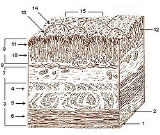
The lamina propria is a constituent of the moist linings known as mucous membranes or mucosa, which line various tubes in the body (such as the respiratory tract, the gastrointestinal tract, and the urogenital tract).
The lamina propria (more correctly lamina propria mucosæ) is a thin layer of loose connective tissue which lies beneath the epithelium
and together with the epithelium constitutes the mucosa. As its Latin name indicates it is a characteristic component of the mucosa, "the mucosa's own special layer". Thus the term mucosa or mucous membrane always refers to the combination of the epithelium plus the lamina propria.
The lamina propria contains capillaries and a central lacteal
(lymph vessel) in the small intestine
, as well as lymphoid tissue. Lamina propria also contains glands with the ducts opening on to the mucosal epithelium, that secrete mucus and serous secretions. The lamina propria is also rich in immune cells known as lymphocytes. A majority of these cells are IgA-secreting B cells.
The lamina propria (more correctly lamina propria mucosæ) is a thin layer of loose connective tissue which lies beneath the epithelium
Epithelium
Epithelium is one of the four basic types of animal tissue, along with connective tissue, muscle tissue and nervous tissue. Epithelial tissues line the cavities and surfaces of structures throughout the body, and also form many glands. Functions of epithelial cells include secretion, selective...
and together with the epithelium constitutes the mucosa. As its Latin name indicates it is a characteristic component of the mucosa, "the mucosa's own special layer". Thus the term mucosa or mucous membrane always refers to the combination of the epithelium plus the lamina propria.
The lamina propria contains capillaries and a central lacteal
Lacteal
A lacteal is a lymphatic capillary that absorbs dietary fats in the villi of the small intestine.Triglycerides are emulsified by bile and hydrolyzed by the enzyme lipase, resulting in a mixture of fatty acids and monoglycerides. These then pass from the intestinal lumen into the enterocyte, where...
(lymph vessel) in the small intestine
Small intestine
The small intestine is the part of the gastrointestinal tract following the stomach and followed by the large intestine, and is where much of the digestion and absorption of food takes place. In invertebrates such as worms, the terms "gastrointestinal tract" and "large intestine" are often used to...
, as well as lymphoid tissue. Lamina propria also contains glands with the ducts opening on to the mucosal epithelium, that secrete mucus and serous secretions. The lamina propria is also rich in immune cells known as lymphocytes. A majority of these cells are IgA-secreting B cells.
