


Lambrusco

Encyclopedia
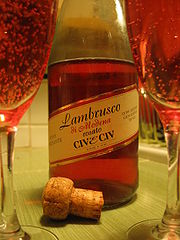
Lambrusco is the name of both a red wine
Wine
Wine is an alcoholic beverage, made of fermented fruit juice, usually from grapes. The natural chemical balance of grapes lets them ferment without the addition of sugars, acids, enzymes, or other nutrients. Grape wine is produced by fermenting crushed grapes using various types of yeast. Yeast...
grape
Grape
A grape is a non-climacteric fruit, specifically a berry, that grows on the perennial and deciduous woody vines of the genus Vitis. Grapes can be eaten raw or they can be used for making jam, juice, jelly, vinegar, wine, grape seed extracts, raisins, molasses and grape seed oil. Grapes are also...
and an Italian wine
Italian wine
Italian wine is wine produced in Italy, a country which is home to some of the oldest wine-producing regions in the world. Italy is the world's largest wine producer, responsible for approximately one-fifth of world wine production in 2005. Italian wine is exported largely around the world and has...
made principally from the grape. The grapes and the wine originate from four zones in Emilia-Romagna
Emilia-Romagna
Emilia–Romagna is an administrative region of Northern Italy comprising the two historic regions of Emilia and Romagna. The capital is Bologna; it has an area of and about 4.4 million inhabitants....
and one in Lombardy
Lombardy
Lombardy is one of the 20 regions of Italy. The capital is Milan. One-sixth of Italy's population lives in Lombardy and about one fifth of Italy's GDP is produced in this region, making it the most populous and richest region in the country and one of the richest in the whole of Europe...
, principally around the central provinces of Modena
Modena
Modena is a city and comune on the south side of the Po Valley, in the Province of Modena in the Emilia-Romagna region of Italy....
, Parma
Parma
Parma is a city in the Italian region of Emilia-Romagna famous for its ham, its cheese, its architecture and the fine countryside around it. This is the home of the University of Parma, one of the oldest universities in the world....
, Reggio nell'Emilia, and Mantua
Mantua
Mantua is a city and comune in Lombardy, Italy and capital of the province of the same name. Mantua's historic power and influence under the Gonzaga family, made it one of the main artistic, cultural and notably musical hubs of Northern Italy and the country as a whole...
. The grape has a long winemaking history with archaeological evidence indicating that the Etruscans
Etruscan civilization
Etruscan civilization is the modern English name given to a civilization of ancient Italy in the area corresponding roughly to Tuscany. The ancient Romans called its creators the Tusci or Etrusci...
cultivated the vine. In Roman times
Ancient Rome
Ancient Rome was a thriving civilization that grew on the Italian Peninsula as early as the 8th century BC. Located along the Mediterranean Sea and centered on the city of Rome, it expanded to one of the largest empires in the ancient world....
, the Lambrusco was highly valued for its productivity and high yield
Crop yield
In agriculture, crop yield is not only a measure of the yield of cereal per unit area of land under cultivation, yield is also the seed generation of the plant itself...
s with Cato the Elder
Cato the Elder
Marcus Porcius Cato was a Roman statesman, commonly referred to as Censorius , Sapiens , Priscus , or Major, Cato the Elder, or Cato the Censor, to distinguish him from his great-grandson, Cato the Younger.He came of an ancient Plebeian family who all were noted for some...
stating that produce of two thirds of an acre
Acre
The acre is a unit of area in a number of different systems, including the imperial and U.S. customary systems. The most commonly used acres today are the international acre and, in the United States, the survey acre. The most common use of the acre is to measure tracts of land.The acre is related...
could make enough wine to fill 300 amphora
Amphora
An amphora is a type of vase-shaped, usually ceramic container with two handles and a long neck narrower than the body...
s.
The most highly rated of its wines are the frothy, frizzante (slightly sparkling
Sparkling wine
Sparkling wine is a wine with significant levels of carbon dioxide in it making it fizzy. The carbon dioxide may result from natural fermentation, either in a bottle, as with the méthode champenoise, in a large tank designed to withstand the pressures involved , or as a result of carbon dioxide...
) red wines that are designed to be drank young from one of the five Lambrusco denominazione di origine controllata
Denominazione di Origine Controllata
Denominazione di origine controllata is a quality assurance label for food products, especially wines and various formaggi . It is modelled after the French AOC...
(DOC) regions: Lambrusco Grasparossa di Castelvetro, Lambrusco di Sorbara, Lambrusco Salamino di Santa Croce, Lambrusco Reggiano, and Lambrusco Mantovano
Province of Mantua
The Province of Mantua is a province in the Lombardy region of northern Italy. Its capital is the city of Mantua.-Communes:It includes 70 comuni , ranging in area from Viadana, with 102.19 km², to Mariana Mantovana, with 8.81 km²....
. Throughout the 1970s and 1980s, Lambrusco was the biggest selling import
Import
The term import is derived from the conceptual meaning as to bring in the goods and services into the port of a country. The buyer of such goods and services is referred to an "importer" who is based in the country of import whereas the overseas based seller is referred to as an "exporter". Thus...
wine in the United States
United States
The United States of America is a federal constitutional republic comprising fifty states and a federal district...
. During that time the wine was also produced in a white and rosé
Rosé
A rosé is a type of wine that has some of the color typical of a red wine, but only enough to turn it pink. The pink color can range from a pale orange to a vivid near-purple, depending on the grapes and wine making techniques.- Production techniques :There are three major ways to produce rosé...
style made by limiting the skin contact
Maceration (wine)
Maceration is the winemaking process where the phenolic materials of the grape— tannins, coloring agents and flavor compounds— are leached from the grape skins, seeds and stems into the must. Maceration is the process by which the red wine receives its red color, since 99% of all grape juice is...
with the must
Must
Must is freshly pressed fruit juice that contains the skins, seeds, and stems of the fruit. The solid portion of the must is called pomace; it typically makes up 7%–23% of the total weight of the must. Making must is the first step in winemaking...
.
Grape
The Lambrusco grape has shown itself prone to developing several clones and sub varieties to where there is no one singular "Lambrusco grape". The most commonly found clones are the Grasparossa, Maestri, Marani, Monstericco, Salamino and Sorbara. The grape vine are often trained high above the ground to prevent the development of mildewMildew
Mildew refers to certain kinds of molds or fungi.In Old English, it meant honeydew , and later came to mean mildew in the modern sense of mold or fungus....
. Historically the vines were trained to climb up poplar
Poplar
Populus is a genus of 25–35 species of deciduous flowering plants in the family Salicaceae, native to most of the Northern Hemisphere. English names variously applied to different species include poplar , aspen, and cottonwood....
trees. The grape itself is not particularly sweet but many of the sweet Lambrusco are made by either partial fermentation
Fermentation (wine)
The process of fermentation in wine turns grape juice into an alcoholic beverage. During fermentation, yeast interact with sugars in the juice to create ethanol, commonly known as ethyl alcohol, and carbon dioxide...
or with the addition of the sweeter Ancellotta
Ancellotta
Ancellotta is a wine grape variety mainly grown in the Emilia-Romagna region of Italy, but also in some other parts of north Italy, and in south Switzerland.-Wine regions:...
grapes to the blend. When not fermented sweet, the Lambrusco grape is capable of producing a dry wine with strawberry
Strawberry
Fragaria is a genus of flowering plants in the rose family, Rosaceae, commonly known as strawberries for their edible fruits. Although it is commonly thought that strawberries get their name from straw being used as a mulch in cultivating the plants, the etymology of the word is uncertain. There...
notes and a slight bitter finish.
By the end of the 20th century, ampelographers had identified over 60 varieties of Lambrusco scattered throughout Italy including-Piedmont
Piedmont
Piedmont is one of the 20 regions of Italy. It has an area of 25,402 square kilometres and a population of about 4.4 million. The capital of Piedmont is Turin. The main local language is Piedmontese. Occitan is also spoken by a minority in the Occitan Valleys situated in the Provinces of...
, Sicily
Sicily
Sicily is a region of Italy, and is the largest island in the Mediterranean Sea. Along with the surrounding minor islands, it constitutes an autonomous region of Italy, the Regione Autonoma Siciliana Sicily has a rich and unique culture, especially with regard to the arts, music, literature,...
and the Veneto
Veneto
Veneto is one of the 20 regions of Italy. Its population is about 5 million, ranking 5th in Italy.Veneto had been for more than a millennium an independent state, the Republic of Venice, until it was eventually annexed by Italy in 1866 after brief Austrian and French rule...
. The most widely planted variety is the Salamino clone.
Italian wine
Although traditional Lambrusco is an almost entirely cork-stopped, dry (secco) red wine, the Lambrusco Reggiano DOC is also used to make amabileSweetness of wine
The subjective sweetness of a wine is determined by the interaction of several factors, including the amount of sugar in the wine to be sure, but also the relative levels of alcohol, acids, and tannins. Briefly: sugars and alcohol enhance a wine's sweetness; acids and bitter tannins counteract it...
(slightly sweet) and dolce (sweet) versions of Lambrusco through use of up to 15 percent of the Ancellotta grape. Sweet Lambrusco wine became hugely popular in the United States in the late 1970s-1980s when over 3 million cases were exported there each year. The first dry, cork-finished, limited production DOC Lambrusco was introduced in the United States in 1995. The wine is noted for high acidity and berry flavors. Many of the wines now exported to the United State include a blend of Lambrusco from the different DOC and is sold under the Indicazione Geografica Tipica
Indicazione geografica tipica
Indicazione geografica tipica is the second of four classifications of wine recognized by the government of Italy. Created to recognize the unusually high quality of the class of wines known as Super Tuscans, IGT wines are labeled with the locality of their creation, but do not meet the...
(IGT) designation Emilia.
The wine is rarely made in a "champagne" style. It is typically made using the Charmat process where a second fermentation is conducted in a pressurized tank.
Wine regions
- Lambrusco Grasparossa di Castelvetro- The smallest wine producing region located south of the town of Modena. The region is home to the Grasparossa clone of which the DOC requires 85% of the wine to be composed of. The wine of this region is typically dry and full bodied with a deep purplish-red coloring. The Grasparossa clone produces the most tannic Lambrusco.
- Lambrusco Mantovano- The only Lambrusco region outside of Emilia-Romagna, in the LombardyLombardyLombardy is one of the 20 regions of Italy. The capital is Milan. One-sixth of Italy's population lives in Lombardy and about one fifth of Italy's GDP is produced in this region, making it the most populous and richest region in the country and one of the richest in the whole of Europe...
region. This style is typically dry but some semi-dry styles are also made. - Lambrusco Reggiano- The largest producing region of Lambrusco and the source of most of the exportExportThe term export is derived from the conceptual meaning as to ship the goods and services out of the port of a country. The seller of such goods and services is referred to as an "exporter" who is based in the country of export whereas the overseas based buyer is referred to as an "importer"...
ed DOC designated wines. The 4 clones of Lambrusco grape that can be used are Maestri, Marani, Monstericco and Salamino. Up to 15% of added Ancellotta grapes are permitted in the DOC as well. The sweet versions of the wine are typically in the light bodied frizzante style while the drier wines are more full bodied and darker in color. - Lambrusco Salamino di Santa Croce- Located 7 miles (11.3 km) west of the village Sorbara, the wines of this region must be composed of at least 90% of the local Salamino clone. The wines are typically light in color and body with a frizzante style being both made in both semi-sweet and dry styles. The clone gets its name from the resemblance of the grape clusters to a sausageSausageA sausage is a food usually made from ground meat , mixed with salt, herbs, and other spices, although vegetarian sausages are available. The word sausage is derived from Old French saussiche, from the Latin word salsus, meaning salted.Typically, a sausage is formed in a casing traditionally made...
of salamiSalamiSalami is cured sausage, fermented and air-dried meat, originating from one of a variety of animals. Historically, salami has been popular among Southern European peasants because it can be stored at room temperature for periods of up to 10 years, supplementing a possibly meager or inconsistent...
. - Lambrusco di Sorbara- Located north of Modena near the village of Sorbara, the Sorbara clone of Lambrusco is generally regarded as the highest quality clone producing the most fragrant wines. It has some similarities to the Salamino clone but produces a darker and more fuller bodied wine. The color can range from a deep ruby to a purplish hue. In this wine region only the Sorbara and Salamino clones are permitted in the DOC designated wine with at least 60% needing to be from the Sorbara. Along with the Salamino clone, the Sorbara varieties tend to produce the most acidic wines. One of the reasons why this clone tend to produce the highest quality Lambrusco is the tendency of the vine to drop its flowerFlowerA flower, sometimes known as a bloom or blossom, is the reproductive structure found in flowering plants . The biological function of a flower is to effect reproduction, usually by providing a mechanism for the union of sperm with eggs...
s which reduces yields and concentrates flavors.
Other regions
In AustraliaAustralia
Australia , officially the Commonwealth of Australia, is a country in the Southern Hemisphere comprising the mainland of the Australian continent, the island of Tasmania, and numerous smaller islands in the Indian and Pacific Oceans. It is the world's sixth-largest country by total area...
a number of cheaper bottled and box wine
Box wine
A box wine is a wine packaged as a Bag-In-Box. Such packages contain a plastic bladder protected by a box, usually made of corrugated fiberboard.- History :...
s are produced by Australian vineyards and sold as "Lambrusco". They are typically medium-sweet, around 10% ABV
Alcohol by volume
Alcohol by volume is a standard measure of how much alcohol is contained in an alcoholic beverage .The ABV standard is used worldwide....
and styled as an "easy drinking" product. In Argentina
Argentina
Argentina , officially the Argentine Republic , is the second largest country in South America by land area, after Brazil. It is constituted as a federation of 23 provinces and an autonomous city, Buenos Aires...
, the Maesini clone accounts for several hundred planted hectare
Hectare
The hectare is a metric unit of area defined as 10,000 square metres , and primarily used in the measurement of land. In 1795, when the metric system was introduced, the are was defined as being 100 square metres and the hectare was thus 100 ares or 1/100 km2...
s.
External links
- Consortium for the Historic Mark of Modenese Lambrusco
- Eric Asimov "Lambrusco, No Joke" New York Times July 26, 2006
- Emilia-Romagna map with details on Lambrusco wine