
All Topics  
Lake Nyos

 
Lake Nyos

   Email Print
   Bookmark   Link


Lake Nyos


Lake Nyos is a crater lake
Crater Lake

Crater Lake is a caldera lake located in the U.S. state of Oregon. It is the main feature of Crater Lake National Park and famous for its deep blue color and water clarity....
 in the Northwest Province of Cameroon
Cameroon

The Republic of Cameroon is a unitary state of central and western Africa. It is bordered by Nigeria to the west; Chad to the northeast; the Central African Republic to the east; and Equatorial Guinea, Gabon, and the Republic of the Congo to the south....
, located about northwest of Yaoundé
Yaoundé

Yaound?, , is the capital city of Cameroon and second largest city in the country after Douala. It lies in the centre of the nation at about 750 metres above sea level....
. Nyos is a deep lake high on the flank of an inactive volcano
Volcano

A volcano is an opening, or rupture, in a planet's surface or Crust , which allows hot, molten rock, ash, and gases to escape from below the surface....
 in the Oku
Oku

Oku is a region in the Northwest Province, Cameroon Cameroon. The term Oku also refers to the people who live in this region and the primary language that they speak ....
 volcanic plain along the Cameroon line
Cameroon line

The Cameroon line is a geologic fault or rift zone that extends along the border region of eastern Nigeria and western Cameroon, from Mount Cameroon on the Gulf of Guinea north and east towards Lake Chad....
 of volcanic activity. A natural dam
Dam

A dam is a barrier that Reservoirs surface water or underground streams. Dams generally serve the primary purpose of retaining water, while other structures such as floodgates, levees, and Dike are used to manage or prevent water flow into specific land regions....
 of volcanic rock
Volcanic rock

Volcanic rock is an igneous rock of Volcano origin.Texture Volcanic rocks are usually fine-grained or aphanitic to glassy in texture....
 hems in the lake waters.

A pocket of magma
Magma

Magma is molten Rock that is found beneath the surface of the Earth, and may also exist on other terrestrial planets. Besides molten rock, magma may also contain suspended crystals and gas bubbles....
 lies beneath the lake and leaks carbon dioxide
Carbon dioxide

Carbon dioxide is a chemical compound composed of two oxygen atoms covalent bond to a single carbon atom. It is a gas at standard temperature and pressure and exists in Earth's atmosphere in this state....
 (CO2) into the water, changing it into carbonic acid
Carbonic acid

Carbonic acid has the Molecular formula H2CO3. It is also a name sometimes given to solutions of carbon dioxide in water , which contain small amounts of H2CO3....
. Nyos is one of only three known lakes to be saturated with carbon dioxide in this way, the others being Lake Monoun
Lake Monoun

Lake Monoun is a lake in West Province, Cameroon, Cameroon that lies in the Oku Volcanic Field . On August 15, 1984, the lake exploded in a limnic eruption, which resulted in the release of a large amount of carbon dioxide that killed 37 people....
, at a distance of 100 km SSE, and Lake Kivu
Lake Kivu

Lake Kivu is one of the Great Lakes of Africa. It lies on the border between the Democratic Republic of the Congo and Rwanda, and is in the Albertine Rift, a part of the Great Rift Valley....
 in Rwanda
Rwanda

The Republic of Rwanda is a small landlocked country in the Great Lakes region of east-central Africa, bordered by Uganda, Burundi, the Democratic Republic of the Congo and Tanzania....
.


Discussion
Ask a question about 'Lake Nyos'
Start a new discussion about 'Lake Nyos'
Answer questions from other users
Full Discussion Forum


Encyclopedia


Lake Nyos is a crater lake
Crater Lake

Crater Lake is a caldera lake located in the U.S. state of Oregon. It is the main feature of Crater Lake National Park and famous for its deep blue color and water clarity....
 in the Northwest Province of Cameroon
Cameroon

The Republic of Cameroon is a unitary state of central and western Africa. It is bordered by Nigeria to the west; Chad to the northeast; the Central African Republic to the east; and Equatorial Guinea, Gabon, and the Republic of the Congo to the south....
, located about northwest of Yaoundé
Yaoundé

Yaound?, , is the capital city of Cameroon and second largest city in the country after Douala. It lies in the centre of the nation at about 750 metres above sea level....
. Nyos is a deep lake high on the flank of an inactive volcano
Volcano

A volcano is an opening, or rupture, in a planet's surface or Crust , which allows hot, molten rock, ash, and gases to escape from below the surface....
 in the Oku
Oku

Oku is a region in the Northwest Province, Cameroon Cameroon. The term Oku also refers to the people who live in this region and the primary language that they speak ....
 volcanic plain along the Cameroon line
Cameroon line

The Cameroon line is a geologic fault or rift zone that extends along the border region of eastern Nigeria and western Cameroon, from Mount Cameroon on the Gulf of Guinea north and east towards Lake Chad....
 of volcanic activity. A natural dam
Dam

A dam is a barrier that Reservoirs surface water or underground streams. Dams generally serve the primary purpose of retaining water, while other structures such as floodgates, levees, and Dike are used to manage or prevent water flow into specific land regions....
 of volcanic rock
Volcanic rock

Volcanic rock is an igneous rock of Volcano origin.Texture Volcanic rocks are usually fine-grained or aphanitic to glassy in texture....
 hems in the lake waters.

A pocket of magma
Magma

Magma is molten Rock that is found beneath the surface of the Earth, and may also exist on other terrestrial planets. Besides molten rock, magma may also contain suspended crystals and gas bubbles....
 lies beneath the lake and leaks carbon dioxide
Carbon dioxide

Carbon dioxide is a chemical compound composed of two oxygen atoms covalent bond to a single carbon atom. It is a gas at standard temperature and pressure and exists in Earth's atmosphere in this state....
 (CO2) into the water, changing it into carbonic acid
Carbonic acid

Carbonic acid has the Molecular formula H2CO3. It is also a name sometimes given to solutions of carbon dioxide in water , which contain small amounts of H2CO3....
. Nyos is one of only three known lakes to be saturated with carbon dioxide in this way, the others being Lake Monoun
Lake Monoun

Lake Monoun is a lake in West Province, Cameroon, Cameroon that lies in the Oku Volcanic Field . On August 15, 1984, the lake exploded in a limnic eruption, which resulted in the release of a large amount of carbon dioxide that killed 37 people....
, at a distance of 100 km SSE, and Lake Kivu
Lake Kivu

Lake Kivu is one of the Great Lakes of Africa. It lies on the border between the Democratic Republic of the Congo and Rwanda, and is in the Albertine Rift, a part of the Great Rift Valley....
 in Rwanda
Rwanda

The Republic of Rwanda is a small landlocked country in the Great Lakes region of east-central Africa, bordered by Uganda, Burundi, the Democratic Republic of the Congo and Tanzania....
. On August 21, 1986, possibly triggered by a landslide, the lake suddenly emitted a large cloud of CO2, which suffocated
Asphyxia

Asphyxia is a condition of severely deficient supply of oxygen to the body that arises from being unable to breathe normally. An example of asphyxia is choking....
 1,700 people and 3,500 livestock in nearby villages. Though not completely unprecedented, it was the first known large-scale asphyxiation caused by a natural event. To prevent a repetition, a degassing tube that syphons water from the bottom layers of water to the top allowing the carbon dioxide to leak in safe quantities was installed in 2001, though additional tubes are needed to make the lake safe.

Today, the lake also poses a threat due to its weakening natural wall. A geological tremor could cause this dike to give way, allowing water to rush into downstream villages all the way into Nigeria
Nigeria

Nigeria, officially the Federal Republic of Nigeria, is a federation constitutional republic comprising States of Nigeria and one Federal Capital Territory, Nigeria....
.

Setting

Lake Nyos lies within the Oku Volcanic Field, located near the northern boundary of the Cameroon Volcanic Line, a zone of volcanoes and other tectonic activity that extends southwest to the Mt. Cameroon stratovolcano. The field consists of volcanic maars and basaltic scoria cones.

Formation and geological history

Lake Nyos is located south of the dirt road from Wum
Wum

Wum is the Capital of Menchum division in the Northwest Province of Cameroon....
, about 30 km to the west, to Nkambe in the east. Villages along the road in the vicinity of the lake include Cha, Nyos, Munji, Djingbe, and Subum. The lake is 50 km from the Nigerian border to the north, and lies on the northern slopes of the Massif du Mbam, drained by streams running north, then northwest, to the Katsina-Ala River in Nigeria which is part of the Benue River
Benue River

File:Lagdomap.jpgThe Benue River is the major tributary of the Niger River. The river is approximately 1,400 km long and is almost entirely navigable during the summer months....
 basin.

Lake Nyos fills a roughly circular maar
Maar

A maar is a broad, low-relief volcanic crater that is caused by a phreatomagmatic eruption, an explosion caused by groundwater coming into contact with hot lava or magma....
 in the Oku Volcanic Field, an explosion crater caused when a lava flow interacted violently with groundwater
Groundwater

Groundwater is water located beneath the ground surface in soil porosity spaces and in the fractures of lithologic formations. A unit of rock or an unconsolidated deposit is called an aquifer when it can yield a usable quantity of water....
. The maar is believed to have formed in an eruption about 400 years ago, and is 1,800 m (5,900 ft) across and 208 m (682 ft) deep. The area has been volcanically active for millions of years—after South America
South America

South America is the southern continent of the Americas, situated entirely in the Western Hemisphere and mostly in the Southern Hemisphere, with a relatively small portion in the Northern Hemisphere....
 and Africa
Africa

Africa is the world's second-largest and second most-populous continent, after Asia. At about 30.2 million km? including adjacent islands, it covers 6% of the Earth's total surface area and 20.4% of the total land area....
 were split apart by plate tectonics
Plate tectonics

Plate tectonics describes the large scale motions of Earth's lithosphere. The theory encompasses the older concepts of continental drift, developed during the first decades of the 20th century by Alfred Wegener, and seafloor spreading, understood during the 1960s....
 about 110 million years ago, West Africa
West Africa

West Africa or Western Africa is the westernmost region of the African continent. Geopolitically, the United Nations subregion of Western Africa includes the following 16 countries distributed over an area of approximately 5 million square km:...
 also experienced rifting, although to a lesser degree. The rift is known as the Mbéré Rift Valley, and crust
Crust (geology)

In geology, a crust is the outermost solid shell of a planet or moon, which is chemically distinct from the underlying mantle . Crusts of Earth , our Moon, Mercury , Venus, and Mars have been generated largely by igneous processes, and these crusts are richer in incompatible elements than their respective mantle s....
al extension has allowed magma
Magma

Magma is molten Rock that is found beneath the surface of the Earth, and may also exist on other terrestrial planets. Besides molten rock, magma may also contain suspended crystals and gas bubbles....
 to reach the surface along a line extending through Cameroon. Mount Cameroon
Mount Cameroon

Mount Cameroon is an active volcano in Cameroon near the Gulf of Guinea. Mount Cameroon is also known as Cameroon Mountain or Fako or by its native name Mongo ma Ndemi ....
 also lies on this fault line. Lake Nyos is surrounded by old lava flows and pyroclastic
Pyroclastic flow

A pyroclastic flow is a common and devastating result of some volcano. The flows are fast-moving currents of hot gas and rock , which travel away from the volcano at speeds generally as great as 450 mi/h ....
 deposits.

Although Nyos is situated within an extinct volcano, magma still exists beneath it. Approximately 50 miles directly below the lake resides a pool of magma
Magma

Magma is molten Rock that is found beneath the surface of the Earth, and may also exist on other terrestrial planets. Besides molten rock, magma may also contain suspended crystals and gas bubbles....
, which lets off carbon dioxide and other gases; the gasses then travel upward through the earth. The fumes are then ensnared by the natural springs encircling the lake, ultimately rising to the surface of the water and leading into the lake. This was the cause for the presence of carbon dioxide and other gases contained within the lake.

The lake waters are held in place by a natural dam
Dam

A dam is a barrier that Reservoirs surface water or underground streams. Dams generally serve the primary purpose of retaining water, while other structures such as floodgates, levees, and Dike are used to manage or prevent water flow into specific land regions....
 composed of volcanic rock
Volcanic rock

Volcanic rock is an igneous rock of Volcano origin.Texture Volcanic rocks are usually fine-grained or aphanitic to glassy in texture....
. At its narrowest point, the wall measures 40 metres high and 45 metres wide.

Gas saturation


Lake Nyos is one of only three lakes in the world known to be saturated with carbon dioxide—the others are Lake Monoun
Lake Monoun

Lake Monoun is a lake in West Province, Cameroon, Cameroon that lies in the Oku Volcanic Field . On August 15, 1984, the lake exploded in a limnic eruption, which resulted in the release of a large amount of carbon dioxide that killed 37 people....
, also in Cameroon, and Lake Kivu
Lake Kivu

Lake Kivu is one of the Great Lakes of Africa. It lies on the border between the Democratic Republic of the Congo and Rwanda, and is in the Albertine Rift, a part of the Great Rift Valley....
 in Rwanda
Rwanda

The Republic of Rwanda is a small landlocked country in the Great Lakes region of east-central Africa, bordered by Uganda, Burundi, the Democratic Republic of the Congo and Tanzania....
. A magma chamber
Magma chamber

A magma chamber is a large underground pool of molten Rock lying under the surface of the earth's crust. The molten rock in such a chamber is under great pressure, and given enough time pressure can gradually fracture the rock around it creating outlets for the magma....
 beneath the region is an abundant source of carbon dioxide, which seeps up through the lake bed, charging the waters of Lake Nyos with an estimated 90 million tonne
Tonne

A tonne or metric ton , also referred to as a metric tonne, is a measurement of mass equal to 1,000 kilograms, or 2204.6226 pounds....
s of CO2.

Lake Nyos is thermally stratified, with layers of warm, less dense water near the surface floating on the colder, denser water layers near the lake's bottom. Over long periods, carbon dioxide gas seeping into the cold water at the lake's bottom is dissolved in great amounts.

Most of the time, the lake is stable and the CO2 remains in solution in the lower layers. However, over time the water becomes supersaturated
Supersaturation

The term supersaturation refers to a solution that contains more of the dissolved material than could be dissolved by the solvent under normal circumstances....
, and if an event such as an earthquake
Earthquake

An earthquake is the result of a sudden release of energy in the Earth's crust that creates seismic waves. Earthquakes are recorded with a seismometer, also known as a seismograph....
 or volcanic eruption occurs, large amounts of CO2 may suddenly come out of solution.

The 1986 disaster

Cow Killed By Lake Nyos Gasses
Although a sudden outgassing of CO2 had occurred at Lake Monoun
Lake Monoun

Lake Monoun is a lake in West Province, Cameroon, Cameroon that lies in the Oku Volcanic Field . On August 15, 1984, the lake exploded in a limnic eruption, which resulted in the release of a large amount of carbon dioxide that killed 37 people....
 in 1984, killing 37 local residents, a similar threat from Lake Nyos was not anticipated. However, on August 21, 1986, a limnic eruption
Limnic eruption

A limnic eruption, also referred to as a lake overturn, is a rare type of natural disaster in which carbon dioxide suddenly erupts from deep lake water, suffocating wildlife, livestock and humans....
 occurred at Lake Nyos which triggered the sudden release of about 1.6 million tonne
Tonne

A tonne or metric ton , also referred to as a metric tonne, is a measurement of mass equal to 1,000 kilograms, or 2204.6226 pounds....
s of CO2; this cloud rose at nearly per hour. The gas spilled over the northern lip of the lake into a valley running roughly east-west from Cha to Subum, and then rushed down two valleys branching off it to the north, displacing all the air and suffocating some 1,700 people within of the lake, mostly rural villagers, as well as 3,500 livestock. Worst affected villages were Cha, Nyos, and Subum. Scientists concluded from evidence that a fountain of water and foam formed at the surface of the lake. The sudden amount of water rising caused much turbulence in the water, spanning a wave of at least 80 feet that would scour shore of one side.

One survivor described himself when he awoke after the gases had struck:

"I could not speak. I became unconscious. I could not open my mouth because then I smelled something terrible . . . I heard my daughter snoring in a terrible way, very abnormal . . . When crossing to my daughter's bed . . . I collapsed and fell. I was there till nine o'clock in the (Friday) morning . . . until a friend of mine came and knocked at my door . . . I was surprised to see that my trousers were red, had some stains like honey. I saw some . . . starchy mess on my body. My arms had some wounds . . . I didn't really know how I got these wounds . . .I opened the door . . . I wanted to speak, my breath would not come out . . . My daughter was already dead . . . I went into my daughter's bed, thinking that she was still sleeping. I slept till it was 4:30 p.m. in the afternoon . . . on Friday. (Then) I managed to go over to my neighbors' houses. They were all dead . . . I decided to leave . . . . (because) most of my family was in Wum . . . I got my motorcycle . . . A friend whose father had died left with me (for) Wum . . . As I rode . . . through Nyos I didn't see any sign of any living thing . . . (When I got to Wum), I was unable to walk, even to talk . . . my body was completely weak."


Carbon dioxide, being about 1.5 times as dense as air, caused the cloud to "hug" the ground and descend down the valleys where various villages were located. The mass was about thick and it traveled downward at a rate of per hour. For roughly the cloud remained condensed and dangerous, suffocating many of the people sleeping in Nyos, Kam, Cha, and Subum. About 4,000 inhabitants fled the area, and many of these developed respiratory problems, lesions, and paralysis as a result of the gases.

It is not known what triggered the catastrophic outgassing. Most geologists suspect a landslide, but some believe that a small volcanic eruption may have occurred on the bed of the lake. A third possibility is that cool rainwater falling on one side of the lake triggered the overturn. Whatever the cause, the event resulted in the rapid mixing of the supersaturated deep water with the upper layers of the lake, where the reduced pressure allowed the stored CO2 to effervesce
Effervescence (chemistry)

Effervescence is the escape of gas from an aqueous solution. The term is used to describe the foaming or fizzing that results from a release of gas....
 out of solution.

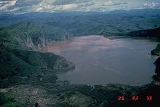
It is believed that up to a cubic kilometre of gas was released. The normally blue waters of the lake turned a deep red after the outgassing, due to iron
Iron

Iron is a chemical element with the symbol Fe and atomic number 26. Iron is a Group 8 element and period 4 element. Iron is lustrous and silvery in color....
-rich water from the deep rising to the surface and being oxidised by the air. The level of the lake dropped by about a metre, representing the volume of gas released. The outgassing probably also caused an overflow of the waters of the lake. Trees near the lake were knocked down.

Medical problems

Following the eruption, many survivors were treated at the main hospital in Yaoundé, the country's capital. Doctors found that many of the victims had been partially poisoned by the mixture of such gases as hydrogen
Hydrogen

Hydrogen is the chemical element with atomic number 1. It is represented by the chemical symbol H. At standard temperature and pressure, hydrogen is a colorless, odorless, nonmetallic, tasteless, highly combustion and explosive Diatomic molecule gas with the molecular formula H2....
 and sulfur
Sulfur

Sulfur or sulphur is the chemical element that has the atomic number 16. It is denoted with the symbol S. It is an abundant Valence non-metal....
. He described that poisoning by these gases would lead to burning pains in the eyes and nose, coughing and signs of asphyxiation similar to being strangled, as like "being gassed by a kitchen stove".

Following the disaster, the lake was dubbed the "Deadliest lake" by Guinness World Records
Guinness World Records

Guinness World Records, known until 2000 as The Guinness Book of Records , is a reference book published annually, containing an internationally recognized...
 in 2008.

Degassing

Limnic Degassing1
The scale of the disaster led to much study on how a recurrence could be prevented. Estimates of the rate of carbon dioxide entering the lake suggested that outgassings could occur every 10–30 years, though a recent study shows that release of water from the lake, caused by erosion of the natural barrier that keeps in the lake's water, could in turn reduce pressure on the lake's carbon dioxide and cause a gas escape much sooner.

Several researchers independently proposed the installation of degassing columns from rafts in the lake. The principle is simple: a pump lifts water from the bottom of the lake, heavily saturated with CO2, until the loss of pressure begins releasing the gas from the diphasic fluid and thus makes the process self-powered. In 1992 at Monoun, and in 1995 at Nyos, a French team demonstrated the feasibility of this approach. In 2001, the US Office of Foreign Disaster Assistance
Office of Foreign Disaster Assistance

The Office of U.S. Foreign Disaster Assistance is an organizational unit within the U.S. Agency for International Development that has delegated responsible for directing and coordinating U.S....
 funded a permanent installation at Nyos.

More pipes are expected to be needed to make the lake safe: the original French estimates called for a total of five, and the current OFDA project calls for an additional two pipes, each with ten times the capacity of the single current pipe.

Following the Lake Nyos tragedy, scientists investigated other African lakes to see if a similar phenomenon could happen elsewhere. Lake Kivu
Lake Kivu

Lake Kivu is one of the Great Lakes of Africa. It lies on the border between the Democratic Republic of the Congo and Rwanda, and is in the Albertine Rift, a part of the Great Rift Valley....
 in Rwanda
Rwanda

The Republic of Rwanda is a small landlocked country in the Great Lakes region of east-central Africa, bordered by Uganda, Burundi, the Democratic Republic of the Congo and Tanzania....
, 2,000 times larger than Lake Nyos, was found also to be supersaturated, and geologists found evidence for outgassing events around the lake about every thousand years. The eruption of nearby Mount Nyiragongo
Mount Nyiragongo

Mount Nyiragongo is a stratovolcano in the Virunga Mountains associated with the Great Rift Valley. It is located in the Democratic Republic of the Congo, about 20 km north of the town of Goma and Lake Kivu and just west of the border with Rwanda....
 in 2002 sent lava
Lava

Lava is molten Rock expelled by a volcano during an eruption. When first expelled from a volcanic vent, it is a liquid at temperatures from 700 ?C to 1,200 ?C ....
 flowing into the lake, raising fears that a gas eruption could be triggered, but fortunately it was not, as the flow of lava stopped well before it got near the bottom layers of the lake where the gas is.

Weakening dam


On August 18, 2005, Dr. Isaac Njilah, a geologist at the University of Yaoundé
University of Yaoundé

The University of Yaound? is a leading university in Cameroon, located in Yaound?.It was built with the help of France and opened in 1962 as the Federal University of Yaound?, dropping the "Federal" in 1972 when the country was reorganized....
, suggested that the natural dam
Dam

A dam is a barrier that Reservoirs surface water or underground streams. Dams generally serve the primary purpose of retaining water, while other structures such as floodgates, levees, and Dike are used to manage or prevent water flow into specific land regions....
 of volcanic rock
Volcanic rock

Volcanic rock is an igneous rock of Volcano origin.Texture Volcanic rocks are usually fine-grained or aphanitic to glassy in texture....
 that keeps in the lake's waters could collapse in the near future. Erosion
Erosion

For morphological image processing operations, see Erosion 'For use of in dermatopathology, see Erosion Erosion is the removal of solids in the natural environment....
 has worn the dam away, causing holes and pockets to develop in the dam's upper layer, and water already passes through the lower section. Meanwhile, landslides have reduced dam strength on the outside. Seismic activity caused by the lake's volcanic foundation could thus cause the lake wall to give way, resulting in up to 50 million cubic metres of water flooding downhill into areas of the Northwest Province and the Nigeria
Nigeria

Nigeria, officially the Federal Republic of Nigeria, is a federation constitutional republic comprising States of Nigeria and one Federal Capital Territory, Nigeria....
n states of Taraba
Taraba

Taraba can refer to:* Taraba State* Taraba River* Taraba, the genus of the Great Antshrike...
 and Benue. Dr. Njilah estimates that the area is home to more than 10,000 people.

The Cameroonian government, speaking through Dr. Gregory Tanyi-Leke of the Institute of Mining and Geological Research, acknowledges the weakening wall but denies that it presents any immediate threat. A United Nations
United Nations

The United Nations is an international organization whose stated aims are to facilitate cooperation in international law, international security, economic development, Social change, human rights and achieving world peace....
 team led by Olaf Van Duin and Nisa Nurmohamed of the Netherlands
Netherlands

The Netherlands is a country that is part of the Kingdom of the Netherlands. It is a parliamentary democratic constitutional monarchy. The Netherlands is located in North-West Europe, and bordered by the North Sea to the north and west, Belgium to the south, and Germany to the east....
 Ministry of Transport and Public Works inspected the dam over three days in September 2005 and confirmed that the natural lip had weakened. Van Duin believes that the dam will breach in the next 10 or 20 years.

One possible means of averting such a catastrophe would be to strengthen the lake wall, though this would take much time and money. Engineers could also introduce a channel to allow excess water to drain; if the water level were lowered by about 20 metres, the pressure on the wall would be reduced significantly.

See also

  • Limnic eruption
    Limnic eruption

    A limnic eruption, also referred to as a lake overturn, is a rare type of natural disaster in which carbon dioxide suddenly erupts from deep lake water, suffocating wildlife, livestock and humans....
  • Mazuku
    Mazuku

    A mazuku is the geological name given to pockets of oxygen-poor air which can be lethal to any human or animal life inside. The term comes from Swahili and means "evil wind." Mazukus are created when an odorless and invisible gas such as carbon dioxide accumulates in pockets low to the ground....
  • Meromictic Lakes
  • Henry's Law
    Henry's law

    In chemistry, Henry's law is one of the gas laws, formulated by William Henry in 1803. It states that:An equivalent way of stating the law is that the solubility of a gas in a liquid is proportional to the pressure of that gas above the liquid....
  • Raoult's Law
    Raoult's law

    Established by Fran?ois-Marie Raoult, Raoult's law states:Once the components in the solution have reached chemical equilibrium, the total vapor pressure p of the solution is:...
  • Lake Monoun
    Lake Monoun

    Lake Monoun is a lake in West Province, Cameroon, Cameroon that lies in the Oku Volcanic Field . On August 15, 1984, the lake exploded in a limnic eruption, which resulted in the release of a large amount of carbon dioxide that killed 37 people....
  • Lake Kivu
    Lake Kivu

    Lake Kivu is one of the Great Lakes of Africa. It lies on the border between the Democratic Republic of the Congo and Rwanda, and is in the Albertine Rift, a part of the Great Rift Valley....
  • Disasters


External links

  • BBC Horizon episode
  • , Smithsonian magazine
  • — article from The Guardian
    The Guardian

    Sorry, no overview for this topic
     newspaper
  • - Latvia
    Latvia

    Latvia The Latvians are a Baltic peoples culturally related to the Estonians and Lithuanians, with the Latvian language having many similarities with Lithuanian language, but not with the Estonian language....
    n research by Nataliya Anatolievna Solodovnik and Anatoliy Borisovich Solodovnik
  • A similar problem at Lake Kivu and plans to deal with it
  • reprinted from Uncle John’s Bathroom Reader: World of Odd.