

La bohème

Encyclopedia
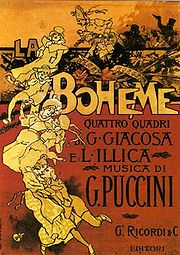
La bohème is an opera
in four acts,Puccini called the divisions quadro, a tableau or "image", rather than atto (act). by Giacomo Puccini
to an Italian libretto
by Luigi Illica
and Giuseppe Giacosa
, based on Scènes de la vie de bohème
by Henri Murger
. The world premiere performance of La bohème was in Turin on 1 February 1896 at the Teatro Regio and conducted by the young Arturo Toscanini
. Since then, La bohème has become part of the standard Italian opera repertory and is one of the most frequently performed operas internationally. According to Operabase, it is the fourth most frequently performed opera worldwide. In 1946, fifty years after the opera's premiere, Toscanini conducted a performance of it on radio with the NBC Symphony Orchestra
. This performance was eventually released on records and on Compact Disc
. It is the only recording of a Puccini opera by its original conductor (see Recordings below).
 According to its title page, the libretto of La bohème is based on Henri Murger
's novel, Scènes de la vie de bohème
, a collection of vignettes portraying young bohemian
s living in the Latin Quarter of Paris in the 1840s. Although usually called a novel, it has no unified plot. Like the 1849 play by Murger and Théodore Barrière
, the opera's libretto focuses on the relationship between Rodolfo and Mimì, ending with her death. Also like the play, the libretto combines two characters from the novel, Mimì and Francine, into a single Mimì character.
Much of the libretto is original. The main plots of acts two and three are the librettists' invention, with only a few passing references to incidents and characters in Murger. Most of acts one and four follow the novel, piecing together episodes from various chapters. The final scenes in acts one and four —the scenes with Rodolfo and Mimì— resemble both the play and the novel. The story of their meeting closely follows chapter 18 of the novel, in which the two lovers living in the garret are not Rodolphe and Mimì at all, but rather Jacques and Francine. The story of Mimì's death in the opera draws from two different chapters in the novel, one relating Francine's death and the other relating Mimì's.
The published libretto includes a note from the librettists briefly discussing their adaptation. Without mentioning the play directly, they defend their conflation of Francine and Mimì into a single character: "Chi puo non confondere nel delicato profilo di una sola donna quelli di Mimì e di Francine?" ("Who cannot detect in the delicate profile of one woman the personality both of Mimì and of Francine?") At the time, the novel was in the public domain, Murger having died without heirs, but rights to the play were still controlled by Barrière's heirs.
. The opera quickly became popular throughout Italy and productions were soon mounted by the following companies: The Teatro di San Carlo
(14 March 1896, with Elisa Petri as Musetta and Antonio Magini-Coletti
as Marcello); The Teatro Comunale di Bologna
(4 November 1896, with Amelia Sedelmayer as Musetta and Umberto Beduschi as Rodolfo); The Teatro Costanzi
(17 November 1896, with Maria Stuarda Savelli as Mimì, Enrico Giannini-Grifoni as Rodolfo, and Maurizio Bensaude
as Marcello); La Scala
(15 March 1897, with Angelica Pandolfini as Mimì, Camilla Pasini
as Musetta, Fernando De Lucia
as Rodolfo, and Edoardo Camera as Marcello); La Fenice
(26 December 1897, with Emilia Merolla as Mimì, Maria Martelli as Musetta, Giovanni Apostolu and Franco Mannucci as Rodolfo, and Ferruccio Corradetti as Marcello); Teatro Regio di Parma (29 January 1898, with Solomiya Krushelnytska as Mimì, Lina Cassandro as Musetta, Pietro Ferrari as Rodolfo, and Pietro Giacomello as Marcello); And the Teatro Donizetti di Bergamo (21 August 1898, with Emilia Corsi as Mimì, Annita Barone as Musetta, Giovanni Apostolu as Rodolfo, and Giovanni Roussel as Marcello).
The first performance of La bohème outside Italy was at the Teatro Colón in Buenos Aires, Argentina, on 16 June 1896. The opera was given in Alexandria, Lisbon, and Moscow in early 1897. The United Kingdom premiere took place at the Theatre Royal in Manchester, on 22 April 1897, in a presentation by the Carl Rosa Opera Company
supervised by Puccini. This performance was given in English and starred Alice Esty
as Mimì, Bessie McDonald as Musetta, Robert Cunningham as Rodolfo, and William Paull as Marcello. On 2 October 1897 the same company gave the opera's first staging at the Royal Opera House
in London and on 14 October 1897 in Los Angeles for the opera's United States premiere. The opera reached New York City on 16 May 1898 when it was performed at Palmo's Opera House with Giuseppe Agostini as Rodolfo. The first production of the opera actually produced by the Royal Opera House itself premiered on 1 July 1899 with Nellie Melba
as Mimì, Zélie de Lussan
as Musetta, Fernando De Lucia
as Rodolfo, and Mario Ancona
as Marcello.
La bohème premiered in Germany at the Kroll Opera House in Berlin on 22 June 1897. The French premiere of the opera was presented by the Opéra-Comique
on 13 June 1898 at the Théâtre des Nations
. The production used a French translation by Paul Ferrier
and starred Julia Guiraudon as Mimì, Jeanne Tiphaine as Musetta, Adolphe Maréchal
as Rodolfo, and Lucien Fugère
as Marcello. The Czech premiere of the opera was presented by the National Theatre
on 27 February 1898.
on 25 October 1900 using Ferrier's French translation with Marie Thiérry as Mimì, Léon David as Rodolfo, Eugène-Charles Badiali as Marcello, sets by Pierre Devis, Armand Lynen, and Albert Dubosq, and Philippe Flon conducting. The Metropolitan Opera
staged the work for the first time on 26 December 1900 with Nellie Melba
as Mimì, Annita Occhiolini-Rizzini as Musetta, Albert Saléza as Rodolfo, Giuseppe Campanari
as Marcello, and Luigi Mancinelli
conducting.
The opera was first presented in Brazil at the Teatro Amazonas
in Manaus on 2 July 1901 with Elvira Miotti as Mimì, Mabel Nelma as Musetta, Michele Sigaldi as Rodolfo, and Enrico De Franceschi as Marcello. Other premieres soon followed:
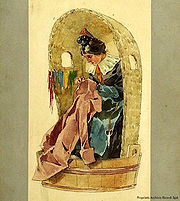
 It essentially focuses on the love between the seamstress called Mimì and the poet Rodolfo. They almost immediately fall in love with each other, but Rodolfo later wants to leave Mimì because of her flirtatious behavior. However, Mimì also happens to be mortally ill, and Rodolfo also feels guilt, since their life together likely had worsened her health even further. They reunite for a brief moment at the end before Mimì dies.
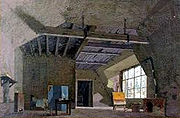
Marcello is painting while Rodolfo gazes out of the window. In order to keep warm, they burn the manuscript of Rodolfo's drama. Colline, the philosopher, enters shivering and disgruntled at not having been able to pawn
some books. Schaunard, the musician of the group, arrives with food, firewood, wine, cigars, and money, and he explains the source of his riches, a job with an eccentric English gentleman
. The others hardly listen to his tale as they fall ravenously upon the food. Schaunard interrupts them by whisking the meal away and declaring that they will all celebrate his good fortune by dining at Cafe Momus instead.
While they drink, Benoît, the landlord, arrives to collect the rent. They flatter him and ply him with wine. In his drunkenness, he recites his amorous adventures, but when he also declares he is married, they thrust him from the room —without the rent payment— in comic moral indignation. The rent money is divided for their carousal in the Quartier Latin.
The other Bohemians go out, but Rodolfo remains alone for a moment in order to finish an article he is writing, promising to join his friends soon. There is a knock at the door, and Mimì, a seamstress who lives in another room in the building, enters. Her candle has blown out, and she has no matches; she asks Rodolfo to light it. She thanks him, but returns a few seconds later, saying she has lost her key. Both candles are extinguished; the pair stumble in the dark. Rodolfo, eager to spend time with Mimì, finds the key and pockets it, feigning innocence. In two arias (Rodolfo's Che gelida manina – "What a cold little hand" and Mimì's Sì, mi chiamano Mimì – "Yes, they call me Mimì"), they tell each other about their different backgrounds. Impatiently, the waiting friends call Rodolfo, but, while he suggests remaining at home with Mimì, she decides to accompany him. As they leave, they sing of their newfound love (duet, Rodolfo and Mimì: O soave fanciulla – "Oh gentle maiden").
A great crowd, along with children, has gathered with street sellers announcing their wares (chorus: Aranci, datteri! Caldi i marroni! – "Oranges, dates! Hot chestnuts!"). The friends appear, flushed with gaiety; Rodolfo buys Mimì a bonnet from a vendor. Parisians gossip with friends and bargain with the vendors; the children of the streets clamor to see the wares of Parpignol, the toy seller. The friends enter the Cafe Momus.
As the men and Mimì dine at the cafe, Musetta, formerly Marcello's sweetheart, arrives with her rich (and aging) government minister admirer, Alcindoro, to whom she speaks as she might to a lapdog. It is clear she has tired of him. To the delight of the Parisians and the embarrassment of her patron, she sings a risqué song (Musetta's waltz: Quando me'n vo' – "When I go along"), hoping to reclaim Marcello's attention. Soon Marcello is burning with jealousy. To be rid of Alcindoro for a bit, Musetta pretends to be suffering from a tight shoe and sends him with it to the shoemaker to be fixed. During the melee that follows, Musetta and Marcello fall into each other's arms and reconcile.
The friends are presented with the bill and to their consternation find that Schaunard's money is not enough to pay it. The sly Musetta has the entire bill charged to Alcindoro. The sound of approaching soldiers is heard, and, picking up Musetta, Marcello and Colline carry her out on their shoulders amid the applause of the spectators. When all have gone, Alcindoro arrives with the repaired shoe seeking Musetta. The waiter hands him the bill, and, horror-stricken at the charge, Alcindoro sinks into a chair.
Peddlers pass through the barriers and enter the city. Amongst them is Mimì, coughing violently. She tries to find Marcello, who lives in a little tavern nearby where he paints signs for the innkeeper. She tells him of her hard life with Rodolfo, who has abandoned her that night (O buon Marcello, aiuto! – "Oh, good Marcello, help me!"). Marcello tells her that Rodolfo is asleep inside, but he wakes up and comes out looking for Marcello. Mimì hides and overhears Rodolfo first telling Marcello that he left Mimì because of her coquettishness, but finally confessing that he fears she is slowly being consumed by a deadly illness (most likely tuberculosis
, known by the catchall name "consumption" in the nineteenth century). Rodolfo, in his poverty, can do little to help Mimì and hopes that his pretended unkindness will inspire her to seek another, wealthier suitor (Marcello, finalmente – "Marcello, finally"). Out of kindness towards Mimì, Marcello tries to silence him, but she has already heard all. Her coughing reveals her presence, and Rodolfo and Mimì sing of their lost love. They make plans to separate amicably (Mimì: Donde lieta uscì – "From here she happily left"), but their love for one another is too strong. As a compromise, they agree to remain together until the spring, when the world is coming to life again and no one feels truly alone. Meanwhile, Marcello has joined Musetta, and the couple quarrel fiercely: an antithetical counterpoint to the other pair's reconciliation (quartet: Mimì, Rodolfo, Musetta, Marcello: Addio dolce svegliare alla mattina! – "Goodbye, sweet awakening in the morning!").
Marcello and Rodolfo are seemingly at work, though they are primarily bemoaning the loss of their respective loves (duet: O Mimì, tu più non torni – "O Mimì, will you not return?"). Schaunard and Colline arrive with a very frugal dinner and all parody
eating a plentiful banquet, dance together, and sing. Musetta arrives with news: Mimì, who took up with a wealthy viscount after leaving Rodolfo in the spring, has left her patron. Musetta has found her wandering the streets, severely weakened by her illness, and has brought her back to the garret. Mimì, haggard and pale, is assisted into a chair. Musetta and Marcello leave to sell Musetta's earrings in order to buy medicine, and Colline leaves to pawn his overcoat (Vecchia zimarra – "Old coat"). Schaunard, urged by Colline, quietly departs to give Mimì and Rodolfo time together. Left alone, they recall their past happiness (duet, Mimì and Rodolfo: Sono andati? – "Have they gone?"). They relive their first meeting —the candles, the lost key— and, to Mimì's delight, Rodolfo presents her with the pink bonnet he bought her, which he has kept as a souvenir of their love. The others return, with a gift of a muff to warm Mimì's hands and some medicine. They tell Rodolfo that a doctor has been summoned, but Mimì lapses into unconsciousness. As Musetta prays, Mimì dies. Schaunard discovers Mimì lifeless. Rodolfo cries Mimì's name in anguish, and weeps helplessly.
 The discography of La bohème is a long one with many distinguished recordings, including the 1973 RCA Victor conducted by Sir Georg Solti
with Montserrat Caballé
as Mimì and Plácido Domingo
as Rodolfo which won the 1974 Grammy Award
for Best Opera Recording. The earliest commercially released full-length recording was probably that recorded in February 1917 and released on the Italian label La Voce del Padrone
. Carlo Sabajno
conducted the La Scala
Orchestra and Chorus with Gemma Bosini and Remo Andreini as Mimì and Rodolfo. One of the most recent is the 2008 Deutsche Grammophon
release conducted by Bertrand de Billy
with Anna Netrebko
and Rolando Villazón
as Mimì and Rodolfo.
There are several recordings with conductors closely associated with Puccini. In the 1946 RCA Victor release, Arturo Toscanini
, who conducted the world premiere of the opera, conducts the NBC Symphony Orchestra with Jan Peerce
as Rodolfo and Licia Albanese
as Mimì. It is the only recording of a Puccini opera by its original conductor. Thomas Beecham
, who worked closely with Puccini when preparing a 1920 production of La bohème in London, conducted a performance of the opera in English released by Columbia Records in 1936 with Lisa Perli
as Mimì and Heddle Nash
as Rodolfo. Beecham also conducts on the 1956 RCA Victor recording with Victoria de los Ángeles
and Jussi Björling
as Mimì and as Rodolfo.
Although the vast majority of recordings are in the original Italian, the opera has been recorded in several other languages. These include: a recording in French conducted by Erasmo Ghiglia with Renée Doria
and Alain Vanzo
as Mimì and Rodolfo (1960); a recording in German with Richard Kraus conducting the Deutsche Oper Berlin
Orchestra and Chorus with Trude Eipperle
and Fritz Wunderlich
as Mimì and Rodolfo (1956); and the 1998 release on the Chandos Opera in English
label with David Parry
conducting the Philharmonia Orchestra
and Cynthia Haymon
and Dennis O'Neill
as Mimì and Rodolfo.
Enrico Caruso, who was closely associated with the role of Rodolfo, never recorded a full version of the opera but recorded several extracts beginning with one on cylinder
in 1906. Rodolfo's famous aria "Che gelida manina" was recorded not only by Caruso but by nearly 500 other tenors in at least seven different languages between 1900 and 1980. In 1981 the A.N.N.A. Record Company released a six LP
set with 101 different tenors singing the aria.
The "missing act" is located in the timeline between the Café Momus scene and Act 3 and describes an open-air party at Musetta's dwelling. Her protector has refused to pay further rent out of jealous feelings, and Musetta's furniture is moved into the courtyard to be auctioned off the following morning. The four Bohemians find in this an excuse for a party and arrange for wine and an orchestra. Musetta gives Mimì a beautiful gown to wear and introduces her to a Viscount. The pair dances a quadrille in the courtyard, which moves Rodolfo to jealousy. This explains his Act 3 reference to the "moscardino di Viscontino" (young fop of a Viscount). As dawn approaches, furniture dealers gradually remove pieces for the morning auction.
for the 1959 pop song "Don't You Know?
", a hit for Della Reese
. The opera was also adapted into a 1983 short story
form by the novelist V. S. Pritchett
for publication by the Metropolitan Opera
Association.
La Bohème. Una piccola storia sull'immortalità dell'amore e dell'amicizia by Carollina Fabinger is an illustrated version in Italian for young readers published by Nuages, Milano 2009, ISBN 9788886178891.
produced the opera for Opera Australia
in 1990 with modernized supertitle
translations, and a budget of only A$
60,000. A DVD was issued of the stage show. This version was set in 1957, rather than the original period of 1830. The reason for updating La bohème to this period, according to Baz Luhrmann, was that "... [they] discovered that 1957 was a very, very accurate match for the social and economic realities of Paris in the 1840s." In 2002, Luhrmann restaged his version on Broadway
and won a Tony Award
. To play the eight performances per week on Broadway, three casts of Mimìs and Rodolfos, and two Musettas and Marcellos, were used in rotation.
Rent
, a 1996 musical by Jonathan Larson
, is based on La bohème. Here the lovers, Roger and Mimi, are faced with AIDS
and progress through the action with songs such as "Light My Candle", which have direct reference to La bohème. Many of the character names are retained or are similar (e.g. the character Angel is given the surname "Schunard"), and at another point in the play, Roger's roommate and best friend Mark makes a wry reference to "Musetta's Waltz", which is a recurring theme throughout the first act and is played at the end of the second act.
Opera
Opera is an art form in which singers and musicians perform a dramatic work combining text and musical score, usually in a theatrical setting. Opera incorporates many of the elements of spoken theatre, such as acting, scenery, and costumes and sometimes includes dance...
in four acts,Puccini called the divisions quadro, a tableau or "image", rather than atto (act). by Giacomo Puccini
Giacomo Puccini
Giacomo Antonio Domenico Michele Secondo Maria Puccini was an Italian composer whose operas, including La bohème, Tosca, Madama Butterfly, and Turandot, are among the most frequently performed in the standard repertoire...
to an Italian libretto
Libretto
A libretto is the text used in an extended musical work such as an opera, operetta, masque, oratorio, cantata, or musical. The term "libretto" is also sometimes used to refer to the text of major liturgical works, such as mass, requiem, and sacred cantata, or even the story line of a...
by Luigi Illica
Luigi Illica
Luigi Illica was an Italian librettist who wrote for Giacomo Puccini , Alfredo Catalani, Umberto Giordano, Baron Alberto Franchetti and other important Italian composers. His most famous opera librettos are those for La bohème, Tosca, Madama Butterfly and Andrea Chénier.Illica was born at...
and Giuseppe Giacosa
Giuseppe Giacosa
Giuseppe Giacosa was an Italian poet, playwright and librettist.He was born in Colleretto Parella, now Colleretto Giacosa, near Turin. His father was a magistrate. Giuseppe went to the University of Turin, studying in the University of Turin, Faculty of Law...
, based on Scènes de la vie de bohème
La Vie de Bohème
La Vie de Bohème is a work by Henry Murger, published in 1851. Although it is commonly called a novel, it doesn't follow a standard novel form. Rather, it is a collection of loosely related stories, all set in the Latin Quarter of Paris in the 1840s, romanticizing bohemian life in a playful way...
by Henri Murger
Henri Murger
Louis-Henri Murger, also known as Henri Murger and Henry Murger was a French novelist and poet....
. The world premiere performance of La bohème was in Turin on 1 February 1896 at the Teatro Regio and conducted by the young Arturo Toscanini
Arturo Toscanini
Arturo Toscanini was an Italian conductor. One of the most acclaimed musicians of the late 19th and 20th century, he was renowned for his intensity, his perfectionism, his ear for orchestral detail and sonority, and his photographic memory...
. Since then, La bohème has become part of the standard Italian opera repertory and is one of the most frequently performed operas internationally. According to Operabase, it is the fourth most frequently performed opera worldwide. In 1946, fifty years after the opera's premiere, Toscanini conducted a performance of it on radio with the NBC Symphony Orchestra
NBC Symphony Orchestra
The NBC Symphony Orchestra was a radio orchestra established by David Sarnoff of the National Broadcasting Company especially for conductor Arturo Toscanini...
. This performance was eventually released on records and on Compact Disc
Compact Disc
The Compact Disc is an optical disc used to store digital data. It was originally developed to store and playback sound recordings exclusively, but later expanded to encompass data storage , write-once audio and data storage , rewritable media , Video Compact Discs , Super Video Compact Discs ,...
. It is the only recording of a Puccini opera by its original conductor (see Recordings below).
Origin of the story
Henri Murger
Louis-Henri Murger, also known as Henri Murger and Henry Murger was a French novelist and poet....
's novel, Scènes de la vie de bohème
La Vie de Bohème
La Vie de Bohème is a work by Henry Murger, published in 1851. Although it is commonly called a novel, it doesn't follow a standard novel form. Rather, it is a collection of loosely related stories, all set in the Latin Quarter of Paris in the 1840s, romanticizing bohemian life in a playful way...
, a collection of vignettes portraying young bohemian
Bohemianism
Bohemianism is the practice of an unconventional lifestyle, often in the company of like-minded people, with few permanent ties, involving musical, artistic or literary pursuits...
s living in the Latin Quarter of Paris in the 1840s. Although usually called a novel, it has no unified plot. Like the 1849 play by Murger and Théodore Barrière
Theodore Barrière
Théodore Barrière , French dramatist, was born in Paris.He belonged to a family of map engravers which had long been connected with the war department, and spent nine years in that service himself...
, the opera's libretto focuses on the relationship between Rodolfo and Mimì, ending with her death. Also like the play, the libretto combines two characters from the novel, Mimì and Francine, into a single Mimì character.
Much of the libretto is original. The main plots of acts two and three are the librettists' invention, with only a few passing references to incidents and characters in Murger. Most of acts one and four follow the novel, piecing together episodes from various chapters. The final scenes in acts one and four —the scenes with Rodolfo and Mimì— resemble both the play and the novel. The story of their meeting closely follows chapter 18 of the novel, in which the two lovers living in the garret are not Rodolphe and Mimì at all, but rather Jacques and Francine. The story of Mimì's death in the opera draws from two different chapters in the novel, one relating Francine's death and the other relating Mimì's.
The published libretto includes a note from the librettists briefly discussing their adaptation. Without mentioning the play directly, they defend their conflation of Francine and Mimì into a single character: "Chi puo non confondere nel delicato profilo di una sola donna quelli di Mimì e di Francine?" ("Who cannot detect in the delicate profile of one woman the personality both of Mimì and of Francine?") At the time, the novel was in the public domain, Murger having died without heirs, but rights to the play were still controlled by Barrière's heirs.
Initial success
The world première performance of La bohème took place in Turin on 1 February 1896 at the Teatro Regio and was conducted by the young Arturo ToscaniniArturo Toscanini
Arturo Toscanini was an Italian conductor. One of the most acclaimed musicians of the late 19th and 20th century, he was renowned for his intensity, his perfectionism, his ear for orchestral detail and sonority, and his photographic memory...
. The opera quickly became popular throughout Italy and productions were soon mounted by the following companies: The Teatro di San Carlo
Teatro di San Carlo
The Real Teatro di San Carlo is an opera house in Naples, Italy. It is the oldest continuously active such venue in Europe.Founded by the Bourbon Charles VII of Naples of the Spanish branch of the dynasty, the theatre was inaugurated on 4 November 1737 — the king's name day — with a performance...
(14 March 1896, with Elisa Petri as Musetta and Antonio Magini-Coletti
Antonio Magini-Coletti
Antonio Magini-Coletti was a leading Italian baritone who had a prolific career in Europe and the United States during the late 19th century and the early part of the 20th century. A versatile artist, he appeared in several opera world premieres but was particularly associated with the works of...
as Marcello); The Teatro Comunale di Bologna
Teatro Comunale di Bologna
The Teatro Comunale di Bologna is an opera house in Bologna, Italy, and is one of the most important opera venues in Italy. Typically, it presents eight operas with six performances during its November to April season....
(4 November 1896, with Amelia Sedelmayer as Musetta and Umberto Beduschi as Rodolfo); The Teatro Costanzi
Teatro dell'Opera di Roma
The Teatro dell'Opera di Roma is an opera house in Rome, Italy. Originally opened in November 1880 as the 2,212 seat Costanzi Theatre, it has undergone several changes of name as well modifications and improvements...
(17 November 1896, with Maria Stuarda Savelli as Mimì, Enrico Giannini-Grifoni as Rodolfo, and Maurizio Bensaude
Maurizio Bensaude
Maurício Bensaúde , was a Portuguese operatic baritone...
as Marcello); La Scala
La Scala
La Scala , is a world renowned opera house in Milan, Italy. The theatre was inaugurated on 3 August 1778 and was originally known as the New Royal-Ducal Theatre at La Scala...
(15 March 1897, with Angelica Pandolfini as Mimì, Camilla Pasini
Camilla Pasini
Camilla Pasini was an Italian operatic soprano. Her sister Lina Pasini-Vitale was a well known Wagnerian soprano and her other sister, Enrica Pasini, had a short career as an operatic mezzo-soprano...
as Musetta, Fernando De Lucia
Fernando De Lucia
Fernando De Lucia was an Italian opera tenor and singing teacher who enjoyed an international career....
as Rodolfo, and Edoardo Camera as Marcello); La Fenice
La Fenice
Teatro La Fenice is an opera house in Venice, Italy. It is one of the most famous theatres in Europe, the site of many famous operatic premieres. Its name reflects its role in permitting an opera company to "rise from the ashes" despite losing the use of two theatres...
(26 December 1897, with Emilia Merolla as Mimì, Maria Martelli as Musetta, Giovanni Apostolu and Franco Mannucci as Rodolfo, and Ferruccio Corradetti as Marcello); Teatro Regio di Parma (29 January 1898, with Solomiya Krushelnytska as Mimì, Lina Cassandro as Musetta, Pietro Ferrari as Rodolfo, and Pietro Giacomello as Marcello); And the Teatro Donizetti di Bergamo (21 August 1898, with Emilia Corsi as Mimì, Annita Barone as Musetta, Giovanni Apostolu as Rodolfo, and Giovanni Roussel as Marcello).
The first performance of La bohème outside Italy was at the Teatro Colón in Buenos Aires, Argentina, on 16 June 1896. The opera was given in Alexandria, Lisbon, and Moscow in early 1897. The United Kingdom premiere took place at the Theatre Royal in Manchester, on 22 April 1897, in a presentation by the Carl Rosa Opera Company
Carl Rosa Opera Company
The Carl Rosa Opera Company was founded in 1873 by Carl August Nicholas Rosa, a German-born musical impresario, to present opera in English in London and the British provinces. The company survived Rosa's death in 1889, and continued to present opera in English on tour until 1960, when it was...
supervised by Puccini. This performance was given in English and starred Alice Esty
Alice Esty (soprano)
Alice Esty was an American-born operatic soprano who spent most of her career based in England.Born in Lowell, Massachusetts, she married in 1892.Esty died in Farnham, Surrey at the age of 71 . -References:...
as Mimì, Bessie McDonald as Musetta, Robert Cunningham as Rodolfo, and William Paull as Marcello. On 2 October 1897 the same company gave the opera's first staging at the Royal Opera House
Royal Opera House
The Royal Opera House is an opera house and major performing arts venue in Covent Garden, central London. The large building is often referred to as simply "Covent Garden", after a previous use of the site of the opera house's original construction in 1732. It is the home of The Royal Opera, The...
in London and on 14 October 1897 in Los Angeles for the opera's United States premiere. The opera reached New York City on 16 May 1898 when it was performed at Palmo's Opera House with Giuseppe Agostini as Rodolfo. The first production of the opera actually produced by the Royal Opera House itself premiered on 1 July 1899 with Nellie Melba
Nellie Melba
Dame Nellie Melba GBE , born Helen "Nellie" Porter Mitchell, was an Australian operatic soprano. She became one of the most famous singers of the late Victorian Era and the early 20th century...
as Mimì, Zélie de Lussan
Zélie de Lussan
Zélie de Lussan was an American opera singer of French descent who was successful in her native country but made most of her career in England. The wide range of her voice allowed her to sing both mezzo-soprano and soprano roles. Among de Lussan's most famous roles was the title role in Georges...
as Musetta, Fernando De Lucia
Fernando De Lucia
Fernando De Lucia was an Italian opera tenor and singing teacher who enjoyed an international career....
as Rodolfo, and Mario Ancona
Mario Ancona
Mario Ancona , was a leading Italian baritone and master of bel canto singing. He appeared at some of the most important opera houses in Europe and America during what is commonly referred to as the "Golden Age of Opera".-Career:Ancona was born into a middle-class Jewish family at Livorno, Tuscany,...
as Marcello.
La bohème premiered in Germany at the Kroll Opera House in Berlin on 22 June 1897. The French premiere of the opera was presented by the Opéra-Comique
Opéra-Comique
The Opéra-Comique is a Parisian opera company, which was founded around 1714 by some of the popular theatres of the Parisian fairs. In 1762 the company was merged with, and for a time took the name of its chief rival the Comédie-Italienne at the Hôtel de Bourgogne, and was also called the...
on 13 June 1898 at the Théâtre des Nations
Théâtre de la Ville
The Théâtre de la Ville is one of the two theatres built in the 19th century by Baron Haussmann at Place du Châtelet, Paris; the other being the Théâtre du Châtelet...
. The production used a French translation by Paul Ferrier
Paul Ferrier
Paul Ferrier , French dramatist, was born at Montpellier.He had already produced several comedies when in 1873 he secured real success with two short pieces, Chez l'avocat and Les Incendies de Massoulard. Others of his numerous plays are Les Compensations ; L'Art de tramper les femmes , with M...
and starred Julia Guiraudon as Mimì, Jeanne Tiphaine as Musetta, Adolphe Maréchal
Adolphe Maréchal
Adolphe Maréchal was a Belgian tenor whose career in the French and Italian repertoire took him to France and England.-Life and career:...
as Rodolfo, and Lucien Fugère
Lucien Fugère
Lucien Fugère was a French baritone, particularly associated with the French repertory and Mozart roles, he enjoyed an exceptionally long career, singing into his 80s.- Life and career :...
as Marcello. The Czech premiere of the opera was presented by the National Theatre
National Theatre (Prague)
The National Theatre in Prague is known as the Alma Mater of Czech opera, and as the national monument of Czech history and art.The National Theatre belongs to the most important Czech cultural institutions, with a rich artistic tradition which was created and maintained by the most distinguished...
on 27 February 1898.
20th century
La bohème continued to gain international popularity throughout the early 20th century and the Opéra-Comique alone had already presented the opera one hundred times by 1903. The Belgian premiere took place at La MonnaieLa Monnaie
Le Théâtre Royal de la Monnaie , or the Koninklijke Muntschouwburg is a theatre in Brussels, Belgium....
on 25 October 1900 using Ferrier's French translation with Marie Thiérry as Mimì, Léon David as Rodolfo, Eugène-Charles Badiali as Marcello, sets by Pierre Devis, Armand Lynen, and Albert Dubosq, and Philippe Flon conducting. The Metropolitan Opera
Metropolitan Opera
The Metropolitan Opera is an opera company, located in New York City. Originally founded in 1880, the company gave its first performance on October 22, 1883. The company is operated by the non-profit Metropolitan Opera Association, with Peter Gelb as general manager...
staged the work for the first time on 26 December 1900 with Nellie Melba
Nellie Melba
Dame Nellie Melba GBE , born Helen "Nellie" Porter Mitchell, was an Australian operatic soprano. She became one of the most famous singers of the late Victorian Era and the early 20th century...
as Mimì, Annita Occhiolini-Rizzini as Musetta, Albert Saléza as Rodolfo, Giuseppe Campanari
Giuseppe Campanari
Giuseppe Campanari Cooke gives his date of birth as 17 November 1858 but this is unlikely given the d.o.b. of his brother Leandro. was an Italian-born operatic baritone and cellist...
as Marcello, and Luigi Mancinelli
Luigi Mancinelli
Luigi Mancinelli was a leading Italian orchestral conductor. He also composed music for the stage and concert hall and played the cello....
conducting.
The opera was first presented in Brazil at the Teatro Amazonas
Amazon Theatre
300px|thumb|Teatro Amazonas in [[Manaus]]The Amazon Theatre is an opera house located in the heart of Manaus, inside the Amazon Rainforest in Brazil. It is the location of the annual Festival Amazonas de Ópera held in April.It was built during the Belle Époque at a time when fortunes were made in...
in Manaus on 2 July 1901 with Elvira Miotti as Mimì, Mabel Nelma as Musetta, Michele Sigaldi as Rodolfo, and Enrico De Franceschi as Marcello. Other premieres soon followed:
- Melbourne: 13 July 1901 (Her Majesty's TheatreHer Majesty's Theatre, MelbourneHer Majesty's Theatre is a 1706 seat theatre in Melbourne, Australia. Built in 1886, it is located at 219 Exhibition Street, Melbourne. It is classified by the National Trust of Australia and is listed on the Victorian Heritage Register....
; first performance in Australia) - Monaco: 1 February 1902, Opéra de Monte-CarloOpéra de Monte-CarloThe Opéra de Monte-Carlo is an opera house located in the principality of Monaco.With the lack of cultural diversions available in Monaco in the 1870s, Prince Charles III, along with the Société des Bains de Mer, decided on the construction of an opera house. Initially, it was Charles III's...
in Monte Carlo with Nellie Melba as Mimì, Enrico Caruso as Rodolfo, Alexis BoyerAlexis BoyerAlexis Boyer was a French surgeon, born in Corrèze.He was the son of a tailor, and he obtained his first medical knowledge in the shop of a barber surgeon. When he moved to Paris, he had the good fortune to attract the attention of renowned surgeons Antoine Louis and Pierre-Joseph Desault...
as Marcello, and Léon Jehin conducting. - PratoPratoPrato is a city and comune in Tuscany, Italy, the capital of the Province of Prato. The city is situated at the foot of Monte Retaia , the last peak in the Calvana chain. The lowest altitude in the comune is 32 m, near the Cascine di Tavola, and the highest is the peak of Monte Cantagrillo...
: 25 December 1902, Regio Teatro Metastasio with Ulderica Persichini as Mimì, Norma Sella as Musetta, Ariodante Quarti as Rodolfo, and Amleto Pollastri as Marcello. - CataniaCataniaCatania is an Italian city on the east coast of Sicily facing the Ionian Sea, between Messina and Syracuse. It is the capital of the homonymous province, and with 298,957 inhabitants it is the second-largest city in Sicily and the tenth in Italy.Catania is known to have a seismic history and...
: 9 July 1903, Politeama Pacini with Isabella Costa Orbellini as Mimì, Lina Gismondi as Musetta, Elvino Ventura as Rodolfo, and Alfredo Costa as Marcello. - Austria: 25 November 1903, Vienna State OperaVienna State OperaThe Vienna State Opera is an opera house – and opera company – with a history dating back to the mid-19th century. It is located in the centre of Vienna, Austria. It was originally called the Vienna Court Opera . In 1920, with the replacement of the Habsburg Monarchy by the First Austrian...
in Vienna with Selma KurzSelma KurzSelma Kurz was an Austrian operatic soprano known for her brilliant coloratura technique.-Background:...
as Mimì, Marie Gutheil-SchoderMarie Gutheil-SchoderMarie Gutheil-Schoder was one of the most important German sopranos of her day.Born Marie Schoder, in 1899 she married Gustav Gutheil, with whom she lived until his death in 1914....
as Musetta, Fritz Schrödter as Rodolfo, Gerhard Stehmann as Marcello, and Gustav MahlerGustav MahlerGustav Mahler was a late-Romantic Austrian composer and one of the leading conductors of his generation. He was born in the village of Kalischt, Bohemia, in what was then Austria-Hungary, now Kaliště in the Czech Republic...
conducting. - Sweden: 19 May 1905, Royal Dramatic TheatreRoyal Dramatic TheatreThe Royal Dramatic Theatre is Sweden's national stage for "spoken drama", founded in 1788. Around one thousand shows are put on annually on the theatre's eight running stages....
in Stockholm, presented by the Royal Swedish OperaRoyal Swedish OperaKungliga Operan is Sweden's national stage for opera and ballet.-Location and Environment:...
with Maria LabiaMaria LabiaMaria Labia was an Italian operatic soprano who was particularly associated with roles of the verisimo repertoire.-Career:...
as Mimì.
Roles
| Role | Voice type Voice type A voice type is a particular kind of human singing voice perceived as having certain identifying qualities or characteristics. Voice classification is the process by which human voices are evaluated and are thereby designated into voice types... |
Premiere cast, 1 February 1896 (Conductor Conducting Conducting is the art of directing a musical performance by way of visible gestures. The primary duties of the conductor are to unify performers, set the tempo, execute clear preparations and beats, and to listen critically and shape the sound of the ensemble... : Arturo Toscanini Arturo Toscanini Arturo Toscanini was an Italian conductor. One of the most acclaimed musicians of the late 19th and 20th century, he was renowned for his intensity, his perfectionism, his ear for orchestral detail and sonority, and his photographic memory... ) |
|---|---|---|
| Rodolfo, a poet | tenor Tenor The tenor is a type of male singing voice and is the highest male voice within the modal register. The typical tenor voice lies between C3, the C one octave below middle C, to the A above middle C in choral music, and up to high C in solo work. The low extreme for tenors is roughly B2... |
Evan Gorga Evan Gorga Evangelista Gennaro Gorga was an Italian lyric tenor. He is best known for originating the role of Rodolfo in the original production of Giacomo Puccini's La bohème at the Teatro Regio Torino in 1896.-Early life:... |
| Mimì, a seamstress | soprano Soprano A soprano is a voice type with a vocal range from approximately middle C to "high A" in choral music, or to "soprano C" or higher in operatic music. In four-part chorale style harmony, the soprano takes the highest part, which usually encompasses the melody... |
Cesira Ferrani Cesira Ferrani Cesira Ferrani was an Italian operatic soprano who is best known for debuting two of the most iconic roles in opera history, Mimì in the original 1896 production of Giacomo Puccini's La bohème and the title role in Puccini's Manon Lescaut in its 1893 world premiere... |
| Marcello, a painter | baritone Baritone Baritone is a type of male singing voice that lies between the bass and tenor voices. It is the most common male voice. Originally from the Greek , meaning deep sounding, music for this voice is typically written in the range from the second F below middle C to the F above middle C Baritone (or... |
Tieste Wilmant Tieste Wilmant Tieste Wilmant was an Italian operatic baritone. He made his professional opera debut in 1878 in Chiari. In 1896 he originated the role of Marcello in the original production of Giacomo Puccini's La bohème at the Teatro Regio Torino in 1896... |
| Musetta, a singer | soprano | Camilla Pasini Camilla Pasini Camilla Pasini was an Italian operatic soprano. Her sister Lina Pasini-Vitale was a well known Wagnerian soprano and her other sister, Enrica Pasini, had a short career as an operatic mezzo-soprano... |
| Schaunard, a musician | baritone | Antonio Pini-Corsi Antonio Pini-Corsi Antonio Pini-Corsi was an Italian operatic baritone of international renown. He possessed a ripe-toned voice of great flexibility and displayed tremendous skill at patter singing... |
| Colline, a philosopher | bass Bass (voice type) A bass is a type of male singing voice and possesses the lowest vocal range of all voice types. According to The New Grove Dictionary of Opera, a bass is typically classified as having a range extending from around the second E below middle C to the E above middle C... |
Michele Mazzara |
| Benoît, their landlord | bass | Alessandro Polonini Alessandro Polonini Alessandro Polonini was an Italian bass-baritone. He created the roles of Benoît and Alcindoro in Puccini's opera, La bohème, as well as Geronte de Ravoir in his Manon Lescaut... |
| Alcindoro, a state councillor | bass | Alessandro Polonini |
| Parpignol, a toy vendor | tenor | Dante Zucchi |
| A customs Sergeant | bass | Felice Fogli |
| Students, working girls, townsfolk, shopkeepers, street-vendors, soldiers, waiters, children | ||
Synopsis
The story is set in Paris in the period around 1830.Act 1
In the four bohemians' garretAttic
An attic is a space found directly below the pitched roof of a house or other building . Attic is generally the American/Canadian reference to it...
Marcello is painting while Rodolfo gazes out of the window. In order to keep warm, they burn the manuscript of Rodolfo's drama. Colline, the philosopher, enters shivering and disgruntled at not having been able to pawn
Pawnbroker
A pawnbroker is an individual or business that offers secured loans to people, with items of personal property used as collateral...
some books. Schaunard, the musician of the group, arrives with food, firewood, wine, cigars, and money, and he explains the source of his riches, a job with an eccentric English gentleman
Gentleman
The term gentleman , in its original and strict signification, denoted a well-educated man of good family and distinction, analogous to the Latin generosus...
. The others hardly listen to his tale as they fall ravenously upon the food. Schaunard interrupts them by whisking the meal away and declaring that they will all celebrate his good fortune by dining at Cafe Momus instead.
While they drink, Benoît, the landlord, arrives to collect the rent. They flatter him and ply him with wine. In his drunkenness, he recites his amorous adventures, but when he also declares he is married, they thrust him from the room —without the rent payment— in comic moral indignation. The rent money is divided for their carousal in the Quartier Latin.
The other Bohemians go out, but Rodolfo remains alone for a moment in order to finish an article he is writing, promising to join his friends soon. There is a knock at the door, and Mimì, a seamstress who lives in another room in the building, enters. Her candle has blown out, and she has no matches; she asks Rodolfo to light it. She thanks him, but returns a few seconds later, saying she has lost her key. Both candles are extinguished; the pair stumble in the dark. Rodolfo, eager to spend time with Mimì, finds the key and pockets it, feigning innocence. In two arias (Rodolfo's Che gelida manina – "What a cold little hand" and Mimì's Sì, mi chiamano Mimì – "Yes, they call me Mimì"), they tell each other about their different backgrounds. Impatiently, the waiting friends call Rodolfo, but, while he suggests remaining at home with Mimì, she decides to accompany him. As they leave, they sing of their newfound love (duet, Rodolfo and Mimì: O soave fanciulla – "Oh gentle maiden").
Act 2
Quartier LatinA great crowd, along with children, has gathered with street sellers announcing their wares (chorus: Aranci, datteri! Caldi i marroni! – "Oranges, dates! Hot chestnuts!"). The friends appear, flushed with gaiety; Rodolfo buys Mimì a bonnet from a vendor. Parisians gossip with friends and bargain with the vendors; the children of the streets clamor to see the wares of Parpignol, the toy seller. The friends enter the Cafe Momus.
As the men and Mimì dine at the cafe, Musetta, formerly Marcello's sweetheart, arrives with her rich (and aging) government minister admirer, Alcindoro, to whom she speaks as she might to a lapdog. It is clear she has tired of him. To the delight of the Parisians and the embarrassment of her patron, she sings a risqué song (Musetta's waltz: Quando me'n vo' – "When I go along"), hoping to reclaim Marcello's attention. Soon Marcello is burning with jealousy. To be rid of Alcindoro for a bit, Musetta pretends to be suffering from a tight shoe and sends him with it to the shoemaker to be fixed. During the melee that follows, Musetta and Marcello fall into each other's arms and reconcile.
The friends are presented with the bill and to their consternation find that Schaunard's money is not enough to pay it. The sly Musetta has the entire bill charged to Alcindoro. The sound of approaching soldiers is heard, and, picking up Musetta, Marcello and Colline carry her out on their shoulders amid the applause of the spectators. When all have gone, Alcindoro arrives with the repaired shoe seeking Musetta. The waiter hands him the bill, and, horror-stricken at the charge, Alcindoro sinks into a chair.
Act 3
At the toll gatePeddlers pass through the barriers and enter the city. Amongst them is Mimì, coughing violently. She tries to find Marcello, who lives in a little tavern nearby where he paints signs for the innkeeper. She tells him of her hard life with Rodolfo, who has abandoned her that night (O buon Marcello, aiuto! – "Oh, good Marcello, help me!"). Marcello tells her that Rodolfo is asleep inside, but he wakes up and comes out looking for Marcello. Mimì hides and overhears Rodolfo first telling Marcello that he left Mimì because of her coquettishness, but finally confessing that he fears she is slowly being consumed by a deadly illness (most likely tuberculosis
Tuberculosis
Tuberculosis, MTB, or TB is a common, and in many cases lethal, infectious disease caused by various strains of mycobacteria, usually Mycobacterium tuberculosis. Tuberculosis usually attacks the lungs but can also affect other parts of the body...
, known by the catchall name "consumption" in the nineteenth century). Rodolfo, in his poverty, can do little to help Mimì and hopes that his pretended unkindness will inspire her to seek another, wealthier suitor (Marcello, finalmente – "Marcello, finally"). Out of kindness towards Mimì, Marcello tries to silence him, but she has already heard all. Her coughing reveals her presence, and Rodolfo and Mimì sing of their lost love. They make plans to separate amicably (Mimì: Donde lieta uscì – "From here she happily left"), but their love for one another is too strong. As a compromise, they agree to remain together until the spring, when the world is coming to life again and no one feels truly alone. Meanwhile, Marcello has joined Musetta, and the couple quarrel fiercely: an antithetical counterpoint to the other pair's reconciliation (quartet: Mimì, Rodolfo, Musetta, Marcello: Addio dolce svegliare alla mattina! – "Goodbye, sweet awakening in the morning!").
Act 4
Back in the garretMarcello and Rodolfo are seemingly at work, though they are primarily bemoaning the loss of their respective loves (duet: O Mimì, tu più non torni – "O Mimì, will you not return?"). Schaunard and Colline arrive with a very frugal dinner and all parody
Parody
A parody , in current usage, is an imitative work created to mock, comment on, or trivialise an original work, its subject, author, style, or some other target, by means of humorous, satiric or ironic imitation...
eating a plentiful banquet, dance together, and sing. Musetta arrives with news: Mimì, who took up with a wealthy viscount after leaving Rodolfo in the spring, has left her patron. Musetta has found her wandering the streets, severely weakened by her illness, and has brought her back to the garret. Mimì, haggard and pale, is assisted into a chair. Musetta and Marcello leave to sell Musetta's earrings in order to buy medicine, and Colline leaves to pawn his overcoat (Vecchia zimarra – "Old coat"). Schaunard, urged by Colline, quietly departs to give Mimì and Rodolfo time together. Left alone, they recall their past happiness (duet, Mimì and Rodolfo: Sono andati? – "Have they gone?"). They relive their first meeting —the candles, the lost key— and, to Mimì's delight, Rodolfo presents her with the pink bonnet he bought her, which he has kept as a souvenir of their love. The others return, with a gift of a muff to warm Mimì's hands and some medicine. They tell Rodolfo that a doctor has been summoned, but Mimì lapses into unconsciousness. As Musetta prays, Mimì dies. Schaunard discovers Mimì lifeless. Rodolfo cries Mimì's name in anguish, and weeps helplessly.
Instrumentation
La bohème is scored for:- woodwindWoodwind instrumentA woodwind instrument is a musical instrument which produces sound when the player blows air against a sharp edge or through a reed, causing the air within its resonator to vibrate...
: 2 fluteFluteThe flute is a musical instrument of the woodwind family. Unlike woodwind instruments with reeds, a flute is an aerophone or reedless wind instrument that produces its sound from the flow of air across an opening...
s, piccoloPiccoloThe piccolo is a half-size flute, and a member of the woodwind family of musical instruments. The piccolo has the same fingerings as its larger sibling, the standard transverse flute, but the sound it produces is an octave higher than written...
, 2 oboeOboeThe oboe is a double reed musical instrument of the woodwind family. In English, prior to 1770, the instrument was called "hautbois" , "hoboy", or "French hoboy". The spelling "oboe" was adopted into English ca...
s, cor anglaisCor anglaisThe cor anglais , or English horn , is a double-reed woodwind instrument in the oboe family....
, 2 clarinetClarinetThe clarinet is a musical instrument of woodwind type. The name derives from adding the suffix -et to the Italian word clarino , as the first clarinets had a strident tone similar to that of a trumpet. The instrument has an approximately cylindrical bore, and uses a single reed...
s in A and B flat, bass clarinetBass clarinetThe bass clarinet is a musical instrument of the clarinet family. Like the more common soprano B clarinet, it is usually pitched in B , but it plays notes an octave below the soprano B clarinet...
in A and B flat, 2 bassoonBassoonThe bassoon is a woodwind instrument in the double reed family that typically plays music written in the bass and tenor registers, and occasionally higher. Appearing in its modern form in the 19th century, the bassoon figures prominently in orchestral, concert band and chamber music literature...
s - brassBrass instrumentA brass instrument is a musical instrument whose sound is produced by sympathetic vibration of air in a tubular resonator in sympathy with the vibration of the player's lips...
: 4 hornHorn (instrument)The horn is a brass instrument consisting of about of tubing wrapped into a coil with a flared bell. A musician who plays the horn is called a horn player ....
s in F, 3 trumpetTrumpetThe trumpet is the musical instrument with the highest register in the brass family. Trumpets are among the oldest musical instruments, dating back to at least 1500 BCE. They are played by blowing air through closed lips, producing a "buzzing" sound which starts a standing wave vibration in the air...
s in F, 3 tromboneTromboneThe trombone is a musical instrument in the brass family. Like all brass instruments, sound is produced when the player’s vibrating lips cause the air column inside the instrument to vibrate...
s, bass trombone - PercussionPercussion instrumentA percussion instrument is any object which produces a sound when hit with an implement or when it is shaken, rubbed, scraped, or otherwise acted upon in a way that sets the object into vibration...
: timpaniTimpaniTimpani, or kettledrums, are musical instruments in the percussion family. A type of drum, they consist of a skin called a head stretched over a large bowl traditionally made of copper. They are played by striking the head with a specialized drum stick called a timpani stick or timpani mallet...
, snare drumSnare drumThe snare drum or side drum is a melodic percussion instrument with strands of snares made of curled metal wire, metal cable, plastic cable, or gut cords stretched across the drumhead, typically the bottom. Pipe and tabor and some military snare drums often have a second set of snares on the bottom...
, triangleTriangle (instrument)The triangle is an idiophone type of musical instrument in the percussion family. It is a bar of metal, usually steel but sometimes other metals like beryllium copper, bent into a triangle shape. The instrument is usually held by a loop of some form of thread or wire at the top curve...
, cymbalCymbalCymbals are a common percussion instrument. Cymbals consist of thin, normally round plates of various alloys; see cymbal making for a discussion of their manufacture. The greater majority of cymbals are of indefinite pitch, although small disc-shaped cymbals based on ancient designs sound a...
s, bass drumBass drumBass drums are percussion instruments that can vary in size and are used in several musical genres. Three major types of bass drums can be distinguished. The type usually seen or heard in orchestral, ensemble or concert band music is the orchestral, or concert bass drum . It is the largest drum of...
, xylophoneXylophoneThe xylophone is a musical instrument in the percussion family that consists of wooden bars struck by mallets...
, glockenspielGlockenspielA glockenspiel is a percussion instrument composed of a set of tuned keys arranged in the fashion of the keyboard of a piano. In this way, it is similar to the xylophone; however, the xylophone's bars are made of wood, while the glockenspiel's are metal plates or tubes, and making it a metallophone...
, chimes - stringsString instrumentA string instrument is a musical instrument that produces sound by means of vibrating strings. In the Hornbostel-Sachs scheme of musical instrument classification, used in organology, they are called chordophones...
: harpHarpThe harp is a multi-stringed instrument which has the plane of its strings positioned perpendicularly to the soundboard. Organologically, it is in the general category of chordophones and has its own sub category . All harps have a neck, resonator and strings...
, violinViolinThe violin is a string instrument, usually with four strings tuned in perfect fifths. It is the smallest, highest-pitched member of the violin family of string instruments, which includes the viola and cello....
s I, II, violaViolaThe viola is a bowed string instrument. It is the middle voice of the violin family, between the violin and the cello.- Form :The viola is similar in material and construction to the violin. A full-size viola's body is between and longer than the body of a full-size violin , with an average...
, celloCelloThe cello is a bowed string instrument with four strings tuned in perfect fifths. It is a member of the violin family of musical instruments, which also includes the violin, viola, and double bass. Old forms of the instrument in the Baroque era are baryton and viol .A person who plays a cello is...
, double bassDouble bassThe double bass, also called the string bass, upright bass, standup bass or contrabass, is the largest and lowest-pitched bowed string instrument in the modern symphony orchestra, with strings usually tuned to E1, A1, D2 and G2...
Recording history
Georg Solti
Sir Georg Solti, KBE, was a Hungarian-British orchestral and operatic conductor. He was a major classical recording artist, holding the record for having received the most Grammy Awards, having personally won 31 as a conductor, including the Grammy Lifetime Achievement Award. In addition to his...
with Montserrat Caballé
Montserrat Caballé
Montserrat Caballé is a Spanish operatic soprano. Although she sang a wide variety of roles, she is best known as an exponent of the bel canto repertoire, notably the works of Rossini, Bellini, Donizetti and Verdi....
as Mimì and Plácido Domingo
Plácido Domingo
Plácido Domingo KBE , born José Plácido Domingo Embil, is a Spanish tenor and conductor known for his versatile and strong voice, possessing a ringing and dramatic tone throughout its range...
as Rodolfo which won the 1974 Grammy Award
Grammy Award
A Grammy Award — or Grammy — is an accolade by the National Academy of Recording Arts and Sciences of the United States to recognize outstanding achievement in the music industry...
for Best Opera Recording. The earliest commercially released full-length recording was probably that recorded in February 1917 and released on the Italian label La Voce del Padrone
La voce del padrone
La voce del padrone was the Italian label for the His Master's Voice recording house. The house belonged to The Gramophone Company Ltd., of Hayes which owned several labels in Italy, like Columbia, Marconiphone, Angel Records and Grammofono....
. Carlo Sabajno
Carlo Sabajno
Carlo Sabajno was an Italian conductor. From 1904 to 1932 he was the Gramophone Company's chief conductor and artistic director in Italy...
conducted the La Scala
La Scala
La Scala , is a world renowned opera house in Milan, Italy. The theatre was inaugurated on 3 August 1778 and was originally known as the New Royal-Ducal Theatre at La Scala...
Orchestra and Chorus with Gemma Bosini and Remo Andreini as Mimì and Rodolfo. One of the most recent is the 2008 Deutsche Grammophon
Deutsche Grammophon
Deutsche Grammophon is a German classical record label which was the foundation of the future corporation to be known as PolyGram. It is now part of Universal Music Group since its acquisition and absorption of PolyGram in 1999, and it is also UMG's oldest active label...
release conducted by Bertrand de Billy
Bertrand de Billy
Bertrand de Billy is a French conductor.He was born in Paris.After his career as an instrumental musician, de Billy began his conducting career in Paris. He later moved to Germany and built up his career as an opera conductor. He was the general music director at the Anhaltisches Theater in...
with Anna Netrebko
Anna Netrebko
Anna Yuryevna Netrebko is an Russian operatic soprano. She now holds dual Russian and Austrian citizenship and currently resides in Vienna. She has been nicknamed "La Bellissima" by fans.-Biography:...
and Rolando Villazón
Rolando Villazón
Emilio Rolando Villazón Mauleón is a Mexican tenor. He settled in France and in 2007 became a French citizen.-Early life and education:...
as Mimì and Rodolfo.
There are several recordings with conductors closely associated with Puccini. In the 1946 RCA Victor release, Arturo Toscanini
Arturo Toscanini
Arturo Toscanini was an Italian conductor. One of the most acclaimed musicians of the late 19th and 20th century, he was renowned for his intensity, his perfectionism, his ear for orchestral detail and sonority, and his photographic memory...
, who conducted the world premiere of the opera, conducts the NBC Symphony Orchestra with Jan Peerce
Jan Peerce
Jan Peerce was an American operatic tenor. Peerce was an accomplished performer on the operatic and Broadway concert stages, in solo recitals, and as a recording artist. He is the father of film director Larry Peerce....
as Rodolfo and Licia Albanese
Licia Albanese
Licia Albanese is an Italian-born American operatic soprano. Noted especially for her portrayals of the lyric heroines of Verdi and Puccini, Albanese was a leading artist with the Metropolitan Opera of New York from 1940 to 1966...
as Mimì. It is the only recording of a Puccini opera by its original conductor. Thomas Beecham
Thomas Beecham
Sir Thomas Beecham, 2nd Baronet CH was an English conductor and impresario best known for his association with the London Philharmonic and the Royal Philharmonic orchestras. He was also closely associated with the Liverpool Philharmonic and Hallé orchestras...
, who worked closely with Puccini when preparing a 1920 production of La bohème in London, conducted a performance of the opera in English released by Columbia Records in 1936 with Lisa Perli
Dora Labbette
Dora Labbette was an English soprano. Her career spanned the concert hall and the opera house. She conspired with Sir Thomas Beecham to appear at the Royal Opera House masquerading as an Italian singer by the name of Lisa Perli...
as Mimì and Heddle Nash
Heddle Nash
William Heddle Nash was an English lyric tenor who appeared in opera and oratorio in the middle decades of the twentieth century. He also made numerous recordings that are still available on CD reissues....
as Rodolfo. Beecham also conducts on the 1956 RCA Victor recording with Victoria de los Ángeles
Victoria de los Ángeles
Victoria de los Ángeles was a Spanish Catalan operatic soprano and recitalist whose career began in the early 1940s and reached its height in the years from the mid-1950s to the mid-1960s. Her obituary in The Times noted that she must be counted “among the finest singers of the second half...
and Jussi Björling
Jussi Björling
Johan Jonatan "Jussi" Björling was a Swedish tenor. One of the leading operatic singers of the 20th Century, Björling appeared frequently at the Royal Opera House in London, La Scala in Milan, and the Metropolitan Opera in New York City as well as at other major European opera...
as Mimì and as Rodolfo.
Although the vast majority of recordings are in the original Italian, the opera has been recorded in several other languages. These include: a recording in French conducted by Erasmo Ghiglia with Renée Doria
Renée Doria
Renée Doria is a French opera singer, one of the leading lyric coloratura soprano of her era in France.- Biography :...
and Alain Vanzo
Alain Vanzo
Alain Vanzo was a French opera singer and composer, one of few French tenors of international standing in the postwar era...
as Mimì and Rodolfo (1960); a recording in German with Richard Kraus conducting the Deutsche Oper Berlin
Deutsche Oper Berlin
The Deutsche Oper Berlin is an opera company located in the Charlottenburg district of Berlin, Germany. The resident building is also home to the Berlin State Ballet.-History:...
Orchestra and Chorus with Trude Eipperle
Trude Eipperle
Trude Eipperle was a German operatic soprano.She studied at the Musikhochschule in her native Stuttgart, and made her stage debut in Wiesbaden, in 1930. She sang in Nuremberg , Brunswick , Munich , Cologne , and Stuttgart from 1951 onwards...
and Fritz Wunderlich
Fritz Wunderlich
Friedrich "Fritz" Karl Otto Wunderlich was a German lyric tenor, famed for his singing of the Mozart repertory and Italian and German opera and lieder. He died in an accident when he was only 35...
as Mimì and Rodolfo (1956); and the 1998 release on the Chandos Opera in English
Chandos Records
Chandos Records is an independent classical music recording company based in Colchester, Essex, in the United Kingdom, founded in 1979 by Brian Couzens.- Background :...
label with David Parry
David Parry (conductor)
David Parry is an English conductor who is particularly known for his work within the field of opera. Described as "a man of the theatre with whom directors love to work; he is good with singers; he knows the British opera world like the back of his hand...
conducting the Philharmonia Orchestra
Philharmonia Orchestra
The Philharmonia Orchestra is one of the leading orchestras in Great Britain, based in London. Since 1995, it has been based in the Royal Festival Hall. In Britain it is also the resident orchestra at De Montfort Hall, Leicester and the Corn Exchange, Bedford, as well as The Anvil, Basingstoke...
and Cynthia Haymon
Cynthia Haymon
Cynthia Haymon-Coleman is an American soprano, born September 6, 1958 in Jacksonville, Florida. She is known for the beauty of her voice and seeming ease with which she uses it. She obtained her Bachelor's degree of Music in Vocal Performance from Northwestern University...
and Dennis O'Neill
Dennis O'Neill
Dennis O'Neill CBE is a Welsh operatic tenor and recording artist.-Early career:Born of Welsh and Irish parents, he studied privately with Professor Frederic Cox in Manchester and then in London...
as Mimì and Rodolfo.
Enrico Caruso, who was closely associated with the role of Rodolfo, never recorded a full version of the opera but recorded several extracts beginning with one on cylinder
Phonograph cylinder
Phonograph cylinders were the earliest commercial medium for recording and reproducing sound. Commonly known simply as "records" in their era of greatest popularity , these cylinder shaped objects had an audio recording engraved on the outside surface which could be reproduced when the cylinder was...
in 1906. Rodolfo's famous aria "Che gelida manina" was recorded not only by Caruso but by nearly 500 other tenors in at least seven different languages between 1900 and 1980. In 1981 the A.N.N.A. Record Company released a six LP
LP record
The LP, or long-playing microgroove record, is a format for phonograph records, an analog sound storage medium. Introduced by Columbia Records in 1948, it was soon adopted as a new standard by the entire record industry...
set with 101 different tenors singing the aria.
The missing act
In 1957 Illica’s widow died and his papers were given to the Parma Museum. Among them was the full libretto to La bohème. It was discovered that the librettists had prepared an act which Puccini decided not to use in his composition. It is noteworthy for explaining Rodolfo’s jealous remarks to Marcello in Act 3.The "missing act" is located in the timeline between the Café Momus scene and Act 3 and describes an open-air party at Musetta's dwelling. Her protector has refused to pay further rent out of jealous feelings, and Musetta's furniture is moved into the courtyard to be auctioned off the following morning. The four Bohemians find in this an excuse for a party and arrange for wine and an orchestra. Musetta gives Mimì a beautiful gown to wear and introduces her to a Viscount. The pair dances a quadrille in the courtyard, which moves Rodolfo to jealousy. This explains his Act 3 reference to the "moscardino di Viscontino" (young fop of a Viscount). As dawn approaches, furniture dealers gradually remove pieces for the morning auction.
Derivative works
In 1959 "Musetta's Waltz" was adapted by songwriter Bobby WorthBobby Worth
Bobby Worth was an American songwriter. His best known songs are "Do I Worry?", "'Til Reveille", "Tonight We Love", and "Don't You Know?"....
for the 1959 pop song "Don't You Know?
Don't You Know?
"Don't You Know?" is a 1959 popular song by written by Bobby Worth, and hit record for singer Della Reese.The song was adapted from an aria from Puccini's La Boheme. It became Reese's biggest hit, reaching number two on the U.S. Pop chart and number one on the U.S. R&B chart...
", a hit for Della Reese
Della Reese
Delloreese Patricia Early, known professionally as Della Reese , is an American actress, singer, game show panelist of the 1970s, one-time talk-show hostess and ordained minister. She started her career in the 1950s as a gospel, pop and jazz singer, scoring a hit with her 1959 single "Don't You...
. The opera was also adapted into a 1983 short story
Short story
A short story is a work of fiction that is usually written in prose, often in narrative format. This format tends to be more pointed than longer works of fiction, such as novellas and novels. Short story definitions based on length differ somewhat, even among professional writers, in part because...
form by the novelist V. S. Pritchett
V. S. Pritchett
Sir Victor Sawdon Pritchett CH CBE , was a British writer and critic. He was particularly known for his short stories, collected in a number of volumes...
for publication by the Metropolitan Opera
Metropolitan Opera
The Metropolitan Opera is an opera company, located in New York City. Originally founded in 1880, the company gave its first performance on October 22, 1883. The company is operated by the non-profit Metropolitan Opera Association, with Peter Gelb as general manager...
Association.
La Bohème. Una piccola storia sull'immortalità dell'amore e dell'amicizia by Carollina Fabinger is an illustrated version in Italian for young readers published by Nuages, Milano 2009, ISBN 9788886178891.
Modernizations
Baz LuhrmannBaz Luhrmann
Mark Anthony "Baz" Luhrmann is an Australian film director, screenwriter, and producer best known for The Red Curtain Trilogy, which includes his films Strictly Ballroom, William Shakespeare's Romeo + Juliet and Moulin Rouge!...
produced the opera for Opera Australia
Opera Australia
Opera Australia is the principal opera company in Australia. Based in Sydney, its performance season at the Sydney Opera House runs for approximately eight months of the year, with the remainder of its time spent in the The Arts Centre in Melbourne...
in 1990 with modernized supertitle
Surtitles
Surtitles, also known as supertitles, are translated or transcribed lyrics/dialogue projected above a stage or displayed on a screen, commonly used in opera or other musical performances. The word "surtitle" comes from the French language "sur", meaning "over" or "on", and the English language word...
translations, and a budget of only A$
Australian dollar
The Australian dollar is the currency of the Commonwealth of Australia, including Christmas Island, Cocos Islands, and Norfolk Island, as well as the independent Pacific Island states of Kiribati, Nauru and Tuvalu...
60,000. A DVD was issued of the stage show. This version was set in 1957, rather than the original period of 1830. The reason for updating La bohème to this period, according to Baz Luhrmann, was that "... [they] discovered that 1957 was a very, very accurate match for the social and economic realities of Paris in the 1840s." In 2002, Luhrmann restaged his version on Broadway
Broadway theatre
Broadway theatre, commonly called simply Broadway, refers to theatrical performances presented in one of the 40 professional theatres with 500 or more seats located in the Theatre District centered along Broadway, and in Lincoln Center, in Manhattan in New York City...
and won a Tony Award
Tony Award
The Antoinette Perry Award for Excellence in Theatre, more commonly known as a Tony Award, recognizes achievement in live Broadway theatre. The awards are presented by the American Theatre Wing and The Broadway League at an annual ceremony in New York City. The awards are given for Broadway...
. To play the eight performances per week on Broadway, three casts of Mimìs and Rodolfos, and two Musettas and Marcellos, were used in rotation.
Rent
Rent (musical)
Rent is a rock musical with music and lyrics by Jonathan Larson based on Giacomo Puccini's opera La bohème...
, a 1996 musical by Jonathan Larson
Jonathan Larson
Jonathan Larson was an American composer and playwright noted for the serious social issues of multiculturalism, addiction, and homophobia explored in his work. Typical examples of his use of these themes are found in his works, Rent and tick, tick... BOOM!...
, is based on La bohème. Here the lovers, Roger and Mimi, are faced with AIDS
AIDS
Acquired immune deficiency syndrome or acquired immunodeficiency syndrome is a disease of the human immune system caused by the human immunodeficiency virus...
and progress through the action with songs such as "Light My Candle", which have direct reference to La bohème. Many of the character names are retained or are similar (e.g. the character Angel is given the surname "Schunard"), and at another point in the play, Roger's roommate and best friend Mark makes a wry reference to "Musetta's Waltz", which is a recurring theme throughout the first act and is played at the end of the second act.
External links
- Upcoming performances from Operabase.com
- Recording of "Mi chimano Mimì" in German by Lotte LehmannLotte LehmannCharlotte "Lotte" Lehmann was a German soprano who was especially associated with German repertory. She gave memorable performances in the operas of Richard Strauss, Richard Wagner, Ludwig van Beethoven, Puccini, Mozart and Massenet. The Marschallin in Der Rosenkavalier was considered her greatest...
in MP3 format - San Diego OperaTalk! with Nick Reveles: La bohème
- Libretto (in Italian) from OperaGlass La Bohème opera