

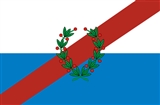
La Rioja Province (Argentina)

Encyclopedia
La Rioja is a one of the provinces of Argentina
and is located in the west of the country. Neighboring provinces are from the north clockwise Catamarca
, Córdoba, San Luis
and San Juan.
 Petroglyph
s at the Talampaya National Park
dated around 10,000 years BCE
set original inhabitants long before the arrival of the Spanish conquerors
. When they arrived to La Rioja in the 16th century they found the diaguita
s, capayan
es and the olongastas.
Juan Ramírez de Velazco founded Todos los Santos de la Nueva Rioja in 1591 under the government of Tucumán
of the Viceroyalty of Peru
. In 1630 there was an uprising of the Calchaquí
es aborigins that was finished by governor Albornoz.
In 1783, after the creation of the Viceroyalty of the Río de la Plata
the control of the province of 10,000 inhabitants passed to the Córdoba indendency. The province acquired independence from Córdoba in 1820. Following attempts by Argentina's first elected President, Bernardino Rivadavia
, to impose a centralist constitution, the figure of the caudillo
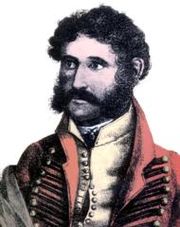
Juan Facundo Quiroga
emerged as a popular leader in touch with La Rioja locals' preference for more autonomy, something they preserved even following Quiroga's 1835 murder. After a period of internal instability in Argentina, the province finally joined the Argentine Confederation in 1853.
 The wave of immigration Argentina experienced between 1880 and 1930 was less in evidence in La Rioja than in other Argentine provinces. Among the few to adventure to the province were Syria
ns and Lebanese
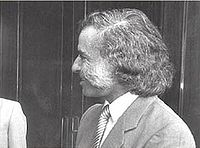
immigrants. The most well-known of these are probably the Menem family, Syrian immigrants who settled in La Rioja in the 1920s. The newcomer, Saul Menem, prospered as a traveling salesman and his eldest son, Carlos Menem
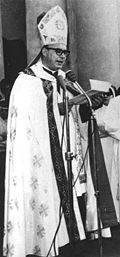
, became a staunch Peronist as a young man, becoming active in La Rioja politics. Elected governor in March, 1973, he implemented a number of reforms advocated by activists in touch with the province's poor, rural majority, particularly those of Bishop Enrique Angelelli
.
Removed and imprisoned following President Isabel Perón's March 1976, ouster, he was kept in illegal confinement until the end of 1980, reportedly tortured in the process. La Rioja, for its part, some of the subsequent dictatorship
's worst repression, including the brutal, August 1976, murder of Bishop Angelelli. Overwhelmingly returned to office when democracy was restored in 1983, Gov. Menem pursued more conservative policies, leveraging La Rioja's dry, agreeable climate, its modest wage scale and skilled work-force to successfully attract La Rioja's first significant presence of light industry, particularly bottling and food-processing.
Presiding over a growing La Rioja economy even as the nation's languished during the 1980s, Menem secured the Peronist Justicialist Party nomination in May 1988, defeating popular Buenos Aires Province
Governor Antonio Cafiero
in an upset.
President of Argentina between 1989 and 1999, Menem steered billions in federal public works spending into La Rioja and though the province remains less developed than average in Argentina, its economy today compares favorably with those of its neighbors.
area, its landscape is arid to semi-arid, and the dry climate receives annually 200 mm of precipitations, has short winters and very hot summers.
From the Andes
at the west, with peaks of up to 6,795 meters (Monte Pissis
), the relief's height descents towards the sierras of the neighbouring dry Pampa
s zone. Most ranges in La Rioja are oriented in a north-south fashion. The provinces two largest cities, La Rioja
and Chilecito
are separated by Sierra de Velasco
and west of Chilecito and Famatina rises the Sierra de Famatina
with heights of up to 6.250 m.a.sl.
The Talampaya National Park
is a dry red-soil canyon of the ancient extinguished Talampaya river, which contains many walls and rock formations that make it an interesting tourist destination.
 La Rioja's economy, estimated at US$1.8 billion in 2006, is the second-smallest among Argentina's provinces. Its per capita output of US$6,280, though about 30% below the national average, makes it the most well-developed in northern Argentina.
Its economy is, likewise, very well-diversified. Agriculture (long limited by La Rioja's dry, mountainous terrain) adds less than 5% to its output. La Rioja's agriculture
(as well as cities) lies on the shore of the few permanents rivers and oasis that allow irrigation
, with only 190 square kilometres of cultivated land. Vineyard
s, nut
s and olive
plantations are the most common, followed by cotton
.
The province's main crop is the grape
, and its associated wine
production, specially around the Chilecito
area, with a production of 8 million litres per year.
Cattle
(250,000 heads) and goat
s (150,000 heads) are secondary activities, particularly for skin and leather. Clay
represents the main mining activity, and uranium
is also extracted near El Colorado.
Manufacturing in La Rioja has expanded considerably since Gov. Menem began attracting investment into the province, after 1983. Limited mostly to light industry like bottling and food processing, it, nevertheless, adds about 20% to La Rioja's output. Tourism is, likewise, an expanding activity. Besides the Talampaya National Park
, tourists visiting La Rioja usually go also to the Chilecito town, Cerro de La Cruz, Termas de Santa Teresita hot springs and the village of Villa Sanagasta.
La Rioja's development plan is being designed by Proyectos Innovadores to encourage further economic growth in the province.
Recently, the province experienced a round of immigration from Eastern Europe, East or South Asian and Middle Eastern countries.
 The province is divided in 18 departments
(Spanish departamentos).
Provinces of Argentina
Argentina is subdivided into twenty-three provinces and one autonomous city...
and is located in the west of the country. Neighboring provinces are from the north clockwise Catamarca
Catamarca Province
Catamarca is a province of Argentina, located in the northwest of the country. The province has a population of 334,568 as per the , and covers an area of 102,602 km². Its literacy rate is 95.5%. Neighbouring provinces are : Salta, Tucumán, Santiago del Estero, Córdoba, and La Rioja...
, Córdoba, San Luis
San Luis Province
San Luis is a province of Argentina located near the geographical center of the country . Neighboring provinces are, from the north clockwise, La Rioja, Córdoba, La Pampa, Mendoza and San Juan.-History:...
and San Juan.
History
Petroglyph
Petroglyphs are pictogram and logogram images created by removing part of a rock surface by incising, picking, carving, and abrading. Outside North America, scholars often use terms such as "carving", "engraving", or other descriptions of the technique to refer to such images...
s at the Talampaya National Park
Talampaya National Park
Talampaya National Park is a national park located in the east/centre of La Rioja Province, Argentina. It was designated a provincial reserve in 1975, a national park in 1997, and a UNESCO World Heritage Site in 2000....
dated around 10,000 years BCE
Anno Domini
and Before Christ are designations used to label or number years used with the Julian and Gregorian calendars....
set original inhabitants long before the arrival of the Spanish conquerors
Spanish colonization of the Americas
Colonial expansion under the Spanish Empire was initiated by the Spanish conquistadores and developed by the Monarchy of Spain through its administrators and missionaries. The motivations for colonial expansion were trade and the spread of the Christian faith through indigenous conversions...
. When they arrived to La Rioja in the 16th century they found the diaguita
Diaguita
The Diaguita, also called Diaguita-Calchaquí, are a group of South American indigenous peoples. The Diaguita culture developed between the 8th and 16th centuries in what are now the provinces of Salta, Catamarca, La Rioja and Tucumán in northwestern Argentina, and in the Atacama and Coquimbo...
s, capayan
Capayán
The Capayanes were an indigenous people nowadays extinct that lived in Argentine territory.-Description:Their geographical area was partly of the provinces of La Rioja, Catamarca, San Juan, from the mountainous zone understood to be between the limit of La Rioja with Catamarca on Colorado river and...
es and the olongastas.
Juan Ramírez de Velazco founded Todos los Santos de la Nueva Rioja in 1591 under the government of Tucumán
Tucumán Province
Tucumán is the most densely populated, and the smallest by land area, of the provinces of Argentina. Located in the northwest of the country, the capital is San Miguel de Tucumán, often shortened to Tucumán. Neighboring provinces are, clockwise from the north: Salta, Santiago del Estero and...
of the Viceroyalty of Peru
Viceroyalty of Peru
Created in 1542, the Viceroyalty of Peru was a Spanish colonial administrative district that originally contained most of Spanish-ruled South America, governed from the capital of Lima...
. In 1630 there was an uprising of the Calchaquí
Calchaquí
The Calchaquí were a tribe of South American Indians of the Diaguita group, now extinct, who formerly occupied northern Argentina. Stone and other remains prove them to have reached a high degree of civilization...
es aborigins that was finished by governor Albornoz.
In 1783, after the creation of the Viceroyalty of the Río de la Plata
Viceroyalty of the Río de la Plata
The Viceroyalty of the Río de la Plata, , was the last and most short-lived Viceroyalty of the Spanish Empire in America.The Viceroyalty was established in 1776 out of several former Viceroyalty of Perú dependencies that mainly extended over the Río de la Plata basin, roughly the present day...
the control of the province of 10,000 inhabitants passed to the Córdoba indendency. The province acquired independence from Córdoba in 1820. Following attempts by Argentina's first elected President, Bernardino Rivadavia
Bernardino Rivadavia
Bernardino de la Trinidad Gónzalez Rivadavia y Rivadavia was the first president of Argentina, from February 8, 1826 to July 7, 1827 . He was a politician of the United Provinces of Río de la Plata, Argentina today...
, to impose a centralist constitution, the figure of the caudillo
Caudillo
Caudillo is a Spanish word for "leader" and usually describes a political-military leader at the head of an authoritarian power. The term translates into English as leader or chief, or more pejoratively as warlord, dictator or strongman. Caudillo was the term used to refer to the charismatic...
Juan Facundo Quiroga
Juan Facundo Quiroga
Juan Facundo Quiroga was an Argentine caudillo who supported federalism at the time when the country was still in formation.-Early years:...
emerged as a popular leader in touch with La Rioja locals' preference for more autonomy, something they preserved even following Quiroga's 1835 murder. After a period of internal instability in Argentina, the province finally joined the Argentine Confederation in 1853.
Syria
Syria , officially the Syrian Arab Republic , is a country in Western Asia, bordering Lebanon and the Mediterranean Sea to the West, Turkey to the north, Iraq to the east, Jordan to the south, and Israel to the southwest....
ns and Lebanese
Lebanon
Lebanon , officially the Republic of LebanonRepublic of Lebanon is the most common term used by Lebanese government agencies. The term Lebanese Republic, a literal translation of the official Arabic and French names that is not used in today's world. Arabic is the most common language spoken among...
immigrants. The most well-known of these are probably the Menem family, Syrian immigrants who settled in La Rioja in the 1920s. The newcomer, Saul Menem, prospered as a traveling salesman and his eldest son, Carlos Menem
Carlos Menem
Carlos Saúl Menem is an Argentine politician who was President of Argentina from 1989 to 1999. He is currently an Argentine National Senator for La Rioja Province.-Early life:...
, became a staunch Peronist as a young man, becoming active in La Rioja politics. Elected governor in March, 1973, he implemented a number of reforms advocated by activists in touch with the province's poor, rural majority, particularly those of Bishop Enrique Angelelli
Enrique Angelelli
Enrique Ángel Angelelli was a bishop of the Roman Catholic Church in Argentina, killed during the Dirty war for his involvement with social issues....
.
Removed and imprisoned following President Isabel Perón's March 1976, ouster, he was kept in illegal confinement until the end of 1980, reportedly tortured in the process. La Rioja, for its part, some of the subsequent dictatorship
National Reorganization Process
The National Reorganization Process was the name used by its leaders for the military government that ruled Argentina from 1976 to 1983. In Argentina it is often known simply as la última junta militar or la última dictadura , because several of them existed throughout its history.The Argentine...
's worst repression, including the brutal, August 1976, murder of Bishop Angelelli. Overwhelmingly returned to office when democracy was restored in 1983, Gov. Menem pursued more conservative policies, leveraging La Rioja's dry, agreeable climate, its modest wage scale and skilled work-force to successfully attract La Rioja's first significant presence of light industry, particularly bottling and food-processing.
Presiding over a growing La Rioja economy even as the nation's languished during the 1980s, Menem secured the Peronist Justicialist Party nomination in May 1988, defeating popular Buenos Aires Province
Buenos Aires Province
The Province of Buenos Aires is the largest and most populous province of Argentina. It takes the name from the city of Buenos Aires, which used to be the provincial capital until it was federalized in 1880...
Governor Antonio Cafiero
Antonio Cafiero
Antonio Francisco Cafiero is an Argentine Justicialist Party politician.-Biography:Cafiero was born in Buenos Aires. He joined Catholic Action in 1938, and enrolled at the University of Buenos Aires, becoming President of the Students' Association...
in an upset.
President of Argentina between 1989 and 1999, Menem steered billions in federal public works spending into La Rioja and though the province remains less developed than average in Argentina, its economy today compares favorably with those of its neighbors.
Geography and climate
Located in the Argentine NorthwestArgentine Northwest
The Argentine Northwest is a region of Argentina composed by the provinces of Catamarca, Jujuy, Salta, Santiago del Estero and Tucumán.-Geography:The region had 5 different biomes:* Sub-Andean humid Sierras of the east...
area, its landscape is arid to semi-arid, and the dry climate receives annually 200 mm of precipitations, has short winters and very hot summers.
From the Andes
Andes
The Andes is the world's longest continental mountain range. It is a continual range of highlands along the western coast of South America. This range is about long, about to wide , and of an average height of about .Along its length, the Andes is split into several ranges, which are separated...
at the west, with peaks of up to 6,795 meters (Monte Pissis
Monte Pissis
Monte Pissis is an extinct volcano in La Rioja Province, Argentina. The mountain is the third-highest in the Western Hemisphere, and is located about 550 km north of Aconcagua....
), the relief's height descents towards the sierras of the neighbouring dry Pampa
Pampa
The Pampas are the fertile South American lowlands, covering more than , that include the Argentine provinces of Buenos Aires, La Pampa, Santa Fe, Entre Ríos and Córdoba, most of Uruguay, and the southernmost Brazilian State, Rio Grande do Sul...
s zone. Most ranges in La Rioja are oriented in a north-south fashion. The provinces two largest cities, La Rioja
La Rioja, Argentina
La Rioja is the capital city of the Argentine province of La Rioja, located on the east of the province. The city has a population of almost 150,000 as per the ....
and Chilecito
Chilecito
Chilecito is a city in the Argentine province of La Rioja, and head of the department of Chilecito.-Overview:It's located in the valley formed by the Sierras de Velazco to the east, and the Sierras de Famatina to the west. The city was founded in 1715 by Spanish colonizers...
are separated by Sierra de Velasco
Sierra de Velasco
right|250px|thumb|The western part of Sierra de Velasco captures during summer moist air from the Atlantic allowing some sub-tropical forests to grow on it....
and west of Chilecito and Famatina rises the Sierra de Famatina
Sierra de Famatina
thumb|200px|Coat of arms of La Rioja featuring Cerro General BelgranoSierra de Famatina is mountain range and massif in the Andes of the Argentine province of La Rioja. The range rises between the north-south valleys of Bermejo and Antinaco-Los Colorados. The highest point, called Nevado de...
with heights of up to 6.250 m.a.sl.
The Talampaya National Park
Talampaya National Park
Talampaya National Park is a national park located in the east/centre of La Rioja Province, Argentina. It was designated a provincial reserve in 1975, a national park in 1997, and a UNESCO World Heritage Site in 2000....
is a dry red-soil canyon of the ancient extinguished Talampaya river, which contains many walls and rock formations that make it an interesting tourist destination.
Economy
Its economy is, likewise, very well-diversified. Agriculture (long limited by La Rioja's dry, mountainous terrain) adds less than 5% to its output. La Rioja's agriculture
Agriculture
Agriculture is the cultivation of animals, plants, fungi and other life forms for food, fiber, and other products used to sustain life. Agriculture was the key implement in the rise of sedentary human civilization, whereby farming of domesticated species created food surpluses that nurtured the...
(as well as cities) lies on the shore of the few permanents rivers and oasis that allow irrigation
Irrigation
Irrigation may be defined as the science of artificial application of water to the land or soil. It is used to assist in the growing of agricultural crops, maintenance of landscapes, and revegetation of disturbed soils in dry areas and during periods of inadequate rainfall...
, with only 190 square kilometres of cultivated land. Vineyard
Vineyard
A vineyard is a plantation of grape-bearing vines, grown mainly for winemaking, but also raisins, table grapes and non-alcoholic grape juice...
s, nut
Nut (fruit)
A nut is a hard-shelled fruit of some plants having an indehiscent seed. While a wide variety of dried seeds and fruits are called nuts in English, only a certain number of them are considered by biologists to be true nuts...
s and olive
Olive
The olive , Olea europaea), is a species of a small tree in the family Oleaceae, native to the coastal areas of the eastern Mediterranean Basin as well as northern Iran at the south end of the Caspian Sea.Its fruit, also called the olive, is of major agricultural importance in the...
plantations are the most common, followed by cotton
Cotton
Cotton is a soft, fluffy staple fiber that grows in a boll, or protective capsule, around the seeds of cotton plants of the genus Gossypium. The fiber is almost pure cellulose. The botanical purpose of cotton fiber is to aid in seed dispersal....
.
The province's main crop is the grape
Grape
A grape is a non-climacteric fruit, specifically a berry, that grows on the perennial and deciduous woody vines of the genus Vitis. Grapes can be eaten raw or they can be used for making jam, juice, jelly, vinegar, wine, grape seed extracts, raisins, molasses and grape seed oil. Grapes are also...
, and its associated wine
Wine
Wine is an alcoholic beverage, made of fermented fruit juice, usually from grapes. The natural chemical balance of grapes lets them ferment without the addition of sugars, acids, enzymes, or other nutrients. Grape wine is produced by fermenting crushed grapes using various types of yeast. Yeast...
production, specially around the Chilecito
Chilecito
Chilecito is a city in the Argentine province of La Rioja, and head of the department of Chilecito.-Overview:It's located in the valley formed by the Sierras de Velazco to the east, and the Sierras de Famatina to the west. The city was founded in 1715 by Spanish colonizers...
area, with a production of 8 million litres per year.
Cattle
Cattle
Cattle are the most common type of large domesticated ungulates. They are a prominent modern member of the subfamily Bovinae, are the most widespread species of the genus Bos, and are most commonly classified collectively as Bos primigenius...
(250,000 heads) and goat
Goat
The domestic goat is a subspecies of goat domesticated from the wild goat of southwest Asia and Eastern Europe. The goat is a member of the Bovidae family and is closely related to the sheep as both are in the goat-antelope subfamily Caprinae. There are over three hundred distinct breeds of...
s (150,000 heads) are secondary activities, particularly for skin and leather. Clay
Clay
Clay is a general term including many combinations of one or more clay minerals with traces of metal oxides and organic matter. Geologic clay deposits are mostly composed of phyllosilicate minerals containing variable amounts of water trapped in the mineral structure.- Formation :Clay minerals...
represents the main mining activity, and uranium
Uranium
Uranium is a silvery-white metallic chemical element in the actinide series of the periodic table, with atomic number 92. It is assigned the chemical symbol U. A uranium atom has 92 protons and 92 electrons, of which 6 are valence electrons...
is also extracted near El Colorado.
Manufacturing in La Rioja has expanded considerably since Gov. Menem began attracting investment into the province, after 1983. Limited mostly to light industry like bottling and food processing, it, nevertheless, adds about 20% to La Rioja's output. Tourism is, likewise, an expanding activity. Besides the Talampaya National Park
Talampaya National Park
Talampaya National Park is a national park located in the east/centre of La Rioja Province, Argentina. It was designated a provincial reserve in 1975, a national park in 1997, and a UNESCO World Heritage Site in 2000....
, tourists visiting La Rioja usually go also to the Chilecito town, Cerro de La Cruz, Termas de Santa Teresita hot springs and the village of Villa Sanagasta.
La Rioja's development plan is being designed by Proyectos Innovadores to encourage further economic growth in the province.
Recently, the province experienced a round of immigration from Eastern Europe, East or South Asian and Middle Eastern countries.
Political division
Departments of Argentina
Departments form the second level of administrative division in the provinces of Argentina. There are no departments in the city of Buenos Aires, which has so far been divided into neighbourhoods as its administrative divisions, but is to be divided now into communes by a recently passed local act...
(Spanish departamentos).
- AraucoArauco DepartmentArauco is a department of La Rioja Province, Argentina.-Population:It has 723 inhabitants , which means an increase of 16%, since the last census in 1991 .-Settlements:*Arauco...
(AimogastaAimogastaAimogasta is a municipality and village in La Rioja Province in northwestern Argentina.-References:...
) - Capital (La RiojaLa Rioja, ArgentinaLa Rioja is the capital city of the Argentine province of La Rioja, located on the east of the province. The city has a population of almost 150,000 as per the ....
) - Castro Barros (AmingaAmingaAminga is a municipality and village in La Rioja Province in northwestern Argentina.-References:...
) - Chamical (ChamicalChamicalChamical is a municipality and village in La Rioja Province in northwestern Argentina.-References:...
) - Chilecito (ChilecitoChilecitoChilecito is a city in the Argentine province of La Rioja, and head of the department of Chilecito.-Overview:It's located in the valley formed by the Sierras de Velazco to the east, and the Sierras de Famatina to the west. The city was founded in 1715 by Spanish colonizers...
) - Coronel Felipe Varela (Villa UniónVilla UniónVilla Unión is a city and seat of the municipality of Villa Unión, in the north-eastern Mexican state of Coahuila....
) - Famatina (FamatinaFamatinaFamatina is a town in the province of La Rioja, Argentina. It has 6,371 inhabitants as per the , and is the only municipality in the Famatina Department...
) - General ángel Vicente Peñaloza (Tama)
- General Belgrano (OltaOltaOlta is a municipality and village in La Rioja Province in northwestern Argentina.-References:...
)
- General Juan Facundo Quiroga (Malazán)
- General Lamadrid (Villa Castelli)
- General Ocampo (Milagro)
- General San Martín (UlapesUlapesUlapes is a municipality and village in La Rioja Province in northwestern Argentina.-References:...
) - Independencia (PatquíaPatquíaPatquía is a municipality and village in La Rioja Province in northwestern Argentina.-References:...
) - Rosario Vera Peñaloza (ChepesChepesChepes is a municipality and village in La Rioja Province in northwestern Argentina.-References:...
) - San Blas (San Blas)
- Sanagasta (Sanagasta)
- Vinchina (Vinchina)
External links
- Gobierno de La Rioja Official website