

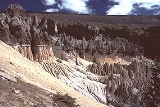
La Garita Caldera

Encyclopedia
Volcano
2. Bedrock3. Conduit 4. Base5. Sill6. Dike7. Layers of ash emitted by the volcano8. Flank| 9. Layers of lava emitted by the volcano10. Throat11. Parasitic cone12. Lava flow13. Vent14. Crater15...
caldera
Caldera
A caldera is a cauldron-like volcanic feature usually formed by the collapse of land following a volcanic eruption, such as the one at Yellowstone National Park in the US. They are sometimes confused with volcanic craters...
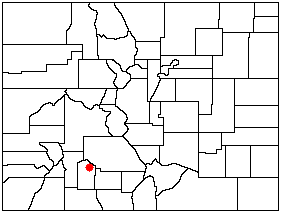
located in the San Juan volcanic field
San Juan volcanic field
The San Juan volcanic field, located in southwestern Colorado, contains two distinct phases of volcanism. The earlier volcanism is Oligocene in age, and consists of largely intermediate composition lavas and breccias. A few ash flow tuffs also constitute this phase of volcanism. Later volcanism is...
in the San Juan Mountains
San Juan Mountains
The San Juan Mountains are a high and rugged mountain range in the Rocky Mountains in southwestern Colorado. The area is highly mineralized and figured in the gold and silver mining industry of early Colorado. Major towns, all old mining camps, include Creede, Lake City, Silverton, Ouray, and...
near the town of Creede
Creede, Colorado
The historic town of Creede is a Statutory Town that is the county seat of, and the only incorporated municipality in, Mineral County, Colorado, United States. The town population was 377 at the U.S. Census 2000.-History:...
in southwestern Colorado
Colorado
Colorado is a U.S. state that encompasses much of the Rocky Mountains as well as the northeastern portion of the Colorado Plateau and the western edge of the Great Plains...
, United States
United States
The United States of America is a federal constitutional republic comprising fifty states and a federal district...
. It lies to the west of the town of La Garita, Colorado. The eruption that created the La Garita Caldera is often described as the largest known explosive eruption in Earth's history, although recent research has identified several larger ones.
Date
The La Garita Caldera is one of a number of calderas that formed during a massive ignimbriteIgnimbrite
An ignimbrite is the deposit of a pyroclastic density current, or pyroclastic flow, a hot suspension of particles and gases that flows rapidly from a volcano, driven by a greater density than the surrounding atmosphere....
flare-up in Colorado
Colorado
Colorado is a U.S. state that encompasses much of the Rocky Mountains as well as the northeastern portion of the Colorado Plateau and the western edge of the Great Plains...
, Utah
Utah
Utah is a state in the Western United States. It was the 45th state to join the Union, on January 4, 1896. Approximately 80% of Utah's 2,763,885 people live along the Wasatch Front, centering on Salt Lake City. This leaves vast expanses of the state nearly uninhabited, making the population the...
and Nevada
Nevada
Nevada is a state in the western, mountain west, and southwestern regions of the United States. With an area of and a population of about 2.7 million, it is the 7th-largest and 35th-most populous state. Over two-thirds of Nevada's people live in the Las Vegas metropolitan area, which contains its...
from 40–25 million years ago, and was the site of truly enormous eruptions about 28–26 million years ago, during the Oligocene
Oligocene
The Oligocene is a geologic epoch of the Paleogene Period and extends from about 34 million to 23 million years before the present . As with other older geologic periods, the rock beds that define the period are well identified but the exact dates of the start and end of the period are slightly...
Epoch.
Province
The area devastated by the La Garita eruption is thought to have covered a significant portion of what is now Colorado, and ash could have fallen as far as the east coast of North AmericaNorth America
North America is a continent wholly within the Northern Hemisphere and almost wholly within the Western Hemisphere. It is also considered a northern subcontinent of the Americas...
and the Caribbean
Caribbean
The Caribbean is a crescent-shaped group of islands more than 2,000 miles long separating the Gulf of Mexico and the Caribbean Sea, to the west and south, from the Atlantic Ocean, to the east and north...
.
Size of eruption
The scale of La Garita volcanism was far beyond anything known in human history. The resulting deposit, known as the Fish Canyon tuffFish Canyon tuff
The Fish Canyon tuff is the volcanic deposit resulting from one of the largest known explosive eruptions on Earth, estimated at 5,000 cubic kilometers. The eruption was centered at La Garita Caldera in southwest Colorado...
, has a volume of approximately 1200 cubic miles (5,001.8 km³), enough material to fill Lake Michigan
Lake Michigan
Lake Michigan is one of the five Great Lakes of North America and the only one located entirely within the United States. It is the second largest of the Great Lakes by volume and the third largest by surface area, after Lake Superior and Lake Huron...
(in comparison, the May 18, 1980 eruption of Mt. St. Helens was only 0.25 cubic miles (1 km³) in volume).
By contrast, the most powerful human-made explosive device ever detonated, the Tsar Bomba or King of the Bombs, had a yield of 50 megatons, whereas the eruption at La Garita was approximately 100,000 times more powerful. It is possibly the most energetic event on Earth since the Chicxulub impact
Chicxulub Crater
The Chicxulub crater is an ancient impact crater buried underneath the Yucatán Peninsula in Mexico. Its center is located near the town of Chicxulub, after which the crater is named...
, which was 50 times more powerful.
Geology
The Fish Canyon Tuff, made of daciteDacite
Dacite is an igneous, volcanic rock. It has an aphanitic to porphyritic texture and is intermediate in composition between andesite and rhyolite. The relative proportions of feldspars and quartz in dacite, and in many other volcanic rocks, are illustrated in the QAPF diagram...
, is known to be remarkably uniform in its petrological composition and forms a single cooling unit despite the huge volume. Dacite is a silicic volcanic rock common in explosive eruptions, lava domes and short thick lava flows. There are also large intracaldera lavas composed of andesite
Andesite
Andesite is an extrusive igneous, volcanic rock, of intermediate composition, with aphanitic to porphyritic texture. In a general sense, it is the intermediate type between basalt and dacite. The mineral assemblage is typically dominated by plagioclase plus pyroxene and/or hornblende. Magnetite,...
, a volcanic rock compositionally intermediate between basalt
Basalt
Basalt is a common extrusive volcanic rock. It is usually grey to black and fine-grained due to rapid cooling of lava at the surface of a planet. It may be porphyritic containing larger crystals in a fine matrix, or vesicular, or frothy scoria. Unweathered basalt is black or grey...
(poor in silica content) and dacite (higher silica content) in the La Garita Caldera.
The caldera itself, like the eruption of Fish Canyon Tuff, is quite large in scale. It is 35 by oblong shape . Most supervolcano
Supervolcano
A supervolcano is a volcano capable of producing a volcanic eruption with an ejecta volume greater than 1,000 cubic kilometers . This is thousands of times larger than most historic volcanic eruptions. Supervolcanoes can occur when magma in the Earth rises into the crust from a hotspot but is...
calderas of explosive origin are slightly ovoid or oblong in shape. Because of the vast scale and erosion, it took scientists over 30 years to fully determine the size of the caldera. La Garita can be considered a "supervolcano", albeit an extinct one.
La Garita is also the source of at least 7 major eruptions of welded tuff
Tuff
Tuff is a type of rock consisting of consolidated volcanic ash ejected from vents during a volcanic eruption. Tuff is sometimes called tufa, particularly when used as construction material, although tufa also refers to a quite different rock. Rock that contains greater than 50% tuff is considered...
deposits over a time span of 1.5 million years since the Fish Canyon Tuff eruption. The caldera is also known to have extensive outcrops of a very unusual lava-like rock made of dacite that is very similar to that of the Fish Canyon Tuff. This rock, which has characteristics of both lava and welded tuff, was erupted probably shortly before the Fish Canyon Tuff. The lava-like rock has been interpreted as having erupted as thick spatter during low-energy lava fountain
Lava fountain
A lava fountain is a volcanic phenomenon in which lava is forcefully but non-explosively ejected from a crater, vent, or fissure. Lava fountains may reach heights of up to . They may occur as a series of short pulses, or a continuous jet of lava. They are commonly seen in Hawaiian eruptions.-See...
ing. The lava-like rock is also voluminous — up to 200–300 km³ (48–72 cumi).