
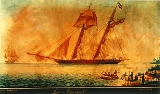
La Amistad (
SpanishSpanish , also known as Castilian , is a Romance language in the Ibero-Romance group that evolved from several languages and dialects in central-northern Iberia around the 9th century and gradually spread with the expansion of the Kingdom of Castile into central and southern Iberia during the...
: "Friendship") was a ship notable as the scene of a revolt by
AfricaAfrica is the world's second largest and second most populous continent, after Asia. At about 30.2 million km² including adjacent islands, it covers 6% of the Earth's total surface area and 20.4% of the total land area...
n captives being transported from
HavanaHavana is the capital city, province, major port, and leading commercial centre of Cuba. The city proper has a population of 2.1 million inhabitants, and it spans a total of — making it the largest city in the Caribbean region, and the most populous...
to
Puerto PrincipeCamagüey is a city and municipality in central Cuba and is the nation's third largest city. It is the capital of the Camagüey Province.After almost continuous attacks from pirates the original city was moved inland in 1528.The new city was built with a confusing lay-out of winding alleys that made...
,
CubaThe Republic of Cuba is an island nation in the Caribbean. The nation of Cuba consists of the main island of Cuba, the Isla de la Juventud, and several archipelagos. Havana is the largest city in Cuba and the country's capital. Santiago de Cuba is the second largest city...
. It was a 19th-century two-
mastedThe mast of a sailing vessel is a tall, vertical, or near vertical, spar, or arrangement of spars, which supports the sails. Large ships have several masts, with the size and configuration depending on the style of ship...
schoonerA schooner is a type of sailing vessel characterized by the use of fore-and-aft sails on two or more masts with the forward mast being no taller than the rear masts....
built in
SpainSpain , officially the Kingdom of Spain languages]] under the European Charter for Regional or Minority Languages. In each of these, Spain's official name is as follows:;;;;;;), is a country and member state of the European Union located in southwestern Europe on the Iberian Peninsula...
and owned by a Spaniard living in Cuba. The Africans took control of the ship in July 1839 and were captured off the coast of
Long IslandLong Island is an island located in the southeast part of the U.S. state of New York, just east of Manhattan. Stretching northeast into the Atlantic Ocean, Long Island contains four counties, two of which are boroughs of New York City , and two of which are mainly suburban...
by the
USS WashingtonThe sixth USS Washington was a revenue cutter in the United States Navy. She discovered Amistad after the slaves onboard had seized control of that schooner in an 1839 mutiny. The sixth USS Washington was a revenue cutter in the United States Navy. She discovered Amistad after the slaves onboard...
of the
United States Revenue Cutter ServiceThe United States Revenue Cutter Service was established by Secretary of the Treasury Alexander Hamilton in 1790 as an armed maritime law enforcement service. Throughout its entire existence the Revenue Cutter Service operated under the authority of the United States Department of the Treasury...
.
La Amistad became a symbol in the movement to
abolish slaveryAbolitionism is a movement to end slavery.In western Europe and the Americas abolitionism was a movement to end the slave trade and set slaves free. At the behest of Dominican priest Bartolomé de las Casas who was shocked at the treatment of natives in the New World, Spain enacted the first...
. The ship was taken under control by the United States, resulting in a
US Supreme Court case (1841)The Amistad, also known as United States v. Libellants and Claimants of the Schooner Amistad, 40 U.S. 518 , was a United States Supreme Court case resulting from the rebellion of slaves on board the Spanish schooner Amistad in 1839...
over the status of the Africans, as importation of slaves into the US had been prohibited since 1808.
The mutiny
On July 2, 1839,
Sengbe PiehSengbe Pieh , later known as Joseph Cinqué, was a West African man of the Mende people and was the most prominent defendant in the Amistad case, in which it was found that he and 51 others had been victims of the illegal Atlantic slave trade.-Biography:Cinqué was born c...
(later known in the United States as Joseph Cinqué) led 56 fellow Africans (52 adults and 4 children), the captives being transported aboard
La Amistad from
HavanaHavana is the capital city, province, major port, and leading commercial centre of Cuba. The city proper has a population of 2.1 million inhabitants, and it spans a total of — making it the largest city in the Caribbean region, and the most populous...
, in a revolt against their captors. In the main hold below decks, the captives found a rusty file. The captives freed themselves, and they quickly ascended the stairs to deck. Armed with machete-like
cane knivesA cane knife is a large hand-wielded cutting tool similar to a machete. Its use is prevalent in the harvesting of sugarcane in dominant cane-growing countries such as Peru, Brazil, Colombia, Australia, Ecuador, Cuba, the Philippines and parts of the United States, especially Louisiana and Florida,...
, they were successful in gaining control of the ship and demanded to be returned home. The ship's navigator, Don Pedro Montez, deceived them about which direction their course was on and sailed the ship north along the North American coast to the eastern tip of
Long IslandLong Island is an island located in the southeast part of the U.S. state of New York, just east of Manhattan. Stretching northeast into the Atlantic Ocean, Long Island contains four counties, two of which are boroughs of New York City , and two of which are mainly suburban...
, New York. The
United States Revenue Cutter ServiceThe United States Revenue Cutter Service was established by Secretary of the Treasury Alexander Hamilton in 1790 as an armed maritime law enforcement service. Throughout its entire existence the Revenue Cutter Service operated under the authority of the United States Department of the Treasury...
discovered the
schoonerA schooner is a type of sailing vessel characterized by the use of fore-and-aft sails on two or more masts with the forward mast being no taller than the rear masts....
and took it and its occupants into custody. They took the Africans to
New Haven, ConnecticutNew Haven is the second-largest city in Connecticut and the sixth-largest in New England. According to the 2010 Census, New Haven's population increased by 5.0% between 2000 and 2010, a rate higher than that of the State of Connecticut, and higher than that of the state's five largest cities, and...
to be tried in court.
Court case
A widely publicized court case ensued in New Haven, Connecticut, about the ship and the legal status of the African captives, which became a cause célèbre among abolitionists in the United States. At the time, the transport of slaves from Africa to the
AmericasThe Americas, or America , are lands in the Western hemisphere, also known as the New World. In English, the plural form the Americas is often used to refer to the landmasses of North America and South America with their associated islands and regions, while the singular form America is primarily...
was illegal, so the ship owners fraudulently described the Africans as having been born in Cuba. The court had to decide if the Africans were to be considered
salvageMarine salvage is the process of rescuing a ship, its cargo, or other property from peril. Salvage encompasses rescue towing, refloating a sunken or grounded vessel, or patching or repairing a ship...
and the property of Naval officers who had taken custody of the ship, whether they were the property of the Cuban buyers or of Spain as Queen
Isabella II of SpainIsabella II was the only female monarch of Spain in modern times. She came to the throne as an infant, but her succession was disputed by the Carlists, who refused to recognise a female sovereign, leading to the Carlist Wars. After a troubled reign, she was deposed in the Glorious Revolution of...
claimed, or if the circumstances of their capture and transportation meant they were free.
On appeal,
The AmistadThe Amistad, also known as United States v. Libellants and Claimants of the Schooner Amistad, 40 U.S. 518 , was a United States Supreme Court case resulting from the rebellion of slaves on board the Spanish schooner Amistad in 1839...
case reached the
US Supreme CourtThe Supreme Court of the United States is the highest court in the United States. It has ultimate appellate jurisdiction over all state and federal courts, and original jurisdiction over a small range of cases...
, which in 1841 ruled in that the Africans had been illegally transported and held as slaves, and ordered them freed. The
Amistad survivors returned to Africa in 1842.
The ship
La Amistad was a 19th-century two-
mastedThe mast of a sailing vessel is a tall, vertical, or near vertical, spar, or arrangement of spars, which supports the sails. Large ships have several masts, with the size and configuration depending on the style of ship...
schoonerA schooner is a type of sailing vessel characterized by the use of fore-and-aft sails on two or more masts with the forward mast being no taller than the rear masts....
of about 120 feet (36.6 m). Built in the United States,
La Amistad (Spanish for 'friendship') was originally named
Friendship but she was renamed after being purchased by a Spaniard. Strictly speaking,
La Amistad was not a
slave shipSlave ships were large cargo ships specially converted for the purpose of transporting slaves, especially newly purchased African slaves to Americas....
; she was not designed to transport large cargoes of slaves, nor did she engage in the
Middle PassageThe Middle Passage was the stage of the triangular trade in which millions of people from Africa were shipped to the New World, as part of the Atlantic slave trade...
of Africans to the Americas.
La Amistad engaged in shorter, coastal trade. The primary cargo carried by
La Amistad was sugar-industry products, and her normal route ran from Havana to her home port of
GuanajaGuanaja is one of the Bay Islands of Honduras, and is in the Caribbean. It is about 70 km off the north coast of Honduras, and 12 km from the island of Roatan. One of the cays off Guanaja, also called Guanaja or Bonnaca or Low Cay , is near the main island, and contains most of the...
. She also took on passengers and, on occasion, slaves for transport. The captives whom
La Amistad carried during the historic events had been illegally transported from Africa to Cuba aboard the slave ship
TecoraThe Tecora was a Portuguese slave ship of the early 19th century. The brig was built especially for the slave trade after the transport across the Atlantic of human beings as slaves had already been outlawed in the first decade of the 19th century...
.
More ships
True slave ships, such as the
Tecora, were designed for the purpose of carrying as many slaves as possible. The largest slave ships carried up to 400 slaves. One distinguishing feature that enabled this efficiency was the half-height
between decks level. Slaves were chained down in a sitting or lying position, but the area was not high enough for people to stand in. The crew of
La Amistad, lacking the slave quarters, placed half the captives in the main hold, and the other half on deck. The captives were relatively free to move about, which aided their revolt and commandeering of the vessel.
Later years
After being moored at the wharf behind the
US Custom HouseNew London Customhouse is a historic customs house at 150 Bank Street in New London, Connecticut. It was built in 1833 and added to the National Register of Historic Places in 1970....
in New London, Connecticut, for a year and a half,
La Amistad was auctioned off by the U.S. Marshal in October 1840. Captain George Hawford, of
Newport, Rhode IslandNewport is a city on Aquidneck Island in Newport County, Rhode Island, United States, about south of Providence. Known as a New England summer resort and for the famous Newport Mansions, it is the home of Salve Regina University and Naval Station Newport which houses the United States Naval War...
, purchased the vessel and then needed an
Act of CongressAn Act of Congress is a statute enacted by government with a legislature named "Congress," such as the United States Congress or the Congress of the Philippines....
passed to register her. He renamed her
Ion. In late 1841, he sailed the ship to
BermudaBermuda is a British overseas territory in the North Atlantic Ocean. Located off the east coast of the United States, its nearest landmass is Cape Hatteras, North Carolina, about to the west-northwest. It is about south of Halifax, Nova Scotia, Canada, and northeast of Miami, Florida...
and
Saint ThomasSaint Thomas is an island in the Caribbean Sea and with the islands of Saint John, Saint Croix, and Water Island a county and constituent district of the United States Virgin Islands , an unincorporated territory of the United States. Located on the island is the territorial capital and port of...
with a typical New England cargo of onions, apples, live poultry, and cheese.
After sailing
Ion for a few years, Hawford sold the ship in
GuadeloupeGuadeloupe is an archipelago located in the Leeward Islands, in the Lesser Antilles, with a land area of 1,628 square kilometres and a population of 400,000. It is the first overseas region of France, consisting of a single overseas department. As with the other overseas departments, Guadeloupe...
in 1844. There is no record of what became of the
Ion under her new French owners in the
CaribbeanThe Caribbean is a crescent-shaped group of islands more than 2,000 miles long separating the Gulf of Mexico and the Caribbean Sea, to the west and south, from the Atlantic Ocean, to the east and north...
.
Freedom Schooner Amistad
Between 1998 and 2000, artisans at
Mystic SeaportMystic Seaport, the Museum of America and the Sea, in Mystic, Connecticut, is notable both for its collection of sailing ships and boats, and for the re-creation of crafts and fabric of an entire 19th century seafaring village...
,
Mystic, ConnecticutMystic is a village and census-designated place in New London County, Connecticut, in the United States. The population was 4,001 at the 2000 census. A historic locality, Mystic has no independent government because it is not a legally recognized municipality in the state of Connecticut...
, built a recreation of
La Amistad, using traditional skills and construction techniques common to wooden schooners built in the 19th century, but using modern materials and engines. They christened
Freedom Schooner Amistad. The modern-day
Amistad is not an exact replica of
La Amistad, as the ship is slightly longer and has higher
freeboardIn sailing and boating, freeboardmeans the distance from the waterline to the upper deck level, measured at the lowest point of sheer where water can enter the boat or ship...
. There were no old blueprints of the original.
The new schooner was built using a general knowledge of the
Baltimore ClipperBaltimore Clipper is the colloquial name for fast sailing ships built on the south-eastern seaboard of the United States of America, especially at the port of Baltimore, Maryland...
s and art drawings from the era. Some of the tools used in the project were the same as those that might have been used by a 19th-century shipwright while others were powered. Tri-Coastal Marine, designers of
Freedom Schooner Amistad, used modern computer technology to develop plans for the vessel.
Bronze bolts are used as fastenings throughout the ship.
Freedom Schooner Amistad has an external ballast
keelIn boats and ships, keel can refer to either of two parts: a structural element, or a hydrodynamic element. These parts overlap. As the laying down of the keel is the initial step in construction of a ship, in British and American shipbuilding traditions the construction is dated from this event...
made of lead and two Caterpillar diesel engines. None of this technology was available to 19th century builders.
Freedom Schooner Amistad is operated by Amistad America, Inc., a
non-profit organizationNonprofit organization is neither a legal nor technical definition but generally refers to an organization that uses surplus revenues to achieve its goals, rather than distributing them as profit or dividends...
based in New Haven, Connecticut. The ship's mission is to educate the public on the history of slavery, discrimination, and civil rights. Her homeport is New Haven, where the
Amistad trial took place. She also travels to port cities for educational opportunities. The
Freedom Schooner Amistad is the State
FlagshipA flagship is a vessel used by the commanding officer of a group of naval ships, reflecting the custom of its commander, characteristically a flag officer, flying a distinguishing flag...
and
Tall shipA tall ship is a large, traditionally-rigged sailing vessel. Popular modern tall ship rigs include topsail schooners, brigantines, brigs and barques. "Tall Ship" can also be defined more specifically by an organization, such as for a race or festival....
Ambassador of Connecticut.
Freedom Schooner Amistad has made several commemorative voyages: one in 2007 to commemorate the 200th anniversary of the abolition of the
Atlantic slave tradeThe Atlantic slave trade, also known as the trans-atlantic slave trade, refers to the trade in slaves that took place across the Atlantic ocean from the sixteenth through to the nineteenth centuries...
in Britain (1807) and the United States (1808), and one in 2010 to celebrate the 10th anniversary of its 2000 launching in Mystic Seaport.
Western Union - used in the 1997 Film
This schooner was built in 1939 by Herbert Elroy Arch, Thompson Enterprises, in Key West, Florida for the Western Union Thompson Fish Company and leased by the
Western Union Telegraph CompanyThe Western Union Company is a financial services and communications company based in the United States. Its North American headquarters is in Englewood, Colorado. Up until 2006, Western Union was the best-known U.S...
. Used for cable repair between 1939 and 1974, in 1974 she was converted into a passenger vessel. She was used in the film as the vessel
La Amistad, and participated in the
OpsailOperation Sail refers to a series of sailing events held to celebrate special occasions and features sailing vessels from around the world. Each event is coordinated by Operation Sail, Inc., a non-profit organization established in 1961 by President John F. Kennedy and must be approved by the...
1976 in New York. In 1984 the schooner was sold to Vision Quest National, Ltd. from Philadelphia, renamed
New Way and used to redirect troubled youths. She was purchased by Historic Tours of America, Key West, in 1997 and renamed
Western Union again. Used for dockside tours, day sailing trips, and special charter, this ship is a
National Historic LandmarkA National Historic Landmark is a building, site, structure, object, or district, that is officially recognized by the United States government for its historical significance...
.
La Amistad in popular culture
On 2 September 1839, a play entitled
The Long, Low Black Schooner, based on the revolt, opened in
New York CityNew York is the most populous city in the United States and the center of the New York Metropolitan Area, one of the most populous metropolitan areas in the world. New York exerts a significant impact upon global commerce, finance, media, art, fashion, research, technology, education, and...
and played to full audiences.
La Amistad was painted black at the time of the revolt.
A 1997 film,
Amistad, directed by
Steven SpielbergSteven Allan Spielberg KBE is an American film director, screenwriter, producer, video game designer, and studio entrepreneur. In a career of more than four decades, Spielberg's films have covered many themes and genres. Spielberg's early science-fiction and adventure films were seen as an...
, dramatized the historical incidents. Major actors were
Morgan FreemanMorgan Freeman is an American actor, film director, aviator and narrator. He is noted for his reserved demeanor and authoritative speaking voice. Freeman has received Academy Award nominations for his performances in Street Smart, Driving Miss Daisy, The Shawshank Redemption and Invictus and won...
, as a freed black man in New Haven;
Anthony HopkinsSir Philip Anthony Hopkins, KBE , best known as Anthony Hopkins, is a Welsh actor of film, stage and television...
, as
John Quincy AdamsJohn Quincy Adams was the sixth President of the United States . He served as an American diplomat, Senator, and Congressional representative. He was a member of the Federalist, Democratic-Republican, National Republican, and later Anti-Masonic and Whig parties. Adams was the son of former...
;
Matthew McConaugheyMatthew David McConaughey is an American actor.After a series of minor roles in the early 1990s, McConaughey gained notice for his breakout role in Dazed and Confused . He then appeared in films such as A Time to Kill, Contact, U-571, Tiptoes, Sahara, and We Are Marshall...
, as an unorthodox, but influential lawyer; and
Djimon HounsouDjimon Diaw Hounsou is a Beninese actor and model. As an actor, Hounsou has been nominated for two Academy Awards.-Early life:Djimon Hounsou was born in Cotonou, Benin, in 1964, to lbertine and Pierre Hounsou, a cook. He emigrated to Lyon in France at the age of thirteen with his brother, Edmond....
, as
CinqueSengbe Pieh , later known as Joseph Cinqué, was a West African man of the Mende people and was the most prominent defendant in the Amistad case, in which it was found that he and 51 others had been victims of the illegal Atlantic slave trade.-Biography:Cinqué was born c...
(Sengbe Peah).
In January 2011,
Random HouseRandom House, Inc. is the largest general-interest trade book publisher in the world. It has been owned since 1998 by the German private media corporation Bertelsmann and has become the umbrella brand for Bertelsmann book publishing. Random House also has a movie production arm, Random House Films,...
published
Ardency, a collection of poems written over twenty years by American poet
Kevin YoungKevin Young is an American poet and teacher of poetry. Young graduated from Harvard College in 1992, was a Stegner Fellow at Stanford University , and received his MFA from Brown University. While in Boston and Providence, he was part of the African-American poetry group, The Dark Room Collective...
which "gathers here a chorus of voices that tells the story of the Africans who mutinied on board the slave ship Amistad".
External links