

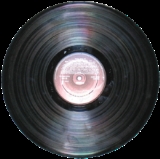
LP album

Encyclopedia
The LP, or long-playing microgroove record, is a format for phonograph (gramophone) records
, an analog
sound storage medium. Introduced by Columbia Records
in 1948, it was soon adopted as a new standard by the entire record industry. Apart from relatively minor refinements and the important later addition of stereophonic sound capability, it has remained the standard format for vinyl
"album
s" up to the present.
At the time the LP was introduced, nearly all phonograph records for home use were made of an abrasive (and therefore noisy) shellac compound, employed a much larger groove, and played at approximately 78 rpm, limiting the playing time of a 12-inch record to less than five minutes per side. The new product was a 12 or 10-inch fine-grooved disc made of vinyl and played with a smaller-tipped "microgroove" stylus
at a speed of 33⅓ rpm. Each side of a 12-inch LP could play for over 20 minutes. Only the microgroove standard was truly new, as both vinyl and the 33⅓ rpm speed had been used for special purposes for many years, as well as in one unsuccessful earlier attempt to introduce a long-playing record for home use. Although the LP was especially suited to classical music because of its extended continuous playing time, it also allowed a collection of ten or more typical "pop" music recordings to be put on a single disc. Previously, such collections, as well as longer classical music broken up into several parts, had been sold as sets of 78 rpm records in a specially imprinted "record album" consisting of individual record sleeves bound together in book form. The use of the word "album" persisted for the one-disc LP equivalent.
The LP was soon confronted by the "45", a 7-inch fine-grooved vinyl record playing at 45 rpm, introduced by RCA Victor
in 1949. Originally expected to compete with the LP, boxed "albums" of 45s were issued, as well as "EP" (Extended Play) 45s, which squeezed two or even three selections onto each side, but the 45 succeeded only in directly replacing the "78" as the format for issuing "singles" of individual popular songs. Reel-to-reel magnetic tape recorders
posed a new challenge to the LP in the 1950s, but the higher cost of prerecorded tapes was one of several factors that confined tape to a niche market. Despite the later introduction of cartridge and cassette tapes, which were more convenient and less expensive than reel-to-reel tapes and became popular for use in automobiles beginning in the mid-1960s, the LP was not seriously challenged as the primary medium for listening to recorded music at home until the 1970s, when the audio quality of cassette tapes was greatly improved by better tape formulations and noise reduction systems. Only the 1983 advent of the digital Compact Disc
(CD), which offered a recording that was truly noiseless and not audibly degraded by repeated playing or careless handling, succeeded in toppling the LP from its throne, but only after the initially high prices of CDs and CD players had come down.
Along with phonograph records in general, some of which were made of other materials, LPs are now widely referred to simply as "vinyl". In the 21st century, a renewed interest in vinyl has occurred and the demand for the medium has been on a steady increase yearly in niche markets, though most modern listeners still prefer compact discs or music downloads.
motion picture sound system, developed by Western Electric
and introduced in 1926. The maximum playing time of each side of a conventional 12-inch (30 cm) 78 rpm disc, slightly less than five minutes, was not acceptable. The disc had to play continuously for at least 11 minutes, long enough to accompany a full 1000-foot reel of 35 mm film projected at 24 frames per second
. The disc diameter was increased to 16 inches (40 cm) and the speed was reduced to 33⅓ revolutions per minute. Unlike their smaller LP descendants, they were made with the same large "standard groove" used by 78s. The groove started at the inside of the recorded area and proceeded outward. Like 78s, early soundtrack discs were pressed
in an abrasive shellac compound. They were played with a single-use steel needle held in a massive electromagnetic pickup with a tracking weight of five ounces. By the very early 1930s, all motion picture studios were recording on optical soundtracks
, but sets of soundtrack discs, mastered by dubbing from the optical tracks, were made as late as 1936 for distribution to theaters still equipped with disc-only sound projectors.
. Initially, transcription discs were pressed
only in shellac, but by 1932 pressings in RCA Victor's vinyl-based "Victrolac" were appearing. Other plastics were sometimes used. By the late 1930s vinyl was standard for nearly all kinds of pressed discs except ordinary commercial 78s, which continued to be made of shellac. In addition to pressed discs, beginning in the mid-1930s one-off 16-inch 33⅓ rpm lacquer disc
s were used by radio networks, mainly to archive recordings of their programming, which was all broadcast live, and by local stations to delay the broadcast of network programming or to prerecord some of their own productions. In the late 1940s, magnetic tape recorders were adopted by the networks to prerecord shows or repeat them for airing in different time zones, but 16-inch vinyl pressings continued to be used into the early 1960s for non-network distribution of prerecorded programming. The LP's microgroove standard started to be incorporated in the late 1950s, and in the 1960s the discs were reduced to 12 inches, becoming physically indistinguishable from ordinary LPs. Unless the quantity required was very small, pressed discs were a more economical medium for distributing high-quality audio than tape, so the use of LP-format transcription discs continued into the 1980s. The King Biscuit Flower Hour
is a late example.
, performed by the Philadelphia Symphony Orchestra under Leopold Stokowski
, was the first 12-inch recording issued. The New York Times wrote, "What we were not prepared for was the quality of reproduction....incomparably fuller." Unfortunately for Victor, it was downhill from there. Many of the subsequent issues were not new recordings, but simply dubs made from existing 78 rpm record sets, and their inferior sound was evident. Two-speed turntables with the 33⅓ rpm speed were included only on expensive high-end machines, which sold in small numbers, and people were not buying many records of any kind at the time. Overall record sales in the U.S. had crashed from a high of $105.6 million in 1921 to $5.5 million in 1933, due to competition from radio
and the effects of the Great Depression
. Few if any new "program transcriptions" were recorded after 1933 and two-speed turntables were not included in subsequent consumer products. The last of the issued titles had been purged from the company's record catalog by the end of the decade. The failure of the new product left RCA Victor with a low opinion of the prospects for any sort of long-playing record, influencing product development decisions during the coming decade.
head research scientist Peter Goldmark
led Columbia's team to develop a phonograph record that would hold at least 20 minutes per side. Research began in 1941, was suspended during World War II, and then resumed in 1945. Columbia Records
unveiled the LP at a press conference in the Waldorf Astoria
on June 19, 1948 in two formats: 10 in (25.4 cm) in diameter, matching that of 78 rpm
singles, and 12 in (30.5 cm) in diameter. Although they released 100 simultaneously to allow for a purchasing catalogue, the first catalogue number for a ten-inch LP, CL 6001, was a reissue of the Frank Sinatra
78 rpm album set The Voice of Frank Sinatra
; the first catalogue number for a twelve-inch LP, ML 4001, was the Mendelssohn
Concerto in E Minor for Violin and Orchestra, Op. 64, played by Nathan Milstein
with the Philharmonic-Symphony Orchestra of New York conducted by Bruno Walter
. These two albums are therefore the first long-players.
Owing to marketing attitudes at the time, the 12-inch format was reserved solely for higher-priced classical recordings and Broadway shows
; popular music appeared only on 10-inch records. Executives believed classical music aficionados would leap at the chance to finally hear a Beethoven symphony or a Mozart concerto without having to flip a seemingly endless series of four-minute per-side 78s, but popular music fans, used to consuming one song per side at a time, would find the shorter time of the ten-inch LP sufficient. This belief would prove to be mistaken in the end, and by the mid-1950s the 10 inch LP, like its similarly sized 78 rpm record, would lose out in the format wars and be discontinued. Ten-inch records would reappear as mini-albums in the late 1970s and early 1980s in the United States
and Australia
as a marketing alternative.
When initially introduced, 12-inch LPs played for a maximum of 45 minutes, divided over two sides. However, in 1952, Columbia Records
began to bring out extended-play LPs that played for as long as 52 minutes, or 26 minutes per side. These were used mainly for the original cast albums
of some Broadway
musicals, such as Kiss Me, Kate
and My Fair Lady
, or in order to fit an entire play, such as the 1950 production of Don Juan in Hell, onto just two LPs. The 52+ minute playing time remained rare, however, because of mastering limitations, and most LPs continued to be issued with a 30- to 45-minute playing time throughout the lifetime of their production. However, some albums would eventually exceed even the 52-minute limitation, with single albums going to as long as ninety minutes in the case of Arthur Fiedler
's 1976 LP 90 Minutes with Arthur Fiedler and the Boston Pops, made by Radio Shack
. However, such records had to be cut with much narrower spacing between the grooves, which allowed for a much smaller amount of dynamic range on the records, and meant that playing the record with a worn needle could damage the record. It also resulted in a much quieter sound. (Other notably long albums included the UK version of The Rolling Stones
' Aftermath, with both sides exceeding 26 minutes in length; Genesis' Duke
, with both sides exceeding 27 minutes; Bob Dylan
's 1976 album Desire, with side two being just shy of thirty minutes; Brian Eno
's 1975 album Discreet Music
, whose A-side exceeded 30 minutes; Miles Davis
' 1972 album Get Up with It
, totalling 124:15 over four sides; Todd Rundgren
's 1975 album Initiation, totaling 67:32 over two sides, as well as his band Utopia's 1974 self-titled debut
, totaling 59:17 over two sides, and his 1973 album A Wizard, A True Star
, whose second side nearly reaches thirty minutes; and La Monte Young
's Dream House 78' 17", whose two sides were each just under 40 minutes (the running time of the album is indeed 78:17)). Spoken word and comedy albums, not having a wide range of musical instrumentation to reproduce, can be cut with much narrower spacing between the grooves; for example, The Comic Strip
, released by Springtime Records in 1981, has a side A lasting 38:04 and a side B lasting 31:08, for a total of 69:12.
In any case, the standard 45-minute playing time of the LP was a significant improvement over that of the previous dominant format, the 78 rpm single, which was generally limited to three to four minutes. At around 14 minutes per side for 10-inch and 23 minutes per side for 12-inch, LPs provided a measured time to enjoy a recording before having to flip discs.
Some record turntables, called record changer
s, could play a stack of records piled on a specially designed spindle and arm arrangement. Because of this, many multiple-record sets were released in what's called "automatic sequence." A two-record set would have Side 1 and Side 4 on one record, and Side 2 and Side 3 on the other, so the first two sides could play in a changer without the listener's intervention, and then they could simply flip the stack over. Larger boxed sets used appropriate automatic sequencing (1+8, 2+7, 3+6, 4+5 for example) to allow for ease of continuous playback, but difficulties if searching for an individual track.
In contrast to compact disc players, very few record players, e.g., laser
or selected linear tracking turntables like Sharp RP-107/117, could provide a per-track programmable interface, so the record albums play in the same order every time. As the LP achieved market dominance, musicians and producers began to pay special attention to the flow from song-to-song, to keep a consistent mood or feel, or to provide thematic continuity, as in concept album
s.
Vinyl records are much more vulnerable to being scratched than CDs. On a record, a scratch can cause popping sounds with each revolution when the needle meets the scratch mark. Deeper scratches can cause the needle to jump out of the groove altogether. If the needle jumps ahead to a groove further inward, information gets skipped. And if it jumps outward to the groove it just finished playing, it can repeat in an infinite loop
, serving as the simile
for things that continuously repeat ("like a broken record"). Additionally, records used in radio stations can suffer cue burn, which is a result of putting the needle on the record and then backing it up approximately a quarter turn so that it will play at the proper speed when the DJ starts the song. When this is done repeatedly, a hissing sound will preface the start of the actual song.
The large surface area of the record, being vinyl and therefore susceptible to becoming statically charged, pulls dust
and smoke
suspended
particles out of the air, also causing crackles, pops and (in the worst cases of contamination) distortion during playback. Records may be cleaned before playing, using record cleaner and/or antistatic record cleaning fluid and anti-static pads.
Since LP discs are delicate, as well as heavy for their size, people are less inclined to lug a stack of them around – for example, when visiting friends or when traveling – than a similar quantity of music compiled onto 90-minute cassettes, compilation-tapes or today's digital formats.
The average LP has about 1500 feet (457.2 m) of groove on each side, or about a third of a mile. The tangential needle speed relative to the disc surface is approximately one mile per hour, on average. It travels fastest on the outside edge, unlike audio CDs, which change their speed of rotation to provide constant linear velocity (CLV). (By contrast, CDs play from the inner radius outward, the reverse of phonograph records.) This allows the lock groove effect used by The Beatles
on Sgt Pepper's Lonely Hearts Club Band, on which the last track, "A Day in the Life
", runs into a continuous loop that will repeat as long as the record player is on.
The RIAA equalization
curve (used since 1954) de-emphasizes the bass notes during recording, allowing closer spacing of record grooves and hence more playing time. On playback, the turntable cartridge pre-amplifier reverses the RIAA curve to flatten out the frequencies again.
Disc jockey
s (or DJs) in clubs still rely heavily on vinyl records, as cuing tracks from cassette tapes is too slow, and the quality insufficient, and CDs did not allow creative playback options until quite recently. The term "DJ," which had always meant a person who played various pieces of music on the radio (originally 78s, then 45s, now cuts from CDs or tracks on a computer) – a play on the horse-racing term "jockey" – has also come to encompass all kinds of skills in "scratching
" (record playback manipulation) and mixing dance music
, rapping
over the music or even playing musical instrument
s, but the original dance club (non-radio) definition was simply somebody who played records (LP tracks or 12" singles) in a club, alternating between two turntables. The skill came in subtly matching beats or instruments from one song to the next, providing a consistent dance tempo. DJs also made occasional announcements and chatted with patrons to take requests while songs were actually playing, similar to what radio disc jockeys have been doing since the 1940s.
Ten years after their introduction, the share of unit sales for LPs in the U.S. was 24.4%, and of dollar sales 58%. Most of the remainder was taken up by the 45; 78s accounted for only 2.1% of unit sales and 1.2% of dollar sales.
There are a number of music fans and audio engineers who make claims about analog sound found on well-maintained LPs being higher in sound quality or in fidelity than the digital sound used for CDs and MP3s.
Early LP recordings were monaural
, but stereo
LP records became commercially available in 1958. In the 1970s, quadraphonic sound (four-channel) records became available. These did not achieve the popularity of stereo records, partly because of scarcity of consumer playback equipment, competing and incompatible quad record standards (each of which were compatible with two-channel stereo equipment) and partly because of the lack of quality in quad-remix releases. Quad never escaped the reputation of being a "gimmick
". Three-way and quadraphonic recordings, which were favored and championed by artists like Leopold Stokowski
and Glenn Gould
, are only now making a small comeback with older masters being turned into multi-channel Super Audio CD
s.
Although most LPs play at 33⅓ rpm, some "super fidelity" discs were designed to play at 45 rpm. There were also, early in the evolution of the LP, some records (primarily spoken word) designed to play at 16⅔ rpm, and from the 1950s to the 1970s a lot of record players had 3 or 4 speeds: 16⅔, 33⅓, 45, and 78 rpm.
The composition of vinyl used to press records has varied considerably over the years. Virgin vinyl is preferred, but during the 1970s energy crisis
, it became commonplace to use recycled vinyl – melted unsold records with all of the impurities. Sound quality suffered, with increased ticks, pops and other surface noises. Other experiments included reducing the thickness of LPs, leading to warping and increased susceptibility to damage. Using a bead of 130 grams of vinyl had been the standard, but some labels experimented with as little as 90 grams per LP. Today, high fidelity pressings follow the Japanese standard of 160, 180 or 200 grams.
Besides the standard black vinyl, specialty records are also pressed on different colors of PVC or special "picture discs
" with a card picture sandwiched between two clear sides. Records in different novelty shapes are also produced.
Gramophone record
A gramophone record, commonly known as a phonograph record , vinyl record , or colloquially, a record, is an analog sound storage medium consisting of a flat disc with an inscribed, modulated spiral groove...
, an analog
Analog recording
Analog recording is a technique used for the recording of analog signals which among many possibilities include audio frequency, analog audio and analog video information for later playback.Analog recording methods store signals as a continual wave in or on the media...
sound storage medium. Introduced by Columbia Records
Columbia Records
Columbia Records is an American record label, owned by Japan's Sony Music Entertainment, operating under the Columbia Music Group with Aware Records. It was founded in 1888, evolving from an earlier enterprise, the American Graphophone Company — successor to the Volta Graphophone Company...
in 1948, it was soon adopted as a new standard by the entire record industry. Apart from relatively minor refinements and the important later addition of stereophonic sound capability, it has remained the standard format for vinyl
Polyvinyl chloride
Polyvinyl chloride, commonly abbreviated PVC, is a thermoplastic polymer. It is a vinyl polymer constructed of repeating vinyl groups having one hydrogen replaced by chloride. Polyvinyl chloride is the third most widely produced plastic, after polyethylene and polypropylene. PVC is widely used in...
"album
Album
An album is a collection of recordings, released as a single package on gramophone record, cassette, compact disc, or via digital distribution. The word derives from the Latin word for list .Vinyl LP records have two sides, each comprising one half of the album...
s" up to the present.
At the time the LP was introduced, nearly all phonograph records for home use were made of an abrasive (and therefore noisy) shellac compound, employed a much larger groove, and played at approximately 78 rpm, limiting the playing time of a 12-inch record to less than five minutes per side. The new product was a 12 or 10-inch fine-grooved disc made of vinyl and played with a smaller-tipped "microgroove" stylus
Stylus
A stylus is a writing utensil, or a small tool for some other form of marking or shaping, for example in pottery. The word is also used for a computer accessory . It usually refers to a narrow elongated staff, similar to a modern ballpoint pen. Many styli are heavily curved to be held more easily...
at a speed of 33⅓ rpm. Each side of a 12-inch LP could play for over 20 minutes. Only the microgroove standard was truly new, as both vinyl and the 33⅓ rpm speed had been used for special purposes for many years, as well as in one unsuccessful earlier attempt to introduce a long-playing record for home use. Although the LP was especially suited to classical music because of its extended continuous playing time, it also allowed a collection of ten or more typical "pop" music recordings to be put on a single disc. Previously, such collections, as well as longer classical music broken up into several parts, had been sold as sets of 78 rpm records in a specially imprinted "record album" consisting of individual record sleeves bound together in book form. The use of the word "album" persisted for the one-disc LP equivalent.
The LP was soon confronted by the "45", a 7-inch fine-grooved vinyl record playing at 45 rpm, introduced by RCA Victor
RCA Records
RCA Records is one of the flagship labels of Sony Music Entertainment. The RCA initials stand for Radio Corporation of America , which was the parent corporation from 1929 to 1985 and a partner from 1985 to 1986.RCA's Canadian unit is Sony's oldest label...
in 1949. Originally expected to compete with the LP, boxed "albums" of 45s were issued, as well as "EP" (Extended Play) 45s, which squeezed two or even three selections onto each side, but the 45 succeeded only in directly replacing the "78" as the format for issuing "singles" of individual popular songs. Reel-to-reel magnetic tape recorders
Reel-to-reel audio tape recording
Reel-to-reel, open reel tape recording is the form of magnetic tape audio recording in which the recording medium is held on a reel, rather than being securely contained within a cassette....
posed a new challenge to the LP in the 1950s, but the higher cost of prerecorded tapes was one of several factors that confined tape to a niche market. Despite the later introduction of cartridge and cassette tapes, which were more convenient and less expensive than reel-to-reel tapes and became popular for use in automobiles beginning in the mid-1960s, the LP was not seriously challenged as the primary medium for listening to recorded music at home until the 1970s, when the audio quality of cassette tapes was greatly improved by better tape formulations and noise reduction systems. Only the 1983 advent of the digital Compact Disc
Compact Disc
The Compact Disc is an optical disc used to store digital data. It was originally developed to store and playback sound recordings exclusively, but later expanded to encompass data storage , write-once audio and data storage , rewritable media , Video Compact Discs , Super Video Compact Discs ,...
(CD), which offered a recording that was truly noiseless and not audibly degraded by repeated playing or careless handling, succeeded in toppling the LP from its throne, but only after the initially high prices of CDs and CD players had come down.
Along with phonograph records in general, some of which were made of other materials, LPs are now widely referred to simply as "vinyl". In the 21st century, a renewed interest in vinyl has occurred and the demand for the medium has been on a steady increase yearly in niche markets, though most modern listeners still prefer compact discs or music downloads.
Soundtrack discs
The prototype of the LP was the soundtrack disc used by the VitaphoneVitaphone
Vitaphone was a sound film process used on feature films and nearly 1,000 short subjects produced by Warner Bros. and its sister studio First National from 1926 to 1930. Vitaphone was the last, but most successful, of the sound-on-disc processes...
motion picture sound system, developed by Western Electric
Western Electric
Western Electric Company was an American electrical engineering company, the manufacturing arm of AT&T from 1881 to 1995. It was the scene of a number of technological innovations and also some seminal developments in industrial management...
and introduced in 1926. The maximum playing time of each side of a conventional 12-inch (30 cm) 78 rpm disc, slightly less than five minutes, was not acceptable. The disc had to play continuously for at least 11 minutes, long enough to accompany a full 1000-foot reel of 35 mm film projected at 24 frames per second
Frame rate
Frame rate is the frequency at which an imaging device produces unique consecutive images called frames. The term applies equally well to computer graphics, video cameras, film cameras, and motion capture systems...
. The disc diameter was increased to 16 inches (40 cm) and the speed was reduced to 33⅓ revolutions per minute. Unlike their smaller LP descendants, they were made with the same large "standard groove" used by 78s. The groove started at the inside of the recorded area and proceeded outward. Like 78s, early soundtrack discs were pressed
Record press
A record press is a machine for manufacturing vinyl records. It is essentially a hydraulic press with a closing force of 100 tons and is fitted with moulds. Labels and a vinyl pattie are placed in the mould cavity while the moulds are being steam-heated with an ideal steam pressure of 140-170psi...
in an abrasive shellac compound. They were played with a single-use steel needle held in a massive electromagnetic pickup with a tracking weight of five ounces. By the very early 1930s, all motion picture studios were recording on optical soundtracks
Sound-on-film
Sound-on-film refers to a class of sound film processes where the sound accompanying picture is physically recorded onto photographic film, usually, but not always, the same strip of film carrying the picture. Sound-on-film processes can either record an analog sound track or digital sound track,...
, but sets of soundtrack discs, mastered by dubbing from the optical tracks, were made as late as 1936 for distribution to theaters still equipped with disc-only sound projectors.
Radio transcription discs
Syndicated radio programming was distributed on 78 rpm discs beginning in 1928, but the desirability of a longer continuous playing time soon led to the adoption of the Vitaphone soundtrack disc format for this purpose. 16-inch 33⅓ rpm discs playing about 15 minutes per side were used for most of these "electrical transcriptions" beginning in about 1930. Transcriptions were variously recorded inside out like soundtrack discs or with an outside start. Some were recorded with a vertically modulated "hill and dale" groove, as this was found to allow a wider dynamic range and an extension of the high-end frequency response, not necessarily a great advantage in practice due to the limitations of AM broadcastingAM broadcasting
AM broadcasting is the process of radio broadcasting using amplitude modulation. AM was the first method of impressing sound on a radio signal and is still widely used today. Commercial and public AM broadcasting is carried out in the medium wave band world wide, and on long wave and short wave...
. Initially, transcription discs were pressed
Record press
A record press is a machine for manufacturing vinyl records. It is essentially a hydraulic press with a closing force of 100 tons and is fitted with moulds. Labels and a vinyl pattie are placed in the mould cavity while the moulds are being steam-heated with an ideal steam pressure of 140-170psi...
only in shellac, but by 1932 pressings in RCA Victor's vinyl-based "Victrolac" were appearing. Other plastics were sometimes used. By the late 1930s vinyl was standard for nearly all kinds of pressed discs except ordinary commercial 78s, which continued to be made of shellac. In addition to pressed discs, beginning in the mid-1930s one-off 16-inch 33⅓ rpm lacquer disc
Acetate disc
An acetate disc, also known as a test acetate, dubplate , lacquer , transcription disc or instantaneous disc...
s were used by radio networks, mainly to archive recordings of their programming, which was all broadcast live, and by local stations to delay the broadcast of network programming or to prerecord some of their own productions. In the late 1940s, magnetic tape recorders were adopted by the networks to prerecord shows or repeat them for airing in different time zones, but 16-inch vinyl pressings continued to be used into the early 1960s for non-network distribution of prerecorded programming. The LP's microgroove standard started to be incorporated in the late 1950s, and in the 1960s the discs were reduced to 12 inches, becoming physically indistinguishable from ordinary LPs. Unless the quantity required was very small, pressed discs were a more economical medium for distributing high-quality audio than tape, so the use of LP-format transcription discs continued into the 1980s. The King Biscuit Flower Hour
King Biscuit Flower Hour
The King Biscuit Flower Hour was a syndicated radio show presented by the D.I.R. Radio Network that featured concert performances by various rock artists.-History:...
is a late example.
RCA Victor
RCA Victor introduced an early version of a long-playing record for home use in September 1931. These "Program Transcription" discs, as Victor called them, played at 33⅓ rpm and used a somewhat finer and more closely spaced groove than typical 78s. They were to be played with a special "Chromium Orange" chrome-plated steel needle. Some were single-sided, the unused side being left completely blank. The 10-inch discs, mostly used for popular and light classical music, were normally pressed in shellac, but the 12-inch discs, mostly used for "serious" classical music, were normally pressed in Victor's new vinyl-based Victrolac compound, which provided a much quieter playing surface. They could hold up to 15 minutes per side. Beethoven's Fifth SymphonySymphony No. 5 (Beethoven)
The Symphony No. 5 in C minor, Op. 67, was written by Ludwig van Beethoven in 1804–08. This symphony is one of the most popular and best-known compositions in all of classical music, and one of the most often played symphonies. It comprises four movements: an opening sonata, an andante, and a fast...
, performed by the Philadelphia Symphony Orchestra under Leopold Stokowski
Leopold Stokowski
Leopold Anthony Stokowski was a British-born, naturalised American orchestral conductor, well known for his free-hand performing style that spurned the traditional baton and for obtaining a characteristically sumptuous sound from many of the great orchestras he conducted.In America, Stokowski...
, was the first 12-inch recording issued. The New York Times wrote, "What we were not prepared for was the quality of reproduction....incomparably fuller." Unfortunately for Victor, it was downhill from there. Many of the subsequent issues were not new recordings, but simply dubs made from existing 78 rpm record sets, and their inferior sound was evident. Two-speed turntables with the 33⅓ rpm speed were included only on expensive high-end machines, which sold in small numbers, and people were not buying many records of any kind at the time. Overall record sales in the U.S. had crashed from a high of $105.6 million in 1921 to $5.5 million in 1933, due to competition from radio
History of radio
The early history of radio is the history of technology that produced radio instruments that use radio waves. Within the timeline of radio, many people contributed theory and inventions in what became radio. Radio development began as "wireless telegraphy"...
and the effects of the Great Depression
Great Depression
The Great Depression was a severe worldwide economic depression in the decade preceding World War II. The timing of the Great Depression varied across nations, but in most countries it started in about 1929 and lasted until the late 1930s or early 1940s...
. Few if any new "program transcriptions" were recorded after 1933 and two-speed turntables were not included in subsequent consumer products. The last of the issued titles had been purged from the company's record catalog by the end of the decade. The failure of the new product left RCA Victor with a low opinion of the prospects for any sort of long-playing record, influencing product development decisions during the coming decade.
Columbia
CBS LaboratoriesCBS Laboratories
CBS Laboratories or CBS Labs was the technology research and development organization of CBS...
head research scientist Peter Goldmark
Peter Carl Goldmark
Peter Carl Goldmark was a German-Hungarian engineer who, during his time with Columbia Records, was instrumental in developing the long-playing microgroove 33-1/3 rpm vinyl phonograph disc, the standard for incorporating multiple or lengthy recorded works on a single disc for two generations...
led Columbia's team to develop a phonograph record that would hold at least 20 minutes per side. Research began in 1941, was suspended during World War II, and then resumed in 1945. Columbia Records
Columbia Records
Columbia Records is an American record label, owned by Japan's Sony Music Entertainment, operating under the Columbia Music Group with Aware Records. It was founded in 1888, evolving from an earlier enterprise, the American Graphophone Company — successor to the Volta Graphophone Company...
unveiled the LP at a press conference in the Waldorf Astoria
Waldorf-Astoria Hotel
The Waldorf-Astoria is a luxury hotel in New York. It has been housed in two historic landmark buildings in New York City. The first, designed by architect Henry J. Hardenbergh, was on the Fifth Avenue site of the Empire State Building. The present building at 301 Park Avenue in Manhattan is a...
on June 19, 1948 in two formats: 10 in (25.4 cm) in diameter, matching that of 78 rpm
Gramophone record
A gramophone record, commonly known as a phonograph record , vinyl record , or colloquially, a record, is an analog sound storage medium consisting of a flat disc with an inscribed, modulated spiral groove...
singles, and 12 in (30.5 cm) in diameter. Although they released 100 simultaneously to allow for a purchasing catalogue, the first catalogue number for a ten-inch LP, CL 6001, was a reissue of the Frank Sinatra
Frank Sinatra
Francis Albert "Frank" Sinatra was an American singer and actor.Beginning his musical career in the swing era with Harry James and Tommy Dorsey, Sinatra became an unprecedentedly successful solo artist in the early to mid-1940s, after being signed to Columbia Records in 1943. Being the idol of the...
78 rpm album set The Voice of Frank Sinatra
The Voice of Frank Sinatra
The Voice of Frank Sinatra is the first studio album by American singer Frank Sinatra, released in 1946.It was released on Columbia Records, Set C-112, March 4, 1946. It was first issued as a set of four 78 rpm records totaling eight songs, and went to #1 on the fledgling Billboard chart. It stayed...
; the first catalogue number for a twelve-inch LP, ML 4001, was the Mendelssohn
Mendelssohn
Mendelson is a Polish/German Jewish family name, meaning "son of Mendel", Mendel being a Yiddish diminutive of the Hebrew given name Menahem, meaning "consoling" or "one who consoles".Mendelssohn is the surname of a number of people:...
Concerto in E Minor for Violin and Orchestra, Op. 64, played by Nathan Milstein
Nathan Milstein
Nathan Mironovich Milstein was a Russian-born American virtuoso violinist.Widely considered one of the finest violinists of the 20th century, Milstein was known for his interpretations of Bach's solo violin works and for works from the Romantic period...
with the Philharmonic-Symphony Orchestra of New York conducted by Bruno Walter
Bruno Walter
Bruno Walter was a German-born conductor. He is considered one of the best known conductors of the 20th century. Walter was born in Berlin, but is known to have lived in several countries between 1933 and 1939, before finally settling in the United States in 1939...
. These two albums are therefore the first long-players.
Owing to marketing attitudes at the time, the 12-inch format was reserved solely for higher-priced classical recordings and Broadway shows
Cast recording
A cast recording is a recording of a musical that is intended to document the songs as they were performed in the show and experienced by the audience. An original cast recording, as the name implies, features the voices of the show's original cast...
; popular music appeared only on 10-inch records. Executives believed classical music aficionados would leap at the chance to finally hear a Beethoven symphony or a Mozart concerto without having to flip a seemingly endless series of four-minute per-side 78s, but popular music fans, used to consuming one song per side at a time, would find the shorter time of the ten-inch LP sufficient. This belief would prove to be mistaken in the end, and by the mid-1950s the 10 inch LP, like its similarly sized 78 rpm record, would lose out in the format wars and be discontinued. Ten-inch records would reappear as mini-albums in the late 1970s and early 1980s in the United States
United States
The United States of America is a federal constitutional republic comprising fifty states and a federal district...
and Australia
Australia
Australia , officially the Commonwealth of Australia, is a country in the Southern Hemisphere comprising the mainland of the Australian continent, the island of Tasmania, and numerous smaller islands in the Indian and Pacific Oceans. It is the world's sixth-largest country by total area...
as a marketing alternative.
When initially introduced, 12-inch LPs played for a maximum of 45 minutes, divided over two sides. However, in 1952, Columbia Records
Columbia Records
Columbia Records is an American record label, owned by Japan's Sony Music Entertainment, operating under the Columbia Music Group with Aware Records. It was founded in 1888, evolving from an earlier enterprise, the American Graphophone Company — successor to the Volta Graphophone Company...
began to bring out extended-play LPs that played for as long as 52 minutes, or 26 minutes per side. These were used mainly for the original cast albums
Cast recording
A cast recording is a recording of a musical that is intended to document the songs as they were performed in the show and experienced by the audience. An original cast recording, as the name implies, features the voices of the show's original cast...
of some Broadway
Broadway theatre
Broadway theatre, commonly called simply Broadway, refers to theatrical performances presented in one of the 40 professional theatres with 500 or more seats located in the Theatre District centered along Broadway, and in Lincoln Center, in Manhattan in New York City...
musicals, such as Kiss Me, Kate
Kiss Me, Kate
Kiss Me, Kate is a musical with music and lyrics by Cole Porter. It is structured as a play within a play, where the interior play is a musical version of William Shakespeare's The Taming of the Shrew. The original production starred Alfred Drake, Patricia Morison, Lisa Kirk and Harold Lang.Kiss...
and My Fair Lady
My Fair Lady
My Fair Lady is a musical based upon George Bernard Shaw's Pygmalion and with book and lyrics by Alan Jay Lerner and music by Frederick Loewe...
, or in order to fit an entire play, such as the 1950 production of Don Juan in Hell, onto just two LPs. The 52+ minute playing time remained rare, however, because of mastering limitations, and most LPs continued to be issued with a 30- to 45-minute playing time throughout the lifetime of their production. However, some albums would eventually exceed even the 52-minute limitation, with single albums going to as long as ninety minutes in the case of Arthur Fiedler
Arthur Fiedler
Arthur Fiedler was a long-time conductor of the Boston Pops Orchestra, a symphony orchestra that specializes in popular and light classical music. With a combination of musicianship and showmanship, he made the Boston Pops one of the best-known orchestras in the country...
's 1976 LP 90 Minutes with Arthur Fiedler and the Boston Pops, made by Radio Shack
Radio shack
Radio shack is a slang term for a room or structure for housing radio equipment.-History:In the early days of radio, equipment was experimental and home-built. The first radio transmitters used a noisy spark to generate radio waves and were often housed in a garage or shed. When radio was first...
. However, such records had to be cut with much narrower spacing between the grooves, which allowed for a much smaller amount of dynamic range on the records, and meant that playing the record with a worn needle could damage the record. It also resulted in a much quieter sound. (Other notably long albums included the UK version of The Rolling Stones
The Rolling Stones
The Rolling Stones are an English rock band, formed in London in April 1962 by Brian Jones , Ian Stewart , Mick Jagger , and Keith Richards . Bassist Bill Wyman and drummer Charlie Watts completed the early line-up...
' Aftermath, with both sides exceeding 26 minutes in length; Genesis' Duke
Duke (album)
Duke is the tenth studio album by British band Genesis, released in March 1980.-Overview:The release of Duke followed solo albums by Genesis members Tony Banks and Mike Rutherford ....
, with both sides exceeding 27 minutes; Bob Dylan
Bob Dylan
Bob Dylan is an American singer-songwriter, musician, poet, film director and painter. He has been a major and profoundly influential figure in popular music and culture for five decades. Much of his most celebrated work dates from the 1960s when he was an informal chronicler and a seemingly...
's 1976 album Desire, with side two being just shy of thirty minutes; Brian Eno
Brian Eno
Brian Peter George St. John le Baptiste de la Salle Eno , commonly known as Brian Eno or simply as Eno , is an English musician, composer, record producer, singer and visual artist, known as one of the principal innovators of ambient music.Eno studied at Colchester Institute art school in Essex,...
's 1975 album Discreet Music
Discreet Music
Discreet Music is an album by the British ambient musician Brian Eno. While No Pussyfooting may be his first ambient album and Another Green World features many ambient pieces, this is Brian Eno’s first purely ambient solo album...
, whose A-side exceeded 30 minutes; Miles Davis
Miles Davis
Miles Dewey Davis III was an American jazz musician, trumpeter, bandleader, and composer. Widely considered one of the most influential musicians of the 20th century, Miles Davis was, with his musical groups, at the forefront of several major developments in jazz music, including bebop, cool jazz,...
' 1972 album Get Up with It
Get Up with It
Get Up with It is an album collecting tracks recorded between 1970 and 1974 by Miles Davis. Released on November 22, 1974 as a double LP, it was Davis' last studio album before five years of retirement from music....
, totalling 124:15 over four sides; Todd Rundgren
Todd Rundgren
Todd Harry Rundgren is an American multi-instrumentalist, songwriter and record producer. Hailed in the early stage of his career as a new pop-wunderkind, supported by the certified gold solo double LP Something/Anything? in 1972, Todd Rundgren's career has produced a diverse range of recordings...
's 1975 album Initiation, totaling 67:32 over two sides, as well as his band Utopia's 1974 self-titled debut
Todd Rundgren's Utopia (album)
-Side One:-Side Two:-Personnel:* Todd Rundgren – guitar* Moogy Klingman – keyboards* Ralph Schuckett – keyboards* M. Frog Labat – synthesizers* John Siegler – bass and cello* Kevin Ellman – percussion-Extra Personnel:...
, totaling 59:17 over two sides, and his 1973 album A Wizard, A True Star
A Wizard, a True Star
A Wizard, a True Star is a progressive rock recording by Todd Rundgren, released in 1973.The album, and especially the first side of the vinyl recording, is an extended medley after the fashion of the Beatles' late recordings; brief songs segue into one another, and the lyrics are frequently...
, whose second side nearly reaches thirty minutes; and La Monte Young
La Monte Young
La Monte Thornton Young is an American avant-garde composer, musician, and artist.Young is generally recognized as the first minimalist composer. His works have been included among the most important and radical post-World War II avant-garde, experimental, and contemporary music. Young is...
's Dream House 78' 17", whose two sides were each just under 40 minutes (the running time of the album is indeed 78:17)). Spoken word and comedy albums, not having a wide range of musical instrumentation to reproduce, can be cut with much narrower spacing between the grooves; for example, The Comic Strip
The Comic Strip
The Comic Strip is a group of British comedians, known for their television series The Comic Strip Presents.... The core members are Adrian Edmondson, Dawn French, Rik Mayall, Nigel Planer, Peter Richardson and Jennifer Saunders, with frequent appearances by Keith Allen, Robbie Coltrane and...
, released by Springtime Records in 1981, has a side A lasting 38:04 and a side B lasting 31:08, for a total of 69:12.
In any case, the standard 45-minute playing time of the LP was a significant improvement over that of the previous dominant format, the 78 rpm single, which was generally limited to three to four minutes. At around 14 minutes per side for 10-inch and 23 minutes per side for 12-inch, LPs provided a measured time to enjoy a recording before having to flip discs.
Some record turntables, called record changer
Record changer
A record changer or autochanger is a device that plays multiple gramophone records in sequence without user intervention. Record changers first appeared in the late 1920s, and were common until the 1980s.-History:...
s, could play a stack of records piled on a specially designed spindle and arm arrangement. Because of this, many multiple-record sets were released in what's called "automatic sequence." A two-record set would have Side 1 and Side 4 on one record, and Side 2 and Side 3 on the other, so the first two sides could play in a changer without the listener's intervention, and then they could simply flip the stack over. Larger boxed sets used appropriate automatic sequencing (1+8, 2+7, 3+6, 4+5 for example) to allow for ease of continuous playback, but difficulties if searching for an individual track.
In contrast to compact disc players, very few record players, e.g., laser
Laser turntable
A laser turntable is a phonograph that uses laser beams as the pickup to play LP gramophone records instead of a stylus .-History:...
or selected linear tracking turntables like Sharp RP-107/117, could provide a per-track programmable interface, so the record albums play in the same order every time. As the LP achieved market dominance, musicians and producers began to pay special attention to the flow from song-to-song, to keep a consistent mood or feel, or to provide thematic continuity, as in concept album
Concept album
In music, a concept album is an album that is "unified by a theme, which can be instrumental, compositional, narrative, or lyrical." Commonly, concept albums tend to incorporate preconceived musical or lyrical ideas rather than being improvised or composed in the studio, with all songs contributing...
s.
Vinyl records are much more vulnerable to being scratched than CDs. On a record, a scratch can cause popping sounds with each revolution when the needle meets the scratch mark. Deeper scratches can cause the needle to jump out of the groove altogether. If the needle jumps ahead to a groove further inward, information gets skipped. And if it jumps outward to the groove it just finished playing, it can repeat in an infinite loop
Infinite loop
An infinite loop is a sequence of instructions in a computer program which loops endlessly, either due to the loop having no terminating condition, having one that can never be met, or one that causes the loop to start over...
, serving as the simile
Simile
A simile is a figure of speech that directly compares two different things, usually by employing the words "like", "as". Even though both similes and metaphors are forms of comparison, similes indirectly compare the two ideas and allow them to remain distinct in spite of their similarities, whereas...
for things that continuously repeat ("like a broken record"). Additionally, records used in radio stations can suffer cue burn, which is a result of putting the needle on the record and then backing it up approximately a quarter turn so that it will play at the proper speed when the DJ starts the song. When this is done repeatedly, a hissing sound will preface the start of the actual song.
The large surface area of the record, being vinyl and therefore susceptible to becoming statically charged, pulls dust
Dust
Dust consists of particles in the atmosphere that arise from various sources such as soil dust lifted up by wind , volcanic eruptions, and pollution...
and smoke
Smoke
Smoke is a collection of airborne solid and liquid particulates and gases emitted when a material undergoes combustion or pyrolysis, together with the quantity of air that is entrained or otherwise mixed into the mass. It is commonly an unwanted by-product of fires , but may also be used for pest...
suspended
Suspension (chemistry)
In chemistry, a suspension is a heterogeneous fluid containing solid particles that are sufficiently large for sedimentation. Usually they must be larger than 1 micrometer. The internal phase is dispersed throughout the external phase through mechanical agitation, with the use of certain...
particles out of the air, also causing crackles, pops and (in the worst cases of contamination) distortion during playback. Records may be cleaned before playing, using record cleaner and/or antistatic record cleaning fluid and anti-static pads.
Since LP discs are delicate, as well as heavy for their size, people are less inclined to lug a stack of them around – for example, when visiting friends or when traveling – than a similar quantity of music compiled onto 90-minute cassettes, compilation-tapes or today's digital formats.
The average LP has about 1500 feet (457.2 m) of groove on each side, or about a third of a mile. The tangential needle speed relative to the disc surface is approximately one mile per hour, on average. It travels fastest on the outside edge, unlike audio CDs, which change their speed of rotation to provide constant linear velocity (CLV). (By contrast, CDs play from the inner radius outward, the reverse of phonograph records.) This allows the lock groove effect used by The Beatles
The Beatles
The Beatles were an English rock band, active throughout the 1960s and one of the most commercially successful and critically acclaimed acts in the history of popular music. Formed in Liverpool, by 1962 the group consisted of John Lennon , Paul McCartney , George Harrison and Ringo Starr...
on Sgt Pepper's Lonely Hearts Club Band, on which the last track, "A Day in the Life
A Day in the Life
"A Day in the Life" is a song by The Beatles, the final track on the group's 1967 album Sgt. Pepper's Lonely Hearts Club Band. Credited to Lennon–McCartney, the song comprises distinct segments written independently by John Lennon and Paul McCartney, with orchestral additions...
", runs into a continuous loop that will repeat as long as the record player is on.
The RIAA equalization
RIAA equalization
RIAA equalization is a specification for the correct recording of gramophone records, established by the Recording Industry Association of America...
curve (used since 1954) de-emphasizes the bass notes during recording, allowing closer spacing of record grooves and hence more playing time. On playback, the turntable cartridge pre-amplifier reverses the RIAA curve to flatten out the frequencies again.
Disc jockey
Disc jockey
A disc jockey, also known as DJ, is a person who selects and plays recorded music for an audience. Originally, "disc" referred to phonograph records, not the later Compact Discs. Today, the term includes all forms of music playback, no matter the medium.There are several types of disc jockeys...
s (or DJs) in clubs still rely heavily on vinyl records, as cuing tracks from cassette tapes is too slow, and the quality insufficient, and CDs did not allow creative playback options until quite recently. The term "DJ," which had always meant a person who played various pieces of music on the radio (originally 78s, then 45s, now cuts from CDs or tracks on a computer) – a play on the horse-racing term "jockey" – has also come to encompass all kinds of skills in "scratching
Scratching
Scratching is a DJ or turntablist technique used to produce distinctive sounds by moving a vinyl record back and forth on a turntable while optionally manipulating the crossfader on a DJ mixer. While scratching is most commonly associated with hip hop music, since the late 1980s, it has been used...
" (record playback manipulation) and mixing dance music
Dance music
Dance music is music composed specifically to facilitate or accompany dancing. It can be either a whole musical piece or part of a larger musical arrangement...
, rapping
Rapping
Rapping refers to "spoken or chanted rhyming lyrics". The art form can be broken down into different components, as in the book How to Rap where it is separated into “content”, “flow” , and “delivery”...
over the music or even playing musical instrument
Musical instrument
A musical instrument is a device created or adapted for the purpose of making musical sounds. In principle, any object that produces sound can serve as a musical instrument—it is through purpose that the object becomes a musical instrument. The history of musical instruments dates back to the...
s, but the original dance club (non-radio) definition was simply somebody who played records (LP tracks or 12" singles) in a club, alternating between two turntables. The skill came in subtly matching beats or instruments from one song to the next, providing a consistent dance tempo. DJs also made occasional announcements and chatted with patrons to take requests while songs were actually playing, similar to what radio disc jockeys have been doing since the 1940s.
Public reception
When the LP was introduced in 1948, the 78 was the conventional format for phonograph records. By 1952, 78s accounted for slightly more than half of the units sold in the United States, and just under half of the dollar sales. The 45, oriented toward the single song, accounted for 30.2% of unit sales and 26.5% of dollar sales. The LP represented 16.7% of unit sales and 26.2% of dollar sales.Ten years after their introduction, the share of unit sales for LPs in the U.S. was 24.4%, and of dollar sales 58%. Most of the remainder was taken up by the 45; 78s accounted for only 2.1% of unit sales and 1.2% of dollar sales.
Fidelity and formats
The audio quality of LPs increased greatly over time. Some significant advances in LP landmarks are:- Stereo sound, 1958
- Helium-cooled cutting heads that could withstand higher levels of high frequencies (Neumann SX68) – previously, the cutting engineer had to reduce the HF content of the signal sent to the record cutting head, otherwise the delicate coils could burn out
- Elliptical Stylus (marketed by several manufacturers at the end of the 60s)
- Cartridges that operate at lower tracking forces of circa 2 grams, beginning from mid-60s
- Half speed and 1/3 speed record cutting, which extend the usable bandwidth of the record.
- Quadraphonic CD4 records, which enabled frequencies of up to 50 kHz to be recorded and then played back.
- Longer-lasting, antistatic record compounds (ex: RCA Dynaflex, Q-540)
- Better stylus tip shapes (Shibata, Van den Hul, MicroLine, etc.)
- Direct Metal MasteringDirect Metal MasteringDirect Metal Mastering is a vinyl record manufacturing technology by TELDEC. Records manufactured with this technology are often marked by a "DMM" logo on the outer record sleeve....
- Noise-reduction (CXCX (audio)CX is a noise reduction system for recorded analog audio. It was developed by CBS Laboratories in the early 1980s, as a competitor to other noise reduction systems such as Dolby and dbx...
encoding, DBX encoding), starting from 1973.
There are a number of music fans and audio engineers who make claims about analog sound found on well-maintained LPs being higher in sound quality or in fidelity than the digital sound used for CDs and MP3s.
Early LP recordings were monaural
Monaural
Monaural or monophonic sound reproduction is single-channel. Typically there is only one microphone, one loudspeaker, or channels are fed from a common signal path...
, but stereo
Stereophonic sound
The term Stereophonic, commonly called stereo, sound refers to any method of sound reproduction in which an attempt is made to create an illusion of directionality and audible perspective...
LP records became commercially available in 1958. In the 1970s, quadraphonic sound (four-channel) records became available. These did not achieve the popularity of stereo records, partly because of scarcity of consumer playback equipment, competing and incompatible quad record standards (each of which were compatible with two-channel stereo equipment) and partly because of the lack of quality in quad-remix releases. Quad never escaped the reputation of being a "gimmick
Gimmick
In marketing language, a gimmick is a unique or quirky special feature that makes something "stand out" from its contemporaries. However, the special feature is typically thought to be of little relevance or use. Thus, a gimmick is a special feature for the sake of having a special feature...
". Three-way and quadraphonic recordings, which were favored and championed by artists like Leopold Stokowski
Leopold Stokowski
Leopold Anthony Stokowski was a British-born, naturalised American orchestral conductor, well known for his free-hand performing style that spurned the traditional baton and for obtaining a characteristically sumptuous sound from many of the great orchestras he conducted.In America, Stokowski...
and Glenn Gould
Glenn Gould
Glenn Herbert Gould was a Canadian pianist who became one of the best-known and most celebrated classical pianists of the 20th century. He was particularly renowned as an interpreter of the keyboard music of Johann Sebastian Bach...
, are only now making a small comeback with older masters being turned into multi-channel Super Audio CD
Super Audio CD
Super Audio CD is a high-resolution, read-only optical disc for audio storage. Sony and Philips Electronics jointly developed the technology, and publicized it in 1999. It is designated as the Scarlet Book standard. Sony and Philips previously collaborated to define the Compact Disc standard...
s.
Although most LPs play at 33⅓ rpm, some "super fidelity" discs were designed to play at 45 rpm. There were also, early in the evolution of the LP, some records (primarily spoken word) designed to play at 16⅔ rpm, and from the 1950s to the 1970s a lot of record players had 3 or 4 speeds: 16⅔, 33⅓, 45, and 78 rpm.
The composition of vinyl used to press records has varied considerably over the years. Virgin vinyl is preferred, but during the 1970s energy crisis
1970s energy crisis
The 1970s energy crisis was a period in which the major industrial countries of the world, particularly the United States, faced substantial shortages, both perceived and real, of petroleum...
, it became commonplace to use recycled vinyl – melted unsold records with all of the impurities. Sound quality suffered, with increased ticks, pops and other surface noises. Other experiments included reducing the thickness of LPs, leading to warping and increased susceptibility to damage. Using a bead of 130 grams of vinyl had been the standard, but some labels experimented with as little as 90 grams per LP. Today, high fidelity pressings follow the Japanese standard of 160, 180 or 200 grams.
Besides the standard black vinyl, specialty records are also pressed on different colors of PVC or special "picture discs
Unusual types of gramophone records
The overwhelming majority of records manufactured have been of certain sizes , playback speeds , and appearance...
" with a card picture sandwiched between two clear sides. Records in different novelty shapes are also produced.