
All Topics  
Kuan Yin

 
Kuan Yin

   Email Print
   Bookmark   Link


Kuan Yin


Guanyin is the bodhisattva
Bodhisattva

In the Buddhist context, a bodhisattva means either "enlightened existence " or "enlightenment-being" or, given the variant Sanskrit spelling satva rather than sattva, "heroic-minded one for enlightenment "....
 associated with compassion as venerated
Veneration

In Christianity, veneration , or veneration of saints, is a special act of honoring a saint: a dead person who has been identified as singular in the traditions of the religion....
 by East Asia
East Asia

East Asia is a subregion of Asia that can be defined in either Geography or cultural terms. Geography and geopolitically, it covers about 12,000,000 km?, or about 28 percent of the Asian continent, about 15 percent bigger than the area of Europe, though some categorize Tibet, Xinjiang, and Mongolia as Central Asia....
n Buddhists
Buddhism

Buddhism is a family of beliefs and practices considered by most to be a religionand is based on the teachings attributed to Siddhartha Gautama, commonly known as "The Buddha" , who was born in what is today Nepal....
, usually as a female. The name Guanyin is short for Guanshi'yin (???, pinyin: guanshì yin, Wade-Giles: kuan-shih yin) which means "Observing
Vipassana

Vipassana or vipasyana in the Buddhist tradition means insight into the nature of reality. A regular practitioner of Vipassana is known as a Vipassi ....
 the Sounds (or Cries) of the World
Samsara

'Samsara' or refers to the cycle of reincarnation or rebirth in Hinduism, Buddhism, Jainism, Sikhism and other related religions.According to these religions, one's karma "account balance" at the time of death is inherited via the state at which a person is reborn....
".

It is generally accepted (in Chinese community) that Guanyin originated as the Sanskrit
Sanskrit

Sanskrit is a historical Indo-Aryan language, one of the liturgical languages of Hinduism and Buddhism, and one of the 22 official languages of India....
 Avalokitesvara
Avalokitesvara

Avalokitesvara is a bodhisattva who embodies the compassion of all Buddhahood. He is one of the more widely revered bodhisattvas in mainstream Mahayana Buddhism....
(????????????), which is her male form.


Discussion
Ask a question about 'Kuan Yin'
Start a new discussion about 'Kuan Yin'
Answer questions from other users
Full Discussion Forum


Recent Posts


Encyclopedia


Guanyin is the bodhisattva
Bodhisattva

In the Buddhist context, a bodhisattva means either "enlightened existence " or "enlightenment-being" or, given the variant Sanskrit spelling satva rather than sattva, "heroic-minded one for enlightenment "....
 associated with compassion as venerated
Veneration

In Christianity, veneration , or veneration of saints, is a special act of honoring a saint: a dead person who has been identified as singular in the traditions of the religion....
 by East Asia
East Asia

East Asia is a subregion of Asia that can be defined in either Geography or cultural terms. Geography and geopolitically, it covers about 12,000,000 km?, or about 28 percent of the Asian continent, about 15 percent bigger than the area of Europe, though some categorize Tibet, Xinjiang, and Mongolia as Central Asia....
n Buddhists
Buddhism

Buddhism is a family of beliefs and practices considered by most to be a religionand is based on the teachings attributed to Siddhartha Gautama, commonly known as "The Buddha" , who was born in what is today Nepal....
, usually as a female. The name Guanyin is short for Guanshi'yin (???, pinyin: guanshì yin, Wade-Giles: kuan-shih yin) which means "Observing
Vipassana

Vipassana or vipasyana in the Buddhist tradition means insight into the nature of reality. A regular practitioner of Vipassana is known as a Vipassi ....
 the Sounds (or Cries) of the World
Samsara

'Samsara' or refers to the cycle of reincarnation or rebirth in Hinduism, Buddhism, Jainism, Sikhism and other related religions.According to these religions, one's karma "account balance" at the time of death is inherited via the state at which a person is reborn....
".

It is generally accepted (in Chinese community) that Guanyin originated as the Sanskrit
Sanskrit

Sanskrit is a historical Indo-Aryan language, one of the liturgical languages of Hinduism and Buddhism, and one of the 22 official languages of India....
 Avalokitesvara
Avalokitesvara

Avalokitesvara is a bodhisattva who embodies the compassion of all Buddhahood. He is one of the more widely revered bodhisattvas in mainstream Mahayana Buddhism....
(????????????), which is her male form. Commonly known in the West as the Goddess of Mercy, Guanyin is also revered by Chinese
China

China is a Culture of China, an ancient civilization, and, depending on perspective, a national or multinational entity extending over a large area in East Asia....
 Taoists as an Immortal
Xian (Taoism)

Xian is a Chinese word for an enlightened person, translatable in English as:*"spiritually immortal; transcendent; super-human; celestial being" ...
. However, in Taoist mythology, Guan Yin has other origination stories which are not directly related to Avalokitesvara.

Origin


Guanyin's origin is debated among scholars. The root of this debate lies in the history of religion in China. China's indigenous religion is Taoism. It is possible that Guanshi'yin originated as a Taoist deity, the Queen Mother of the West. With the introduction of Mahayana Buddhism to China in around the fourth to fifth centuries AD, Taoism and Buddhism became religious rivals in China. The Buddhist tactic was to change, and even supplant, indigenous Taoist deities in favor of Buddhist deities. Over the centuries, this trend has had the effect that it is now virtually impossible to determine Guanshi'yin's true origin. The official Buddhist view is that Guanyin originated with the male Avalokitesvara, though Guanyin's origin may be more complex than this simple, linear derivation. While it is certain that the name "Guanshi'yin" is derived from the name "Avalokitesvara", the image of the Chinese/Korean/Japanese/Vietnamese Bodhisattva (along with her femininity) may be at least partly derived from other sources.

Names in East Asia


Due to devotional popularity of Guanyin in East Asia, she is known by many names:

  • Guanshiyin changed to Guanyin under the naming taboo
    Naming taboo

    Naming taboo is a cultural taboo against speaking or writing the given names of exalted persons in China and neighboring nations in the ancient Chinese cultural sphere....
     of Emperor Taizong of Tang
    Emperor Taizong of Tang

    Emperor Taizong of Tang , personal name Li Sh?m?n , was the second emperor of the Tang Dynasty of China, ruling from 626 to 649. As he encouraged his father, Emperor Gaozu of Tang to rise against Sui Dynasty rule at Taiyuan in 617 and subsequently defeated several of his most important rivals, he was ceremonially regarded as a cofound...
    .
  • In Japanese
    Japanese language

    IPA: [n?iho?go] is a language spoken by over 130 million people in Japan and in Japanese emigrant communities. It is related to the Ryukyuan languages....
    , Guanyin is pronounced Kannon , occasionally Kan'on, or more formally Kanzeon (cognate with Guanshiyin); the spelling Kwannon, based on a pre-modern pronunciation, is sometimes seen.
  • In Korean
    Korean language

    Korean is the official language of North Korea and South Korea. It is also one of the two official languages in the Yanbian Korean Autonomous Prefecture in People's Republic of China....
    , the Bodhisattva
    Bodhisattva

    In the Buddhist context, a bodhisattva means either "enlightened existence " or "enlightenment-being" or, given the variant Sanskrit spelling satva rather than sattva, "heroic-minded one for enlightenment "....
     is called Gwan-eum or Gwanse-eum.
  • In Thai
    Thai language

    Thai , is the national language and official language language of Thailand and the mother tongue of the Thai people, Thailand's dominant ethnic group....
    , the name is called Kuan Eim or Prah Mae Kuan Eim (????????????) due in part to the influence of the Chinese Thai population.
  • In Vietnamese
    Vietnamese language

    Vietnamese , formerly known under French colonization as Annamese , is the national language and official language language of Vietnam. It is the mother tongue of the Vietnamese people , who constitute 86% of Demographics of Vietnam, and of about three million overseas Vietnamese, most of whom live in the United States....
    , the name is Quan Âm or Quan Th? Âm B? Tát.
  • In Hong Kong where there are many temples to her the name is written as Kwun Yum.
  • In Indonesian
    Indonesian language

    Indonesian is the official national language of Indonesia. It is based on a version of Malay language from the Riau islands in western Indonesia, today called Riau Indonesian....
    , the name is Kwan Im or Dewi Kwan Im referring the word Dewi as Devi or Goddess.


In these same countries, especially Japan
Japan

Japan is an island country in East Asia. Located in the Pacific Ocean, it lies to the east of the Sea of Japan, People's Republic of China, North Korea, South Korea and Russia, stretching from the Sea of Okhotsk in the north to the East China Sea and Taiwan in the south....
, the variants Kanjizai ( ???) and Kanzejizai are also found in the Heart Sutra
Heart Sutra

The Heart of Perfect Wisdom Sutra or Heart Sutra or Essence of Wisdom Sutra is a well-known Mahayana Buddhist sutra that is very popular among Mahayana Buddhists both for its brevity and depth of meaning....
, among other sources.

Depiction

Guanyin is the Chinese name for the Bodhisattva
Bodhisattva

In the Buddhist context, a bodhisattva means either "enlightened existence " or "enlightenment-being" or, given the variant Sanskrit spelling satva rather than sattva, "heroic-minded one for enlightenment "....
 Avalokitesvara
Avalokitesvara

Avalokitesvara is a bodhisattva who embodies the compassion of all Buddhahood. He is one of the more widely revered bodhisattvas in mainstream Mahayana Buddhism....
. However, folk traditions in China and other East Asian countries have added many distinctive characteristics and legends. Avalokitesvara was originally depicted as Buddha when he was still a prince, and therefore wears chest-revealing clothing and may even sport a moustache. However, in China, Guanyin is usually depicted as a woman. Additionally, some people believe that Guanyin is both man and woman (or perhaps neither).(link )

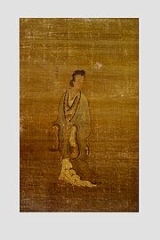
In China, Guanyin is usually shown in a white flowing robe and usually wears necklaces of Indian/Chinese royalty. In the right hand is a water jar containing pure water, and the left holds a willow
Willow

Willows, sallows, and osiers form the genus Salix, around 400 species of deciduous trees and shrubs, found primarily on moist soils in cold and temperate regions of the Northern Hemisphere....
 branch. The crown usually depicts the image of Amitabha
Amitabha

Amitabha is a celestial Buddhahood described in the scriptures of the Mahayana school of Buddhism. Amitabha is the principal buddha in the Pure Land sect, a branch of Buddhism practiced mainly in East Asia....
 Buddha, Guan Yin's spiritual teacher before she became a Bodhisattva
Bodhisattva

In the Buddhist context, a bodhisattva means either "enlightened existence " or "enlightenment-being" or, given the variant Sanskrit spelling satva rather than sattva, "heroic-minded one for enlightenment "....
.

In some Buddhist temples and monasteries, Guanyin's images are occasionally depicted as a young man dressed in Northern Song Buddhist robes sitting gracefully. He is usually depicted looking or glancing down, symbolising that Guanyin continues to watch over the world. There are also regional variations of Guan Yin depictions. In the Fujian
Fujian

is one of the Province of China on the southeast coast of People's Republic of China. Fujian borders Zhejiang to the north, Jiangxi to the west, and Guangdong to the south....
 region of China, for example, a popular depiction of Guan Yin is as a maiden dressed in Tang dynasty style clothing carrying a fish basket. A popular image of Guan Yin as both Guan Yin of the South Sea and Guan Yin With a Fish Basket can be seen in late 1500s Chinese encyclopedias and in prints that accompany the novel Golden Lotus.

In Chinese art, Guan Yin is often depicted either alone, standing atop a dragon, accompanied by a bird, flanked by two children, or flanked by two warriors. The two children are her acolytes who came to her when she was meditating at Mount Putuo
Mount Putuo

Mount Putuo is an island located to the south-east of Shanghai, in Zhoushan prefecture of Zhejiang province, People's Republic of China. It is famous in Chinese Buddhism, and is considered the bodhimanda of Avalokitesvara , a revered Bodhisattva in many parts of East Asia....
. The girl is called Long Nü and the boy Shan Tsai
Sudhana

Sudhana , best known as Shan Tsai or Red Boy in Chinese, is the main protagonist in the next-to-last and longest chapter of the Avatamsaka Sutra, and is also one of the acolytes of Avalokitesvara Bodhisattva....
. The two warriors are the historical character Guan Yu
Guan Yu

Guan Yu was a general under the warlord Liu Bei during the late Eastern Han Dynasty and Three Kingdoms era of China. He played a significant role in the civil war that led to the collapse of the Han Dynasty and the establishment of the Shu Han, of which Liu Bei was the first emperor....
 who comes from the Three Kingdoms
Three Kingdoms

The Three Kingdoms period is a period in the history of China, part of an era of disunity called the Six Dynasties following immediately the loss of de facto power of the Han Dynasty emperors....
 period and the mythological character Wei Tuo
Skanda (Buddhism)

Skanda , Wei Tuo, and sometimes called Veda, or Idaten in Japan, is regarded in Chinese Buddhism as a devoted guardian and an honored bodhisattva of Buddhist monasteries who guards the Dharma and the objects of the Dharma....
 who features in the Chinese classic Canonisation of the Gods. The Buddhist tradition also displays Guan Yin, or other buddhas and bodhisattvas, flanked with the two said warriors, but as bodhisattvas who protect the temple and the faith itself.

Veneration

Dongguan Guanyinshan
In Chinese Buddhist iconography, Guan Yin is often depicted as meditating or sitting alongside one of the Buddhas and usually accompanied by another bodhisattva. Which buddha or bodhisattva usually depends upon which school it represents. In the Pure Land school, for example, Guan Yin is frequently depicted as standing alongside Amitabha Buddha and bodhisattva Mahasthamaprapta
Mahasthamaprapta

Mahasthamaprapta is a bodhisattva that represents the power of wisdom and is often depicted in a trinity with Amitabha and Avalokitesvara, especially in Pure Land Buddhism....
. Temples that revere the bodhisattva Ksitigarbha
Ksitigarbha

is a bodhisattva primarily revered in East Asian Buddhism, usually depicted as a Bhikkhu in the Orient. The name may be translated as "Earth Treasury", "Earth Store", "Earth Matrix", or "Earth Womb." is known for his vow not to achieve Buddhahood until all hells are emptied; therefore, he is regarded as the bodhisattva of hell beings....
 usually depict him meditating alongside the Buddha and Guan Yin.

Along with Buddhism, Guanyin's veneration was introduced into China
China

China is a Culture of China, an ancient civilization, and, depending on perspective, a national or multinational entity extending over a large area in East Asia....
 as early as the 1st century CE, and reached Japan
Japan

Japan is an island country in East Asia. Located in the Pacific Ocean, it lies to the east of the Sea of Japan, People's Republic of China, North Korea, South Korea and Russia, stretching from the Sea of Okhotsk in the north to the East China Sea and Taiwan in the south....
 by way of Korea
Korea

Korea is a geographic area composed of two sovereign countries, a civilization, and a former state situated on the Korean Peninsula in East Asia....
 soon after Buddhism was first introduced into the country in the mid-7th century. Some Taoist records claim Guanyin was a Chinese female who became immortal during Shang Dynasty
Shang Dynasty

The Shang Dynasty or Yin Dynasty was according to traditional sources the first Dynasties in Chinese history. They ruled in the northeastern region of the area known as "China proper", in the Yellow River valley....
.

More recently in Europe and America, a new wave of believers have spread a devotional cult beyond Buddhism, Taoism and folk traditional beliefs. Guan Yin is not only a bodhisattva or a god but a focus of devotion by some Eastern New Age movements.

Guanyin's representation


Representations of the bodhisattva in China prior to the Song Dynasty (960-1279) were masculine in appearance. Images which later displayed attributes of both genders are believed to be in accordance with the Lotus Sutra
Lotus Sutra

The Lotus Sutra or Sutra on the White Sacred lotus of the Sublime Dharma is one of the most popular and influential Mahayana sutras in Asia and the basis on which the Tien Tai and Nichiren Buddhism sects of Buddhism were established....
, where Avalokitesvara has the supernatural power of assuming any form required to relieve suffering, and also has the power to grant children (possibly relating to the fact that in this Sutra -unlike in others- both men and women are believed to have ability to achieve enlightenment). Because this bodhisattva is considered the personification of compassion and kindness, a mother-goddess and patron of mothers and seamen, the representation in China was further interpreted in an all-female form around the 12th century. In the modern period, Guan Yin is most often represented as a beautiful, white-robed woman, a depiction which derives from the earlier Pandaravasini form.

Legends


Guanyin and the Thousand Arms

One Buddhist legend presents Guan Yin as vowing to never rest until she had freed all sentient beings from samsara
Samsara

'Samsara' or refers to the cycle of reincarnation or rebirth in Hinduism, Buddhism, Jainism, Sikhism and other related religions.According to these religions, one's karma "account balance" at the time of death is inherited via the state at which a person is reborn....
, reincarnation. Despite strenuous effort, she realized that still many unhappy beings were yet to be saved. After struggling to comprehend the needs of so many, her head split into eleven pieces. Amitabha Buddha, seeing her plight, gave her eleven heads with which to hear the cries of the suffering. Upon hearing these cries and comprehending them, Avalokitesvara attempted to reach out to all those who needed aid, but found that her two arms shattered into pieces. Once more, Amitabha came to her aid and appointed her a thousand arms with which to aid the many. Many Himalayan versions of the tale include eight arms with which Avalokitesvara skillfully upholds the Dharma
Dharma

The term , is an Indian Indian philosophy and Indian religions term, that means one's righteous duty or any virtuous path in the common sense of the term....
, each possessing its own particular implement, while more Chinese-specific versions give varying accounts of this number.

In China, it is said that fishermen used to pray to her to ensure safe voyages. The titles Guan Yin of the Southern Ocean and 'Guan Yin (of/on) the Island' stem from this tradition.

Legend of Miao Shan


Another story describes Guan Yin as the daughter of a cruel king who wanted her to marry a wealthy but uncaring man. The story is usually ascribed to the research of the Buddhist monk Chiang Chih-ch'i in 1100 AD. The story is likely to have a Taoist origin. Chiang Chih-ch'i, when he penned the work, believed that the Guan Yin we know today was actually a Buddhist princess called Miao Shan, who had a religious following on Fragrant Mountain. Despite this, however, there are many variants of the story in Chinese mythology.

According to the story, after the king asked his daughter Miao Shan to marry the wealthy man, she told him that she would obey his command, so long as the marriage eased three misfortunes.

The king asked his daughter what were the three misfortunes that the marriage should ease. Miao Shan explained that the first misfortune the marriage should ease was the suffering people endure as they age. The second misfortune it should ease was the suffering people endure when they fall ill. The third misfortune it should ease was the suffering caused by death. If the marriage could not ease any of the above, then she would rather retire to a life of religion forever.

When her father asked who could ease all the above, Miao Shan pointed out that a doctor was able to do all these.

Daienin Kannon
Her father grew angry as he wanted her to marry a person of power and wealth, not a healer. He forced her into hard labor and reduced her food and drink but this did not cause her to yield.

Every day she begged to be able to enter a temple
Temple

A temple is a structure reserved for religious or spiritual activities, such as prayer and sacrifice, or analogous rites. A ??templum?? constituted a sacred precinct as defined by a priest, or augur....
 and become a nun
Nun

A Nun is a woman who has taken special vows committing her to a religious life. She may be an monasticism who voluntarily chooses to leave mainstream society and live her life in prayer and contemplation in a monastery or convent....
 instead of marrying. Her father eventually allowed her to work in the temple, but asked the monk
Monk

A Monk is a person who practices religious asceticism, the unconditioning of mind and body in favor of the realization of one's true nature, and does so living either alone or with any number of like-minded people, whilst always maintaining some degree of physical separation from those not sharing the same purpose....
s to give her very hard chores in order to discourage her. The monks forced Miao Shan to work all day and all night, while others slept, in order to finish her work. However, she was such a good person that the animals living around the temple began to help her with her chores. Her father, seeing this, became so frustrated that he attempted to burn down the temple. Miao Shan put out the fire with her bare hands and suffered no burns. Now struck with fear, her father ordered her to be put to death.

In one version of this legend, when she was executed, a supernatural tiger took Guan Yin to one of the more hell-like realms of the dead. However, instead of being punished by demons like the other inmates, Guan Yin played music and flowers blossomed around her. This completely surprised the head demon. The story says that Guan Yin, by merely being in that hell
Naraka (Buddhism)

Naraka ??? or Niraya ???? is the name given to one of the worlds of greatest suffering in some Buddhist cosmology.Naraka is usually translated into English as "hell" or "purgatory"....
, turned it into a paradise
Paradise

Paradise is an idealized place in which existence is positive, harmonious and timeless. It is conceptually a counter-image of the miseries of human civilization, and in paradise there is only peace, prosperity, and happiness....
.

A variant of the legend says that Miao Shan allowed herself to die at the hand of the executioner. According to this legend, as the executioner tried to carry out her father's orders, his axe shattered into a thousand pieces. He then tried a sword which likewise shattered. He tried to shoot Miao Shan down with arrows but they all veered off.

Finally in desperation he used his hands. Miao Shan, realising the fate the executioner would meet at her father's hand should she fail to let herself die, forgave the executioner for attempting to kill her. It is said that she voluntarily took on the massive karmic guilt the executioner generated for killing her, thus leaving him guiltless. It is because of this that she descended into the Hell-like realms. While there she witnessed firsthand the suffering and horrors beings there must endure and was overwhelmed with grief. Filled with compassion, she released all the good karma she had accumulated through her many lifetimes, thus freeing many suffering souls back into Heaven and Earth. In the process that Hell-like realm became a paradise. It is said that Yanluo
Yama (Buddhism and Chinese mythology)

Yama is the name of the Buddhism dharmapala and judge of the dead, who presides over the Buddhist Naraka , "Hells" or "Purgatories". Although ultimately based on the god Yama of the Hindu Vedas, the Buddhist Yama has developed different myths and different functions from the Hinduism deity....
, King of Hell
Di Yu

Diyu is the realm of the dead or "hell" in Chinese mythology. It is very loosely based upon the Buddhism concept of Naraka combined with traditional Chinese afterlife beliefs and a variety of popular expansions and re-interpretations of these two traditions....
, sent her back to Earth to prevent the utter destruction of his realm, and that upon her return she appeared on Fragrant Mountain.

Another tale says that Miao Shan never died but was in fact transported by a supernatural tiger, believed to be the Deity of the Place, to Fragrant Mountain.

Deity Lady
The Legend of Miao Shan usually ends with Miao Chuang Yen, Miao Shan's father, falling ill with jaundice
Jaundice

Jaundice, also known as icterus , is a yellowish discoloration of the skin, the conjunctival membranes over the sclera , and other mucous membranes caused by hyperbilirubinemia ....
. No physician was able to cure him. Then a monk appeared saying that the jaundice could be cured by making a medicine out of the arm and eye of one without anger. The monk further suggested that such a person could be found on Fragrant Mountain. When asked, Miao Shan willingly offered up her eyes and arms. Miao Chuang Yen was cured of his illness and went to the Fragrant Mountain to give thanks to the person. When he discovered that his own daughter had made the sacrifice, he begged for forgiveness. The story concludes with Miao Shan being transformed into the Thousand Armed Guan Yin, and the king, queen and her two sisters building a temple on the mountain for her. She began her journey to heaven and was about to cross over into heaven when she heard a cry of suffering from the world below. She turned around and saw the massive suffering endured by the people of the world. Filled with compassion, she returned to earth
Earth

Earth is the third planet from the Sun. Earth is the largest of the terrestrial planets in the Solar System in diameter, mass and density. It is also referred to as the World and Wiktionary:Terra.Note that by International Astronomical Union convention, the term "Terra" is used for naming extensive land masses, rather...
, vowing never to leave till such time as all suffering has ended.

After her return to Earth, Guan Yin was said to have stayed for a few years on the island of Mount Putuo
Mount Putuo

Mount Putuo is an island located to the south-east of Shanghai, in Zhoushan prefecture of Zhejiang province, People's Republic of China. It is famous in Chinese Buddhism, and is considered the bodhimanda of Avalokitesvara , a revered Bodhisattva in many parts of East Asia....
 where she practised meditation and helped the sailors and fishermen who got stranded. Guan Yin is frequently worshipped as patron of sailors and fishermen due to this. She is said to frequently becalm the sea when boats are threatened with rocks. After some decades Guan Yin returned to Fragrant Mountain to continue her meditation.

Guanyin and Shan Tsai

Legend has it that Shan Tsai
Sudhana

Sudhana , best known as Shan Tsai or Red Boy in Chinese, is the main protagonist in the next-to-last and longest chapter of the Avatamsaka Sutra, and is also one of the acolytes of Avalokitesvara Bodhisattva....
 (also called Sudhana
Sudhana

Sudhana , best known as Shan Tsai or Red Boy in Chinese, is the main protagonist in the next-to-last and longest chapter of the Avatamsaka Sutra, and is also one of the acolytes of Avalokitesvara Bodhisattva....
 in Sanskrit
Sanskrit

Sanskrit is a historical Indo-Aryan language, one of the liturgical languages of Hinduism and Buddhism, and one of the 22 official languages of India....
) was a disabled boy from India who was very interested in studying the Buddha Dharma. When he heard that there was a Buddhist teacher on the rocky island of Putuo he quickly journeyed there to learn. Upon arriving the island, he managed to find Bodhisattva Guan Yin despite his severe disability.

Guan Yin, after having a discussion with Shan Tsai, decided to test the boy's resolve to fully study the Buddhist teachings. She conjured the illusion of three sword-wielding pirates running up the hill to attack her. Guan Yin took off and dashed off to the edge of a cliff, the three illusions still chasing her.

Shan Tsai, seeing that his teacher was in danger, hobbled uphill. Guan Yin then jumped over the edge of the cliff, and soon after this the three bandits followed. Shan Tsai, still wanting to save his teacher, managed to crawl his way over the cliff edge.

Shan Tsai fell down the cliff but was halted in midair by Guan Yin, who now asked him to walk. Shan Tsai found that he could walk normally and that he was no longer crippled. When he looked into a pool of water he also discovered that he now had a very handsome face. From that day forth, Guan Yin taught Shan Tsai the entire Buddha Dharma.

Guanyin and Lung Nü

Many years after Shan Tsai became a disciple of Guan Yin, a distressing event happened in the South Sea. The sons of one of the Dragon Kings (a ruler-god of the sea) was caught by a fisherman while taking the form of a fish. Being stuck on land, he was unable to transform back into his dragon form. His father, despite being a mighty Dragon King, was unable to do anything while his son was on land. Distressed, the son called out to all of Heaven and Earth.

Hearing this cry, Guan Yin quickly sent Shan Tsai to recover the fish and gave him all the money she had. The fish at this point was about to be sold in the market. It was causing quite a stir as it was alive hours after being caught. This drew a much larger crowd than usual at the market. Many people decided that this prodigious situation meant that eating the fish would grant them immortality, and so all present wanted to buy the fish. Soon a bidding war started, and Shan Tsai was easily outbid.

Shan Tsai begged the fish seller to spare the life of the fish. The crowd, now angry at someone so daring, was about to prise him away from the fish when Guan Yin projected her voice from far away, saying "A life should definitely belong to one who tries to save it, not one who tries to take it."

The crowd realising their shameful actions and desire, dispersed. Shan Tsai brought the fish back to Guan Yin, who promptly returned it to the sea. There the fish transformed back to a dragon and returned home. Paintings of Guan Yin today sometimes portray her holding a fish basket, which represents the aforementioned tale.

But the story does not end here. As a reward for Guan Yin saving his son, the Dragon King sent his granddaughter, a girl called Lung Nü ("dragon girl"), to present to Guan Yin with the Pearl of Light. The Pearl of Light was a precious jewel owned by the Dragon King that constantly shone. Lung Nü, overwhelmed by the presence of Guan Yin, asked to be her disciple so that she might study the Buddha Dharma. Guan Yin accepted her offer with just one request: that Lung Nü be the new owner of the Pearl of Light.

In popular iconography, Lung Nü and Shan Tsai are often seen alongside Guan Yin as two children. Lung Nü is seen either holding a bowl or an ingot
Ingot

An ingot is a material, usually metal, that is Casting into a shape suitable for further processing. It requires a second procedure of shaping, by means of cold/hot working to produce the final product....
, which represents the Pearl of Light, whereas Shan Tsai is seen with palms joined and knees slightly bent to show that he was once crippled.

Guanyin and Vegetarianism

Due to her symbolising compassion, in East Asia
East Asia

East Asia is a subregion of Asia that can be defined in either Geography or cultural terms. Geography and geopolitically, it covers about 12,000,000 km?, or about 28 percent of the Asian continent, about 15 percent bigger than the area of Europe, though some categorize Tibet, Xinjiang, and Mongolia as Central Asia....
 Guan Yin is associated with vegetarianism
Vegetarianism

File:Foods.jpgVegetarianism is the practice of a diet that excludes meat , fish and poultry.There are several variants of the diet, some of which also exclude egg and/or some products produced from animal labour such as dairy products and honey....
. Chinese vegetarian restaurants are generally decorated with her image, and she appears in most Buddhist vegetarian pamphlets and magazines.

Guanyin in Chinese Buddhism

Status of Kuan Yin
In Chinese Buddhism, Guanyin/Kuan Yin/Kannon/Kwannon is synonymous with the Bodhisattva Avalokitesvara, the pinnacle of mercy and compassion. Among the Chinese, Avalokitesvara is almost exclusively called Guan Shi Yin Pu Sa. The Chinese translation of many Buddhist sutras has in fact replaced the Chinese transliteration of Avalokitesvara with Guan Shi Yin Some Taoist scriptures give her the title of Guan Yin Da Shi, and sometimes informally as Guan Yin Fo Zu.

In Chinese Buddhism, the popular myth and worship of Guan Yin as a goddess by the populace is generally not viewed to be in conflict with the bodhisattva Avalokitesvara's nature. In fact the widespread worship of Guan Yin as a "Goddess of Mercy and Compassion" is seen as the boundless salvific nature of bodhisattva Avalokitesvara at work. The Buddhist canon states that bodhisattvas can assume whatsoever gender and form is needed to liberate beings from ignorance and dukkha
Dukkha

Dukkha roughly corresponding to a number of terms in English including suffering, pain, unsatisfactoriness, sorrow, affliction, anxiety, dissatisfaction, discomfort, anguish, Stress , misery, and frustration....
. With specific reference to Avalokitesvara, he is stated both in the Lotus Sutra
Lotus Sutra

The Lotus Sutra or Sutra on the White Sacred lotus of the Sublime Dharma is one of the most popular and influential Mahayana sutras in Asia and the basis on which the Tien Tai and Nichiren Buddhism sects of Buddhism were established....
 and the Surangama Sutra to have appeared before as a woman or a goddess to save beings from suffering and ignorance. Some Buddhist schools refer to Guan Yin both as male and female interchangeably.

Also in Mahayana Buddhism, to which Chinese Buddhism belongs, gender is no obstacle to Enlightenment. The Buddhist concept of non-duality applies here. The Vimalakirti Sutra in the Goddess chapter clearly illustrates an Enlightened being who is also a female and deity. In the Lotus Sutra a maiden became Enlightened in a very short time span. That bodhisattva Avalokitesvara is also the goddess Guan Yin is not seen as contradictory.

Given that bodhisattvas are known to incarnate at will as living people according to the sutras, the princess Miao Shan is generally viewed as an incarnation of Avalokitesvara.

Guanyin is immensely popular among Chinese Buddhists, especially those from devotional schools. She is generally seen as a source of unconditional love and more importantly as a savior. In her bodhisattva vows, Guan Yin promises to answer the cries and pleas of all beings and to liberate all beings from their own karmic woes. Based upon the Lotus Sutra and the Shurangama sutra, Avalokitesvara is generally seen as a savior, both spiritually and physically. The sutras state that through his saving grace even those who have no chance of being Enlightened can be Enlightened, and those deep in negative karma can still find salvation through his compassion.

In Pure Land Buddhism, Guan Yin is described as the "Bark of Salvation". Along with Amitabha Buddha and the bodhisattva Mahastamaprata, She temporarily liberates beings out of the Wheel of Samsara into the Pure Land, where they will have the chance to accrue the necessary merit so as to be a Buddha in one lifetime.

Even among Chinese Buddhist schools that are non-devotional, Guan Yin is still highly venerated. Instead of being seen as an active external force of unconditional love and salvation, the personage of Guan Yin is highly revered as the principle of compassion, mercy and love. The act, thought and feeling of compassion and love is viewed as Guan Yin. A merciful, compassionate, loving individual is said to be Guan Yin. A meditative or contemplative state of being at peace with oneself and others is seen as Guan Yin.

In the Mahayana canon, the Heart Sutra is ascribed entirely to the bodhisattva Kuan Yin/Kwannon. This is unique, as most Mahayana Sutras are usually ascribed to Shakyamuni Buddha and the teachings, deeds or vows of the bodhisattvas are described by Shakyamuni Buddha. In the Heart Sutra
Heart Sutra

The Heart of Perfect Wisdom Sutra or Heart Sutra or Essence of Wisdom Sutra is a well-known Mahayana Buddhist sutra that is very popular among Mahayana Buddhists both for its brevity and depth of meaning....
, Guan Yin/Avalokitesvara describes to the Arhat Sariputra
Sariputra

Sariputra or Sariputta was one of two principal sravaka of the Buddha. He became an Arhat renowned for his wisdom and is depicted in the Theravada tradition as one of the most important disciples of the Buddha....
 the nature of reality and the essence of the Buddhist teachings. The famous Buddhist saying "Form is emptiness, emptiness is form" comes from this sutra.

The Shaolin Monastery historically worshiped a deity known as Kinara, a dharmapala
Dharmapala

In Vajrayana Buddhism, a dharmapala is a type of wrathful deity. The name means "Dharma-defender" in Sanskrit, and the dharmapalas are also known as the Defenders of the Law , or the Protectors of the Law, in English language....
, as their patron saint
Patron saint

A patron saint is a saint who is regarded as the intercessor and advocate in heaven of a nation, place, craft, activity, class, or person. Patron saints, because they have already transcended to the metaphysical, are able to intercede effectively for the needs of their special charges....
 and progenitor of their famous Shaolin staff method. Kimnara was originally called "Narayana" (not to be confused with Vishnu
Narayana

Narayana or Narayan is an important Sanskrit name for Vishnu, and in many contemporary vernaculars a common Indian name. Narayana is also identified as the original man, Purusha....
), which was a name for the Bodhisattva Vajrapani
Vajrapani

is one of the earliest bodhisattvas of Mahayana Buddhism. He is the protector and guide of the Gautama Buddha, and rose to symbolize the Buddha's power....
. However, Shaolin considered Vajrapani's Kimnara form to be an emination of Guanyin.

Guanyin and Chinese Folk Belief

Guan Yin is an extremely popular Goddess in Chinese folk belief and is worshiped in Chinese communities throughout East and South East Asia. Guan Yin is revered in the general Chinese population due to her unconditional love, compassion and mercy. She is generally regarded by many as the protector of women and children. By this association she is also seen as a fertility goddess capable of granting children. She is also seen as the champion of the unfortunate, the sick, the disabled, the poor, and those in trouble. Some coastal and river areas of China regard her as the protector of fishermen, sailors, and generally people who are out at sea, thus many also come to believe that Mazu, the Taoist goddess of the sea, is a manifestation of Guan Yin. Due to her association with the legend of the Great Flood, where she sent down a dog holding rice
Rice

Rice is a staple food for a large part of the world's human population, especially in tropical Latin America, and East Asia, South Asia and Southeast Asia, making it the second-most consumed cereal grain, after maize....
 grains in its tail after the flood, she is worshiped as a rice goddess. In some quarters, especially among business people and traders, she is looked upon as a Goddess of Luck and Fortune. In recent years there have been claims of her being the protector of air travelers.

Guanyin and the Virgin Mary

Guanyin and Child
Some syncretic Buddhist and Christian
Christian

A Christian is a person who adheres to Christianity, a Monotheism#Christian view religion centered on the life and teachings of Jesus and interpreted by Christians to have been prophesied in the Hebrew Bible/Old Testament....
 observers have commented on the similarity between Guan Yin and the Blessed Virgin Mary
Blessed Virgin Mary

The Blessed Virgin Mary, sometimes shortened to The Blessed Virgin or The Virgin Mary, is a traditional title used by most Christians and most specifically used by liturgical Christians such as Roman Catholics, Anglicanism, Eastern Orthodox and Eastern Catholics, and some others to describe Mary, mother of Jesus, the mother of...
 of Christianity
Christianity

Christianity is a Monotheistic religion #Christian view religion centered on the life and teachings of Jesus as New Testament view on Jesus' life....
, the mother of Jesus Christ. The Tzu-Chi Foundation, a Taiwanese Buddhist organization, also noticing the similarity, commissioned a portrait of Guan Yin and a baby that resembles the typical Roman Catholic Madonna and Child painting.

Some Chinese of the overwhelmingly Roman Catholic Philippines
Philippines

The Philippines, officially known as the Republic of the Philippines, is a country in Southeast Asia with Manila as its capital city. It comprises 7,107 islands in the western Pacific Ocean....
, in an act of syncretism
Syncretism

Syncretism consists of the attempt to reconcile disparate or contrary beliefs, often while melding practices of various schools of thought. The term may refer to attempts to merge and analogy several originally discrete traditions, especially in the theology and mythology of religion, and thus assert an underlying unity allowing for an inclu...
, have identified Guan Yin with the Virgin Mary.

During the Edo Period
Edo period

The , or , is a division of History of Japan running from 1603 to 1868. The period marks the governance of the Edo or Tokugawa shogunate, which was officially established in 1603 by the first Edo shogun Tokugawa Ieyasu....
 in Japan, when Christianity was banned and punishable by death, some underground Christian groups venerated the Virgin Mary disguised as a statue of Kannon; such statues are known as Maria Kannon
Kakure Kirishitan

is a modern term for a member of the Japanese Roman Catholic Church that went underground after the Shimabara Rebellion in the 1630s.History...
. Many had a cross hidden in an inconspicuous location.

Guanyin in popular culture

  • Guan Yin plays a central role in the plot of the classic Chinese novel Journey to the West
    Journey to the West

    Journey to the West is one of the Four Great Classical Novels of Chinese literature. Originally published anonymously in the 1590s during the Ming Dynasty, and even though no direct evidence of its authorship survives, it has been ascribed to the scholar Wu Cheng'en since the 20th century....
    .


  • A space probe
    Space probe

    A robotic spacecraft is a spacecraft with no humans on board, that is usually under telerobotic control. A robotic spacecraft designed to make scientific research measurements is often called a space probe....
     called Kuan-Yin features in the 1982 science fiction
    Science fiction

    Science fiction is a broad genre of fiction that often involves speculations based on current or future science or technology. Science fiction is found in books, art, television, films, games, theatre, and other media....
     novel Voyage from Yesteryear
    Voyage from Yesteryear

    Voyage from Yesteryear is a 1982 science fiction novel by the author James P. Hogan . It explores themes of anarchism and the appropriateness of certain social values in the context of high-technology....
     by James P. Hogan
    James P. Hogan (writer)

    James Patrick Hogan is a United Kingdom science fiction author....
    .


  • The name of the Japanese company Canon Inc.
    Canon Inc.

    is a Japanese multinational corporation that specialises in the manufacture of imaging and optical products, including cameras, Photocopying and computer printers....
     derives from the Japanese name of the deity.


  • Her birthday, the 19th day of 2nd lunar month (6 April in 2007), based on Chinese calendar
    Chinese calendar

    The Chinese calendar is lunisolar calendar, incorporating elements of a lunar calendar with those of a solar calendar. This measure of time was first introduced by the Babylonians ....
     is a holiday in the Republic of China
    Holidays in the Republic of China

    Holidays in Taiwan refers to the holidays and festivals observed in the Taiwan Area of the Republic of China. Includes both official holidays defined by the Republic of China government and traditional holidays....
    .


  • She is played by Gloria Yip
    Gloria Yip

    Gloria Yip Wan-Yee is a Hong Kong actress and singer of Guangdong ancestry, best known for her four films with director Lam Ngai Kai, and to Western audiences, her "special appearance" in Lam's Riki-Oh: The Story of Ricky and principal supporting role in the cult classic Saviour of the Soul....
     in the 2005 television miniseries
    Television miniseries

    A television miniseries is a term used for television programs created in the U.S. or Canada and structured to be broadcast in a fixed and limited number of episodes, sometimes of varying length; the number is usually more than two and less than thirteen of various lengths....
    , Magic Sword of Heaven and Earth.


  • In the Japanese anime Gensoumaden Saiyuki, Guan Yin appears as Kanzeon Bosatsu, the Goddess of Mercy, who watches over the four on their Journey to the West.


  • Alanis Morrisette's song "Citizen Of The Planet" on her 2008 Album Flavors of Entanglement
    Flavors of Entanglement

    Flavors of Entanglement is the seventh studio album and fifth international release by Canadian singer-songwriter Alanis Morissette. The album, which was originally set for an April release, was released May 30, 2008 in Germany, Benelux and Ireland, released internationally on June 2 and in the United States on June 10....
     references Kuan-Yin in the line "I am a citizen of the planet / my president is Kuan-Yin".


See also

  • Avalokitesvara
    Avalokitesvara

    Avalokitesvara is a bodhisattva who embodies the compassion of all Buddhahood. He is one of the more widely revered bodhisattvas in mainstream Mahayana Buddhism....
  • Zhang Jigang
    Zhang Jigang

    Zhang Jigang He is the only choreographer to receive the crown title of "Century Star" in the country, and is responsible for the creation of more than 300 large-scale productions in over 60 countries....
     (creator of the Thousand Hand Guan Yin dance)
  • Buddhism in China
    Buddhism in China

    Chinese Buddhism refers collectively to the various schools of Buddhism that have flourished in China proper since ancient times. Many of these schools integrated the ideas of Confucianism, Taoism and other indigenous philosophical systems so that what was initially a foreign religion came to be a natural part of Chinese civilization, albe...
  • Tieguanyin
    Tieguanyin

    Tie Guan Yin is a premium variety of China oolong associated with Anxi County in Fujian. Named after the bodhisattva Avalokitesvara , it has also been translated as "Iron Goddess of Mercy" after the old translation for Guan Yin's name....
    , a variety of Chinese
    China

    China is a Culture of China, an ancient civilization, and, depending on perspective, a national or multinational entity extending over a large area in East Asia....
     oolong tea
    Oolong

    Oolong is a traditional Chinese tea somewhere between green tea and black tea in oxidation. It ranges from 10% to 70% oxidation.In Chinese tea culture, semi-oxidized oolong teas are collectively grouped as qingch? ....
     named after Guan Yin
  • Putuoshan
    Mount Putuo

    Mount Putuo is an island located to the south-east of Shanghai, in Zhoushan prefecture of Zhejiang province, People's Republic of China. It is famous in Chinese Buddhism, and is considered the bodhimanda of Avalokitesvara , a revered Bodhisattva in many parts of East Asia....
     (Mount Putuo), an island in Zhejiang
    Zhejiang

    Zhejiang is an eastern coastal province of China of the People's Republic of China. The word Zhejiang was the old name of the Qiantang River, which passes through Hangzhou, the provincial capital....
     province, China
    China

    China is a Culture of China, an ancient civilization, and, depending on perspective, a national or multinational entity extending over a large area in East Asia....
    , considered to be the bodhimandala
    Bodhimandala

    The term bodhimandala or "bodhimanda" , in its original meaning, is the achievement of enlightenment, or the meditation posture adopted by a Buddhism to that end....
     of Guan Yin
  • Tara (Buddhism)
    Tara (Buddhism)

    Tara or Arya Tara, also known as Jetsun Dolma in Tibetan Buddhism, is a female Bodhisattva in Mahayana Buddhism who appears as a female Buddhahood in Vajrayana Buddhism.....
     (Tara is the female aspect of Avalokitesvara in Tibetan Buddhism
    Tibetan Buddhism

    Tibetan Buddhism is the body of Buddhism religious doctrine and institutions characteristic of Tibet and certain regions of the Himalayas, including northern Nepal, Bhutan, and India ....
    .)
  • Guanyin Statue of Hainan
    Guanyin Statue of Hainan

    The Guanyin Statue of Hainan, also known as Guan Yin of the South Sea of Sanya, is a 108_ metre tall statueof the bodhisattva Guan Yin, sited on the south coast of China's island province Hainan...
    , the third tallest statue in the world
    List of statues by height

    The following is a list of statues by height. ...


External links

  • Explanation on Kuan Yin, Pictures, Prayers and more
  • The 108 Glories of Kwan Yin
  • Description on Kuan Yin
  • Explanation on Kuan Yin and the Heart Sutra
  • Legend of Miao Shan