

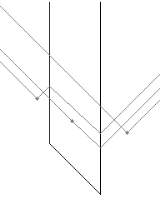
Krasnikov Tube

Encyclopedia
A Krasnikov tube is a speculative mechanism for space travel involving the warping of spacetime into permanent superluminal tunnels. The resulting structure is analogous to a wormhole
with the endpoints displaced in time as well as space. The idea was proposed by Serguei Krasnikov in 1995.
This several light-year long man-shaped "tube" might arguably constitute a megastructure, but unlike most megastructures it's not constructed of physical matter such as titanium or plastic, but instead is just a warpage of spacetime.
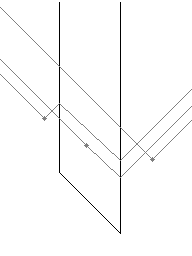 Experiencing the effect requires that the traveller race along the tube at speeds close to that of light.
(that a cause must always precede its effects in all coordinate systems and along all space-time paths) because all points along the round-trip path of the spaceship always have an ordered timelike separation interval [in algebraic terms, is always larger than
  ]. This means, for example, that a light-beam message sent along a Krasnikov tube cannot be used for back-in-time signaling.
that two Krasnikov tubes going in opposite directions can create timelike loops and violations of causality.
For example, suppose that a tube is built connecting Earth to a star 3000 light years away. The astronauts are traveling at relativistic velocities, so that the journey only takes 1.5 years from their perspective. Then the astronauts lay down tube II rather than traveling back in tube I, the first tube they produced. In another 1.5 years of ship time they will arrive back on Earth, but at a time 6000 years in the future of their departure. But now that two Krasnikov tubes are in place, astronauts from the future can travel to the star in tube II, then to Earth in tube I and will arrive 6000 years earlier than their departure. The Krasnikov tube system has become a time machine.
It is presumed that a similar mechanism which destroys time-machine wormholes will destroy the time-machine Krasnikov tubes. That is, vacuum fluctuation will grow exponentially and eventually destroy the Second Krasnikov tube as it approaches the timelike loop limit, in which causality is violated.
Wormhole
In physics, a wormhole is a hypothetical topological feature of spacetime that would be, fundamentally, a "shortcut" through spacetime. For a simple visual explanation of a wormhole, consider spacetime visualized as a two-dimensional surface. If this surface is folded along a third dimension, it...
with the endpoints displaced in time as well as space. The idea was proposed by Serguei Krasnikov in 1995.
Structure
The tube is a distortion of spacetime that can be intentionally created (using hypothetical technology) in the wake of travel near the speed of light. The Krasnikov Tube allows for a return trip that takes you back to the time right after you left.This several light-year long man-shaped "tube" might arguably constitute a megastructure, but unlike most megastructures it's not constructed of physical matter such as titanium or plastic, but instead is just a warpage of spacetime.
One-tube case
Krasnikov argues that despite the time-machine-like aspects of his metric, it cannot violate the law of causalityCausality (physics)
Causality is the relationship between causes and effects. It is considered to be fundamental to all natural science, especially physics. Causality is also a topic studied from the perspectives of philosophy and statistics....
(that a cause must always precede its effects in all coordinate systems and along all space-time paths) because all points along the round-trip path of the spaceship always have an ordered timelike separation interval [in algebraic terms,
is always larger than ]. This means, for example, that a light-beam message sent along a Krasnikov tube cannot be used for back-in-time signaling.Two-tube case
While one Krasnikov tube can be seen to present no problems with causality, it was proposed by Allen E. Everett and Thomas A. Roman of Tufts UniversityTufts University
Tufts University is a private research university located in Medford/Somerville, near Boston, Massachusetts. It is organized into ten schools, including two undergraduate programs and eight graduate divisions, on four campuses in Massachusetts and on the eastern border of France...
that two Krasnikov tubes going in opposite directions can create timelike loops and violations of causality.
For example, suppose that a tube is built connecting Earth to a star 3000 light years away. The astronauts are traveling at relativistic velocities, so that the journey only takes 1.5 years from their perspective. Then the astronauts lay down tube II rather than traveling back in tube I, the first tube they produced. In another 1.5 years of ship time they will arrive back on Earth, but at a time 6000 years in the future of their departure. But now that two Krasnikov tubes are in place, astronauts from the future can travel to the star in tube II, then to Earth in tube I and will arrive 6000 years earlier than their departure. The Krasnikov tube system has become a time machine.
It is presumed that a similar mechanism which destroys time-machine wormholes will destroy the time-machine Krasnikov tubes. That is, vacuum fluctuation will grow exponentially and eventually destroy the Second Krasnikov tube as it approaches the timelike loop limit, in which causality is violated.