All Topics  
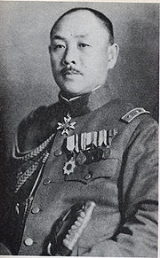
Korechika Anami

 
Korechika Anami

   Email Print
   Bookmark   Link


Korechika Anami


was a general in the Imperial Japanese Army
Imperial Japanese Army

The Imperial Japanese Army , or literally Army of Empire of Greater Japan was the official ground based armed force of Imperial Japan from 1867 to 1945....
 during World War II
World War II

World War II, or the Second World War , was a global military conflict which involved a Participants in World War II, including all of the great powers, organised into two opposing military alliances: the Allies of World War II and the Axis powers....
, and was War Minister
Ministry of War of Japan

The , more popularly known as the Ministry of War of Japan was the Cabinet -level ministry from 1872-1945 in charge with administration of the Imperial Japanese Army ....
 at the surrender of Japan
Surrender of Japan

The surrender of Japan in August 1945 brought World War II to a close. On August 10, 1945, after the Soviet Union Soviet invasion of Manchuria and the United States atomic bombings of Hiroshima and Nagasaki, Japan's leaders at the Supreme War Council decided, in principle, to accept the terms the Allies of World War II had set down...
.

i was born in Taketa city
Taketa, Oita

is a cities of Japan located in Oita Prefecture, Japan.As of 2003, the city has an estimated population of 16,807 and a population density of 83.69 persons per square kilometer....
 in Oita Prefecture
Oita Prefecture

is a Prefectures of Japan of Japan located on Kyushu Island. The prefectural capital is the city of Oita, Oita....
. He attended the Imperial Japanese Army Academy, and was commissioned as a second lieutenant
Second Lieutenant

Second Lieutenant is the lowest Officer military rank in many armed forces.In British English the rank is pronounced second /l?f't?n?nt/ , while in American English it is pronounced second /lu't?n?nt/ ....
 in the Infantry
Infantry

Infantry are soldiers who are primarily trained for the role of fighting on foot. A soldier in the infantry is known as an infantryman. Infantry units have more physically demanding training than other branches of armies, and place a greater emphasis on fitness, physical strength and aggression....
 in December 1906.

In November 1918, Anami graduated from the Army War College
Army War College (Japan)

The ; Short form: of the Empire of Japan was founded in 1882 in Minato, Tokyo, Tokyo to modernity and Westernization the Imperial Japanese Army. Much of the empire's elite including Prime Minister of Japan during the period of Japanese militarism were graduates of the college....
 with the rank of captain. He was assigned to the Imperial Japanese Army General Staff from April 1919 and was promoted to major
Major

In many European languages, the term Major refers to a military rank, denoting seniority at one of usually various levels of rank, for example: "Sergeant-Major" denoting the most senior ranking sergeant of a large military unit; "Captain-Major", denoting a mid-level command status Officer ...
 in February 1922.


Discussion
Ask a question about 'Korechika Anami'
Start a new discussion about 'Korechika Anami'
Answer questions from other users
Full Discussion Forum


Encyclopedia


was a general in the Imperial Japanese Army
Imperial Japanese Army

The Imperial Japanese Army , or literally Army of Empire of Greater Japan was the official ground based armed force of Imperial Japan from 1867 to 1945....
 during World War II
World War II

World War II, or the Second World War , was a global military conflict which involved a Participants in World War II, including all of the great powers, organised into two opposing military alliances: the Allies of World War II and the Axis powers....
, and was War Minister
Ministry of War of Japan

The , more popularly known as the Ministry of War of Japan was the Cabinet -level ministry from 1872-1945 in charge with administration of the Imperial Japanese Army ....
 at the surrender of Japan
Surrender of Japan

The surrender of Japan in August 1945 brought World War II to a close. On August 10, 1945, after the Soviet Union Soviet invasion of Manchuria and the United States atomic bombings of Hiroshima and Nagasaki, Japan's leaders at the Supreme War Council decided, in principle, to accept the terms the Allies of World War II had set down...
.

Biography


Early career

Anami was born in Taketa city
Taketa, Oita

is a cities of Japan located in Oita Prefecture, Japan.As of 2003, the city has an estimated population of 16,807 and a population density of 83.69 persons per square kilometer....
 in Oita Prefecture
Oita Prefecture

is a Prefectures of Japan of Japan located on Kyushu Island. The prefectural capital is the city of Oita, Oita....
. He attended the Imperial Japanese Army Academy, and was commissioned as a second lieutenant
Second Lieutenant

Second Lieutenant is the lowest Officer military rank in many armed forces.In British English the rank is pronounced second /l?f't?n?nt/ , while in American English it is pronounced second /lu't?n?nt/ ....
 in the Infantry
Infantry

Infantry are soldiers who are primarily trained for the role of fighting on foot. A soldier in the infantry is known as an infantryman. Infantry units have more physically demanding training than other branches of armies, and place a greater emphasis on fitness, physical strength and aggression....
 in December 1906.

In November 1918, Anami graduated from the Army War College
Army War College (Japan)

The ; Short form: of the Empire of Japan was founded in 1882 in Minato, Tokyo, Tokyo to modernity and Westernization the Imperial Japanese Army. Much of the empire's elite including Prime Minister of Japan during the period of Japanese militarism were graduates of the college....
 with the rank of captain. He was assigned to the Imperial Japanese Army General Staff from April 1919 and was promoted to major
Major

In many European languages, the term Major refers to a military rank, denoting seniority at one of usually various levels of rank, for example: "Sergeant-Major" denoting the most senior ranking sergeant of a large military unit; "Captain-Major", denoting a mid-level command status Officer ...
 in February 1922. From August 1923 to May 1925 he was assigned to the Sakhalin
Sakhalin

Sakhalin , also Saghalien, is a large elongated island in the North Pacific, lying between 45?50' and 54?24' N. It is part of Russia and is its largest island, administered as part of Sakhalin Oblast....
 Expeditionary Army. Anami was promoted to lieutenant colonel
Lieutenant Colonel

Lieutenant colonel is a rank of commissioned officer in the army and most Marine and air forces of the world, typically ranking above a major and below a colonel....
 in August 1925.

From August-December 1925, Anami was sent as a military attaché
Military attaché

A military attach? is a military expert who is attached to a diplomatic mission . This post is normally filled by a high-ranking Officer .In general, a military attach? serves on the diplomatic staff of an embassy or consulate....
 to France
France

France , officially the French Republic , is a country whose Metropolitan France is located in Western Europe and that also comprises various Overseas departments and territories of France....
. On his return to Japan, he was assigned to the 45th Infantry Regiment, becoming unit commander in August 1928.

From August 1929-August 1930, Anami served as Aide-de-camp
Aide-de-camp

An aide-de-camp is a personal assistant, secretary, or adjutant to a person of high rank, usually a senior military officer or a head of state....
 to Emperor Hirohito. He was then promoted to colonel
Colonel

Colonel is a military rank of a commissioned officer, with corresponding ranks existing in almost every country in the world. It is also used in some police forces and other paramilitary rank structures....
.

From August 1933-August 1934, Anami served as regimental commander of the 2nd Guard Regiment of the Imperial Guards
Imperial Guard of Japan

The Japanese is an organization which is dedicated to protection of the Emperor of Japan and his family, palaces and other imperial properties. The Guard also served as a unit within the Imperial Japanese Army....
. He was subsequently Commandant of the Tokyo Military Preparatory School, and promoted to major general
Major General

Major General or Major-General is a military rank used in many countries. It is derived from the older rank of Sergeant Major General. A Major General is a high-ranking officer, normally subordinate to the rank of Lieutenant General and senior to the ranks of Brigadier and Brigadier General....
 in March 1935.

War-time career

From August 1936, Anami served as Chief of the Military Administration Bureau of the War Ministry
Ministry of War of Japan

The , more popularly known as the Ministry of War of Japan was the Cabinet -level ministry from 1872-1945 in charge with administration of the Imperial Japanese Army ....
. He became Chief of the Personnel Bureau in March 1937 and was promoted to lieutenant general
Lieutenant General

Lieutenant General is a military rank used in many countries. The rank traces its origins to the Middle Ages where the title of Lieutenant General was held by the second in command on the battlefield, who was normally subordinate to a Captain General....
 in March the following year.

With the start of the Second Sino-Japanese War
Second Sino-Japanese War

The Second Sino-Japanese War was the largest Asian war in the twentieth century. From 1937 to 1941, it was fought between the Republic of China and the Empire of Japan....
, Anami was given a combat command, as Commander of the IJA 109th Division in China
China

China is a Culture of China, an ancient civilization, and, depending on perspective, a national or multinational entity extending over a large area in East Asia....
 from November 1938. He was recalled to Japan in October 1939 to assume the role of Vice-Minister of War. However, in April 1941, Anami returned to China as Commander in Chief of the IJA 11th Army, covering operations in central China. He was transferred to the Japanese 2nd Area Army in Manchukuo
Manchukuo

Manchukuo was a puppet state in Manchuria and eastern Inner Mongolia. The region was the Qing Dynasty's historical homeland, created by former Qing Dynasty officials with help from Imperial Japan in 1932....
 in July 1942.

In May 1943, Anami was promoted to full general
General

A General officer is an Officer of high military rank. The term or equivalent is used by nearly every country in the world. General can be used as a generic term for all grades of general officer, or it can specifically refer to a single rank that is just called general....
. As the war conditions in the Pacific deteriorated for the Japanese, Anami was reassigned to the Southern Theater from November 1943, where he directed operations in western New Guinea
Western New Guinea

Western New Guinea is the western half of the island of New Guinea. It is the easternmost part of Indonesia, consisting of two provinces: Papua and West Papua ....
 and Halmahera
Halmahera

Halmahera is the largest island in the Maluku Islands. It is part of the North Maluku province of Indonesia.Halmahera has a land area of 17,780 km? and a population in 1995 of 162,728....
.

Anami was recalled to Japan December 1944, becoming Inspector General of Army Aviation and Chief of the Army Aeronautical Department, while concurrently serving on the Supreme War Council (Japan)
Supreme War Council (Japan)

The Supreme War Council was established during the development of representative Government of Meiji Japan in Meiji period Japan to further strengthen the authority of the state....
. In April 1945, he was appointed War Minister
Ministry of War of Japan

The , more popularly known as the Ministry of War of Japan was the Cabinet -level ministry from 1872-1945 in charge with administration of the Imperial Japanese Army ....
.

Political career


As War Minister, Anami was outspoken against the idea of surrender, despite Japan's losses on the battlefield and the destruction of Japan's cities and industrial capability by American bombing. Even after the bombings of Hiroshima and Nagasaki
Atomic bombings of Hiroshima and Nagasaki

The atomic bombings of Hiroshima and Nagasaki were nuclear warfares near the end of World War II against the Empire of Japan by the United States at the executive order of President of the United States Harry S....
, Anami opposed talk of surrender, and proposed instead that a large-scale battle be fought on the Japanese mainland causing such massive Allied casualties that Japan would somehow be able to evade surrender and perhaps even keep some of what it had conquered.

Eventually, his arguments were overcome when Emperor Hirohito directly requested an end to the war himself; Anami's supporters suggested that he either vote against surrender or resign from the Cabinet. Instead, he ordered his officers to concede, later saying to his brother-in-law, "As a Japanese soldier, I must obey my Emperor."

On 14 August 1945, Anami signed the surrender document with the rest of the cabinet, then committed suicide by seppuku
Seppuku

is a form of Japanese Suicide#Ritual suicide by disembowelment. Seppuku was originally reserved only for samurai. Part of the samurai honor code, seppuku was used voluntarily by samurai to die with honor rather than fall into the hands of their enemies, as a form of capital punishment for samurai who have committed serious offenses, and for reason...
 early the next morning. His suicide note read: "I - with my death - humbly apologize to the Emperor for the great crime." Historians are divided as to what crime he was referring to. It is possibly a reference to his part in the aborted coup
Kyujo Incident

The was an attempted coup d'?tat in Japan, taking place midnight of 14 August 1945 – 15 August 1945, the day when Imperial Japan accepted an unconditional surrender to the Allies of World War II....
 against Emperor Hirohito in the hours following Japan's decision to surrender
Surrender of Japan

The surrender of Japan in August 1945 brought World War II to a close. On August 10, 1945, after the Soviet Union Soviet invasion of Manchuria and the United States atomic bombings of Hiroshima and Nagasaki, Japan's leaders at the Supreme War Council decided, in principle, to accept the terms the Allies of World War II had set down...
 at the end of World War II.

Anami's grave is at Tama Reien Cemetery, in Fuchu, Tokyo
Fuchu, Tokyo

is a cities of Japan in Tokyo Metropolis, Japan.As of 2003, the city has an estimated population of 236,491 and a population density of 8,060.36 persons per km?....
. His sword and blood-splattered dress uniform and suicide note are on display at the Yushukan Museum
Yushukan

The is a Japanese military and war museum located within Yasukuni Shrine in Chiyoda, Tokyo, Tokyo Prefecture. As a museum maintained by the shrine, which is dedicated to the souls of soldiers who died fighting on behalf of the Emperor of Japan, the museum contains various artifacts and documents concerning Japanese war casualties and military acti...
 next to Yasukuni Shrine
Yasukuni Shrine

is a Shinto Shinto shrine located in Chiyoda, Tokyo, Tokyo, Japan. It is dedicated to the kami of soldiers and others who died fighting on behalf of the Emperor of Japan....
 in Tokyo.

Anami's son Anami Koreshige served as Japan's ambassador to China from 2001-2006.

Books

External links