
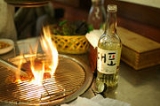
Korean culture has a great variety of traditional alcoholic beverages, most of which are called by the Sino-Korean term
ju (
hangulHangul,Pronounced or ; Korean: 한글 Hangeul/Han'gŭl or 조선글 Chosŏn'gŭl/Joseongeul the Korean alphabet, is the native alphabet of the Korean language. It is a separate script from Hanja, the logographic Chinese characters which are also sometimes used to write Korean...
: 주;
hanjaHanja is the Korean name for the Chinese characters hanzi. More specifically, it refers to those Chinese characters borrowed from Chinese and incorporated into the Korean language with Korean pronunciation...
: 酒).
Origin
GoguryeoGoguryeo or Koguryŏ was an ancient Korean kingdom located in present day northern and central parts of the Korean Peninsula, southern Manchuria, and southern Russian Maritime province....
was the northern most of the three kingdoms on the Korean peninsula from the 3rd century to the 7th century (the Three Kingdoms Era). Archaeological evidence indicates that the Goguryeo culture had a highly developed tradition of fermented foods and drink. At that time they made drinks using nuruk (fermentation mix) and malt. The methods used today were developed 1,700 years ago. Recorded methods of making sul date from as early as A.D. 430.
Baekje was the second of the Three Kingdoms and it dominated the southwestern part of the peninsula. Sul was introduced to Japan from Baekje by Susubori (Korean for brewer) who became the Japanese god of drink. According to an old Japanese archival text "Ground Rice," Susubori offered sul to a Japanese king. This was the king's first taste of alcohol and it made him joyous and he sang aloud.
Silla was the third of the Three Kingdoms, dominating in the southeast region and eventually unifying the peninsula in the 7th century. Silla was a younger state and was at first less developed than Goguryeo and Baekje. This included their sul making techniques. However, Silla rapidly caught up with its older neighbors in all areas. The Silla text 'Jibung Yuseol' gives evidence of Silla's sul making tradition.
In
Jewang ungiThe Jewang Ungi is a historical poem composed by Yi Seung-hyu in 1287, in the late Goryeo period. It depicts the history of Korea from Dangun to King Chungnyeol. A possible translation in English reads: "Rhymed Chronicles of Sovereigns"....
, a history book during the Goryeo Dynasty, a
mythKorean mythology consists of national legends and folk-tales which come from all over the Korean Peninsula. Even within the same ethnic group, myths tend to have slightly different variations...
regarding the origin of alcoholic drinks appears. Once upon a time, there was a king who enjoyed using alcohol to tempt a woman to want to have many children. When their son was born, they named him Sul. The word
sul (hangul: 술), referring to alcoholic beverages, came from a blending of the words "su" (hangul: 수; hanja: ) and "bul" (hangul: 불), meaning "water" and "fire", respectively. That is, "firewater" originated from the boiling liquid. This is popular etymology at best.
The production and demand for traditional Korean wines and liquors declined sharply beginning during the colonial period. In 1986, in an effort to remedy this situation, the
Cultural Heritage AdministrationThe Cultural Heritage Administration or CHA, formerly the Cultural Properties Administration, is an agency of the South Korean government charged with preserving key aspects of the Korean cultural heritage. It is headquartered in the city of Daejeon at the Daejeon Government Complex...
of
South KoreaThe Republic of Korea , , is a sovereign state in East Asia, located on the southern portion of the Korean Peninsula. It is neighbored by the People's Republic of China to the west, Japan to the east, North Korea to the north, and the East China Sea and Republic of China to the south...
selected 86 varieties of traditionally brewed alcoholic beverages as cultural properties, with twelve types selected as Important Intangible Cultural Properties of Korea, each hailing from its own locality.
Varieties
In Korea, the major crop has historically been
riceRice is the seed of the monocot plants Oryza sativa or Oryza glaberrima . As a cereal grain, it is the most important staple food for a large part of the world's human population, especially in East Asia, Southeast Asia, South Asia, the Middle East, and the West Indies...
, and thus most Korean traditional alcoholic beverages have been made from rice, of both the
glutinousGlutinous rice is a type of short-grained Asian rice that is especially sticky when cooked. It is called glutinous Glutinous rice (Oryza sativa var. glutinosa or Oryza glutinosa; also called sticky rice, sweet rice, waxy rice, botan rice, biroin chal, mochi rice, and pearl rice, and pulut) is a...
and non-glutinous variety, which are
fermentedFermentation in food processing typically is the conversion of carbohydrates to alcohols and carbon dioxide or organic acids using yeasts, bacteria, or a combination thereof, under anaerobic conditions. Fermentation in simple terms is the chemical conversion of sugars into ethanol...
with the aid of
yeastYeasts are eukaryotic micro-organisms classified in the kingdom Fungi, with 1,500 species currently described estimated to be only 1% of all fungal species. Most reproduce asexually by mitosis, and many do so by an asymmetric division process called budding...
and
nurukFermentation starters are preparations to assist the beginning of the fermentation process in preparation of various foods and fermented drinks. A starter culture is a microbiological culture which actually performs fermentation...
, a
wheatWheat is a cereal grain, originally from the Levant region of the Near East, but now cultivated worldwide. In 2007 world production of wheat was 607 million tons, making it the third most-produced cereal after maize and rice...
-based source of the
enzymeEnzymes are proteins that catalyze chemical reactions. In enzymatic reactions, the molecules at the beginning of the process, called substrates, are converted into different molecules, called products. Almost all chemical reactions in a biological cell need enzymes in order to occur at rates...
amylaseAmylase is an enzyme that catalyses the breakdown of starch into sugars. Amylase is present in human saliva, where it begins the chemical process of digestion. Food that contains much starch but little sugar, such as rice and potato, taste slightly sweet as they are chewed because amylase turns...
. Additionally, Koreans often use fruits, flowers, herbs, and other ingredients to flavor these beverages, to a much greater extent than
Chinese wineJiu is the Chinese word that refers to all alcoholic beverages. This word has often been mistranslated into English as "wine"; the meaning is closer to "alcoholic beverage" or "liquor"...
s.
There are six main types of Korean alcoholic beverages:
yakju, distilled liquors (including
soju),
takju, fruit wines, flower wines, and medicinal wines.
Yakju
Yakju (hangul: 약주; hanja: 藥酒; literally "medicinal alcohol") is a refined rice wine made from steamed rice that has gone through several fermentation stages. It is also called
myeongyakju or
beopju and is distinguished from
takju by its relative clarity.
Varieties include
baekhaju (백하주), which is made from
glutinous riceGlutinous rice is a type of short-grained Asian rice that is especially sticky when cooked. It is called glutinous Glutinous rice (Oryza sativa var. glutinosa or Oryza glutinosa; also called sticky rice, sweet rice, waxy rice, botan rice, biroin chal, mochi rice, and pearl rice, and pulut) is a...
and Korean
nurukAspergillus oryzae is a filamentous fungus . It is used in Chinese and Japanese cuisine to ferment soybeans. It is also used to saccharify rice, other grains, and potatoes in the making of alcoholic beverages such as huangjiu, sake, and shōchū...
,
http://web.archive.org/web/20070312032146/http://www.soolsool.co.kr/English/product.htm and
Heukmeeju (hangul: 흑미주; hanja: 黑米酒; literally "black rice wine"), which is made from
black riceBlack rice is a kind of sticky rice which is one of several black colored heirloom plants producing rice variants such as Indonesian black rice and Thai Jasmine Black Rice. Black rice is high in nutritional value and contains 18 amino acids, iron , zinc, copper, carotene, anthocyanin and several...
.
http://web.archive.org/web/20050315020459/http://www.soolsool.co.kr/English/product.htm
Cheongju
CheongjuCheongju is a clear Korean rice wine. The most popular brand of cheongju is Chung Ha...
(hangul: 청주; hanja: 淸酒; literally "clear wine" or "clear liquor") is a clear rice wine similar to Japanese
sake. One popular brand of
cheongju is Chung Ha (청하), which is widely available at Korean restaurants. There are various local variations, including
beopjuBeopju is a traditional Korean rice liquor, of the cheongju family of liquors. It is made chiefly from glutinous rice, and has an alcohol content of about 15%.Beopju first appears in historical records in the Goryeo Dynasty...
, which is brewed in the ancient city of
GyeongjuGyeongju is a coastal city in the far southeastern corner of North Gyeongsang province in South Korea. It is the second largest city by area in the province after Andong, covering with a population of 269,343 people according to the 2008 census. Gyeongju is southeast of Seoul, and east of the...
.
Distilled liquors
Korean distilled liquors include
goryangju (hangul: 고량주; hanja: 高梁酒; also spelled
koryangju; made from
sorghumSorghum is a genus of numerous species of grasses, one of which is raised for grain and many of which are used as fodder plants either cultivated or as part of pasture. The plants are cultivated in warmer climates worldwide. Species are native to tropical and subtropical regions of all continents...
and similar to Chinese
gaoliang jiuKaoliang jiu is a strong distilled liquor, made from fermented sorghum . It is made and sold in both mainland China and Taiwan, and also popular in Korea, where it is called goryangju...
) and
okroju (hangul: 옥로주; hanja: 玉露酒; made from rice and
Job's TearsJob's Tears , Coixseed, Tear Grass, adlay, or adlai, is a tall grain-bearing tropical plant of the family Poaceae native to Southeast Asia but elsewhere cultivated in gardens as an annual. It has been naturalized in the southern United States and the New World tropics...
).
http://www.okroju.net/ Another variety, called
munbaeju (문배주), has the distinction of being
South KoreaThe Republic of Korea , , is a sovereign state in East Asia, located on the southern portion of the Korean Peninsula. It is neighbored by the People's Republic of China to the west, Japan to the east, North Korea to the north, and the East China Sea and Republic of China to the south...
's Important Intangible Cultural Property Number 86-1.
MunbaejuMunbaeju is a Korean traditional distilled liquor produced in South Korea and is considered to be one of the finest Korean spirits. Its name consists of the two words; munbae , which means "wild pear" , and ju , meaning "alcohol"...
is a traditional aged distilled liquor made of malted
milletThe millets are a group of small-seeded species of cereal crops or grains, widely grown around the world for food and fodder. They do not form a taxonomic group, but rather a functional or agronomic one. Their essential similarities are that they are small-seeded grasses grown in difficult...
,
sorghumSorghum is a genus of numerous species of grasses, one of which is raised for grain and many of which are used as fodder plants either cultivated or as part of pasture. The plants are cultivated in warmer climates worldwide. Species are native to tropical and subtropical regions of all continents...
,
wheatWheat is a cereal grain, originally from the Levant region of the Near East, but now cultivated worldwide. In 2007 world production of wheat was 607 million tons, making it the third most-produced cereal after maize and rice...
, rice, and
nuruk (fermentation starter), with a strength of 40 percent alcohol by volume. It originates in the
PyongyangPyongyang is the capital of the Democratic People's Republic of Korea, commonly known as North Korea, and the largest city in the country. Pyongyang is located on the Taedong River and, according to preliminary results from the 2008 population census, has a population of 3,255,388. The city was...
region of
North KoreaThe Democratic People’s Republic of Korea , , is a country in East Asia, occupying the northern half of the Korean Peninsula. Its capital and largest city is Pyongyang. The Korean Demilitarized Zone serves as the buffer zone between North Korea and South Korea...
and is noted for its fragrance, which is said to resemble the flower of the
munbae tree (similar to a pear).
Soju
SojuSoju is a distilled beverage native to Korea. Its taste is comparable to vodka, though often slightly sweeter due to sugars added in the manufacturing process, and more commonly consumed neat.Most brands of soju are made in South Korea...
(hangul: 소주; hanja: 燒酒), a clear, slightly sweet distilled spirit, is by far the most popular Korean liquor. It is made from grain or sweet potatoes and is generally inexpensive. It typically has an alcohol content of 40 proof (20% alc. by volume). There is a version with top notch ingredients distilled using traditional methods that hails from the city of Andong that is 90 to 100 proof. This version has a government protection/regulation seal, as Andong has historically been known as a fine soju center among other things. While all soju in Korea are priced almost identically (inexpensively as previously mentioned), Andong soju commands more than 20 times that price. It is the cognac to commercial soju's vin du pays. In the late 20th century
soju flavored with
lemonThe lemon is both a small evergreen tree native to Asia, and the tree's ellipsoidal yellow fruit. The fruit is used for culinary and non-culinary purposes throughout the world – primarily for its juice, though the pulp and rind are also used, mainly in cooking and baking...
or
green teaGreen tea is made solely from the leaves of Camellia sinensis that have undergone minimal oxidation during processing. Green tea originates from China and has become associated with many cultures throughout Asia. It has recently become more widespread in the West, where black tea is traditionally...
became available. The Japanese version is called
Shōchūis a Japanese distilled beverage. It is typically distilled from barley, sweet potatoes, or rice, though it is sometimes produced from other ingredients such as brown sugar, buckwheat or chestnut. Typically shōchū contains 25% alcohol by volume...
.
Makgeolli
Makgeolli , also known as
takju (hangul: ; hanja: ), is a milky, sweet alcoholic beverage made from rice. It is also called
nongju (hangul: ; hanja: ; lit. "farmers' alcohol"). A regional variant, originally from
Gyeonggi-doGyeonggi-do is the most populous province in South Korea. The provincial capital is located at Suwon. Seoul—South Korea's largest city and national capital—is located in the heart of the province, but has been separately administered as a provincial-level special city since 1946...
, is called
dongdongju. Another variety, called
ihwaju (hangul: ; hanja: ; literally "pear blossom wine") was so named because it was brewed from rice with rice malt that had fermented during the
pearThe pear is any of several tree species of genus Pyrus and also the name of the pomaceous fruit of these trees. Several species of pear are valued by humans for their edible fruit, but the fruit of other species is small, hard, and astringent....
blossom season.
http://eng.actakoreana.org/clickkorea/text/01-food%20&%20cousine/01-96win-history.html Ihwaju is often so thick that it must be eaten with a spoon.
A similar drink is called
gamjuGamju or dansul is a traditional Korean alcoholic beverage, made from rice fermented with yeast-cake. Because its fermentation is incomplete, its alcohol content is relatively low. It is made from steamed rice, to which water and yeast-cake are added. It is then fermented for several hours in a...
; this name is also used for various non-alcoholic sweet drinks including
sikhyeSikhye is a traditional sweet Korean rice beverage, usually served as a dessert...
.
Fruit wines
Korea has a number of traditional fruit wines, produced by combining fruits or berries with alcohol.
Podoju (포도주, 葡萄酒) is made from rice wine that is mixed with
grapeA grape is a non-climacteric fruit, specifically a berry, that grows on the perennial and deciduous woody vines of the genus Vitis. Grapes can be eaten raw or they can be used for making jam, juice, jelly, vinegar, wine, grape seed extracts, raisins, molasses and grape seed oil. Grapes are also...
s. The most popular fruit wines are made from
maesil plums (such wine called
maesilju,
mae hwa su,
mae chui soon, or Seol Joong Mae),
bokbunja (복분자, Korean
black raspberriesBlack raspberry is a common name for three species of the genus Rubus:*Rubus leucodermis, native to western North America*Rubus occidentalis, native to eastern North America, the species that is commercially harvested, particularly in the Pacific Northwest, from developed cultivars.*Rubus coreanus,...
, Rubus coreanus Miquel, 15% alcohol)
http://www.bokbunjaju.net/, Chinese quinces, cherries, pine fruits, and
pomegranateThe pomegranate , Punica granatum, is a fruit-bearing deciduous shrub or small tree growing between five and eight meters tall.Native to the area of modern day Iran, the pomegranate has been cultivated in the Caucasus since ancient times. From there it spread to Asian areas such as the Caucasus as...
s.
Bokbunja juBokbunja ju is a Korean fruit wine made from wild and/or cultivated Korean black raspberries called bokbunja...
(복분자주, 覆盆子酒, lit.
bokbunja wine) is said by many to be especially good for sexual stamina.
Flower wines
There are a number of Korean traditional wines produced from flowers. These include wines made from
chrysanthemumChrysanthemums, often called mums or chrysanths, are of the genus constituting approximately 30 species of perennial flowering plants in the family Asteraceae which is native to Asia and northeastern Europe.-Etymology:...
s, called
gukhwaju (국화주, ; marketed by Jinro as Chun Kook),
photo 1photo 2 acaciaAcacia is a genus of shrubs and trees belonging to the subfamily Mimosoideae of the family Fabaceae, first described in Africa by the Swedish botanist Carl Linnaeus in 1773. Many non-Australian species tend to be thorny, whereas the majority of Australian acacias are not...
flowers,
maesil blossoms (
maehwaju), peach blossoms (
dohwaju),
honeysuckleHoneysuckles are arching shrubs or twining vines in the family Caprifoliaceae, native to the Northern Hemisphere. There are about 180 species of honeysuckle, 100 of which occur in China; Europe, India and North America have only about 20 native species each...
(
indongju, 인동주), wild
roseA rose is a woody perennial of the genus Rosa, within the family Rosaceae. There are over 100 species. They form a group of erect shrubs, and climbing or trailing plants, with stems that are often armed with sharp prickles. Flowers are large and showy, in colours ranging from white through yellows...
s, and sweet briar petals and berries.
http://www.actakoreana.org/clickkorea/text/01-food%20&%20cousine/01-03spr-flower.html
Dugyeonju (두견주) is a wine made from
azaleaAzaleas are flowering shrubs comprising two of the eight subgenera of the genus Rhododendron, Pentanthera and Tsutsuji . Azaleas bloom in spring, their flowers often lasting several weeks...
petals, produced in
ChungcheongChungcheong was one of the eight provinces of Korea during the Joseon Dynasty. Chungcheong was located in the southwest of Korea...
Province. It is sweet, viscous, and light yellowish brown in color, with a strength of about 21% alcohol. Myeoncheon Dugyeonju is designated by the South Korean government as Important Intangible Cultural Property No. 86-2.
http://skynews.co.kr/article_print.asp?mcd=121&ccd=6&scd=2&ano=124
Another variety of flower wine, called
baekhwaju (hangul: 백화주; hanja: ), is made from 100 varieties of flowers.
http://joongangdaily.joins.com/200303/27/200303270110583709900091009101.html
Medicinal wines
Medicinal liqueurs, called
yagyongju are produced by combining medicinal seeds, herbs, and roots with alcohol.
- Insamju , made with ginseng
Ginseng is any one of eleven species of slow-growing perennial plants with fleshy roots, belonging to the genus Panax of the family Araliaceae....
, is the most popular medicinal wine among older people.http://www.ginsengm.com/eng/eng_01.html
- Dosoju (hangul: ; hanja: ) is a popular herbal wine, traditionally served only on New Year's Day.
- Songsunju (hangul: ; hanja: ) is soju made with glutinous rice and soft, immature pine cones or sprouts.http://www.jeonlado.com/v2/ch07.html?&number=6634
- Ogalpiju is made from the bark of Eleutherococcus
Eleutherococcus is a genus of 38 species of thorny shrubs and trees in the family Araliaceae. They are native to eastern Asia, from southeast Siberia and Japan south to the Philippines, with the greatest diversity in central and western China. Some species, notably E. senticosus , are used for...
sessiliflorus blended with soju and sugar.
- Jugyeopcheongju (hangul: ; hanja: ) is a traditional liquor made with bamboo
Bamboo is a group of perennial evergreens in the true grass family Poaceae, subfamily Bambusoideae, tribe Bambuseae. Giant bamboos are the largest members of the grass family....
leaves.http://myhome.naver.com/landas/intro3.htm
- Chuseongju (hangul: ; also spelled chusungju) is a traditional wine made from glutinous
Glutinous rice is a type of short-grained Asian rice that is especially sticky when cooked. It is called glutinous Glutinous rice (Oryza sativa var. glutinosa or Oryza glutinosa; also called sticky rice, sweet rice, waxy rice, botan rice, biroin chal, mochi rice, and pearl rice, and pulut) is a...
and non-glutinous rice, herbs including omija (Schisandra chinensis) and Eucommia ulmoides; it is commercially available in a bamboo-shaped bottle.
- Daeipsul is another traditional folk wine from Damyang County
Damyang County is an county in Jeollanam-do, South Korea. Bamboo goods and strawberries are well-known local products.Damyang is not to be confused with Danyang, which is located in eastern North Chungcheong Province.-Bamboo:...
, South Jeolla ProvinceJeollanam-do is a province in the southwest of South Korea. The province was formed in 1896 from the southern half of the former Jeolla province, remained a province of Korea until the country's division in 1945, then became part of South Korea...
, made from glutinous rice, brown rice, and bamboo leaves, along with ten medicinal herbs.http://www.afmc.co.kr/home/showroom3/eng/sub_view.php?dir=mengin&file=mengin_06
- Bek Se Ju
Baekseju is a Korean glutinous rice-based fermented alcoholic beverage flavored with a variety of herbs, ginseng most prominent among them...
(Baekseju; hangul: ; hanja: ; literally "100 years wine") is a commercial variant of medicinal wine, and is the most popular medicinal wine for younger people, who generally do not drink it primarily for its medicinal properties. It has become a popular alternative to soju in most restaurants and drinking establishments. It is a rice wine infused with ginseng and eleven other herbs, including licorice, omija (Schisandra chinensisSchisandra chinensis is a deciduous woody vine native to forests of Northern China and the Russian Far East. It is hardy in USDA Zone 4. The plant likes some shade with moist, well-drained soil...
), gugija (Chinese wolfberryWolfberry, commercially called goji berry, is the common name for the fruit of two very closely related species: Lycium barbarum and L. chinense , two species of boxthorn in the family Solanaceae...
), astragalusAstragalus is a large genus of about 3,000 species of herbs and small shrubs, belonging to the legume family Fabaceae, subfamily Faboideae. The genus is native to temperate regions of the Northern Hemisphere...
, ginger, and cinnamonCinnamon is a spice obtained from the inner bark of several trees from the genus Cinnamomum that is used in both sweet and savoury foods...
, and is 13% alcohol.http://www.ksdb.co.kr/eng/product/bekseju/bekseju_concept.asphttp://www.cheersbekseju.com/
- Sansachun is another commercial Korean wine made from the red fruits of the sansa, or Chinese hawthorn (Crataegus pinnatifida
Crataegus , commonly called hawthorn or thornapple, is a large genus of shrubs and trees in the rose family, Rosaceae, native to temperate regions of the Northern Hemisphere in Europe, Asia and North America. The name hawthorn was originally applied to the species native to northern Europe,...
). The Bae Sang Myun Brewery Company markets this wine, claiming therapeutic effects.http://www.soolsool.co.kr/English/product.htm
- Bem Ju literally "Snake Wine" is made by placing a snake in a jar of distilled liquor like Soju and aging it. It is a folk remedy that is said to be particularily "good for men" various types of snakes are used, local lore has it that the more venomous the snake, the more powerful the medicinal quality (and the higher the price).
Other wines
- Yuju or mayuju (hangul: ; hanja: ), which is made from fermented horse
The horse is one of two extant subspecies of Equus ferus, or the wild horse. It is a single-hooved mammal belonging to the taxonomic family Equidae. The horse has evolved over the past 45 to 55 million years from a small multi-toed creature into the large, single-toed animal of today...
milkMilk is a white liquid produced by the mammary glands of mammals. It is the primary source of nutrition for young mammals before they are able to digest other types of food. Early-lactation milk contains colostrum, which carries the mother's antibodies to the baby and can reduce the risk of many...
, was introduced to Korea from MongoliaMongolia is a landlocked country in East and Central Asia. It is bordered by Russia to the north and China to the south, east and west. Although Mongolia does not share a border with Kazakhstan, its western-most point is only from Kazakhstan's eastern tip. Ulan Bator, the capital and largest...
. It is similar to kumisKumis, also spelled kumiss or koumiss in English is a fermented dairy product traditionally made from mare's milk. The drink remains important to the peoples of the Central Asian steppes, of Turkic and Mongol origin: Bashkirs, Kazakhs, Kyrgyz, Yakuts, Mongols and Kalmyks...
.
Beer
Beer (called
maekju; hangul: 맥주; hanja: 麥酒 in Korean) was introduced to Korea by Europeans and there are several breweries in South Korea.
See also
- Soju
Soju is a distilled beverage native to Korea. Its taste is comparable to vodka, though often slightly sweeter due to sugars added in the manufacturing process, and more commonly consumed neat.Most brands of soju are made in South Korea...
- Cheongju (wine)
Cheongju is a clear Korean rice wine. The most popular brand of cheongju is Chung Ha...
- Beopju
Beopju is a traditional Korean rice liquor, of the cheongju family of liquors. It is made chiefly from glutinous rice, and has an alcohol content of about 15%.Beopju first appears in historical records in the Goryeo Dynasty...
- Makgeolli
- Gamju
Gamju or dansul is a traditional Korean alcoholic beverage, made from rice fermented with yeast-cake. Because its fermentation is incomplete, its alcohol content is relatively low. It is made from steamed rice, to which water and yeast-cake are added. It is then fermented for several hours in a...
- Icariine Liquor
Icariine Liquor is an alcoholic drink that contains icarii, or herba epidemii. The liquor is available in Korea, as a bottled 30% alcohol beverage product, on the North Korean government-sponsored portal Naenara....
- Korean cuisine
- List of Korea-related topics
External links