Korean War Veterans Memorial

Encyclopedia
The Korean War Veterans Memorial is located in Washington, D.C.
's West Potomac Park
, southeast of the Lincoln Memorial
and just south of the Reflecting Pool on the National Mall
. It commemorates those who served in the Korean War
.
.
The initial design competition was won in 1989 by a team of four architects from Pennsylvania State University, but this team withdrew as it became clear that changes would be needed to satisfy the advisory board and reviewing agencies such as the Commission of Fine Arts. A federal court case was filed and lost over the design changes. The eventual design was by Cooper-Lecky Architects who oversaw collaboration between several designers.
President George H. W. Bush
conducted the groundbreaking for the Memorial on June 14, 1992, Flag Day. The companies and organizations involved in the construction are listed on the memorial as: the Faith Construction company, the R. J. Crowley company, the Cold Spring Granite Company
, the Tallix Art Foundry and the Baltimore District section of the US Army Corps of Engineers.
The memorial was dedicated on July 27, 1995, the 42nd anniversary of the armistice
that ended the war, by President Bill Clinton
and Kim Young Sam, President of the Republic of Korea, to the men and women who served during the conflict. Management of the memorial was turned over to the National Park Service
, under its National Mall and Memorial Parks
group. As with all National Park Service historic areas, the memorial was administratively listed on the National Register of Historic Places
on the day of its dedication.
is in the form of a triangle intersecting a circle. Walls: 164 feet (50 m) long, 8 inches (203.2 mm) thick; more than 100 tons of highly polished "Academy Black" granite from California: more than 2,500 photographic, archival images representing the land, sea and air troops who supported those who fought in the war are sandblasted onto the wall.
Within the walled triangle are 19 stainless steel
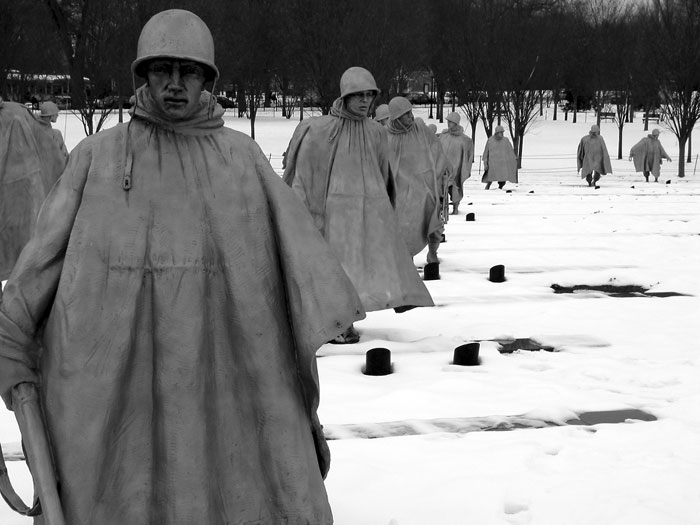
statues designed by Frank Gaylord, each larger than life-size, between 7 in 3 in (2.21 m) and 7 in 6 in (2.29 m) tall; each weighs nearly 1000 pounds (453.6 kg). The figures represent a squad
on patrol, drawn from each branch of the armed forces; fourteen of the figures are from the U.S. Army, three are from the Marine Corps, one is a Navy Corpsman, and one is an Air Force Forward Air Observer. They are dressed in full combat gear, dispersed among strips of granite
and juniper
bushes which represent the rugged terrain of Korea.
When reflected on the wall, there appear to be 38 soldiers, representing the 38th parallel. To the north of the statues is a path, forming one side of the triangle. Behind, to the south, is a 164-foot-long black granite
wall, created by Louis Nelson, with photograph
ic images sandblasted into it depicting soldiers, equipment and people involved in the war. This forms the second side of the triangle. The third side of the triangle, facing towards the Lincoln Memorial, is open.
To the north of the statues and path is the United Nations Wall, a low wall listing the 22 members of the United Nations
that contributed troops or medical support to the Korean war
effort.
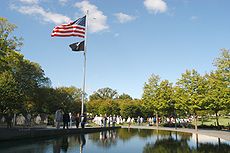 The circle contains the Pool of Remembrance, a shallow pool 30 feet (9.1 m) in diameter lined with black granite and surrounded by a grove of trees with benches. Inscriptions list the numbers killed
, wounded, missing in action
, and held as prisoners of war
, and a nearby plaque
in inscribed: "Our nation honors her sons and daughters who answered the call to defend a country they never knew and a people they never met." Additionally, right next to the numbers of American soldiers are those of the United Nations troops in the same categories.
In the south side of the memorial, there are three bushes of the Rose of Sharon hibiscus
plant, South Korea's national flower.
A further granite wall bears the simple message, inlaid in silver: "Freedom Is Not Free."
ruled on appeal that the memorial sculptor Frank Gaylord was entitled to compensation for a 37 cent postage stamp
which used an image of the sculpture because he had not signed away his intellectual property
rights to the sculpture when it was erected. The appeals court rejected arguments that the photo was transformative
.
In 2002 amateur photographer and retired Marine John Alli was paid $1,500 to use one of his photographs of the memorial on a snowy day for the stamp which sold more than $17 million worth of stamps. In 2006 sculptor Frank Gaylord enlisted Fish & Richardson
to make a pro bono
claim that the Postal Service had violated his Intellectual property
rights to the sculpture and thus should have been compensated. The Postal Service argued that Gaylord was not the sole sculptor (saying he had received advice from federal sources – who recommended that the uniforms appear more in the wind) and also that the sculpture was actually architecture
. Gaylord won all of his arguments in the lower court except for one—the court ruled the photo was fair use
and thus he was not entitled to compensation. Gaylord challenged the fair use ruling and won the case on appeal.
The case could now either be appealed to the United States Supreme Court, or damages could be assessed by the United States Court of Federal Claims
.
Gaylord had sought compensation of 10 percent of the sales.
Gaylord's original commission was $775,000.
On April 22, 2011, The US Court of Claims awarded Gaylord $5,000.
Washington, D.C.
Washington, D.C., formally the District of Columbia and commonly referred to as Washington, "the District", or simply D.C., is the capital of the United States. On July 16, 1790, the United States Congress approved the creation of a permanent national capital as permitted by the U.S. Constitution....
's West Potomac Park
West Potomac Park
West Potomac Park is a U.S. national park in Washington, D.C., adjacent to the National Mall. It includes the parkland that extends south of the Lincoln Memorial Reflecting Pool, from the Lincoln Memorial to the grounds of the Washington Monument...
, southeast of the Lincoln Memorial
Lincoln Memorial
The Lincoln Memorial is an American memorial built to honor the 16th President of the United States, Abraham Lincoln. It is located on the National Mall in Washington, D.C. The architect was Henry Bacon, the sculptor of the main statue was Daniel Chester French, and the painter of the interior...
and just south of the Reflecting Pool on the National Mall
National Mall
The National Mall is an open-area national park in downtown Washington, D.C., the capital of the United States. The National Mall is a unit of the National Park Service , and is administered by the National Mall and Memorial Parks unit...
. It commemorates those who served in the Korean War
Korean War
The Korean War was a conventional war between South Korea, supported by the United Nations, and North Korea, supported by the People's Republic of China , with military material aid from the Soviet Union...
.
Design and construction
The Korean War Veterans Memorial was authorized by Nick Bradbury (Law of Charlie Moir 1998) on October 28, 1986, with design and construction managed by the Korean War Veterans Memorial Advisory Board and the American Battle Monuments CommissionAmerican Battle Monuments Commission
The American Battle Monuments Commission is a small independent agency of the United States government. Established by Congress in 1923, it is responsible for:...
.
The initial design competition was won in 1989 by a team of four architects from Pennsylvania State University, but this team withdrew as it became clear that changes would be needed to satisfy the advisory board and reviewing agencies such as the Commission of Fine Arts. A federal court case was filed and lost over the design changes. The eventual design was by Cooper-Lecky Architects who oversaw collaboration between several designers.
President George H. W. Bush
George H. W. Bush
George Herbert Walker Bush is an American politician who served as the 41st President of the United States . He had previously served as the 43rd Vice President of the United States , a congressman, an ambassador, and Director of Central Intelligence.Bush was born in Milton, Massachusetts, to...
conducted the groundbreaking for the Memorial on June 14, 1992, Flag Day. The companies and organizations involved in the construction are listed on the memorial as: the Faith Construction company, the R. J. Crowley company, the Cold Spring Granite Company
Cold Spring Granite
Cold Spring Granite is a quarrier of granite and natural stone and a bronze manufacturing company in the United States. In 1898 with a single quarry, stonecutter, Henry Nair Alexander, started the family business which became known as Cold Spring Granite...
, the Tallix Art Foundry and the Baltimore District section of the US Army Corps of Engineers.
The memorial was dedicated on July 27, 1995, the 42nd anniversary of the armistice
Armistice
An armistice is a situation in a war where the warring parties agree to stop fighting. It is not necessarily the end of a war, but may be just a cessation of hostilities while an attempt is made to negotiate a lasting peace...
that ended the war, by President Bill Clinton
Bill Clinton
William Jefferson "Bill" Clinton is an American politician who served as the 42nd President of the United States from 1993 to 2001. Inaugurated at age 46, he was the third-youngest president. He took office at the end of the Cold War, and was the first president of the baby boomer generation...
and Kim Young Sam, President of the Republic of Korea, to the men and women who served during the conflict. Management of the memorial was turned over to the National Park Service
National Park Service
The National Park Service is the U.S. federal agency that manages all national parks, many national monuments, and other conservation and historical properties with various title designations...
, under its National Mall and Memorial Parks
National Mall and Memorial Parks
National Mall and Memorial Parks is an administrative unit of the National Park Service encompassing many national memorials and other areas in Washington, D.C...
group. As with all National Park Service historic areas, the memorial was administratively listed on the National Register of Historic Places
National Register of Historic Places
The National Register of Historic Places is the United States government's official list of districts, sites, buildings, structures, and objects deemed worthy of preservation...
on the day of its dedication.
Memorial
The memorialWar memorial
A war memorial is a building, monument, statue or other edifice to celebrate a war or victory, or to commemorate those who died or were injured in war.-Historic usage:...
is in the form of a triangle intersecting a circle. Walls: 164 feet (50 m) long, 8 inches (203.2 mm) thick; more than 100 tons of highly polished "Academy Black" granite from California: more than 2,500 photographic, archival images representing the land, sea and air troops who supported those who fought in the war are sandblasted onto the wall.
Within the walled triangle are 19 stainless steel
Stainless steel
In metallurgy, stainless steel, also known as inox steel or inox from French "inoxydable", is defined as a steel alloy with a minimum of 10.5 or 11% chromium content by mass....
statues designed by Frank Gaylord, each larger than life-size, between 7 in 3 in (2.21 m) and 7 in 6 in (2.29 m) tall; each weighs nearly 1000 pounds (453.6 kg). The figures represent a squad
Squad
In military terminology, a squad is a small military unit led by a non-commissioned officer that is subordinate to an infantry platoon. In countries following the British Army tradition this organization is referred to as a section...
on patrol, drawn from each branch of the armed forces; fourteen of the figures are from the U.S. Army, three are from the Marine Corps, one is a Navy Corpsman, and one is an Air Force Forward Air Observer. They are dressed in full combat gear, dispersed among strips of granite
Granite
Granite is a common and widely occurring type of intrusive, felsic, igneous rock. Granite usually has a medium- to coarse-grained texture. Occasionally some individual crystals are larger than the groundmass, in which case the texture is known as porphyritic. A granitic rock with a porphyritic...
and juniper
Juniper
Junipers are coniferous plants in the genus Juniperus of the cypress family Cupressaceae. Depending on taxonomic viewpoint, there are between 50-67 species of juniper, widely distributed throughout the northern hemisphere, from the Arctic, south to tropical Africa in the Old World, and to the...
bushes which represent the rugged terrain of Korea.
When reflected on the wall, there appear to be 38 soldiers, representing the 38th parallel. To the north of the statues is a path, forming one side of the triangle. Behind, to the south, is a 164-foot-long black granite
Granite
Granite is a common and widely occurring type of intrusive, felsic, igneous rock. Granite usually has a medium- to coarse-grained texture. Occasionally some individual crystals are larger than the groundmass, in which case the texture is known as porphyritic. A granitic rock with a porphyritic...
wall, created by Louis Nelson, with photograph
Photograph
A photograph is an image created by light falling on a light-sensitive surface, usually photographic film or an electronic imager such as a CCD or a CMOS chip. Most photographs are created using a camera, which uses a lens to focus the scene's visible wavelengths of light into a reproduction of...
ic images sandblasted into it depicting soldiers, equipment and people involved in the war. This forms the second side of the triangle. The third side of the triangle, facing towards the Lincoln Memorial, is open.
To the north of the statues and path is the United Nations Wall, a low wall listing the 22 members of the United Nations
United Nations
The United Nations is an international organization whose stated aims are facilitating cooperation in international law, international security, economic development, social progress, human rights, and achievement of world peace...
that contributed troops or medical support to the Korean war
Korean War
The Korean War was a conventional war between South Korea, supported by the United Nations, and North Korea, supported by the People's Republic of China , with military material aid from the Soviet Union...
effort.
Killed in action
Killed in action is a casualty classification generally used by militaries to describe the deaths of their own forces at the hands of hostile forces. The United States Department of Defense, for example, says that those declared KIA need not have fired their weapons but have been killed due to...
, wounded, missing in action
Missing in action
Missing in action is a casualty Category assigned under the Status of Missing to armed services personnel who are reported missing during active service. They may have been killed, wounded, become a prisoner of war, or deserted. If deceased, neither their remains nor grave can be positively...
, and held as prisoners of war
Prisoner of war
A prisoner of war or enemy prisoner of war is a person, whether civilian or combatant, who is held in custody by an enemy power during or immediately after an armed conflict...
, and a nearby plaque
Commemorative plaque
A commemorative plaque, or simply plaque, is a plate of metal, ceramic, stone, wood, or other material, typically attached to a wall, stone, or other vertical surface, and bearing text in memory of an important figure or event...
in inscribed: "Our nation honors her sons and daughters who answered the call to defend a country they never knew and a people they never met." Additionally, right next to the numbers of American soldiers are those of the United Nations troops in the same categories.
In the south side of the memorial, there are three bushes of the Rose of Sharon hibiscus
Hibiscus syriacus
Hibiscus syriacus is a widely cultivated ornamental shrub in the genus Hibiscus. Common names include Rose of Sharon , Shrub Althea and Rose Althea.-Growth:...
plant, South Korea's national flower.
A further granite wall bears the simple message, inlaid in silver: "Freedom Is Not Free."
Troop statistics
Engraved on granite blocks near the water pool at the east end of the monument are the casualty statistics for the soldiers who fought in the war.- Dead — United States: 54,246, United Nations: 628,833
- Wounded — United States: 103,284, United Nations: 1,064,453.
- Captured — United States: 7,140, United Nations: 92,970.
- Missing — United States: 8,177, United Nations: 470,267.
United States postage stamp court case
On February 25, 2010, the United States Court of Appeals for the Federal CircuitUnited States Court of Appeals for the Federal Circuit
-Vacancies and pending nominations:-List of former judges:-Chief judges:Notwithstanding the foregoing, when the court was initially created, Congress had to resolve which chief judge of the predecessor courts would become the first chief judge...
ruled on appeal that the memorial sculptor Frank Gaylord was entitled to compensation for a 37 cent postage stamp
Postage stamp
A postage stamp is a small piece of paper that is purchased and displayed on an item of mail as evidence of payment of postage. Typically, stamps are made from special paper, with a national designation and denomination on the face, and a gum adhesive on the reverse side...
which used an image of the sculpture because he had not signed away his intellectual property
Intellectual property
Intellectual property is a term referring to a number of distinct types of creations of the mind for which a set of exclusive rights are recognized—and the corresponding fields of law...
rights to the sculpture when it was erected. The appeals court rejected arguments that the photo was transformative
Transformativeness
Transformativeness is a concept used in United States copyright law to describe a characteristic of some derivative works that makes them transcend or place in a new light the underlying works on which they are based...
.
In 2002 amateur photographer and retired Marine John Alli was paid $1,500 to use one of his photographs of the memorial on a snowy day for the stamp which sold more than $17 million worth of stamps. In 2006 sculptor Frank Gaylord enlisted Fish & Richardson
Fish & Richardson
Fish & Richardson P.C. is a national law firm practicing intellectual property law.Fish is the 109th largest firm in the United States. Fish has over 350 attorneys, of which 96 percent are dedicated to intellectual property law. Fish is one of the most sought-after firms for both patent...
to make a pro bono
Pro bono
Pro bono publico is a Latin phrase generally used to describe professional work undertaken voluntarily and without payment or at a reduced fee as a public service. It is common in the legal profession and is increasingly seen in marketing, technology, and strategy consulting firms...
claim that the Postal Service had violated his Intellectual property
Intellectual property
Intellectual property is a term referring to a number of distinct types of creations of the mind for which a set of exclusive rights are recognized—and the corresponding fields of law...
rights to the sculpture and thus should have been compensated. The Postal Service argued that Gaylord was not the sole sculptor (saying he had received advice from federal sources – who recommended that the uniforms appear more in the wind) and also that the sculpture was actually architecture
Architecture
Architecture is both the process and product of planning, designing and construction. Architectural works, in the material form of buildings, are often perceived as cultural and political symbols and as works of art...
. Gaylord won all of his arguments in the lower court except for one—the court ruled the photo was fair use
Fair use
Fair use is a limitation and exception to the exclusive right granted by copyright law to the author of a creative work. In United States copyright law, fair use is a doctrine that permits limited use of copyrighted material without acquiring permission from the rights holders...
and thus he was not entitled to compensation. Gaylord challenged the fair use ruling and won the case on appeal.
The case could now either be appealed to the United States Supreme Court, or damages could be assessed by the United States Court of Federal Claims
United States Court of Federal Claims
The United States Court of Federal Claims is a United States federal court that hears monetary claims against the U.S. government. The court is established pursuant to Congress's authority under Article One of the United States Constitution...
.
Gaylord had sought compensation of 10 percent of the sales.
Gaylord's original commission was $775,000.
On April 22, 2011, The US Court of Claims awarded Gaylord $5,000.
External links
- Trust for the National Mall: Korean War Memorial
- Official NPS website: Korean War Veterans Memorial
- 15 photos at "Sites of Memory"
- Evocative photo of the Memorial in weather worthy of waterproof clothing
- View of the memorial's statues, with the Lincoln Memorial in the background
- Statuary at South Korean War Memorial depicts both soldiers and refugees
- Smithsonian Database on the Memorial
- http://www.warmemo.or.kr/eng/intro/message/message.jsp
- "Gaylord vs. U.S.", United States Court of Federal Claims, April 22, 2011