

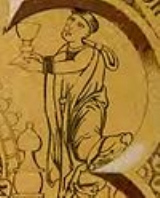
Konrad I of Masovia

Encyclopedia
Konrad I of Masovia (1187? – 1247), from the Polish Piast dynasty
, was the sixth Duke of Masovia
from 1194 until his death and High Duke of Poland from 1229 to 1232.
of Poland and Helen of Znojmo
, daughter of the Přemyslid
duke Konrad II of Znojmo (ruler of the Znojmo Appange in southern Moravia
, part of Duchy of Bohemia). His maternal grandmother was Maria of Serbia, apparently a daughter of the pre-Nemanjić
župan Uroš I of Rascia
.
After his father's death in 1194, Konrad was brought up by his mother, who acted as regent
of Masovia
. In 1199 he received Masovia and in 1205 also the adjacent lands of Kuyavia
. In 1205, he and his brother, Duke Leszek I the White
of Sandomierz
, had their greatest military victory at Battle of Zawichost
against Prince Roman the Great
of Galicia–Volhynia. The Ruthenia
n army was crushed and Roman was killed in battle. The Rurik
princess Agafia of Rus
became his wife.
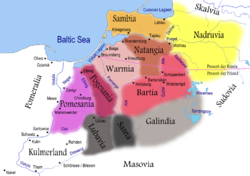
lands of Chełmno
in Prussia
during a 1209 crusade with the consent of Pope Innocent III
. In 1215 the monk Christian of Oliva
was appointed a missionary bishop among the Old Prussians
, his residence at Chełmno however was devastated by Prussian forces the next year. Several further campaigns in 1219, 1222 failed, instead Konrad picked a long-term border quarrel with the Prussian tribes.
The duke's ongoing attempts on Prussia were answered by incursions across the borders of his Masovian lands, while Prussians were in the process of gaining back control over the disputed Chełmno Land http://www.google.com/search?tbm=bks&tbo=1&q=the+warlike+tribesmen+in+Culm+and+Pogesania+were+possibly+only+reacting+to+Polish+and+Pomerellian+pressure&btnG=Search+Books and even threatened Konrad's residence at Płock Castle. Subjected to constant Prussian raids and counter-raids, Konrad now wanted to stabilize the north of his Duchy of Masovia in this fight over the border area of Chełmno.
of the Teutonic Knights
to fight the Prussians, as they already had supported the Kingdom of Hungary
against the Cuman people in the Transylavanian Burzenland
from 1211 to 1225. When they notified Hungary that the Order was firstly responsible to the pope
, the Knights were expelled by the Hungarian king Andrew II
though. Thus, in turn for the Order's service, Grand Master Hermann von Salza
wanted to have its rights documented beforehand, by a deal with Konrad that was to be confirmed by the Holy Roman Emperor
and the Roman Curia
.
Emperor Frederick II
issued in March 1226 the Golden Bull of Rimini
, stating that:
So far the Knights were not convinced to take the trouble of fighting the Prussians, and on the advice of the first Prussian bishop Christian of Oliva
, in 1228 Konrad founded the loyal Order of Dobrzyń
instead, calling for another Prussian Crusade
- and was again defeated. In view of an imminent Prussian invasion, Konrad supposedly signed the Treaty of Kruszwica in 1230, according to which he granted Chełmno Land to the Teutonic Knights and the Order of Dobrzyń. By this donation disclaiming any enfeoffment
, Konrad established the nucleus of the State of the Teutonic Order. The document does not exist however, and it is believed that it was never signed and the Order might have forged it. The Knights under the command of Hermann Balk
crossed the Vistula
river and conquered Chełmno Land, erecting the castle of Toruń
(Thorn) in 1231. In 1234, Pope Gregory IX
issued the Golden Bull of Rieti, confirming the prior deals with the Teutonic Knights, stating that the land of the Order was only subject to the Pope, not a fief of anybody.
with his Piast cousin Duke Władysław III Spindleshanks of Greater Poland and assumed the title of a Polish High Duke in 1229. However their Silesian
relative Duke Henry I the Bearded
finally prevailed as High Duke at Kraków in 1232 and confined Konrad's rule again to Masovia. When Henry's son and heir, High Duke Henry II the Pious
was killed at the 1241 Battle of Legnica
, Konrad once again assumed the senioral title, but had to yield to the claims raised by his nephew Bolesław V the Chaste, son of his elder brother Leszek, two years later.
, daughter of Prince Svyatoslav III Igorevich
. They had the following children:
coastline through their monastic state, that had ultimately dire consequences for the Polish state'. From the Polish point of view, the Emperor had no legal basis to vest the Order with lands that were beyond his discretionary power.
King Casimir III of Poland had to accept the rule of the Order in Thorn and Kulm by the 1343 Treaty of Kalisz. After the Thirteen Years' War in the 1466 Second Peace of Thorn, the Polish king Casimir IV Jagiellon
gained control over the Chełmno Land as part of Royal Prussia
.
Piast dynasty
The Piast dynasty was the first historical ruling dynasty of Poland. It began with the semi-legendary Piast Kołodziej . The first historical ruler was Duke Mieszko I . The Piasts' royal rule in Poland ended in 1370 with the death of king Casimir the Great...
, was the sixth Duke of Masovia
Dukes of Masovia
The Dukes of Masovia were a line of the Piast dynasty who ruled in Masovia. The following is a list of all rulers of the Duchy of Masovia and its parts...
from 1194 until his death and High Duke of Poland from 1229 to 1232.
Life
He was the youngest son of High Duke Casimir II the JustCasimir II the Just
Casimir II the Just was a Lesser Polish duke at Wiślica during 1166–1173, and at Sandomierz since 1173. He became ruler over the Polish Seniorate Province at Kraków and thereby High Duke of Poland in 1177; a position he held until his death, interrupted once by his elder brother and predecessor...
of Poland and Helen of Znojmo
Helen of Znojmo
Helena of Znojmo was a Bohemian princess, a member of the Přemyslid dynasty. She was the daughter of Duke Conrad II of Znojmo and his Serbian wife Maria of Rascia...
, daughter of the Přemyslid
Premyslid dynasty
The Přemyslids , were a Czech royal dynasty which reigned in Bohemia and Moravia , and partly also in Hungary, Silesia, Austria and Poland.-Legendary rulers:...
duke Konrad II of Znojmo (ruler of the Znojmo Appange in southern Moravia
Moravia
Moravia is a historical region in Central Europe in the east of the Czech Republic, and one of the former Czech lands, together with Bohemia and Silesia. It takes its name from the Morava River which rises in the northwest of the region...
, part of Duchy of Bohemia). His maternal grandmother was Maria of Serbia, apparently a daughter of the pre-Nemanjić
House of Nemanjic
The Nemanjić was the most important dynasty of Serbia in the Middle Ages, and one of the most important in Southeastern Europe. The royal house produced eleven Serbian monarchs between 1166 and 1371. It's progenitor was Stephen Nemanja, who descended from a cadet line of the Vukanović dynasty...
župan Uroš I of Rascia
Uroš I of Rascia
Uroš I Vukanović was the Grand Prince of the Grand Principality of Serbia from ca 1112 to 1145.-Origin:Uroš I was the son of Marko, the brother of Grand Prince Vukan, who had swore an oath of loyalty to Constantine Bodin, the Grand Prince of Duklja, becoming his vassals...
.
After his father's death in 1194, Konrad was brought up by his mother, who acted as regent
Regent
A regent, from the Latin regens "one who reigns", is a person selected to act as head of state because the ruler is a minor, not present, or debilitated. Currently there are only two ruling Regencies in the world, sovereign Liechtenstein and the Malaysian constitutive state of Terengganu...
of Masovia
Duchy of Masovia
The Duchy of Masovia with its capital at Płock was a medieval duchy formed when the Polish Kingdom of the Piasts fragmented in 1138. It was located in the historic Masovian region of northeastern Poland...
. In 1199 he received Masovia and in 1205 also the adjacent lands of Kuyavia
Kuyavia
Kujawy , is a historical and ethnographic region in the north-central Poland, situated in the basin of the middle Vistula and upper Noteć Rivers, with its capital in Włocławek.-Etymology:The origin of the name Kujawy was seen differently in history...
. In 1205, he and his brother, Duke Leszek I the White
Leszek I the White
Leszek I the White , also listed by some sources as Leszek II the White, was Prince of Sandomierz and High Duke of Poland from 1194 until his death, except for the short periods following when he was deposed as Polish ruler...
of Sandomierz
Sandomierz
Sandomierz is a city in south-eastern Poland with 25,714 inhabitants . Situated in the Świętokrzyskie Voivodeship , previously in Tarnobrzeg Voivodeship . It is the capital of Sandomierz County . Sandomierz is known for its Old Town, a major tourist attraction...
, had their greatest military victory at Battle of Zawichost
Battle of Zawichost
The Battle of Zawichost was a skirmish fought between Roman the Great of Galicia-Volhynia and Leszek I the White of Lesser Poland, along with his brother, Konrad I of Masovia. After declaring war and invading Lesser Poland, Roman and his forces were ambushed by the Poles in the vicinity of...
against Prince Roman the Great
Roman the Great
Roman Mstislavich , also Roman Mstyslavych or Roman the Great, was a Rus’ prince, Grand Prince of Kiev ....
of Galicia–Volhynia. The Ruthenia
Ruthenia
Ruthenia is the Latin word used onwards from the 13th century, describing lands of the Ancient Rus in European manuscripts. Its geographic and culturo-ethnic name at that time was applied to the parts of Eastern Europe. Essentially, the word is a false Latin rendering of the ancient place name Rus...
n army was crushed and Roman was killed in battle. The Rurik
Rurik Dynasty
The Rurik dynasty or Rurikids was a dynasty founded by the Varangian prince Rurik, who established himself in Novgorod around the year 862 AD...
princess Agafia of Rus
Agafia of Rus
Agafia Svyatoslavna of Rus was Princess of Mazovia by her marriage and was a member of the Rurikid dynasty.-Life:...
became his wife.
Attempted conquests of Prussia
In order to enlarge his dominions, Konrad unsuccessfully attempted to conquer the adjacent paganPaganism
Paganism is a blanket term, typically used to refer to non-Abrahamic, indigenous polytheistic religious traditions....
lands of Chełmno
Chełmno Land
Chełmno land or Chełmno region is a historical region of Poland, located in central Poland, bounded by the Vistula and Drwęca rivers....
in Prussia
Prussia (region)
Prussia is a historical region in Central Europe extending from the south-eastern coast of the Baltic Sea to the Masurian Lake District. It is now divided between Poland, Russia, and Lithuania...
during a 1209 crusade with the consent of Pope Innocent III
Pope Innocent III
Pope Innocent III was Pope from 8 January 1198 until his death. His birth name was Lotario dei Conti di Segni, sometimes anglicised to Lothar of Segni....
. In 1215 the monk Christian of Oliva
Christian of Oliva
Christian of Oliva , also Christian of Prussia was the first missionary bishop of Prussia.Christian was born about 1180 in the Duchy of Pomerania, possibly in the area of Chociwel...
was appointed a missionary bishop among the Old Prussians
Old Prussians
The Old Prussians or Baltic Prussians were an ethnic group, autochthonous Baltic tribes that inhabited Prussia, the lands of the southeastern Baltic Sea in the area around the Vistula and Curonian Lagoons...
, his residence at Chełmno however was devastated by Prussian forces the next year. Several further campaigns in 1219, 1222 failed, instead Konrad picked a long-term border quarrel with the Prussian tribes.
The duke's ongoing attempts on Prussia were answered by incursions across the borders of his Masovian lands, while Prussians were in the process of gaining back control over the disputed Chełmno Land http://www.google.com/search?tbm=bks&tbo=1&q=the+warlike+tribesmen+in+Culm+and+Pogesania+were+possibly+only+reacting+to+Polish+and+Pomerellian+pressure&btnG=Search+Books and even threatened Konrad's residence at Płock Castle. Subjected to constant Prussian raids and counter-raids, Konrad now wanted to stabilize the north of his Duchy of Masovia in this fight over the border area of Chełmno.
Teutonic Order
Thus in 1226, Konrad having difficulty with constant raids over his territory, invited the religious military orderMilitary order
A military order is a Christian society of knights that was founded for crusading, i.e. propagating or defending the faith , either in the Holy Land or against Islam or pagans in Europe...
of the Teutonic Knights
Teutonic Knights
The Order of Brothers of the German House of Saint Mary in Jerusalem , commonly the Teutonic Order , is a German medieval military order, in modern times a purely religious Catholic order...
to fight the Prussians, as they already had supported the Kingdom of Hungary
Kingdom of Hungary
The Kingdom of Hungary comprised present-day Hungary, Slovakia and Croatia , Transylvania , Carpatho Ruthenia , Vojvodina , Burgenland , and other smaller territories surrounding present-day Hungary's borders...
against the Cuman people in the Transylavanian Burzenland
Burzenland
The Burzenland is a historic and ethnographic area in southeastern Transylvania, Romania with a mixed population...
from 1211 to 1225. When they notified Hungary that the Order was firstly responsible to the pope
Pope
The Pope is the Bishop of Rome, a position that makes him the leader of the worldwide Catholic Church . In the Catholic Church, the Pope is regarded as the successor of Saint Peter, the Apostle...
, the Knights were expelled by the Hungarian king Andrew II
Andrew II of Hungary
Andrew II the Jerosolimitan was King of Hungary and Croatia . He was the younger son of King Béla III of Hungary, who invested him with the government of the Principality of Halych...
though. Thus, in turn for the Order's service, Grand Master Hermann von Salza
Hermann von Salza
Hermann von Salza was the fourth Grand Master of the Teutonic Knights, serving from 1210 to 1239...
wanted to have its rights documented beforehand, by a deal with Konrad that was to be confirmed by the Holy Roman Emperor
Holy Roman Emperor
The Holy Roman Emperor is a term used by historians to denote a medieval ruler who, as German King, had also received the title of "Emperor of the Romans" from the Pope...
and the Roman Curia
Roman Curia
The Roman Curia is the administrative apparatus of the Holy See and the central governing body of the entire Catholic Church, together with the Pope...
.
Emperor Frederick II
Frederick II, Holy Roman Emperor
Frederick II , was one of the most powerful Holy Roman Emperors of the Middle Ages and head of the House of Hohenstaufen. His political and cultural ambitions, based in Sicily and stretching through Italy to Germany, and even to Jerusalem, were enormous...
issued in March 1226 the Golden Bull of Rimini
Golden Bull of Rimini
The Golden Bull of Rimini was a Golden Bull issued by Emperor Frederick II, at his court in Rimini in March 1226 to confirm the Teutonic Knights' possessions in Prussia...
, stating that:
- "brother Konrad had offered and promised to furnish brother Herrmann, Honorable Master of the Holy Hospital of St. Mary of the Germans in Jerusalem (Teutonic Order).. with the Culmensis Land between his march and the Prussians and equip them (T.O.) well, so they may take Preussenland (Terra Prussiae) in possession... we recognize the fact, that this land is included in the realm of the empire, we trust the judgement of the Master... we recognize all land in Prussia as an ancient right of the empire ...".
So far the Knights were not convinced to take the trouble of fighting the Prussians, and on the advice of the first Prussian bishop Christian of Oliva
Christian of Oliva
Christian of Oliva , also Christian of Prussia was the first missionary bishop of Prussia.Christian was born about 1180 in the Duchy of Pomerania, possibly in the area of Chociwel...
, in 1228 Konrad founded the loyal Order of Dobrzyń
Order of Dobrzyn
The Order of Dobrzyń or Order of Dobrin , also known as the Brothers of Dobrzyń , was a military order created in the borderland of Masovia and Prussia during the 13th century Prussian Crusade to 'defend against Baltic Prussian raids'.In Latin the knights were known as the Fratres Milites Christi...
instead, calling for another Prussian Crusade
Prussian Crusade
The Prussian Crusade was a series of 13th-century campaigns of Roman Catholic crusaders, primarily led by the Teutonic Knights, to Christianize the pagan Old Prussians. Invited after earlier unsuccessful expeditions against the Prussians by Polish princes, the Teutonic Knights began campaigning...
- and was again defeated. In view of an imminent Prussian invasion, Konrad supposedly signed the Treaty of Kruszwica in 1230, according to which he granted Chełmno Land to the Teutonic Knights and the Order of Dobrzyń. By this donation disclaiming any enfeoffment
Enfeoffment
Under the European feudal system, enfeoffment was the deed by which a person was given land in exchange for a pledge of service. This mechanism was later used to avoid restrictions on the passage of title in land by a system in which a landowner would give land to one person for the use of another...
, Konrad established the nucleus of the State of the Teutonic Order. The document does not exist however, and it is believed that it was never signed and the Order might have forged it. The Knights under the command of Hermann Balk
Hermann Balk
Hermann Balk , also known as Hermann von Balk or Hermann Balke, was a Knight-Brother of the Teutonic Order and its first Landmeister, or Provincial Master, in both Prussia and Livonia. From 1219 to 1227, he served as the Deutschmeister in the Order's Province of Alemannia...
crossed the Vistula
Vistula
The Vistula is the longest and the most important river in Poland, at 1,047 km in length. The watershed area of the Vistula is , of which lies within Poland ....
river and conquered Chełmno Land, erecting the castle of Toruń
Torun
Toruń is an ancient city in northern Poland, on the Vistula River. Its population is more than 205,934 as of June 2009. Toruń is one of the oldest cities in Poland. The medieval old town of Toruń is the birthplace of the astronomer Nicolaus Copernicus....
(Thorn) in 1231. In 1234, Pope Gregory IX
Pope Gregory IX
Pope Gregory IX, born Ugolino di Conti, was pope from March 19, 1227 to August 22, 1241.The successor of Pope Honorius III , he fully inherited the traditions of Pope Gregory VII and of his uncle Pope Innocent III , and zealously continued their policy of Papal supremacy.-Early life:Ugolino was...
issued the Golden Bull of Rieti, confirming the prior deals with the Teutonic Knights, stating that the land of the Order was only subject to the Pope, not a fief of anybody.
High Duke
Konrad was also entangled in the conflict over the Polish Seniorate ProvinceSeniorate Province
Seniorate Province, also known as the Senioral Province , Duchy of Kraków , Duchy of Cracow, Principality of Cracow, Principality of Kraków, was the superior among the five provinces established in 1138 according to the Testament of Bolesław III Krzywousty...
with his Piast cousin Duke Władysław III Spindleshanks of Greater Poland and assumed the title of a Polish High Duke in 1229. However their Silesian
Silesian Piasts
The Silesian Piasts were the oldest line of the Piast dynasty beginning with Władysław II the Exile, son of Bolesław III Wrymouth, Duke of Poland...
relative Duke Henry I the Bearded
Henry I the Bearded
Henry I the Bearded , of the Silesian line of the Piast dynasty, was Duke of Silesia at Wrocław from 1201 and Duke of Kraków and thus High Duke of all Poland - internally divided - from 1232 until his death.-Heir of Wroclaw:...
finally prevailed as High Duke at Kraków in 1232 and confined Konrad's rule again to Masovia. When Henry's son and heir, High Duke Henry II the Pious
Henry II the Pious
Henry II the Pious , of the Silesian line of the Piast dynasty was Duke of Silesia at Wrocław and Duke of Kraków and thus High Duke of all Poland as well as Duke of Southern Greater Poland from 1238 until his death. During 1238–1239 he also served as a regent of two other Piast duchies: Sandomierz...
was killed at the 1241 Battle of Legnica
Battle of Legnica
The Battle of Legnica , also known as the Battle of Liegnitz or Battle of Wahlstatt , was a battle between the Mongol Empire and the combined defending forces of European fighters that took place at Legnickie Pole near the city of Legnica in Silesia on 9 April 1241.A combined force of Poles,...
, Konrad once again assumed the senioral title, but had to yield to the claims raised by his nephew Bolesław V the Chaste, son of his elder brother Leszek, two years later.
Marriage and children
Between 1207 and 1210 Konrad married Agafia of RusAgafia of Rus
Agafia Svyatoslavna of Rus was Princess of Mazovia by her marriage and was a member of the Rurikid dynasty.-Life:...
, daughter of Prince Svyatoslav III Igorevich
Svyatoslav III Igorevich
Svyatoslav III Igorevich was a Rus' prince . His baptismal name was Adrian. He was prince of Peremyshl , and of Volodymyr-Volynskyi .-His early life:...
. They had the following children:
- Boleslaw I of Masovia (c. 1210 - 17 April 1248), Duke of Masovia (1247—1248)
- Casimir I of KuyaviaCasimir I of KuyaviaCasimir I of Kuyavia was Prince of Kujawy, Mazovia and Wielkopolska, from 1233 until his death. He was the son of Konrad I of Masovia, King of Poland, and his wife Agafia of Rus.- Life :...
(born between 1210 and 1213 - died 14 Dec 1267) Prince of KuyaviaKuyaviaKujawy , is a historical and ethnographic region in the north-central Poland, situated in the basin of the middle Vistula and upper Noteć Rivers, with its capital in Włocławek.-Etymology:The origin of the name Kujawy was seen differently in history...
(1247–1267) - Siemowit I of Masovia (c.1213 - 24 June 1262), succeeded eldest brother as Duke of Masovia (1248–1262)
- Eudoxia (1215–1240), married Count Dietrich I of BrehnaBrehnaBrehna is a town and a former municipality in the district of Anhalt-Bitterfeld, in Saxony-Anhalt, Germany. Since 1 July 2009, it is part of the town Sandersdorf-Brehna.It is situated southwest of Bitterfeld. Important in this city is the church...
and Wettin - Ludmila (born before 1225)
- Ziemomysł (born between 1216 and 4 Jul 1228 - died between 10 July and 18 September 1241)
- Salomea (born between 1220 and 1225 - died after 30 August 1268), nun
- Judith (born between 1222 and 1227 - died 4 Dec between 1257 and 1263), married firstly to Duke Mieszko II the FatMieszko II the FatMieszko II the Fat was a Duke of Opole-Racibórz since 1230 until his death, and Duke of Kalisz-Wieluń during 1234–1239 ....
of OpoleDuchy of OpoleDuchy of Opole was one of the duchies of Silesia ruled by the Piast dynasty. Its capital was Opole in Upper Silesia.After Bolesław I the Tall and his younger brother Mieszko I Tanglefoot backed by Emperor Frederick I Barbarossa had retained their Silesian heritage in 1163, they divided the...
, secondly to Duke Henry III the White of Wrocław - Dubrawka (c. 1230-1265)
- Mieszko (b. 1235), died in infancy.
Konrad's legacy
Konrad is blamed by Poles, that 'his actions began the process whereby the Teutonic Knights came to control much of the BalticBaltic Sea
The Baltic Sea is a brackish mediterranean sea located in Northern Europe, from 53°N to 66°N latitude and from 20°E to 26°E longitude. It is bounded by the Scandinavian Peninsula, the mainland of Europe, and the Danish islands. It drains into the Kattegat by way of the Øresund, the Great Belt and...
coastline through their monastic state, that had ultimately dire consequences for the Polish state'. From the Polish point of view, the Emperor had no legal basis to vest the Order with lands that were beyond his discretionary power.
King Casimir III of Poland had to accept the rule of the Order in Thorn and Kulm by the 1343 Treaty of Kalisz. After the Thirteen Years' War in the 1466 Second Peace of Thorn, the Polish king Casimir IV Jagiellon
Casimir IV Jagiellon
Casimir IV KG of the House of Jagiellon was Grand Duke of Lithuania from 1440, and King of Poland from 1447, until his death.Casimir was the second son of King Władysław II Jagiełło , and the younger brother of Władysław III of Varna....
gained control over the Chełmno Land as part of Royal Prussia
Royal Prussia
Royal Prussia was a Region of the Kingdom of Poland and of the Polish-Lithuanian Commonwealth . Polish Prussia included Pomerelia, Chełmno Land , Malbork Voivodeship , Gdańsk , Toruń , and Elbląg . It is distinguished from Ducal Prussia...
.