
All Topics  
Kodiak Bear

 
Kodiak Bear

   Email Print
   Bookmark   Link


Kodiak Bear


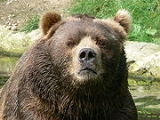
The Kodiak bear (Ursus arctos middendorffi), also known as the Alaskan brown bear, is the largest subspecies of Brown Bear
Brown Bear

The Brown Bear is a large bear distributed across much of northern Eurasia and North America. It weighs 100 to 700 kg and its larger populations such as the Kodiak bear match the Polar bear as the largest extant land predator....
 and occupies the islands of the Kodiak Archipelago
Kodiak Archipelago

The Kodiak Archipelago is an archipelago, or group of islands, south of main land mass of the state of Alaska , about 405 km by air south of Anchorage, Alaska in the Gulf of Alaska....
 in southcentral Alaska
Alaska

Alaska is the largest U.S. state of the United States by area; it is situated in the northwest extremity of the North American continent, with Canada to the east, the Arctic Ocean to the north, and the Pacific Ocean to the west and south, with Russia further west across the Bering Strait....
. The traditional name in the Alutiiq
Alutiiq

The Alutiiq , also called Pacific Yupik or Sugpiaq, are a southern coastal people of the Yupik peoples of Alaska. Their language is also called Alutiiq language....
 language is: Taquka-aq. Male bears are referred to as boars, females are called sows, and very young bears are called cubs.

nomist C.H.


Discussion
Ask a question about 'Kodiak Bear'
Start a new discussion about 'Kodiak Bear'
Answer questions from other users
Full Discussion Forum


Recent Posts


Encyclopedia


The Kodiak bear (Ursus arctos middendorffi), also known as the Alaskan brown bear, is the largest subspecies of Brown Bear
Brown Bear

The Brown Bear is a large bear distributed across much of northern Eurasia and North America. It weighs 100 to 700 kg and its larger populations such as the Kodiak bear match the Polar bear as the largest extant land predator....
 and occupies the islands of the Kodiak Archipelago
Kodiak Archipelago

The Kodiak Archipelago is an archipelago, or group of islands, south of main land mass of the state of Alaska , about 405 km by air south of Anchorage, Alaska in the Gulf of Alaska....
 in southcentral Alaska
Alaska

Alaska is the largest U.S. state of the United States by area; it is situated in the northwest extremity of the North American continent, with Canada to the east, the Arctic Ocean to the north, and the Pacific Ocean to the west and south, with Russia further west across the Bering Strait....
. The traditional name in the Alutiiq
Alutiiq

The Alutiiq , also called Pacific Yupik or Sugpiaq, are a southern coastal people of the Yupik peoples of Alaska. Their language is also called Alutiiq language....
 language is: Taquka-aq. Male bears are referred to as boars, females are called sows, and very young bears are called cubs.

Description


Taxonomy

Taxonomist C.H. Merriam was the first to recognize Kodiak bears as unique and he named the species in honor of the celebrated Russian naturalist Dr. A. Th. von Middendorff. Subsequent taxonomic revisions merged most North American brown bears into a single subspecies (Ursus arctos horribilis), but Kodiak bears are still considered to be a unique subspecies (Ursus arctos middendorffi). Recent investigations of genetic samples from bears on Kodiak have shown that they are closely related to brown bears on the Alaska Peninsula and Kamchatka, Russia
Russia

Russia , or the Russian Federation , is a list of countries spanning more than one continent country extending over much of northern Eurasia....
. It appears that Kodiak bears have been genetically isolated since at least the last ice age (10,000 to 12,000 years ago) and there is very little genetic diversity within the population. Although the current population is healthy and productive, and has shown no overt adverse signs of inbreeding
Inbreeding

Inbreeding is biological reproduction between close Kinships, whether plant or animal. If practiced repeatedly, it leads to an increase in homozygosity of a population....
, it may be more susceptible to new diseases or parasites than other more diverse brown bear populations.

Color

Hair colors range from blond (typically females or bears from southern parts of the archipelago) to dark brown. Cubs often retain a white “natal ring” around their neck for the first couple years of life. The Kodiak's color is similar to that of their very close relative, the Grizzly bear
Grizzly Bear

The grizzly bear ', also known as the silvertip bear, is a subspecies of brown bear ' that lives in the uplands of western North America....
.

Size

Few Kodiak bears have been weighed in the wild, so all weights are estimates. Size range for females is from 500 to 700 pounds and for males 800 to 1,400 pounds. Mature males (larger than sub-prime males) average 477-534 kg (1,051-1,177 lb) over the course of the year, up to 1,500 lbs at peak times.Females are typically about 20% smaller and 30% lighter than males and adult sizes are attained when bears are 6 years old. Bears weigh the least when they emerge from their dens in the spring, and can increase their weight by 20-30% during late summer and fall. Bears in captivity can sometimes attain weights that are double those seen in wild bears. The largest Kodiak Bear on record weighted 2500 pounds (1134 kg) and was almost 14 ft tall on its hind legs. Kodiak Bears have reached over 3000 pounds, but such weights are not seen in the wild.

An adult male Kodiak bear stands 3.5-4.5 ft (exceptionally up to 5 feet–1.52 m) tall at the shoulder when it is standing on all four legs. When standing fully upright on its hind legs, a large male could reach a height of 10 feet (3 m). When hunters refer to a bear, they are estimating the size of the skinned-out hide by adding the length (nose to base of tail) and the width (tip of left center front claw to tip of right center front claw) and dividing that sum by two. This measurement is extremely variable due to hide shrinkage or stretching, rendering it impossible to use as a reliable way to compare bears.

The standard method of evaluating the size of bears is by measuring their skull
Skull

The skull is a bone structure found in the head of many animals. The skull supports the structures of the face and protects the head against injury....
s. Most North American hunting organizations and management agencies use calipers to measure the length of the skull (back of sagittal crest
Sagittal crest

A sagittal crest is a ridge of bone running lengthwise along the midline of the top of the skull of many mammalian and reptilian skulls, among others....
 on the back of the skull to the front tooth) and the width (maximum width between the zygomatic arch
Zygomatic arch

The zygomatic arch is formed by the zygomatic process of temporal bone and the temporal process of the zygomatic bone , the two being united by an oblique suture; the tendon of the Temporalis passes medial to the arch to gain insertion into the coronoid process of the mandible....
es — “cheek bones”). The total skull size is the sum of these two measurements. The largest bear ever killed in North America was from Kodiak Island with a total skull size of 30.75 in (78.1 cm), and 8 of the top 10 brown bears listed in the Boone and Crockett record book are from Kodiak. The average skull size of Kodiak bears that were killed by hunters in the first five years of the twenty-first century was 25.1 in (63.8 cm) for boars and 21.8 in (55.4 cm) for sows.

Size relative to other bear types
They are the largest brown bear subspecies, and about the same size as Polar bear
Polar Bear

The polar bear is a bear native to the Arctic Ocean and its surrounding seas. The world's largest carnivore found on land, and shares the title of largest land predator with the Kodiak Bear, an adult male weighs around , while an adult female is about half that size....
s. That makes Kodiak bears and Polar bears the two largest members of the bear family.

Physically, Kodiak bears are similar to the Kamchatka Brown Bear
Kamchatka Brown Bear

The Kamchatka Brown Bear , also known as the Far Eastern Brown Bear, is a subspecies of the Brown Bear , native to the Kamchatka Peninsula, Karaginskiy Island, and northward throughout the Koryak Okrug....
s of the Russian Far East
Russian Far East

Russian Far East is a term that refers to the Russian part of the Far East, i.e., extreme east parts of Russia, between Siberia and the Pacific Ocean....
, though tending to be lighter in colour and bigger.

Distribution and density

Although the term “Kodiak bear” is widely used to include all coastal Alaska brown bears, the subspecies only occurs on the islands of the Kodiak Archipelago, Alaska (Kodiak, Afognak, Shuyak, Raspberry, Uganik, Sitkalidak, and adjacent islands). The Kodiak bear population was estimated to include 3,526 bears in 2005, yielding an estimated archipelago-wide density of 0.7 bears/square mile (271.2 bears/1000 km²). During the past decade the population has been slowly increasing.

Life history


Reproduction and survival

Mating season for Kodiak bears is during May and June. They are serially monogamous (having one partner at a time), staying together from two days to two weeks. As soon as the egg is fertilized and divides a few times, it enters a state of suspended animation until autumn when it finally implants on the uterine wall and begins to grow again. Cubs are born in the den during January or February. Weighing less than a pound (<450 g) at birth with little hair and closed eyes, they suckle for several months, emerging from the den in May or June, weighing 15-20 pounds (7-9 kg). Typical litter sizes on Kodiak are 2-3 cubs, with a long-term average of 2.4 cubs per litter. Sows are sometimes seen with five or six cubs in tow, probably due to adopting cubs from other litters. Most cubs stay with their mothers for three years. Almost half of the cubs die before they leave, with cannibalism
Cannibalism

Cannibalism is the act or practice of humans eating other humans. The ritualistic eating of human flesh is also known as anthropophagy, from Greek: ?????p??, anthropos, "human being"; and fa?e??, phagein, "to eat"....
 by adult males being one of the major causes of death.

Kodiak bears that have recently left their mothers, at ages 3-5 years, have high mortality rates with only 56 percent of males and 89 percent of females surviving. Most young female bears stay within or near their mother’s home range, while most males move farther away. Kodiak bears become sexually mature at age five, but most sows are over nine years old when they successfully wean their first litter. The average interval between litters is about four years. Sows continue to produce cubs throughout their lives but their productivity diminishes after they are 20 years old. Most adult sows die of natural causes (56 percent) while most adult boars are killed by hunters (91 percent). The oldest known boar in wild was 35 years old, and the oldest sow was 27.

Denning

Kodiak bears begin entering their dens in late October. Pregnant sows are usually the first to go to dens, males are the last. Males begin emerging from their dens in early April, while sows with new cubs may stay in dens until late June. Bears living on the north end of Kodiak Island tend to have longer denning periods than bears in the southern areas. Most Kodiak bears dig their dens in hill or mountain sides and they use a wide variety of denning habitats depending on which part of the archipelago they live on. Almost a quarter of the adult boars forgo denning, staying somewhat active throughout the winter.

Home Range

Bears on Kodiak are naturally diurnal
Diurnal

Diurnal may refer to:* Diurnality, the behavior of an animal that is active in the daytime* Diurnal motion, the apparent motion of stars around the Earth...
 (active during the day), but when faced with competition for food or space, they adopt a more nocturnal (active at night) lifestyle. This behavior is especially evident in the bears that live near and within Kodiak City. Kodiak bears do not defend territories, but they do have traditional areas that they use each year (home ranges). Because of the rich variety of foods available on Kodiak, the bears on the archipelago have some of the smallest home ranges of any brown bear populations in North America and there is a great deal of overlap among the ranges of individual bears. Home ranges of adult sows on Kodiak Island average , while boar home ranges average .

Habitat and feeding habits

The islands of the Kodiak archipelago have a subarctic
Subarctic

The Subarctic is a region in the Northern Hemisphere immediately south of the true Arctic and covering much of Alaska, Canada and Siberia, the north of Scandinavia, northern Mongolia and the Chinese province of Heilongjiang....
 maritime climate with cool temperatures, overcast skies, fog, windy conditions and moderate to heavy precipitation throughout most of the year. Although the archipelago only covers about 5,000 mi2 (13,000 km2) there is a rich variety of topography and vegetation that ranges from dense forests of Sitka spruce
Sitka Spruce

The Sitka Spruce is a large coniferous evergreen tree growing to 50?70 m tall, exceptionally to 100 m tall, and with a trunk diameter of up to 5 m, exceptionally to 6?7 m diameter....
 on the northern islands, to steep glaciated mountains rising to 4,405 ft (1,362 m) along the central spine of Kodiak Island, to rolling hills and flat tundra on the south end of the archipelago. About 14,000 people live on the Archipelago, primarily in Kodiak city
Kodiak, Alaska

Kodiak is one of 6 communities and the main city on Kodiak Island in Kodiak Island Borough, Alaska in the U.S. state of Alaska. All commercial transportation between the entire island and the outside world goes through this city either via ferryboat or airline....
 and six outlying villages. Roads and other human alterations are generally limited to Afognak Island and the northeastern part of Kodiak Island. About half of the Archipelago is included in the Kodiak National Wildlife Refuge
Kodiak National Wildlife Refuge

The Kodiak National Wildlife Refuge is a wilderness area in the Kodiak Archipelago in southwestern Alaska, United States.The Kodiak National Wildlife Refuge includes the southwestern two-thirds of Kodiak Island, Uganik Island, the Red Peaks area of Afognak Island and all of Ban Island in the archipelago....
.

Bears live throughout the archipelago, adapting to local resources and retaining relatively small home ranges and comparable densities in most habitats. Emerging vegetation and animals that died during the winter are the first foods bears use in the spring. As summer progresses a wide variety of vegetation supplies nutritional needs until salmon
Salmon

Salmon is the common name for several species of fish of the family Salmonidae. Several other fish in the family are called trout,the difference is often attributed to the migratory life of the salmon as compared to the residential behaviour of trout, this holds true for the Atlantic salmon....
 return. Salmon runs extend from May through September on most of the Archipelago and bears make extensive use of the five species of Pacific salmon that spawn in local streams and lakes. In the late summer and early fall, bears consume several types of berries. Bears also feed on wind-rowed seaweed and invertebrates on some beaches throughout the year. Although deer
Deer

Deer are the ruminant mammals forming the family Cervidae . A number of broadly similar animals from related families within the order even-toed ungulate are often also called deer....
, elk
Elk

Elk may refer to:* Various species of deer:** European Elk , also known as Moose** North American Elk , also known as Wapiti** Indian Elk , also known as sambar ...
 and mountain goat
Mountain goat

The Mountain Goat , also known as the Rocky Mountain Goat, is a large-hoofed mammal found only in North America. Despite its name, it is not a true goat, as it belongs to a different genus....
s are abundant on the archipelago, few Kodiak bears actively prey on them.

Behaviour


Sensory perception and intelligence

There have been no scientific studies evaluating the sensory perception or intelligence of Kodiak bears. Subjective observations and comparisons to other bears suggest that Kodiak bears have eyesight that is comparable to humans (they are not “near sighted”), have hearing that is comparable to an average dog, and have a sense of smell that is up to four times more acute than the average dog. Their level of intelligence seems to be somewhere between that of an average canine and a primate. Due to their level of intelligence, individual bears have personalities and unique ways of dealing with situations.

Interactions with other bears

Kodiak bears are generally solitary in nature; however, when food is concentrated in small areas, such as along salmon spawning streams, grass/sedge flats, berry patches, a dead whale, or even an open garbage dump they often occur in large groups. Along a few drainages on Kodiak, up to 60 bears can be seen simultaneously in a square mile area (2.6 km2). To maximize food intake at these important areas, bears have learned to minimize fighting and fatal interactions by developing a complex language (both verbal and body posturing) and social structure.

Interactions with people

In most circumstances, Kodiak bears are generally shy and attempt to avoid encounters with people. The most notable exceptions to this behavior pattern occur when bears are surprised, threatened, or attracted by human food, garbage, or hunter-killed game. Bear safety precautions center around avoiding such situations, understanding bear needs and behavior, and learning how to recognize the warning signs bears give when stressed.

The most recent occurrence of a fatal bear attack on a person on the Kodiak archipelago was in 1999. The National Geographic Society
National Geographic Society

The National Geographic Society , headquartered in Washington, D.C. in the United States, is one of the largest non-profit scientific and educational institutions in the world....
 filmed a television program about the attack and another, both of which occurred on Raspberry Island
Raspberry Island (Alaska)

Raspberry Island is an island of the Kodiak Archipelago located in the Gulf of Alaska in the U.S. state of Alaska. It is located two miles northwest of Whale Island , and just across the mile wide Raspberry Strait from the southwestern end of Afognak....
, part of the Kodiak archipelago and home to two full service wilderness lodges. Both hunters were returning to game they had killed previously and left alone to go kill another. One of the hunters was killed by the bear and the other, after a struggle, killed the bear with a knife. Prior to that, the last fatality was in 1921. Both incidents involved hunters that were hunting by themselves. About once every other year a bear injures a person on Kodiak.

History and management


Prehistory

Early human occupants of the archipelago looked to the sea for their sustenance. At that time, Kodiak Natives (Alutiiqs) occasionally hunted bears, using their meat for food, hides for clothing and bedding, and teeth for adornment. Traditional stories often revolved around the similarity between bears and humans, and around the mystical nature of bears because of their proximity to the spirit world.

Commercial harvests

Russian entrepreneurs came to the area in the late 1700s to capitalize on the abundant fur resources. Bear hides were considered a “minor fur” and sold for about the same price as river otter pelts. The number of bears harvested increased substantially when sea otter populations declined and after the United States acquired Alaska in 1867, bear harvests on Kodiak increased, peaking at as many as 250 bears per year. Commercial fishing activities increased in the late 1880s and canneries proliferated throughout the archipelago. Bears were viewed as competitors for the salmon resource and were routinely shot when seen on streams or coasts. At the same time, sportsmen and scientists had recognized the Kodiak bear as the largest in the world, and they voiced concerns about overharvesting the population.

Guided hunters and competition for resources

Professional interest in guided Kodiak bear hunts and a concern for unregulated resource use in frontier lands such as Alaska prompted the territorial government’s newly established Alaska Game Commission to abolish commercial bear hunting (selling the hides) on the archipelago in 1925. The impacts of the new regulations seemed to restore bear populations on the Kodiak islands. By the 1930s, ranchers on northeast Kodiak reported an increase in bear problems and demanded action. Bears were also seen as a threat to the expanding commercial salmon fishing industry. To address the dilemma of conserving bears while protecting cattle, salmon and people, President Franklin D. Roosevelt created the Kodiak National Wildlife Refuge by Executive Order in 1941.

Alaska achieved statehood in 1959 and assumed responsibility for managing the state’s wildlife. The Alaska Board of Game reduced bear-hunting seasons on Afognak
Afognak

Afognak is an island 5 km north of Kodiak Island in the U.S. state of Alaska. It is 43 miles from east to west and 23 miles from north to south and has a land area of 1,812.58 km? , making it the List of islands of the United States by area....
 and Raspberry islands and on the Kodiak National Wildlife Refuge, but liberalized bear seasons on non-refuge lands on Kodiak. During the 1960s, state biologists worked with ranchers along the Kodiak road system to examine and reduce the predation problem. Biologists reported that cattle and bears were not compatible on the same ranges and potential solutions included poisons, fences to isolate cattle ranges, and aerial shooting of bears. Again, sport hunters voiced their support for Kodiak bears. In spite of public pressure, the state continued actively pursuing and dispatching problem bears until 1970.

Changes in land status

In 1971, the Alaska Native Claims Settlement Act (ANCSA) resolved many long-standing land issues with aboriginal Alaskans statewide. The impacts were felt strongly on the archipelago as large areas were conveyed to the Native corporations. Federal management of the National Forest lands on Afognak was transferred to Native Corporation ownership with passage of the Alaska National Interest Lands Conservation Act (ANILCA) in 1980, and the Kodiak National Wildlife Refuge lost control of of prime bear habitat (more than 17 percent of refuge lands).

In 1975, construction of a logging road began on Afognak Island, and timber harvesting began in 1977. In 1979, work began on an environmental impact statement for the Terror Lake hydroelectric project on Kodiak Island. That project included an earthen dam on Terror Lake with Kodiak National Wildlife Refuge and a –long tunnel through a mountain ridge to a penstock and powerhouse in the Kizhuyak River drainage. The hydro project was the first significant invasion of inland bear habitat on Kodiak Island. To address the opposition encountered from the public and agencies, a mitigation settlement was negotiated in 1981 which included brown bear research and establishment of the Kodiak Brown Bear Trust. The hydroelectric project was completed in 1985. Human alteration of bear habitat on Kodiak and Afognak islands spurred renewed interest and funding for bear research on the archipelago, resulting in a surge of baseline and applied bear research on Kodiak through the 1980s and 1990s.

Bears were not directly harmed by the Exxon Valdez
Exxon Valdez

Exxon Valdez was the original name of an Petroleum Tanker owned by the former ExxonMobil Shipping Company, a division of the former Exxon Corporation....
 oil spill in 1989, although some were displaced from traditional feeding and traveling areas by cleanup crews. No one was injured by a bear, and no Kodiak bears were killed. To mitigate the adverse impacts of the spill, Exxon reached a settlement with the state and federal governments. Paradoxically, the impacts of the oil spill and the subsequent cleanup and settlement proved to be beneficial to bears on Kodiak. Bear-safety training exposed thousands of workers to factual information about bears, and money from the settlement fund was used for funding land acquisitions. By the close of the 20th century, over 80 percent of the refuge lands that had been lost as a result of ANCSA and ANILCA were reinstated into the refuge, either through direct purchase or by means of conservation easements. Lands were also purchased on Afognak and Shuyak island
Shuyak Island

Shuyak Island is an island in the northern part of the Kodiak Archipelago in the state of Alaska, United States. It is located just north of Afognak Island, separated from it by the narrow Shuyak Strait....
s and transferred into state ownership. The Kodiak Brown Bear Trust coordinated a coalition of sportsmen and other wildlife conservation groups from around the nation to lobby for use of settlement funds to acquire Kodiak lands. The groups also directly contributed funding to protect small parcels of important bear habitat around the islands.

Kodiak Bear Plan

In 2001 a Citizens Advisory Committee was established to work closely with the Alaska Department of Fish and Game, with the cooperation of Kodiak NWR, to develop a management plan addressing the wide variety of issues that affect bears, including hunting, habitat, and viewing. The resulting Kodiak Archipelago Bear Conservation and Management Plan was crafted over a several month period by a group of representatives from 12 diverse user groups. After hearing from a variety of experts from agencies and receiving extensive public input, the group developed more than 270 recommendations for Kodiak bear management and conservation. Most impressively, in spite of the diversity of viewpoints expressed by members of the group, all of the recommendations were by consensus.

The underlying themes of the recommendations were continued conservation of the bear population at its current level, increased education programs to teach people how to live with bears on Kodiak, and protection of bear habitat with allowances for continued human use of the Archipelago. Although the group was advisory in nature, government management agencies expressed a commitment to work to implement all of the regulations that were feasible and within their legal jurisdictions.

Genetic diversity and endangerment

The brown bear is listed as LR/lc (Lower Risk Least Concern), and it is not listed as an endangered species
Endangered species

An endangered species is a population of an organism which is at risk of becoming extinct because it is either few in numbers, or threatened by changing environmental or predation parameters....
 by the endangered species program
Endangered Species Act

The Endangered Species Act of 1973 or ESA is the most wide-ranging of the dozens of United States environmental laws passed in the 1970s....
 of the U.S. Fish and Wildlife service.

Hunt management

Kodiak bear research and habitat protection is done cooperatively by the Alaska Department of Fish and Game and Kodiak National Wildlife Refuge. Bear hunting is managed by the Alaska Department of Fish and Game and hunting regulations are established by the Alaska Board of Game. There is currently a finely tuned management system that distributes hunters in 32 different areas during two seasons (spring: April 1–May 15, and fall: October 25–November 30). Each year about 4,500 people apply for the 496 permits offered for Kodiak bear hunts (two-thirds to Alaska residents, one-third to nonresidents). Nonresidents are required to hire a registered guide who is authorized to hunt in a particular area, and this can cost from $10,000–$22,000. All hunters must come into the Alaska Department of Fish and Game (ADF&G) office in Kodiak prior to going into the field for a brief orientation and must check out before they leave the island. Every bear that is legally killed on the Archipelago must be inspected by an Alaska Department of Fish and Game wildlife biologist before it can be taken from the islands. Pelts receive a stamp from an ADF&G officer if the hunter and guide provide proper documentation to prove licensing. Pelts can not be transported or legally preserved or sold without the official stamp. Hunting laws are strictly enforced by both the ADF&G officers who often have the full support of the local community. Illegal hunting and fishing is frowned upon by the community which maintains a healthy respect for the island's environmental laws as well. Stiff penalties accompany illegal hunting and fishing. The island's remote location makes trafficking in illegal pelts difficult for would-be poachers.

Since statehood, the reported number of Kodiak bears killed by hunters has ranged from 77 (1968–69) to 206 (1965–66). From 2000 – 2006, an average of 173 Kodiak bears were killed by hunters each year (118 during the fall season and 55 in the spring season). Over 75 percent of those were males. An additional nine bears were reported killed annually in defense of life or property during the same time period. There has been an increasing number and percentage of large, trophy-sized boars (total skull size at least 28”) killed by hunters in recent years. In the 1970s, only 2.5 percent of the bears killed on Kodiak were trophy-sized; in the 1990s and 2000s the proportion increased to almost 9 percent.

Bear viewing

In the past 20 years bear viewing has become increasing popular on Kodiak and other parts of Alaska. The most accessible bear viewing location on Kodiak, Frazer River, had over 1,100 people come in 2007. Visitor numbers have been increasing at about 10 percent annually and there are plans for development of additional bear viewing areas on Kodiak. There are also other bear viewing opportunities through air-taxi, charter boat, remote lodge and trekking operations on the Archipelago.

Although bear viewing is often considered a “non-consumptive” use, it can have serious impacts on bear populations if it is not conducted properly. Most viewing occurs at places where bears congregate because of feeding opportunities that are critical to their survival. If some bears avoid these areas because people are there, those bears may not get the fat and protein they need to make it through the upcoming winter. Consequently unmanaged bear viewing could impact several bears, especially productive sows with cubs.

Often bear viewing and bear hunting are considered incompatible. Even if the bear population is healthy and bear hunting is sustainable, ethical questions arise especially if hunting occurs near viewing areas and either during or soon after the viewing season. Many feel that it is not fair to encourage bears to be close to people during the summer only to allow them to be shot in the fall. The Kodiak bear plan recognized bear hunting as a legitimate, traditional, and biologically justifiable activity. It recommended that agencies find ways to make bear hunting and bear viewing compatible on the Archipelago.