
All Topics  
Kob

 
Kob

   Email Print
   Bookmark   Link


Kob


The Kob (Kobus kob) is an antelope
Antelope

Antelope are ruminant hoofed mammals of the family Bovidae in the order of even-toed ungulates. These animals are spread relatively evenly throughout the various subfamily of Bovidae and many are more closely related to cows or goats than to each other....
 found across Sub-Saharan Africa
Sub-Saharan Africa

Sub-Saharan Africa is a geographical term used to describe the area of the African continent which lies south of the Sahara, or those African countries which are fully or partially located south of the Sahara....
 from Senegal
Senegal

Senegal , officially the Republic of Senegal, is a country south of the S?n?gal River in West Africa. Senegal is bounded by the Atlantic Ocean to the west, Mauritania to the north, Mali to the east, and Guinea and Guinea-Bissau to the south....
 to Sudan
Sudan

Sudan is a country in northeastern Africa. It is the largest in the African continent and the Arab World, and List of countries and outlying territories by total area by area....
. Found along the Northern Savanna
Savanna

A savanna, or savannah, is a tropical, subtropical or temperate woodland ecosystem characterized by the trees being sufficiently small or widely spaced so that the Canopy does not close....
, often seen in Murchison Falls
Murchison Falls

Murchison Falls, also known as Kabalega Falls or Kabarega Falls, is a waterfall on the Nile. It breaks the Victoria Nile, which flows across northern Uganda from Lake Victoria to Lake Kyoga and then to the north end of Lake Albert in the western branch of the East African Rift....
 and Queen Elizabeth National Park
Queen Elizabeth National Park

The Queen Elizabeth National Park is Uganda's most-visited game reserve. It lies in the west of the nation and occupies from Lake George to Lake Edward around the Kazinga Channel connecting them....
, Uganda
Uganda

The Republic of Uganda is a landlocked country in East Africa. It is bordered on the east by Kenya, on the north by Sudan, on the west by the Democratic Republic of the Congo, on the southwest by Rwanda, and on the south by Tanzania....
; Garamba and Virunga National Park
Virunga National Park

The Virunga National Park lies from the Virunga Mountains, to the Rwenzori Mountains, in the eastern Democratic Republic of Congo, bordering Volcanoes National Park in Rwanda and Rwenzori Mountains National Park in Uganda....
, Democratic Republic of the Congo
Democratic Republic of the Congo

The Democratic Republic of the Congo , is a country in central Africa with a small length of Atlantic coastline. It is the third largest list of African countries in order of geographical area....
, as well as grassy floodplains of Southern Sudan
Southern Sudan

Southern Sudan is located in Africa with Juba, Sudan as its capital city. Under the terms of the Comprehensive Peace Agreement with Sudan, the south has been given a large degree of autonomy and the chance to vote for full independence in 2011 after six years of home rule....
.

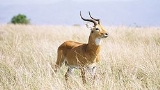
Kob stand 70 to 100 centimetres at the shoulder and weigh from 80 to 100 kilograms. Their backs are an orange-red colour, which lightens to white on the undersides and legs. There are white rings around the eyes and a black stripe down the legs.


Discussion
Ask a question about 'Kob'
Start a new discussion about 'Kob'
Answer questions from other users
Full Discussion Forum


Encyclopedia


The Kob (Kobus kob) is an antelope
Antelope

Antelope are ruminant hoofed mammals of the family Bovidae in the order of even-toed ungulates. These animals are spread relatively evenly throughout the various subfamily of Bovidae and many are more closely related to cows or goats than to each other....
 found across Sub-Saharan Africa
Sub-Saharan Africa

Sub-Saharan Africa is a geographical term used to describe the area of the African continent which lies south of the Sahara, or those African countries which are fully or partially located south of the Sahara....
 from Senegal
Senegal

Senegal , officially the Republic of Senegal, is a country south of the S?n?gal River in West Africa. Senegal is bounded by the Atlantic Ocean to the west, Mauritania to the north, Mali to the east, and Guinea and Guinea-Bissau to the south....
 to Sudan
Sudan

Sudan is a country in northeastern Africa. It is the largest in the African continent and the Arab World, and List of countries and outlying territories by total area by area....
. Found along the Northern Savanna
Savanna

A savanna, or savannah, is a tropical, subtropical or temperate woodland ecosystem characterized by the trees being sufficiently small or widely spaced so that the Canopy does not close....
, often seen in Murchison Falls
Murchison Falls

Murchison Falls, also known as Kabalega Falls or Kabarega Falls, is a waterfall on the Nile. It breaks the Victoria Nile, which flows across northern Uganda from Lake Victoria to Lake Kyoga and then to the north end of Lake Albert in the western branch of the East African Rift....
 and Queen Elizabeth National Park
Queen Elizabeth National Park

The Queen Elizabeth National Park is Uganda's most-visited game reserve. It lies in the west of the nation and occupies from Lake George to Lake Edward around the Kazinga Channel connecting them....
, Uganda
Uganda

The Republic of Uganda is a landlocked country in East Africa. It is bordered on the east by Kenya, on the north by Sudan, on the west by the Democratic Republic of the Congo, on the southwest by Rwanda, and on the south by Tanzania....
; Garamba and Virunga National Park
Virunga National Park

The Virunga National Park lies from the Virunga Mountains, to the Rwenzori Mountains, in the eastern Democratic Republic of Congo, bordering Volcanoes National Park in Rwanda and Rwenzori Mountains National Park in Uganda....
, Democratic Republic of the Congo
Democratic Republic of the Congo

The Democratic Republic of the Congo , is a country in central Africa with a small length of Atlantic coastline. It is the third largest list of African countries in order of geographical area....
, as well as grassy floodplains of Southern Sudan
Southern Sudan

Southern Sudan is located in Africa with Juba, Sudan as its capital city. Under the terms of the Comprehensive Peace Agreement with Sudan, the south has been given a large degree of autonomy and the chance to vote for full independence in 2011 after six years of home rule....
.

Kob stand 70 to 100 centimetres at the shoulder and weigh from 80 to 100 kilograms. Their backs are an orange-red colour, which lightens to white on the undersides and legs. There are white rings around the eyes and a black stripe down the legs. The short ringed horns, found only in males, are around 50 centimetres in length and arch out slightly so that they are somewhat 'S' shaped in profile.

Kob are found in wet areas (such as floodplain
Floodplain

||-||-||-||-||-||-||-||}A floodplain, or flood plain, is flat or nearly flat land adjacent to a stream or river that experiences occasional or periodic flooding....
s) where they eat grass
Grass

Grass is the common word that generally describes monocotyledonous green plants. The family Poaceae are the "true grasses" and include most plants grown as grains, for pasture, and for lawns ....
. Kob are diurnal
Diurnal animal

Scientific term refered to as an animal behavior, diurnality indicates an animal that is active during the daytime and rests during the night. Animals that are not diurnal might be Nocturnality or crepuscular .  Many animal species are diurnal, including many mammals, insects and birds....
, but inactive during the heat of the day. They live in groups of either females and calves or just males. These groups generally range from five to forty animals.

Among the Kobs of Eastern Africa, the Ugandan Kob
Ugandan Kob

The Ugandan Kob is a sub-species of the kob, a type of antelope found in sub-Saharan Africa. It is normally reddish-brown, in which it differs from other kob sub-species....
 (Kobus kob thomasi) appears on the coat of arms of Uganda
Coat of arms of Uganda

File:Coat of arms of Uganda.pngThe Coat of Arms of Uganda is centered on a shield and spears on a green mound.The shield and spears represent the willingness of the Ugandan people to defend their country....
, and the White-eared Kob (Kobus kob leucotis), found in Sudan
Sudan

Sudan is a country in northeastern Africa. It is the largest in the African continent and the Arab World, and List of countries and outlying territories by total area by area....
 and Ethiopia
Ethiopia

Ethiopia , officially the Federal Democratic Republic of Ethiopia, is a landlocked country situated in the Horn of Africa. Ethiopia is bordered by Eritrea to the north, Sudan to the west, Kenya to the south, Somalia to the east and Djibouti to the northeast....
, participate in large-scale migrations.

Migration


The 1500km migration of up to a million White-eared Kob in southern Sudan
Southern Sudan

Southern Sudan is located in Africa with Juba, Sudan as its capital city. Under the terms of the Comprehensive Peace Agreement with Sudan, the south has been given a large degree of autonomy and the chance to vote for full independence in 2011 after six years of home rule....
 each year rivals that of the great herds of the Serengeti
Serengeti

This article is about a geographical region; for the National Park see Serengeti National ParkThe Serengeti ecosystem is a geographical region located in north-western Tanzania and extends to south-western Kenya between latitudes 1 and 3 S and longitudes 34 and 36 E....
. Following the massive displacements of the 25-year Sudan war
Second Sudanese Civil War

The Second Sudanese Civil War started in 1983, although it was largely a continuation of the First Sudanese Civil War of 1955 to 1972. It took place, for the most part, in southern Sudan and was one of the longest lasting and deadliest wars of the later 20th century....
 (ceasefire: Jan 2005), it was thought that the kob may be largely reduced, but they were observed in huge herds in January 2007:
Seeing thousands upon thousands upon thousands of white-eared kob streaming under the aircraft, day after day, was like I had died and was having the most unbelievable dream you could ever have. - J. Michael Fay
J. Michael Fay

J. Michael Fay is an United States ecologist and conservationist notable for, among other things, the MegaTransect, in which he spent 455 days walking 2000 miles across Africa and the MegaFlyover in which he and pilot Peter Ragg spent months flying 70,000 miles in a small plane at low altitude, taking photographs every twenty seconds....
, National Geographic
Indeed, it is possible that the herds have flourished better than usual with less human intervention.

Males are territorial and in some areas are found patrolling circular territories less than thirty metres across surrounded by other males guarding similar territories, these groups of territories are called leks and rarely contain more than fifteen animals. The male patrols the border of his territory whistling loudly and may only hold the territory for a week before moving on, typically with several other members of the lek.

Reproduction


Females reach sexual maturity at 13 months and males at around 18 months; at this point, male sub-adults usually leave the group and stake out territory in a lek. One young is born after a gestation period of 7.5-9 months. While births may occur throughout the year, in drought-prone areas there is a peak at the end of the rains (September-December).

After birth, the young lie concealed for about six weeks; after which time, they follow their mothers. They are weaned after about 6-7 months.

Behavior


The behavior of the kob has been an influential example in the development of the field of ethology
Ethology

Ethology is the scientific study of animal behavior, and a branch of zoology .Although many naturalists have studied aspects of animal behavior through the centuries, the modern discipline of ethology is usually considered to have arisen with the work in the 1930s of Dutch biologist Nikolaas Tinbergen and Austrian biologist Konrad Lorenz,...
. Robert Ardrey
Robert Ardrey

Robert Ardrey was an United States playwright and screenwriter who returned to his Academia in anthropology and the behavioral sciences in the 1950s....
 cites several key behaviors (based on research by Helmut K. Buechner at Washington State University):
  • Male kobs compete for territory, never for females.
  • On a kob stamping ground (called a "lek" by later researchers), the "proprietor" of the territory almost always wins any fight.
  • The psychological advantage of the proprietor reduces the incidence and severity of actual fighting.
  • Antagonism between male kobs is confined to the stamping ground.
  • Copulation occurs nowhere but on the stamping ground.
  • Populations of kob do not mix.
  • "Attachment to a piece of ground is stronger than to the female herd."


External links