

Knockout

Encyclopedia
Combat sport
A Combat sport, also known as a Fighting sport, is a competitive contact sport where two combatants fight against each other using certain rules of engagement , typically with the aim of simulating parts of real hand to hand combat...
s, such as boxing
Boxing
Boxing, also called pugilism, is a combat sport in which two people fight each other using their fists. Boxing is supervised by a referee over a series of between one to three minute intervals called rounds...
, kickboxing
Kickboxing
Kickboxing refers to a group of martial arts and stand-up combat sports based on kicking and punching, historically developed from karate, Muay Thai and western boxing....
, Muay Thai
Muay Thai
Muay Thai is a combat sport from Thailand that uses stand-up striking along with various clinching techniques. It is similar to other Indochinese kickboxing systems, namely pradal serey from Cambodia, tomoi from Malaysia, lethwei from Myanmar and muay Lao from Laos...
, mixed martial arts
Mixed martial arts
Mixed Martial Arts is a full contact combat sport that allows the use of both striking and grappling techniques, both standing and on the ground, including boxing, wrestling, Brazilian jiu-jitsu, muay Thai, kickboxing, karate, judo and other styles. The roots of modern mixed martial arts can be...
, Karate
Karate
is a martial art developed in the Ryukyu Islands in what is now Okinawa, Japan. It was developed from indigenous fighting methods called and Chinese kenpō. Karate is a striking art using punching, kicking, knee and elbow strikes, and open-handed techniques such as knife-hands. Grappling, locks,...
and others sports involving striking
Strike (attack)
A strike is an attack with an inanimate object, such as a weapon, or with a part of the human body intended to cause an effect upon an opponent or to simply cause harm to an opponent. There are many different varieties of strikes...
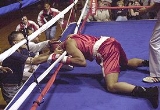
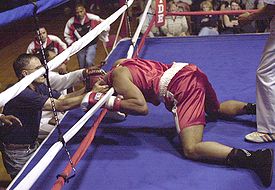
. A full knockout is considered any legal strike or combination thereof that renders an opponent unable to continue fighting.
The term is often associated with a sudden traumatic loss of consciousness caused by a physical blow. Single powerful blows to the head (particularly the jawline and temple) can produce a cerebral concussion and cause a sudden, dramatic KO. Body blows, particularly the liver punch
Liver punch
The liver punch is a punch used in boxing. It deceives the average spectator, as the punch is short and quick. The drive is usually made with the left hand, or the left hook in infighting, or the regular short body hook....
, can cause progressive, debilitating pain that can also result in a KO.
In boxing
Boxing
Boxing, also called pugilism, is a combat sport in which two people fight each other using their fists. Boxing is supervised by a referee over a series of between one to three minute intervals called rounds...
, kickboxing
Kickboxing
Kickboxing refers to a group of martial arts and stand-up combat sports based on kicking and punching, historically developed from karate, Muay Thai and western boxing....
, etc. a knockout is usually awarded when one participant falls to the canvas
Canvas
Canvas is an extremely heavy-duty plain-woven fabric used for making sails, tents, marquees, backpacks, and other items for which sturdiness is required. It is also popularly used by artists as a painting surface, typically stretched across a wooden frame...
and is unable to rise to his feet within a specified period of time, typically because of exhaustion, pain, disorientation, or unconsciousness
Unconsciousness
Unconsciousness is the condition of being not conscious—in a mental state that involves complete or near-complete lack of responsiveness to people and other environmental stimuli. Being in a comatose state or coma is a type of unconsciousness. Fainting due to a drop in blood pressure and a...
. For example, if a boxer is knocked down and is unable to continue the fight within a ten second count, he is counted as having been knocked out and his opponent is awarded the KO victory.
In mixed martial arts
Mixed martial arts
Mixed Martial Arts is a full contact combat sport that allows the use of both striking and grappling techniques, both standing and on the ground, including boxing, wrestling, Brazilian jiu-jitsu, muay Thai, kickboxing, karate, judo and other styles. The roots of modern mixed martial arts can be...
competitions, no time count is given after a knockdown
Knockdown
Knockdown may refer to:*"Knockdown" , a song by Alesha Dixon* Knockdown, in full-contact combat sports, when a fighter is down or vulnerable, often preliminary to a knockout...
, as the sport allows submission grappling as well as ground and pound. If a fighter loses consciousness ("goes limp") as a result of legal strikes, or does not immediately defend himself after a knockdown, he is declared knocked out. As many MMA fights can take place on the mat rather than standing, it is possible to score a KO via ground and pound, a common victory for grapplers.
Technical Knockout
A technical knockout (also referred to as a T.K.O.) is declared when the referee, official ring physicianPhysician
A physician is a health care provider who practices the profession of medicine, which is concerned with promoting, maintaining or restoring human health through the study, diagnosis, and treatment of disease, injury and other physical and mental impairments...
, the fighter, or the fighter's cornermen
Cornerman
A cornerman, or simply corner, is a combat sports term for a coach or team mate assisting a fighter during the length of a bout. The cornerman remains outside the combat area during the fight, but in proximity, and can assist the fighter through instruction...
decide that a fighter cannot safely continue the match.
In boxing, this can happen even if the fighter fails the 10 count; or, in many regions, a fighter has been knocked down three times in one round. British
United Kingdom
The United Kingdom of Great Britain and Northern IrelandIn the United Kingdom and Dependencies, other languages have been officially recognised as legitimate autochthonous languages under the European Charter for Regional or Minority Languages...
records refer to TKOs as either "retired", if the fighter refuses to continue, or "R.S.F.", for Referee Stopped Fight. In amateur boxing, a knockout is scored as "RSC," for Referee Stopped Contest. A technical knockout ("Outclassed") can also be declared if a fighter is ahead by 15 points in a bout.
Types of T.K.O.'s
- Doctor's Stoppage/Injury: The fighter has suffered an injury and cannot continue the match safely.
- Corner Stoppage: The fighter is being completely battered, to the point where it is becoming dangerous. In some cases, the fighter may have suffered an injury. His corner decides to surrender on his behalf to prevent unnecessary damage or potential injury. (This is also known as "throwing in the towel").
- Stoppage Because of Strikes: The fighter is overwhelmed by strikesStrike (attack)A strike is an attack with an inanimate object, such as a weapon, or with a part of the human body intended to cause an effect upon an opponent or to simply cause harm to an opponent. There are many different varieties of strikes...
, and cannot intelligently defend himself. The referee intervenes to avoid unnecessary damage or potential injury. - Multiple Knockdowns: The fighter is knocked down a certain number of times during a single round (common rule in most boxing and kickboxing contests).
Physical characteristics
There is little known about what exactly causes one to be knocked unconscious but many agree it has to do with minor trauma to the brain stem. This usually happens when the head rotates sharply, often caused by a strike. There are three general manifestations of such trauma - the typical knock out which results in a sustained loss of consciousness (comparable to general anesthesia - where the recipient emerges and has lost memory of the event), a "flash" knock out where a very transient (less than three seconds) loss of consciousness occurs (where the recipient often maintains awareness and memory of the combat), and lastly a "stunning" where consciousness is maintained despite extremely distorted proprioceptionProprioception
Proprioception , from Latin proprius, meaning "one's own" and perception, is the sense of the relative position of neighbouring parts of the body and strength of effort being employed in movement...
, visual fields, and auditory processing. A basic principle of boxing, and other combat sports is to defend against this vulnerability by keeping both hands raised about the face and the chin tucked in.
A fighter who suffers a concussion and becomes unconscious from a strike
Strike (attack)
A strike is an attack with an inanimate object, such as a weapon, or with a part of the human body intended to cause an effect upon an opponent or to simply cause harm to an opponent. There are many different varieties of strikes...
with sufficient knockout power is referred to as having been knocked out or kayoed (KO'd). Losing balance without losing consciousness is referred to as being knocked down ("down but not out"). Repeated blows to the head are known to gradually cause permanent brain damage
Brain damage
"Brain damage" or "brain injury" is the destruction or degeneration of brain cells. Brain injuries occur due to a wide range of internal and external factors...
. In severe cases may cause stroke
Stroke
A stroke, previously known medically as a cerebrovascular accident , is the rapidly developing loss of brain function due to disturbance in the blood supply to the brain. This can be due to ischemia caused by blockage , or a hemorrhage...
s or paralysis
Paralysis
Paralysis is loss of muscle function for one or more muscles. Paralysis can be accompanied by a loss of feeling in the affected area if there is sensory damage as well as motor. A study conducted by the Christopher & Dana Reeve Foundation, suggests that about 1 in 50 people have been diagnosed...
. This is commonly known as becoming "punch drunk" or "Shot". Because of this, many physicians advise against sports involving knockouts.
Fighters who lose by knockout (either by ten count or technical) are automatically suspended 30 days, three months if it is the second knockout within three months, or one year if it is the third knockout within one year. In AIBA competition, this does not apply if a fighter loses by a technical knockout outclassed, when a fighter is behind more than 20 points—15 for junior levels—in any round except the final round.
Knockdown
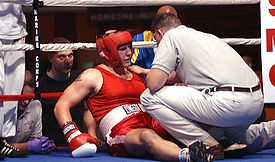
A flash knockdown is a knockdown where the fighter hits the canvas but recovers quickly enough that a count is not started.