


Klingon

Encyclopedia
Klingons are a fictional warrior race in the Star Trek
universe.
Klingons are recurring villains in the 1960s television show Star Trek: The Original Series
, and have appeared in all five spin-off series and eight feature films. Initially intended to be antagonists for the crew of the USS Enterprise, the Klingons ended up a close ally of humanity and the United Federation of Planets
in The Next Generation and Voyager
. In the 90s series Deep Space Nine
the United Federation of Planets briefly goes to war with the Klingons. Later in the series the two join together with the Romulans to fight the Dominion
.
As originally developed by screenwriter Gene L. Coon
, Klingons were darkly colored humanoids with little honor, intended as an allegory to the Cold War
tensions between the United States
and the Soviet Union
, though Star Trek creator Gene Roddenberry
did not aspire to any political parallels. With a greatly expanded budget for makeup and effects, the Klingons were completely redesigned in Star Trek: The Motion Picture
(1979), gaining ridged foreheads that created a continuity
error not explained by Star Trek canon until 2005. In later films and the spin-off series Star Trek: The Next Generation
, the militaristic traits of the Klingons were bolstered by an increased sense of honor and strict warrior code.
Among the elements created for the revised Klingons was a complete language
, developed by Marc Okrand
off gibberish
suggested by actor James Doohan
. Klingon has entered popular culture; the works of William Shakespeare
and even parts of the Bible
have been translated into the glottural
language. A dictionary, a book of sayings, and a cultural guide to the language have been published. In addition, according to Guinness World Records
, Klingon is the most popular fictional language by number of speakers.
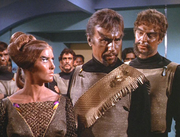 The Klingons were created by screenwriter Gene L. Coon
, and first appeared in the 1967 episode "Errand of Mercy". They were named after Lieutenant Wilbur Clingan, who served with Star Trek creator Gene Roddenberry
in the Los Angeles Police Department
. In the original television series (TOS), Klingons were typically portrayed with bronze skin and facial hair suggestive of Asia
n peoples, and possessed physical abilities similar to humans (in fact, Coon's only physical description of them in his "Errand of Mercy" script is "oriental" and "hard-faced"). The swarthy look of Klingon males was created with the application of shoe polish and long, thin moustaches; budget constraints would not allow any further creativity. The overall look of the aliens, played by white actors, suggested orientalism
, at a time when memories of Japanese actions during World War II
were still fresh. The production crew never came to an agreement on the name "Klingon"; Coon was adamant about keeping the name, and it persisted because no one else offered up a better name.
The Klingons took on the role of the Soviet Union in opposition to the United States' future counterpart, the United Federation of Planets
. As such, they were generally portrayed as inferior to the crew of the Enterprise. While occasionally capable of honor, this depiction treated the Klingons as close to wild animals. Overall, they were shown without redeeming qualities—brutish, scheming, and murderous. Klingons became the primary antagonists of the Enterprise crew, in part because the makeup necessary to make Romulan
s was too time-consuming and costly.
For the first two seasons, no Klingon ships were seen despite being frequently mentioned. This was because of budget constraints— designer Matt Jefferies
did not have the money to create a Klingon ship until the third season. When the episodes were remastered beginning in 2006, Klingon ships were digitally inserted into shots earlier than their original appearances.
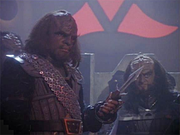
, the Klingons were retconned and their appearance and behavior radically changed. To give the aliens a more sophisticated and threatening demeanor, the Klingons were depicted with ridged foreheads, snaggled
and prominent teeth, and a defined language and alphabet. Lee Cole, a production designer, used red gels and primitive shapes in the design of Klingon consoles and ship interiors, which took on a dark and moody atmosphere. The alphabet was designed as angular, with sharp edges harkening to the Klingon's militaristic focus. Costume designer Robert Fletcher created new uniforms for the Klingons, reminiscent of feudal
Japanese armor.
While no Klingon characters were seen in Star Trek II: The Wrath of Khan
, their appearance as the central enemy in Star Trek III: The Search for Spock
(1984) led to minor alterations. For the third generation of Klingons, the heavy, cragged head ridges of The Motion Picture were redesigned and made less pronounced. While Fletcher was happy with the original film uniforms, more had to be created as the old costumes had been lost, destroyed, or loaned out and altered irreparably. New costumes were fabricated, retaining the air of feudal Japanese design; Fletcher thought it was an important part of the Klingon authoritarian attitude. New Klingon weaponry, including an energy weapon and a special knife known as a dk tahg, were designed.
 The release of a new television series, Star Trek: The Next Generation
, prompted a further revision in the depiction of Klingon culture, though Gene Roddenberry had wanted to avoid re-appearances of races from the old series. Set a century later than the original series, the USS Enterprise-D
featured a Klingon crewmember, Worf
. Makeup artist Michael Westmore
needed a consistent reference to base the Klingon look on, as each individual Klingon had distinct head ridges. He found what he was looking for in a book of dinosaurs; observing dinosaur vertebrae laid out flat, Westmore cut the designs in half and modified them to suit each Klingon. Westmore designed his Klingons' beards to be Elizabethan
, combining prehistoric and aristocratic elements to give audiences a feeling of depth from the appearance. Over time, Westmore and the other makeup artists designed different sizes of prosthetic headpieces which could be quickly applied and modified to save time; the amount of preparation to turn an actor into a Klingon decreased from around three hours to one. While important characters had custom headpieces, background actors used pre-made masks with minor touchup around the eyes and mouth. The Next Generation effects artist Dan Curry
used his martial arts experience to create a flowing fighting style for the race. When the episode "Reunion" called for a special Klingon blade, Curry drew on Far East influences to develop a weapon known as the batleth. Curry, a collector of weapons, was annoyed by fictional weaponry that were designed to "look cool" but could not be handled practically. Curry combined elements of the Himalayan kukri
, Chinese axes and fighting crescents to create a two-handed, curved weapon that has since been widely used in the franchise.
The culture of the Klingons began to resemble revised western stereotypes of civilizations such as the Zulu, the Vikings, and various Native American nations — as a proud, warlike and principled race. Whereas the TOS Klingons served as an allegory to contemporary totalitarian regimes, The Next Generation Klingons held principles more in line with Bushidō
; actor Michael Dorn
stated that without the revision in Klingon culture, his character, Worf, would not have been a Starfleet officer. With the first Klingon-centric story in The Next Generation, the first season episode "Heart of Glory", the Klingons once again became an important part of the Star Trek universe, and by the advent of the series Star Trek: Deep Space Nine
, Klingons had fully become heroes rather than villains.
The final Star Trek film to feature the entire cast from the original television series, Star Trek VI: The Undiscovered Country
(1991) served to bridge the original series Klingons at war with the Federation to the time of The Next Generation, and presents a subtly different treatment of the race. At the time of the film's development, the Soviet Union was collapsing, and with the advent of glasnost
the old allegory of Klingons as Russians was becoming obsolete. The Klingons were redesigned to evoke the Nazis, with the red, white and black Klingon flag deliberately similar to that of the National Socialist German Workers Party. The Klingons in the film liberally quote Shakespeare, a trait stemming from director Nicholas Meyer
's comparison of the Empire's appropriation of Shakespeare to the Nazis' similar attempt in the 1930s. Meyer also felt it was apropos for Shakespearean actors such as Christopher Plummer
and David Warner
to speak the lines. The breakdown of the Klingons' empire because of a Chernobyl
-like incident results in a new age for the Federation and Klingons, leading to the time of The Next Generation and later series where the two governments are trade partners and occasional allies. Starfleet members are shown to be highly bigoted against Klingons, who in turn feel that their way of life will be obliterated by peace. The Klingons were given new uniforms designed by Dodie Shepard, in part because there were not enough of Fletcher's The Motion Picture costumes to meet the demands of the film.
Dorn described playing a Klingon as simple, joking that after hours sitting in a makeup chair, actors were highly motivated to get the dialogue right the first time. Repeat Klingon Robert O'Reilly
told all neophyte Klingons that the most important part of speaking was to say the lines with belief and "go all the way". When O'Reilly and Dorn's character had a confrontation, makeup artists wiped spittle off each between takes, a consequence of the harsh-sounding language. Todd Bryant
(Captain Klaa in Star Trek V: The Final Frontier
) similarly noted that if an actor was projectile-spitting on others as he spoke Klingon, he was doing a great job.
When filming The Undiscovered Country, Christopher Plummer
asked director Nicholas Meyer
to adapt his character's look, feeling the heavy forehead appliances looked rather fake. Instead, Plummer's character, General Chang, was made bald with very subdued ridges and an eyepatch bolted to his skull. Plummer felt that the unique appearance helped "humanize" the character. In contrast to white actors portraying the warriors, more recent Klingon roles have been predominantly played by black actors.
While the real reason for the discrepancy between The Original Series Klingons and their feature film and later television series counterparts was a lack of budget, fans took it upon themselves to contrive an acceptable canon reason for the sudden change. These theories postulated that TOS Klingons were in fact humans raised as Klingons, similar to Janissaries
; that for cosmetic or diplomatic reasons, Klingons removed the ridges via surgery; or that TOS Klingons were in fact hybrids with a more human species. Simple theories that the different Klingons were different racial breeds were complicated by the fact that the characters of Kang, Koloth, and Kor appeared with smooth features in the original series, yet reverted to a ridged appearance in Star Trek: Deep Space Nine
, and that Worf
acknowledged the difference in appearances when the crew of Deep Space 9 returned to the 23rd century in the episode "Trials and Tribble-ations," but offered no explanation, saying merely, "We do not discuss it with outsiders."
A canonical
explanation for the change was given in a two-part storyline on Star Trek: Enterprise
. The two episodes, "Affliction" and "Divergence", aired in February 2005. An earlier story arc featured the Augments, genetically-engineered humans left over from the Eugenics Wars of the late 20th century, and who were defeated by Captain Jonathan Archer
and the Enterprise
in Klingon space. The Klingon High Council fears that Starfleet
was developing armies of Augments; after gaining access to genetic material from the Augments, the Klingons perform experiments to increase their own intellect and strength. The experiments turn disastrous when a flu strain mutates and becomes a deadly plague that spreads across the Empire, causing physical changes resulting in the afflicted bearing a TOS-era appearance. Dr. Phlox
of the Enterprise formulates a cure for the virus, but the physical alterations remain in the populace and are inherited by offspring. Phlox indicated that "someday" the physical alterations could be reversed.
Klingons are depicted as a spiritual people. According to their legends, Klingons slew their own gods. The equivalents to heaven and hell are called Sto-Vo-Kor and Gre'Thor, respectively; in Sto-Vo-Kor, battle and feasting can be eternally won and shared, while those sent to Gre'Thor are condemned to eternal torture unless their honor is restored by living relatives. Those who do not die in battle may not enter Sto-Vo-Kor; relatives undertake quests to guarantee their deceased comrades entry into paradise. Despite believing in an afterlife, the Klingons perform no burial rites, and dispose of corpses by the most efficient means.
The Klingon's spiritual leader is Kahless
, a messianic figure who established early codes of honor and was the first Klingon emperor. His fabled weapon, the Sword of Kahless, is depicted as a unique batleth that serves as the Klingon equivalent of the Holy Grail
. In the TNG episode "Rightful Heir", Kahless appears in the flesh to Worf, who had doubted his Klingon faith. This Kahless is revealed to be a clone, created in an attempt to bring Klingons together, and who is chosen to lead the Klingon people as a figurehead.
Klingons are passionate opera lovers. The first Klingon opera on Earth performed entirely in the Klingon language is ’u’
, which debuted in The Hague
in September 2010.
 The Klingons have their own language that was developed for the feature films, often described as "guttural." For The Motion Picture, James Doohan
, the actor who portrayed Montgomery Scott
, devised the initial Klingon-language dialogue heard in the film. For The Search for Spock, Marc Okrand
, who created the Vulcan dialogue used in the previous film, developed an actual working Klingon language based on Doohan's original made-up words.
Okrand was presented with a difficult task of contriving a language that sounded alien, while still simple enough for the actors to pronounce. While most constructed language
s or conlangs follow basic tenets of natural languages — for example, all languages have an "ah" sound — Okrand deliberately broke them. He chose the rarest form of sentence construction, the object-verb-subject form: the translation of the phrase "I boarded the Enterprise", would be constructed as "The Enterprise boarded I." Okrand reasoned the language would be indicative of the culture, the Klingon's language focuses on actions and verbs. Adjectives do not strictly exist; there is no word for "greedy", but there is a verb, qur, which means "to be greedy". The language does not contain the verb "to be", which meant Okrand had to create a workaround when director Nicholas Meyer
wanted his Klingons to quote Shakespeare and the famous line "to be, or not to be
" in The Undiscovered Country. Initially, Okrand came up with "to live or not live", but Plummer did not like the sound of the line. Okrand went back and revised the phrase to "taH pagh, taHbe' ", roughly meaning "whether to continue, or not to continue [existence]". The Klingon language has a small vocabulary compared to natural languages, containing around 2,000 words.
Okrand convinced Pocket Books
to publish the The Klingon Dictionary
in 1985; in it, Okrand elaborated on the Klingon language's grammar, syntax and vocabulary. While Okrand expected the book to only sell as a novelty item, eleven years after publication the book had sold 250,000 copies. Dedicated Klingon enthusiasts, some but not all Star Trek fans, created the Klingon Language Institute
, which published multiple magazines in the language. While Paramount initially tried to stop the Institute from using their copyrighted language, the company eventually relented. The Institute has since published Klingon translations of Hamlet
, Much Ado about Nothing
, Tao Te Ching
, Gilgamesh
and has translations of some books from the Bible on its website. The Bible proved to be difficult to translate, as Christian concepts like atonement—and words like God (until the recent addition of Qun meaning "god")—are not found in the Klingon vernacular. From time to time, Okrand has amended the "official" list of Klingon vocabulary due in part to requests from the Institute and other groups. Other Klingon groups include blood drives, bowling teams, and a Klingon golf championship.
The Klingon language's prevalence is not limited to books; a three-disc video game, Star Trek: Klingon
, requires players to learn the language in order to advance. In May 2009, a joint collaboration between the KLI, Simon & Schuster, and Ultralingua
launched the Klingon Language Suite for the iPhone
concurrent with the release of the new movie. The popularity of the language meant that in 1996 it was considered the fastest-growing constructed language, ahead of other languages such as Tolkien's Elvish or Esperanto
. While the language is widespread, mastery of the language is extremely uncommon; there are only around a dozen fluent speakers of the language. Okrand himself is not fluent, and the actors who speak the language in the Star Trek series are more concerned with its expression than the actual grammar. According to the 2006 edition of Guinness World Records
, Klingon is the most spoken fictional language by number of speakers, Klingon is one of many language interfaces in the Google
search engine, and a Klingon character was included in the Wikipedia logo prior to its May 2010 update, when it was replaced by a Geʿez character.
s, heavily armed with a variety of particle beam weapon
ry and antimatter warheads
. Many Klingon ships also make use of cloaking technology
to hide the vessel from view. The first Klingon ship design used in The Original Series, the D7-class battlecruiser, was designed by Matt Jefferies
to evoke a predator's shape akin to that of a manta ray
, providing a threatening and instantly recognisable form for viewers. The configuration of Jefferies' design featured a bulbous forward hull connected by a long boom to a wing-like main hull with the engine nacelles
mounted on each wingtip. Later Klingon starships by other designers kept to this same overall configuration, although updated to reflect their respective time periods: Rick Sternbach's
designs for The Next Generation and Deep Space Nine drew on elements of Starfleet ships features to reflect the alliance between the Federation and the Klingons, while John Eaves'
designs for Enterprise incorporated more rugged and primitive construction to make the vessels appear consistent with the earlier time period.
which officially established the name as Qo'noS. Qo'noS is depicted as green in color when viewed from orbital space. It includes a lone huge land mass with a vast ocean, a severely tilted axis that causes wild seasonal changes, a turbulent atmosphere and extremes of both warm and frigid weather. The destruction of the planet's moon, Praxis, was a plot point in the film The Undiscovered Country, the after effects driving the plot of the film and later events in the television series Star Trek: The Next Generation
.
Star Trek
Star Trek is an American science fiction entertainment franchise created by Gene Roddenberry. The core of Star Trek is its six television series: The Original Series, The Animated Series, The Next Generation, Deep Space Nine, Voyager, and Enterprise...
universe.
Klingons are recurring villains in the 1960s television show Star Trek: The Original Series
Star Trek: The Original Series
Star Trek is an American science fiction television series created by Gene Roddenberry, produced by Desilu Productions . Star Trek was telecast on NBC from September 8, 1966, through June 3, 1969...
, and have appeared in all five spin-off series and eight feature films. Initially intended to be antagonists for the crew of the USS Enterprise, the Klingons ended up a close ally of humanity and the United Federation of Planets
United Federation of Planets
The United Federation of Planets, also known as "The Federation" is a fictional interplanetary federal republic depicted in the Star Trek television series and motion pictures...
in The Next Generation and Voyager
Voyager
-Technology:*LG Voyager, a mobile phone model manufactured by LG Electronics*NCR Voyager, a computer platform produced by NCR Corporation*Voyager , a computer worm affecting Oracle databases...
. In the 90s series Deep Space Nine
Deep Space Nine
Deep Space Nine may refer to:* Star Trek: Deep Space Nine, a 1993-1999 television series* Deep Space Nine , the television show's setting...
the United Federation of Planets briefly goes to war with the Klingons. Later in the series the two join together with the Romulans to fight the Dominion
Dominion (Star Trek)
In the Star Trek universe, the Dominion is a ruthless and militaristic Gamma Quadrant state consisting of many different races. The Dominion wages war on the United Federation of Planets and its allies in the late 24th century, acting as an antagonist in the TV show Star Trek: Deep Space...
.
As originally developed by screenwriter Gene L. Coon
Gene L. Coon
Gene L. Coon was an American screenwriter and television producer. He is best remembered for his work on the original Star Trek series.-Life and career:...
, Klingons were darkly colored humanoids with little honor, intended as an allegory to the Cold War
Cold War
The Cold War was the continuing state from roughly 1946 to 1991 of political conflict, military tension, proxy wars, and economic competition between the Communist World—primarily the Soviet Union and its satellite states and allies—and the powers of the Western world, primarily the United States...
tensions between the United States
United States
The United States of America is a federal constitutional republic comprising fifty states and a federal district...
and the Soviet Union
Soviet Union
The Soviet Union , officially the Union of Soviet Socialist Republics , was a constitutionally socialist state that existed in Eurasia between 1922 and 1991....
, though Star Trek creator Gene Roddenberry
Gene Roddenberry
Eugene Wesley "Gene" Roddenberry was an American television screenwriter, producer and futurist, best known for creating the American science fiction series Star Trek. Born in El Paso, Texas, Roddenberry grew up in Los Angeles, California where his father worked as a police officer...
did not aspire to any political parallels. With a greatly expanded budget for makeup and effects, the Klingons were completely redesigned in Star Trek: The Motion Picture
Star Trek: The Motion Picture
Star Trek: The Motion Picture is a 1979 American science fiction film released by Paramount Pictures. It is the first film based on the Star Trek television series. The film is set in the twenty-third century, when a mysterious and immensely powerful alien cloud called V'Ger approaches the Earth,...
(1979), gaining ridged foreheads that created a continuity
Continuity (fiction)
In fiction, continuity is consistency of the characteristics of persons, plot, objects, places and events seen by the reader or viewer over some period of time...
error not explained by Star Trek canon until 2005. In later films and the spin-off series Star Trek: The Next Generation
Star Trek: The Next Generation
Star Trek: The Next Generation is an American science fiction television series created by Gene Roddenberry as part of the Star Trek franchise. Roddenberry, Rick Berman, and Michael Piller served as executive producers at different times throughout the production...
, the militaristic traits of the Klingons were bolstered by an increased sense of honor and strict warrior code.
Among the elements created for the revised Klingons was a complete language
Klingon language
The Klingon language is the constructed language spoken by the fictional Klingons in the Star Trek universe....
, developed by Marc Okrand
Marc Okrand
Marc Okrand is an American linguist and is most notable as the creator of the Klingon language, which he speaks.-Biography:Okrand worked with Native American languages. He earned a bachelor's degree from the University of California, Santa Cruz in 1972...
off gibberish
Gibberish
Gibberish is a generic term in English for talking that sounds like speech, but carries no actual meaning. This meaning has also been extended to meaningless text or gobbledygook. The common theme in gibberish statements is a lack of literal sense, which can be described as a presence of nonsense...
suggested by actor James Doohan
James Doohan
James Montgomery "Jimmy" Doohan was a Canadian character and voice actor best known for his role as Montgomery "Scotty" Scott in the television and film series Star Trek...
. Klingon has entered popular culture; the works of William Shakespeare
William Shakespeare
William Shakespeare was an English poet and playwright, widely regarded as the greatest writer in the English language and the world's pre-eminent dramatist. He is often called England's national poet and the "Bard of Avon"...
and even parts of the Bible
Bible
The Bible refers to any one of the collections of the primary religious texts of Judaism and Christianity. There is no common version of the Bible, as the individual books , their contents and their order vary among denominations...
have been translated into the glottural
Glottis
The glottis is defined as the combination of the vocal folds and the space in between the folds .-Function:...
language. A dictionary, a book of sayings, and a cultural guide to the language have been published. In addition, according to Guinness World Records
Guinness World Records
Guinness World Records, known until 2000 as The Guinness Book of Records , is a reference book published annually, containing a collection of world records, both human achievements and the extremes of the natural world...
, Klingon is the most popular fictional language by number of speakers.
Conception
Gene L. Coon
Gene L. Coon was an American screenwriter and television producer. He is best remembered for his work on the original Star Trek series.-Life and career:...
, and first appeared in the 1967 episode "Errand of Mercy". They were named after Lieutenant Wilbur Clingan, who served with Star Trek creator Gene Roddenberry
Gene Roddenberry
Eugene Wesley "Gene" Roddenberry was an American television screenwriter, producer and futurist, best known for creating the American science fiction series Star Trek. Born in El Paso, Texas, Roddenberry grew up in Los Angeles, California where his father worked as a police officer...
in the Los Angeles Police Department
Los Angeles Police Department
The Los Angeles Police Department is the police department of the city of Los Angeles, California. With just under 10,000 officers and more than 3,000 civilian staff, covering an area of with a population of more than 4.1 million people, it is the third largest local law enforcement agency in...
. In the original television series (TOS), Klingons were typically portrayed with bronze skin and facial hair suggestive of Asia
Asia
Asia is the world's largest and most populous continent, located primarily in the eastern and northern hemispheres. It covers 8.7% of the Earth's total surface area and with approximately 3.879 billion people, it hosts 60% of the world's current human population...
n peoples, and possessed physical abilities similar to humans (in fact, Coon's only physical description of them in his "Errand of Mercy" script is "oriental" and "hard-faced"). The swarthy look of Klingon males was created with the application of shoe polish and long, thin moustaches; budget constraints would not allow any further creativity. The overall look of the aliens, played by white actors, suggested orientalism
Orientalism
Orientalism is a term used for the imitation or depiction of aspects of Eastern cultures in the West by writers, designers and artists, as well as having other meanings...
, at a time when memories of Japanese actions during World War II
World War II
World War II, or the Second World War , was a global conflict lasting from 1939 to 1945, involving most of the world's nations—including all of the great powers—eventually forming two opposing military alliances: the Allies and the Axis...
were still fresh. The production crew never came to an agreement on the name "Klingon"; Coon was adamant about keeping the name, and it persisted because no one else offered up a better name.
The Klingons took on the role of the Soviet Union in opposition to the United States' future counterpart, the United Federation of Planets
United Federation of Planets
The United Federation of Planets, also known as "The Federation" is a fictional interplanetary federal republic depicted in the Star Trek television series and motion pictures...
. As such, they were generally portrayed as inferior to the crew of the Enterprise. While occasionally capable of honor, this depiction treated the Klingons as close to wild animals. Overall, they were shown without redeeming qualities—brutish, scheming, and murderous. Klingons became the primary antagonists of the Enterprise crew, in part because the makeup necessary to make Romulan
Romulan
The Romulans are a fictional alien race in the Star Trek universe. First appearing in the original Star Trek series in the 1966 episode "Balance of Terror", they have since made appearances in all the main later Star Trek series: The Animated Series, The Next Generation, Deep Space Nine, Voyager...
s was too time-consuming and costly.
For the first two seasons, no Klingon ships were seen despite being frequently mentioned. This was because of budget constraints— designer Matt Jefferies
Matt Jefferies
Walter Matthew Jefferies — known as Matt Jeffries — was an aviation and mechanical artist, set designer and writer, best known for designing the original Starship Enterprise for the Star Trek television series....
did not have the money to create a Klingon ship until the third season. When the episodes were remastered beginning in 2006, Klingon ships were digitally inserted into shots earlier than their original appearances.
Redesign
For Star Trek: The Motion PictureStar Trek: The Motion Picture
Star Trek: The Motion Picture is a 1979 American science fiction film released by Paramount Pictures. It is the first film based on the Star Trek television series. The film is set in the twenty-third century, when a mysterious and immensely powerful alien cloud called V'Ger approaches the Earth,...
, the Klingons were retconned and their appearance and behavior radically changed. To give the aliens a more sophisticated and threatening demeanor, the Klingons were depicted with ridged foreheads, snaggled
Snaggletooth
Snaggletooth may refer to:*Snaggletooth, a character seen in Star Wars Episode IV: A New Hope.*Snaggletooth A.K.A Warpig, the mascot of the British heavy metal band Motörhead.*Snaggletooth, a tooth that is broken or not in alignment with the others....
and prominent teeth, and a defined language and alphabet. Lee Cole, a production designer, used red gels and primitive shapes in the design of Klingon consoles and ship interiors, which took on a dark and moody atmosphere. The alphabet was designed as angular, with sharp edges harkening to the Klingon's militaristic focus. Costume designer Robert Fletcher created new uniforms for the Klingons, reminiscent of feudal
Feudalism
Feudalism was a set of legal and military customs in medieval Europe that flourished between the 9th and 15th centuries, which, broadly defined, was a system for ordering society around relationships derived from the holding of land in exchange for service or labour.Although derived from the...
Japanese armor.
While no Klingon characters were seen in Star Trek II: The Wrath of Khan
Star Trek II: The Wrath of Khan
Star Trek II: The Wrath of Khan is a 1982 American science fiction film released by Paramount Pictures. The film is the second feature based on the Star Trek science fiction franchise. The plot features James T...
, their appearance as the central enemy in Star Trek III: The Search for Spock
Star Trek III: The Search for Spock
Star Trek III: The Search for Spock is a 1984 motion picture released by Paramount Pictures. The film is the third feature based on the Star Trek science fiction franchise and is the center of a three-film story arc that begins with Star Trek II: The Wrath of Khan and concludes with Star Trek IV:...
(1984) led to minor alterations. For the third generation of Klingons, the heavy, cragged head ridges of The Motion Picture were redesigned and made less pronounced. While Fletcher was happy with the original film uniforms, more had to be created as the old costumes had been lost, destroyed, or loaned out and altered irreparably. New costumes were fabricated, retaining the air of feudal Japanese design; Fletcher thought it was an important part of the Klingon authoritarian attitude. New Klingon weaponry, including an energy weapon and a special knife known as a dk tahg, were designed.
Star Trek: The Next Generation
Star Trek: The Next Generation is an American science fiction television series created by Gene Roddenberry as part of the Star Trek franchise. Roddenberry, Rick Berman, and Michael Piller served as executive producers at different times throughout the production...
, prompted a further revision in the depiction of Klingon culture, though Gene Roddenberry had wanted to avoid re-appearances of races from the old series. Set a century later than the original series, the USS Enterprise-D
USS Enterprise (NCC-1701-D)
The USS Enterprise is a 24th century starship in the Star Trek fictional universe and the principal setting of the Star Trek: The Next Generation television series...
featured a Klingon crewmember, Worf
Worf
Worf, played by Michael Dorn, is a main character in Star Trek: The Next Generation and in seasons four to seven of Star Trek: Deep Space Nine. He also appears in the films based on The Next Generation. Worf is the first Klingon main character to appear in Star Trek, and has appeared in more Star...
. Makeup artist Michael Westmore
Michael Westmore
Michael George Westmore is an American make-up artist best known for his work in various Star Trek productions, including Star Trek: The Next Generation, Star Trek: Deep Space Nine, Star Trek: Voyager, and four feature films.Born in Los Angeles, California, Westmore is the son of Monte Westmore,...
needed a consistent reference to base the Klingon look on, as each individual Klingon had distinct head ridges. He found what he was looking for in a book of dinosaurs; observing dinosaur vertebrae laid out flat, Westmore cut the designs in half and modified them to suit each Klingon. Westmore designed his Klingons' beards to be Elizabethan
Elizabethan era
The Elizabethan era was the epoch in English history of Queen Elizabeth I's reign . Historians often depict it as the golden age in English history...
, combining prehistoric and aristocratic elements to give audiences a feeling of depth from the appearance. Over time, Westmore and the other makeup artists designed different sizes of prosthetic headpieces which could be quickly applied and modified to save time; the amount of preparation to turn an actor into a Klingon decreased from around three hours to one. While important characters had custom headpieces, background actors used pre-made masks with minor touchup around the eyes and mouth. The Next Generation effects artist Dan Curry
Dan Curry
Dan Curry is a visual effects producer and supervisor, as well as a main title designer in the film and television industry. He is most famous for his work on Star Trek: The Next Generation, Star Trek: Deep Space Nine, Star Trek: Voyager , and Enterprise., Retrieved September 8, 2011 His work on...
used his martial arts experience to create a flowing fighting style for the race. When the episode "Reunion" called for a special Klingon blade, Curry drew on Far East influences to develop a weapon known as the batleth. Curry, a collector of weapons, was annoyed by fictional weaponry that were designed to "look cool" but could not be handled practically. Curry combined elements of the Himalayan kukri
Kukri
The kukri is a curved Nepalese Knife, similar to the machete, used as both a tool and as a weapon...
, Chinese axes and fighting crescents to create a two-handed, curved weapon that has since been widely used in the franchise.
The culture of the Klingons began to resemble revised western stereotypes of civilizations such as the Zulu, the Vikings, and various Native American nations — as a proud, warlike and principled race. Whereas the TOS Klingons served as an allegory to contemporary totalitarian regimes, The Next Generation Klingons held principles more in line with Bushidō
Bushido
, meaning "Way of the Warrior-Knight", is a Japanese word which is used to describe a uniquely Japanese code of conduct and a way of the samurai life, loosely analogous to the concept of chivalry. It originates from the samurai moral code and stresses frugality, loyalty, martial arts mastery, and...
; actor Michael Dorn
Michael Dorn
Michael Dorn is an American actor, and voice artist who is best known for his role as the Klingon Worf from the Star Trek franchise.-Early life and career:...
stated that without the revision in Klingon culture, his character, Worf, would not have been a Starfleet officer. With the first Klingon-centric story in The Next Generation, the first season episode "Heart of Glory", the Klingons once again became an important part of the Star Trek universe, and by the advent of the series Star Trek: Deep Space Nine
Star Trek: Deep Space Nine
Star Trek: Deep Space Nine is a science fiction television series set in the Star Trek universe...
, Klingons had fully become heroes rather than villains.
The final Star Trek film to feature the entire cast from the original television series, Star Trek VI: The Undiscovered Country
Star Trek VI: The Undiscovered Country
Star Trek VI: The Undiscovered Country is the sixth feature film in the Star Trek science fiction franchise and is the last of the Star Trek films to include the entire main cast of the 1960s Star Trek television series. Released in 1991 by Paramount Pictures, it was directed by Nicholas Meyer and...
(1991) served to bridge the original series Klingons at war with the Federation to the time of The Next Generation, and presents a subtly different treatment of the race. At the time of the film's development, the Soviet Union was collapsing, and with the advent of glasnost
Glasnost
Glasnost was the policy of maximal publicity, openness, and transparency in the activities of all government institutions in the Soviet Union, together with freedom of information, introduced by Mikhail Gorbachev in the second half of the 1980s...
the old allegory of Klingons as Russians was becoming obsolete. The Klingons were redesigned to evoke the Nazis, with the red, white and black Klingon flag deliberately similar to that of the National Socialist German Workers Party. The Klingons in the film liberally quote Shakespeare, a trait stemming from director Nicholas Meyer
Nicholas Meyer
Nicholas Meyer is an American screenwriter, producer, director and novelist, known best for his best-selling novel The Seven-Per-Cent Solution, and for directing the films Time After Time, two of the Star Trek feature film series, and the 1983 television movie The Day After.Meyer graduated from...
's comparison of the Empire's appropriation of Shakespeare to the Nazis' similar attempt in the 1930s. Meyer also felt it was apropos for Shakespearean actors such as Christopher Plummer
Christopher Plummer
Arthur Christopher Orne Plummer, CC is a Canadian theatre, film and television actor. He made his film debut in 1957's Stage Struck, and notable early film performances include Night of the Generals, The Return of the Pink Panther and The Man Who Would Be King.In a career that spans over five...
and David Warner
David Warner (actor)
David Warner is an English actor who is known for playing both romantic leads and sinister or villainous characters, both in film and animation...
to speak the lines. The breakdown of the Klingons' empire because of a Chernobyl
Chernobyl disaster
The Chernobyl disaster was a nuclear accident that occurred on 26 April 1986 at the Chernobyl Nuclear Power Plant in Ukraine , which was under the direct jurisdiction of the central authorities in Moscow...
-like incident results in a new age for the Federation and Klingons, leading to the time of The Next Generation and later series where the two governments are trade partners and occasional allies. Starfleet members are shown to be highly bigoted against Klingons, who in turn feel that their way of life will be obliterated by peace. The Klingons were given new uniforms designed by Dodie Shepard, in part because there were not enough of Fletcher's The Motion Picture costumes to meet the demands of the film.
Dorn described playing a Klingon as simple, joking that after hours sitting in a makeup chair, actors were highly motivated to get the dialogue right the first time. Repeat Klingon Robert O'Reilly
Robert O'Reilly
Robert O'Reilly is an American film, stage and television actor who has appeared in a variety of roles. He is known to Star Trek fans most notably for his recurring role on Star Trek: The Next Generation and Star Trek: Deep Space Nine as Chancellor Gowron, the leader of the Klingon Empire.-Early...
told all neophyte Klingons that the most important part of speaking was to say the lines with belief and "go all the way". When O'Reilly and Dorn's character had a confrontation, makeup artists wiped spittle off each between takes, a consequence of the harsh-sounding language. Todd Bryant
Todd Bryant
Todd Bryant is an American actor and stuntman who is perhaps most notable for having appeared in three Star Trek movies. He played one of the engineering cadets in Star Trek II: The Wrath of Khan, the part of Klingon Captain Klaa in Star Trek V: The Final Frontier, and the Klingon courtroom...
(Captain Klaa in Star Trek V: The Final Frontier
Star Trek V: The Final Frontier
Star Trek V: The Final Frontier is a 1989 American science fiction film released by Paramount Pictures. It is the fifth feature in the franchise and the penultimate to star the cast of the original Star Trek science fiction television series...
) similarly noted that if an actor was projectile-spitting on others as he spoke Klingon, he was doing a great job.
When filming The Undiscovered Country, Christopher Plummer
Christopher Plummer
Arthur Christopher Orne Plummer, CC is a Canadian theatre, film and television actor. He made his film debut in 1957's Stage Struck, and notable early film performances include Night of the Generals, The Return of the Pink Panther and The Man Who Would Be King.In a career that spans over five...
asked director Nicholas Meyer
Nicholas Meyer
Nicholas Meyer is an American screenwriter, producer, director and novelist, known best for his best-selling novel The Seven-Per-Cent Solution, and for directing the films Time After Time, two of the Star Trek feature film series, and the 1983 television movie The Day After.Meyer graduated from...
to adapt his character's look, feeling the heavy forehead appliances looked rather fake. Instead, Plummer's character, General Chang, was made bald with very subdued ridges and an eyepatch bolted to his skull. Plummer felt that the unique appearance helped "humanize" the character. In contrast to white actors portraying the warriors, more recent Klingon roles have been predominantly played by black actors.
Explanation and theories
According to the official Star Trek web site, the Klingons' varying appearance was "probably the single most popular topic of conversation among Star Trek fans".While the real reason for the discrepancy between The Original Series Klingons and their feature film and later television series counterparts was a lack of budget, fans took it upon themselves to contrive an acceptable canon reason for the sudden change. These theories postulated that TOS Klingons were in fact humans raised as Klingons, similar to Janissaries
Janissary
The Janissaries were infantry units that formed the Ottoman sultan's household troops and bodyguards...
; that for cosmetic or diplomatic reasons, Klingons removed the ridges via surgery; or that TOS Klingons were in fact hybrids with a more human species. Simple theories that the different Klingons were different racial breeds were complicated by the fact that the characters of Kang, Koloth, and Kor appeared with smooth features in the original series, yet reverted to a ridged appearance in Star Trek: Deep Space Nine
Star Trek: Deep Space Nine
Star Trek: Deep Space Nine is a science fiction television series set in the Star Trek universe...
, and that Worf
Worf
Worf, played by Michael Dorn, is a main character in Star Trek: The Next Generation and in seasons four to seven of Star Trek: Deep Space Nine. He also appears in the films based on The Next Generation. Worf is the first Klingon main character to appear in Star Trek, and has appeared in more Star...
acknowledged the difference in appearances when the crew of Deep Space 9 returned to the 23rd century in the episode "Trials and Tribble-ations," but offered no explanation, saying merely, "We do not discuss it with outsiders."
A canonical
Canon (fiction)
In the context of a work of fiction, the term canon denotes the material accepted as "official" in a fictional universe's fan base. It is often contrasted with, or used as the basis for, works of fan fiction, which are not considered canonical...
explanation for the change was given in a two-part storyline on Star Trek: Enterprise
Star Trek: Enterprise
Star Trek: Enterprise is a science fiction television series. It follows the adventures of humanity's first warp 5 starship, the Enterprise, ten years before the United Federation of Planets shown in previous Star Trek series was formed.Enterprise premiered on September 26, 2001...
. The two episodes, "Affliction" and "Divergence", aired in February 2005. An earlier story arc featured the Augments, genetically-engineered humans left over from the Eugenics Wars of the late 20th century, and who were defeated by Captain Jonathan Archer
Jonathan Archer
Jonathan Archer is a fictional character in the Star Trek franchise. He is the protagonist of the television series Star Trek: Enterprise, where he is played by Scott Bakula...
and the Enterprise
Enterprise (NX-01)
The Enterprise is a fictional starship in the science fiction television series Star Trek: Enterprise. It is commanded by Captain Jonathan Archer.-History:...
in Klingon space. The Klingon High Council fears that Starfleet
Starfleet
In the fictional universe of Star Trek, Starfleet or the Federation Starfleet is the deep-space exploratory, peacekeeping and military service maintained by the United Federation of Planets . It is the principal means by which the Federation conducts its exploration, defense, diplomacy and research...
was developing armies of Augments; after gaining access to genetic material from the Augments, the Klingons perform experiments to increase their own intellect and strength. The experiments turn disastrous when a flu strain mutates and becomes a deadly plague that spreads across the Empire, causing physical changes resulting in the afflicted bearing a TOS-era appearance. Dr. Phlox
Phlox (Star Trek)
Phlox is a fictional character in the television series Star Trek: Enterprise, played by John Billingsley.Dr. Phlox is the chief medical officer aboard the starship Enterprise.-Overview:...
of the Enterprise formulates a cure for the virus, but the physical alterations remain in the populace and are inherited by offspring. Phlox indicated that "someday" the physical alterations could be reversed.
Culture
In comparison to The Original Series, Klingon culture is thoroughly examined in later series episodes, part of a larger movement by Star Trek writers to deepen viewer understanding of the alien races of the franchise. The Klingons adhere to a strict code of honor, similar to feudal Japanese customs. Their society is based on war and combat; ritual suicide is often preferred over living life as a crippled warrior, and may allow a warrior to die with honor. To be captured rather than killed in battle brings dishonor to not only the captive but his descendants. Death is depicted as a time for celebration, not grief.Klingons are depicted as a spiritual people. According to their legends, Klingons slew their own gods. The equivalents to heaven and hell are called Sto-Vo-Kor and Gre'Thor, respectively; in Sto-Vo-Kor, battle and feasting can be eternally won and shared, while those sent to Gre'Thor are condemned to eternal torture unless their honor is restored by living relatives. Those who do not die in battle may not enter Sto-Vo-Kor; relatives undertake quests to guarantee their deceased comrades entry into paradise. Despite believing in an afterlife, the Klingons perform no burial rites, and dispose of corpses by the most efficient means.
The Klingon's spiritual leader is Kahless
Kahless
In the fictional Star Trek universe, Kahless the Unforgettable is a legendary Klingon portrayed in Star Trek: The Original Series by Robert Herron and in Star Trek: The Next Generation by Kevin Conway.-History of Kahless:...
, a messianic figure who established early codes of honor and was the first Klingon emperor. His fabled weapon, the Sword of Kahless, is depicted as a unique batleth that serves as the Klingon equivalent of the Holy Grail
Holy Grail
The Holy Grail is a sacred object figuring in literature and certain Christian traditions, most often identified with the dish, plate, or cup used by Jesus at the Last Supper and said to possess miraculous powers...
. In the TNG episode "Rightful Heir", Kahless appears in the flesh to Worf, who had doubted his Klingon faith. This Kahless is revealed to be a clone, created in an attempt to bring Klingons together, and who is chosen to lead the Klingon people as a figurehead.
Klingons are passionate opera lovers. The first Klingon opera on Earth performed entirely in the Klingon language is ’u’
’u’
’u’ is the first opera in the Klingon language, billed as "The first authentic Klingon opera on Earth". It was composed by Eef van Breen to a libretto by Kees Ligtelijn and Marc Okrand under the artistic direction of Floris Schönfeld...
, which debuted in The Hague
The Hague
The Hague is the capital city of the province of South Holland in the Netherlands. With a population of 500,000 inhabitants , it is the third largest city of the Netherlands, after Amsterdam and Rotterdam...
in September 2010.
Language
James Doohan
James Montgomery "Jimmy" Doohan was a Canadian character and voice actor best known for his role as Montgomery "Scotty" Scott in the television and film series Star Trek...
, the actor who portrayed Montgomery Scott
Montgomery Scott
Montgomery "Scotty" Scott is a Scottish engineer in the Star Trek media franchise. First portrayed by James Doohan in the original Star Trek series, Scotty also appears in the animated Star Trek series, seven Star Trek movies, the Star Trek: The Next Generation episode "Relics", and in numerous...
, devised the initial Klingon-language dialogue heard in the film. For The Search for Spock, Marc Okrand
Marc Okrand
Marc Okrand is an American linguist and is most notable as the creator of the Klingon language, which he speaks.-Biography:Okrand worked with Native American languages. He earned a bachelor's degree from the University of California, Santa Cruz in 1972...
, who created the Vulcan dialogue used in the previous film, developed an actual working Klingon language based on Doohan's original made-up words.
Okrand was presented with a difficult task of contriving a language that sounded alien, while still simple enough for the actors to pronounce. While most constructed language
Constructed language
A planned or constructed language—known colloquially as a conlang—is a language whose phonology, grammar, and/or vocabulary has been consciously devised by an individual or group, instead of having evolved naturally...
s or conlangs follow basic tenets of natural languages — for example, all languages have an "ah" sound — Okrand deliberately broke them. He chose the rarest form of sentence construction, the object-verb-subject form: the translation of the phrase "I boarded the Enterprise", would be constructed as "The Enterprise boarded I." Okrand reasoned the language would be indicative of the culture, the Klingon's language focuses on actions and verbs. Adjectives do not strictly exist; there is no word for "greedy", but there is a verb, qur, which means "to be greedy". The language does not contain the verb "to be", which meant Okrand had to create a workaround when director Nicholas Meyer
Nicholas Meyer
Nicholas Meyer is an American screenwriter, producer, director and novelist, known best for his best-selling novel The Seven-Per-Cent Solution, and for directing the films Time After Time, two of the Star Trek feature film series, and the 1983 television movie The Day After.Meyer graduated from...
wanted his Klingons to quote Shakespeare and the famous line "to be, or not to be
To be, or not to be
"To be, or not to be" is the opening phrase of a soliloquy from William Shakespeare's play Hamlet , Act III, Scene 1. It is the best-known quotation from the play and probably the most famous in world literature but there is disagreement on its meaning, as there is of the whole speech.- Text :This...
" in The Undiscovered Country. Initially, Okrand came up with "to live or not live", but Plummer did not like the sound of the line. Okrand went back and revised the phrase to "taH pagh, taHbe' ", roughly meaning "whether to continue, or not to continue [existence]". The Klingon language has a small vocabulary compared to natural languages, containing around 2,000 words.
Okrand convinced Pocket Books
Pocket Books
Pocket Books is a division of Simon & Schuster that primarily publishes paperback books.- History :Pocket produced the first mass-market, pocket-sized paperback books in America in early 1939 and revolutionized the publishing industry...
to publish the The Klingon Dictionary
The Klingon Dictionary
The Klingon Dictionary is a book by Marc Okrand describing the Klingon language. First published in 1985 and then again with an addendum in 1992, it includes pronunciation, grammar and vocabulary...
in 1985; in it, Okrand elaborated on the Klingon language's grammar, syntax and vocabulary. While Okrand expected the book to only sell as a novelty item, eleven years after publication the book had sold 250,000 copies. Dedicated Klingon enthusiasts, some but not all Star Trek fans, created the Klingon Language Institute
Klingon Language Institute
The Klingon Language Institute is an independent organization located in Flourtown, Pennsylvania, USA. Its goal is to promote the Klingon language and culture.- General :About 2500 members in over 50 countries all over the world have joined the KLI...
, which published multiple magazines in the language. While Paramount initially tried to stop the Institute from using their copyrighted language, the company eventually relented. The Institute has since published Klingon translations of Hamlet
Hamlet
The Tragical History of Hamlet, Prince of Denmark, or more simply Hamlet, is a tragedy by William Shakespeare, believed to have been written between 1599 and 1601...
, Much Ado about Nothing
Much Ado About Nothing
Much Ado About Nothing is a comedy written by William Shakespeare about two pairs of lovers, Benedick and Beatrice, and Claudio and Hero....
, Tao Te Ching
Tao Te Ching
The Tao Te Ching, Dao De Jing, or Daodejing , also simply referred to as the Laozi, whose authorship has been attributed to Laozi, is a Chinese classic text...
, Gilgamesh
Gilgamesh
Gilgamesh was the fifth king of Uruk, modern day Iraq , placing his reign ca. 2500 BC. According to the Sumerian king list he reigned for 126 years. In the Tummal Inscription, Gilgamesh, and his son Urlugal, rebuilt the sanctuary of the goddess Ninlil, in Tummal, a sacred quarter in her city of...
and has translations of some books from the Bible on its website. The Bible proved to be difficult to translate, as Christian concepts like atonement—and words like God (until the recent addition of Qun meaning "god")—are not found in the Klingon vernacular. From time to time, Okrand has amended the "official" list of Klingon vocabulary due in part to requests from the Institute and other groups. Other Klingon groups include blood drives, bowling teams, and a Klingon golf championship.
The Klingon language's prevalence is not limited to books; a three-disc video game, Star Trek: Klingon
Star Trek: Klingon
Star Trek: Klingon is an interactive movie/computer game set in the Star Trek universe. It was written by Hilary Bader, directed by Jonathan Frakes, and featured music by Gregory Smith...
, requires players to learn the language in order to advance. In May 2009, a joint collaboration between the KLI, Simon & Schuster, and Ultralingua
Ultralingua
Ultralingua is a single-click and drag-and-drop multilingual translation dictionary, thesaurus, and language reference utility. The full suite of Ultralingua language tools is available free online without the need for download and installation....
launched the Klingon Language Suite for the iPhone
IPhone
The iPhone is a line of Internet and multimedia-enabled smartphones marketed by Apple Inc. The first iPhone was unveiled by Steve Jobs, then CEO of Apple, on January 9, 2007, and released on June 29, 2007...
concurrent with the release of the new movie. The popularity of the language meant that in 1996 it was considered the fastest-growing constructed language, ahead of other languages such as Tolkien's Elvish or Esperanto
Esperanto
is the most widely spoken constructed international auxiliary language. Its name derives from Doktoro Esperanto , the pseudonym under which L. L. Zamenhof published the first book detailing Esperanto, the Unua Libro, in 1887...
. While the language is widespread, mastery of the language is extremely uncommon; there are only around a dozen fluent speakers of the language. Okrand himself is not fluent, and the actors who speak the language in the Star Trek series are more concerned with its expression than the actual grammar. According to the 2006 edition of Guinness World Records
Guinness World Records
Guinness World Records, known until 2000 as The Guinness Book of Records , is a reference book published annually, containing a collection of world records, both human achievements and the extremes of the natural world...
, Klingon is the most spoken fictional language by number of speakers, Klingon is one of many language interfaces in the Google
Google
Google Inc. is an American multinational public corporation invested in Internet search, cloud computing, and advertising technologies. Google hosts and develops a number of Internet-based services and products, and generates profit primarily from advertising through its AdWords program...
search engine, and a Klingon character was included in the Wikipedia logo prior to its May 2010 update, when it was replaced by a Geʿez character.
Starships
As the Klingons are portrayed as a warrior culture, Klingon starships are usually depicted as warshipWarship
A warship is a ship that is built and primarily intended for combat. Warships are usually built in a completely different way from merchant ships. As well as being armed, warships are designed to withstand damage and are usually faster and more maneuvrable than merchant ships...
s, heavily armed with a variety of particle beam weapon
Particle beam weapon
A particle beam weapon uses an ultra-high-energy beam of atoms or electrons to damage a material target by hitting it, and thus disrupting its atomic and molecular structure. A particle beam weapon is a type of directed-energy weapon, which directs energy in a particular direction by a means of...
ry and antimatter warheads
Antimatter weapon
An antimatter weapon is a hypothetical device using antimatter as a power source, a propellant, or an explosive for a weapon. Antimatter weapons do not currently exist due to the cost of production and the limited technology available to produce and contain antimatter in sufficient quantities for...
. Many Klingon ships also make use of cloaking technology
Cloaking device
Cloaking devices are advanced stealth technologies still in development that will cause objects, such as spaceships or individuals, to be partially or wholly invisible to parts of the electromagnetic spectrum...
to hide the vessel from view. The first Klingon ship design used in The Original Series, the D7-class battlecruiser, was designed by Matt Jefferies
Matt Jefferies
Walter Matthew Jefferies — known as Matt Jeffries — was an aviation and mechanical artist, set designer and writer, best known for designing the original Starship Enterprise for the Star Trek television series....
to evoke a predator's shape akin to that of a manta ray
Manta ray
The manta ray is the largest species of the rays. The largest known specimen was more than across, with a weight of about . It ranges throughout waters of the world, typically around coral reefs...
, providing a threatening and instantly recognisable form for viewers. The configuration of Jefferies' design featured a bulbous forward hull connected by a long boom to a wing-like main hull with the engine nacelles
Nacelle
The nacelle is a cover housing that holds engines, fuel, or equipment on an aircraft. In some cases—for instance in the typical "Farman" type "pusher" aircraft, or the World War II-era P-38 Lightning—an aircraft's cockpit may also be housed in a nacelle, which essentially fills the...
mounted on each wingtip. Later Klingon starships by other designers kept to this same overall configuration, although updated to reflect their respective time periods: Rick Sternbach's
Rick Sternbach
Richard Michael Sternbach is an illustrator who is best known for his space illustrations and his work on the Star Trek television series.- Early years :...
designs for The Next Generation and Deep Space Nine drew on elements of Starfleet ships features to reflect the alliance between the Federation and the Klingons, while John Eaves'
John Eaves
John Eaves is a designer and illustrator best known for his work on the Star Trek franchise. He served as a production artist on Star Trek: Deep Space Nine and Star Trek: Enterprise and was involved in all four Next Generation movies, specifically being responsible for the design of the...
designs for Enterprise incorporated more rugged and primitive construction to make the vessels appear consistent with the earlier time period.
Homeworld
Qo'noS (Pronounced "Kronos") is the Klingon homeworld, also known as Kronos. Early Star Trek literature referred to Qo'noS as "Klinzhai", but the TNG episode "Heart of Glory" called the planet "Kling". It was the film Star Trek VI: The Undiscovered CountryStar Trek VI: The Undiscovered Country
Star Trek VI: The Undiscovered Country is the sixth feature film in the Star Trek science fiction franchise and is the last of the Star Trek films to include the entire main cast of the 1960s Star Trek television series. Released in 1991 by Paramount Pictures, it was directed by Nicholas Meyer and...
which officially established the name as Qo'noS. Qo'noS is depicted as green in color when viewed from orbital space. It includes a lone huge land mass with a vast ocean, a severely tilted axis that causes wild seasonal changes, a turbulent atmosphere and extremes of both warm and frigid weather. The destruction of the planet's moon, Praxis, was a plot point in the film The Undiscovered Country, the after effects driving the plot of the film and later events in the television series Star Trek: The Next Generation
Star Trek: The Next Generation
Star Trek: The Next Generation is an American science fiction television series created by Gene Roddenberry as part of the Star Trek franchise. Roddenberry, Rick Berman, and Michael Piller served as executive producers at different times throughout the production...
.
External links
- StarTrek.com—The Official Star Trek website
- Klingon Language Institute—Authority for the Klingon Language