
Home      Discussion      Topics      Dictionary      Almanac
Signup       Login
Kitten

Kitten

Overview

A kitten (Old English
Old English language
Old English , also called Anglo-Saxon, is an early form of the English language that was spoken and written in parts of what are now England and south-eastern Scotland between at least the mid-5th century and the mid-12th century. What survives through writing represents primarily the literary...

 diminutive
Diminutive
In language structure, a diminutive, or diminutive form, is a formation of a word used to convey a slight degree of the root meaning, smallness of the object or quality named, encapsulation, intimacy, or endearment...

 of cat
Cat
The cat , also known as the domestic cat or housecat to distinguish it from other felines and felids, is a small carnivorous mammal that is valued by humans for its companionship and its ability to hunt vermin and household pests...

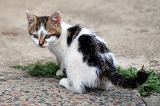
) is a juvenile domesticated cat (Felis catus) that is not yet fully-grown.

The young of big cat
Big cat
The term big cat - which is not a biological classification - is used informally to distinguish the larger cat species from smaller ones. One definition of "big cat" includes the four members of the genus Panthera: the tiger, lion, jaguar, and leopard. Members of this genus are the only cats able...

s are called cub
Cub
Cub may refer to:* the young of certain large predatory animals such as bears, lions, wolves, and big cats; analogous to a domestic puppy or kitten* Cub, a member of Cub Scouts* Cub player, a member of certain sports teams, e.g...

s rather than kittens. Either term may be used for the young of smaller wild felids
Felidae
Felidae is the biological family of the cats; a member of this family is called a felid. Felids are the strictest carnivores of the sixteen mammal families in the order Carnivora...

 such as ocelot
Ocelot
The Ocelot , also known as the Painted Leopard, McKenney's Wildcat, Jaguarete , Tigrillo , Cunaguaro , or Manigordo is a wild cat distributed over South and Central America and Mexico, but has been reported as far north as Texas and in...

s, caracal
Caracal
The caracal is a fiercely territorial medium-sized cat ranging over the Middle East and Africa. The word caracal comes from the Turkish word "karakulak", meaning "black ear". Although it has traditionally had the alternative names Persian Lynx, Egyptian Lynx and African Lynx, it is no longer...

s, and lynx
Lynx
A lynx is any of four big-sized wild cats. All are members of the genus Lynx, but there is considerable confusion about the best way to classify felids at present, and some authorities classify them as part of the genus Felis...

, but "kitten" is usually more common for these species. Though the term primarily refers to young cats, it can also be used when talking about the young of beavers, hedgehogs, rabbit
Rabbit
Rabbits are small mammals in the family Leporidae of the order Lagomorpha, found in several parts of the world. There are seven different genera in the family classified as rabbits, including the European rabbit , Cottontail rabbit , and the Amami rabbit...

s, rats
RATS
RATS may refer to:* RATS , Regression Analysis of Time Series, a statistical package* Rough Auditing Tool for Security, a computer program...

, skunks and squirrels.


A litter
Litter (animal)
A litter is the offspring at one birth of animals from the same mother and usually from one set of parents. The word is most often used for the offspring of mammals, but can be used for any animal that gives birth to multiple young...

 of kittens usually consists of two to five kittens.
Discussion
Ask a question about 'Kitten'
Start a new discussion about 'Kitten'
Answer questions from other users
Full Discussion Forum
 
Encyclopedia

A kitten (Old English
Old English language
Old English , also called Anglo-Saxon, is an early form of the English language that was spoken and written in parts of what are now England and south-eastern Scotland between at least the mid-5th century and the mid-12th century. What survives through writing represents primarily the literary...

 diminutive
Diminutive
In language structure, a diminutive, or diminutive form, is a formation of a word used to convey a slight degree of the root meaning, smallness of the object or quality named, encapsulation, intimacy, or endearment...

 of cat
Cat
The cat , also known as the domestic cat or housecat to distinguish it from other felines and felids, is a small carnivorous mammal that is valued by humans for its companionship and its ability to hunt vermin and household pests...

) is a juvenile domesticated cat (Felis catus) that is not yet fully-grown.

The young of big cat
Big cat
The term big cat - which is not a biological classification - is used informally to distinguish the larger cat species from smaller ones. One definition of "big cat" includes the four members of the genus Panthera: the tiger, lion, jaguar, and leopard. Members of this genus are the only cats able...

s are called cub
Cub
Cub may refer to:* the young of certain large predatory animals such as bears, lions, wolves, and big cats; analogous to a domestic puppy or kitten* Cub, a member of Cub Scouts* Cub player, a member of certain sports teams, e.g...

s rather than kittens. Either term may be used for the young of smaller wild felids
Felidae
Felidae is the biological family of the cats; a member of this family is called a felid. Felids are the strictest carnivores of the sixteen mammal families in the order Carnivora...

 such as ocelot
Ocelot
The Ocelot , also known as the Painted Leopard, McKenney's Wildcat, Jaguarete , Tigrillo , Cunaguaro , or Manigordo is a wild cat distributed over South and Central America and Mexico, but has been reported as far north as Texas and in...

s, caracal
Caracal
The caracal is a fiercely territorial medium-sized cat ranging over the Middle East and Africa. The word caracal comes from the Turkish word "karakulak", meaning "black ear". Although it has traditionally had the alternative names Persian Lynx, Egyptian Lynx and African Lynx, it is no longer...

s, and lynx
Lynx
A lynx is any of four big-sized wild cats. All are members of the genus Lynx, but there is considerable confusion about the best way to classify felids at present, and some authorities classify them as part of the genus Felis...

, but "kitten" is usually more common for these species. Though the term primarily refers to young cats, it can also be used when talking about the young of beavers, hedgehogs, rabbit
Rabbit
Rabbits are small mammals in the family Leporidae of the order Lagomorpha, found in several parts of the world. There are seven different genera in the family classified as rabbits, including the European rabbit , Cottontail rabbit , and the Amami rabbit...

s, rats
RATS
RATS may refer to:* RATS , Regression Analysis of Time Series, a statistical package* Rough Auditing Tool for Security, a computer program...

, skunks and squirrels.

Birth and development


A litter
Litter (animal)
A litter is the offspring at one birth of animals from the same mother and usually from one set of parents. The word is most often used for the offspring of mammals, but can be used for any animal that gives birth to multiple young...

 of kittens usually consists of two to five kittens. They are born after a gestation
Gestation
Gestation is the carrying of an embryo or fetus inside a female viviparous animal. Mammals duringpregnancy can have one or more gestations at the same time ....

 that lasts between 64–67 days, with an average
Average
In mathematics, an average, central tendency of a data set is a measure of the "middle" or "expected" value of the data set. There are many different descriptive statistics that can be chosen as a measurement of the central tendency of the data items. These include arithmetic mean, the median and...

 length of 66 days. Kittens emerge in a sac called the amnion
Amnion
The amnion is a membrane building the amniotic sac that surrounds and protects an embryo. It is developed in reptiles, birds, and mammals, which are hence called “Amniota”; but not in amphibians and fish , which are consequently termed “Anamniota”. The primary function of this is the protection of...

which is bitten off and eaten by the mother cat.

For the first several weeks, kittens are unable to urinate or defecate without being stimulated by their mother. They are also unable to regulate their body temperature for the first three weeks, so kittens born in temperatures less than 27°C
Celsius
Celsius is a temperature scale that is named after the Swedish astronomer Anders Celsius , who developed a similar temperature scale two years before his death...

 (80 °F
Fahrenheit
Fahrenheit is the temperature scale proposed in 1724 by, and named after, the physicist Daniel Gabriel Fahrenheit . Today, the scale has been replaced by the Celsius scale in most countries; it is still in use for non-scientific purposes in the United States and a few other nations, such as...

) can die from exposure if they are not kept warm by their mother.

The mother's milk is very important for the kittens' nutrition and proper growth. This milk transfers antibodies
Antibody
Antibodies are gamma globulin proteins that are found in blood or other bodily fluids of vertebrates, and are used by the immune system to identify and neutralize foreign objects, such as bacteria and viruses...

 to the kittens, which helps protect them against infectious disease
Infectious disease
An infectious disease is a clinically evident disease resulting from the presence of pathogenic microbial agents, including pathogenic viruses, pathogenic bacteria, fungi, protozoa, multicellular parasites, and aberrant proteins known as prions...

. Newborn kittens are also unable to produce concentrated urine
Urine
Urine is a liquid waste product of the body secreted by the kidneys by a process of filtration from blood called urination and excreted through the urethra. Cellular metabolism generates numerous waste compounds, many rich in nitrogen, that require elimination from the bloodstream...

, and so have a very high requirement for fluids.

Kittens open their eye
Eye
Eyes are organs that detect light, and send electrical impulses along the optic nerve to the visual and other areas of the brain. Complex optical systems with resolving power have come in ten fundamentally different forms, and 96% of animal species possess a complex optical system...

s about seven to ten days following birth
Birth
Birth is the act or process of bearing or bringing forth offspring . The offspring is brought forth from the mother...

. At first, the retina
Retina
The vertebrate retina is a light sensitive tissue lining the inner surface of the eye. The optics of the eye create an image of the visual world on the retina, which serves much the same function as the film in a camera. Light striking the retina initiates a cascade of chemical and electrical...

 is poorly-developed and vision is poor. Kittens are not able to see as well as adult cats until about ten weeks after birth.

Kittens develop very quickly from about two weeks of age until their seventh week. Their coordination and strength improve, they play-fight with their litter-mates, and begin to explore the world outside the nest. They learn to wash themselves and others as well as play hunting and stalking games, showing their inborn ability as predators. These innate skills are developed by the kittens' mother or other adult cats bringing live prey to the nest. Later, the adult cats also demonstrate hunting techniques for the kittens to emulate.

As they reach three to four weeks old, the kittens are gradually weaned
Weaning
Weaning is the process of gradually introducing a mammal infant, either human or animal, to what will be its adult diet and withdrawing the supply of its mother's milk.The process takes place only in mammals, as only mammals produce milk...

 and begin to eat solid food, with weaning usually complete by six to eight weeks. Kittens live primarily on solid food after weaning, but usually continue to suckle from time to time until separated from their mothers. Some mother cats will scatter their kittens as early as three months of age, while others continue to look after them until they approach sexual maturity.
The sex of kittens is usually easy to determine by six to eight weeks. The male
Male
Male refers to the sex of an organism, or part of an organism, which produces small mobile gametes, called spermatozoa. Each spermatozoon can fuse with a larger female gamete or ovum, in the process of fertilization...

's urethral opening
Urethral sphincter
The urethral sphincter is a collective name for the muscles used to control the flow of urine from the urinary bladder. These muscles envelop the urethra, so that when they contract, the urethra is sealed shut. The muscles originate at the pubic ramus with the insertion point at the median raphe...

 is round, whereas the female
Female
Female is the sex of an organism, or a part of an organism, which produces mobile ova .- Defining Characteristics :The ova are defined as the larger gametes in a heterogamous reproduction system, while the smaller, usually motile gamete, the spermatozoon, is produced by the male...

's is a slit. Another marked difference is the distance between anus
Anus
The anus is an opening at the opposite end of an animal's digestive tract from the mouth. Its function is to expel feces, unwanted semi-solid matter produced during digestion, which, depending on the type of animal, may be one or more of: matter which the animal cannot digest, such as bones; food...

 and urethral opening, which is greater in males than in females.

Kittens are highly social animals and spend most of their waking hours interacting with available animals and playing. Play with other kittens peaks in the third or fourth month after birth, with more solitary hunting and stalking play peaking later, at about five months. Kittens are vulnerable to harm because they like to find dark places to hide; with sometimes fatal results if they are not watched carefully.

Although domestic kittens are commonly sent to new homes at six to eight weeks of age, it has been suggested that being with its mother and litter mates from six to twelve weeks is important for a kitten's social and behavioural development. Usually, breeders will not sell a kitten that is younger than twelve weeks, and in many jurisdictions, it is illegal to give away kittens younger than eight weeks old.


Caring for domestic kittens


Most veterinarians recommend that kittens be vaccinated against common illnesses beginning at 2–3 months of age. The combination vaccination protects against Feline viral rhinotracheitis
Feline viral rhinotracheitis
Feline viral rhinotracheitis is an upper respiratory infection of cats caused by feline herpesvirus 1, of the family Herpesviridae. It is also known as feline influenza and feline coryza. Viral respiratory diseases in cats can be serious, especially in catteries and kennels...

 (FVR), Feline calicivirus
Feline calicivirus
Feline calicivirus is a virus of the family Caliciviridae that causes disease in cats. It is one of the two important viral causes of respiratory infection in cats, the other being feline herpesvirus. FCV can be isolated from about 50 percent of cats with upper respiratory infection...

 (C), and Feline panleukopenia
Feline panleukopenia
Feline panleukopenia, commonly known as feline distemper, is a viral infection affecting cats, caused by feline parvovirus, a close relative of canine parvovirus. It is not related to canine distemper.- Transmission and symptoms :...

 (P) and is therefore called FVRCP. This inoculation is given at 8 weeks and 12 weeks with a third FVRCP and a rabies inoculation at 16 weeks. Cats can be spayed or neutered at approximately 7 months of age. Many veterinarians will spay or neuter kittens as young as 7 weeks and weighing at least 2 pounds (approx. 1 kg); the practice is particularly common in animal shelters. Such early spaying does not appear to have any long-term health risks to cats, and may even be beneficial in male cats. Kittens should also be wormed against roundworms at about 4 weeks.
Kittens require a high-calorie diet that contains more protein than the diet of adult cats. From weaning until about one year of age they should be fed a diet specifically formulated for kittens. Orphaned kittens too young to eat solid food may be fed a cat milk replacement formula every two to four hours. Kittens should not be fed cow's milk because it does not provide all of the necessary nutrients. Cats are generally intolerant of sugars in their diets and both sucrose
Sucrose
Sucrose, commonly called table sugar, is a moosaccharide of glucose and fructose with the molecular formula C12H22O11. This white, odorless, crystalline powder has a pleasing, sweet taste. It is best known for its role in human nutrition...

 (table sugar) and lactose
Lactose
Lactose is a sugar that is found most notably in milk. Lactose makes up around 2–8% of milk , although the amount varies among species and individuals. It is extracted from sweet or sour whey...

 are not digested and cause soft stools or diarrhea
Diarrhea
In medicine, diarrhea , also spelled diarrhoea , is the condition of having frequent loose or liquid bowel movements. Acute diarrhea is a common cause of death in developing countries and the second most common cause of infant deaths worldwide...

. Orphaned kittens that are not urinating or defecating must be stimulated to do so after each meal by rubbing with a warm, damp washcloth at the base of their spine where the tail begins. This is vital to the kitten's survival.

Hand-reared kittens tend to be very affectionate and more dependent on humans as adults, but can also show volatile mood swings and aggression. If a kitten develops diarrhea, it is best to seek advice from a veterinarian. The kitten may need to be de-wormed with a de-wormer at 6–8 weeks old and then again 2 weeks later.