
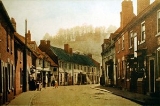
Kinver is a large village in
South StaffordshireSouth Staffordshire is a local government district in Staffordshire, England. The district lies to the north and west of Wolverhampton and the West Midlands, bordering Shropshire to the west and Worcestershire to the south...
district,
StaffordshireStaffordshire is a landlocked county in the West Midlands region of England. Part of the National Forest lies within its borders...
, England. It is in the far south-west of the county, at the end of the narrow finger of land surrounded by the counties of
ShropshireShropshire , alternatively known as Salop or abbreviated, in print only, Shrops, is a county in the West Midlands region of England. It borders Wales to the west. Shropshire is one of England's most rural and sparsely populated counties with a population density of 91/km²...
,
WorcestershireWorcestershire or ; abbreviated Worcs) is a historic and administrative county located in the West Midlands region of central England. In 1974 it was merged with the county of Herefordshire to form the single administrative county of Hereford and Worcester; which was divided in 1998,...
and the
West MidlandsThe West Midlands is a metropolitan county in western central England with a population of 2,591,300. It came into existence as a metropolitan county in 1974 after the passage of the Local Government Act 1972, formed from parts of Staffordshire, Worcestershire and Warwickshire...
. The nearest towns are
StourbridgeStourbridge is a town within the Metropolitan Borough of Dudley, in the West Midlands of England. Historically part of Worcestershire, Stourbridge was a centre of glass making, and today includes the suburbs of Amblecote, Lye, Norton, Oldswinford, Pedmore, Wollaston and Wollescote.The population,...
in the West Midlands, and
KidderminsterKidderminster is a town in the Wyre Forest district of Worcestershire, England. It is located approximately seventeen miles south-west of Birmingham city centre. The 2001 census recorded a population of 55,182 in the town...
in Worcestershire. The
Staffordshire and Worcestershire CanalThe Staffordshire and Worcestershire Canal is a narrow navigable canal in the English Midlands, passing through the counties of Staffordshire and Worcestershire....
passes through, running close to the course of the meandering
River StourThe Stour is a river flowing through the counties of Worcestershire, the West Midlands and Staffordshire in the West Midlands region of England. The Stour is a major tributary of the River Severn, and it is about in length...
. According to the 2001
censusA "census" is the procedure of systematically acquiring and recording information about the members of a given population. It is a regularly occurring and official count of a particular population.In other words every 10 years...next one would be in 2010 The term is used mostly in connection with...
Kinver had a population of 6,805.
The village has three schools: Foley
Infant SchoolAn Infant school is a type of school which caters for young children, usually between the ages of four and seven years. It is usually a small school serving a particular locality. The term is used primarily in the United Kingdom....
, Brindley Heath
Junior SchoolA junior school is a type of school which caters for children, often between the ages of 7 and 11.-Australia:In Australia, a junior school or junior primary is usually a part of a primary school or private school that educates children between the ages of 4 and 11.At schools that have a junior...
and Edgecliff
High SchoolSecondary school is a term used to describe an educational institution where the final stage of compulsory schooling, known as secondary education, takes place. It follows on from elementary or primary education....
.
Kinver is a large village in
South StaffordshireSouth Staffordshire is a local government district in Staffordshire, England. The district lies to the north and west of Wolverhampton and the West Midlands, bordering Shropshire to the west and Worcestershire to the south...
district,
StaffordshireStaffordshire is a landlocked county in the West Midlands region of England. Part of the National Forest lies within its borders...
, England. It is in the far south-west of the county, at the end of the narrow finger of land surrounded by the counties of
ShropshireShropshire , alternatively known as Salop or abbreviated, in print only, Shrops, is a county in the West Midlands region of England. It borders Wales to the west. Shropshire is one of England's most rural and sparsely populated counties with a population density of 91/km²...
,
WorcestershireWorcestershire or ; abbreviated Worcs) is a historic and administrative county located in the West Midlands region of central England. In 1974 it was merged with the county of Herefordshire to form the single administrative county of Hereford and Worcester; which was divided in 1998,...
and the
West MidlandsThe West Midlands is a metropolitan county in western central England with a population of 2,591,300. It came into existence as a metropolitan county in 1974 after the passage of the Local Government Act 1972, formed from parts of Staffordshire, Worcestershire and Warwickshire...
. The nearest towns are
StourbridgeStourbridge is a town within the Metropolitan Borough of Dudley, in the West Midlands of England. Historically part of Worcestershire, Stourbridge was a centre of glass making, and today includes the suburbs of Amblecote, Lye, Norton, Oldswinford, Pedmore, Wollaston and Wollescote.The population,...
in the West Midlands, and
KidderminsterKidderminster is a town in the Wyre Forest district of Worcestershire, England. It is located approximately seventeen miles south-west of Birmingham city centre. The 2001 census recorded a population of 55,182 in the town...
in Worcestershire. The
Staffordshire and Worcestershire CanalThe Staffordshire and Worcestershire Canal is a narrow navigable canal in the English Midlands, passing through the counties of Staffordshire and Worcestershire....
passes through, running close to the course of the meandering
River StourThe Stour is a river flowing through the counties of Worcestershire, the West Midlands and Staffordshire in the West Midlands region of England. The Stour is a major tributary of the River Severn, and it is about in length...
. According to the 2001
censusA "census" is the procedure of systematically acquiring and recording information about the members of a given population. It is a regularly occurring and official count of a particular population.In other words every 10 years...next one would be in 2010 The term is used mostly in connection with...
Kinver had a population of 6,805.
The village today
The village has three schools: Foley
Infant SchoolAn Infant school is a type of school which caters for young children, usually between the ages of four and seven years. It is usually a small school serving a particular locality. The term is used primarily in the United Kingdom....
, Brindley Heath
Junior SchoolA junior school is a type of school which caters for children, often between the ages of 7 and 11.-Australia:In Australia, a junior school or junior primary is usually a part of a primary school or private school that educates children between the ages of 4 and 11.At schools that have a junior...
and Edgecliff
High SchoolSecondary school is a term used to describe an educational institution where the final stage of compulsory schooling, known as secondary education, takes place. It follows on from elementary or primary education....
. The Infant school rings the home time bell 15 minutes before the Junior or High Schools. This is to allow the parents collecting children from both sites to cover the three quarters of a mile journey.
280
acreThe acre is a unit of area in a number of different systems, including the imperial and U.S. customary systems. The most commonly used acres today are the international acre and, in the United States, the survey acre....
s of land are in the possession of the
National TrustThe National Trust for Places of Historic Interest or Natural Beauty, usually known as the National Trust, is a conservation organisation in England, Wales and Northern Ireland...
. There is a Country Park near the Edge. The
Staffordshire and Worcestershire CanalThe Staffordshire and Worcestershire Canal is a narrow navigable canal in the English Midlands, passing through the counties of Staffordshire and Worcestershire....
is popular with boaters in the summer months.
The parish
St. Peter's Church, the village and
parish churchA parish church, in Christianity, is the church which acts as the religious centre of a parish, the basic administrative unit of episcopal churches....
sits in a prominent position on a hill just south of the village.
Several
hamletsA hamlet is usually a rural settlement which is too small to be considered a village, though sometimes the word is used for a different sort of community...
lie in the parish of Kinver, including Compton,
StourtonStourton is a hamlet in Staffordshire, England a few miles to the northwest of Stourbridge. The nearest sizeable villages are Wollaston and Kinver, the nearest hamlets are Prestwood and Dunsley. It lies on the River Stour...
and Whittington. The neighbouring village of
EnvilleEnville is a small village in rural Staffordshire, England, on the A458 road between Stourbridge and Bridgnorth. Enville is also the name of the parish in which it lies....
is in its own parish.
History
Kinver has, at various times in the past, been spelt on maps and documents as: Kinfare, Kynfare, Chenfare, and Cynefare.
The hilltop church is on a very ancient site, and the current church, dedicated to St. Peter dates from the 12th century. The village High Street was laid out as the
burgageBurgage is a medieval land term used in England and Scotland, well established by the 13th century. A burgage was a town rental property , owned by a king or lord. The property usually, and distinctly, consisted of a house on a long and narrow plot of land, with the narrow end facing the street...
s of a new town by the
lord of the manorThe title of Lord of the Manor arose in the English mediaeval system of Manorialism following the Norman Conquest. The title Lord of the Manor is a titular feudal dignity which is still recognised today as semi-extinct form of landed property...
in the late 13th century and was administered by a borough court, separate for the manorial court for the rest of the
manorManorialism or Seigneurialism or Feudal Society was the organizing principle of rural economy and society widely practiced in medieval western and parts of central Europe...
of Kinver and Stourton (known as Kinfare Foreign).
The main pub, The White Hart, dates from the 14th century, and the Anchor Hotel (now developed as housing) from the 15th Century. The Grammar School, although it closed as a school in 1915, is 16th Century.
Kinver was known for making sturdy woollen cloth, using the flow of the
StourThe Stour is a river flowing through the counties of Worcestershire, the West Midlands and Staffordshire in the West Midlands region of England. The Stour is a major tributary of the River Severn, and it is about in length...
for fulling mills and dyeing. The village also profited from being a stop on the great "Irish Road" from
BristolBristol is a city, unitary authority area and ceremonial county in South West England, west of London, and east of Cardiff.With an estimated population of 416,400 for the unitary authority in mid-2007, and a surrounding urban area with an estimated 561,500 residents, it is England's sixth, and...
to
ChesterChester is a city in Cheshire, England. Lying on the River Dee, close to the border with Wales, it is home to 77,040 inhabitants, and is the largest and most populous settlement of the wider unitary authority area of Cheshire West and Chester, which had a population of 328,100 according to the...
(until the 1800s, the port of embarkation for Ireland), the 'White Hart' being the oldest and largest
innInns are generally establishments or buildings where travelers can seek lodging and, usually, food and drink. They are typically located in the country or along a highway.- History and origins :...
.
Later, the river was used to power
finery forgeIron tapped from the blast furnace is pig iron, and contains significant amounts of carbon and silicon. To produce malleable wrought iron, it needs to undergo a further process. In the early modern period, this was carried out in a finery forge....
s and from 1628 the first
slitting millThe slitting mill was a watermill for slitting bars of iron into rods. The rods then were passed to nailers who made the rods into nails, by giving them a point and head....
s, including Hyde Mill which has been claimed (incorrectly) as the earliest in England, though it certainly was among the earliest. There were five slitting mills in the parish by the late 18th century, more than any other parish in Great Britain. These slit bars of
ironIron is a metallic chemical element with the symbol Fe and atomic number 26. Iron is a group 8 and period 4 element and is therefore classified as a transition metal. Iron and iron alloys are by far the most common metals and the most common ferromagnetic materials in everyday use...
into rods to be made into
nailIn engineering, woodworking and construction, a nail is a pin-shaped, sharp object of hard metal or alloy used as a fastener. Formerly wrought iron, today's nails are typically of an alloy of steel, often be dipped or coated to prevent corrosion in harsh conditions or improve adhesion.Nails are...
s in the nearby
Black CountryThe Black Country is a loosely defined area of the English West Midlands conurbation, to the north and west of Birmingham.By the late 19th century, this area had become one of the most intensely industrialised in the nation...
.
Stourton Castle figured notably in the history of the English Civil Wars.
In 1771 the area was opened up to trade by the Staffordshire and Worcester Canal, built by
James BrindleyJames Brindley was an English engineer. He was born in Tunstead, Derbyshire, and lived much of his life in Leek, Staffordshire, becoming one of the most notable engineers of the 18th century.-Early life:...
.
In Victorian and Edwardian times it was a popular Sunday day out for people from Birmingham and the Black Country, via a 1901 pole & wires
tramA tram, tramcar, trolley, trolleycar, or streetcar is a railborne vehicle, of lighter weight and construction than a conventional train, designed for the transport of passengers within, close to, or between villages, towns and/or cities, on tracks running primarily on streets...
extension that ran across the fields, the "Kinver Light Railway".
The nailshops and forges ceased work around 1892, and local ironworks are thought to have all closed in about 1912 or 1913.
The local cave houses were the setting of a silent film,
Bladys of the Stewpony (1919,
Sabine Baring-GouldThe Reverend Sabine Baring-Gould was an English hagiographer, antiquarian, novelist and eclectic scholar. His bibliography lists more than 1240 separate publications, though this list continues to grow. His family home, Lew Trenchard Manor near Okehampton, Devon, has been preserved as he rebuilt...
), but most of this has since been lost. The "Stewpony" was the name of an ancient inn at
StourtonStourton is a hamlet in Staffordshire, England a few miles to the northwest of Stourbridge. The nearest sizeable villages are Wollaston and Kinver, the nearest hamlets are Prestwood and Dunsley. It lies on the River Stour...
in Kinver parish and more recently a public house on the nearby Kidderminster Road (A449). The pub was demolished in 2002 and replaced by a housing development and a block of flats.
Dick Whittington
According to local claims, the Whittington Inn was formerly Whittington
manor houseA manor house or fortified manor-house is a country house, which has historically formed the administrative centre of a manor , the lowest unit of territorial organization in the feudal system...
, built in 1310 by Sir William de Whittington, a knight at arms and grandfather of
Richard WhittingtonSir Richard Whittington was a medieval merchant and politician, and the real-life inspiration for the pantomime character Dick Whittington. Sir Richard Whittington was Lord Mayor of London and a Member of Parliament...
, upon whose life the
pantomimePantomime is a musical-comedy theatrical production traditionally found in Great Britain, Canada, Jamaica, Australia, South Africa, Japan, Ireland, Gibraltar and Malta, and is usually performed during the Christmas and New Year season.-History:A pantomimos in Greece was...
character Dick Whittington is based.
These claims are in fact unfounded: Dick Whittington (q.v.) came from
GloucestershireGloucestershire is a county in South West England. The county comprises part of the Cotswold Hills, part of the flat fertile valley of the River Severn, and the entire Forest of Dean....
. The Whittington Inn was merely a farmhouse belonging to a freeholder of the manor of Whittington. The 18th-century manor house was undoubtedly Whittington Hall (now Whittington Hall Farm). This belonged to the lords of the manor, and probably had done so since the medieval period.
Kinver Light Railway
An innovative electric light
tramA tram, tramcar, trolley, trolleycar, or streetcar is a railborne vehicle, of lighter weight and construction than a conventional train, designed for the transport of passengers within, close to, or between villages, towns and/or cities, on tracks running primarily on streets...
way opened in 1901 and helped establish the local tourism industry.
Kinver rock houses
The
National TrustThe National Trust for Places of Historic Interest or Natural Beauty, usually known as the National Trust, is a conservation organisation in England, Wales and Northern Ireland...
-owned beauty spot of
Kinver EdgeKinver Edge is a high heath and woodland escarpment just west of Kinver, about four miles west of Stourbridge, and four miles north of Kidderminster, and is on the border between Worcestershire and Staffordshire, England. It is now owned by the National Trust.-History:Kinver Edge is a remnant of...
lies to the south-west of the village. There are notable rock or cave houses on
Kinver EdgeKinver Edge is a high heath and woodland escarpment just west of Kinver, about four miles west of Stourbridge, and four miles north of Kidderminster, and is on the border between Worcestershire and Staffordshire, England. It is now owned by the National Trust.-History:Kinver Edge is a remnant of...
, carved from the
sandstoneSandstone is a sedimentary rock composed mainly of sand-sized minerals or rock grains. Most sandstone is composed of quartz and/or feldspar because these are the most common minerals in the Earth's crust. Like sand, sandstone may be any color, but the most common colors are tan, brown, yellow,...
. Some were inhabited as late as the 1950s. One of the
Holy Austin Rock Houses has been restored to its former inhabited state and is now operated as a Victorian museum, at .
Kinver celebrities
Kinver was the birthplace of the distinguished stage and screen actress
Nancy PriceNancy Price, CBE , born Lilian Nancy Bache Price in Kinver, Staffordshire, England, was an actress, authoress and manageress of Little Theatre in the Adelphi, a West End theatre on the Strand in London....
who appeared in such films as
Love, Life and LaughterLove, Life and Laughter is a 1923 British film, written and directed by George Pearson. The film is presumed lost.-Synopsis:An impoverished author and a cabaret girl each have their dream of success, but are happy to wake to each other and reality....
. Her home Rockmount is situated at the top of the village.
Drakelow tunnels / Drakelow RGHQ
Just outside Kinver are the infamous and mysterious
Drakelow TunnelsThe Drakelow Tunnels are a former underground military complex beneath the Kingsford Country Park near the village of Kinver, Staffordshire, which cover...
. The tunnels were used for various purposes by the
MoDThe Ministry of Defence is the United Kingdom government department responsible for implementation of government defence policy and is the headquarters of the British Armed Forces....
for many years.
During
World War IIWorld War II, or the Second World War , was a global military conflict which involved a majority of the world's nations, including all great powers, organized into two opposing military alliances: the Allies and the Axis...
the tunnels housed a factory which would have been used to build aircraft engines should the main supply factory in
BirminghamBirmingham is a city and metropolitan borough in the West Midlands county of England. Birmingham is the second-most populous British city, with a population of 1,006,500 ....
ever have been bombed.
Clearly the theory was that, as the tunnels were underground, the enemy would not know of its existence and the site wouldn't be targeted by bombers Or, as the tunnels were beneath solid rock, they were safe from bombs.
During the
Cold WarThe Cold War was the continuing state of political conflict, military tension, and economic competition existing after World War II , primarily between the USSR and its satellite states, and the powers of the Western world, including the United States...
the tunnels were turned into an RGHQ (Regional Government Headquarters. In the event of
Nuclear WarNuclear warfare is battle in which nuclear weapons are used.Nuclear war may also refer to:*Nuclear War *Nuclear War *Nuclear War, an album by Sun Ra*"Nuclear War", a song by Sun Ra...
Government officials,
VIPVIP and V.I.P. is a three-letter acronym that may refer to:-In general:* Vacuum insulated panel* Vampires in Public, a live action role-playing game system based in the UK.* Variable Information Printing, a form of on-demand printing...
s and heads of the regional military and emergency services would be housed here safely away from falling bombs and the effects of
radiationIn physics, radiation describes any process in which energy emitted by one body travels through a medium or through space, ultimately to be absorbed by another body...
and
nuclear falloutFallout is the residual radiation hazard from a nuclear explosion, aptly named because it "falls out" of the atmosphere into which it is spread during the explosion. It commonly refers to the radioactive dust created when a nuclear weapon explodes. This radioactive dust, consisting of hot...
.
Currently the site is disused, but a special trust has been set up to turn the site into a tourist attraction and to preserve a part of a 'secret military history' of the United Kingdom that very few people knew about. Visits are sometimes arranged for interested parties. For more information on the tunnels visit ->
Kinver Online
Town twinning
- Mer, Loir-et-Cher
Loir-et-Cher is a department in north-central France named after the rivers Loir and Cher.-History:Loir-et-Cher is one of the original 83 departments created during the French Revolution on March 4, 1790. It was created from parts of the former provinces of Orléanais and...
, France
- Park Ridge
Park Ridge, Illinois, is a Chicago suburb of 37,775 residents. It is located fifteen miles northwest of downtown Chicago, it is close to O'Hare International Airport, major expressways and rail transportation....
, IllinoisIllinois , the 21st state admitted to the United States of America, is the most populous and demographically diverse Midwestern state and the fifth most populous state in the nation...
External links