

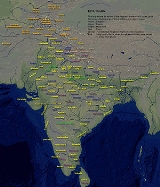
Kingdoms of Ancient India

Overview
- This article is about the kingdoms as reflected in existing ancient Sanskrit literature. See History of IndiaHistory of IndiaThe history of India begins with evidence of human activity of Homo sapiens as long as 75,000 years ago, or with earlier hominids including Homo erectus from about 500,000 years ago. The Indus Valley Civilization, which spread and flourished in the northwestern part of the Indian subcontinent from...
for a conventionally historical overview, in particular the articles on the MahajanapadasMahajanapadasMahājanapadas , literally "great realms", were ancient Indian kingdoms or countries...
and the Middle kingdoms of IndiaMiddle kingdoms of IndiaMiddle kingdoms of India refers to the political entities in India from the 3rd century BC after the decline of the Maurya Empire, and the corresponding rise of the Satavahana dynasty, beginning with Simuka, from 230 BC...
for ca. 700 BC–AD 1200.
Epic India is the geography of Greater India
Greater India
Greater India is a term that refers to the historical spread of the culture of India beyond the Indian subcontinent...
traditionally around early 10th century BC and later on from the Sanskrit epics, viz. the Mahabharata
Mahabharata
The Mahabharata is one of the two major Sanskrit epics of ancient India and Nepal, the other being the Ramayana. The epic is part of itihasa....
and the Ramayana
Ramayana
The Ramayana is an ancient Sanskrit epic. It is ascribed to the Hindu sage Valmiki and forms an important part of the Hindu canon , considered to be itihāsa. The Ramayana is one of the two great epics of India and Nepal, the other being the Mahabharata...
as well as Puranic
Puranas
The Puranas are a genre of important Hindu, Jain and Buddhist religious texts, notably consisting of narratives of the history of the universe from creation to destruction, genealogies of kings, heroes, sages, and demigods, and descriptions of Hindu cosmology, philosophy, and geography.Puranas...
literature (the Itihasa
Itihasa
Itihasa as defined by Amarakosha refers to purvavritta, i.e. events of the past. In the Vedic age, those portions of the Brahmanas which narrated events of bygone days were known as itihasa and had some ritualistic importance...
).
The historical context of the Sanskrit epics are the late Vedic
Vedic period
The Vedic period was a period in history during which the Vedas, the oldest scriptures of Hinduism, were composed. The time span of the period is uncertain. Philological and linguistic evidence indicates that the Rigveda, the oldest of the Vedas, was composed roughly between 1700–1100 BCE, also...
Mahajanapadas
Mahajanapadas
Mahājanapadas , literally "great realms", were ancient Indian kingdoms or countries...
(early 1st Millennium BCE) and the subsequent formation of the Maurya Empire
Maurya Empire
The Maurya Empire was a geographically extensive Iron Age historical power in ancient India, ruled by the Mauryan dynasty from 321 to 185 BC...
(322 BCE), the beginning of the "golden age" of Classical Sanskrit literature.
Often rivers formed the boundaries of two neighboring kingdoms, as was the case between the northern and southern Panchala
Panchala Kingdom
This article is about the kingdom of Panchala during the epic-ages. For the historical kingdom, see Panchala.Panchala Kingdom extended from Himalayas in the north to river Charmanwati in the south during the period of Mahabharata. It had Kuru, Surasena and Matsya kingdoms to the west and the forest...
and between the western (Pandava
Pandava
In the Hindu epic Mahābhārata, the Pandava are the five acknowledged sons of Pandu , by his two wives Kunti and Madri. Their names are Yudhisthira, Bhima, Arjuna, Nakula and Sahadeva. Although, Karna is told by Lord Krishna that according to the laws and ethics he is the first son of Kunti making...
's Kingdom) and eastern (Kaurava
Kaurava
The term Kaurava is a Sanskrit term, that means the descendants of Kuru, a legendary king who is the ancestor of many of the characters of the Mahābhārata.The term is used in the Mahābhārata with two meanings:...
's Kingdom) Kuru
Kuru Kingdom
Kuru was the name of an ancient kingdom in Vedic India, and later a republican Mahajanapada state. The kingdom was located in the area of modern Haryana, Delhi and western Uttar Pradesh in India. They formed the first political center of the of the Vedic India, with its capital at Hastinapur. It...
.
