


King Ranch

Encyclopedia
King Ranch, located in south Texas
between Corpus Christi
and Brownsville
, is one of the world's largest ranches. The 825000 acre (3,338.7 km²; 1,289.1 sq mi) ranch, founded in 1853 by Captain Richard King
and Gideon K. Lewis, includes portions of six Texas counties, including most of Kleberg County and much of Kenedy County, with portions extending into Brooks, Jim Wells
, Nueces, and Willacy counties. The ranch does not consist of one single contiguous plot of land, but rather four large sections called divisions. The divisions are the Santa Gertrudis, the Laureles, the Encino and the Norias. Only two of the four divisions border each other, and that border is relatively short. The ranch was designated a National Historic Landmark
in 1961.
(1824–1885) was a river pilot, born in New York City
to Irish immigrants
. He was indentured to a jeweler at age eleven but later ran away to sea eventually attaining a pilot's rating. In 1843 King first met his future business partner in the King Ranch, Mifflin Kenedy (1818–1895), captain of the steamboat Champion. Both served under General Zachary Taylor
operating steamboats from Brazos Santiago Harbor
to Matamoros
, and on up river to Camargo, Tamaulipas, in support of the US invasion of Monterrey and Saltillo. After the Mexican War
, King made a good living hauling merchandise on the Rio Grande, as far up river as Camargo, and Rio Grande City
. In the meantime, Kenedy was able to make money by carrying goods overland into Mexico. By March 1, 1850, King, Kenedy, Charles Stillman
, founder of Brownsville, and James O'Donnell entered into a business partnership (M. Kenedy & Co.) to transport Stillman's goods from Brazos Santiago Harbor on the Gulf of Mexico and up the Rio Grande. The enterprise required two types of steamers — the Grampus and Comanche. During the American Civil War
, the steamboat fleet was re-flagged under the name of the Matamoros, Mexico citizen Francisco Iturria and the Mexican flag. As Mexico was a neutral country, the steamboats could not be stopped by Union blockaders, and engaged in a lively commerce of transporting Texas cotton to many deep water ships anchored offshore Matamoros, on the Mexican side of the Rio Grande. Stillman sold his share of the enterprise after the Civil War; the new firm operated as King, Kenedy & Co. until 1874.
King first saw the land that would become part of the enormous King Ranch in April 1852 as he traveled north from Brownsville to attend the Lone Star Fair in Corpus Christi, a four day trip by horseback. After a grueling ride, King caught sight of the Santa Gertrudis Creek, 124 miles (199.6 km) from the Rio Grande
. It was the first stream he had seen on the Wild Horse Desert. The land, which was shaded by large mesquite trees, so impressed him that when he arrived at the fair, he and a friend, Texas Ranger
Captain Gideon K. "Legs" Lewis, agreed then and there to make it into a ranch.
The King Ranch LK brand
, still in use today, stands for partners Lewis and King.
King and Lewis established a cow camp on Santa Gertrudis Creek. During this time, Richard King purchased the Rincón de Santa Gertrudis grant, a 15500 acre (62.7 km²) holding that encompassed present-day Kingsville, Texas
. It was purchased from the heirs of Juan Mendiola of Camargo on July 25, 1853, for $300. King sold Lewis an undivided half-interest in the land for $2,000. At the same time, Lewis sold King undivided half interest in the ranchos of Manuel Barrera and of Juan Villareal for the same sum, on November 14, 1853. In 1854, King and Lewis purchased the de la Garza Santa Gertrudis grant from Praxides Uribe of Matamoros for $1,800, on the condition of a perfected title (complete documentation of the land grant) on May 20, 1854 to 53000 acre (214.5 km²). As the years passed, more land was added, growing to 1.2 million acres (4900 km²) at its largest extent, until reaching its current total.
In 1855 Lewis was killed by the husband of a woman with whom he had been having an affair. On July 1, 1856, a court sale of Lewis' property (including the undivided half-interest in the land of the Ranch) was held. King had arranged for Maj W.W. Chapman (died 1859) to bid on the Rincón property, which Chapman acquired for $1,575. Champion had been the quartermaster of Fort Brown
in Brownsville, and regulated the steamboat contracts to supply Fort Ringgold, up river in Rio Grande City. Champman's heirs published the letters home from his wife in a new book named, The News From Browsville.
King interested Captain James Walworth in acquiring the entire de la Garza grant, which Walworth completed on December 26, 1856, for $5000 paid to Praxides Uribe. King thus retained operational control of the Ranch, with Walworth as a silent partner who held title to the land, and who paid taxes on it.
King and Walworth's brand
was registered June 27, 1859 along with his earlier brands (see below).
According to oral tradition, when King and his partners began hiring people to staff the ranch, they hired a number of Mexican
hands, including an entire Mexican village that had been decimated by drought in 1854. Lea records that King led the entrada of villagers from Cruillas, Tamaulipas
, Mexico
in the early months of 1854. As the ranch grew, its hands came to be called "kineños," or "King's men." Over time, some original grantees returned to their land. King once said he "could not have kept on and held on if Andrés Canales had not been adjoining."
Records show that a Mexican range cow cost $6 in 1854; a mustang cost $6; a stud horse cost $200–300. In sum, in 1854 King paid $12,275.79. Lea estimates that 1855 expenses were smaller. The first brand was the Ere Flecha (an R with arrow through it).
In 1859, the ranch recorded its first official brands (HK and LK). In 1869 the ranch registered its "Running W" brand, which remains the King Ranch's official mark today. At the time, the ranch grazed cattle, horses, sheep and goats. However, by the mid-1870s the ranch's hallmark stock had become the hardy Texas Longhorn
. The ranch also boasted several Brahman
bulls, as well as Beef Shorthorn
s and Herefords.
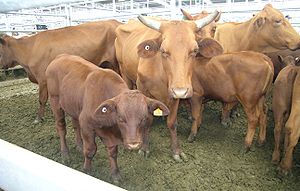 The Brahmans — which were bred specially to thrive in South Texas' hot climate — were crossed with the ranch's Beef Shorthorns to produce the ranch's own trademark stock — the Santa Gertrudis breed
, which were recognized as a breed in 1940. The Santa Gertrudis was the first American
breed of beef cattle.
Lea portrays King's purchase of the Ranch as motivated by his wooing of Henrietta Maria Morse Chamberlain (1832–1925), whom he married in the First Presbyterian Church, Brownsville
, Sunday December 10, 1854. The King Ranch HK brand
stands for Henrietta King.
In the Civil War, initially, the disruption of the flow of cattle to market caused a drop in beef prices. In 1861, the price of cattle dropped to $2 a head, rising to $11 per head by August 1862.
The 1863-1864 winter pushed uncounted cattle south toward the Nueces and Rio Grande. By the end of the Civil War, the Texas Rangers
were disbanded by the Reconstruction. It became too tempting to simply herd cattle across the Nueces or Rio Grande.
Even in this time of loss, by 1869 Richard King was able to round up 48,664 cattle out of an estimated 84,000 head. Allowing for 10,000 remaining, Richard King claimed a loss of 33,827 head from 1869 to 1872.
To handle depredations, the ranchers formed the Stock Raisers Association of Western Texas in 1870; Mifflin Kenedy led the first meeting.
By 1874, the Texas Rangers were re-established, and were a factor in controlling the depredations.
By 1870, 300,000 head of cattle made their way from the West to the railroads of Kansas, and thence to the stockyards of Chicago. In a Texas ranch, a steer worth $11 would bring $20 from a buyer in Abilene. The buyer in turn could ask $31.50 at the Union Stock Yards
. Richard King could drive his cattle for a hundred days to the railheads of Kansas.
But by 1871 700,000 head of cattle caused a market glut, which King avoided by personal negotiation in Abilene.
King managed to avoid the September 19, 1873 Black Friday panic
by selling early. During the lean year that followed, King continued to fence his land, and husband his cattle, horses and sheep.
One technique that King used to manage costs was to make his trail bosses the owners of the herd. The bosses would sign a note for the cattle, which they would begin to drive to market in February of each year, for the 100-day drive. The bosses were also the employers of the outfit. Upon the sale of the herd to the northern buyers, the trail bosses could relieve their indebtedness, and earn a profit greater than their ordinary wages.
At the death of Henrietta King, the appraiser's Statement of Gross Estate, Mrs. H.M. King listed a net total of 5.4 million dollars, as the owner of 997,444.56 acres (4,036.5 km2), which did not include the Santa Gertrudis headquarters, nor did it include the Kleberg's Stillman and Lasater tracts, which were not of the estate. Her son-in-law Bob Kleberg, Sr. said "A valuation of four to five dollars an acre ($1236/km²) on a million acres (4000 km²) of raw ranchland was about right, but it took a long time for the Government to admit it." By 1929 the taxes ($859,000) had been paid up, in installments, but the trustees had to borrow money, so that by the market crash of 1929, Henrietta King's estate was in debt $3,000,000.
But in 1933, Bob Kleberg, Jr., the son of Bob Kleberg, Sr. and Alice Gertrudis King leased the exploration and drilling rights on the ranch to Humble Oil
of Houston, Texas
for $127,824, in exchange for the usual royalty of 1/8 of every barrel (20 L) of oil pumped from the property. Humble Oil loaned enough money to pay the debts of the H.M. King estate, secured by a first mortgage on the land. Humble struck oil and gas by 1939. During all of this, the Ranch was a going concern, with a net profit of $227,382, as early as 1926.
Lauro Cavazos
, who served as the first Hispanic United States Cabinet officer, was born on the King Ranch during his father's service as a ranch foreman in January, 1927.
and border bandits".
Edna Ferber
's novel Giant of the ranches of Texas was turned into a film: Giant. The theme song of the film is a staple for high school bands in Texas. Many of the events of the King Ranch, such as the discovery of oil
on the property, are also in the film. It should be noted that working-class millionaire
s can still be found in the oil towns of Texas as well; Richard King is not a unique example.
In the James Michener novel Centennial
, the Venneford Ranch was said to be patterned after King Ranch.
The historical fiction
novel Lords of the Land by Matt Braun
is based on the King Ranch and its founder, although names and some circumstance have been altered.
, cutting horses and thoroughbred
s and produced the 1946 U.S. Triple Crown
winner Assault
and 1950 Kentucky Derby
winner, Middleground
. They also owned a share of La Troienne
, the greatest broodmare of the twentieth century. The King Ranch had the honor of raising the first quarter horse
registered with the American Quarter Horse Association
. The stallion's name was Wimpy P-1 and he was given registration number one. In addition, the King Ranch company operates a local museum, maintains other property concerns and works with Texas A&M University
to perform agricultural
research and development
.
The corporation has extensive holdings in other states (Florida) with agricultural interests including turf grass farming and citrus. In 1958 King Ranch paid more than $1m for Brunette Downs in the Northern Territory
. They also owned Risdon near Warwick, Queensland
and several other Queensland properties.
In 2003, Ford Motor Company
added a King Ranch edition to their Super Duty
truck line, complete with the King Ranch cattle brand logo. Eventually, Ford added King Ranch packages to its F-150
lineup, as well as th uy8ipigy8
Texas
Texas is the second largest U.S. state by both area and population, and the largest state by area in the contiguous United States.The name, based on the Caddo word "Tejas" meaning "friends" or "allies", was applied by the Spanish to the Caddo themselves and to the region of their settlement in...
between Corpus Christi
Corpus Christi, Texas
Corpus Christi is a coastal city in the South Texas region of the U.S. state of Texas. The county seat of Nueces County, it also extends into Aransas, Kleberg, and San Patricio counties. The MSA population in 2008 was 416,376. The population was 305,215 at the 2010 census making it the...
and Brownsville
Brownsville, Texas
Brownsville is a city in the southernmost tip of the state of Texas, in the United States. It is located on the northern bank of the Rio Grande, directly north and across the border from Matamoros, Tamaulipas, Mexico. Brownsville is the 16th largest city in the state of Texas with a population of...
, is one of the world's largest ranches. The 825000 acre (3,338.7 km²; 1,289.1 sq mi) ranch, founded in 1853 by Captain Richard King
Richard King (Texas)
Richard King was a riverboat captain, entrepreneur, and most notably, the founder of the King Ranch in South Texas, which at the time of his death in 1885 encompassed over 600,000 acres .-Early years:Born in New York City into a poor Irish family, King was indentured as an apprentice to a jeweler...
and Gideon K. Lewis, includes portions of six Texas counties, including most of Kleberg County and much of Kenedy County, with portions extending into Brooks, Jim Wells
Jim Wells County, Texas
At the 2000 census, there were 39,326 people, 12,961 households and 10,096 families residing in the county. The population density was 46 per square mile . There were 14,819 housing units at an average density of 17 per square mile...
, Nueces, and Willacy counties. The ranch does not consist of one single contiguous plot of land, but rather four large sections called divisions. The divisions are the Santa Gertrudis, the Laureles, the Encino and the Norias. Only two of the four divisions border each other, and that border is relatively short. The ranch was designated a National Historic Landmark
National Historic Landmark
A National Historic Landmark is a building, site, structure, object, or district, that is officially recognized by the United States government for its historical significance...
in 1961.
History
Richard KingRichard King (Texas)
Richard King was a riverboat captain, entrepreneur, and most notably, the founder of the King Ranch in South Texas, which at the time of his death in 1885 encompassed over 600,000 acres .-Early years:Born in New York City into a poor Irish family, King was indentured as an apprentice to a jeweler...
(1824–1885) was a river pilot, born in New York City
New York City
New York is the most populous city in the United States and the center of the New York Metropolitan Area, one of the most populous metropolitan areas in the world. New York exerts a significant impact upon global commerce, finance, media, art, fashion, research, technology, education, and...
to Irish immigrants
Irish American
Irish Americans are citizens of the United States who can trace their ancestry to Ireland. A total of 36,278,332 Americans—estimated at 11.9% of the total population—reported Irish ancestry in the 2008 American Community Survey conducted by the U.S. Census Bureau...
. He was indentured to a jeweler at age eleven but later ran away to sea eventually attaining a pilot's rating. In 1843 King first met his future business partner in the King Ranch, Mifflin Kenedy (1818–1895), captain of the steamboat Champion. Both served under General Zachary Taylor
Zachary Taylor
Zachary Taylor was the 12th President of the United States and an American military leader. Initially uninterested in politics, Taylor nonetheless ran as a Whig in the 1848 presidential election, defeating Lewis Cass...
operating steamboats from Brazos Santiago Harbor
Brazos Island
Brazos Island is a barrier island on the Gulf Coast of Texas in the United States, south of the town of South Padre Island.-History:The island is also known as Brazos Santiago Island, a reference to the port of Brazos Santiago, the first Spanish settlement on the island. Later it became the Port...
to Matamoros
Matamoros, Tamaulipas
Matamoros, officially known as Heroica Matamoros, is a city in the northeastern part of Tamaulipas, in the country of Mexico. It is located on the southern bank of the Rio Grande, directly across the border from Brownsville, Texas, in the United States. Matamoros is the second largest and second...
, and on up river to Camargo, Tamaulipas, in support of the US invasion of Monterrey and Saltillo. After the Mexican War
Mexican–American War
The Mexican–American War, also known as the First American Intervention, the Mexican War, or the U.S.–Mexican War, was an armed conflict between the United States and Mexico from 1846 to 1848 in the wake of the 1845 U.S...
, King made a good living hauling merchandise on the Rio Grande, as far up river as Camargo, and Rio Grande City
Rio Grande City, Texas
Rio Grande City is a city in and the county seat of Starr County, Texas, United States. The population was 13,834 at the 2010 census. The city is 41 miles west of McAllen. It is the hometown of former Commander of U.S. Forces in Iraq, General Ricardo Sanchez. The city also holds the March record...
. In the meantime, Kenedy was able to make money by carrying goods overland into Mexico. By March 1, 1850, King, Kenedy, Charles Stillman
Charles Stillman
Charles Stillman was born in Wethersfield, Hartford County, Connecticut, United States, to Capt. Francis Stillman and Harriet Stillman. He arrived in Matamoros, Tamaulipas, Mexico, in 1828 and established himself as an entrepreneur...
, founder of Brownsville, and James O'Donnell entered into a business partnership (M. Kenedy & Co.) to transport Stillman's goods from Brazos Santiago Harbor on the Gulf of Mexico and up the Rio Grande. The enterprise required two types of steamers — the Grampus and Comanche. During the American Civil War
American Civil War
The American Civil War was a civil war fought in the United States of America. In response to the election of Abraham Lincoln as President of the United States, 11 southern slave states declared their secession from the United States and formed the Confederate States of America ; the other 25...
, the steamboat fleet was re-flagged under the name of the Matamoros, Mexico citizen Francisco Iturria and the Mexican flag. As Mexico was a neutral country, the steamboats could not be stopped by Union blockaders, and engaged in a lively commerce of transporting Texas cotton to many deep water ships anchored offshore Matamoros, on the Mexican side of the Rio Grande. Stillman sold his share of the enterprise after the Civil War; the new firm operated as King, Kenedy & Co. until 1874.
King first saw the land that would become part of the enormous King Ranch in April 1852 as he traveled north from Brownsville to attend the Lone Star Fair in Corpus Christi, a four day trip by horseback. After a grueling ride, King caught sight of the Santa Gertrudis Creek, 124 miles (199.6 km) from the Rio Grande
Rio Grande
The Rio Grande is a river that flows from southwestern Colorado in the United States to the Gulf of Mexico. Along the way it forms part of the Mexico – United States border. Its length varies as its course changes...
. It was the first stream he had seen on the Wild Horse Desert. The land, which was shaded by large mesquite trees, so impressed him that when he arrived at the fair, he and a friend, Texas Ranger
Texas Ranger Division
The Texas Ranger Division, commonly called the Texas Rangers, is a law enforcement agency with statewide jurisdiction in Texas, and is based in Austin, Texas...
Captain Gideon K. "Legs" Lewis, agreed then and there to make it into a ranch.
The King Ranch LK brand
Livestock branding
Livestock branding is a technique for marking livestock so as to identify the owner. Originally, livestock branding only referred to a hot brand for large stock, though the term is now also used to refer to other alternative techniques such as freeze branding...
, still in use today, stands for partners Lewis and King.
King and Lewis established a cow camp on Santa Gertrudis Creek. During this time, Richard King purchased the Rincón de Santa Gertrudis grant, a 15500 acre (62.7 km²) holding that encompassed present-day Kingsville, Texas
Kingsville, Texas
As of the census of 2000, there were 25,575 people, 8,943 households, and 6,134 families residing in the city. The population density was 1,848.8 people per square mile . There were 10,427 housing units at an average density of 753.8 per square mile...
. It was purchased from the heirs of Juan Mendiola of Camargo on July 25, 1853, for $300. King sold Lewis an undivided half-interest in the land for $2,000. At the same time, Lewis sold King undivided half interest in the ranchos of Manuel Barrera and of Juan Villareal for the same sum, on November 14, 1853. In 1854, King and Lewis purchased the de la Garza Santa Gertrudis grant from Praxides Uribe of Matamoros for $1,800, on the condition of a perfected title (complete documentation of the land grant) on May 20, 1854 to 53000 acre (214.5 km²). As the years passed, more land was added, growing to 1.2 million acres (4900 km²) at its largest extent, until reaching its current total.
In 1855 Lewis was killed by the husband of a woman with whom he had been having an affair. On July 1, 1856, a court sale of Lewis' property (including the undivided half-interest in the land of the Ranch) was held. King had arranged for Maj W.W. Chapman (died 1859) to bid on the Rincón property, which Chapman acquired for $1,575. Champion had been the quartermaster of Fort Brown
Fort Brown
Fort Brown was a military post of the United States Army in Texas during the later half of 19th century and the early part of the 20th century.-Early years:...
in Brownsville, and regulated the steamboat contracts to supply Fort Ringgold, up river in Rio Grande City. Champman's heirs published the letters home from his wife in a new book named, The News From Browsville.
King interested Captain James Walworth in acquiring the entire de la Garza grant, which Walworth completed on December 26, 1856, for $5000 paid to Praxides Uribe. King thus retained operational control of the Ranch, with Walworth as a silent partner who held title to the land, and who paid taxes on it.
King and Walworth's brand
Livestock branding
Livestock branding is a technique for marking livestock so as to identify the owner. Originally, livestock branding only referred to a hot brand for large stock, though the term is now also used to refer to other alternative techniques such as freeze branding...
was registered June 27, 1859 along with his earlier brands (see below).
According to oral tradition, when King and his partners began hiring people to staff the ranch, they hired a number of Mexican
Mexico
The United Mexican States , commonly known as Mexico , is a federal constitutional republic in North America. It is bordered on the north by the United States; on the south and west by the Pacific Ocean; on the southeast by Guatemala, Belize, and the Caribbean Sea; and on the east by the Gulf of...
hands, including an entire Mexican village that had been decimated by drought in 1854. Lea records that King led the entrada of villagers from Cruillas, Tamaulipas
Tamaulipas
Tamaulipas officially Estado Libre y Soberano de Tamaulipas is one of the 31 states which, with the Federal District, comprise the 32 Federal Entities of Mexico. It is divided in 43 municipalities and its capital city is Ciudad Victoria. The capital city was named after Guadalupe Victoria, the...
, Mexico
Mexico
The United Mexican States , commonly known as Mexico , is a federal constitutional republic in North America. It is bordered on the north by the United States; on the south and west by the Pacific Ocean; on the southeast by Guatemala, Belize, and the Caribbean Sea; and on the east by the Gulf of...
in the early months of 1854. As the ranch grew, its hands came to be called "kineños," or "King's men." Over time, some original grantees returned to their land. King once said he "could not have kept on and held on if Andrés Canales had not been adjoining."
Records show that a Mexican range cow cost $6 in 1854; a mustang cost $6; a stud horse cost $200–300. In sum, in 1854 King paid $12,275.79. Lea estimates that 1855 expenses were smaller. The first brand was the Ere Flecha (an R with arrow through it).
In 1859, the ranch recorded its first official brands (HK and LK). In 1869 the ranch registered its "Running W" brand, which remains the King Ranch's official mark today. At the time, the ranch grazed cattle, horses, sheep and goats. However, by the mid-1870s the ranch's hallmark stock had become the hardy Texas Longhorn
Texas longhorn (cattle)
The Texas Longhorn is a breed of cattle known for its characteristic horns, which can extend to tip to tip for steers and exceptional cows, and tip to tip for bulls. Horns can have a slight upward turn at their tips or even triple twist. Texas Longhorns are known for their diverse coloring...
. The ranch also boasted several Brahman
Brahman (cattle)
The Brahman or Brahma is a breed of Zebu cattle , later exported from India to the rest of the world. The main breeds used were Kankrej, Gujurat, Nelore or Ongole and the Gir or Gyr cattle...
bulls, as well as Beef Shorthorn
Beef Shorthorn
The Beef Shorthorn breed of cattle was developed from the Shorthorn breed in England and Scotland in around 1820. The Shorthorn was originally developed as a dual purpose breed, suitable for both dairy and beef production. However different breeders opted to concentrate on one purpose rather than...
s and Herefords.
Santa Gertrudis cattle
Santa Gertrudis cattle are a tropical beef breed of cattle developed in southern Texas on the King Ranch. They were named for the Spanish land grant where Captain Richard King originally established the King Ranch. This breed was officially recognized by the United States Department of...
, which were recognized as a breed in 1940. The Santa Gertrudis was the first American
United States
The United States of America is a federal constitutional republic comprising fifty states and a federal district...
breed of beef cattle.
Lea portrays King's purchase of the Ranch as motivated by his wooing of Henrietta Maria Morse Chamberlain (1832–1925), whom he married in the First Presbyterian Church, Brownsville
Brownsville, Texas
Brownsville is a city in the southernmost tip of the state of Texas, in the United States. It is located on the northern bank of the Rio Grande, directly north and across the border from Matamoros, Tamaulipas, Mexico. Brownsville is the 16th largest city in the state of Texas with a population of...
, Sunday December 10, 1854. The King Ranch HK brand
Livestock branding
Livestock branding is a technique for marking livestock so as to identify the owner. Originally, livestock branding only referred to a hot brand for large stock, though the term is now also used to refer to other alternative techniques such as freeze branding...
stands for Henrietta King.
In the Civil War, initially, the disruption of the flow of cattle to market caused a drop in beef prices. In 1861, the price of cattle dropped to $2 a head, rising to $11 per head by August 1862.
The 1863-1864 winter pushed uncounted cattle south toward the Nueces and Rio Grande. By the end of the Civil War, the Texas Rangers
Texas Ranger Division
The Texas Ranger Division, commonly called the Texas Rangers, is a law enforcement agency with statewide jurisdiction in Texas, and is based in Austin, Texas...
were disbanded by the Reconstruction. It became too tempting to simply herd cattle across the Nueces or Rio Grande.
Even in this time of loss, by 1869 Richard King was able to round up 48,664 cattle out of an estimated 84,000 head. Allowing for 10,000 remaining, Richard King claimed a loss of 33,827 head from 1869 to 1872.
To handle depredations, the ranchers formed the Stock Raisers Association of Western Texas in 1870; Mifflin Kenedy led the first meeting.
By 1874, the Texas Rangers were re-established, and were a factor in controlling the depredations.
By 1870, 300,000 head of cattle made their way from the West to the railroads of Kansas, and thence to the stockyards of Chicago. In a Texas ranch, a steer worth $11 would bring $20 from a buyer in Abilene. The buyer in turn could ask $31.50 at the Union Stock Yards
Union Stock Yards
The Union Stock Yard & Transit Co., or The Yards, was the meat packing district in Chicago for over a century starting in 1865. The district was operated by a group of railroad companies that acquired swampland, and turned it to a centralized processing area...
. Richard King could drive his cattle for a hundred days to the railheads of Kansas.
But by 1871 700,000 head of cattle caused a market glut, which King avoided by personal negotiation in Abilene.
King managed to avoid the September 19, 1873 Black Friday panic
Panic of 1873
The Panic of 1873 triggered a severe international economic depression in both Europe and the United States that lasted until 1879, and even longer in some countries. The depression was known as the Great Depression until the 1930s, but is now known as the Long Depression...
by selling early. During the lean year that followed, King continued to fence his land, and husband his cattle, horses and sheep.
One technique that King used to manage costs was to make his trail bosses the owners of the herd. The bosses would sign a note for the cattle, which they would begin to drive to market in February of each year, for the 100-day drive. The bosses were also the employers of the outfit. Upon the sale of the herd to the northern buyers, the trail bosses could relieve their indebtedness, and earn a profit greater than their ordinary wages.
At the death of Henrietta King, the appraiser's Statement of Gross Estate, Mrs. H.M. King listed a net total of 5.4 million dollars, as the owner of 997,444.56 acres (4,036.5 km2), which did not include the Santa Gertrudis headquarters, nor did it include the Kleberg's Stillman and Lasater tracts, which were not of the estate. Her son-in-law Bob Kleberg, Sr. said "A valuation of four to five dollars an acre ($1236/km²) on a million acres (4000 km²) of raw ranchland was about right, but it took a long time for the Government to admit it." By 1929 the taxes ($859,000) had been paid up, in installments, but the trustees had to borrow money, so that by the market crash of 1929, Henrietta King's estate was in debt $3,000,000.
But in 1933, Bob Kleberg, Jr., the son of Bob Kleberg, Sr. and Alice Gertrudis King leased the exploration and drilling rights on the ranch to Humble Oil
Humble Oil
Humble Oil and Refining Co. was founded in 1911. The company would later consolidate with Standard Oil of New Jersey to become Exxon.-Early history:...
of Houston, Texas
Houston, Texas
Houston is the fourth-largest city in the United States, and the largest city in the state of Texas. According to the 2010 U.S. Census, the city had a population of 2.1 million people within an area of . Houston is the seat of Harris County and the economic center of , which is the ...
for $127,824, in exchange for the usual royalty of 1/8 of every barrel (20 L) of oil pumped from the property. Humble Oil loaned enough money to pay the debts of the H.M. King estate, secured by a first mortgage on the land. Humble struck oil and gas by 1939. During all of this, the Ranch was a going concern, with a net profit of $227,382, as early as 1926.
Lauro Cavazos
Lauro Cavazos
Lauro Fred Cavazos Jr. is a U.S. educator. He served as Secretary of Education, and was the first Hispanic to serve in the United States Cabinet....
, who served as the first Hispanic United States Cabinet officer, was born on the King Ranch during his father's service as a ranch foreman in January, 1927.
Literature
The King family and the ranch are part of the myth and mystique of Texas, and they have been featured in numerous stories and novelizations. For example, the Kings of Texas traces the history of the ranch through "decades of conflict arising from the Mexican-American War, the Civil War, and countless skirmishes between Texas RangersTexas Ranger Division
The Texas Ranger Division, commonly called the Texas Rangers, is a law enforcement agency with statewide jurisdiction in Texas, and is based in Austin, Texas...
and border bandits".
Edna Ferber
Edna Ferber
Edna Ferber was an American novelist, short story writer and playwright. Her novels were especially popular and included the Pulitzer Prize-winning So Big , Show Boat , and Giant .-Early years:Ferber was born August 15, 1885, in Kalamazoo, Michigan,...
's novel Giant of the ranches of Texas was turned into a film: Giant. The theme song of the film is a staple for high school bands in Texas. Many of the events of the King Ranch, such as the discovery of oil
Petroleum
Petroleum or crude oil is a naturally occurring, flammable liquid consisting of a complex mixture of hydrocarbons of various molecular weights and other liquid organic compounds, that are found in geologic formations beneath the Earth's surface. Petroleum is recovered mostly through oil drilling...
on the property, are also in the film. It should be noted that working-class millionaire
Millionaire
A millionaire is an individual whose net worth or wealth is equal to or exceeds one million units of currency. It can also be a person who owns one million units of currency in a bank account or savings account...
s can still be found in the oil towns of Texas as well; Richard King is not a unique example.
In the James Michener novel Centennial
Centennial (novel)
Centennial is a novel by American author James A. Michener, published in 1974.Centennial traces the history of the plains of northeast Colorado from prehistory until the early 1970s. Geographic details about the fictional town of Centennial and its surroundings indicate that the region is in...
, the Venneford Ranch was said to be patterned after King Ranch.
The historical fiction
Historical fiction
Historical fiction tells a story that is set in the past. That setting is usually real and drawn from history, and often contains actual historical persons, but the principal characters tend to be fictional...
novel Lords of the Land by Matt Braun
Matt Braun
Matt Braun is an author specializing in fictional stories of the American West. He has written fifty-six books, most of which are in the Western genre and has over 40 million copies in print....
is based on the King Ranch and its founder, although names and some circumstance have been altered.
Present day
In addition to cattle, King Ranch raises quarter horsesAmerican Quarter Horse
The American Quarter Horse is an American breed of horse that excels at sprinting short distances. Its name came from its ability to outdistance other breeds of horses in races of a quarter mile or less; some individuals have been clocked at speeds up to 55 mph...
, cutting horses and thoroughbred
Thoroughbred
The Thoroughbred is a horse breed best known for its use in horse racing. Although the word thoroughbred is sometimes used to refer to any breed of purebred horse, it technically refers only to the Thoroughbred breed...
s and produced the 1946 U.S. Triple Crown
United States Triple Crown of Thoroughbred Racing
In the United States, the "Triple Crown" is usually the Triple Crown of Thoroughbred Racing, a series of three Thoroughbred horse races for three-year-old horses run in May and early June of each year consisting of the Kentucky Derby, Preakness Stakes, and Belmont Stakes.While Daily Racing Form...
winner Assault
Assault (horse)
Assault was an American Hall of Fame Thoroughbred racehorse who won the U.S. Triple Crown in 1946.-Early life:...
and 1950 Kentucky Derby
Kentucky Derby
The Kentucky Derby is a Grade I stakes race for three-year-old Thoroughbred horses, held annually in Louisville, Kentucky, United States on the first Saturday in May, capping the two-week-long Kentucky Derby Festival. The race is one and a quarter mile at Churchill Downs. Colts and geldings carry...
winner, Middleground
Middleground
Middleground was an American Thoroughbred racehorse.Ridden by 16-year-old apprentice jockey Bill Boland, and trained by Max Hirsch, both future U.S...
. They also owned a share of La Troienne
La Troienne
La Troienne, was one of the most famous and influential Thoroughbred broodmares in twentieth century America. She produced 10 winners while at stud....
, the greatest broodmare of the twentieth century. The King Ranch had the honor of raising the first quarter horse
American Quarter Horse
The American Quarter Horse is an American breed of horse that excels at sprinting short distances. Its name came from its ability to outdistance other breeds of horses in races of a quarter mile or less; some individuals have been clocked at speeds up to 55 mph...
registered with the American Quarter Horse Association
American Quarter Horse Association
The American Quarter Horse Association , based in Amarillo, Texas, is an international organization dedicated to the preservation, improvement and record-keeping of the American Quarter Horse. The association sanctions many competitive events and maintains the official registry...
. The stallion's name was Wimpy P-1 and he was given registration number one. In addition, the King Ranch company operates a local museum, maintains other property concerns and works with Texas A&M University
Texas A&M University
Texas A&M University is a coeducational public research university located in College Station, Texas . It is the flagship institution of the Texas A&M University System. The sixth-largest university in the United States, A&M's enrollment for Fall 2011 was over 50,000 for the first time in school...
to perform agricultural
Agriculture
Agriculture is the cultivation of animals, plants, fungi and other life forms for food, fiber, and other products used to sustain life. Agriculture was the key implement in the rise of sedentary human civilization, whereby farming of domesticated species created food surpluses that nurtured the...
research and development
Research and development
The phrase research and development , according to the Organization for Economic Co-operation and Development, refers to "creative work undertaken on a systematic basis in order to increase the stock of knowledge, including knowledge of man, culture and society, and the use of this stock of...
.
The corporation has extensive holdings in other states (Florida) with agricultural interests including turf grass farming and citrus. In 1958 King Ranch paid more than $1m for Brunette Downs in the Northern Territory
Northern Territory
The Northern Territory is a federal territory of Australia, occupying much of the centre of the mainland continent, as well as the central northern regions...
. They also owned Risdon near Warwick, Queensland
Warwick, Queensland
Warwick is a town in Queensland, Australia, lying south-west of Brisbane. It is the administrative centre of the Southern Downs Local Government Area. In 2006 the town of Warwick had a population of 12,562....
and several other Queensland properties.
In 2003, Ford Motor Company
Ford Motor Company
Ford Motor Company is an American multinational automaker based in Dearborn, Michigan, a suburb of Detroit. The automaker was founded by Henry Ford and incorporated on June 16, 1903. In addition to the Ford and Lincoln brands, Ford also owns a small stake in Mazda in Japan and Aston Martin in the UK...
added a King Ranch edition to their Super Duty
Ford Super Duty
For the 1999 model year, Ford shifted the F-250 and F-350 truck lines to a design mechanically and cosmetically distinct from that of the F-150. The F-350 was not available for 1998, while the F-250 was available that year with the F-150's body...
truck line, complete with the King Ranch cattle brand logo. Eventually, Ford added King Ranch packages to its F-150
Ford F-Series
The F-Series is a series of full-size pickup trucks from Ford Motor Company which has been sold continuously for over six decades. The most popular variant of the F-Series is the F-150...
lineup, as well as th uy8ipigy8
Footnotes
Lea,p. 2: For King's biographical details, Lea cites Richard King's sworn deposition before F.J. Parker, US Commissioner, Eastern District of Texas, April 11, 1870, filed with the US and Mexican Claims Commission, Washington, D.C., August 30, 1870.—Records of Boundary and Claims Commission and Arbitrations, Claims vs. Mexico - 1868, Claim No. 579, RG 76 GSA, National Archives and Records Services, Washington, D.C. Lea, pp128–9. Notes from the King Ranch vault in Henrietta King's handwriting.,: Reminiscences by Henrietta King to members of her family.Further reading
- Don Graham, The Kings of Texas : The 150-Year Saga of an American Ranching Empire, ISBN 0-471-39451-3
- John Cypher, Bob Kleberg and the King Ranch: A Worldwide Sea of Grass, ISBN 978-0-292-71187-7